M A G A Z I N E
AWARENESS MONTH
Jenna Malone
THE RIPPLE EFFECT: Navigating PostSecondary PTSD
ARTS & HEALING
How to manage those first steps to healing
PTSD and Dental Health PTSD through the Lens of MST
WE SIGNED UP TOO The Journey of The Military Child
VETERAN
DADS & DEPLOYMENT
A Talk with Military Fathers
A Veteran’s Guide to Thriving in the Civilian Workforce
Career Strategies & Resources TRANSITION To Civilian Life RESOURCES-SUPPORT
Vol. 11 • Number 6 • June 2024
Homeland
P
D
T S

“I’m
happier with myself. Having been in therapy, period, has helped me be in a better place now.”
Rogelio “Roger” Rodriguez, Jr US Navy (1987 – 1993) US Air Force (1993 – 2013)

PTSD treatment can turn your life around. For more information visit: www.ptsd.va.gov/aboutface
2 WWW.HomelandMagazine.com / June 2024
Your Summer Travel Could Earn You 40K Bonus Points¹

Open a Flagship credit card, and you can earn 40,000 bonus points (a $400 value) when you spend $3,500 within 90 days of opening your account.¹ Plus, you’ll get a free year of Amazon Prime®2 (a $139 value)—on us. 3

You’ll also enjoy:
ends June 30, 2024

WWW.HomelandMagazine.com / June 2024 3
Navy Federal is federally insured by NCUA. ¹Offer valid for new Visa Signature® Flagship Rewards Credit Card accounts applied for between 5/1/24 and 6/30/24. To be eligible for the 40,000 points offer, you must make $3,500 or more in net purchases within 90 days of account opening. Rewards are earned on eligible net purchases. “Net purchases” means the sum of your eligible purchase transactions minus returns and refunds. Eligible purchase transactions do not include, and rewards are not earned for, the following transactions: cash advances, convenience checks, balance transfers, gambling, or fees of any kind, including finance charges, late fees, returned check fees, ATM cash advance fees, and annual fees, if any. Cash-equivalent transactions, such as the purchase, loading, or reloading of gift and prepaid cards (e.g., money orders, GO Prepaid Cards, and other cash-equivalent gift cards), may not be eligible purchase transactions and may not earn rewards. Please allow up to 8 weeks after the 90-day period for the 40,000 points to post to your rewards balance. Account must be open and not in default at the time the 40,000 points are posted to your rewards balance. Limit of one promotional offer at account opening. 2Amazon and all related logos are trademarks of Amazon.com, Inc. or its affiliates. 3Offer applies only to annual Amazon Prime memberships. Not valid for recurring membership monthly payment option or Amazon Prime Student. Annual membership must be purchased by 1/1/25. Offer valid for your Visa Signature Flagship Rewards Credit Card and is not transferable. Limit of one promotional offer per card. Please allow 6-8 weeks after the membership is renewed or opened for the statement credit to post to your account. Navy Federal reserves the right to end or modify this offer at any time without notice. 4Visa Signature Flagship Rewards Credit Cards earn 3 points for every $1 of net purchases made on travel and 2 points for every $1 of other net purchases. “Net purchases” means the sum of your eligible purchase transactions minus returns and refunds. Eligible purchase transactions do not include, and rewards are not earned for, the following transactions: cash advances, convenience checks, balance transfers, gambling, or fees of any kind, including finance charges, late fees, returned check fees, ATM cash advance fees, and annual fees. Cash-equivalent transactions, such as the purchase, loading, or reloading of gift and prepaid cards (e.g., money orders, GO Prepaid Cards, and other cash-equivalent gift cards), may not be eligible purchase transactions and may not earn rewards. A travel purchase may only earn 2 points per dollar spent, depending on the merchant code used to process the transaction. Travel is typically categorized under merchant category codes such as airline, hotel, car rental, bus lines, taxis, cruise lines, time shares, parking, and transit. Additional categories may be ineligible, in which case you will receive 2 points per dollar spent at these locations based on the merchant category codes. For more information, view the Flagship Rewards Program Description at navyfederal.org © 2024 Navy Federal NFCU 14225 (3-24) 2 X Points on Everything Else4 $ 0 Intro Annual Fee3 3X Points on Travel Purchases4 2 X Points on Everything Else4 $ 0 Intro Annual Fee3 3X Points on Travel Purchases4
Apply today! Visit navyfederal.org/flagship
Hurry—offer
Our Members Are the Mission® navyfederal.org/flagship www.thetrain.com

www.HomelandMagazine.com EDITOR’S LETTER

Welcome to Homeland Magazine!
Homeland is a veteran-focused magazine throughout the country. It serves to assist all veterans, active military as well as their spouses and families.
It’s the leading veterans magazine emphasizing resources, support and focusing on topics and issues facing today’s veteran community. Homeland focuses on resources, support, community, transition, mental health and inspiration for our veterans, & military personnel.
The content is the driving force behind our magazine and the connection it makes with our veterans, service members, military families, and civilians.
The magazine is supported by a distinguishing list of veteran organizations & members, resource centers, coalitions, veteran advocates, and more.
We are honored to share the work of so many committed and thoughtful people.
Despite all the challenges, our team has upheld their focus and let not one opportunity go to provide resources and support to our veterans & military personnel.
On behalf of our team, we wanted to take this moment to say THANK YOU to the readers and the military and veteran community for supporting our magazine. With that support we aim to make a difference and continuing to make a profound impact on the quality of life for our veterans, military personnel and their families.
If you want to catch up on the current and all past issues please visit: www.homelandmagazine.com/archives
Mike Miller
Editor-In-Chief
mikemiller@homelandmagazine.com www.homelandmagazine.com
Publisher
Editor-In-Chief
Mike Miller
Monthly Columns
What’s Next Transition
Eve Nasby • Kristin Hennessy
Human Resources
Paul Falcone
Franchise Dreams
Doug Dwyer
Successful Transitioning Stories
Dr. Julie Ducharme
Veterans in Business
Barbara Eldridge
Risky Business
Hadley Wood
Real Talk: Mental Health
Hope Phifer
PTSD: Reclaiming Control
Robert ‘Bob’ Cuyler, PhD
TLC Caregiving
Kie Copenhaver
Legal Eagle
Kelly Bagla, Esq.
Veterans Chamber Commerce
Joe Molina
Contributing Writers
Wounded Warrior Project
Disabled American Veterans
(In-House) Correspondents
Holly Shaffner
CJ Machado
Homeland Magazine 9528 Miramar Road, #41 San Diego, CA 92126
(858) 275-4281
mikemiller@homelandmagazine.com
Homeland
4 WWW.HomelandMagazine.com / June 2024
Magazine is published monthly. Submissions of photographs, Illustrations, drawings, and manuscripts are considered unsolicited materials and the publisher assumes no responsibility for the said items.
rights reserved
All


WWW.HomelandMagazine.com / June 2024 5 JUNE 2024 INSIDE THIS ISSUE NOT ALL WOUNDS ARE VISIBLE PTSD Awareness Month 8 Dads & Deployment (Father’s Day) 11 The Journey of a Military Child 14 PTSD Awareness Month 16 Navigating Post-Secondary PTSD 18 Real Talk: Understanding PTSD 19 Mental and Dental Health 20 PTSD: Psychedelic Therapy II 22 Arts & Healing: First Steps for Healing 24 Finding the Light 26 PTSD Through the MST Lens 28 Caregiving TLC: Planning for the Future 30 Transition to Civilian Life 31 ONWARD OPS 32 What’s Next: Forging A New Path 36 HR: Occupational Outlook Handbook 38 Franchise Dreams: Insights for Veterans 40 Veterans & Successful Businesses 42 Veterans in Business: Rewarding Excellence 44 Legal Eagle: Ways to Sell your Business 46 Risky Business: Earthquake 48 VCCSD: Home Equity Loans - “Just the Basics” 52 Careers in Law Enforcement 54 From Navy Sailor to SFPD 56 SDPD Ride Along - A Story of Two Marines


6 WWW.HomelandMagazine.com / June 2024 www.NonProfitPros.org Resources & Support available at: www.HomelandMagazine.com
Resources Navigating the resources available to veterans can be confusing, but Homeland Magazine believes no veteran should have to go it alone. At Homeland Magazine you can find Veteran organizations and private nonprofits with resources for veterans that can help ease the process of attaining earned benefits, coping with the lasting effects of service-connected injuries
Veteran

Alaska Adventure Project

Be a part of a Hero’s Journey! We provide therapeutic support to veterans and their families through outdoor adventures in the rugged beauty of Alaska.
About Alaska Adventure Project:
Founded in 2017 by U.S. Marine Combat Veteran and Native Alaskan William Boulton. Alaska Adventure Project (AAP) is a 501c3 non-profit dedicated to supporting military veterans and their families.
Our Adventure program entails:
• Therapeutic support for veterans and their families suffering with PTSD and TBI.
• Veterans helping veterans through shared experiences.
• Outdoor activities provide atmosphere’s of reflection, discovery, meaning of service, camaraderie,
• New network of resources, a new extended family, connecting veterans with veterans, establish lifelong bonds, and promote healing.



WWW.HomelandMagazine.com / June 2024 7
AlaskaAdventureProject.org | info@AlaskaAdventureProject.org learn more Visit our website for more info about our program: donate Contribute toward a Hero’s Journey: Contact us Reach out to us with any question:
Real Talk: Mental Health
By Air Force Veteran Arturo Antonio Garcia, Intake Coordinator & Marine Corp Veteran Shawn Grant, Clinical Fellow, The Steven A. Cohen Military Family Clinic VVSD, San Diego www.cohenveteransnetwork.org
Dads & Deployments: A Talk with Military Fathers
As Father's Day is celebrated this June, we turn to military fathers to gain insight into what it's like being a dad while on deployment. Their experiences are unique, and often challenging, as they balance their duties being in the military with their responsibilities as fathers. Through their answers to our questions, we hope communities learn about the difficulties they face, the joys they experience, and the ways they stay connected to their families while serving their country. These stories are a reminder of the sacrifices made by military families and the strength of the human spirit in the face of adversity.
What is it like preparing a family for deployment?
Shawn: Preparing for deployment can be tough. But it also provides a time to reflect on what is important. My family is the most important. But I also signed a military contract to serve my country, and that must be fulfilled. My family is anxious because there is so much going on with everyone: the children are involved in activities I will miss because of deployment, my wife is worried because she is going to have to take care of everything on her own while I am away, and the biggest worry for my family is me being in danger while I am overseas. There are so many things to worry about, yet there is so little time to address all the worries. I think separating the deployment into 1) beginning, 2) middle, 3) and “daddy is coming home soon” phases. This separation of time helps everyone cope with such a long deployment period.
Arturo: A big part of my career was spent on standby or in a status that led us to believe we could go out the door any time. I know, this sounds funny coming from someone in the Air Force, but it is true. Bottom line upfront, I would do my best to focus on my family while I was at home because it is difficult to do that when we are away. One way that we stayed prepared was by automating payments as much as possible. This might be common practice for some but for others paying bills can be a daunting task. I know this isn't game-changing information, but our families must continue their daily activities without us. Another thing we would do is take advantage of the time together, including using Leave. It wasn't always easy, but I would be present at home. Random phone calls from work and deadlines for assignments at work would often derail that, but I would try to be as present in the moment as possible when spending time with my family. Then when I would take Leave, it was important to try detaching from work and focus on family time.
What is it like being away from family for long periods of time?
Shawn: Life on deployment is much different now compared to many years ago. Technology has opened a way to stay connected with family through vivid video connection to families. The connection to my family with social media was very helpful in passing the time. We would exchange letters, send each other gifts, and try to communicate as much as possible about updates on what my family was doing and what I was doing on deployment. One of my favorite things to do with my children was to encourage them right before sports activities or even pray together when they asked me to.
Arturo: We had our first baby later in my military career. By that time, holidays and milestones had lost their significance. Luckily, they were not for my wife, and she made sure that we celebrated in unique ways. One year, she ordered a life-sized cardboard cut out of me so that I could “attend” a party. Afterward, we would laugh looking at the photos of people dancing with “me.”

Cohen Veterans Network focuses on improving mental health outcomes, operating a network of outpatient mental health clinics in high-need communities, in which trained clinicians deliver holistic evidence-based care to treat mental health conditions.
8 WWW.HomelandMagazine.com / June 2024

Father's Day was founded in Spokane, Washington in 1910 by Sonora Smart Dodd. In 1966, President Lyndon Johnson signed an executive order that the holiday be celebrated on the third Sunday in June. Under President Richard Nixon, in 1972, Congress passed an act officially making Father's Day a national holiday. (Six years later, Sonora died at age 96.)
Father’s Day 2024 will occur on Sunday, June 16.
WWW.HomelandMagazine.com / June 2024 9


WOUNDS WE CANNOT SEE
Post Traumatic Stress Disorder does not always allow the affected to seek help. Lend a hand and provide them with methods of help, listen and be a friend.
Homeland Magazine works with nonprofit veteran organizations that help more than one million veterans in life-changing ways each year.

At Homeland Magazine you can visit our website for all current and past articles relating to PTSD, symptoms, resources and real stories of inspiration.
Resources & Articles available at:
E S O U R C E S homelandmagazine.com/category/fighting-ptsd


10 WWW.HomelandMagazine.com / June 2024
Resources. Support. Inspiration.
FIGHTING PTSD R
“We Signed Up, Too” - The Journey of a Military Child
By Cynthia Weiss, Wounded Warrior Project
Growing up as the daughter of an Air Force veteran wounded in service, Sinaiyah Emami, 15, often took pen to paper to capture her feelings. After a particularly stressful time in mid-2023, the aspiring journalist began to wonder if she could use her writing to raise awareness of the invisible wounds many service members return home with and the effect they can have on their families.
“Invisible. That’s how I felt as my family had to overcome the many interruptions thrown at us because of the injuries inflicted on my dad by war.”
Those words began Sinaiyah’s first-person essay, which chronicles her father’s journey to becoming a wounded warrior and how her mental health was affected as a result.
“The life of the child of an injured veteran is a hard one, but it doesn’t have to be,” Sinaiyah wrote.
“I truly believe my experience would have been different if more people had a greater understanding of traumatic brain injuries and post-traumatic stress disorder and lent greater support.”
Sinaiyah and her sister Azara, 13, aspire to publish a blog to help military children find camaraderie and support. Below, Sinaiyah shares the skills and advice she learned growing up with a wounded warrior.


“We must recognize the struggles of military children... because they signed up, too.”
Never be ashamed.
Having a family that is different can be hard, but never allow your situation to make you feel inferior to others. People’s reactions to you, your veteran parent, or your family may stem more from their lack of knowledge of the circumstances. Embrace the opportunity to inform or educate others.
Find your allies.
Because of the constant uncertainty that comes with being in the military, it is easy to feel isolated and alone, especially if you live states or countries away from family and friends. Then there is the uncertainty that comes with having a family member who is suffering from wounds they endured in war.
Continued on next page >
WWW.HomelandMagazine.com / June 2024 11
L-R Omy, Sinaiyah, Nima & Azara
I learned it is easy to become bitter and closed off and not allow others in, especially when people who I thought were there for me, for our family, did not understand that my dad wasn’t the same after he was wounded. He had been fun and lighthearted and always enjoyed being with his family and friends, but he suddenly became distant and disconnected.
It was extremely hard enduring sideways glances and disapproving looks from friends and strangers. At one point, I began to shut down. I had no will to live, make friends, or even trust anyone. It was hard feeling like I was suffering alone, watching as my mom struggled to care for my sister and me, yet at the same time be a caregiver to my father.
Since then, I have learned one valuable lesson from being a military kid: blocking ourselves from others only isolates us further. We were not made to be alone. Humans are social creatures.
It is hard, but we must find ways to surround ourselves with people who can support us. We may have to take the first step to find allies, but the value of being with people we can trust, who will listen, offer hugs, and provide encouragement, is priceless. Fostering healthy relationships now will help us so much in the long run.
Keep communication open within your family.
Looking back, I feel there is a dividing line between the times before my dad was injured and after – BI (before injury) and AI (after injury). Frankly, it seems like two completely different lives. Everything in my life changed when my dad was hurt. It wasn’t like a “sibling going off to college” type of change; it was more of a worldshaking, upside-down, chaos-everywhere scenario. The biggest and hardest changes were the family roles. I witnessed my younger sister step up in a way that no child at the tender age of 6 should have. That was when my dad had a stroke, and our lives were turned upside down. I felt a similar weight fall on me.
In these situations, it is so easy to feel like we are shooting at a bullseye in pitch darkness. And that is where communication comes in. Being intentional about open communication within your family will exponentially relieve some of the stress and burdens of any uneasiness and tension. Find dedicated time to rebuild family bonds.
One of the things my dad and I do now is to go on monthly daddy-daughter dates. Whether going out for a walk or grabbing a scoop of chocolate ice cream, these are special times for us to connect away from the noise and busyness of life and grow our relationship.

I find that I gain clarity as we talk through challenges or uncomfortable things. These are times I can just be with my dad.
Ask for help.
One of the challenges many children of military-injured veterans experience is burnout. Because we often step in to help care for our loved one, it is easy for us to neglect ourselves and fall into a daily routine of waking up, going to school, helping out, going to sleep.
Monotony takes over, and we lose the joy of life.
On my journey, I’ve learned that children of wounded veterans face an increased risk of secondary posttraumatic stress disorder. In short, this is a response you can feel when you witness or hear about a traumatic event experienced by another person. An unfortunate reality is that children of veterans can subconsciously pick up on behaviors or fears our parent with PTSD have, and then we make it our own. That’s why I cannot stress this enough: check on yourself and make sure you are vocal about your feelings. Talk to your parents or a therapist or bring your feelings up to someone you trust. Your mental health concerns are valid, and you deserve to be heard.
12 WWW.HomelandMagazine.com / June 2024
Lean into your faith.
I know that not everyone has the same faith –and some may have no faith at all. But for me, I don’t believe I would be where I am today if it were not for my faith. Whenever I felt like the weight of the world was crushing me, I found that when I listened to certain music, read my Bible, or just prayed, I found peace. I knew in those moments that, although life was not perfect, I had given all my worries and problems over. I must confess, however, there were times when I still felt alone. Looking back, though, I realized I was being carried all along –just like the parable about the footprints in the sand.
No matter your beliefs, I encourage you to forgive. What I mean is that your veteran parent may say or do things that are a symptom of or in response to their combatrelated injuries. Realize they may not mean what they say or do. Your loved one may actually feel shame or remorse.
When I forgave my dad for all that had happened – remembering that it was not him but his brain injury or his brain’s response to his PTSD – I felt truly free. And as a result, our relationship, although not perfect, has grown.
Advocate and raise awareness.
The experience of every veteran and their family is different. They are like a fingerprint. While some families’ stories may appear similar, each is unique to the warrior and their family. We must recognize the struggles of military children and their families because they signed up, too. Even though it can be difficult, by being vocal about our experiences, we can shed light on the struggles and hopefully help save other children from suffering in the shadows of stigma and misunderstanding.

Sinaiyah’s father, Nima, was first introduced to Wounded Warrior Project® (WWP) after being wounded in Afghanistan, but it wasn’t until he suffered a stroke and medically retired a few years later that the entire family became involved with WWP™.
Through the years, the Emami family has remained actively involved and benefitted from various WWP programs and resources from WWP’s community partners, including Our Military Kids.
Through scholarships and engaging activities, Sinaiyah and her sister have met other children of wounded veterans and enjoy many experiences, from cycling events to beach outings, theatre performances, and equine therapy.
To learn more, visit woundedwarriorproject.org or call 888.ALUM (997.2586) to connect with the WWP Resource Center.
WWW.HomelandMagazine.com / June 2024 13


You Don’t Have To Do This Alone
Post Traumatic Stress Disorder does not always allow the affected to seek help. Lend a hand and provide them with methods of help, listen and be a friend.
P T
D
S
The Ripple Effect: Navigating Post-Secondary PTSD
By Cynthia Weiss Wounded Warrior Project

Jenna Malone was helping her husband Issac navigate his post-traumatic stress disorder (PTSD) when she began to notice her behavior changing.
As a mom of three, Jenna was always safety conscious but realized she would get triggered even when she was not with Issac. “I was starting to react to things that he would react to, for example, a large crowd or loud noises. I felt more hypervigilant in my surroundings,” Jenna said.
Eventually, Jenna learned she was experiencing secondary trauma symptoms – also known as indirect trauma. These symptoms affect family members and caregivers of veterans managing PTSD.
According to the 2022 Warrior Survey by Wounded Warrior Project® (WWP), 76% of registered warriors self-reported PTSD or symptoms of PTSD. While symptoms vary, the effects are far-reaching, challenging not only warriors’ daily activities but the overall quality of life for them and their loved ones as well.
“It is a common experience we hear. When a person is living with PTSD, we see families begin to adapt to the individual and take on compensatory behaviors, which, over time, takes a toll on the whole family,” said Erin Fletcher, Psy.D., director of Warrior Care Network® at WWP™. “For instance, if a warrior deals with PTSD triggers through avoidance, family members start isolating themselves, too.”
Dr. Fletcher added that it’s not uncommon to hear family members say things like, “We need to keep our voices down because Mom or Dad doesn’t like loud noise.” Or “We can’t attend this or that because Dad or Mom isn’t comfortable with crowds.”
Family members may feel extra stress trying to meet the veteran’s needs while not having their own needs met. Tempers become shorter, anxiety increases, and family members may turn to unhealthy coping mechanisms, such as eating too much or not enough and selfmedicating with drugs or alcohol. Dr. Fletcher noted that physical symptoms, including stomachaches and headaches, are often common among children.
“Eventually, the entire family has difficulty communicating, trusting, and feeling safe, but with education, positive change is possible,” said Dr. Fletcher, noting that part of WWP’s mission is to increase awareness and bring attention to not only warriors managing PTSD but also support family members facing secondary trauma. “We encourage loved ones to seek treatment for themselves as they learn how to support their loved one’s recovery.”
Despite being engaged with WWP through a caregiver workshop, Jenna knew she needed extra help after her symptoms escalated to panic attacks. Jenna connected with WWP Talk, a free, nonclinical, telephonic program that assists warriors and family members. During weekly emotional support calls, participants work individually with a dedicated WWP Talk partner.
“It was extremely helpful [for me] just to talk out some of the things that I just needed to get off my chest or just work through,” said Jenna, who learned to manage her own symptoms while continuing to be supportive of her spouse.
Jenna said she better understood what her husband dealt with and how to navigate their relationship more effectively while attending couples counseling during Issac’s participation in Warrior Care Network,® an accelerated outpatient treatment program.

16 WWW.HomelandMagazine.com / June 2024
“I didn’t fully understand what Issac was struggling with before. But when we went to Warrior Care Network, we were finally given the tools to really communicate,” said Jenna, adding that after the couple came home, they spent time talking to their children about what Issac was experiencing and educating them on new ways to work through anxiety, anger, and other emotions.
“Learning these new skills helped us improve our relationship with each other. And the kids noticed the difference in how we interacted together and individually toward them,” said Jenna. “I am thrilled to be able to pass on healthier coping skills.”
Based on experiences at Warrior Care Network, Jenna said the family has also embraced art therapy and equine therapy to help maintain their mental health, noting they recently relocated to a farm and adopted two horses.


‘I need help.’ That was the hardest sentence I had to say in my whole life.
— WOUNDED WARRIOR CHRIS HOFF
Chris found hope and support with Wounded Warrior Project® (WWP). WWPTM has resources and programs offered at no cost to veterans and their families facing mental health challenges.

WWW.HomelandMagazine.com / June 2024 17
SCAN TO LEARN MORE OR VISIT woundedwarriorproject.org/mental-health JUNE IS PTSD AWARENESS MONTH ©2024 WOUNDED WARRIOR PROJECT
To
more,
woundedwarriorproject.org
888.ALUM (997.2586) to connect with the WWP Resource Center.
learn
visit
or call
Real Talk: Mental Health
By San Diego Clinic Director Kelly Williams
The Steven A. Cohen Military Family Clinic at VVSD, San Diego Diego www.cohenveteransnetwork.org
June is PTSD Awareness Month, which aims to raise awareness and understanding of Post-Traumatic Stress Disorder (PTSD) and its impact on individuals and communities. PTSD affects millions of people worldwide, including military veterans, first responders, and survivors of trauma.
Cohen Clinic at VVSD, San Diego Clinic Director Kelly Williams provides some insight from her staff on PTSD awareness. Here is what her team of clinicians have to say:
• Did you know only about 20-30% of people that experience a traumatic event will end up developing PTSD?
• No matter how damaged your brain is, it can always heal itself!


• PTSD is NOT a weakness. It is a natural response to a traumatic event. Anyone can develop PTSD at any age.
• People with PTSD are not dangerous. Although PTSD is associated with an increased risk of violence, the majority of veterans and non-veterans with PTSD have never engaged in violence.
Learn more about PTSD by visiting https://www.cohenveteransnetwork.org/ptsd


Cohen Clinics provide therapy to post-9/11 veterans, service members, and their families, including National Guard / Reserves.
CVN Telehealth, face-to-face video therapy available statewide.
18 WWW.HomelandMagazine.com / June 2024
Therapy
for Veterans, Service Members, and their Families
LEARN MORE vvsd.net/cohenclinics 8885 Rio
Dr. Suite 301 3609 Ocean Ranch Blvd. Suite 120
20800 Madrona Avenue, Suite C-100, Torrance, CA San Diego Oceanside Los Angeles our CALIFORNIA locations
San Diego
Awareness Month
Making the Connection: Mental and Dental Health
By Jere Gillan, DMD
As a veteran, it can be incredibly difficult to access dental care–only 15% of veterans are eligible for dental coverage through the VA. As a dentist and a veteran myself, I recognize the challenges veterans face due to this limited access to affordable dental care, including plaque buildup, severe tooth decay, and gum inflammation, to name a few.
Additionally, between 11% and 23% of the nearly two million veterans in the United States could develop posttraumatic stress disorder (PTSD), which puts veterans’ dental health in further distress.
There is a significant bidirectional relationship between mental and dental health. On the one hand, stress can lead to neglecting your dental hygiene practices such as brushing and flossing. That neglect can, in turn, negatively impact teeth and gum health. On the other hand, the condition of your teeth can also provide insight into your overall well-being. Your oral health can reflect your stress levels, anxiety, and mood, as well as indicate potential chronic eating issues.
PTSD has additional specific effects on oral health. PTSD sufferers have an increased likelihood of orofacial pain, and they may experience disruption of masticatory system biomechanics–meaning difficulty chewing.
Lack of access to dental care only compounds these issues, which I’ve seen firsthand among veterans participating in Aspen Dental programs like our annual Day of Service and Smile for Your Service. Many veterans I’ve treated came into my office with serious oral health problems–stemming directly from a lack of access to dental care.
One of my favorite stories is from a patient I’ll call Sam. He came to our office in need of some extractions of several tensing teeth, and he said hadn’t been on a date in about 10 years because of his teeth – which just goes to show how your teeth can impact your entire view of self and mental health.
He had been injured in Vietnam but was not on full disability. He became our patient of the day, and we did the full treatment for him with a new upper denture and a partial lower denture. We were able to give him his smile back. After a couple weeks, he came back and we caught up, and I remembered the story about his dating.
When I asked him if he had been on a date yet, he hilariously said, “Man, I can’t keep them off with a stick!” We had a great laugh at that.
I have seven offices, and we have nearly 100 percent participation on the Day of Service. www.aspendental.com/about/healthy-mouth-movement The entire staff finds it incredibly rewarding to be able to take care of veterans, and Aspen allows us to do that in such a special way.

When it comes to improving veterans’ oral health, enhancing access to dental care would have the most significant impact. However, there are ways to improve dental health even if you don’t have access to a dentist. First and foremost, remembering to brush and floss daily may seem like a simple tip, but it’s your first line of defense against oral health issues. Second, be sure to monitor medication side effects. Certain antidepressants, anti-anxiety medications, and mood stabilizers can cause dry mouth. Dry mouth can have serious consequences–including oral fungal infections and tooth decay. Finally, be aware of the effect your mental health has on your dental health. Recognizing and addressing the interconnected nature of mental and dental health can help improve your overall well-being.

Jere Gillan, DMD is a practicing dentist at Aspen Dental® with nearly fifteen years in the industry. He is also a veteran of the United States Air Force. His journey toward dentistry began about a year after he joined the Air Force, shadowing clinics in his free time. He had always dreamed of being able to care for our troops, and Dr. Gillan is so thankful to have a career with Aspen Dental and be able to realize his passion of taking care of service members.
WWW.HomelandMagazine.com / June 2024 19
PTSD: Reclaiming Control
By: Robert ‘Bob’ Cuyler, PhD Psychologist and Trauma Expert

Exploring Psychedelic Therapy: A New Frontier in PTSD Treatment – Part II


Last month, we discussed recent efforts to study the use of psychedelic substances for treating PTSD, and we’ll continue this conversation. Here’s a brief recap: the resurgence of interest in these controversial drugs has shown significant promise in carefully controlled trials. These trials, conducted with highly trained personnel guiding participants through their psychedelic experiences, have highlighted the importance of pairing the mind-altering effects of the drugs with comprehensive psychotherapy before, during, and after treatment. This combination seems to be a key factor in the reported successes.
Previously, we focused on psilocybin and MDMA, known as ‘ecstasy’ on the street. Now, let’s address the risks. There is no meaningful evidence that psilocybin poses a substantial addiction risk, though it can certainly be misused. MDMA, on the other hand, is a street drug with significant health and abuse risks. The risk has increased in recent years due to fentanyl adulteration, leading to high rates of overdose and death. It is crucial to distinguish between therapeutic uses under careful supervision and ‘self-medication’ with street drugs.

We also have concerns about ketamine treatment for PTSD. Ketamine, an inexpensive anesthetic used for humans and animals, is being used ‘off-label’ for various mental health conditions, primarily depression, but also PTSD. Promising literature is emerging from small studies where ketamine infusions are followed by multiple days of exposure therapy. There is intriguing evidence that ketamine may ‘rewire’ the brain to disrupt traumatic memories. However, its effects, though often dramatically positive, usually fade within one to three months. While ketamine can provide life-saving relief during suicidal crises, it should be part of a comprehensive treatment plan.
Another consideration is that anesthesiologists or other physicians often provide ketamine treatment without mental health training. PTSD is a complex and often chronic condition, and ketamine treatment should always be provided or overseen by clinicians specializing in PTSD. Ketamine, known as ‘Special K’ on the street, has significant abuse potential. There is a risk that individuals may self-medicate rather than seek clinical treatment.
Looking ahead, the positive findings, consumer and media interest, and growing investment in psychedelic clinics suggest that psychedelic treatment will become more prominent. However, scaling this approach into a widely available treatment is complex. These substances are currently either illegal or controlled, and there are too few mental health professionals trained to guide patients safely through therapy. This treatment will be very expensive, and widespread adoption will require substantial personnel and financial resources. I hope this field doesn’t become an exclusive ‘boutique’ experience for the wealthy or desperate. Meanwhile, there is hope that chemical ‘cousins’ of psychedelics may be developed that are equally or more effective but without the dramatic hallucinogenic effects or abuse potential.
Next month, we’ll explore a tech-focused approach to PTSD treatment: virtual reality.
Dr. Cuyler is chief clinical officer of Freespira, an FDAcleared non-medication treatment that helps people with panic and PTSD manage their symptoms by learning how to regulate their breathing. - www.freespira.com
20 WWW.HomelandMagazine.com / June 2024

WOUNDS WE CANNOT SEE
Post-Traumatic Stress Disorder does not always allow the affected to seek help.
Lend a hand and provide them with methods of help, listen and be a friend.

www.freespira.com/veterans


Homeland Magazine works with veteran organizations & for-purpose institutions that help more than one million veterans in life-changing ways each year.
At Homeland Magazine you can visit our website for all “Fighting PTSD” columns, and featured articles relating to mental health, symptoms, therapy and resources.
.

Columns & Articles available at: Homeland Magazine - Fighting PTSD
https://homelandmagazine.com/category/fighting-ptsd
WWW.HomelandMagazine.com / June 2024 21
Resources. Support. Inspiration
Arts & Healing
Arts for Military Veterans
By Amber Robinson

Let it out and let
it
in; how to manage those first steps to healing
June is PTSD Awareness Month, which is fitting to have right after Memorial Day. Many of you may still be trying to put the memories that arise on that day back into their box for the next year. Living with the memories of war or any other trauma isn’t easy. There is always that tendency to want to box up those parts of your past and keep them hidden away.
When I first left the service I remember thinking PTSD was just for the infantry, or those who had gone through severe IED blasts, seen buddies die or had to fight for their lives daily on those small, rural combat outposts. Journalists like me didn’t have to deal with those things routinely, we don’t get PTSD.
The first time I ever had a major anxiety attack due to PTSD was in the VA pharmacy waiting room, of all places. I happened to be sitting next to an old Vietnam veteran who had come up from Tijuana to the ER of our VA Healthcare Center in La Jolla. He was telling me in detail about his ailments when I began to feel the walls closing in. I clutched my purse tight against my chest and shrank into myself as the man’s voice waxed and waned between piercing and faint.
I turned to him in desperation trying to explain that I’m usually more talkative but I thought I was having a panic attack. He just nodded his head and asked where and when I served. I told him Afghanistan for three tours. He nodded knowingly, again. It turns out he was an 100% disabled veteran for PTSD.
As I cried and rocked, trying to regain my balance, he said to me, “You don’t look like an angry sort of person, do you have any way of letting any of this out?
You have to learn how to let it out.”





“Letting it out” is the first step in facing the trauma. Before I even took my first steps into the Vet Center in Chula Vista, or before I ever sat in a group of fellow women veterans sharing my trauma, I wrote a poem.
I decided the old Vietnam veteran was right, I had to find a way to let it out. I chose a moment that was especially traumatic for me, and I began to turn it into prose. Just writing the poem made me very emotional. I would write a few lines, walk away, cry and pace, and then come back to it to write some more. It took me days to chronicle the event in my own way.
22 WWW.HomelandMagazine.com / June 2024
But when I was finished, I felt better. I could look at that poem and see the pain now, I was facing it for the first time.
My next step, I decided, was to “let it out” even more. I decided I would read it to a friend, and have her help me edit it. My next step was to go further, and to read this very vulnerable, traumatic poem to an audience at an open mic night.
“Each time you are brave enough to speak your darkness, it lets a little bit of it out, and makes more room for the light.”

When I did, my hands shook, my voice shook, my knees shook. But I did it, and the more I read that poem at different times and venues, the easier it got. Soon after I began regular group sessions with other female veterans and shared even more of my trauma.
I have a friend I met during a Military Sexual Trauma workshop a few years back, who said to me once that, “each time you are brave enough to speak your darkness, it lets a little bit of it out, and makes more room for the light.” No matter how you speak it, what is important is the “letting it out” part. For me, it was easiest through poetry at first. For you, it may be easiest to start with group sessions, then try art or journaling. Each person must find their own way of releasing the traumatic event.
Healing through art offers a myriad of possibilities. You can let out your pain through paint, poetry, drawings, dance...the ways to say “I hurt”, without words can go on forever in the art world.
But, I also encourage you to “heal creatively". That’s not to say don’t use art or do use art. That simply means don’t be afraid to create your own path to healing. You are the artist of that path, and it’s complexity or simplicity is completely up to you.
WWW.HomelandMagazine.com / June 2024 23

24 WWW.HomelandMagazine.com / June 2024

WWW.HomelandMagazine.com / June 2024 25
PTSD Through the MST Lens
By Amber Robinson
According to a website run by nonprofit, Unbroken Warriors, over 540,000 veterans have been diagnosed with PTSD. What the military is not talking about is how many of those cases were caused by Military Sexual Trauma? The VA reports that 1 in 3 women and 1 in 50 men said “yes” when screened for MST in its most recent report.
Although combat PTSD is no joke, and something I struggle with, the PTSD load from sexual trauma is heavier. Sarah Blum, Vietnam veteran, licensed therapist and author of “Women Under Fire: Abuse in the Military”, says the depth of PTSD from MST is because a sexual assault is experienced as a breach in a person’s sense of self and bodily integrity. Thus, she says the victim’s feelings of safety, self-worth and self-trust deteriorate, making them question their safety, themselves and others constantly.
In service, assaults are doubly damning in that it undermines the much-needed trust between military brothers and sisters in arms. What does it mean if you can’t trust the service member to your left or right during training or a deployment?
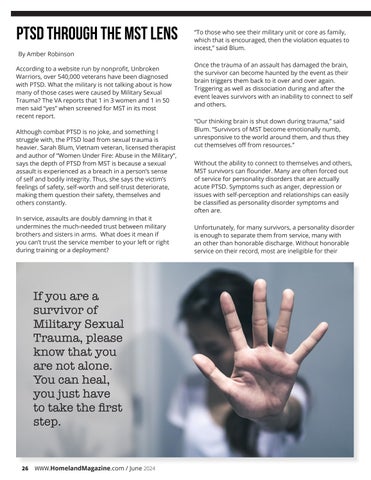
If you are a survivor of Military Sexual Trauma, please know that you are not alone. You can heal, you just have to take the first step.
“To those who see their military unit or core as family, which that is encouraged, then the violation equates to incest,” said Blum.
Once the trauma of an assault has damaged the brain, the survivor can become haunted by the event as their brain triggers them back to it over and over again. Triggering as well as dissociation during and after the event leaves survivors with an inability to connect to self and others.
“Our thinking brain is shut down during trauma,” said Blum. “Survivors of MST become emotionally numb, unresponsive to the world around them, and thus they cut themselves off from resources.”
Without the ability to connect to themselves and others, MST survivors can flounder. Many are often forced out of service for personality disorders that are actually acute PTSD. Symptoms such as anger, depression or issues with self-perception and relationships can easily be classified as personality disorder symptoms and often are.
Unfortunately, for many survivors, a personality disorder is enough to separate them from service, many with an other than honorable discharge. Without honorable service on their record, most are ineligible for their

26 WWW.HomelandMagazine.com / June 2024
earned benefits. This, coupled with the symptoms of their PTSD, are sometimes enough to push survivors into homelessness, addiction or suicide attempts. Sometimes these survivors lose the fight and become one of the 22 a day. But, more often, they find a path to healing.
In past issues, I’ve highlighted the healing journeys of veterans such as Marine veteran, artist and advocate Luz Helena Stacey Thompson, who was given an other than honorable discharge for alerting a local politician to her case. Discharged without benefits, she fought the VA for 16 years to get back what she’d earned.
Now, Thompson, along with many others I’ve met in my advocacy journey, have turned over a new leaf. Thompson is now an artist, surfer and art and surf teacher. She’s happily married with three beautiful kids.
“I still struggle,” said Thompson. “I may always struggle. But I know there’s always going to be a brighter day ahead if I can just get through it.”
Thompson says she credits her healing to her family, art, the ocean and her service dog, Reefer.
What Thompson accomplished took guts and resilience, especially after suffering and being discharged for a sexual assault. Air Force veteran Darci Standefer used that same guts and resilience to find healing after she was assaulted by an Air Force sergeant on a long bus trip.
After service her PTSD symptoms would erupt in angry outbursts at work, her family life suffered, and she would eventually lose her apartment and be at the mercy of family and friends for a place to stay. Standefer would make her first attempt with a steak knife in her kitchen, dragging it clumsily across her wrist. Luckily, she did not cut hard enough.
Her second attempt would be a few years later.
“I just remember thinking, ‘You know, If I killed myself, everything will be ok,” said Standefer. “It seemed like the most logical decision I could make right then.”
Standefer would drive up into the mountains, park and plug her tail pipe, with the intention of asphyxiating via carbon monoxide poisoning. Luckily, her second attempt also failed and would prompt her to finally go to the VA for help.
“I went in and told them I needed help, that I had just tried to kill myself,” said Standefer.
Standefer would do a “week in the psych ward”, as she says, but would come out with a better understanding of how to heal. From there she would begin taking medication and going to counseling. Initially, she says she thought meds and therapy would fix her, but soon learned who was really responsible.
“I started figuring out who had to do the actual work, the actual ‘fixing’, said Standefer.
Now, Standefer is in stable housing, and lives with her cat and dog. She says she still doesn’t date and doesn’t know if she ever will. But her life is still a far cry from where it was when she made an attempt to end her life.
Both Thompson and Standefer have learned that healing and often justice, take time and lots of patience. Both women will forever be changed, each living down a legacy of sexual violence that has plagued the service for far too long.
If you are a survivor of Military Sexual Trauma, please know that you are not alone. You can heal, you just have to take the first step.
If you or someone you know has suffered MST and needs help, call the DoD Safe Helpline at 877-995-5247 for immediate support and guidance or go to Connect and Find Support through DoD Safe Helpline
Visit Safe helpline for more information at: www.safehelpline.org/look-inside-Safe-Helpline

For California locals call your local Vet Center, most of which host MST group therapy. There is no better place to start than with others just like you.
WWW.HomelandMagazine.com / June 2024 27
CAREGIVING TLC
By Kie Copenhaver CSA, RHIA, SHSS, RCFE www.agingwellpartners.com
Planning for the Future
No one likes to think about a time when we may become incapacitated to the point of being unable to make healthcare and financial decisions on our own. This lack of capacity could be due to an injury or illness. It could be a physical inability or a lack of mental ability. And that day may never come for you…but what if it does? Are you prepared with the proper documents should such an event occur?
Advance Directives are just that – directives or instructions in advance of some occurrence. In this case, I am talking about Advance Directives in the realm of healthcare. There are a few main types of Advance Directives:
• Advance Directive paperwork
• Physician Orders for Life-Sustaining Treatment (POLST)
• Durable Power of Attorney (for healthcare and finance)
• Living Will
There is a document called and Advance Directive that many healthcare organizations will give you to fill out with family and perhaps your primary care provider. The Directive goes over many medical scenarios and how you want your healthcare team to treat you should those things occur. Examples of medical scenarios include feeding tubes to sustain life, dementia, and living in a comatose state. The Advance Directive allows you to consider these various scenarios and write out how you think you would like to be treated medically.
The POLST is a one-page document that must be filled out by you and your doctor. It is an order, much like a prescription, that if not signed by a licensed clinician (states differ as to who can sign the POLST so ask your primary care provider), is not valid.


This should be someone you know well and trust. Ideally, they would know that you are naming them your healthcare DPOA. There is a place in the DPOA for you to name an alternate Agent, someone who would step in if your first choice, your Primary Agent, was unwilling or unable to speak on your behalf.
A Living Will is also a legally binding document that is typically drawn up with the assistance of an attorney or lawyer and outlines your healthcare wishes for end-of-life care if you were to become terminally ill and unable to make medical decisions on your own.
While most of us don’t really want to discuss endof-life issues or medical emergencies, it is vital our wishes be known. If you do not have these important documents on hand (and on file with your preferred healthcare organization), your medical treatment may be determined by others and your loved ones may not have a voice in your care and treatment.


A Durable Power of Attorney (DPOA) is a legally binding document that gives a trusted relative or friend the ability to speak on your behalf should you be unable to for some physical or mental reason.
RetirementWhat’s Next
We all have a fire extinguisher in the house. Why? Advance planning for the unexpected. Do the same for yourself and your loved ones by starting your advance healthcare planning today. You may find peace of mind knowing this crucial piece of the journey we call life in place.
28 WWW.HomelandMagazine.com / June 2024





WWW.HomelandMagazine.com / June 2024 29 ELEVATE YOUR GAME with iBOT Qualif ied veterans can receive an iBOT® at no charge to them under VA FSS #36F79721D0202. Contact Mobius Mobility to schedule your demo today. Navigating your future may bring uncertainty. Aging Well Partners can help you discover your best path forward by empowering you with the vetted resources and trusted services that meet your specific needs. Your journey has a roadmap and we are here to help you find it. Proudly featuring our Certified Business Partners Free Consultation: 619.789.1839 www.agingwellpartners.com Housekeeping Transportation Meal Prep Physical Therapy Aging in Place Assisted Living Memory Care Your Local Partners. Your Certified Senior Advisors™. Proudly featuring our Certified Business Partners Navigating your f uture may bring uncertainty Aging Well Partners can help you discover your best path forward by empowering you with the vetted resources and trusted services that meet your specific needs. Your journey has a roadmap and we are here to help you find it Proudly featuring our Certified Business Partners e Consultation: 619.789.1839 www.agingwellpartners.com ™ Your L cal Partners. Your Certified Senior Advisors Housekeeping Transportation Meal Prep Physical Therapy Aging in Place Assisted Living Memory Care www.agingwellpartners.com
TRANSITION

- ONWARD OPS: Transition Support
- What’s Next In Transition: Forging a New Path
- HR: Occupational Outlook Handbook
- Franchise Dreams: Insights for Veterans
- Transition & Successful Businesses
- Business for Veterans: Rewards
- Legal Eagle: Ways to Sell Your Business
- Careers in Law Enforcement


Transitioning out of the Military into the Civilian Workforce?

For editorial & monthly columns regarding transition, career advice, tips, workshops, transition to education, entrepreneurship, straight-forward legal tips for military and veteran business owners and more visit Veterans In Transition at www.homelandmagazine.com/category/veterans-in-transition

30 WWW.HomelandMagazine.com / June 2024
To
June
Issue
Civilian Life
2024

WWW.HomelandMagazine.com / June 2024 31
onwardops.org team@onwardops.org
Forging a New Path: A Veteran's Guide to Thriving in the Civilian Workforce
By Eve Nasby & Kristin Hennessy www.bandofhands.com
For over three decades, Amy Forsythe dedicated her life to serving in the United States Marine Corps and Navy. Her journey through multiple deployments and transitions has provided her with a unique perspective on the challenges veterans face when entering the civilian workforce. As someone who has navigated these uncharted waters herself, Amy offers invaluable insights to those embarking on this exciting, yet often daunting, new chapter.

Change is inevitable. Embrace it!
"One of the most significant hurdles veterans face is adapting to a different work culture and environment," says Amy, author of Heroes Live Here: A Tribute to Camp Pendleton Marines Since 9/11. Having operated within the structured hierarchy of the military, with clearly defined roles and responsibilities, the fluidity and lack of rigid structure in the civilian workforce can be a stark contrast. However, Amy emphasizes the importance of embracing this change and remaining open to new ideas and approaches.


Expand your network beyond military connections. Adaptation has been a constant companion throughout Amy's career, as she currently serves as a U.S Navy Reserve Public Affairs Officer under the U.S. Special Operations Command (Theater Special Operations Command Europe). Her experiences have taught her the value of diversifying her professional network beyond her military circles. "Developing connections with professionals in various industries and locations can open doors to new opportunities and provide valuable insights into the civilian job market," she notes.
Reframe your military experience and update your LinkedIn profile. Redefining one's personal brand and online presence is another critical component of the military-to-civilian transition process. As a veteran, Amy understands that service members possess a wealth of skills and experiences that are highly transferable and valued by employers. However, she emphasizes the importance of translating military accomplishments into language that resonates with civilian hiring managers. "Your military experience is extremely relevant," Amy states, "but it's crucial to communicate it in terms that hiring managers can directly understand."
She advises veterans to document their military experiences and rephrase them to highlight valuable qualities like leadership, project management, and technical proficiencies. Creating or updating professional platforms like LinkedIn to showcase unique strengths and achievements is also essential. By reframing military backgrounds in corporate vernacular and leveraging modern networking tools, veterans can effectively market their qualifications to prospective employers.
32 WWW.HomelandMagazine.com / June 2024
Be honest and transparent with potential employers
Honesty and transparency have been constants throughout Amy's transitions. "Don't be evasive or elusive with potential employers. Be open about your experiences, both the triumphs and the challenges," she advises. "Employers value authenticity and the unique perspectives that veterans bring to the table."
Fuel your journey with education and exploration
Amy's military assignments and adventures have taken her on uncharted paths, from traversing the roads of Sri Lanka, where elephants roamed freely, to navigating the complexities of redefining her brand during transitions. Through it all, she has learned the value of education, pursuing a master's degree after a deployment to broaden her horizons and position herself for roles in the State Department.
Transitioning from the military can also be an opportunity to explore new passions and interests. Amy discovered a love for photography and curating exhibits during her time as a public affairs officer, finding fulfillment in visual storytelling and opening up new avenues for creative expression.
As she reflects on her own transitions, Amy expresses gratitude for the opportunities they have provided her to grow, learn, and expand her horizons. "Volunteering for causes I care about has also played a big role in helping me navigate my passions and purpose. The skills and resilience cultivated during my military service have served me well in the civilian workforce, allowing me to tackle new challenges with confidence and determination."


For those considering entrepreneurship, Amy's journey with her husband in purchasing a commercial pool cleaning business in 2014 provided invaluable lessons on taking calculated risks and embracing challenges. "Entrepreneurship allows you to leverage your leadership skills, adaptability, and problem-solving abilities honed during your military service," she says, encouraging veterans to explore this path.
Make your journey your own!
Remember, the transition process is not a one-size-fitsall experience. Each veteran's journey is unique, shaped by their individual goals, aspirations, and circumstances. Amy encourages veterans to embrace the uncertainty and be willing to adapt and pivot as needed, seeking out mentors, tapping into veteran support networks, and taking advantage of available resources.

To
"Know that you possess a wealth of invaluable experiences and a mindset that sets you apart. Embrace the transition as a chance to redefine yourself, explore new passions, and continue making a positive impact in your community and beyond."
Need help with your transition? Have questions? Link up with Eve on Linked In today. www.linkedin.com/in/eve-nasby-given-hiring-expert
WWW.HomelandMagazine.com / June 2024 33
her fellow veterans embarking on this journey, Amy offers these words of wisdom:


34 WWW.HomelandMagazine.com / June 2024 sandiego.edu/business L E A R N M O R E Ready for your next career step? The Knauss School of Business at the University of San Diego offers flexible graduate programs to help you advance your career, bring your values to enterprise and prepare you for a lifetime of impact. And as a 100% Yellow Ribbon School, tuition is fully covered for most military-connected students. Flexible programs, F O R M O S T M I L I T A R Y 1 0 0 % C O V E R E D www.sandiego.edu/business


WWW.HomelandMagazine.com / June 2024 35 Helping today's heroes achieve success by making it easier to run a small business. www.bandofhands.com Contact Eve Nasby, Band of Hands president and passionate military supporter to learn more. eve@bandofhands.com D o M o r e . S t r e s s L e s s . I f i t ' s r e l a t e d t o e m p l o y m e n t , w e h a n d l e i t f o r y o u . W e a l s o p r o v i d e : M e d i c a l b e n e f i t s a n d 4 0 1 K f o r y o u r e m p l o y e e s a t n o a d d i t i o n a l c o s t t o y o u C o m p l i a n c e w i t h e m p l o y m e n t L a w s U n e m p l o y m e n t c l a i m h a n d l i n g W o r k e r s C o m p c l a i m h a n d l i n g A Veteran Owned Business proudly supporting Veterans, Military Spouses and active duty Military looking for work and employers needing great workers We do all this for you. We've got your back. Our one-stop shop turnkey employment solution makes it simple and affordable for businesses to hire, employ and remain compliant. www.bandofhands.com
Transition to Business HUMAN RESOURCES
By Paul Falcone PaulFalconeHR.com


Using the Bureau of Labor Statistics’ “Occupational Outlook Handbook” in Your Private Sector Job Search

Occupational Outlook
Transitioning from the military to the private sector can feel like an overwhelming and daunting challenge, but there are certain tools available to help you navigate the hurdles. The Bureau of Labor Statistics’ website is a good place to start to gain a 30,000-foot view of the terrain, especially their Occupational Outlook Handbook (www. bls.gov/ooh). Why? Because it projects job growth over the next decade, which is one of the most important considerations in your job search strategy. You can browse “Occupations” that are the highest paying and fastest growing as well as where the most “new jobs” will be created. You can also browse “Resources” that show the ten-year growth projections of particular roles by industry.
If I have your attention at this point, it’s because this tool actually projects the “hidden job market” and anchors where you might want to spend your time and efforts in launching your job search. Specifically, the “Occupational Groups” you’ll find on the main page cover everything from construction to transportation to healthcare to education and protective services, and more. (The “Military Careers” section also provides some interesting insights.) And when you click on a particular role (for example, Human Resources Manager), you’ll find a treasure trove of additional information, including
median pay, educational requirements, work experience in related occupations, and most important, the “Job Outlook” from 2022 – 2032. These projections are developed from payroll data and economic research collected and updated on an ongoing basis.
When it comes to career management, industry trumps company and position. In other words, industries dictate job growth and security more than just about anything else these days. Since I come from the HR world, we can look at human resources as a prime example. HR, as a discipline, has become significantly elevated in the eyes of business owners and senior corporate executives because of its focus on talent management. Since the Covid-19 pandemic, talent availability has become a key driver of company growth. Thanks to the talent scarcity that we continue to face in this postCovid reintegration phase, organizations realize that people are not expendable and that accessing talent through new sources is the key, not just to beating the competition but to keeping the doors open. Yet, HR may still be regarded as an “overhead” discipline in times of economic slowdown or other challenges. Your greatest career defense mechanism as an HR professional will lie in knowing where the jobs are across industries.
Job Outlook Tool: The Best Kept Job Search Secret in Town
When you click on the “Job Outlook” tab for the “Human Resources Manager” classification, you’ll see at the top of the page the job growth prospects for “All Occupations” (for example, three percent). You’ll then see that the job growth prospects for HR Managers come in at a different number (for example, five percent). That’s a healthy trend for an HR management career path relative to the overall job market because it shows HR growing faster than average.
Next, on the “Job Outlook” page, scroll down to the “Get Data” link under the heading “Employment Projections Data for Human Resources Managers, 2022 – 2032.”
36 WWW.HomelandMagazine.com / June 2024
There you’ll find your treasure. Click on the “Employment Percentage Change” column in the spreadsheet provided, and you’ll see that—relative to the five percent overall growth that the HR management role will experience over the next ten years—the fastest and slowest growing HR management roles by industry might look like this:
Employment Percentage Change, 2022 – 2032

Job Search Gold
You get the idea. . . You can perform a similar search for positions in sales, marketing, IT, finance, or any other functions or disciplines listed. And then match those roles to industries that are experiencing extensive or average growth versus decline. A +40/-40% span tells you that anchoring your career planning to a particular industry or industries is a critical factor in your longerterm career planning considerations. And this certainly makes for some fascinating interview discussions, doesn’t it?
The BLS Occupational Outlook Handbook data changes every few years, and the numbers can shift—sometimes significantly—over time. Remember, these are only projections. But tweaking your career focus from paper to digital publishing or targeting pharmaceutical versus paper manufacturing can have a substantial impact on your longer-term career trajectory. So, keep this website and spreadsheet in mind when mapping out your longer-term career path and goals. Candidates armed with this level of intelligence will be well prepared for the swiftly changing markets to follow—and employers will surely be impressed when you share your knowledge of the BLS Occupational Outlook Handbook during your interview.
Paul Falcone (PaulFalconeHR.com) is a consultant specializing in management & leadership training, keynote speaking, and executive coaching.
His bestselling books on hiring, performance management, and leadership development are available at amazon.com/author/paulfalcone.


www.harpercollinsleadership.com/catalog/paul-falcone/
WWW.HomelandMagazine.com / June 2024 37
THE
WORKPLACE ETHICS EFFECTIVE HIRING NEW MANAGERS LEADERSHIP OFFENSE LEADERSHIP DEFENSE
PAUL FALCONE LEADERSHIP SERIES
Transportation and
Healthcare and Social Assistance Utilities Postal Service Coal Mining +38.8% +13.5% +7.9% +0.8% -6.7% -42.2%
Electrical Equipment and Component Manufacturing
Warehousing
Veterans Make Great Entrepreneurs FRANCHISE DREAMs
By Doug Dwyer doug.dwyer@dreammakerbk.com


Misconceptions About Franchising: Insights for Veterans
Franchising presents a unique opportunity for veterans transitioning from military service to civilian life. The structure, support, and established systems can make it an appealing option for those accustomed to discipline and teamwork. However, several misconceptions about franchising can deter veterans. I’d like to take a moment to debunk some of the most common myths, specifically from a veteran's perspective.
Myth 1: Franchising Guarantees Success
A prevalent myth is that franchising guarantees business success. While franchises often have higher success rates than independent startups due to established brand standards and support systems, they are not a guaranteed ticket to prosperity. Veterans, familiar with rigorous training and strategic planning, understand that success depends on several factors such as location, market conditions, and their management skills. The military's emphasis on preparedness and adaptability can be crucial in navigating these variables.
Myth 2: Franchises Are Easy to Run
Some believe that franchises are simple to operate because they come with a set operational model. This misconception can be misleading. Managing a franchise requires effort in areas like staffing, marketing, and customer service. Veterans, who excel in leadership and operational excellence, are well-suited to handle these challenges. The franchisor provides a framework, but veterans must apply their discipline and leadership to execute the business plan effectively.
Myth 3: Franchises Are Mainly for Fast Food
When people think of franchises, they often picture fast food chains like McDonald's. However, franchising spans numerous industries, including healthcare, education, home services, and even kitchen and bath remodeling. Veterans, with their diverse skill sets and experiences, can explore a wide array of franchise opportunities that align with their interests and strengths. This opens possibilities that allow veterans to find a niche that suits their passions and career goals.
Myth 4: Franchisees Lack Independence
Another common misconception is that franchisees are merely extensions of the franchisor with little independence. Franchisees are independently owned and operated, providing you with significant control over your business operations, from staff management to local community involvement. Veterans, who are used to making decisions in high-stakes environments, can thrive in this model. The structure provided by the franchisor ensures consistency, but the day-to-day operations and local adaptations are in the hands of the franchisee.
Myth 5: Franchising Is Only for Large Investors
Many veterans might believe that franchising requires a substantial financial investment. While some franchises do have high entry costs, many are affordable and offer financing options. There are also specific programs and incentives designed to assist veterans in franchise ownership. Organizations like VetFran (go to VetFran.org to learn more) provide resources and discounts to help veterans transition into franchising, making it accessible to those with varying budget levels. At DreamMaker, we’re proud to offer veterans a 20% discount on their franchise fee.
For veterans considering franchising, understanding these misconceptions is crucial. Franchising offers a structured yet flexible path to entrepreneurship, blending the benefits of proven processes and systems with the autonomy of running a business. With realistic expectations and the right approach, veterans can find a rewarding and prosperous career in franchising.

Doug Dwyer is the President & CSO of DreamMaker Bath & Kitchen, a company dedicated to helping its remodeling franchisees achieve Strong Margins and a Quality of Life. doug.dwyer@dreammakerbk.com
38 WWW.HomelandMagazine.com / June 2024

www.dreammakerfranchise.com/veterans-franchising-opportunity
WWW.HomelandMagazine.com / June 2024 39
Transition: Veterans & Successful Businesses
Homeland Magazine had a chance to catch up with a few veterans who started successful businesses. The following veterans were happy to offer advice and share their experiences.

Cynthia Williams - Veteran and cancer survivor who champions black-owned businesses and owns Molly Maid of Winder and Athens. After a decade in the Marine Corps and overcoming leukemia, she embraced small business ownership, founding her Neighborly company over 10 years ago.
Homeland: What were your first few months out of the service like?
Cynthia: Surreal. I missed the structure and the camaraderie of the service where you knew your responsibilities and your unit worked together to get them done. In my first civilian job, I had to learn to get my employees to work together without the directness and speed that I was used to. I had to learn patience relying on leadership more.
Homeland: If you had to name just one, what quality or skill from your service most applies to being a small business owner?
Cynthia: A small business owner has several moving parts, so you must be able to plan, set goals, and motivate others. When your business starts to grow, you will have to train and delegate to your employees, and they need to trust in your vision. With strong leadership, you can grow and guide your business to where you want it to go.

Eric Garcia - Army veteran that grew up in extreme poverty and overcame significant challenges to secure a scholarship to the University of Arkansas as a firstgeneration Mexican American college student. After a few semesters, he joined the military to help his family out of bankruptcy, serving for eight years. Recently, Garcia and fellow veteran Garrett Peek opened Neighborly’s 350th Mr. Handyman location.
Homeland: How did your time in the service influence your current career goals?
Eric: My time in the service influenced my current career goals through the discipline and structure I gained from the military. It helped cultivate, inspire and energize my entrepreneurial spirit.
Homeland: Tell me a little about your business, and do you have a website, if so, can you give me the URL and I’ll share it with our readers.
Eric: Our business is Mr. Handyman of Fort Smith, a Neighborly company, and we have service professionals that provide a range of services for home maintenance and repair needs - both residential and commercial. Our team provides value and expertise with our skilled craftsmen offering their reliable, quality work to our River Valley community. Find us at www.mrhandyman.com/fort-smith

Sara and Sean Bess - A married couple who met in Air Force training 22 years ago have achieved much: both became decorated Air Force Officers, Sara was among the first women to fly the F-15E in combat, they raised four kids, and they opened Mosquito Joe of Northwest Florida.
Homeland: What barriers did you face when starting your own company?
Sean & Sara: We had normal feelings of doubt— wondering if we had made the right decision and if our business would be successful. There were typical challenges from learning the business software to government licensing to logistical challenges.
Sara and I both excel at problem-solving, especially when the problem may be challenging to define. We both can keep our wits about us under fire (literally); so, the Air Force was a great proving ground for the challenges that we would face starting a business.
Homeland: What’s the top piece of advice you’d give a veteran who’s thinking about starting a small business?
Sean & Sara: Take the time to research the business requirements and make sure that lifestyle is compatible with your life. The type of business you select matters.
Even more so than the military, business is a team sport, and it helps to have a few people that you
40 WWW.HomelandMagazine.com / June 2024
can trust and seek advice from to keep things in perspective. A good teammate will also help you distill what core process, experience or service drives profit. It’s important to have a realistic mindset about the time it will take to reach profitability and make sure that your partner(s) is aligned.
Additionally, a franchise model, like Neighborly’s, gave us both a proven process to follow with a track record of success; but also, a cohort of fellow franchisees to collaborate with and incubate new ideas.


www.HomelandMagazine.com
Finding a job in the civilian workplace may seem easy at first. After all, you have learned skills, practiced leadership and demonstrated initiative that will make you successful wherever you go.
The reality, though, is that it can be difficult. In fact, it can be downright depressing, demotivating and you may feel totally disillusioned. We can help.
Veterans In Transition is dedicated to you and to help you succeed in your transition.
For editorial & monthly columns regarding transitioning to business, career advice, tips, workshops, transition to education, entrepreneurship, straight-forward legal tips for Military and Veteran Business Owners please visit our website.
VETERANS IN TRANSITION
WWW.HomelandMagazine.com / June 2024 41
Transitioning out of the Military into the Civilian Workforce?
Sara and Sean Bess
Eric, with Business Partners Garrett and Emily Peek
Homeland-Magazine-Veterans-In-Transition www.homelandmagazine.com/category/veterans-in-transition
Cynthia Williams
BUSINESS FOR VETERANS
By Barbara Eldridge www.mindmasters.com

How Do You Reward Excellence?
“We choose to go…not because it is easy, but because it is hard, because that goal will serve to measure and organize the best of our energies and skills, because that challenge is one that we are willing to accept, one we are unwilling to postpone, and one which we intend to win.”
- John Fitzgerald Kennedy on sending a man to the moon
All Military service groups have always been proud of the accomplishments of the men and women who serve; be it with ribbons, medals of honor or advancing someone’s rank. Simply put, a reward is an extrinsic symbol for the enforcement and celebration of intrinsic values.
So let me ask you, as an entrepreneur/business owner, how do you inspire, promote and celebrate the achievement of your goals? How do you acknowledge and appreciate yourself?” That's right: YOU. Just YOU!
Seriously, think about it. Goals are natural value generators, often because of what you learn and become enroute to their achievement. But having a reward that honors and symbolizes that achievement is a powerful motivator for continued progress and performance excellence.
If you want to improve your performance results, increase innovation to gain and sustain competitive advantages, create an environment that fosters excellence and ethical behavior then you must make rewards and recognition standard protocol.
Whether it's a War Hero receiving a Medal of Honor, an Olympic athlete winning a Gold Medal, an Author being granted a Pulitzer Prize, a Martial Artist earning a Black Belt, or a young child winning a trophy for a local spelling bee - rewards and recognition promote and define personal excellence. They provide an effective but uncomplicated means for reinforcing quality, and worldclass behaviors.
Often we achieve things which we have been planning and visualizing, and then forget to even notice that we have succeeded. So, give yourself some appreciation everyday, not just a pat on the back.

The need for recognition and approval is a fundamental human drive, and one of the motivators behind our willingness to give and serve.
The goal of rewards, recognition and celebration is to feed your motivation and to promote and define excellence.
Therefore, the success of your endeavors that provides constant recognition and applause is one that rewards the good behavior it wants repeated. When you reward the right behavior and its results, you almost guarantee repeat performance.
When you start from a place of feeling positive about that behavior, then you create the necessary positive energy which attracts people, resources and opportunities that match that vibration.

As you approach a new month, I encourage you to become a great believer in the importance of celebration and rewards that boost that energy so that you identify the behavior you want repeated in yourself, your family and associates.
Barbara Eldridge President/ Founder of Mind Masters an organization that provides business owners a proven, repeatable process that keeps the focus on the business of success. She can be reached at (858) 467-9091 or visit wwwmindmasters.com
42 WWW.HomelandMagazine.com / June 2024

The mission of Zero8Hundred is to proactively link military service members, recent veterans, Reservists, National Guard and spouses (including Gold Star spouses) to the broad range of resources and opportunities in their local community dedicated to helping them transition to civilian life
Zero8Hundred derives its name from the daily military ritual of raising the American flag at 0800 hours (8:00 a.m.) to signal that a new day of work has begun.

Zero8Hundred uses a Veterans Wellness Model to create & ensure a better system to ease the transition into the civilian community before, during and after leaving the armed forces
Through a unique partnership with community partners and the military, Zero8Hundred provides a one-stop approach to support transitioning service-members, veterans and their families.

WWW.HomelandMagazine.com / June 2024 43 MILITARY TRANSITION SUPPORT ENROLL TODAY ON OUR WEBSITE: What is Zero8Hundred? How does it work? OUR FIVE PILLARS: Jobs & Employment -
Basic Needs
Health & Wellness
Education -
-
- Community Connections
www.zero8hundred.org Tax ID: 83-1268486
legal Eagle
Straight-forward legal tips for Military and Veteran Business Owners
By Kelly Bagla, Esq.
WAYS TO SELL YOUR BUSINESS

Selling your business is a very complex process and most business owners have never been through a sale process before. But business owners have more options than they realize. Lacking a team of professional advisors, including a strong M&A Advisor, corporate/ transaction attorney and a CPA/tax advisor could have serious financial and tax consequences for both the business owner and the company so seek professional help from the beginning of the process. It pays to understand the various methods to sell or partially cash out of your business for a successful exit.
An outright sale could be the simplest and best way to exit a business. This makes sense when a business owner’s family members have no interest in taking it over or when the owner does not have the desire or capital to take the company to the next level.
There are several ways to sell your business. Regarding the structure of a sale, a business owner can:
• Sell the company’s assets outright, or you can
• Sell the stock in the company (or units if it is a limitedliability company).
Stock sales benefit the seller, while asset sales are more beneficial to the buyer, especially from a liability and tax standpoint.

ASSET SALE
Asset sales involve transferring the company’s equipment, facilities, customers, and customer contracts, as well as intellectual property, such as trademarks and patents including intangibles like goodwill. Asset sales do not involve liabilities (unless specified by the buyer) and are generally protected against prior lawsuits facing the business.
STOCK SALE
Stock sales involve buying the company itself along with the exposure to all of its legal issues and potential problems, as well as the liabilities of the company. This is why most sales of small or mid-size, closely held businesses are structured as asset sales.
PARTIAL OR FULL SALE TO A PRIVATE EQUITY FIRM
Companies with $10,000,000 or more in revenue and $1,500,000 or more in EBITDA (Earnings Before Interest, Taxes, Depreciation and Amortization) can explore selling all or a large portion of their business to a professional Private Equity firm. This method comes with stipulations but has many advantages and potential upside. It also enables business owners to take a significant amount of cash up front and still work as the CEO until the business is sold 100%.
MANAGEMENT BUY OUT
Selling the business to its management team is also a popular option for the right company. An owner might use this method when the company has a trusted, entrepreneurial management team that wants to carry on the business, and this represents the best and most flexible process for the business owner. The primary advantage to this method is that the business owner doesn’t have to spend time trying to seek out a buyer. The trade-off for a streamlined sale is that the purchase price may be lower than what an outside strategic buyer would pay.
ESOP
Another option is to sell the company to its employees through an employee stock-ownership plan (ESOP). Setting up these plans can be a complex undertaking, but they have their advantages. With an ESOP, the owner may want to remain with the company while slowly employees with a long-term incentive for loyalty and hard work. With this method, the company sets up
44 WWW.HomelandMagazine.com / June 2024
transitioning the business over time. It’s a way to reward an independent trust (the ESOP) that buys the owner’s stock at a price set by an independent valuation firm. The trust holds the stock for the employees for as long as they work for the company. When an employee leaves or retires, the employee can sell the stock back to the company at fair market value. This can be a challenge as some business owners don’t like having a third party determine the value of their business as it may mean accepting a lower price than they could receive on the open market. Also, the company has to grow or have cash on hand to buy back employee shares when workers leave. This can divert cash from other business uses and can be a real cash drain if several employees leave the company in close proximity.
RECAPITALIZATION
Owners who want to sell their stake gradually, or who want to take some cash out of the business without giving up control, can recapitalize the business, or change its financial structure using instruments such as stock, preferred stock or debt. Suppose there is an outside buyer who is interested in acquiring the business but doesn’t want to buy it outright up front. The company could issue Preferred Stock and sell it to the potential buyer on a predetermined schedule. This gives the owner cash up front, while the buyer has a chance to learn the company’s operations and line up financing before taking it over completely.
There are many options for business owners who want to sell or cash out. The best method depends on the desire and health of the business and the owner. Understanding your options and getting the right advice from a team of experienced business professionals, such as an M&A Advisor, corporate/transaction attorney and a CPA/financial advisor will make it far easier to pursue the method that’s best for you.
If you need help determining the best asset protection strategies, we can help. Becoming a business owner, you control your own destiny, choose the people you work with, reap big rewards, challenge yourself, give back to the community, and you get to follow your passion. Knowing what you’re getting into is smart business because the responsibility of protecting your business falls on you.
Click here https://baglalaw.com/contact to schedule your consultation.

Disclaimer: This information is made available by Bagla Law Firm, APC for educational purposes only as well as to give you general information and a general understanding of the law, and not to provide specific legal advice. This information should not be used as a substitute for competent legal advice

www.tinyurl.com/Legal-Pearls

Award-winning attorney, Kelly Bagla shows you how to avoid legal pitfalls FROM DAY ONE! Legal Pearls! - The quick and easy guide for avoiding business litigation.
Award-winning Attorney Kelly Bagla distills the legal information every business owner needs to know to avoid costly lawsuits and protect personal assets. Now every entrepreneur can apply the same legal steps and strategies used by top attorneys.
WWW.HomelandMagazine.com / June 2024 45
PEARLS OF WISDOM for Avoiding Business Litigation
Legal Pearls!
• AVOID COSTLY BUSINESS LITIGATION • PROTECT YOUR HARD-EARNED ASSETS
LEGAL
ARISE NEW FROM KELLY BAGLA! Get your copy at amazon today!
• BE READY WHEN
ISSUES
in
state
from a licensed professional attorney
your
RISKY BUSINESS
Insurance Info & Risk Management Tips
By Hadley Wood www.hlinwood-insurance.com

Earthquake!
It is impossible to predict where and when an earthquake will strike but it can help to be prepared and have a plan - just in case. Earthquakes happen all over the country but the west coast up to Alaska is a hotbed of activity due to the Pacific and North American plate overlap. Anyone living in California long enough will tell you that it is a hazard we have to deal with!
Earthquakes are terrifying and cause lasting damage to homeowners and business owners alike. Like homeowners coverage, a standard business insurance policy DOES NOT include Earthquake coverage. It is something you would purchase separately or possibly endorse on to your current policy. This type of insurance can be a bit pricey, and the deductibles can be high, so you would want to weigh the risk of having or not having this coverage. If you live/work in an area that is especially prone for earthquakes, it might be advisable to have this coverage.
Businesses most impacted by earthquake damage are those that have a high amount of valuable inventory/ product stored or where revenue is generated by clients coming to the premises such as restaurants and shops. This type of coverage would cover the loss of damaged inventory and also Loss of Use coverage which would cover vendor and employee payments, lease/mortgage, and lost revenue up to a point (generally 3-6 months).


Here are a few risk management tips to consider to prepare for the aftermath of an earthquake:
1) Purchase Earthquake Insurance for your business (and home)
2) Take pictures/videos of your inventory on a regular basis
3) Know the amount of lost revenue you would lose should your business be shut down for 3 months or 6 months (if you had to close and rebuild)
4) Keep some cash on hand in case you cannot access your bank or accounts immediately
5) Make sure any heavy bookshelves, file cabinets, standing large furniture is firmly secured to the wall or floor
6) Have flashlights in various places around the workspace
7) Create an evacuation plan and meeting place for employees (and family)
8) Perform an annual earthquake drill for employees (duck and cover)
9) Have a backup generator in case the electricity is down
10) Create a plan to inform clients of any closure or delay in shipments
If a quake is especially damaging, you may also consider bringing in a crisis counselor to meet with employees. Remember your employees are your number one asset and keeping them safe and reducing their trauma should be a priority.
Having a plan of action and being prepared is one of the only ways we can reduce the impact of an earthquake or frankly any natural disaster.
Talk with your broker and as always, reach out to me at: www.hlinwood-insurance.com with any business insurance or risk management questions.
46 WWW.HomelandMagazine.com / June 2024





WWW.HomelandMagazine.com / June 2024 47 Become a certified IT professional in 15 weeks with no prior experience necessary! Talk to our friendly veterans admissions counselor today! • GI Bill & MyCAA Approved • Flexible Schedule • Online & In-person Hybrid Classes • Small Class Size • Hands-on Training • Lifelong Job Placement and Career Counseling • Technical Support Specialist • IT Support Technician • Network Administrator • Network Analyst • Systems Administrator Why ICOHS College? Career Outcomes: The median IT job salary in the US was about $88,000 last year. READY TO TAKE CHARGE OF YOUR CAREER? admissions@icohs.edu (858)581-9460 www.icohs.edu
Veterans Chamber of Commerce
By Joseph Molina www.vccsd.org


The Pros and Cons of Home Equity Loans - “Just the Basics”
In the world of real estate financing, home equity loans stand out as a compelling option for homeowners looking to leverage the value of their property to access additional funds.

However, like any financial decision, there are both advantages and disadvantages to consider before pursuing this avenue. Let's consider the pros and cons of home equity loans, along with exploring alternative options available in the market.
Advantages of Home Equity Loans:
1. Lower Interest Rates: Home equity loans typically offer lower interest rates compared to other forms of borrowing, such as personal loans or credit cards. This is because the loan is secured by the equity in your home, making it less risky for lenders.
2. Lump Sum Payment: Home equity loans provide borrowers with a lump sum of cash up front, allowing for greater flexibility in how the funds are used. Whether it's renovating your home, covering unexpected expenses, or funding a major purchase, you have control over how you allocate the money.
Disadvantages of Home Equity Loans:
1. Risk of Foreclosure: Since home equity loans use your property as collateral, defaulting on the loan could result in foreclosure. It's crucial to ensure that you can afford the loan payments and understand the potential consequences of defaulting.
2. Additional Fees and Closing Costs: Like any loan, home equity loans may come with fees and closing costs.
3. Tapping into Home Equity: By taking out a home equity loan, you're essentially borrowing against the “CURRENT” value of your home. This may reduce the equity you have in your property.
Additional Financing Options:
1. Home Equity Line of Credit (HELOC): Similar to a home equity loan, a HELOC allows you to borrow against the equity in your home. However, rather than receiving a lump sum upfront, you have access to a line of credit that you can draw from as needed. This provides expenses or projects with uncertain costs.
2. Cash-Out Refinance: With a cash-out refinance, you replace your existing mortgage with a new one that's larger than your current loan balance. The difference between the two mortgages is paid out to you in cash, which you can use for various purposes. This option allows you to access your home equity while potentially securing a lower interest rate on your overall mortgage.
3. Personal Loans: If you don't want to use your home as collateral or are unable to qualify for a home equity loan, personal loans are another option to consider. These unsecured loans typically have higher interest rates but may be suitable for smaller borrowing needs or if you prefer not to tap into your home equity.
Make sure to contact a Veteran-Friendly Lender –Contact us for the list of Veteran-Friendly Lenders in your area. veteransccsd@gmail.com
Disclaimer: The information provided is for educational purposes only. Make sure to consult with a real estate financing Loan expert who can provide valuable guidance in navigating these decisions and finding the right solution for you.
48 WWW.HomelandMagazine.com / June 2024


WWW.HomelandMagazine.com / June 2024 49 No down payment, No PMI Use your VA loan multiple times Single-Home or Multi-Units C a l l u s r e a l e s t a t e VA E X P E R T S Michael Bullock Real Estate Broker HOUSING FOR HEROES RE# 01237037 bullock.re.brokeroffice@gmail.com ( 9 4 9 ) 2 9 5 4 3 0 0 V e t e r a n - F r i e n d l y A g e n t ( 9 4 9 ) 2 9 5 4 3 0 0 HOUSING FOR HEROES www.thetrain.com


50 WWW.HomelandMagazine.com / June 2024 ENROLL NOW AT WFW.ORG Workshops for Warriors is a nonprofit school that provides veterans and transitioning service members with hands-on training and nationallyrecognized credentials in CNC machining, CAD/CAM programming, and welding. Our students earn credentials that open doors to jobs anywhere in the U.S. Call us at (619) 550-1620. CAD/CAM Programming CNC Machining Welding DoD SkillBridge Organization BEFORE SERVED HONORABLY. AFTER EARNED A CAREER IN JUST 4 MONTHS.
SPORTS MANAGEMENT CERTIFICATE

Our sports managements program supports professionals striving to become leaders in the exciting athletics field. Enrolled students can complete coursework entirely online while receiving guidance from high level coaches, retired pros, and sports industry experts.
WWW.HomelandMagazine.com / June 2024 51
in Sports
Communication in Sports
in Sports Game within the Game
basics
transferable
credit.
more info
Launching your business in Sports Leadership Principles
Strategic
Ethics
NIL
This program is
with our University partners for
For
email synergylearninginstitute@gmail.com

Opportunities in Law Enforcement
Military and law enforcement have had a longstanding relationship with overlaps in training exercises, equipment, and, most important, personnel.
It is not uncommon for a service member to make the jump from the military to law enforcement as both professions look for the same characteristics; leadership, fidelity, chain of command, and teamwork are all common themes in both professions.
Quite understandably, many American military veterans often gravitate to a career in law enforcement when the time comes to rejoin the civilian workforce.

The two professions have many fundamental similarities; from the uniforms they wear with pride, to the firm command structure they serve under, to great personal risk they endure while protecting those who cannot protect themselves.
The following agencies are actively hiring & proudly support our veterans, active military and the families that keep together.

52 WWW.HomelandMagazine.com / June 2024
You’ve served your country, now serve your community!
www.rva.gov/police/personnel www.rva.gov/police/personnel


WWW.HomelandMagazine.com / June 2024 53 Veterans! Join Our Team CHANGE Be the SFPD Salary $103,116 - $147,628 TEXT “JoinSFPD” to (415) 704-3688 www.JoinSFPD.com
From Navy Sailor to San Francisco Police Officer
By Holly Shaffner


Changing careers can be exciting, exhilarating, and filled with trepidation. Meet Officer Cindy Ovares who has made the transition numerous times – from active-duty service member, to student, massage therapist, teacher, and now police officer.
The life experience she gained in those previous longterm jobs set her up to be successful today. She is doing what she’s always wanted to do – have a career that is challenging and rewarding.
Cindy was like many seniors in high school as she contemplated what she would do after graduation. When the Navy recruiter called the house looking for her brother, the recruiter instead got an eager, independent 17-year-old woman who wanted to find adventure. Just a few months later, she was off to “see the world” and start her first career.
As an Aviation Machinist’s Mate, Petty Officer Ovares was a jet engine mechanic. It was a male-dominated job, and she wanted to prove that anything a man could do, she could do better. She attended military schools in Florida and Virginia to learn her trade, and was later stationed in Lemoore, California. She was attached to VFA-22, an F/A-18 Super Hornet squadron, that deployed on ships. After serving four years on active duty, she earned Post 9/11 GI Bill education benefits, and chose to leave the Navy to attend college.
After completing her bachelor’s degree in Secondary Education and being a fluent Spanish speaker, she was hired to be a high school Spanish teacher. The job was gratifying; but also, under resourced, understaffed, and had little room to grow professionally. She wanted something new and challenging, was drawn to the community where she grew up, so, in her late 30s she applied to be a police officer.

“Being able to talk to people, figure out what they are going through, and what they need is a huge portion of the job. I enjoy interacting with the public, and engaging in what I call verbal judo.”
54 WWW.HomelandMagazine.com / June 2024
- Officer Cindy Ovares

Officer Ovares was accepted to the San Francisco Police Academy and has been an officer for the last three years. She is a foot patrol officer working in the Tenderloin District – a 50-block area that has a storied history, and has been known for homelessness, drugs, and crime.
“Being able to talk to people, figure out what they are going through, and what they need is a huge portion of the job. I enjoy interacting with the public, and engaging in what I call verbal judo,” said Officer Ovares.
For Officer Ovares, the parallels between serving in the military and serving in law enforcement made the transition go smoothly:
• Routine – You know what to expect before your shift begins (what time to report, what uniform to wear, the structure of the day).
• Camaraderie – The bond between fellow officers is like the bond between your fellow military brothers and sisters.
• Variety – Every day is different with different assignments and duties, so the job is never boring.
• Benefits – Include a competitive salary, paid vacation days, floating holidays, and sick days, healthcare, retirement, and special pay for certain assignments and being bilingual.


As a Latina giving back to her community, she admits that the job comes with highs and lows. Officer Ovares recommends a career in law enforcement for those military members looking to make a smooth transition to a new chapter.
To learn more about the San Francisco Police Department, or to connect with recruiter, go to: www.sanfranciscopolice.org/your-sfpd/careers


WWW.HomelandMagazine.com / June 2024 55
SDPD Ride Along: A Story of Two Marines
By Amber Robinbson San Diego Veterans Magazine
When I asked to go on a ride along with the San Diego Police Department, making a special request for any veterans-turned-cops, I expected a really serious, possibly dangerous, afternoon of shadowing our city’s toughest crime fighters.
What I got was an afternoon of heartfelt service to our San Diego community, honorable humility and a lot of respect.
When I asked whether former Marine Sergeant Major, Mark Wright, and his partner, former Marine Staff Sergeant, Sean Bunch, had rank or titles he said their titles were just San Diego police officers. They are relatively new partners, but act like they’ve known each other for years, which is usually the case when you get Marines together.
Wright is a newer addition to the force, coming on board two years ago, with Bunch only having two years left.

Currently, these brothers-in-arms spend their days patrolling the entirety of Balboa Park.
Although neither men are taking fire or kicking in the enemy’s door on this beat, like during their time in Iraq or Afghanistan, they still work hard to serve their local community. Service which can range from tracking down criminals to answering questions from lost pedestrians, to giving out stickers to kids and never backing down from a chance to turn on those flashing red and blues just to make one of them smile.
Most of our particular day was cruising around beautiful Balboa Park running car tags to see if they were current, from cars not displaying proper plates and placards to those double parked. Bunch says they often catch parole violators or even stolen cars doing just this. I was struck as I watched both officers go out of their way to look in and around vehicles to find plates or disability placards not displayed correctly so as to avoid issuing superfluous tickets.
“We try to give everyone the benefit of the doubt,” said Wright. “We’re not out to get anybody.”
Although, both officers confirm that enforcing even the most basic of park rules can yield large payoffs. During a recent patrol Bunch spotted an individual smoking in the park, which is illegal. As he circled back round, the individual turned and rapidly tried to walk away, which activated immediate suspicion. He was detained and came back with a warrant for numerous kidnapping and child molestation charges.

Both men say a lot of what they do is talk with museum owners and those living in the neighborhoods surrounding the park about their concerns. A shared concern by all is the park’s homeless population.
Bunch says their posture towards the homeless is mostly that of assistance, adding there are many resources available for those who would take them.
56 WWW.HomelandMagazine.com / June 2024
Officer Sean Bunch
Officer Mark Wright
The city spends a lot of money on resources,” said Bunch. “The biggest problem we run into is whether or not the [homeless] people want them, and a lot of them don’t.”
Thus, the men tend to run into the same issues with the same people pretty often. Although frustrating, they have learned that respect goes a long way when challenged with these repeat offenders. Bunch recalls spotting one such offender in the park, who was in violation of his parole and wanted on warrant. He was unable to get to the offender immediately, but still apprehended him with a verbal request. The parolee waited patiently to be hand-cuffed and arrested, simply out of the respect he held for the law man.
“Being respectful of everyone despite their lot in life goes a long way in this job,” said Wright.
Both men say a huge part of their work is being able to connect and communicate with the myriad of people they meet daily.
Bunch says he feels he and Wright are lucky to come to the force later in life, given it means they have a wider frame of reference for those they meet and serve daily. “We deal with people who are going through all kinds of things in life,” said Bunch. “And it’s helpful to be able to say, ‘hey I know what you are going through, I’ve been there.”
As the day progressed, I realized that both gentlemen definitely had a long list of tough and unique life experiences to pull from. Both proudly served the United States Marines for years, traveling to war and all over the world, experiences that yield much wisdom as well as many a story.

Bunch, for instance, did not come to the force straight from the Marines, but from Hollywood. Surprisingly, he is a member of the Screen Actors Guild, working as a military advisor on various productions, like Lonestar 911, and appearing in some as well, such as one of the most recent Men in Black movies.
“I grew up outside of LA,” said Bunch. “So, I’ve always just kind of been around the business and found a place for myself there with all my military experience.”
Bunch hopes to return to work in Hollywood after he leaves the force, bringing with him a new level of experience and respect.
Wright, who retired from the Marines as a Sergeant Major never worked in Hollywood, but he does have plenty of stories about being a proud grandfather, father and new amputee. When I entered the Central Division Station and met him, he said he was just getting back to work after some time off after losing his leg.
Wright remained unscathed during his over-20-years in service, overseas deployments and endless combat train ups. It wasn’t until after service that he lost his leg in a motorcycle accident late one foggy night a little over a year ago. Wright says it had been an eventful second watch and he was leaving the station about 2 AM on his motorcycle when it happened.
“It was only about two minutes from work,” said Wright. “I was coming around a curve and entered into what I thought was fog, and as I’m entering, I see a headlight and side mirror in my lane.”
That headlight and mirror became an entire car that was blocking Wright’s entire side of the road.
“I was a heuy crew chief in the Marines and reverted to my training from that, grabbed my shoulders, braced for impact and went flying like a human lawn dart over my handlebars,” said Wright.
Wright landed in the ditch on the side of the road. He says he realized immediately that he had a back and leg issue. He learned that a bystander had called 911, but he requested they call back and state that the injured motorcycle rider was a policeman with the San Diego Police Department and expedite services. This one request would become pivotal in saving Wright’s life.
Continued on next page >
WWW.HomelandMagazine.com / June 2024 57
“What I didn’t know at that time was that I had severed two arteries in my leg, and I was bleeding out,” said Wright.
What Wright would learn later is his heel had also been torn off on the wrecked car as he sailed past it into the ditch. After much pain and many surgeries, Wright would finally lose his leg from the knee down. says he doesn’t let it get him down, though. He’s proud to continue to serve as one of our city’s finest.
Both he and Bunch take much pride in their time as Marines and as San Diego Police Officers. Each officer comes from strong military stock, with Wright’s grandfather being a World War II veteran and Prisoner of War and Bunch’s father a decorated veteran of Vietnam.
All in all, this Army vet’s afternoon with two Marines was an impressive one. Both seasoned public servants, these honorable men have discovered you must give respect to get it, that violence is often not the answer and the most important thing to keep in mind along the way, is a good, human dose of empathy.

SDPD NOW HIRING
For more information visit www.joinSDPDnow.com or email us at SDPDrecruiting@pd.sandiego.gov

58 WWW.HomelandMagazine.com / June 2024 SDPD Ride
Along
Officer Sean Bunch - Amber Robinson (Homeland Magazine) - Officer Mark Wright

WWW.HomelandMagazine.com / June 2024 59 www.joinSDPDnow.com SDPDrecruiting@pd.sandiego.gov

60 WWW.HomelandMagazine.com / June 2024 www.dallaspolice.net

WWW.HomelandMagazine.com / June 2024 61 www.joincdcr.com




Your Trauma is Valid @GiveAnHour BREAKING THE STIGMA SUPPORTING PTSD AWARENESS TODAY, AND EVERY DAY no-cost confidential counseling giveanhour.org/military