AUSTRALIAN DENTAL ASSOCIATION WA | MARCH 2021
This issue We’ve got your back Preventing occupational back pain
CPD spotlight Meet paediatric dentist Dr Lisa Bowdin
Anatomy of the root canal system and its clinical implications
THE RECOGNISED VOICE OF ORAL HEALTH IN WA
adawa.com.au
Getting more from my finance partner, means my patients get more from me. credabl.com.au 08 6280 1255 1300 CREDABL (1300 27 33 22)
Practice Purchase • Commercial Property • Goodwill Loans • Overdraft Facilities • Home Loans • Car Loans • Equipment & Fitout Finance • SMSF Lending The issuer and credit provider of these products and services is Credabl Pty Ltd (ACN 615 968 100) Australian Credit Licence No. (ACL) 499547.
got 6 We’ve your back
5 6 12
President’s Report We’ve Got Your Back Taking care of the backs and necks of dental practitioners
Celebrating International Women’s Day Credabl profiles Dr Fabiana Petrykowski
14 17
Partners in Time The new ADAWA member benefit service — ONDA
DMD Graduate Awarded Prestigious Scholarship Dr Jamie Maraj named a 2021 Fulbright scholarship recipient
18 22 25 26
CPD Spotlight Meet Dr Lisa Bowdin
CPD Calendar Education & Training
28
DPL Feature
30
ADA HR Feature
32
How to become an employer of choice
Clinical Challenges in Oral Medicine: Question
33
Clinical Feature
34
Clinical Feature
38 41 42
When dermal fillers go wrong: Part 2
Anatomy of the root canal system and its clinical applications: Part 5
Clinical Challenges in Oral Medicine: Answer WADA Golf Save the Special Needs Clinic Petition for the lease extension of the Special Needs Dental Clinic
Legal Feature Restraints and non-complete clauses
The pursuit of happiness
45
Professional Notices
adawa.com.au
3
Fluoridation Win All correspondence to T (08) 9211 5600 E media@adawa.com.au A PO Box 34, West Perth WA 6872 President Dr Sean Archibald Chief Executive Officer Dr David Hallett Editorial Team Lisa Shearon Brooke Evans-Butler Designer Amie Mason
Closing Date for Bookings Ads: The 7th day of the prior month or the nearest business day before. All advertising must be submitted by the due date by email. Advertisements received after the due date cannot be guaranteed to appear in that issue. Please supply display advertisements as a high-resolution PDF file (embed all fonts) or a JPEG file to media@ adawa.com.au. Please ensure any graphics are of a high quality. Articles should be submitted as a WORD document with any graphics attached as separate files. ISSN 2207-9351 (Online) DISCLAIMER: The views and opinions expressed in this publication and its attachments by advertisers and contributors are not necessarily endorsed by The Australian Dental Association (WA Branch) Inc. The Branch, its members, employees and agents do not assume any loss or damage which may result from any inaccuracy or omission in this publication, or from the use of the information contained, and make no warranties, express or implied, with respect to any of the material contained herein.
On January 6, the WA Chief Health Officer announced that the SouthWest communities of Bunbury and Dalyellup will have fluoridated drinking water on tap by 2023. This follows on from the recent commencement of fluoridation of the neighbouring communities, Eaton and Australind, as well as Burekup, Brunswick Junction, Roelands and Pelican Point. This is incredible news for the largest WA urban area outside of Perth and Mandurah.
We have been through many years of contact with various health ministers, other politicians, councillors, media representatives and other stakeholders to achieve this result.
We have been working hard for decades to finally achieve this result!
Thanks to the combined efforts of local dentists and allied health workers, the South West Dental Convocation, the ADAWA, the AMA, The Chief Dental Officer, Dental Services representatives, the Health Department of WA, the Water Corporation and many, many others, a good outcome has been achieved for the dental health of this community.
The reaction amongst the local dental community has been one of “I never thought I would see the day”, as a vocal minority group has been consistently stalling the process.
This will bring to fruition the WA State Oral Health Plan target of 95 per cent of the Western Australian population having access to fluoridated drinking water.
Repeated studies over the years have shown that the incidence of decay in these areas were well above the average compared to the Perth Metropolitan area, which has had the benefit of fluoridated water since 1968.
The Centre for Disease Control in the USA lists fluoridation as one of Ten Great Health Achievements of the 20th Century. This is alongside such things as vaccination and motor vehicle safety. We are now over 20 years into the next century and finally more of rural Western Australia will be getting the benefits of this important health measure.
A more recent study reported by the Department of Health in 2016 found that it indicated that children from non-fluoridated areas of South West WA still had poorer dental health outcomes than children from the fluoridated Perth metropolitan area and had: • 1.5 times the odds of having one or more decayed, missing or filled deciduous teeth. • 1.6 times the odds of having one or more decayed, missing or filled permanent teeth.
More work is to come to continue, and protect our gains in this area, and we ask that you continue to support this public health initiative in your conversations with patients, the media and others.
Dr Timothy Crofts ADAWA Country Councillor
The
President’s Report
Dr Sean Archibald ADAWA President
Dear Members, In a month were we once again had to deal with the closure of dental practice due to the threat of uncontrolled COVID spread, I wanted to take the opportunity to thank all of you for your support and patience during what is always an interesting time at the branch. Similarly, our office staff are equally appreciative to have received so many messages of appreciation and have asked me to pass on their thanks. We are incredibly fortunate in the way this scenario played out and although I have no interest in entertaining this problem ever again, I will say we are very well prepared for the eventuality, should it arise. As many of you will be aware, this lockdown led us to accelerate the rollout of the “Partners in Practice” program, which we have been working on with both ADAWA Council and the office staff for the last few months. Underpinning this program is a move towards a collaborative approach to engaging with all parts of the dental profession in a more structured and formal setting. We all know the work that ADAWA does but distributing this message to a wider audience has always been difficult. Obviously, we would have preferred to roll out this new initiative in a more controlled manner, but this timing allowed us to reach over 2,000 new people in the WA dental profession in two weeks. With this rapid expansion, we now have a lot of work to do to convert this into a program that benefits the dental profession in WA and, therefore, our members. As with any change, there are concerns and I thank those members who have expressed them to us either directly or indirectly. Rest assured, we have had long discussions to identify risk elements in moving into this space and have a very active review process to ensure this continues. I have high hopes for this initiative in the years to come and I will keep you updated as things develop. In the meantime, please ask anyone you know in the WA dental profession to join the ADAWA Partners in Practice Facebook Group. In further developments in our services offerings through the branch, you will find an article in this edition on the company ONDA. This is the first in a series of new corporate partnerships that we have selected on your behalf. Although not our core purpose, we expect that some members will find the services very useful and we will continue to bring them to your attention.
Cheers,
Sean
adawa.com.au
5
We’ve got your back A dentist is no stranger to occupational back pain, but fortunately there are some easy ways to take care of yourself on the job. We seek advice from the experts about preventing injury and what to do if you are experiencing pain or discomfort
6
March 2021 Western Articulator
Preventing back pain Shane Roenne, physiotherapist, founder of The Movement Mill, and President of the NSW branch of the Australian Physiotherapy Association, says to help prevent back pain, it’s best to move around and not have the same position for long periods (which he says he knows is easier said than done). However, his biggest tip for posture is to get moving outside of work. “Do some regular exercise and make sure you keep your hips, back and thoracic areas mobile,” he says. “Do something to strengthen your body, too. Greater strength leads to increased endurance and you will manage to work all day without a problem.
While passive therapies like massage, mobilisation or manipulation can be helpful in the short term, they tend only to provide short-term relief; long-term strategies are better. “I recommend you sit on a stool, making sure you have the bones in your bottom in contact with the stool. Ensure you don’t sit with your pelvis posteriorly rotated and leaning on your glutes; this tilts your pelvis and aligns your spine,” he adds. “Also, try to keep your back straight. It’s easier to demonstrate than explain in words, so if you need to, go see your physio to get taught how to do this.” Specialist musculoskeletal physiotherapist from Curtin University and Bodylogic Physiotherapy, Professor Peter O’Sullivan, says evidence suggests the big predictors of neck and back pain are things such as inactivity, fatigue, muscle tension, poor sleep, chronic stress and low mood.
adawa.com.au
7
It’s not just about the spine Understanding and managing spinal pain presented by Professor Peter O’Sullivan
FRIDAY SEPTEMBER 17 Friday 1.00pm–5.00pm ADA House, West Perth
With that in mind, his advice for a dentist to help prevent back and/or neck pain are: • Understand why you have pain by asking yourself a few questions: what are my levels of sleep, activity levels, fatigue, stress/tension, mood? • Don’t try to tense or protect the area of pain – respond to pain through relaxation and gentle movement of the painful area. • Put simple measures in place in order to care for your physical and mental health: • Good sleep habits • Regular physical activity – with a combination of cardio and strength work • Relaxation/meditation • Good work-life balance/social engagement If these measures fail, find a physio who can help you identify the factors related to your pain and teach you strategies to effectively manage your pain.
When to seek help Peter says help should be sought from a physiotherapist or other health professional when pain becomes persistent, bothersome, distressing or disabling. “The most important thing to look for in a physiotherapist is a coach – someone who can help identify the key factors linked to your pain and provide self-management approaches to manage it,” he adds. “While passive therapies like massage, mobilisation or manipulation can be helpful in the short term, they tend only to provide short-term relief; long- term strategies are better.”
Treatment options Shane says treatment options may include: • Manual therapies, such as massage, joint mobilising, stretching, taping, gentle activations or exercise to help settle the symptoms/pain. • Addressing any joints above and below the lumbar spine that the client may have been putting too much pressure on while they are working and have been part of the cause of their injury. • Once symptoms are under control, a physio will work with the client to help strengthen their back and body in general. “Most recent studies show that 6-12 weeks of strengthening exercises help reduce back pain recurrence rates and achieve better longterm outcomes,” Shane says. “This is often where people fail – they start feeling better and they stop. Spend the time to strengthen and you will be able to stay at work and prevent developing chronic conditions that are more serious.” • Exercise. “I imagine it’s like brushing your teeth – it doesn’t work if you don’t do it, and the preventative nature of doing it regularly leads to long-term benefits and less serious interventions being required down the track,” Shane says.
8
March 2021 Western Articulator
Jean Wu
Therapeutic Pilates Dr Jean Wu, general dentist, founder of Posture and Core Pilates and current PhD student researching dental-work-related musculoskeletal disorders, understands about back pain. “When I was younger, I did not take care of my physical health and would often feel niggling pain in my back and push through,” she recalls. “Unfortunately, the consequence of these bad choices resulted in a work-related lumbar disc bulge not long after I started my dental career. Luckily, I discovered pilates therapy as part of my rehabilitation. It not only helped me manage my pain but also taught me the importance of prevention.”
Top tip
Prevention is always better than cure. Get some individualised advice on how you can prevent lower-back injury and ways to stay active and look after your back. Your body is how you make your living, you need to ensure you look after it and can stay doing what you love. - Shane Roenne
In Jean’s experience, the most common work-related musculoskeletal disorders among dental professionals include neck pain, upper back pain, lower back pain, hunching, upper shoulder tension and unilateral bending issues. Jean believes therapeutic pilates is helpful in the prevention of occupational back pain, and with an appropriately qualified instructor, provides the tools to rehabilitate existing problems and prevent future problems. “It’s about achieving a balance between flexibility, strength and functional movement that’s specifically seen in the dental industry,” she says. Dental professionals work in a uniquely challenging environment, according to Jean. “A mouth is a very small place in which to perform very high-focus, fine-detail work,” she explains. “This routinely puts our bodies on the line in order to achieve better outcomes for our patients. “The main risk factors for developing musculoskeletal injuries among dental professionals include awkward and sustained postures, poorly-designed workspaces, long working hours without breaks, being subject to heavy and sustained forces and inappropriate ergonomics.”
adawa.com.au
9
Dr Jean Wu’s
3
TOP TIPS TO AVOID OCCUPATIONAL INJURY 1
Extension for prevention! Dental professionals spend most of their workday hunched over. It’s so important to incorporate back extension (both in terms of flexibility and strength) into your daily routine to reverse the effects of dentistry on your body.
2 Make time for movement. Dental work is often highly
focused, and our bodies are in a static position for long periods of time. If possible, find time for short bursts of movement. I recommend to all my students to do 10 minutes of pilates in the morning before work to turn on the postural muscles of the body and it will set you up for the day. Another good option is to go for a short walk at lunch time.
3 Release tight spots and strengthen weak spots.
One common example is the management of uppershoulder tension. It is not enough just to release the tight muscles (usually the upper part of the trapezius muscle) through massage because the minute you return to work, the tension will also return. Instead, there also needs to be strengthening of the surrounding muscles such as the lower part of the trapezius muscle and the latissimus dorsi muscles to act antagonistically and prevent reactivation of the upper trapezius.
10
March 2021 Western Articulator
Your body wants balance, so if you’ve sat one way or done one movement for a long period of time your body wants you to balance it with opposing movements.
Vanessa Smith
Yoga Vanessa Smith, from Vanessa Smith Yoga, says as dentists, there is a requirement to sit for long periods of time, which equals shortened hip flexors, putting more strain on the psoas and lower back. “You’re hunching forward for long periods of time too, so any stretch to twist your spine, open up your hip flexors and open up your chest and shoulders is just going to create so much relief in your body because it’s just not natural to hold that position for so long and the body gets mad and sends pain receptors when we don’t listen to it,” she says. “Your body wants balance, so if you’ve sat one way or done one movement for a long period of time your body wants you to balance it with opposing movements,” she adds. “Otherwise, it creates tightness, aches and pains and all sorts of ongoing issues in order to protest what we’re doing. As humans, we don’t always listen and we tend to complain rather than being proactive, but your body will just keep sending signs that things need to go back to balance until we listen and respond.”
Vanessa has been leading yoga sessions at ADA House for members and says the response from the sessions has been positive. “I think most adults just want an opportunity to take some time out and relax and ease up some aches and the classes seem pretty positive about the results they’ve been getting,” she says. “I try to create a space where clients can unwind and just get out of their heads as I can imagine this profession has a lot of pressure that goes with it. Plus, a lot of people have families so it’s hard to give yourself that ‘me time’. “Overall, I think as long as we are targeting the main areas that are affected by your day job and also give you some space to relax the classes are fairly well received.” For dental practitioners who want to try yoga in the comfort of their own home, Vanessa posts free classes to YouTube: https://youtu.be/974qp0Jtvn4
adawa.com.au
11
Celebrating achievements on
International Women’s Day D R FAB IAN A PE TRYKOW S KI
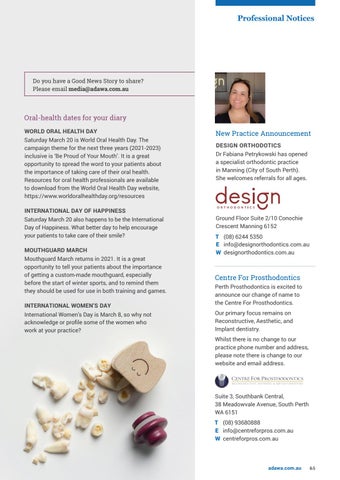
In the lead up to International Women’s Day, specialist dental lender Credabl is listening to the stories of women in dentistry nationally. The Credabl team recently sat down with Dr Fabiana Petrykowski, an orthodontist based in Perth, who has a unique perspective on Australian dentistry and story of her own Fabiana was born in Brazil and lived in Kentucky, USA, as a teenager. After moving back to Brazil, she completed studying dentistry and orthodontics there, where she also worked in her own practice for six years. When asked what made her choose dentistry, rather unusually she recalled role-playing as an orthodontist as a young girl, inspired by a family friend in the profession. Fabiana was enthralled by the energy of her family friend’s practice, the kids coming in and out every 20 minutes, the wires bent and the expressions of joy as kids saw their teeth without braces for the first time. As she grew older, she realised that she needed to study dentistry for five years before even considering orthodontics. Fabiana did not feel that being a woman would hold her back whilst studying dentistry. In fact, as a student, she remembers classes with more women than men but noticed that in more senior roles, men became more dominant. “I never felt that gender played a positive or negative role during my career.” It was only after becoming a mother that Fabiana felt she faced challenges due to her gender. At times like these she felt thankful for her supportive husband and learned the very important skill of delegation. She and her family consider themselves a team, cheering each other on with support and understanding. Fabiana recommends orthodontics to young women because it gives them the flexibility to work part-time while raising their family, but recognises it is a long road to qualification. Coming to Australia from Brazil was a challenge, especially with an established practice and family back home. She knew that moving to a new country could be a backwards step financially but can attest to the overwhelming personal and spiritual growth overcoming this challenge can bring. Fitting in and competing Down Under
12
March 2021 Western Articulator
I never felt that gender played a positive or negative role during my career.
was tough, but with her family and the support of amazing mentors, Fabiana now feels like a part of Australia and wants to contribute as much as she can. Fabiana is now opening her first practice since moving to Australia, after having a taste of the flexibility it offered in her days as a practice owner in Brazil. After completing her studies at UWA she didn’t expect to own a practice again, loving the experience of working with other people in their practices. Starting a practice in the tailwind of COVID might seem like a hard choice, but Fabiana has felt the itch for accomplishment in the past few months and is ready to give it her all with something she is passionate about. Fabiana really is a lifelong lover of orthodontics! For Fabiana, International Women’s Day is a reminder to celebrate the achievements of women who came before; those who fought for a better future and allowed the opportunities that she, her daughter and perhaps a future granddaughter will have tomorrow.
adawa.com.au
13
Partners in time MEMBER BENEFITS
If there’s one thing we know about adawa members, it’s that time is at a premium. That’s why we jumped at the chance to partner with a business and lifestyle concierge service
Aimed at the time-poor professional, ONDA is a business and lifestyle concierge service providing Australian-based administration support. ADAWA recently partnered with ONDA to provide this timesaving service to our members, which will be tailored to the busy dental professional. “I’m delighted to be launching this partnership with ADAWA and am confident that by offering the services, experience and the aggregated buying power of ONDA, we will deliver world-class support, service and costs savings that truly benefits all ADAWA members,” says George Wilson, ONDA CEO. Rather than being in the financial-services sector, George sees ONDA as providing a health and wellbeing service. “We believe everyone deserves the peace of mind of having a trusted guide who has their back in regards to all things financial,” he says.
What the partnership means for adawa members George says ONDA has partnered with ADAWA to offer tailored services to members, helping them gain time, clarity and peace of mind. ADAWA members can access an exclusive 15% reduction on all new ONDA service fees that are initiated this financial year. “Throughout the year we will also be inviting all members to benefit from our aggregate buying power with exclusive offers to reduce business costs. “ONDA believes that everyone deserves a fair go financially, which is why we manage independent reviews of practice costs like insurances and utility bills, and our clients receive all the savings – we don’t take commissions or incentives,” he adds. “With ONDA at their side as their trusted guide, our clients are able to focus on their patients and practices, spending time with loved ones and enjoying their free time.”
I was so time-poor I found it difficult to keep up, and now there’s a different mindset – it’s a sense of relief and I know that everything is being sorted out properly. The service is amazing. So, I am very happy. Damian - Lifestyle Concierge Client “ONDA delivers outsourced practice bookkeeping and administration services on a fixed-fee basis, however, we also couple this by delivering our clients cost savings via reviews of service providers, and support our clients with world-leading security and technology to drive other business efficiencies. We can also support ADAWA members to save time and money across their personal financial management.”
14
March 2021 Western Articulator
To find out more about the ONDA and ADAWA partnership, come along to our General Meeting on March 10. “We would also like to invite members along to complimentary sessions to learn more about ONDA, and most importantly, so that we can learn about how we can best support the members,” George says. If you would like to attend one of these sessions, you can register via this link: https://calendly.com/taraoakley/adawa-info-session
Lifestyle Case Study
Business Case Study
A busy medical practitioner relied heavily on his wife to run the household, looking after young children and managing the family finances. It was a lot to manage and led to unnecessary stress and disagreements. Service providers were rarely reviewed and it was a timeconsuming and frustrating experience when they were.
A practice was struggling to control salary costs, and this could not be addressed due to lack of clarity around the financial reporting. Their part-time finance function meant that when they were not working, nothing was being actioned, meaning financial information and supplier payments were always late and all these issues were compounded by using outdated accounting software.
For $750 per month, ONDA is able to provide bill payments and reconciliations, annual service provider reviews and document storage and reminders for four family members. The main attributes of ONDA’s services this client valued most was the time and cost savings: • $1,400 reduction in general insurance plus identified one lapsed policy • $500 decrease in utility costs and 15% discounted solar installation • $1,100 savings through renegotiation of bank interest rates • $600 of late fees and penalties avoided compared to last year • Around 100 hours saved for the family throughout the year and tax time • ONDA’s fees for this client were 50% tax deductible, meaning the net cost of ONDA services was nil, after deductions, and cost savings
ONDA Business Concierge delivers an outsourced bookkeeping and administration service which: • Directly saved $30,000 annually in salaries • Effectively managed the transfer to new accounting software • Delivered ongoing accurate and timely reporting As part of their service, ONDA managed an independent review of their insurances, energy providers and other business costs: • First year delivered in excess of $20,000 savings, reviewed annually thereafter • Total savings of $50,000+ delivered on the required practice outcomes
I would recommend ONDA to any organisation that is looking for additional support or to outsource completely. I have found it is peace of mind. I have found it a lot easier for our staff. It just takes a hell of a lot of pressure off and I finally receive the financial reporting I always needed but staff struggled to deliver.
Greg - Business Concierge Client
adawa.com.au
15
16
March 2021 Western Articulator
awarded prestigious scholarship
DMD GRADUATE
Congratulations to Dr Jamie Maraj, who was recently named as a recipient of a 2021 Fulbright Scholarship The Fulbright program is a foreign exchange scholarship program, which involves more than 160 countries sending recipients to the United States to work on projects that will expand global knowledge. The international scholarship is an incredible opportunity for Jamie, who graduated from UWA with a Doctor of Dental Medicine last year.
I’m hoping to combine an understanding of public-health policy with my clinical experience as a dentist to help develop effective solutions to the widening socio-economic divide in oral health outcomes in Australia. Jamie was awarded the 2021 Fulbright Scholarship recipient alongside two other scholarship recipients – a Bachelor of Philosophy student (who will study a Master of Space Systems Engineering) and a PhD student (who will continue her studies on how the gut can be a trigger for Parkinson’s disease). UWA Vice-Chancellor Professor Amit Chakma says being selected as a scholar for the prestigious Fulbright program is a great honour. “Fulbright scholars have made remarkable contributions to the world – engaging in genuinely collaborative research and enhancing cultural understanding. We are very proud of our new Fulbright scholars and wish them well in the important work before them.” Jamie says the application process for the scholarship was straightforward, involving both a personal essay and study plan outlwining what kind of impact he hopes to make over his career, followed up by a panel interview. When he found out he was a successful recipient, Jamie says it felt quite surreal to be chosen from such an incredible talent pool. “After it had sunk in, it was
also really heartening to know that an organisation like Fulbright chose to invest both in dental public health and my own potential to make a real difference,” he adds. Jamie will head to the US to begin the scholarship in August, attending Johns Hopkins University, where he will study a Master of Public Health. Although he admits there is a feeling of travelling into the eye of the storm given the large number of COVID-19 cases in the US, he says luckily there has not been any significant changes to the course for the coming academic year. Jamie plans on majoring in health policy through his Master of Public Health. “This involves getting a firm grounding in the policy mechanisms that can be used to implement public health measures and understanding the political and economic realities that create some of health inequities that we, as clinicians, see almost every day,” he says. “I’m hoping to combine an understanding of public health policy with my clinical experience as a dentist to help develop effective solutions to the widening socioeconomic divide in oral health outcomes in Australia,” he adds. “Additionally, I think a large part of this experience will be the relationships cultivated along the way, and the opportunities for international collaboration on issues that affect both the US and Australia.” Once Jamie returns to Australia with his Master of Public Health, he hopes to work on forming the evidence base that governments use when making health policy decisions, and state the best possible case for expanding access to dental care in Australia. “I plan on doing this through working at policy institutes and directly with government health departments, should I get the opportunity,” he explains. “I would also like to keep the hand skills sharp and maintain clinical practice when I return to Australia.” We look forward to catching up with Jamie on his return to find out about his once-in-a-lifetime experience. Watch this space! adawa.com.au
17
Meet
Dr Lisa Bowdin
Brooke Evans-Butler chats to paediatric dentist, Dr Lisa Bowdin, about her career and upcoming dinner course
Dr Lisa Bowdin was inspired to pursue dentistry after completing a high school work-experience placement at a local dental practice. After graduating, while working in private practice in Bunbury, she was fortunate to treat a lot of children, which cemented her decision to specialise in paediatrics.
I think the big thing is to try not to say yes to everything, which is not something I am very good at to be honest. “There wasn’t a paediatric dentist at the time in Bunbury and the practice I was working at was quite well-equipped to see children, so we got a lot of referrals,” she recalls. “My boss is very involved in children’s dentistry, so I got a lot more exposure to working with children as a new graduate. I realised it was the part of dentistry that I really enjoyed.” Lisa juggles various commitments as a paediatric dentist, including working in private practice at First Smiles, tutoring DMD students, and providing after-hours care at Perth Children’s Hospital. She also serves as the WA 18
March 2021 Western Articulator
Federal Councillor on the Federal Australian and New Zealand Society of Paediatric Dentistry (ANZSPD) Council and as Secretary of the Dental Specialists Association of WA (DSSWA). However, she says she aims to achieve some work/life balance. “I think the big thing is to try not to say yes to everything, which is not something I am very good at to be honest,” she laughs. “But I do make an effort. I only work four days a week in private practice and limit the number of on-call days I work. I think it is important to assess where you are at and if you are comfortable with your level of commitments. It is not all about work, you have to enjoy life as well.” They say never work with children or animals, although Lisa reveals the most challenging part of working in paediatrics is often managing parental expectation, rather than the children. However, she clearly does get much enjoyment from her work and says the best thing about her job is getting to see children gain confidence at the dentist. “We often have children who come into our practice really anxious, whether they need treatment or not. Being able to get them to the point where they are comfortable coming in and having a check-up and knowing that they are going to be set up for life seeing dentists as an adult, is very rewarding,” she says.
Princess Crowns and Pirate Teeth A dinner course presented by Dr Lisa Bowdin
THURSDAY MAY 13 6:30pm–9:30pm University Club, Crawley
Dr Lisa Bowdin
Lisa is looking forward to presenting a dinner course ‘Princess Crowns and Pirate Teeth’ in May. The course will cover:
Which three words best describe you? “Organised, laid back and dog-mum”.
• The history of the Hall Technique
If you weren’t in the dentistry field, what would you be doing for a living? “If I wasn’t in dentistry I would probably still be doing something health related,” she says. “Maybe speech pathology or another allied health. I was always interested in doing health; however, the long hours of medicine didn’t appeal. Although then I picked a speciality that has after hours on call,” she laughs.
• Familiarisation with tools and components
What do you do in your spare time? “In my spare time I like to play with my dog Lucy, a three-year-old labradoodle. I am currently planning to demolish and rebuild our house; it is a good project to have with my fiancé, Liam. We had to reschedule our wedding from April 2020 to April 2021 due to COVID, however, we were really lucky, and all of our vendors were available on the new date so we just had to call everyone to rebook.” What is your favourite book? “His Dark Materials Trilogy by Philip Pullman.” Where is your favourite place in the world? “I do really enjoy London,” she says. “My partner has a lot of family there so I have been fortunate enough to go quite a few times and it is probably the one city I have been to besides Perth that I have thought ‘I could live here’”.
• Indications and contraindications • Step-by-step instructions on the placement of a Hall Crown • Scientific evidence for use of the Hall Technique “The Hall Technique is a relatively new technique, and the main advantage is it is a non-invasive procedure so there is no local anaesthetic or drilling required,” Lisa explains. “It has been shown to be quite successful as long as the cases are chosen appropriately. There is now a large body of evidence behind it. “I think general dentists who are treating children and maybe don’t have the confidence to place traditional stainless-steel crowns or are looking for something to expand their repertoire beyond standard fillings will benefit from attending,” she adds. “I hope they take away at least the knowledge that this is an option and that they will have the confidence to consider its use.” The Princess Crowns and Pirate Teeth dinner course, presented by Dr Lisa Bowdin, will be held on May 13.
adawa.com.au
19
join us
for the next ADAWA general meeting, where specialist endodontist Dr Gaurav Vasudeva will present
Applications of CBCT in Endodontics The presentation will cover:
Wednesday 5 May
• CBCT application in diagnostic and procedural-based clinical scenarios
ADA House
including some tips to improve reading CBCTs for endodontic applications. • Interpretation of position statements by leading associations and academies in endodontics.
6.15 pm Eat and Meet 7.30 pm General Meeting 8.00 pm Lecture
Dr Gaurav Vasudeva moved to Perth two years ago and has recently
RSVP Wednesday 28 April
established his endodontic practice in Applecross. Prior to this he was
adawa@adawa.com.au
based in Tasmania. He has had adjunct senior lecturer appointments with University of Queensland and James Cook University. Available on Zoom for those unable to attend in person.
Nobody beats West Coast Dental Depot on W&H West Coast Dental Depot is the largest supplier of W&H sterilising equipment to dentists in Western Australia. For a great deal backed by the most reliable and experienced service and support team in the state, call West Coast.
WCDD_18216
View our full range of dental equipment and consumables at www.westcoastdental.com.au
Wayne Young Sales & Project Manager 0417 948 121
17A Wheeler Street, Belmont WA 6104 • Phone (08) 9479 3244 • Fax (08) 9479 3255 • Email sales@westcoastdental.com.au
$
935 inc GST
Advanced Single Implants & Introduction to Short-Span Bridges Dr Graham Carmichael and Dr Glen Liddelow
Saturday 30 April 2021 6.5 CPD Hours Registration: 8.45am Course: 9am - 5pm Brånemark Center 143 Colin St, West Perth Afternoon tea and lunch included Bookings & Enquiries adawa.com.au/cpd
Dr Graham Carmichael
COURSE OUTLINE For clinicians with some experience with implant therapy, this program expands your skills to include more advanced aesthetic refinement for the single implant restoration, and introduction to short-span implant bridges. From the restorative perspective, this program covers loading concepts, treatment staging and the practical skills for implant provisional restorations that support soft tissue. Biomaterial options for abutments will be evaluated together with case presentations that illustrate the concepts covered in the program. Critical decision factors will be discussed, including: when to immediately load, ASC abutment and full contour zirconia implant restorations. LEARNING OBJECTIVES: • How to restore a short-span bridge • How to treat advanced single implant restorations • Temporisation of implants to sculpt soft tissue • How to customise an impression coping • Restorative options with NobelProcer
ABOUT THE PRESENTERS Dr Graham Carmichael and Dr Glen Liddelow are highlyregarded prosthodontists and respected lecturers, both nationally and internationally.
adawa.com.au
21
Dental
CPD CALENDAR March ADAWA General Meeting Wednesday evening
April 10
ADA House, West Perth
The Art of CBCT Review Dr Raahib Dudhia & Dr Annalene Weston
18
Advanced Single Implants and Introduction to Short-Span Bridges
June 30
20
Dr Graham Carmichael & Dr Glen Liddelow
Friday 9.00am–4.00pm
Friday 9.00am–5.00pm
UWA Dental School, Nedlands
Branemark Centre, West Perth
Socket & Ridge Preservations Hands-On
Dr David Booth & Dr Carolyn Stulner KED FULLY BOO
Saturday 9.00am–2.00pm
Dr David Booth & LY BOOKED FUL Dr Carolyn Stulner CTEC, Crawley
LY BO ULFrank Dr Lee Kaing &FDr Chang
25
31
16
15 18
Tuesday 6:30-8:30pm
28
Ms Julie Meek
Dr Troy McGowen & Dr Annalene Weston
Friday 1.00pm–5.00pm ADA House, West Perth
Webinar: Wednesday 5.30pm
29
Dr Lee Kaing & Dr Frank Chang
Thursday 6:30pm–9:30pm University Club, Crawley
March 2021 Western Articulator
July Dr Graham Carmichael & Dr Glen Liddelow
21
2
Friday 9.00am–5.00pm The Branemark Centre, West Perth
ADAWA General Meeting Wednesday evening
7
ADA House, West Perth
Associate Professor Dieter Gebauer & Mr Leon Smith
ADA House, West Perth (Zoom)
Nutrition for Life
25/26
Friday 8.45am–5.00pm Saturday 9.00am–5.00pm
Hands-on Extraction
Prof Roberto Rossi
ADA House, West Perth
Dr Asheen Behari & Dr Paul Gorgolis
Restore My First Implant
ADA House, West Perth
Friday 9.00am–5.00pm
22
13
Saturday 9.00am–11.00am ASP WA Multidisciplinary Approach on Solving Passive Eruption in Anterior Maxilla
UWA Dental School, Nedlands
UWA Dental School, Nedlands
Thursday 6.30pm–9.30pm
Dr Lee Kaing
WP Paul Abbott AO & Dr Jilen Patel
Blood and Guts – A Dinner Course on Oral Surgery
12
18
Friday 8.30am–5.00pm Ceramic Restorations
Dr Lisa Bowdin
Suturing Workshop
April
The 3 things that are essential for modern high quality periodontal treatment planning
5
University Club, Crawley
Webinar: Wednesday 5.30pm
The Jens Andreasen Memorial Dental Trauma Update
Dr Simon Parsons & Dr Annalene Weston
Princess Crowns & Pirate Teeth – Dinner Course
University Club, Crawley Dr Ralph Kelsey & Dr Annalene Weston
Saying No
ADA House, West Perth Professor Paul Abbott
Webinar: Wednesday 5.30pm
Thursday 6:30pm–9:30pm Case Crunching
ADAWA General Meeting Wednesday evening
Saturday 9.00am–2.00pm Simplified Clinical Endodontics
ADA House, West Perth
Saturday 9.00am–2.00pm
Blood and Guts – A Dinner Course on Oral SurgeryOKED
1
CTEC, Crawley
20
12
Dr Algarves Miranda and Dr Mahnaz Syed
Saturday 9.00am–2.00pm
UWA Dental School, Nedlands
Practical Oral Surgery
May Practical Oral Surgery
FULLY Dr Vanessa William
11
Ms Megan Reilly & Dr Roslyn Franklin
Webinar: Wednesday 4 or 6pm The Primary Dentition: Pulp Therapy and Stainless-Steel Crown RestorationsBOOKED
Surgical Aseptic Technique in the Dental Office
16
Friday 1.00pm–5.00pm CTEC, Crawley
Stretched Not Stressed Alexandra Hof
24
Saturday: 9.00am–12.00pm ADA House, West Perth
RACDS WA Event - Top Hacks for Outstanding Dentistry Dr Michael Mandikos
More details to come
30
October
July Practical Oral Surgery Dr David Booth & Dr Carolyn D KEStulner FULLY BOO
31
Saturday 9.00am–2.00pm
Public Holidays
Practical Oral Surgery Dr David Booth & Dr Carolyn Stulner
16
Saturday 9.00am–2.00pm
CTEC, Crawley
CTEC, Crawley
August
ADAWA Annual General Meeting Wednesday evening
20
Clinical A/Prof Mehdi Valizadeh
The Art of Digital Photography & its Clinical Applications
22
ADA House, West Perth
Szabolcs Hant & Dr Graham Carmichael
ASP WA Event Connective Tissue Grafting around Implants and Teeth
17
Tuesday 6:30-8:30pm
ADAWA & ADANT Specialists in Darwin Saturday 9:00am-5:00pm
28
Friday 9.00am–5.00pm
22
Friday 9.00am–4.00pm
ADAWA General Meeting Wednesday evening
8
ADA House, West Perth
Dealing with Implant Failures Dr Keith Doonan
9
Thursday 9.00am–5.00pm ADA House, West Perth
Single Crown Preps: A Hands-on Course
5/6
Dr Asheen Behari & Dr Paul Gorgolis
UWA Dental School, Nedlands
Dr Albert Tan
Professor Peter O’Sullivan
Friday 1.00pm–5.00pm ADA House, West Perth
Practical Oral Surgery Dr David Booth & Dr Carolyn Stulner
Predictable & Easy Root Canal Instrumentation & Filling Techniques Professor Paul Abbott
18
Friday 8.30am–5.00pm
UWA Dental School, Nedlands
Saturday 9.00am–2.00pm CTEC, Crawley
Please note that parking is very limited for any daytime courses at ADA House, West Perth. Attendees should make themselves aware of public parking facilities in the area, or use public transport. The Red CAT bus route is conveniently located for ADA House.
Christmas Day
Saturday 25 Dec
Boxing Day
Sunday 26 Dec
Friday 2 April - Sunday 18 April
Event Types: WA Dental CPD Events
Dental Protection Events
18
More details to come
17
Monday 7 June
Other CPD Events
UWA Dental School, Nedlands
ASP WA Looking Forward, Looking Back – A Tapestry of Periodontics Over 45 Years
It’s Not Just About the Spine
WA Day
ADAWA General Meetings
Dr Poh Hun Loh & Dr Victor Matsubara
Saturday 9.00am–3.00pm
Sunday 25 April Monday 26 April
Friday 17 Dec - Sunday 30 Jan
Saturday 9.00am–5.00pm Sunday 9.00am–5.00pm
11
ANZAC Day
Satday 25 Sept- Sunday 10 Oct
November Porcelain Veneers & Ceramic Onlays
Monday 5 April
Saturday 3 July - Sunday 18 July
Albany Entertainment Centre, Albany
September
Easter Monday
WA School Holidays
ADA House, West Perth
Dr Amanda Phoon Nguyen
Friday 2 April
Queen’s Birthday Monday 27 Sept
ADA House, West Perth
Red, White, Night & Bite
Vibe Hotel, Darwin
Good Friday
26
Bookings & Enquiries
Additional event information and online bookings available at adawa.com.au Bookings, Course and Payment: T (08) 9211 5600 E cpd@adawa.com.au Other Enquiries to Dr Jenny Ball: M 0419 044 549 E jenny@adawa.com.au
Online Bookings are available on the ADAWA website adawa.com.au in the CPD area. A receipt will be issued listing the course name, date and applicable CPD hours, when registrations are processed. A Certificate of Participation will be provided after attending the course. Replacement certificates cannot be provided.
adawa.com.au
23
$
616 inc GST
Presented by WP Paul Abbott AO and Dr Jilen Patel
Friday 16 April 2021 6.5 CPD Hours
Traumatic dental injuries occur commonly – especially in young children and adolescents. How confident are you to treat these cases?
Registration from 8.30am, Course 9am to 5pm
This full-day presentation will provide you with an update on the latest information about traumatic dental injuries and how to manage them for the best long-term outcomes.
ADA House, 54-58 Havelock Street West Perth
ABOUT THE PRESENTERS
Bookings & Enquiries adawa.com.au/cpd
24
COURSE OUTLINE
March 2021 Western Articulator
Winthrop Professor Paul Abbott AO heads up the Endodontic program at UWA Dental School and helped update the worldwide 2020 Dental Trauma Guideline. Paul is a much-respected international speaker. Specialist paediatric dentist Dr Jilen Patel is a Senior Lecturer in Clinical Dentistry at the UWA Dental School and Consultant at Perth Children’s Hospital. Jilen received the Dental Association/ Pierre Fauchard Academy’s Young Lecturer Award in 2019 and was as also named the 2019 West Australian Young Achiever of the Year Award, recognising his work in remote Kimberley communities.
Photo courtesy: Dental Trauma Guide
The Jens Andreasen Memorial Dental Trauma Update
Education & Training
Hot Topics in Oral Medicine 2021 Perth Oral Medicine & Dental Sleep Centre Complimentary educational afternoon presented by Oral Medicine Specialists in Western Australia, covering the latest in Oral Medicine for our referrers. THE ASTRAL ROOM Saturday, 14th August 2021 2:00pm – Registration 2:30pm – Lectures commence 4:00 – 6:00pm – Refreshments and canapes 2 HOURS CPD Registration: https://hottopics2021.eventbrite.com.au/
RESTORATIVE IMPLANT DENTISTRY MINI RESIDENCY Gain confidence in single, fixed partial denture 16 and full arch implant restorative solutions HOURS CPD
THE COURSE
This unique and comprehensive course provides real experience on real patients. Learn how to take implant impressions, how to check the bite, how to troubleshoot, and how to insert the crown. Presented by Prosthodontist Dr Michael Zaninovich DATES Saturday 10th April and Sunday 11th April 2021 FEE $1,500 + GST (2 day course)
COURSE SUMMARY Full day hands on clinical workshop on real patients • • • • • • • •
Treatment planning the single tooth implant Conventional and digital impression techniques Retentive methods of single and FPD prosthesis Implant systems Biomechanics – understanding forces to avoid failure Restorative materials and fabrication techniques Occlusal principles Maintenance protocols and management of common prosthetic complications
For full details and course information email training@ariadental.net.au
adawa.com.au
25
Restraints and non-compete clauses: an exercise in reasonableness For dentists who operate under a contract with their practice owner, it is usual to expect that the contract will include a post-contractual restraint. That is, a provision which restricts the dentist’s conduct once they leave the practice. These may also be known as non-compete clauses A restraint provision will typically provide that the dentist must not engage in activities that are similar to or in competition with those conducted at the practice; and there will commonly also be an express prohibition on the soliciting of patients. Dentists frequently enquire with us about whether their restraints are enforceable. This may be because a change of practice is imminent, or because they are considering future career plans; or in some cases, they may have already left their former practice only to receive notice that they are in breach of a restraint. Whilst restraints differ contract
26
March 2021 Western Articulator
to contract, and their application and effect is always fact-specific, some general principles are explained below.
Restraints must be reasonable The general rule is that a restraint of trade is contrary to public policy and void, unless it can be shown that the restraint is reasonable. A restraint must go no further than is reasonably necessary to protect the interests of the person in whose favour the restraint operates. Essentially, the courts will assess restraints based on commercial fairness and the need to hold parties to their agreements.
When might a restraint be valid? When evaluating a restraint, the courts will look at circumstances which existed at the time the restraint was entered into. Matters such as the following, may be considered: • the respective bargaining positions of the parties; • the nature of the business and the industry in which it operates (including factors such as the level of specialisation and competition in the market); • the restrained person’s knowledge of and connection to the business, and the clients/patients of the business; • the length of time to re-establish client/patient relationships; • the seniority of the restrained person and their access to confidential information: A restraint applying to a practice principal will usually be more onerous than one applying to an association; • the impact of the restraint on the restrained person; • the length of time it would take or has taken to fill the vacancy created by the restrained person’s departure.
For example, a restraint might be stated as applying within a 5km radius or (if that is not enforceable) a 3km or 1km radius; and similarly, for a period of 2 years or (if that is not enforceable) 1 year or 6 months. It should be noted that the analysis of a restraint is highly fact specific. By way of illustration, in a 2014 Queensland case, the Court upheld a 15km radius and 18-month restraint for an experienced ophthalmologist; while in an earlier case, the same Court held that a 12-month restraint on a doctor was not enforceable because only 3 – 4 months were needed to find their replacement.
What are the consequences of breaching a restraint? Typical remedies for breach of a restraint could include: • Damages and compensation for loss suffered as a result of the breach. • An injunction to prevent the restrained party from acting in breach of their restraint. Usually this will not be ordered if damages are an adequate remedy. Restraints can be a complex area. When including restraints in a dentist’s contract, practice owners
The general rule is that a restraint of trade is contrary to public policy and void, unless it can be shown that the restraint is reasonable. When might a restraint be unenforceable? It is generally more difficult to enforce a restraint if it is drafted in broad and unreasonable terms. Grounds on which a restraint might be held unenforceable could include where:
should seek advice and/or use properly drafted restraint provisions. Conversely, dentists who are agreeing to a restraint or are already subject to a restraint should seek advice if ever unsure of the effect of that restraint.
• the clause goes further than is reasonably necessary to protect a party’s business interests; • the clause would deprive the restrained person from earning a living; • the restrained activity is not defined with specificity; • the restraint period and area are unreasonably wide. In some contracts, the area and period of a restraint may be expressed in a ‘cascading’ fashion to avoid the risk of having a Court strike down the whole restraint.
© Panetta McGrath Lawyers 2020. Author: David McMullen. This information is intended as a general overview and discussion of the subjects dealt with. The information provided is not intended to be, and should not be used as, a substitute for taking legal advice in any specific information. Panetta McGrath is not responsible for any actions taken on the basis of this information.
adawa.com.au
27
The pursuit of
happiness By Colm Harney, Dentolegal Consultant at Dental Protection On July 12, 2012, the UN General Assembly passed a resolution (A/Res/66/281) declaring every March 20 the ‘International Day of Happiness’ in recognition of the pursuit of happiness as an important human goal. According to Muthuri et al, happiness is characterised by experiencing positive emotions while simultaneously perceiving one’s life as meaningful and worthwhile. We all know that the practice of dentistry, while rewarding in so many ways, can also be stressful and challenging – especially when things don’t go according to plan in our interactions with patients, or clinically. At the same time, increasing awareness of burnout in our profession and acknowledging the importance of mental health, means that whilst we work to care for others, we must also care for ourselves. In late 2019, just before COVID-19 struck, the Greater Good Institute for Health Professionals drew practitioners from all around the world to a three-day retreat. From this they formulated five key takeaways on how to cultivate your own wellbeing and happiness as a health professional.
Health care has intrinsic meaning because it involves helping others to be well.
28
March 2021 Western Articulator
Connection
Self-compassion
Positive, kind and helpful connection with colleagues is the most under-appreciated source of stress resilience, wellbeing and peace. This ties in with the old adage that a problem shared is a problem halved.
This is a big one for dental professionals – we are high achievers, working in small spaces where the tolerances between success and failure can be marginal. We are often striving for perfection, increasingly motivated by curated images of beautiful work we see on social media.
Over my years of practice, I can think of so many occasions when I have shared a clinical conundrum or concern about a difficult interaction I’ve had with a patient – the longer I’ve been in practice, the more inclined I am to share and seek help. The mere act of vocalising the problem seems to immediately improve the situation (and often helps me to see a solution) and a sympathetic ear or advice from someone who has been there and done that is often all that is needed. Our profession, even in this age of social media, is still founded on oldfashioned values of collegiate spirit and experienced practitioners mentoring new graduates. The recurring theme in all of this is connection.
Gratitude The institute also reported that “simple practices of gratitude do more than shift our wellbeing and outlook. They also ignite more kind and altruistic behavior”. That is not to diminish the anxiety and real consequences experienced by anybody due to COVID but more to accentuate how good we have it here relative to the rest of the world. At the time of writing during the Covid-19 pandemic, here in WA we can carry out our work that we often take for granted, without fearing that the next patient interaction might have terrible consequences for us, our teams or our patients. This is truly something to be grateful for.
Empathy The institute highlights research that has been replicated over many studies – “a measure of empathy can effectively inform clear-headed, compassionate care, which leads to better outcomes for patients and greater wellbeing and satisfaction for healthcare providers”. The caveat to this is that practice of empathy is a skill and a balance must be struck between “the kind of empathy that leads to distress or cynicism (both related to burnout) versus the empathy that leads to compassionate care”.
“At the institute, participants talked about their harsh inner critic, who is continually comparing their performance to some ideal and evaluating them as falling short. Self-compassion is a practice of giving yourself kind, caring attention – the type you’d give to a friend or a loved one”.
Meaning and purpose “Health care has intrinsic meaning because it involves helping others to be well." Psychiatrist and Holocaust survivor Viktor Frankl suggested that the search for meaning is the primary motivation for human beings. In the context of happiness and search for fulfillment in our career it is worthwhile reflecting on why we go to work and do this difficult but rewarding job. Does this align with what gives us meaning? Is it for monetary reward, seeing the patient’s face light up after having their smile transformed? Relieving pain, giving back to society or as a means to provide opportunities to do something we love in our spare time? Or perhaps simply providing for our families? Understanding what values motivate us deep down and aligning this with what we do in our career, is a way to happiness and life satisfaction. In summary, the pursuit of happiness and the practice of dentistry need not be mutually exclusive. These five points can give a framework for reflection and analysis of what we do, how we do it, and the why sitting behind it all in order to find happiness in this rewarding and challenging profession. REFERENCES Muthuri, R.N.D.K., Senkubuge, F. & Hongoro, C. Determinants of happiness among healthcare professionals between 2009 and 2019: a systematic review. Humanit Soc Sci Commun 7, 98 (2020). https://doi. org/10.1057/s41599-020-00592-x Ekman, E. Five ways to protect your well-being as a health Care Professional. Greater Good Magazine. December 2019. Frankl, V. Man’s search for meaning: the classic tribute to hope from the Holocaust. Rider-Trade. 2008
adawa.com.au
29
How to Become an Employer of Choice Recruiting and retaining talented employees can be difficult; however, becoming an employer of choice can assist in this process. While many employers believe that employees leave for better money, the reality is that most employees choose to resign for other factors, such as lack of job satisfaction, poor work-life balance, and lack of career advancement. This raises the question – what do employees want at work, and how can employers meet these needs and become an employer of choice to retain talented employees?
Employee turnover Employee turnover is a pressing issue that practices may face. It is more efficient and cost-effective to retain a high-quality employee than to recruit, train, and onboard a new one. Turnover can cost practices a significant amount of money, affect practice performance, and cause poor job satisfaction in other employees due to staff shortages. Practices must therefore assess what steps it may need to take to ensure talented staff are retained. This involves looking at what is working, what is not working and implementing improvement strategies. This is commonly known as a retention plan. Practices should remember that employees do not choose an employer just once. In reality, an employee chooses the practice as a potential place of work, chooses to accept or decline an offer of employment, chooses to stay with the practice throughout their employment, and may choose to promote the practice as an employer of choice or refer friends, family, and colleagues. Practices must strive to be an employer of choice to attract and retain the best employees.
Attracting talented employees To attract talented employees, a practice must have a detailed recruitment process in place. This starts with advertising the role strategically and include relevant information 30
March 2021 Western Articulator
in the advertisement so that a candidate can assess their suitability for the role and whether the practice is a right fit. Through the recruitment process the practice should also be able to demonstrate what it has to offer to potential employees. Employee retention is highly influenced by job satisfaction, and as such, potential employees want to know what the practice can do for them before accepting a role. When recruiting, practices should demonstrate workplace culture and values, career development programs and supports in place, and any other relevant factors which make it stand out from the crowd during the recruitment phase. Ultimately, practices should strive to be an employer of choice in all its actions, not just in the recruitment phase; however, the professionalism and nature of the recruitment process will certainly set up the practice and employee for success.
What is an employer of choice? An employer of choice is an employer that maximises the full potential of their employees through effective recruitment, engagement, and retention. In general, the term usually refers to a good employer, which attracts and retains high-quality employees or is a leading place to work compared to others in the industry.
For further information or assistance in relation to the updated Health Professional and Support Services Award 2020, please do not hesitate to contact the ADA HR Advisory Service on 1300 232 462.
The essence of becoming an employer of choice is the quality of the employment relationship. Employers of choice foster a collaborative employment relationship, which focuses on the changing needs of both the employees and the practice, rather than a more traditional "us and them" approach, which largely prioritises the practice needs over the employee’s needs.
What do employees want? If a practice intends to retain employees, it must be able to identify what employees want. Although money has some influence on whether an employee decides to take a position in a business, job satisfaction is what keeps an employee motivated, engaged and committed. So, what factors influence job satisfaction? Employee satisfaction is highly influenced by purpose, wellbeing, and recognition. Employees report that
Further to the desire for safety at work is the concept of psychological safety. Psychological safety is often defined as a belief that one will not be punished for speaking up with ideas, questions, concerns, or mistakes broadly encompasses physical safety, mental health, wellbeing, engagement, and creativity. Research suggests that workplaces that foster psychological safety are more productive and have higher employee satisfaction and less turnover. Psychological safety is a by-product of culture. Where people feel that their work is worthwhile, productive, challenging, and offers learning opportunities and development, engagement is improved. In placing value in employee satisfaction, practices should undertake a holistic assessment of what their employees want. This may mean undertaking surveys, creating an open dialogue with employees and, creating new policies and procedures, including a recruitment or
Although money has some influence on whether an employee decides to take a position in a business, job satisfaction is what keeps an employee motivated, engaged and committed. they have greater job satisfaction when they perceive that their job offers them autonomy, security, future, and meaning. Autonomy means that employees want to feel valued, respected and like they can make a difference in the Practice. Security does not just refer to having job security but extends to feeling mentally, emotionally, and physically safe and secure at work. The idea of security at work further extends to employees wanting to feel that their job offers them a future, including career development and opportunities for advancement.
induction process to ensure all employees have what they need to succeed. Studies have shown the most dangerous time for employee turnover is in the first few months of employment. Practices that focus on employee satisfaction right from the recruitment stage are more likely to retain talented staff. Practices should undertake steps to understand employee needs, including through surveys, ongoing dialogue, and positive workplace relationships. This will assist in becoming an employer of choice, and therefore increase the practice's ability to attract and retain talented employees.
adawa.com.au
31
Question Clinical Challenges in Oral Medicine
Test your clinical knowledge with this issue's oral-medicine challenge
Dr Alissa Jacobs Oral Medicine Specialist
A 75-year-old male was urgently referred to me by his dentist for assessment of a large, painless mass extending across the left maxillary alveolus. The patient had recently had a fall, and attended for a new partial denture, and he noted that it no longer fit. He was otherwise unaware of the mass. Given the presentation, the dentist made phone contact to emphasise the urgency of the patient’s triaging. His medical history was significant for cardiovascular disease; cardiac arrhythmia, hypertension and hypercholesterolaemia. He had a pacemaker in-situ and was taking Amiodarone hydrochloride (antiarrhythmic) Bisoprolol fumarate (beta blocker), Rosuvastatin (HMG-CoA inhibitor), Aspirin and Eliquis (antithrombotic agents). He had a history of adenocarcinoma of the colon in 2005 treated with chemotherapy. He denied any other intervention for this malignancy and despite best efforts no other details were obtained. Clinical examination revealed a frail looking gentleman, without any obvious sign of ataxia or cachexia. Lymphadenopathy was not obvious on extraoral examination. Intraoral examination showed a mass measuring approximately 50mm in an anterior-posterior direction and 30mm transversely. The mass was erythematous and ulcerated, and the teeth involved demonstrated marked mobility. Multiple incisional biopsies were completed across the lesion and the patient was sent for imaging; a CT extending from the diaphragm to floor of orbit.
Intra-oral photograph of lesion
In this case potential diagnosis is: Hyperplastic tissue; due to an old and ill-fitting denture Angiogranuloma; reactive inflammatory response Squamous cell carcinoma; most common oral malignancy Oral melanoma; rare oral malignancy Metastatic adenocarcinoma; rare intraoral metastasis of his primary malignancy
Know the answer?
Turn to page 38 to see if you're right.
32
March 2021 Western Articulator
2 Oral Medicine Specialist
Dr Janina Christoforou
When dermal fillers go wrong Arrows showing sites of cosmetic dermal filler
TAKE-AWAY MESSAGE Dermal fillers incorrectly placed within parotid glands should form a part of the differential diagnoses of unilateral or bilateral facial swellings. I previously wrote an article on delayed hypersensitivity reactions in relation to hyaluronic acid fillers. After recently coming across a patient with a facial swelling, I felt that it would be appropriate to discuss another potential complication which we should be aware of in regard to dermal fillers. A 52-year-old lady approached their dentist with a left facial swelling and associated discomfort. A dental examination was undertaken, and the swelling did not appear to be of odontogenic origin. The patient was subsequently referred for further investigation. Clinical examination had shown a palpable, tender swelling over the left parotid region and there was no obvious secretion noted from the left stensen’s duct. Non-odontogenic, unilateral swellings can arise due to a number of causes, such as sialolithiasis, sialadenitis, allergies, sinusitis, neoplasms, or trauma. An MRI was undertaken to further investigate the swelling and there was evidence of cosmetic dermal filler in the superficial lobes of both parotid glands, appearing subcapsular and juxtaparotid. This was more prominent on the left side of the face.
The patient later disclosed that she had dermal fillers placed 1 week ago. Hence, the swelling was consistent with a parotitis. The swelling responded to a single course of amoxicillin. Nevertheless, there are times when hylauronidase enzyme injections are required to speed up the process of dissolving the hyaluronic acid filler. The placement of dermal fillers is becoming very popular and hence we are likely to see more patients entering our clinics having had these procedures. Patients are often reluctant to disclose recent cosmetic procedures such as dermal filler injections. Hence, directly asking the patient is often required. It is important to consider complications of dermal fillers in potential differential diagnoses of facial swellings. Much of the complications associated with dermal fillers arise from the incorrect positioning of the dermal filler in respect to anatomical structures. It would be advantageous to locate crucial structures and the position of the injected material post-injection by ultrasound investigation. Nevertheless, this may not be feasible for routine clinical application.
adawa.com.au
33
5
Anatomy of the Root Canal System & its Clinical Implications Mandibular Permanent Molars
Dr Gaurav Vasudeva Specialist Endodontist info@endopractice.com.au
This is the final installment of Dr Gaurav Vasudeva’s five-part series on the anatomy of the root canal system. Read the previous four articles in the Western Articulator. PART 1: May 2020
PART 3: Sept 2020
PART 2: June 2020
PART 4: Dec 2020/Jan 2021
In our final article for the series on anatomy of root canal systems, we will discuss the mandibular molars and some further insight to ‘C’ shaped canal systems that are more specific to mandibular 2nd molars. Mandibular molars were always considered to have a less-complicated root canal system in comparison to their maxillary counterparts, but recent micro-CT studies show elusive middle mesial canals and complex C-shaped canal anatomy; although not prevalent it can provide challenges without having the knowledge of their presence and locations. Unlike the maxillary molars that are difficult to read through the periapical radiographs, mandibular molars can be visualised better – exceptions being C-shaped canals and radix entomolaris (additional distal root) although presence of the inferior dental canal fairly close to the apices of these molars can create some difficulty. Precautions need to be taken while cleaning/shaping and obturating the apical 3rd of these teeth. We will discuss some C-shaped canal configurations in more detail due to their highly variable configurations and its marked racial prevalence. Such canals are prevalent in about 16% of mandibular 2nd molars as a whole but can be up to 30-40% of the mandibular 2nd molars in people originating from east and south east Asia.
C-Shaped Root Canal System: Fig1: Showing independent middle mesial canal in the 1st image and the middle mesial merging with the mesio-lingual in the 2nd image.
34
March 2021 Western Articulator
In the last 10 years, there have been few studies that have provided a thorough assessment of the C-shaped root canal configurations. However, the initial attempt to classify this unusual anatomical finding and its particular irregularities was addressed by Melton in 1991 and was characterised as follows.
Fig 2: Mandibular 1st molar with 5 canals including an independent middle mesial. (a) Preop #36 with symptomatic apical periodontitis (b) All 5 canals with files for WL confirmation (c) Image of all canal orifices (d) Post obturation radiograph (e) Post obturation with distal angulation revealing all 3 mesial canals (f) Post obturation image of the access.
•
Category I: A continuous C-shaped canal that flows from the pulp chamber to the apex delineates a C-shaped outline without any separation.
•
Category II: A semicolon-shaped orifice in which dentin separates the main C-shaped canal from one distinct mesial canal.
•
Category III: Those anatomies with two or more discrete and separate canals with a: (1) subdivision I, C-shaped orifice in the coronal third that divides into two or more discrete and separate canals joining apically; (2) subdivision II, C-shaped orifice in the coronal third that divides into two or more discrete and separate canals in the mid-root to the apex; and (3) subdivision III, C-shaped orifice that divides into two or more discrete and separate canals in the coronal third.
a
Fig 3: (a) Milton’s Classification of C-shaped canals. (b) Fan et al 2004. Classification of the C-shaped canal system that was further modification of the Milton’s classification.
b
adawa.com.au
35
Fig 4: 3D classification of C-shaped canal configuration. (a) Merging type; (b) symmetrical type; (c) asymmetrical type (Gao et al)
The next major classification system presented took advantage of the newer technology with the application of extensive micro-CT sections. With some new anatomical information, Fan et al. modified Melton’s classification as follows: • Category I: The shape of the canal was an interrupted “C” with no separation or division. • Category II: The canal shape resembled a semicolon resulting from a discontinuation of the “C” outline; however, either angle created should be no less than 60°. • Category III: Two or three separate canals were present and both angles created were less than 60 • Category IV: Only one round or oval canal was present in that cross section.
Fig 5: C-shaped canal system with an independent MB canal whereas ML and D canals are fused in a C shaped anatomy. (Classification C2)
• Category V: No canal lumen could be observed (usually seen near the apex only) in this variant. All clinical cases performed by Dr Gaurav Vasudeva and published only for the purpose of dental education. Please contact the author for references at info@endopractice.com.au
Fig 6: Another C-shaped anatomy where all 3 canal systems are connected and merge at the apex but have separate orifices.
36
March 2021 Western Articulator
1st Molar
2nd Molar
PERMANENT MANDIBULAR
PERMANENT MANDIBULAR
Complete Root formation
9.2-10 years
13.8-14.8 years
Number of roots
2 (92.2% independent; 5.3% fusion), 3 (2.5%)
2 (independent 39.2%; bifurcation at the middle third 31.8%; fused 26.7%)
2 (86.9%), 3 (12.5%)
3 (2.3%)
1 (0.55%)
4 (0.2%)
2 (8%), 3 (56%), 4 (36%)
2 (16.2%), 3 (72.5%), 4 (11.3%)
Number of root canals
1 (12.5%) Apical Foramen position
M, central 22%; lateral 78%; D, central 20%; lateral 80%
M: central 19%; lateral 81%; D: central 21%; lateral 79%
Accessory canals
M: 45% (coronal, 10.4%; middle, 12.2%; apical, 54.4%)
M: 49% (coronal, 10.1%; middle, 13.1%; apical, 65.8%)
D: 30% (coronal, 8.7%; middle, 10.4%; apical, 57.9%)
D: 34% (coronal, 9.1%; middle, 11.6%; apical, 68.3%)
Apical ramifications (delta)
19.4%- 30.9%
17.5-35.7%
C Shaped Canal
0.53%
16.33% (1.9–44%)
Anomalies
Five canals; six canals, seven canals, radix; taurodontism, apical curvature; gemination/fusion; isthmuses, three roots; C-shaped; middle mesial canal; middle distal canal
One canal; two canals; five canals; apical curvature; gemination/fusion; isthmuses; C-shaped, middle mesial canal
Clinical relevance
• It usually has two roots, but occasionally it has three, with two or three canals in the mesial root and one, two, or three canals in the distal root.
• This tooth is very similar to the first molar; however, the roots are shorter, the canals are more curved, and the range of variation is higher. It may have one to five canals, although the most prevalent configurations are three and four canals.
• The distal surface of the mesial root and the mesial surface of the distal root have a concavity, which makes the dentin wall very thin. • The presence of root canal isthmuses averages 55% in the mesial root and 20% in the distal root; multiple accessory foramina may be present in the furcation area; the dentin overhang at the mesial orifice must be removed to lessen the danger of penetration.
• The two mesial orifices are located closer together; a relatively common variation in root morphology is the presence of C-shaped canal. • Clinical signs of the presence of C-shaped canals include continuous pain and persistent bleeding from the root canal and confluent canals. • The apices of this tooth often are closed to the mandibular canal.
adawa.com.au
37
Answer Clinical Challenges in Oral Medicine
The correct diagnosis was: Oral melanoma; rare oral malignancy
1
2
The lesion in question was histologically proven to be an aggressive oral melanoma. Although oral melanoma is rare, pigmented lesions in the oral cavity must be viewed with a high index of suspicion. In this case, the lesion did not contain any pigmentation and was amelanotic. Amelanotic melanomas of this size are exceedingly rare. Histologically, the lesion itself was highly dedifferentiated and multiple stains were relied upon to ascertain the diagnosis. In this instance the lesion could have very well been one of the afore-mentioned differentials and biopsy (with appropriate staining) is key to the diagnosis.
The dentist has played a pivotal role in giving this patient the best chance of survival. The patient’s imaging showed a large heterogeneously enhancing partly necrotic mass centred on the left maxillary tuberosity and adjacent posterior maxillary alveolar ridge, with superior protrusion into the posteroinferior aspect of the left
38
March 2021 Western Articulator
3
4
5
6
maxillary antrum, extensive aggressive erosion of the maxillary tuberosity and anterior extension within the left maxillary gingivobuccal sulcus and along the left lateral margin of the hard palate. No suspicious lesions were noted elsewhere he was sent for urgent management to his designated tertiary hospital. He was seen in a multi-disciplinary team with the plan of surgery and immunotherapy (Keytruda) as the first line option. The dentist has played a pivotal role in giving this patient the best chance of survival. By picking up the lesion, realising the urgency and calling on the patient’s behalf to ensure his case was bought to my attention. This meant that the patient was seen, diagnosed and staged promptly.
1. Low power amelanotic melanoma 2. High power amelanotic melanoma 3. CT showing the extend of the lesion. 4. CT showing the extend of the lesion. 5. SOX10 showing strong diffuse staining 6. HMB45 showing patchy positive staining
Histopathological imaging: Courtesy of Dr Jason Lau, Anatomical Pathologist, Clinipath Pathology Radiographic imaging: Courtesy of Perth Radiological Clinic References available by email: alissa@pomds.com.au
adawa.com.au
39
Eat Play Sleep ADAWA member Dr Rob Norris has published a book about health and wellbeing – transforming his own health in the process. We spoke to him about the achievement
Eat, Play, Sleep answers many of the questions patients regularly ask in a language the average person can understand. The book is written to break down the science for the general reader with solid facts and plenty of comic relief to explain and maintain interest. According to Rob, we all have a book inside us waiting to get out. With publishing a book on his bucket list, Rob says he thought it would be much easier to achieve than walking the Kokoda Track.
When I corrected my sleep I felt better, had more stamina and the weight seemed to fall off in a matter of months. Rob was inspired to write the book after attending a CPD lecture at ADA House, where the presenter (a physician) spoke about the prevention of systemic disease, to maintain our 21-year-old body size into our seventies and beyond. This became Rob’s goal. Another ‘kick in the pants’ for Rob to look into these health and lifestyle changes was the diagnosis of prostate cancer. The book took around three years to complete. “I started this version in May 2017, or shortly after. I had spent some months previously on a manuscript that explained the evolutionary reasons for our behaviour and physiology,” Rob recalls. “It was awful, so I deleted it to avoid future embarrassment. I have a dear friend who is a retired Naval Officer; he told me that books are never completed, they are abandoned.
40
March 2021 Western Articulator
“My book was probably ‘finished’ in September 2018 and should have been out for Christmas that year, but I fiddled with it endlessly, making incremental improvements. In November 2019 it went to my editor who, in a matter of weeks, fixed my manuscript in a way that would have taken me a lifetime.” The final result – Eat Play Sleep: Three Keys to Finding Your Younger Self – investigates the importance of sleep, activity and food, with many humorous memories, personal experiences and patient stories shared along the way. The book is divided into three sections: • Part One: Sleep to Health, Snooze and Lose the Ooze (where Rob covers sleep basics and sleep disorders) • Part Two: Active Life – Strength and Motion (using energy and being active) • Part Three: Food Glorious Food (nutrition for starters, are you what you eat? The main course) As someone who was relatively active and ate well, there were some surprises for Rob when researching ways to find your younger self that made a big difference to his own health and wellbeing.
About Rob
Rob Norris practices in Wagin, south-west WA. In his spare time, he reads, writes, brews prize-winning beer and drinks it, and watches cricket and F1. If he wasn’t a dentist, he says he probably would have gone into teaching, and dreamed of being a historian or archaeologist.
“I battled unsuccessfully with the incremental weight gain,” he recalls. “I had good eating and exercise habits. I probably had better habits than they are now, but my sleep was short and poor. When I corrected my sleep I felt better, had more stamina and the weight seemed to fall off in a matter of months.” Rob is a real example that the common-sense approach ideas in the book works – he is now the same weight and trouser size that he was aged 22. He says since making the changes to his lifestyle he is feeling pretty good. “I have not felt this well since I was in my late 40s; 15 years ago,” he says. “I feel fitter, have more stamina and have noticed positive changes in attitude.” Rob recommends living better, healthier lives to his dental colleagues. “Dentistry can be a very demanding vocation,” he explains. “Many of us work single-handed and for long hours. We are required to concentrate and focus on delivering a high-quality service – perhaps for those who are not always the most compliant subjects. “When things go wrong, we need to have the resilience to deal with the situation in a timely and professional manner. We owe it to ourselves, our families, and our patients to be the best version of ourselves to deliver the required professional service.” Rob also hopes readers pay more attention to the quality of the information they use to form opinions. “There is a thread of not-so-subtle cynicism running through the book,” he says. “If a reader changed just one or two actions for the better, it would be a good result. Alternatively, if they simply had a laugh at some of the passages and recommended the book to their pals, I will be delighted.” You can purchase Eat Play Sleep: Three Keys to Finding Your Younger Self by Rob Norris, from Amazon: amazon.com/BooksRob-Norris/s?rh=n%3A283155% 2Cp_27%3ARob+Norris
Putters at the ready The WADA golf season commences in February, with our traditional first game at the magnificent Royal Fremantle Golf Club. WADA golf is available to all interested dentists and dental industry representatives. We meet regularly throughout the year, on a Friday afternoon, for a competitive round of golf, at various courses throughout the Metropolitan area. Golfers of all standards are welcome to participate. An official golf handicap is preferred, and budding golfers will be assisted to obtain an official handicap as required. Fellowship, relaxation, and an afternoon away from the drill and fill is what you can expect when you join our friendly group. New participants are most welcome. Should you wish to participate in any of the games this year, please contact me at dentistgolf@gmail.com for more information, or to be included on our mailing list. Our fixtures for the rest of year are as follows: March 26
Gosnells Golf Club
May 5
Hartfield Country Club
June 18
Joondalup Resort
Aug 6
Royal Perth
Sept 17
Cottesloe Golf Club
Oct 20
Country Trip
Nov 19
Lake Karrinyup
Good golfing,
Michael Whitford WADA Golf Captain dentistgolf@gmail.com
adawa.com.au
41
Dental community unites to save the Special Needs Dental Clinic With the lease of the Special Needs Dental Clinic in North Perth being discontinued as of June 30, a parent of one of the dental clinic’s patients is petitioning to have the lease extended until a suitable equivalent facility can be found. When Joan Martin took her daughter Ruth to the Special Needs Dental Clinic in January, she was shocked to find out about the clinic’s imminent closure. “Ruth needed a follow up appointment, and the dentist looked at me and said: ‘I am not too sure where the follow up will be’. The dentist said they had notice that their lease is not going to be extended past the 30th of June and they did not know where they were going to go.” Joan quickly set up a petition for concerned parents and carers at the front desk of the dental clinic to request an interim extension of the lease until a purpose-built facility is completed. Identity WA has also promoted the request to sign the petition to its members and Joan has met with Sam Carrello from Dental Health Services and the Acting CEO of the City of Vincent. Joan is worried about the struggle to find an equivalent interim measure if the lease is not extended for the 2,500-plus people with special needs who rely on the service. “You have people come to the clinic who are non-verbal, people with high anxiety, people with autism,” Joan explains. “One of the joys of the Special Needs Dental Clinic is that they have four large surgeries. You, as a support worker or parent, can go and sit beside the person in the dental chair and hold their hand, for instance. The staff are trained and are fantastic. They desensitise patients over a long period of time so that patients like Ruth can go to the dental clinic with no problem at all.” The disruption to the service is also a great concern. “There is only one Special Needs Dental Clinic in Western Australia,” Joan adds. “At one of Ruth’s appointments, the next patient had flown in from Carnarvon, and there is a 14-month waiting list for recall. There's talk of moving to the large clinic at Fremantle, but it's upstairs, there is no parking immediately there and it has a shared waiting room. It is not an equivalent.” Joan will present the parents’ petition, along with letters from concerned parents, at the City of Vincent’s Council Meeting on March 23.
ADAWA has formally lobbied the City of Vincent and the Hon. Roger Cook (Deputy Premier of Western Australia/Health Minister) regarding the closure of the North Perth Clinic. Many ADAWA members also got behind the petition to show their support.
42
March 2021 Western Articulator
“Dental health is imperative for general health,” Joan adds. “There is a strong possibility the most vulnerable in our community will not be receiving adequate care in the interim until a new purpose-built Special Needs Dental Clinic can be established, or we can be relocated to an equivalent site.”
We live in Ellenbrook and are willing to travel to North Perth to see this clinic. On the first session, Max was a little scared, but the dentist we use was so patient and caring and knew now to speak to Max to get him to co-operate. I was so impressed. On the first visit, he willingly sat in the dentist chair after about 10 minutes and opened his mouth (may seem little to some people but a massive improvement from the meltdowns only a few months before). On today’s visit, he climbed straight up into the chair and our dentist was able to use the polishing drill on his teeth and examine his mouth. This is something that 12 months ago I thought would never happen unless he was sedated. - Hayley Bamford Extract from parent letter in support of the Special Needs Dental Clinic
adawa.com.au
43
GOOD NEWS STORIES Lockdown snippets Going into lockdown was a big surprise for us all, but the WA dental community did an amazing job under pressure and we cannot thank our members enough for their cooperation, patience and resilience. In case you missed it, here are some lockdown snippets: ADAWA council ADAWA councillors and executive did everything they could to support and inform members throughout lockdown. They worked tirelessly throughout the week and made sure they kept in touch the social-distancing way – via Zoom meetings!
Dental screening day at OHCWA for Healing Smiles patients Sadly, the number of women seeking help from Healing Smiles grows by the day. Established by West Australian dentists, Healing Smiles provides pro bono dental treatment to women who have experienced family and domestic violence. As the list of cases grew ever longer, our dental volunteers swung into action, arranging a screening day at the Oral Health Centre of WA, to assess the many women in need of dental treatment. It was a busy and productive day, as dentists, oral health therapists and volunteers put these women on the road to recovery. Thank you to OHTs Natalie, Fatimah, Charity, Carol and Tayeba, and volunteer Fran, as well as Drs Tracey Gold and Lida Sayadelmi. Image caption: (left to right) Recent OHT grads Natalie Rinaldi. Fatimah Etemadi, Charity Ng, Carol Nevin (Curtin OHT staff), Tayeba Hussani and Fran (non-dental volunteer).
Honorary Life Membership Congratulations to Dr Terry Pitsikas AM, who was recently awarded an Honorary Life Membership in the 2020 ADA Awards. Dr Pitsikas was awarded an Honorary Life Membership from the ADAWA Branch back in 2003. This latest honour is much deserved. Well done, Terry!
44
March 2021 Western Articulator
New resources for social media The ADAWA media team has started creating new social media resources for practices to share on their own socials. Keep an eye on the Australian Dental Association of WA Facebook page to keep an eye out for social posts that you can share. facebook.com/adawaoralhealth Partners in Practice During lockdown, ADAWA launched their Partners in Practice program to Practice Managers, Dental Assistants, Oral Health Therapists, Dental Therapists and Dental Hygienists. The program is something we have been working on for some time, but we accelerated the launch to ensure everyone in WA dentistry was getting the same messaging during lockdown. Eventually, we aim to provide support for Practice Managers, refresh our jobs board and hold networking events. Please spread the word to your staff and dental colleagues and ask them to join the ADAWA Partners in Practice Facebook group, facebook.com/groups/757742305160879
Professional Notices
Do you have a Good News Story to share? Please email media@adawa.com.au
Oral-health dates for your diary WORLD ORAL HEALTH DAY Saturday March 20 is World Oral Health Day. The campaign theme for the next three years (2021-2023) inclusive is ‘Be Proud of Your Mouth’. It is a great opportunity to spread the word to your patients about the importance of taking care of their oral health. Resources for oral health professionals are available to download from the World Oral Health Day website, https://www.worldoralhealthday.org/resources INTERNATIONAL DAY OF HAPPINESS Saturday March 20 also happens to be the International Day of Happiness. What better day to help encourage your patients to take care of their smile? MOUTHGUARD MARCH Mouthguard March returns in 2021. It is a great opportunity to tell your patients about the importance of getting a custom-made mouthguard, especially before the start of winter sports, and to remind them they should be used for use in both training and games. INTERNATIONAL WOMEN’S DAY International Women’s Day is March 8, so why not acknowledge or profile some of the women who work at your practice?
New Practice Announcement DESIGN ORTHODOTICS Dr Fabiana Petrykowski has opened a specialist orthodontic practice in Manning (City of South Perth). She welcomes referrals for all ages.
Ground Floor Suite 2/10 Conochie Crescent Manning 6152 T (08) 6244 5350 E info@designorthodontics.com.au W designorthodontics.com.au
Centre For Prosthodontics Perth Prosthodontics is excited to announce our change of name to the Centre For Prosthodontics. Our primary focus remains on Reconstructive, Aesthetic, and Implant dentistry. Whilst there is no change to our practice phone number and address, please note there is change to our website and email address.
Suite 3, Southbank Central, 38 Meadowvale Avenue, South Perth WA 6151 T (08) 93680888 E info@centreforpros.com.au W centreforpros.com.au
adawa.com.au
45
Professional Notices
Dr Gaurav Vasudeva
Dr Christophe Duigou
Dr Nida Khan
THE ENDODONTIC PRACTICE
IMPRESSION ORTHODONTICS
CLASS 1 ORTHODONTICS
Specialist Endodontist
Impression Orthodontics is delighted to announce Dr Christophe Duigou has joined the team in our Ellenbrook practice.
BDS, MDS, MEndo RCSEd
Dr Gaurav Vasudeva is delighted to announce the opening of his new Endodontic practice. He is now accepting referrals.
811 Canning Highway Applecross WA 6153 T (08) 6118 4567 E info@endopractice.com.au W endopractice.com.au
Dr Duigou is accepting all referrals for all aspects of Orthodontic care.
T (08) 9297 6823 E reception@ impressionorthodontics.com.au W impressionorthodontics.com.au
Dr Armand Putra, Dr Hezel Cohen, Dr Janice Kan, and Dr Thomas Elliott are pleased to announce the opening of their new practice in Midland from March 2021. We look forward to supporting your patients with their prosthodontic needs in both our South Perth and Midland practices. CENTRE FOR PROSTHODONTICS - MIDLAND Suite 7, Midland Specialist Centre 81 Yelverton Drive, Midland WA 6056
46
March 2021 Western Articulator
(Adel), MRACDS (Orth)
Dr Chris Orloff and the team at Class 1 Orthodontics are pleased to announce that Dr Nida Khan has joined the team and will be practising out of West Perth and Cockburn.
56 Mornington Parkway Ellenbrook WA 6069
New Practice Announcement
T (08) 93680888 E info@centreforpros.com.au W centreforpros.com.au
BDSc (Hons) (Qld), DClinDent (Ortho)
T 1300 922 722 E prm@class1ortho.com.au W class1ortho.com.au
Perth Oral Medicine & Dental Sleep Centre Perth Oral Medicine and Dental Sleep Centre is excited to announce the opening of a new clinic in Padbury. We are now accepting new referrals. Unit 5, 6 Blackwattle Parade Padbury 6025 T (08) 9376 6789 E padbury@pomds.com.au
Professional Notices
Dr Camile S. Farah
Dr Ken Wan
Dr Dayea Oh
Specialist in Oral Medicine and Oral Pathology
Oral and Maxillofacial Surgeon Head and Neck Cancer Surgeon
BDSc, MDSc (OralMed OralPath), PhD,
MBBS (1stHons), BDSc (Hons),
GCEd (HE), GCExLead, MBA, MAICD,
FRACDS (OMS)
AFCHSM, FRACDS (OralMed), FOMAA,
West Perth Oral & Maxillofacial Surgery and Kings Park Day Hospital are pleased to announce that Dr Ken Wan joined the practice and hospital on the 4th of November 2020. He is the only maxfacs surgeon in WA with formal micro-accreditation to perform head and neck cancer, free flap reconstructive and salivary gland removal surgery.
Oral and Maxillofacial Radiologist Dr Oh, oral and maxillofacial radiologist, has joined Clin Prof Bernard Koong and Dr Tom Huang at Envision Medical Imaging.
FIAOO, FICD, FPFA, FAIM
Dr Farah is pleased to announce the opening of The Oral Medicine Clinic at Hollywood Medical Centre. Dr Farah is a dual registered specialist in oral medicine and oral pathology and is accepting referrals for all aspects of oral medicine and clinical oral pathology including oral cancer and precancer, oral mucosal lesions, medically complex patients, bone and salivary pathology, and orofacial pain and TMD. THE ORAL MEDICINE CLINIC Suite 24, Hollywood Medical Centre Entrance 5, 85 Monash Ave, Nedlands WA 6009 T (08) 6116 8108 E admin@oralmedpath.com.au W oralmedpath.com.au
His interest is in oral pathology, oral cancer and free flap reconstructive surgery but also accepts referrals for general oral surgery. WEST PERTH ORAL AND MAXILLOFACIAL SURGERY T (08) 9322 7363 F (08) 9322 7021 E reception@wpoms.com.au
She is also Senior Lecturer at the UWA Dental School. Dayea is available to assist with all aspects of dental, oral and maxillofacial radiology.
WEMBLEY 178-190 Cambridge St Wembley WA 6014 T (08) 6382 3888 E bookings@envisionmi.com.au BOORAGOON 175 Davy Street Booragoon WA 6168 T (08) 6382 3888 E bookings@envisionmi.com.au
New Practice Announcement PAEDIATRIC DENTAL SPECIALISTS Dr John Camacho and Associate Professor Robert Anthonappa are delighted to inform all our friends and colleagues that we have recommenced seeing patients and new referrals at our new clinic located in the Southbank Specialist Centre, South Perth.
Suite 2, 38 Meadowvale Ave South Perth 6151
Feel free to contact our reception on the details below if you would like any business cards and referral pads sent to your clinics, or if you have any queries regarding referral of patients for us to see.
T (08) 6184 7145 E admin@pdswa.com W pdswa.com