111 Places 1_ Abbey House
Cambridge’s most stately home | 10
2_ The ADC Theatre
A springboard to stardom | 12
3_ All Saints’ Church
A masterpiece of Victorian Gothic Revival | 14
4_ The American Cemetery
‘In proud memory of their valor’ | 16
5_ Anna Maria Vassa Memorial
‘But one, a hapless orphan, slumbers here’ | 18
6_ Arjuna Wholefoods
Doing you good, naturally | 20
7_ Art at Addenbrooke’s
More pictures than patients | 22
8_ Arts Picturehouse
The phoenix rises, again | 24
9_ Ascension Parish Burial Ground Genius beneath our feet | 26
10_ The Beechwoods
A walk on the wild side | 28
11_ The Bells of Great St Mary’s
Ring the changes with Cambridge Surprise Major | 30
12_ Betty Wu Lee Garden
How pineapples helped to create a garden | 32
13_ Bin Brook
The other Cambridge river | 34
14_ The Brick Tree
A single garden for all the world’s habitats | 36
15_ Caius Court
Unhealthy Cambridge | 38
16_ The Cambridge Blue
Top tipples, best beers and winning wines | 40
17_ Cambridge Buddhist Centre
A strange thread linking bawdy comedy to Buddhism | 42
18_ Cambridge Cheese Co.
Hello! Is it Brie you’re looking for? | 44
Cambridge_ND_2021_1.indd 4
11.03.21 14:28
19_ Cambridge Escape Rooms
Game on for those little grey cells | 46
20_ Cambridge Junction
Up the Junction, where art meets life | 48
21_ Cambridge Satchel Company Bags of success | 50
22_ Castle Mound
Next stop – the North Pole | 52
23_ Centre for Computing History
From mainframes to microprocessors | 54
24_ Charles Darwin Sculpture Garden
The gentleman naturalist before he was famous | 56
25_ Cherry Hinton Chalk Pits
The white cliffs of Cambridge | 58
26_ Church of the Holy Sepulchre Christianity in the round | 60
27_ Churchill College
Art for education’s sake | 62
28_ Clip ‘n Climb
How high can you go? | 64
29_ The Clough Gates
Holding out for academic recognition for women | 66
30_ The Cook Memorial
‘He left nothing unattempted’ | 68
31_ The Corpus Clock
Time is not on your side | 70
32_ Cromwell’s Head
Protecting the Protector | 72
33_ David Parr House
A small artistic miracle | 74
34_ Dinky Doors
Wonder as you wander | 76
35_ Disaster at the Fitz
Why you should always do up your shoelaces | 78
36_ The Eagle
Beer and the secret of life | 80
37_ Eddington
An inspirational, aspirational new community | 82
38_ Emma’s Duck Pond Getting the bird | 84
Cambridge_ND_2021_1.indd 5
11.03.21 14:28
1__ Abbey House
Cambridge’s most stately home
Few people travelling along the noisy and very unlovely Newmarket Road out of Cambridge realise that just over 20 yards down an unassuming side street stands a veritable stately home that is the oldest continuously inhabited house in the city. Abbey House was built on land that belonged to Barnwell Priory, which was founded in 1092, although it seems to have had no connection with it. There are a few visible reminders of Barnwell Priory: the wall around the garden was partially built from stones that belonged to the Priory, and in the garden (just visible through the gates from the road) are two rustic arches. The house dates from around 1580, although it was extended in 1678, and was owned by a succession of Cambridge worthies, including ‘Polite’ Tommy Panton, Lady Gwydir and Joseph Sturton, whose names live on in the area. In 1945 the property, by now very dilapidated, was bought by Lord Fairhaven of Anglesey Abbey, who gave it to the Cambridge and County Folk Museum. Although repairs were carried out on it, none of their plans ever came to anything (high winds caused it to creak alarmingly, most likely giving rise to the tales of hauntings). They passed it on to the city council who rented it out, its last tenants being Professor Peter Danckwerts, a brilliant international s cientist, who had been a wartime bomb disposal officer, and his wife. On their deaths the council put the house up for sale; it was acquired by the Friends of the Western Buddhist Order, and is now occupied by a residential spiritual community. For some time they opened the house one day a year for guided tours, but sadly this no longer happens, so visitors can only gaze across the garden and imagine the history hidden behind the walls. And now only the small handful of residents who live there can say if the ghostly nun, disembodied head or spectral animals still haunt the house. 10
Cambridge_ND_2021_1.indd 10
11.03.21 14:28
Address Abbey Road, CB5 8HQ | Getting there Citi 3 to Newmarket Road / Ditton Walk or buses 10, 10A, 11, 12 or 17 to Elizabeth Way | Hours Viewable from the outside only | Tip Nearby, in Beche Road, are the remains of Barnwell Priory. Only the old storehouse, called the Cellarer’s Chequer, survives; it can be viewed from the outside.
Cambridge_ND_2021_1.indd 11
11.03.21 14:28
2__ The ADC Theatre A springboard to stardom
In 1855 the new Cambridge University Amateur Dramatic Club made its home in the old coaching inn off Jesus Lane that is now known simply as the ADC. The University disapproved; performances were often halted by the Proctors, and the number of productions was strictly limited. Today, things are very different. The theatre is now a department of the University, which runs it on behalf of the club. From the start, the club attracted high-profile undergraduates, among them the future King Edward VII. Finances were strained, the theatre was unheated, war and fire interrupted the club’s activities, but from 1935 plays were staged almost continuously. The club’s earliest productions were light comedies, but a serious interest in drama soon began to emerge among its members. The Marlowe Society was the first company to stage little-known works by Christopher Marlowe (after whom it was named) and neglected Jacobean playwrights. Later, the revues produced by the Cambridge Footlights kick-started the satire boom of the 1960s, making household names of those who took part. Two decades later, another generation of students, including Stephen Fry, Hugh Laurie and Rowan Atkinson, similarly revolutionised British comedy. The roll call of actors, directors, writers and comedians who cut their teeth at the ADC includes some of the best-known names in entertainment and public life, from theatrical knights and dames (Ian McKellen, Derek Jacobi, Peter Hall, Trevor Nunn, Julian Fellowes, Emma Thompson) to Oscar winners, TV and radio stars, novelists and politicians. In 2011 the ADC took over the Corpus Playroom in St Edmund’s Passage, a smaller space. Between them, the venues stage two weekly main shows, late shows and one-off productions. Whatever you choose to go and see, make sure you hang on to your programme. The names inside could become award winners in the not-too-distant future. 12
Cambridge_ND_2021_1.indd 12
11.03.21 14:28
Address Park Street, CB5 8AS, +44 (0)1223 300085, www.adctheatre.com | Getting there Any Citi bus (1 – 8) to town centre; Park Street car park | Hours See website for details of productions | Tip Ignore its underwhelming situation next to the Park Street car park – The Maypole pub is a delightful free house with a wide selection of real ales and beers from local breweries. Run by the same Italian family for 35 years, it has a cosy interior and a large covered outside space. Unsurprisingly, its pizzas are very popular.
Cambridge_ND_2021_1.indd 13
11.03.21 14:28
3__ All Saints’ Church
A masterpiece of Victorian Gothic Revival
Once considered one of the finest Victorian churches ever built, by 1973 All Saints’ future hung in the balance. In that year, the vicar retired and the parish was merged with that of the Round Church. For years the church stood empty, grass growing high outside and damage caused by neglect spreading inside; by 1979 it was threatened with demolition. A campaign to save it was mounted by local and national conservation groups, not without controversy: some people felt that the money needed for restoration should go to help the living, not empty churches. But saved it was, and since 1981 it has been cared for by the Churches Conservation Trust, which has put into place a programme of restoration. Its exterior is grey and rather uninviting and, despite its great size, many people manage to pass by it without even noticing that it is there. Inside, it’s neither the altar nor even the paintings that will draw your attention, magnificent though they certainly are; it’s the walls. George Bodley, one of the finest church architects of his generation, drafted in leading Victorian artists to work on the interior, and they were joined by craftsmen from Frederick Leach’s City Road workshop, including David Parr (see ch. 33). When the church was built in 1870, William Morris was commissioned to produce the design for the east end of the church. Here you can see the huge, intricate stencilled patterns against a deep, rich background. Elsewhere, Leach and his son painted much of the rest, which is a riot of pomegranates and flowers. The stained glass windows, so dull from the outside, shine like jewels from within the church. The East Window, which shows figures from the Old Testament, is a Pre-Raphaelite masterpiece displaying the work of William Morris, Edward Burne-Jones and Ford Maddox Brown. Long closed but now open to all, All Saints’ is most definitely worth a visit. 14
Cambridge_ND_2021_1.indd 14
11.03.21 14:28
Address Jesus Lane, CB1 1LQ, +44 (0)20 7213 0660, www.westcott.cam.ac.uk/ all-saints-church | Getting there Citi 1, 1A, 2, 3 or 8 | Hours Open during term-time only, Sat 10am – 4pm | Tip Next door to All Saints’ is the theological college Westcott House, established in 1881 for the training of Anglican ministers. The peaceful and attractive grounds are open to the public.
Cambridge_ND_2021_1.indd 15
11.03.21 14:28
4__ The American Cemetery ‘In proud memory of their valor’
Off the Madingley Road, just as you think you have left Cambridge behind, is the American Cemetery. Constructed from soft Portland stone, the memorial is bright rather than dazzling, and simple rather than stark. But the dignified and stirring language of the tributes to the fallen inevitably brings a lump to the throat. The site evokes the indomitability of the human spirit even while acknowledging the enormous sacrifice of servicemen and women during World War II. The Wall of the Missing, the longest in any war cemetery, lists the names of more than 5,000 members of the army, navy, air force and coastguard lost in action, with statues representing each of the four services. Among the names are those of Glenn Miller and Joseph P. Kennedy Jr, as well as that of Leon Vance, highlighted in gold, a documented hero and the recipient of the US Medal of Honor. Their stories, and those of many less well known, are told in the excellent Visitor Center to the west of the site. The chapel to the east of the site has breathtaking mosaics by Francis Scott Bradford, showing angels escorting aircraft heavenward and images of resurrection. One entire wall is a map showing the campaigns in Europe and the Atlantic, with ships and planes sculpted in silver and gold. More than 11,000 US servicemen and women were interred in the cemetery during the war. Many were killed during training exercises, including the infamous Exercise Tiger on the Devon coast, a rehearsal for the D-Day landings in which nearly 800 US soldiers were killed by friendly fire or ambushed by German ships. After the war, the US government repatriated bodies at their families’ request. Now there are nearly 4,000 graves, which continue to be visited by relatives and descendants. They are laid out in a radial pattern from the focal point of the flagpole, where the Stars and Stripes flies permanently. 16
Cambridge_ND_2021_1.indd 16
11.03.21 14:28
Address Madingley Road, Coton, CB23 7PH, +44 (0)1954 210350, www.abmc.gov/ cemeteries-memorials/europe/cambridge-american-cemetery | Getting there Hop-on Hop-off bus from Drummer Street. By car: A1303, direction Coton / St Neots | Hours Daily 9am – 5pm including UK bank holidays (except 25 Dec and 1 Jan) | Tip Nearby Madingley Hall isn’t open to the public, but you can visit the lovely gardens, designed by Capability Brown in 1756. Waymarked paths show them at their best. Guides are available from the reception.
Cambridge_ND_2021_1.indd 17
11.03.21 14:28
5__ Anna Maria Vassa Memorial
‘But one, a hapless orphan, slumbers here’
High on the wall just by the entrance to St Andrew’s church is a rather grand memorial to a young girl who died in 1797, aged four. That she should be remembered in this way is testament to the esteem in which her father was held, and the story behind his life is an extraordinary one. Her father was Olaudah Equiano, kidnapped from his village in Nigeria at the age of 11 and carried off into slavery. He was bought by a Captain Pascal, who named him Gustavus Vassa and brought him back to England. He learned to read and write and eventually bought his freedom. Living in London, he became active in the anti-slavery movement and was championed by the Revd Dr Peckard, Master of Magdalene College, Cambridge, who was also prominent in the campaign against slavery. It is likely that Peckard encouraged Equiano to write his life story. ‘I believe there are a few events in my life, which have not happened to many.’ So Equiano began his tale, which was published in 1789 under the title The Interesting Narrative of the Life of Olaudah Equiano, or Gustavus Vassa, the African.One of the first widely read slave accounts, the book became a bestseller, and was reprinted eight times in his lifetime. Equiano may have met his future wife, Susannah Cullen, who came from Fordham in Cambridgeshire, through his contact with Revd Peckard. They were married in 1792 and set up home in Soham, not far from her home village. The following year Anna Maria was born, followed in 1795 by her sister, Joanna, but the family’s joy was short-lived: tragedy struck when in February 1796 Susannah died, aged 34. The following year Equiano died, in London, and just a few short months after that Anna Maria too was dead. 18
Cambridge_ND_2021_1.indd 18
11.03.21 14:28
Address St Andrew’s Church, Church Street, Chesterton, CB4 1DT | Getting there Bus 117 or Citi 2 to Chesterton High Street | Hours Mon – Sat 9am – 4pm for visits; Sun services 8am, 10am & 6.30pm | Tip From Church Street, walk down almost to the end of Chapel Street where you will come across Chesterton Tower, built in the mid-14th century. The land on which it stands was sold off for housing in the 1960s, leaving the tower incongruously stranded next to a row of garages.
Cambridge_ND_2021_1.indd 19
11.03.21 14:28
6__ Arjuna Wholefoods Doing you good, naturally
The striking yellow exterior and profusion of herbs outside Arjuna hint at the good things to come inside. When it opened in 1970, the facts behind what we eat were largely unknown and not such a concern for most people. Today, with so much processed food, people want to know something about what they are consuming, and this small, vibrant store that stocks 100 per cent vegetarian food is hugely popular in the local community. Back in the 1970s, wholemeal bread was still a rarity and the UK’s best-known vegetarian restaurant was even called Cranks. A rjuna’s founders were fired with an idealistic desire to spread the word about vegetarian wholefood – and to enjoy themselves in the process. They set themselves up as a co-operative, with everyone participating equally in decisions – something that continues to this day. The small premises soon attracted like-minded people and became a hub for those seeking new social and spiritual directions. In the beginning, food was packed in the shop, but as trade expanded Arjuna took over a unit in Dale’s Brewery. This enabled them to increase the floor space of the shop and to begin wholesaling to colleges and other outlets. Everything was, and still is, packed by hand in their warehouse in biodegradable plastic. Today, the shop sells thousands of lines, from dry goods to organic fruit and vegetables. It keeps its carbon footprint low with the principle of ‘local, national, overseas’, in that order. There are big jars of dried herbs, spices and teas that customers can weigh themselves and put into bags (brown paper, naturally). Herbal remedies, biodegradable cleaning products and natural cosmetics appear alongside superfoods like quinoa (of which Arjuna stocks three kinds), cereals and pulses, rice, non-dairy yogurt, cheese and ice cream, and a variety of breads, from sourdough to gluten-free. Try the vegan lunch or one of their incredible superfood salads. 20
Cambridge_ND_2021_1.indd 20
11.03.21 14:28
Address 12 Mill Road, CB1 2AD, +44 (0)1223 364845, www.arjunawholefoods.co.uk | Getting there Citi 2 to Mill Road, opposite Mortimer Road | Hours Mon – Sat 9.30am – 6pm, Sun 11.30am – 5pm | Tip Many of Cambridge’s best charity shops can be found on the same side of the road as Arjuna, selling clothes, second-hand furniture and bric-à-brac, all at reasonable prices.
Cambridge_ND_2021_1.indd 21
11.03.21 14:28
7__ Art at Addenbrooke’s More pictures than patients
Never mind that Addenbrooke’s has a worldwide reputation as a teaching hospital and centre of medical excellence. Leave aside the advances it has made in organ transplantation, neurology, cancer, midwifery and paediatrics. The really big thing at Addenbrooke’s is art. The hospital has turned its corridors into galleries, and has even found room for a museum to celebrate its 250-year history. As a result there are more works of art in the hospital than patients, and it is all funded through fundraising and charitable donations. The long corridor that links the Outpatients’ Department and the Treatment Centre, crossing the main concourse, is the principal exhibition space, and the one most easily accessed by patients and visitors. Exhibitions are regularly hung here, with all proceeds going to the art fund, and there are permanent displays of paintings, drawings and installations. Winning entries from staff competitions also find space on the walls. The collection brings together work by well-known professional artists, like Quentin Blake, and paintings by famous surgeons, like the transplant pioneer Sir Roy Calne. Opposite a bank of lifts is a wall of stunning floor-to-ceiling mosaics by Jim Anderson, showing scenes of daily life. The joie de vivre and detail in these could keep you rooted to the spot for hours – but there are those lifts behind you… In fact, browsing is not the keynote of a visit to the Addenbrooke’s art collection, unless you are lucky enough to hit a quiet period, a rare thing in a huge modern hospital, and of course corridors must not be blocked. It is difficult to linger anywhere for long, so you will probably need to make several passes at the museum’s exhibits to appreciate them fully. It’s well worth it, however. Having lovely things to look at in hospital corridors and wards improves the well-being of patients, staff and visitors. 22
Cambridge_ND_2021_1.indd 22
11.03.21 14:28
Address Hills Road, CB2 0QQ, +44 (0)1223 217757, www.act4addenbrookes.org.uk | Getting there Most buses from the city centre and to or from Babraham Road Park & Ride; by car, ideally use the Park & Ride; there is a charge for parking on the hospital site | Hours As for the Outpatients’ Department | Tip On the south-west side of the Addenbrooke’s site you can pick up the DNA Cycle Path, which runs alongside the railway from the hospital to Great Shelford. Part of the national cycle network, the path is painted with over 10,000 coloured stripes and represents just one of the genes in the human genome. Look out for the double helix structures at either end.
Cambridge_ND_2021_1.indd 23
11.03.21 14:28
8__ Arts Picturehouse The phoenix rises, again
In 1997 the curtain finally fell at the ABC Cinema, then the name for the magnificent Regal picture palace, which had first opened its doors in 1937. Competition from the new Warner multiplex cinema in the Grafton Centre had taken its inevitable toll. Cambridge had always been rich in cinemas, but the Regal remained the biggest and the best, showing the latest films before any of the others. When major releases came out, queues would build up early and snake around the front, right down the side passageway to the back of the cinema. From the 1950s it was also the venue for a string of rock and pop acts that included Cliff Richard, Billy Fury and a band that was still relatively unknown – the Beatles. Somewhat more modest in scale, the original Arts Cinema in Market Passage opened in the 1930s as the Cosmo. Loved dearly by its countless fans, it had many quirks and faults: smelly drains, poor heating, no disabled access, noise from outside during particularly gripping scenes and – perhaps more critically – no bar. Its closure in 1999 was greeted with howls of protest, and promises to open a bigger and better cinema back on the old Regal site were met with scepticism. But the critics were proved wrong. The site was acquired by pub chain J. D. Wetherspoon, who spent £1.8 million converting part of the former cinema into a pub. Up above, on the site of the old cinema’s restaurant, the Arts Picturehouse was born. With three screens, comfortable seating for 500 and an attractive 1930s-style bar area, the cinema became an immediate success. Art house films, and live screenings of opera and ballet, appear happily alongside more mainstream offerings. State-of-the art projection equipment ensures the best possible experience: there are fewer than 30 cinemas in the UK with 70-millimetre projection capability, and the Arts Picturehouse is proud to be one of them. 24
Cambridge_ND_2021_1.indd 24
11.03.21 14:28
Address 38 – 39 St Andrew’s Street, CB2 3AR, +44 (0)871 902 5720, www.picturehouses.com | Getting there Citi 1, 2 or 3 to Emmanuel Street; Grand Arcade car park | Hours Daily; see website for show times | Tip Take the glass-backed lift to the top floor in the nearby John Lewis department store for a delightfully revealing, if brief, view over Emmanuel College.
Cambridge_ND_2021_1.indd 25
11.03.21 14:28
9__ Ascension Parish Burial Ground Genius beneath our feet
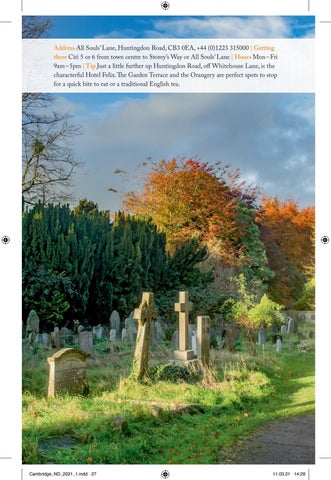
The Ascension Burial Ground on Huntingdon Road was originally Cambridge’s country churchyard, opened when the cemeteries in town began to run out of room. The poet Thomas Gray imagined country churchyards housing ‘some mute inglorious Milton’ but there is nothing inglorious about the clamorous reputations of those buried here. The graves contain the remains of some of the greatest intellectuals of the 19th and 20th centuries. It is easy to miss the entrance to the cemetery, which lies at the end of a surprisingly long track. This leads to a deconsecrated chapel used by the letter cutter Eric Marland as a studio. The cemetery opens out from this point. It is a modest and strangely neglected place compared with the great cemeteries of Highgate in London and Père Lachaise in Paris, although it can boast almost as many world-famous scientists, astronomers, historians, writers and thinkers. The roll call of the great minds interred among the 1,500 graves is impressive. It includes 3 Nobel Prize winners, 8 members of the Order of Merit, 22 knights and 9 Masters or Principals of Cambridge colleges. A panel shows where some of their graves can be found. Scientific, academic and social revolutions can be traced through the names of those buried here. They include several members of the Darwin family, but the most-visited grave is that of Ludwig Wittgenstein – a plain, flat stone on which people sometimes leave strange and touching tributes, all of which Eric Marland collects and archives. It is odd to think that this philosopher and mathematician has become the Jim Morrison of the cemetery. The burial ground is now a City Wildlife Site within a conservation area, and it is managed carefully to maximise the diversity of the plant species found there and to maintain the graves themselves. 26
Cambridge_ND_2021_1.indd 26
11.03.21 14:28
Address All Souls’ Lane, Huntingdon Road, CB3 0EA, +44 (0)1223 315000 | Getting there Citi 5 or 6 from town centre to Storey’s Way or All Souls’ Lane | Hours Mon – Fri 9am – 5pm | Tip Just a little further up Huntingdon Road, off Whitehouse Lane, is the characterful Hotel Felix. The Garden Terrace and the Orangery are perfect spots to stop for a quick bite to eat or a traditional English tea.
Cambridge_ND_2021_1.indd 27
11.03.21 14:28
10__ The Beechwoods A walk on the wild side
To the south of Cambridge, towards the area where the boundaries of the Three Counties (Cambridgeshire, Suffolk and Essex) get a bit muddled, the ground rises to form the only natural hills on this side of the city. These are the Gog Magogs, chalk downs that reach a dizzying 246 feet – just enough to give a view over Cambridge and the surrounding countryside. Nobody really knows why such modest hills should have been named after a mythical giant – an ancient sense of irony, perhaps. Between the Gogs and the city are the Beechwoods, a stand of immensely tall beech trees that form a cathedral-like canopy over undulating paths through the wood. Stepping into this is like stepping back in time, despite the sounds of the nearby roads. Yet the Beechwoods, for all their height and stateliness, are not ancient woodlands. This hillside was farmed from the Middle Ages until the mid-19th century, when the first trees were planted. The gentle rhythm of their changing colours lasts for most of the year, from when the first leaves appear in the spring until the late autumn. The Beechwoods are a nature reserve. Dogs are welcome if kept on a lead, and there is a bike rack just inside the gate for those who cycle out of town. Circular walks take you through the older trees and round an area of newer, mixed planting. Annual pilgrimages are made by nature lovers to see the helleborine orchids that appear in the early spring. The more energetic might like to continue past the Beechwoods to the start of the Roman Road that runs for several miles to the outskirts of Haverhill, eventually joining the Icknield Way. If you are not feeling quite so adventurous, you can walk or cycle a little further along the Babraham Road to the country park at Wandlebury, the site of an Iron Age hill fort that has miles of walks, lovely picnic spots and family activities all year round. 28
Cambridge_ND_2021_1.indd 28
11.03.21 14:28
Address Wort’s Causeway, CB22 3BF | Getting there Stagecoach bus 13 or 13A; bicycle. There is a lay-by directly opposite the entrance to the woods if you come by car | Hours Unrestricted | Tip The award-winning Gog Magog Farm Shop on the Babraham Road has a butcher, a fresh produce shop and a delicatessen selling delicious cheeses and artisan bread, among other things. The café is open for coffee, cake and lunch, including the ever-popular Scotch eggs.
Cambridge_ND_2021_1.indd 29
11.03.21 14:28
2
Histon R
d
Chesterton
on
nt
50
in
gd
on
77
3
Rd
Victor ia
Rd
Rd
d
nR erto
hest
C
102
88
5
74
am
Madin
Rd
Ne
78
ol
Rd
dha ms La
ne
23
Ea
st
Rd
17
t ke ar
m
w
1 C
Grange Rd
ay eth W
gley
Elizab
rC
e Riv
Cambridge
6
d
73
Mi
ll R
39
29 The Fe
82
d
16 33
Romsey
Petersfield
n Caus
eway
55
53
52
42c
14
m
ds Ave
Brooklan
93
28
d
67a
ls R Hil
r Ca
Rive
70
69a
n‘s R
Sidgwick Ave
Quee
West Rd
ge Rd
13 91 108
Colerid
Hu
lt Mi
Trum pingt on R d
20
0
89
0.15 mi
Cambridge_ND_2021_1.indd 233
11.03.21 14:31
85 Victor ia
3
105
Ch
Ca
er
Riv
43
m
Ca
eS
stl
22
94 58
Rd
ton
er est
t
Jesus Green
76 59
103
84
72 41b
109
66 Victoria Ave
95 101 dg
Bri
26
107
t
eS
41a
2
32
CAMBRIDGE
ney St
65 Market
85
t ng S
i own
D
96
e
8 Parker‘s Piece
92
n‘s R
40
d
82
68
Reg ent
47 49
our
is C
n Ten
79
nS
t Rd
to ing mp Tru
35
St
48
sid
t
75 71
Par k
38
‘s S
104
110
100
44
ew
Quee
54
30
ndr
King‘s Parad e
98
97 90 Silver St
63
64 The
45 90 36 31 99
111
Christ‘s Pieces
St A
11 21
60
24
St
15
King St Hobson
Sid
106
Midsummer Common
3 Jesus Lane
86 18
71
n Rd
erto
st Che
Rd
t
81 87
The Fe
n Caus
eway
51 0
Cambridge_ND_2021_1.indd 234
0.1 mi
11.03.21 14:31