2
www.bbj.hu
Budapest Business Journal | March 24 – April 10, 2023
Business
Push to Expand Battery Production Stirs Grass Roots Opposition Should the foreign automakers in Hungary today move their factories to other countries in the future, the outlook for the cities hosting the plants would be bleak indeed, Hungarian Prime Minister Viktor Orbán told the Hungarian Chamber of Commerce and Industry on March 9 in Budapest. KESTER EDDY
“In Hungary, around 300,000 families are dependent for their incomes on factories linked to the automotive industry,” he said, hence retaining these car plants is paramount. With the EU mandating an end to the production of cars powered by the internal combustion engine from 2035, the global automotive industry is moving towards battery-powered vehicles. So, to ensure the automakers remain in the country, the government must do everything necessary to woo battery manufacturers into Hungary to provide a ready supply of these vital components, the PM argued. Aside from the fact that, given the excellent transport links in the region, the automakers could be supplied from neighboring states without the need to move elsewhere, the argument has merit. Hungary is therefore forging ahead with battery (and associated components) production. By 2021, the country could
produce
28 GWh
per annum, making it the third-largest producer globally, behind only the United States and China. (Some claims put Poland ahead of Hungary.) This is being expanded further, most notably with the planned Chineseowned CATL plant in Debrecen (capacity 100 GWh per annum), with the country’s ultimate aim to have a total battery capacity of 250 GWh by 2030. But as this next round of investments is underway, criticism is beginning to mount
Retaining Workers
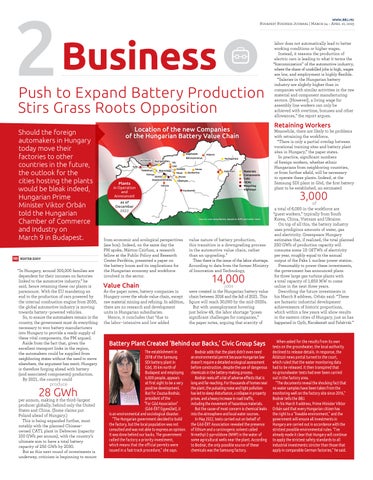
Location of the new Companies of the Hungarian Battery Value Chain Salgótarján Komárom
Nyergesújfalu
Tatabánya
Biatorbágy
Győr Környe
Plants in Operation and Announced
Sóskút Szigetszentmiklós
Miskolc
Bátonyterenye
Nyíregyháza
Heves Jászberény
Debrecen
Vác Göd Gödöllő Pécel Monor Újhartyán
Iváncsa Kecskemét
Materials Components Cells OEMs Recycling Highways
as of December 2022 Source: own compilation, based on HIPA and other news
from economic and ecological perspectives (see box). Indeed, on the same day the PM spoke, Márton Czirfusz, a research fellow at the Public Policy and Research Center Periféria, presented a paper on the battery boom and its implications for the Hungarian economy and workforce involved in the sector.
Value Chain
As the paper notes, battery companies in Hungary cover the whole value chain, except raw material mining and refining. In addition, there are no research and development units in Hungarian subsidiaries. Hence, it concludes that “due to the labor-intensive and low added
value nature of battery production, this transition is a downgrading process in the automotive value chain, rather than an upgrading.” Then there is the issue of the labor shortage. According to data from the former Ministry of Innovation and Technology,
14,000 jobs
were created in the Hungarian battery value chain between 2016 and the fall of 2021. This figure will reach 30,000 by the mid-2020s. But with unemployment hovering just below 4%, the labor shortage “poses significant challenges for companies,” the paper notes, arguing that scarcity of
Battery Plant Created ‘Behind our Backs,’ Civic Group Says The establishment in 2018 of the Samsung SDI battery plant in Göd, 30 km north of Budapest and employing 6,000 people, appears at first sight to be a very positive development. But for Zsuzsa Bodnár, Zsuzsa president of the Bodnár. “For Göd Association” (Göd-ÉRT Egyesület), it is an environmental and sociological disaster. “The Hungarian government decided to build the factory, but the local population was not consulted and was not able to express an opinion. It was done behind our backs. The government called the factory a priority investment, which means that the official permits were issued in a fast-track procedure,” she says.
labor does not automatically lead to better working conditions or higher wages. Instead, it reasons the production of electric cars is leading to what it terms the “foxconnization” of the automotive industry, where the share of unskilled jobs is high, wages are low, and employment is highly flexible. “Salaries in the Hungarian battery industry are slightly higher than in companies with similar activities in the raw material and component manufacturing sectors. [However], a living wage for assembly line workers can only be achieved with overtime, bonuses and other allowances,” the report argues.
Bodnár adds that the plant didn’t even need an environmental permit because Hungarian law doesn’t require a detailed ecological assessment before construction, despite the use of dangerous chemicals in the battery-making process. Bodnár reels off a list of adverse effects that is long and far-reaching. For thousands of homes near the plant, the pulsating noise and light pollution has led to sleep disturbance, a collapse in property prices, and a heavy increase in road traffic, including the movement of hazardous materials. But the cause of most concern is chemical leaks into the atmosphere and local water sources. In May 2022, tests carried out on behalf of the Göd-ÉRT Association revealed the presence of lithium and a carcinogenic solvent called N-methyl-2-pyrrolidone (NMP) in the water of some agricultural wells near the plant. According to Bodnár, the only possible source of these chemicals was the Samsung factory.
Meanwhile, there are likely to be problems with retraining the workforce. “There is only a partial overlap between vocational training sites and battery plant sites in Hungary,” the paper states. In practice, significant numbers of foreign workers, whether ethnic Hungarians from neighboring countries, or from further afield, will be necessary to operate these plants. Indeed, at the Samsung SDI plant in Göd, the first battery plant to be established, an estimated
3,000 of
a total of 6,000 in the workforce are “guest workers,” typically from South Korea, China, Vietnam and Ukraine. On top of all this, the battery industry uses prodigious amounts of water, gas and electricity. Greenpeace Hungary estimates that, if realized, the total planned 250 GWh of production capacity will consume some 15-16TWh of electricity per year, roughly equal to the annual output of the Paks 1 nuclear power station. Presumably to power these investments, the government has announced plans for three large gas turbine plants with a total capacity of 1,650 MW to come online in the next three years. Describing the future investments in his March 9 address, Orbán said: “These are fantastic industrial development achievements of historic proportions, which within a few years will show results in the eastern cities of Hungary, just as has happened in Győr, Kecskemét and Fehérvár.”
When asked for the results from its own tests on the groundwater, the local authority declined to release details. In response, the Átlátszó news portal turned to the court, which ruled that the water monitoring data had to be released. It then transpired that no groundwater tests had ever been carried out in the factory area. “The documents reveal the shocking fact that no water samples have been taken from the monitoring well on the factory site since 2016,” Bodnár tells the BBJ. In his March 9 address, Prime Minister Viktor Orbán said that every Hungarian citizen has the right to a “liveable environment,” and the government will ensure all investments in Hungary are carried out in accordance with the strictest possible environmental rules. “I’ve already made it clear that Hungary will continue to apply the strictest safety standards to all industrial investments: stricter than those that apply in comparable German factories,” he said.