
No.76. MARCH 2026
by
No.76. MARCH 2026
by

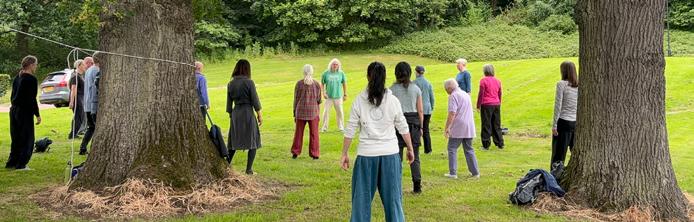
After a particularly wet start to the year, it is a relief to see Spring returning. Many of our members who teach on beaches, in parks, and other open spaces will soon be moving back outdoors to make the most of the longer days and brighter weather.
Alongside daffodils and birdsong, this Spring brings something else new. UNESCO has formally recognised March 21, the Spring Equinox, as the International Day of Tai Chi Chuan. Members of the board had a meeting with the UK National Commission for UNESCO and it was agreed that we will offer support to instructors through templates for promotional materials, boilerplate for press releases, and of course, our events page and social reach to help promote the day.
Earlier this year we moved to a new Lloyds account as part of improving our financial administration. Thank you to the many members who have already updated their standing orders and payment details. The transition has gone smoothly and we are grateful for your cooperation. If you are unsure which details to use, please check before your next renewal date. The previous TSB account is no longer in use.
Work on the new members area is now in its final testing phase. The core features are in place and we will soon begin a gradual rollout.
We have also created new landing pages that will give members a clear overview of benefits. In addition, the next phase is already underway and will simplify how members add their own events to the website.
Following a successful pilot phase, we are now preparing to launch the HSQE professional development courses to the wider membership. Alongside this, as a part of our strategy to increase instructor members, our Technical Panel has started recording a series of short guidance videos. These focus on internal arts principles and clarify what the Panel looks for in a strong application. The videos will be published on a new YouTube channel and embedded on the website to make them easy to access.
We have begun publishing supplementary content to the website to broaden what members and the wider public can access online. So far, this has included selected articles from the magazine archive, making important material from earlier years available to a new audience.
We have also just completed the release of our first long form series. Journey through the Jins was published in eleven instalments exploring the theory and application of jins in the internal arts. The series has proved popular and generated significant online interest that helped
introduce new readers to the Union and reinforces our position as an authoritative voice in the internal arts community.
The digitisation of our magazine archive is now underway. We hold almost a complete record of printed issues, representing decades of teaching, research, interviews and reflection. Our aim is to make all back issues available digitally free as part of your membership. This will allow newer members to access articles that have only been available in print and ensure that knowledge shared over the years remains accessible to future generations.
A number of members have asked whether we would consider alternatives to the annual renewal T-shirt. While current shirts remain popular, we recognise that people might welcome different options. We are therefore looking into expanding merchandise to include tote bags, water bottles or other options. No decisions have been made, but we are evaluating what would be attractive to members.
If you would like to help with any of the work above, whether by running a March 21 event, testing the new members area or contributing to the website or magazine, please email enquiries@taichiunion.com. Thank you for your continued support.
with a focus on calm practice and building a connected structure, the Second Road with a focus on testing that structure while adding jumps, stomps and explosive movements.
The First Road cultivates the foundational qualities we all know from Taijiquan: stable structure, continuous movement, and sustained connection. Building a unified whole-body force (整体合劲) could sum up this kind of training. My shifu (teacher) Chen Yu says: "Generally speaking, the First Road has more softness and less firmness, … The entire routine is strictly organised, with grand momentum and clear rhythm: still like a maiden, issuing like a sudden thunderclap. Repeated folding resembles rolling waves, agile and without stagnation.” (Chen Yu, 2011, p12). This stresses the
foundational training aspects of the routine.
As to the Cannon Fist, he says: "The method of the Second Road corresponds to the softness of the First Road but has more firmness and less softness. Sixty percent firm and forty percent soft, it takes simulated combat as its primary training method, emphasising combat engagement.”
Thus, the Second Road shifts the training conditions. Movements are typically practised more dynamically, with sharper transitions and explicit issuing of force. Force should be sent out cold (冷) and crisp (脆), shocking (惊) and vibrating (抖). This frame can be characterised as one of continued cultivation and verification: what is developed in the First Road is tested and expressed in the Second.
Of course, the art is not defined primarily by tempo. Whether movement is practised slowly or dynamically, this is actually secondary to a more fundamental concern: the embodiment and expression of specific qualities. Building a rooted and strong structure, well connected, with clear movements and directions plus cultivating an embodied spirit (shen) are not abstract ideals but physical realities that must become visible.
Different lineages and teachers emphasise these qualities in different ways, but usually with some shared contents. Taijiquan is not something to be understood intellectually first and embodied later; it must be expressed through the body.
From this perspective, the central question of practice is not whether movement is slow or fast, but whether essential qualities are present and coherent. Thus, the Second Road is not a contradiction to the First Road more commonly seen, but an extension of the same training regimen.
This emphasis on embodiment of Taiji qualities is especially clear in the teaching approach of Chen Zhaokui. He consistently stressed that form
practice must demonstrate clear force pathways, precise directionality, and functional structure. Movement was expected to do something, whether in solo or partner practice, rather than serve as a symbolic or decorative sequence. He summed up 14 qualities which are inherent in all Taijiquan styles:
Chen Zhaokui)
1. 心静身正 以意运动
A calm heart-mind and the body upright, movement is guided by intention.
2. 动作和顺 轻灵圆活
The movements are harmonious and compliant – light, agile, rounded, and lively.
3. 开合虚实 呼吸自然
Opening and closing, empty and full – breathing remains natural.
4. 虚领顶劲 气沉丹田
Empty neck and force (jin) up to the crown; qi sinks to the dantian.
5. 尾闾中正 不偏不倚
The coccyx is centered and upright, neither leaning nor inclining to the side.
6. 含胸拔背 沉肩垂肘
Contain the chest and lengthen the back; sink the shoulders and let the elbows hang downward.
7. 劲起脚跟 主宰于腰
Force (jin) arises from the heels and is governed by the waist (yao).
8. 通于脊背 形于手指
Passing through the spine; taking shape in the hands and fingers.
9. 上下相通 内外相合
Upper and lower interlinked; internal and external unite.
10. 一动俱动 一静俱静
When one part moves, all move; when one part is still, all are still.
11. 节节贯穿 周身一家
Joint by joint interconnected; the whole body forms one unified entity.
12. 相连不断 一气呵成
Mutually linked without interruption; completed in one continuous breath.
13. 蓄发相变 柔刚相济
Storing and issuing transform into one another; softness and hardness complement each other.
14. 刚柔俱泯 一片神行
Hardness and softness both dissolve; a unifed spirit acts.
Chen Zhaokui, June 10, 1961