00_FALSE COVER_KUMHO.indd 1
7/27/2021 3:50:49 PM
00_FALSE COVER_KUMHO.indd 2
7/27/2021 11:13:48 AM
CUV TIRES A NEW SEGMENT MAY BE EMERGING SERVICE EQUIPMENT REPAIR OR REPLACE? WHAT IS YOUR P&L TRYING TO TELL YOU? HOW TO GUARD AGAINST RANSOMWARE ATTACKS
WHEN WILL THE
SHIPPING CRISIS END?
August 2021 | Vol. 102, No. 8 | $10 | www.moderntiredealer.com
00_MTD_Cover.indd 1
7/30/21 10:07 AM
A TIRE FOR EVERY RIDE CUV/SUV GRAND TOURING ALL SEASON
A touring tire that delivers a long tread life, all-season traction and a comfortable ride. Reduced Noise and Increased Comfort
70K
MILEAGE WARRANTY
Upgraded Traction in Light Snow
Cut Fuel Costs and Emissions
3/32"
2-YEAR ROAD HAZARD
36 MO. ROADSIDE ASSISTANCE
45-DAY FREE TRIAL
MUD TERRAIN
This mud-terrain tire offers extreme versatility with an optional sidewall design for a customized and elevated appearance.
DUAL SIDEWALLS - All Roadian MTX tires come with two unique sidewall designs!
36 MO. ROADSIDE ASSISTANCE
45-DAY FREE TRIAL
ULTRA HIGH PERFORMANCE ALL SEASON
A performance, all-season tire, designed for the discretionary driver of luxury and performance coupes and sedans. Improved Braking Performance
Superior Wet Performance
50K
MILEAGE WARRANTY
3/32"
2-YEAR ROAD HAZARD
36 MO. ROADSIDE ASSISTANCE
3D NANO Grip Technology
45-DAY FREE TRIAL
NexenTireUSA.com | FOLLOW US @NexenTireUSA
_2CV_NEXEN_0821.indd 2
7/26/2021 1:55:11 PM
The Industry’s Leading Publication August 2021, Volume 102, Number 8
F E AT U R E S 20 50 Wonderland Tire Co. recently acquired Sumerel Tire Service Inc. and has big plans for its AcuTread network. Find out more on page 50.
DEPARTMENTS 4
Editorial ‘It was the right thing to do’ How a wage hike changed McMahon’s Best-One Tire for the better
6 moderntiredealer.com
Future is uncertain, says expert — but dealers still have options
26 27
Screen test
28
Is a new segment of CUV tires emerging?
36
16 Numbers That Count
Summer cool-down What’s slowing retail sell-out?
42
57 DSP Insight
The benefits of a Monday through Friday week Has COVID-19 changed customer behavior?
61 Business Insight You, your accountant and your P&L Get your statement as soon as possible
Commercial Tire Dealer™
47
‘A quiet giant’
50
It’s a Wonderland world — and it’s getting bigger
66 Ad index
ON THE COVER: UNSPLASH
Modern Tire Dealer is a proud member of:
ST tires are a part of Moore’s Tire Sales’ success
Company plans to expand AcuTread network
62 TPMS Ford-Lincoln MKT-2011-21
Simple, streamlined and straightforward What’s new in hand-held sensors
Are you listening to your P&L? How to use this statement to uncover hidden opportunities
59 Mergers and Acquisitions
Service equipment: repair or replace?
Consider safety, efficiency and productivity when deciding, say experts
Relevant statistics from an industry in constant motion
18 Your Marketplace
More dealers go digital with in-store displays
Off-roading CUVs are pushing boundaries. Here’s what you need to know
Industry News Les Schwab buys Plains Tire Fifth biggest dealership in U.S. looks for growth via buy-outs
Are you prepared for a ransomware attack? The best defense is a good offense
News and navigation tools for MTD’s website
8
When will the shipping crisis end?
52
From highs to lows
54
Steep slope ag tire adjustments
Tougher fuel standards push tiremakers to cut rolling resistance even more
How to optimize performance in hillside operations
w w w . M o d e r n T i r e D e a l e r. c o m
01_MTD_Contents-Masthead.indd 3
3
8/4/21 8:30 AM
Editorial
‘It was the right thing to do’ HOW A WAGE HIKE CHANGED MCMAHON’S BEST-ONE TIRE FOR THE BETTER By
Mike Manges
R
emember the intense debate earlier this year over the proposal to hike the federal, hourly minimum wage from $7.25 to $15? McMahon’s Best-One Tire, an eight-store independent tire dealership based in Fort Wayne, Ind., didn’t wait for a ruling or mandate to take a position. While arguments for and against increasing the minimum wage flew back and forth in Washington D.C., the company raised its minimum hourly rate to $15 on March 1. Nearly six months later, Kim McMahon, one of the company’s three owners, says it was one of the best decisions they ever made. “It was the right thing to do and it also made a statement, which was an important thing for me,” she recently told me. Kim and her partners, Bubba McMahon and Randy Geyer, had heard all the arguments against making such a move: “It will lead to job losses.” “It will hurt your profitability.” “It will make running your business even harder.” One acquaintance — another tire dealer — even called Kim “crazy. What are you doing?” he asked. But the three pressed ahead — for several reasons. One, says Kim, is that a wage hike would demonstrate that the dealership’s employees are more than just numbers on a spreadsheet. McMahon’s Best-One Tire employs 120 people. Most were making more than $15 an hour prior to March 1. But tire technicians and delivery drivers were earning less. They were “thrilled” to receive the bump in pay, says Kim. “But the more important part was the explanation we gave. There are no unimportant jobs and that’s what we wanted our people to feel. We wanted them to understand that every job here is important and every employee is important.” Kim and her partners also believed the wage hike would make McMahon’s Best-One Tire a more attractive option for job seekers. That, too, has proven to be true, she says. Other businesses in the dealership’s markets are struggling to recruit workers. But people are lining up to work at McMahon’s Best-One Tire, she reports. “We have people coming to us, whereas other businesses can’t find people. I think people are looking at us in a different way. It’s not, ‘This is a low-paying job. I can do better.’ They’re looking at us as a quality employer that’s looking out for its employees and its community.” An elevated minimum wage also gives McMahon’s Best-One Tire the ability to pull in applicants from outside the tire and automotive sector. “We’re not just competing with other tire dealers.” A realist, Kim knows that throwing money at a problem doesn’t always solve it. “But compensation is very important when attracting new employees — getting people to come in for interviews and
4
01_MTD_Contents-Masthead.indd 4
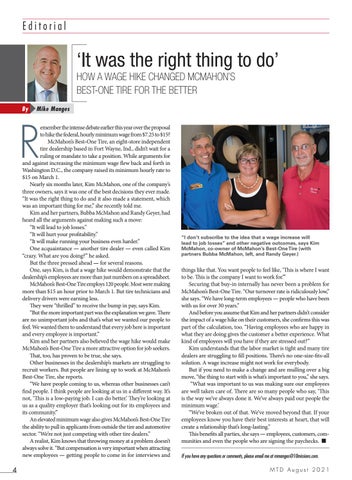
“I don’t subscribe to the idea that a wage increase will lead to job losses” and other negative outcomes, says Kim McMahon, co-owner of McMahon’s Best-One Tire (with partners Bubba McMahon, left, and Randy Geyer.)
things like that. You want people to feel like, ‘This is where I want to be. This is the company I want to work for.’” Securing that buy-in internally has never been a problem for McMahon’s Best-One Tire. “Our turnover rate is ridiculously low,” she says. “We have long-term employees — people who have been with us for over 30 years.” And before you assume that Kim and her partners didn’t consider the impact of a wage hike on their customers, she confirms this was part of the calculation, too. “Having employees who are happy in what they are doing gives the customer a better experience. What kind of employees will you have if they are stressed out?” Kim understands that the labor market is tight and many tire dealers are struggling to fill positions. There’s no one-size-fits-all solution. A wage increase might not work for everybody. But if you need to make a change and are mulling over a big move, “the thing to start with is what’s important to you,” she says. “What was important to us was making sure our employees are well taken care of. There are so many people who say, ‘This is the way we’ve always done it. We’ve always paid our people the minimum wage.’ “We’ve broken out of that. We’ve moved beyond that. If your employees know you have their best interests at heart, that will create a relationship that’s long-lasting.” This benefits all parties, she says — employees, customers, communities and even the people who are signing the paychecks. ■ If you have any questions or comments, please email me at mmanges@10missions.com.
MTD August 2021
8/2/21 10:55 AM
**BINDING EDGE**BINDING EDGE**BINDING EDGE**BINDING EDGE**BINDING EDGE**BINDING EDGE**BINDING EDGE**BINDING EDGE**BINDING EDGE**BINDING EDGE**BINDING EDGE**BINDING EDGE**
800.723.2553 | FALKEN | CUV SPIFF AD | MODERN TIRE DEALER | *Full Page Ad* | 7-1 | 7.875”W x 10.75”H
7/26/2021 1:49:13 PM
05_FALKEN TIRE_0821.indd 5
ModernTireDealer.com DIGITAL RESOURCES FOR THE INDEPENDENT TIRE DEALER
MTD website keeps you informed MTD’s website provides you with breaking news, feature articles, links to exclusive MTD research and blogs, new products and much more 24/7. Check it out today!
MTD digital edition
eNewsletters Sign up now for Modern Tire Dealer eNewsletters. We’ll send you the latest news and most popular articles. Go to: www.moderntiredealer.com and scroll to The Modern Tire Dealer Newsletter is the Definitive Source for Tire Dealer Success.
Hit Digital Edition at the bottom of our www.moderntiredealer.com homepage.
Like MTD on Facebook:
www.facebook.com/ModernTireDealer
Follow MTD on Twitter:
www.twitter.com/MTDMagazine @MTDMagazine
Tiers, tariffs, shipping and price hikes dominate the news
HOME OFFICE 3515 Massillon Rd., Suite 350 Uniontown, OH 44685 (330) 899-2200, fax (330) 899-2209 Website: www.moderntiredealer.com PUBLISHER Greg Smith, ext. 2212 gsmith@10missions.com EDITORIAL Editor: Mike Manges, ext. 2213 mmanges@10missions.com Managing Editor: Ron Ledgard, ext. 2216 rledgard@10missions.com Senior Editor & Digital Projects Editor: Joy Kopcha, ext. 2215 jkopcha@10missions.com PRODUCTION Art Director: Zach Pate Graphic Designer: Olivia Curti Production Artist: Lauren Coleman Production Manager: Karen Runion, ext. 2210 krunion@10missions.com SALES Publisher: Greg Smith gsmith@10missions.com (330) 899-2200, ext. 2212 Midwest: Bob Marinez bmarinez@10missions.com (330) 899-2200, ext. 2217 West Coast: Marianne Dyal mdyal@10missions.com (706) 344-1388 Automotive Aftermarket: Dan Thornton dthornton@10missions.com (734) 676-9135, mobile (734) 626-4950 Sean Thornton sthornton@10missions.com (269) 499-0257 MTD READER ADVISORY BOARD Rick Benton, Black’s Tire Service Inc. Jessica Palanjian Rankin, Grand Prix Performance John McCarthy Jr., McCarthy Tire Service Co. Inc. Jamie Ward, Tire Discounters Inc.
The economy is picking up as the pandemic lifts and you can see that reflected in some of the most popular stories on MTD’s website. Tariffs, shipping delays and price increases are all having a big effect on the U.S. tire market. And all three hitting the domestic industry at once is creating an especially chaotic situation in the lower tiers.
CUSTOMER/SUBSCRIPTION SERVICE (800) 260-0562 subscriptions@moderntiredealer.com
1. 2. 3. 4. 5. 6. 7. 8. 9. 10.
EXECUTIVE OFFICE 10 Missions Media 571 Snelling Ave. N. St. Paul, MN 55104 (651) 224-6207
‘Tier-four is in total chaos’ ITC rules some, but not all, tariffs will stick Industry braces for tariffs while a new ‘contender’ quietly emerges Tire Discounters details franchise and acquisition program Podcast: Goodyear-Cooper: What’s next? Analyst Healy weighs in Tire registration fines could devastate your business Some tariff relief possible for Chinese truck tires ATD to hike flat-rate shipping fees Les Schwab will acquire Plains Tire in Wyoming Sailun is developing electric vehicle-specific line
CORPORATE OFFICERS President: Jay DeWitt Vice President: Chris Messer Vice President, Content & Events: Bryce Evans
Modern Tire Dealer (ISSN: 0026-8496) is published monthly by 10 Missions Media, LLC, 571 Snelling Ave N, St. Paul, MN 55104-1804. Copyright © 2021 by 10 Missions Media, LLC. All rights reserved. Modern Tire Dealer content may not be photocopied, reproduced, or redistributed without the consent of the publisher. Periodicals postage paid at St Paul, MN and additional mailing offices. POSTMASTERS Send address changes to: Modern Tire Dealer, 571 Snelling Ave N, St. Paul, MN 55104.
6
01_MTD_Contents-Masthead.indd 6
MTD August 2021
8/2/21 10:55 AM
07_LINGLONG_0821.indd 7
7/26/2021 1:52:00 PM
Industry News
Les Schwab buys Plains Tire
FIFTH BIGGEST DEALERSHIP IN U.S. LOOKS FOR GROWTH VIA BUY-OUTS
L
es Schwab Tire Centers Inc.’s acquisition of Plains Tire Inc., a nine-store chain with locations throughout Wyoming, signals an emphasis on growth through acquisition for the Bend, Ore.based dealership. The deal, announced in mid-July, is scheduled to close this month and expands Les Schwab’s presence in Wyoming to 10 locations. (Les Schwab opened its first store in the state during 2019.) Terms have not been disclosed. The Plains Tire locations were owned by Larry Nicholls and were part of his Logan, Utah-based Associated Tire Stores Inc. group, which also includes Bargain Tire and Discount Tire and Automotive, both of which will remain under the ownership of the Nicholls family. Nicholls says that being part of Les Schwab “will create even more opportunity for our people and I know our employees, customers and communities will be well cared for. “I don’t believe I could have found a better partner than Les Schwab to sell our family’s company to and I’m excited to watch these stores grow and flourish.” The Plains Tire acquisition “puts us as far east as some of our Montana and Colorado stores,” says Dale Thompson, Les Schwab’s chief marketing officer. “It kind of fills in that eastern front.” In addition to Wyoming, Montana and Colorado, Les Schwab operates stores in its native Oregon, as well as Washington, Idaho, California, Nevada, Utah and Alaska. Plains Tire has outlets in Laramie, Rock Springs, Gillette, Evanston, Casper, Sheridan, Riverton and Green River, Wyo.
‘AN ESTABLISHED PLAYER’
Thompson says Les Schwab will continue to open new stores, but also will pursue acquisition opportunities.
8
02_MTD_News-Numbers.indd 8
“We’ve been doing a lot more organic greenfield growth in the last 10 to 15 years,” says Dale Thompson, chief marketing officer, Les Schwab Tire Centers Inc.
He notes that the company has acquired Les Schwab member-dealer stores over the years. (The company has nearly 55 member-dealer locations.) “But we’ve been doing a lot more organic greenfield growth in the last 10 to 15 years.” Schwab itself was acquired by Meritage Group LP, a California-based investment company, in September 2020. “We’ve always looked for growth opportunities and historically have been more greenfield. Why not (do) more acquisitions, as well as greenfields? And that’s what we’re doing. We’re looking at both avenues right now.” There are several advantages to entering a new market by acquiring an existing dealership, according to Thompson. “When we looked at Wyoming, we had one store there. Now we have 10, so speed is an advantage. I also think when you look at our (recent entry into) the community, it makes things difficult when it comes to zoning.” With Plains Tire, “we have an established player in the marketplace. And I think also an established reputation versus starting from scratch and brand building … that would be one of the bigger advantages.”
A decision has not been made regarding Plains Tire’s branding. “We’re going to run them as they are and look for how to best integrate the two (dealerships’) systems and that’s our plan,” says Thompson. The companies share the same philosophy when it comes to customer service, employee relations and community engagement, he adds. “That kind of alignment with our strategy creates a very good fit and what we think is a tremendous opportunity.” When asked about future acquisitions, Thompson declined to comment on specifics, but mentioned that Les Schwab is “looking for well-run, highly respected companies that align with our strategy: a strong brand, well-respected within the community — those are the things we think align well with us.” The Plains Tire acquisition gives Les Schwab 453 company-owned outlets, making it the fifth largest independent tire dealership in the U.S., according to the 2021 MTD 100, which was published in the July issue of MTD. Les Schwab, who was MTD’s Tire Dealer of the Year Award winner in 2000, founded the company in 1952. — Mike Manges MTD August 2021
8/2/21 10:56 AM
Consumer Promotion
July 1 - August 31, 2021
GET UP TO A
Rebate Form must be submitted online or by mail, postmarked by 9/30/21.
$100
VISA PREPAID CARD ®
*
with the purchase of 4 qualifying light truck/SUV Continental Tires**
TerrainContact™ H/T
$100
TerrainContact™ A/T
VISA PREPAID OR CARD
with a purchase of a set of 4 TerrainContact™ A/T tires*
QUALIFYING $70 TIRES
4x4Contact™ 4x4SportContact™ CrossContact™ LX
GET A
GET A
CrossContact™ LX 25
VikingContact™ 7
$70
VISA PREPAID CARD
with a purchase of a set of 4 qualifying light truck/SUV Continental Tires* CrossContact™ LX Sport CrossContact™ LX20 CrossContact™ LX25
CrossContact™ UHP SureContact™ LX TerrainContact™ H/T
VancoFourSeason™ VanContact™ A/S VikingContact™ 7
RESTRICTIONS AND LIMITATIONS APPLY, VISIT CONTINENTALTIRE.COM/OFFERS FOR COMPLETE DETAILS.
**
*The Continental Tire Visa Prepaid Card is issued by MetaBank®, N.A., Member FDIC, pursuant to a license from Visa U.S.A. Inc. No cash access or recurring payments. Can be used everywhere Visa debit cards are accepted. Card valid for up to 6 months; unused funds will forfeit after the valid thru date. Card terms and conditions apply.
09_CONTINENTAL TIRE_0821.indd 9
7/26/2021 1:51:27 PM
Industry News
Bites Kumho wins Nissan fitment Kumho Tire USA Inc.’s Crugen HP71 will be original equipment on the 2021 Nissan Pathfinder in size 255/60R18. The tire is produced in Kumho’s Macon, Ga. plant.
Nexen says ‘We Got You’ Nexen Tire Corp. has revealed the company’s new corporate slogan, “We Got You,” a message that Nexen officials say is a pledge “to enhance customer satisfaction in mobility and beyond tire manufacturing.” Volkswagen recently selected the Nexen N’Fera Sport to be original equipment on the newest version of the Golf.
Sailun develops EV tire Sailun Tire Group is developing the ERANGE EV, a new tire line that is specifically engineered for electric vehicle applications. Sailun says the line will launch “with a wide range of sizes to cover nearly 90% of electric vehicles being sold today.”
Pirelli touts online sales Pirelli Tire North America Inc. CEO Pietro Berardi says dealers will notice an increase in business thanks to the tire company’s “click-to-buy” platform introduced earlier this year. Berardi says the platform is part of the company’s digital transformation.
Fountain Tire celebrates 65 Fountain Tire Ltd. is marking 65 years in business with a pair of programs, one for its external customers and another for its 2,500-plus associates across its 160-store network.
Sun Auto Tire expands Sun Auto Tire & Service Inc. has expanded its Sun Auto Service brand into the San Antonio, Texas, market with the addition of four locations. The company, previously known as GB Auto Service, also has stores in Houston, Austin and the Dallas/Fort Worth area.
Yokohama promotes execs Yokohama Tire Corp. has promoted Stan Chandgie to executive vice president of sales and support and Heather Adelman to vice president of consumer replacement sales. Chandgie most recently served as vice president of consumer sales. Adelman most recently served as director of strategic accounts in consumer sales.
10
02_MTD_News-Numbers.indd 10
Tire Discounters details franchise and acquisition program
T
ire Discounters Inc. has formalized its franchise and acquisition program options. The nation’s eighth-largest independent tire dealer is calling its program “Protect Your Legacy.” The company revealed its plan to start a franchise program to MTD in September 2020 and on June 25 made it official with an event at its new headquarters in Cincinnati, Ohio. Jamie Ward, CEO and president of Tire Discounters, said, “We believe we have several compelling options for tire and auto business owners to consider as they look to protect “We look forward to welcoming their legacies into the future.” other businesses to the Tire DisWard noted that the program focuses on counters family,” says Jamie Ward, helping family-owned businesses protect the dealership’s CEO and president. what they’ve worked hard to build by offering succession planning options. “We hear continually from owner-operators of momand-pop shops that they are struggling. It’s everything from supply costs, payroll (and) competitors to hiring and keeping good talent to IT expenses and security “They tell us they are handcuffed to the business and tired. They are unable to take vacations or take a much-needed break from the business. “Frankly, their succession options are limited,” he said. “That’s where we can come in and help them.” Tire Discounters’ “Protect Your Legacy” program offers three options to tire and automotive business owners: 1. Acquisition, in which a dealer sells both real estate and business to Tire Discounters. Owners can retire fully and know that their customers will be taken care of by another family-owned business, according to Ward; 2. Sell and lease, which allows dealers to sell their businesses to Tire Discounters while continuing to own their real estate. This is an opportunity for owners to continue to make money with monthly rental income, he added; 3. Franchise, which allows dealers to partner with Tire Discounters and tap into the company’s resources. This option gives franchisees access to resources from Tire Discounters, including cost-savings via the buying power of more than 140 stores, access to three distribution centers and the Tire Discounters name; access to Tire Discounters’ systems and processes, like training, operations and customer communication; marketing support; and more. “Tire Discounters will welcome family-owned businesses that are looking to maintain a family legacy, but are unable to make the financial commitment in today’s competitive market. We are hearing from companies who want us to continue to look after their customers in the way they do. That’s exactly the type of companies we’re after.” The dealership reports that two independent tire dealerships have joined its fold. Tire Discounters has become the operator of Porterfield Tire’s stores in Athens and Watkinsville, Ga., as well as the dealership’s warehouse and commercial tire outlet. The Porterfield family has maintained ownership of the stores’ properties and is leasing to Tire Discounters. Tire Discounters also has acquired Westgate Tire and Auto Service, which is based in Newport, Tenn. “Just like us, Westgate Tire has been family-owned and operated since the 1970’s,” said Ward. MTD August 2021
8/2/21 10:56 AM
A LONG WAY
TOGETHER
WHEREVER YOU ARE, BKT IS WITH YOU No matter how challenging your needs, BKT is with you offering a wide range of OTR tires specifically designed for the toughest operating conditions: from mining to construction sites. Sturdy and resistant, reliable and safe, able to combine comfort and high performance. BKT is with you, even when work gets tough.
VISIT US AT BKT USA Inc. 202 Montrose West Ave. Suite 240 Copley, Ohio 44321 Toll free: (+1) 888-660-0662 Office: (+1) 330-836-1090 Fax: (+1) 330-836-1091
Booth #4457 Central Hall
11_BKT TIRES_0821.indd 11
7/26/2021 1:50:34 PM
Industry News
Bites Bridgestone names CMO Philip Dobbs, the chief marketing officer for Bridgestone Americas Inc. for more than a decade, will retire in October. He’ll be replaced by Sara Correa, who joins the company to take over all marketing for the Bridgestone and Firestone brands, as well as Bridgestone’s sports platforms, corporate communications, research and training.
TIA resumes classes The Tire Industry Association is offering in-person Certified Instructor Automotive Tire Service classes in three cities this year. The first set of classes will take place Aug. 31-Sept. 3 in Baltimore, Md., followed by Nov. 16-19 in Los Angeles, Calif. Dates for sessions during December in Charlotte, N.C. will be determined.
NHTSA unveils recall tool The National Highway Traffic Safety Administration has unveiled a new, cloudbased vehicle recall dashboard that will be updated on a daily basis. The dashboard will hold more than 50 years of recall data.
Biden backs Right to Repair President Joe Biden has signed an executive order calling on the Federal Trade Commission (FTC) to institute rules to curb anti-competitive vehicle repair restrictions. The order encompasses 72 specific initiatives, including a requirement that the FTC begin rulemaking on auto repair and maintenance.
Three MTD 100 dealerships expand
T
hree dealerships on the 2021 MTD 100 have recently added locations. Cape Girardeau, Mo.-based Plaza Tire Service Inc. is closing in on 70 locations. The company’s newest store is in Bentonville, Ark., and has eight bays. The addition of the outlet makes Plaza Tire the 17th largest independent tire dealership in the U.S. Flynn’s Tire Group has opened its 30th Flynn’s Plaza Tire Service Inc.’s new Tire & Auto Service outlet, a five-bay store in the Bentonville, Ark., store gives the Akron, Ohio, suburb of Cuyahoga Falls. dealership nearly 70 locations. The store offers both tires and automotive services and fills a gap in the map for the Hermitage, Pa.-based company, which is the 36th largest tire dealership in the U.S., according to the 2021 MTD 100. A third VIP Tires & Service store has opened in Vermont, giving VIP Inc. 64 locations in New England. The Burlington, Vt., outlet opened on June 23 in a renovated, 8,670-square-foot facility that features eight service bays. VIP is the 19th largest tire dealership in the U.S., according to the 2021 MTD 100, which is featured in the July edition of MTD.
Bridgestone to open 27 more stores
B
ridgestone Retail Operations opened 28 stores throughout 16 states — including six in Texas and four in Florida — during the first half of 2021 and plans to open 27 more by the end of the year. The openings are part of the company’s “continued growth strategy,” according to Bridgestone officials. Bridgestone operates more than 2,200 companyowned stores throughout the United States under the Firestone Complete Auto Care, Tires Plus, Hibdon Tires Plus and Wheel Works brands.
GM invests more in EVs General Motors recently announced that it will invest $35 billion in the continued development of electric and autonomous vehicles, with the goal of becoming “the market leader in EVs in North America.” This ups its initially announced investment in EV development. The company is targeting EV sales of more than one million by 2025.
Lincoln to go all-electric Ford Motor Co. says its luxury Lincoln line will be fully electric by 2030 and the first all-electric Lincoln vehicle will make its debut next year. By mid-decade, Ford expects half of its global Lincoln brand volume to be zero-emissions vehicles.
12
02_MTD_News-Numbers.indd 12
T
This Firestone Complete Auto Care store in Casa Grande, Ariz., is one of nearly 30 that opened during the first half of 2021.
Some tariff relief possible for Chinese truck tires
ruck tire manufacturers based in China are poised to get some tariff relief as the United States Department of Commerce (DOC) conducts a regular review of countervailing duties that were imposed on Chinese-made truck tires in February 2019. These tariff investigations come in two phases: the preliminary phase and then the final phase. This is the preliminary phase, so there’s still a possibility tariff numbers could change in the coming months. But preliminary numbers indicate lower rates are a possibility. The DOC is using data from two exporters/producers as its guide: Prinx Chengshan (Shandong) Tire Co. Ltd (PCT) and Qingdao Ge Rui Da Rubber Co., Ltd. (GRT). Since February 2019, medium truck and bus tires from China have been subject to both anti-dumping and countervailing duties. The anti-dumping rates — set at 9% for 256 specifically named tiremakers and 22.57% for all others — remain unchanged. The current review applies only to countervailing duties, which are meant to off-set subsidies. The proposed rates all fall in the 16% to 17% range. When rates were originally set in 2019, they started at 20.98% and went as high as 63.34%. MTD August 2021
8/2/21 10:56 AM
ASSOCIATE DEALER
SMART PROGRAM
We provide marketing tools and incentives to help you reach more customers, push sales and…
Smart Program features: • Quarterly Cash Rewards • Dealer Trip • Smart Card
• Promotional Materials • Online Training • Point of Sale & Signage
• Dealer Locator Call your representative about the 2021 program enhancement!
WWW.GTRADIALSMARTPROGRAM.COM
13_GITI TIRE_0821.indd 13
7/26/2021 1:56:24 PM
Industry News
Bites Certegy goes virtual Certegy has unveiled its new Virtual Terminal platform, allowing both in-store and mobile merchants to process paper checks and ACH transactions. Virtual Terminal provides merchants with the option to use either a web browser or mobile device to serve as their point-of-sale.
Titan is helping farmers Titan International Inc. is supporting farmers during harvest season with its “Flags Over Harvest” campaign. Titan is giving away American flags to farmers to display on their equipment. For each flag requested, the tiremaker is donating $5 to Farm Rescue, a nonprofit that supports farmers who have suffered a major calamity or natural disaster.
Belle partners with school Belle Tire Distributors Inc. has unveiled a newly remodeled and equipped classroom at the Indianapolis, Ind., campus of automotive trade school Lincoln Tech. The dealership also presented three $1,000 scholarships to Lincoln Tech students.
CEOs will speak at AAPEX Top executives from Advance Auto Parts, AutoZone, O’Reilly Auto Parts and several other companies will speak during the keynote session at AAPEX 2021. The keynote will take place Nov. 2 at the Sands Expo and Caesars Forum Conference Center in Las Vegas, Nev.
Love’s adds locations Love’s Travel Stops has opened 10 new Speedco locations and one new Love’s Truck Care center. The Speedco outlets are in Nebraska, Nevada, Missouri, Wyoming, Mississippi, Tennessee, Ohio and Alabama. The Truck Care center is located in Bath, N.Y.
Ex-Kelly CEO Lee Fiedler dies Lee Fiedler, Tire Industry Hall of Fame member and former president and CEO of The KellySpringfield Tire Co., has died at age 79.
Buck Blair has died Tire repair industry veteran Russell “Buck” Blair has died at the age of 73. He was a longtime executive at Tech International and also served on the Tire Industry Association’s board during his multi-decade career.
14
02_MTD_News-Numbers.indd 14
ATD is increasing its flat-rate shipping fees on passenger, light truck and trailer tires that dealers order through ATD Total Access.
ATD to hike flat-rate shipping fees
A
merican Tire Distributors Inc. (ATD) is increasing its flat-rate shipping rates on passenger, light truck and trailer tires ordered through ATD Total Access, a program that gives independent tire dealers access to ATD’s national inventory beyond their local networks. The price hike went into effect on July 5. Tire Pros dealers can continue to use ATD Total Access without a fee. For ATD Activate customers, the rate is increasing to $6 per unit. For all other eligible customers, the price will be $12 per unit. In a note to customers, ATD said it was increasing its price in response to
F
higher shipping costs that have come “as a result of COVID-19 and its disruption of our global supply chains. Higher demand and light capacity have led many parcel services to adjust their shipping rates in recent months.” ATD operates more than 130 distribution centers. Owen Schiano, chief operating officer at ATD, tells MTD that ATD Total Access “gives these independent dealers the ability to order (passenger, light truck and trailer) tires through our national network by way of discounted flat-rate shipping.” Schiano says ATD Activate is a customer loyalty program that is open to any ATD independent dealer.
Tire prices continue to rise
our more tiremakers increased prices this month, while a fifth recently imposed freight surcharges up to $10,000 on every container of tires. Giti Tire (USA) Ltd. increased freight surcharges on July 5, charging up to $10,000 per container “for some destinations, due to the challenges that all companies who use ocean freight for the transportation of goods are facing. “The vessel space shortages have effectively created a global crisis and dramatically increased container ocean freight rates to new heights. Giti is monitoring the situation continuously and will adjust accordingly as container shipping capacity restrictions ease and return to normal.” Four tire manufacturers hiked prices on Aug. 1. Hankook Tire America Corp. increased prices of its Hankook and Laufenn
brand passenger and light truck tires by up to 7%. The price hikes vary according to product. Sumitomo Rubber North America Inc. raised tire prices in the U.S., Canada and Puerto Rico. The increase of up to 8% pertains to Falken and Ohtsu brand passenger, light truck and medium truck tires. The company also will implement inline adjustments on a per size basis. Toyo Tire U.S.A. Corp. applied its price increase to all tire categories. The company said dealer base prices went up by up to 8%. Yokohama Tire Corp. increased the price of its consumer replacement tires and commercial truck tires sold in the U.S., though the company didn’t detail how much prices would go up. The tiremakers attributed the need for the increases to rising material and logistics costs, as well as “other market factors.” ■ MTD August 2021
8/2/21 10:57 AM
15_YOKOHAMA OHT_0821.indd 15
7/26/2021 1:59:55 PM
NumbersThatCount
Relevant statistics from an industry in constant motion
28.8%
Average passenger tire retail sales margin in the U.S., down from 30% in 2019. SOURCE: MTD’S 2021 FACTS ISSUE
$1.7 billion
Size of the U.S. replacement OTR tire segment in 2020. SOURCE: MTD’S 2021 FACTS ISSUE
21%
Of the nine regions that make up the U.S., the South Atlantic area has the most independent tire dealer locations with 21% of the overall total. SOURCE: MTD’S 2021 FACTS ISSUE
16
02_MTD_News-Numbers.indd 16
12.1
Current average age — in years — of light vehicles on U.S. roads. SOURCE: IHS MARKIT
11%
Percentage of respondents to MTD’s latest Tire Dealer Automotive Service Survey who say they have more than three service bays per outlet. SOURCE: MTD 2020-2021 TIRE DEALER AUTOMOTIVE SERVICE SURVEY
MTD August 2021
8/4/21 8:31 AM
STOCKED & READY
TO SHIP. A Family of Brands Designed for Your Profit.
The current status of many ports nationwide is causing logistical nightmares. Sentury Tire USA wants to assure you that our state-side warehouses are stocked and ready to ship, and our factory direct programs are in full operation. Our brands are designed to keep your business' revenue moving and your competitive advantage strong. Don't miss this opportunity, contact Sentury Tire USA today at 305-621-5101. View our recent factory status video on our YouTube channel - Sentury Tire USA. Already a Delinte or Landsail distributor? Visit our websites and get your business location listed on our Dealer Locator maps today: Delintetires.com/dealer-inquiries Landsailtires.com/dealer-inquiries
SENTURYTIREUSA.COM
17_SENTURY TIRE_0821.indd 17
305-621-5101
3850 W 108th St, Suite 1, Hialeah Gardens, FL 33018
7/29/2021 1:36:37 PM
Yo u r M a r k e t p l a c e
Summer cool-down WHAT’S SLOWING RETAIL SELL-OUT? By
John Healy
I
s retail tire sell-out starting to cool down? Our recent conversations with dealers leave us with the view that retail sell-out trends have stalled on a year-over-year basis as we have now lapped the beginning stages of the COVID-19 pandemic, while also cooling down in terms of previous-month numbers. From a volume standpoint, surveyed dealers report that unit sales were flat last month, which follows the largest, year-overyear increase in sell-out trends ever recorded by our index. We believe that there was a divergence last month from record-setting trends due to fewer drivers taking their vehicles in for preventive maintenance prior to the summer trip season. In addition, our contacts noted that similar levels in demand compared to last year also were impacted by lower inventory levels and price hikes by tire manufacturers.
OPEN FOR BUSINESS
Given the continued COVID-19 pandemic, we looked at a number of data points to assess the continued health of automobile travel demand, which directly correlates to tire usage and wear. In looking at state reopenings in recent weeks, we see that all states have fully reopened, which compared to slightly more than half just two months ago. While state economies are back in full force, the delta variant of the COVID-19 virus may cause government officials to reimpose some lockdown measures in the
coming weeks if infection rates continue to increase.
TWO FOR THE ROAD
Our latest survey indicates that tier-two brands remain the segment of most significant growth among our contacts. This could be a sign that prior strength in consumer preference for tier-three products may be starting to subside as customers are more confident in their economic outlook and are more willing to balance both performance and value. We also note that tier-one brands have ranked second in our survey for two months in a row, which is the first time this has occurred since before the pandemic — in January 2020 and February 2020, specifically. Dealers indicate that inventory remains low while price increases continue to be pushed through by all tire manufacturers. This appears to not have dampened the relative strength of tier-one products, which had been expected by some dealers due to the price differences between tiers as prices have increased. Throughout the pandemic, we have seen that consumers seem to change their preferences for certain tiers of products according to the current COVID-19 situation. With high vaccination rates and broad reopenings throughout the country, we believe that tier-two brands will continue to remain at the top of most consumers’ preferences. As stated in previous columns, we also remain confident that the North American
Snapshot of Dealers’ PLT Tire Volumes (Year-Over-Year-Change) Apr-20
May-20
Jun-20
Apr-21
May-21
Jun-21
Average
Increase
0%
25%
22%
83%
33%
24%
40%
Flat
12%
50%
22%
0%
34%
52%
30%
Decline
88%
25%
56%
17%
33%
24%
30%
Total
100%
100%
100%
100%
100%
100%
100%
SOURCE: NORTHCOAST RESEARCH ESTIMATES
18
02_MTD_News-Numbers.indd 18
tire pricing environment will remain rational and in-line with raw material costs, while tire manufacturers remain disciplined in their efforts to manage the trade-off between price and volume, with a focus on optimizing profit.
STILL RISING
Looking at raw materials costs, the “basket” of raw materials needed to build a standard replacement tire rose on a year-over-year basis and also increased on a sequential basis by 1.1% from previous-month levels. This continues the overall trend of increasing raw material pricing inputs that began at the start of 2021, although year-over-year increases have moderated since the highs seen this past April. Holding current spot prices flat would yield a 33.8% year-over-year increase in input costs during the second quarter of 2021, up nearly 5% from the previous quarter. Examining individual components, we note that carbon black has seen its price grow on a year-over-year basis for six months in a row now. In last month’s column, I noted that crude oil prices experienced extreme cost pressures at the start of the pandemic, with average prices down 37% year-over-year through the end of 2020, on average. Things have turned around in 2021. Oil prices jumped 84% on a year-over-year basis this past June, with sequential gains. Meanwhile, natural rubber prices rose by 42.4% in June, which marks strong, doubledigit grains over the last 11 months. Synthetic rubber costs were up at the high-teens level in June, year-over-year. The category that continues to track negative on a year-over-year basis is reinforcement items, such as fabric and cord, at its usual low- to mid-single-digit rate. ■ John Healy is a managing director and research analyst with Northcoast Research Holdings LLC, based in Cleveland, Ohio. Healy covers a variety of subsectors of the automotive industry.
MTD August 2021
8/2/21 10:57 AM
FOR More information Please contact your local K&M Tire Sales Representative or contact Mr. Tire/Big 3 Tire headquarters at 419-695-1061 Ext. 3014. * Program only available in geographic regions serviced by K&M Tire *
Shipping crisis
“The cost to ship a 40-foot container from the port of Shanghai to the port of Los Angeles was typically around $1,500, pre-pandemic, and since then, the price of doing that now has increased four-fold to over $6,000,” says shipping industry expert Martin Dixon.
When will the shipping crisis end?
FUTURE IS UNCERTAIN, SAYS EXPERT — BUT DEALERS STILL HAVE OPTIONS By
Dixon believes the shipping crisis “could get worse in the short term because the trade is entering the peak season for container shipping.”
Mike Manges
Y
ou would be hard-pressed to find a tire dealership that has not been impacted in some way or another by the ongoing shipping crisis. From extended delivery delays to sky-high freight rates, the slowdown continues to throw a monkey wrench into supply chains — and many dealers are shouldering the burden. What’s happening today? When will the shipping crisis end? What can dealers do in the meantime? Martin Dixon, head of research products for Drewry — a global shipping industry consultancy with offices in the United Kingdom, China, India and Singapore — provides answers in this MTD exclusive.
20
03_MTD_Feature-3Questions.indd 20
Dixon has more than three decades of operational experience in international shipping and supply chain management. “There are things (dealers) can do” to help lessen the impact of the shipping crisis on their own businesses, he says. MTD: So many of our readers sell tires that are made in southeast Asia and depend on containers to arrive when they are supposed to. But what used to take 90 days to arrive now takes twice as long to arrive — and maybe more. Can you walk us through what’s happening and how we arrived at this point? Dixon: In terms of the origin of what’s been causing this slowdown and the big spike in
freight rates, it’s really all down to the disruptions caused by the COVID-19 pandemic. The effect of that was firstly to make cargo volumes moved in ships extremely volatile, whereas normally, these volumes are much more easily predictable. And then coupled with that is that shipping lines’ response to this volatility has been to change their capacity of ships offered into the market. And the effect of that has then stoked problems further down the line across the container supply chain, particularly in regard to the availability of shipping equipment — that is, the empty containers that are used to move the cargo. The other thing to add here is that (in) many supply chains that tire manufacturers, MTD August 2021
8/2/21 10:58 AM
T:7.875" S:6.875"
and superior performance in the snow. Plus, they're backed by our longest-ever, 70,000 mile limited warranty.**
21_FIRESTONE TIRE_0821.indd 21
7/26/2021 1:58:42 PM
T:10.75"
S:9.75"
The Firestone Destination LE3 tire. Built for improved safety in the rain*
Shipping crisis MTD: You mentioned disruptions caused by the pandemic. Can you elaborate on that point? Dixon: There’s been this perfect storm of a number of things that have come together at broadly the same time, although there has been some chronology to that. In the first half of last year, we saw this very sharp contraction in trade as the global economy closed up due to COVID-19 lockdowns. And therefore in response to MTD: And freight rates have spiked. that, shipping lines significantly cut capacity. Do you expect rates to remain elevated? On some trade lanes, capacity was cut by Dixon: Yes, we do — especially over the as much as 30% through canceling sailings. short-term. The cost to ship a 40-foot And the effect of this was to heavily disrupt container from the port of Shanghai to the the recycling of shipping containers. port of Los Angeles was typically around So if you look at most trade — particu$1,500, pre-pandemic, and since then, larly those that are heavily imbalanced, the price of doing that now has increased (like) the trade between Asia and North four-fold to over $6,000. So there’s been a America — the lines need to recycle lots big increase in freight rates. of empty containers back to Asia in order And if you look at the trade from Asia to have a sufficient number available to fill into Europe, the increase in freight rates new cargo, because there isn’t enough trade there has been almost seven-fold, so it’s not moving from North America back to Asia. just North American cargo owners who are That recycling of containers is critical in terms of maintainfeeling the pain. The elevation in ing the availability of these freight rates is containers. That was ‘We will not see a return to heavily disrupted. And due to two things, the $1,500-a-box rate that that meant that when principally. One has to do with the disruption the trade recovered we saw, pre-pandemic.’ we’ve seen since the during the second half —MARTIN DIXON, HEAD OF start of the pandemic. of last year — (which) RESEARCH PRODUCTS, DREWRY But I think the other was a very sharp and factor — which is very significant and has strong recovery — there were not enough more longer-term implications for freight shipping containers at the right place. And rates — is that carriers have become much that was the start of the major constraints better now at managing capacity. to available capacity. The industry is far more concentrated, to At the same time, shipping lines were the point where a small number of carriers adding sailings in order to (accommodate) control a large part of the market. And we this big spike in cargo demand. Therefore, think, therefore, that cargo owners need to the impact later on — as you got more face really what is a new normal of much toward the end of the year — (was that) we started to see a build-up of congeshigher freight rates to come. We don’t think rates will necessarily rise tion in ports. That was partly the effect of much further over the next few years, but COVID-19 restricting some of the labor I think we are in an era where people will availability in these ports. need to pay more money to ship cargo. I And also, ports are fairly rigid in terms think there will be some drop-offs in some of their capacity opportunity because they spot rates and some premium rates. are highly capital-intensive and their ability Cargo owners, in some cases, are paying to respond to a big change in shipping $15,000 to $20,000 a box in order to secure through-put is heavily constrained. particular sailings and secure particular The impact, then, of reduced labor equipment types. Expect to see some of availability and the inability to scale up these premium rates drop off, in time. to meet this big spike in shipping demand But I think that over the medium-term, is that (ports) became heavily congested. we will not see a return to the $1,500-a-box You had a lot of empty containers building rate that we saw, pre-pandemic. up around the west coast of the U.S. and distributors and retailers may have, the container supply chain has become very lean because it has had to. The very low freight rates that have been the case for over a decade have made the trade particularly unprofitable for some players and quite challenging, so therefore they’ve had to be lean. And the leanness of this container supply chain has been really tested during the COVID-19 pandemic.
22
03_MTD_Feature-3Questions.indd 22
you had a huge shortage of containers back in Asia. So this created a gridlock in the system. And to add to that, it’s not just purely what’s been happening on the supply side. Back along the inland supply chain, you’re seeing more and more congestion there, too, because the impact of COVID-19 on staffing levels has (impacted) trucking companies and warehousing companies. The confluence of all of these different factors happening broadly at once and to some extent, synchronized has (had) quite a devastating effect on the supply chain. MTD: Last summer, tire dealers reported a sharp increase in demand. They went from seeing very few cars in March and April, more vehicles during the month of May and then in June, everything went bonkers, which was great for their business. But it sounds like the shipping industry was not in a good position to react quickly to that spike. Dixon: I think the degree of change in shipping demand was quite considerable. If you are running a highly asset-based business like ships or ports, it’s hard to scale up very quickly. And I think probably initially, at least in the early stages — June to July of last year — carriers, to some extent, were holding back on releasing extra capacity into the market because they were still conscious of trying to hold onto the pricing gains they achieved during the course of the pandemic and the first half of the year. Shipping had been plagued by overcapacity for a decade and that’s why it had been so cheap. There was an element of slowing the release of capacity. But I think all that was exacerbated by the shortage of shipping containers and containers simply being in the wrong place at the wrong time. MTD: When can tire dealers expect to see some kind of relief? Will we begin to see a meaningful reversal during the second half of the year? Dixon: No — I don’t think so. I think it could get worse in the short term because the trade is entering the peak season for container shipping, as retailers and manufacturers build up inventory for their year-end peak sales. We expect port congestion to remain an issue. And don’t forget there are other issues at play exacerbating this. There’s been an outbreak of COVID-19 at the port of MTD August 2021
8/2/21 10:58 AM
23_YOKOHAMA_0821.indd 23
7/26/2021 1:57:33 PM
Shipping crisis ‘It’s hit or miss’ Dealers struggle with longer waits, higher fees The shipping crisis is impacting tire dealers across the United States. Darrin Mallet, owner, Kilgore Tire Center in Kilgore, Texas, says he doesn’t order a lot of containers — “three or four a year, maybe five.” But most of the containers he has ordered within the last 12 months have been delayed. “I had one that was supposed to come in at the end of last month and we now have no date” on when it will arrive. “It could be three weeks from now. It could be another month from now. We’re used to having a steady supply. But that’s been disrupted.” He also is wrestling with escalating freight rates. “I ordered a container in July of last year and got it in October. All the shipping costs were (factored in) with the container. The price of the tires basically covered the shipping cost. “I turned around and ordered another container and received it at the end of February 2021.” It came with a $1,500 surcharge. Mallett has been hit with additional surcharges — up to $4,000 in a recent case — forcing him to pass costs along to his customers. “We have to,” he says. Joe Ramsay, president of Pit Stop Auto Repair, a seven-store chain based in Venice, Fla., says the shipping slowdown has hit his dealership particularly hard within the last three months. “Different models and brands come and go,” particularly at the tier-four level, he explains. “It’s hit or miss, depending on the size and who has it that day. You get what you can get sometimes.” Domestic tiremaker price hikes have complicated matters. “It’s made for a really interesting time in the market,” he says. “‘I’ve told all of my managers, ‘Sell what you can get.’ We’ve probably been less brand-loyal over the last several months than we’ve ever been in the past. “I’m not a ‘sky is falling’ guy, but it is concerning,” he says. Steve Paden, owner of Elite Tire & Auto, a single-store dealership in Modesto, Calif., buys most of his tires from a wholesale distributor, which communicates with
24
03_MTD_Feature-3Questions.indd 24
off-shore manufacturers. “I don’t have hands-on experience” working directly with factories, he says. “But the thing I can speak to is checking on inventories on a product you’ve been selling your whole career and then all of a sudden, that product is not available.” Most of Paden’s customers opt for lowerpriced tires. “And those are the tires that have been the most impacted” by the shipping crisis. “They are drying up.” Like other dealers, he’s been forced to pass freight rate increases onto his customers in the form of elevated retail prices. “Over the last six months, we’ve had to hike (prices by) about $100 per set of tires, on average. A set that was going for $399 is now (selling for) $499. “The kick with that is you think you’re making more money. But the reality is, you’re making the same amount.” The shipping slowdown is affecting bigger dealerships, too. Beth Barron, CEO of Morgan City, La.-based Chabill’s Tire Service LLC, which has 18 locations, had been ordering medium truck tires from an overseas supplier. “We got an email saying, ‘Every container will be an extra $3,000.’ “I wasn’t surprised because I’d been hearing all the rumors” about freight rate spikes, she says. “But it took us out of buying that product. It didn’t make sense to take on all that inventory when we can buy something from a local wholesaler for around the same price.” Scott Mulvey, owner of Hoffman Automotive Tire Pros, a single-store dealership in Fayetteville, Ga., says the slowdown has extended to ground logistics providers, which is hurting his company. Mulvey notes that his primary supplier, American Tire Distributors Inc., has been consistent with deliveries. But he can’t say the same for outside shipping companies that he has occasionally used. Justin Hall, service writer at Wilmington Tire & Auto in Wilmington, N.C., says “there are shortages across the board” and it’s been harder for his dealership to get product overall. “I’m even talking about domestic tires. You’re limited in your selection.”
Yantian in southern China and that has severely reduced the available capacity there. It’s a major port — a major hub for exports to North America — and that’s leading to increasing congestion at (other) ports around southern China. That will have ripple effects across the supply chain. We saw a vessel get stuck in the Suez Canal not that long ago. That had repercussions, too. And of course, you have a number of vessels transiting the Suez Canal — servicing the east coast of North America, particularly coming out of southeast Asia. So we think it isn’t going to get any better over the next few months. We do think, though, that once peak season has receded and we’re into the fourth quarter, things may start to ease a bit. But then you have the run-up in the first quarter to Chinese New Year and we think that will be a very busy time. We expect these disruptive conditions to continue through the end of the first quarter of next year. MTD: It seems that managing supply chains will be even more critical for dealers — making sure they are forecasting more accurately, working more closely with their tire suppliers, etc. Dixon: That’s going to be critical. If they are in control of their own shipping, there are things they can do. What they can’t do is try to negotiate lower rates. This is a seller’s market. The carriers control the market at the moment, so they can’t do much about that. But what they can do is take steps to ensure they can secure capacity at the best possible price and they can do that in a number of different ways. They can benchmark their rates to see how the rates they are paying compare with their peers. Drewry has a benchmarking club open only to cargo owners that enables that. And I think one of the key things that’s going to be increasingly important going forward is for cargo owners to present themselves as the customer of choice to shipping lines — to make themselves as attractive as possible to shipping lines by being very smart at forecasting their future shipping requirements accurately and being very organized in how they manage their shipping supply chain, so that they are an appealing client to shipping lines, which at the moment can take or reject cargo at will. ■ MTD August 2021
8/2/21 10:59 AM
PEOPLE | PRODUCTS | VEHICLES | IDEAS NOVEMBER 2–5, 2021 • LAS VEGAS CONVENTION CENTER • LAS VEGAS, NEVADA
SEMASHOW.COM/REGISTER
21SS_Attendee_Reconnect_GTE_Ad_MTD.indd 1 25_SEMA SHOW_0821.indd 25
4/23/21 1:04 PM 7/29/2021 1:35:56 PM
Ransomware
Are you prepared for a ransomware attack? THE BEST DEFENSE IS A GOOD OFFENSE By
Mike Manges
R
ansomware attacks are back in the news and they have the ability to severely disrupt tire dealerships’ business. In fact, ransomware attacks “can bring your business to a grinding halt,” says Jay Adams, president of MaddenCo Inc. “Businesses have to be prepared.” Last month, a massive ransomware attack struck an estimated 1,500 companies throughout North America, Europe and Asia. The assault — perhaps the largest ransomware attack to date — follows on the heels of a similar strike in May that led to the temporary shutdown of the Colonial Pipeline, which supplies the East Coast of the United States with at least 50% of its oil. “The organizations that perpetrate this type of activity have gotten more sophisticated — and so have the demands of these organizations,” says Adams. The group that took credit for last month’s global ransomware attack demanded $70 million in cryptocurrency in return for a key that would unlock captured data, according to reports. “I would also note that there are now more opportunities to attack sensitive data, given that all of our devices are networked,” says Adams.
THE BEST DEFENSE
Jared Bailey, head of TireMaster operations for ASA Automotive Systems Inc., says the best way for tire dealers to defend against ransomware attacks “is to be proactive in their security approach. You don’t have to be a tech wizard to keep your system safe.” Bailey recommends these steps: Install anti-virus/malware software. “Having anti-virus software is a must to prevent your system from getting infected,” says Bailey. “Don’t compromise on the anti-virus software based on its price,” which he says “will be dwarfed by the cost to remove a virus and the man-hours required to restore your lost data.”
26
03_MTD_Feature-3Questions.indd 26
“There are now more opportunities to attack sensitive data, given that all of our devices are networked,” says Jay Adams, president of MaddenCo Inc.
Ensure your connections are secure. Bailey recommends using an internet browser with the latest security protocols — such as Chrome or Firefox — when web surfing. “And make sure all the websites you visit are secure.” Secure websites, he explains, “will always begin with https://. The ‘s’ is critical. Websites beginning with just http:// are not secure.” Keep your system up-to-date. “Whenever your operating system, point-of-sale system or accounting software tells you it’s time to make an update, do it. Systems with the most up-to-date software are less vulnerable to malware, ransomware and crypto-viruses.” Don’t open emails or click on attachments from unknown senders. “If you receive an email that looks suspicious, the safest option is to just delete it without even opening or downloading attachments,” says Bailey. “Hopefully, your spam filters will catch any phishing emails before you even see them. But make sure to always check the sender’s address — especially on
emails requesting personal information or passwords. These messages are almost always phishing emails.” Use cloud back-up. “While you can do your best to protect your data and systems from ransomware, there is never a 100% guarantee. It is therefore critical to be prepared and keep your business data safe by using cloud back-up.” Bailey notes that ASA is working with tire dealers “to help them keep their data safe on the cloud” and also works with data recovery specialists to provide high levels of encryption and security, while ensuring full data recovery in the event of a cyber-attack. Ransomware attacks “are a definite problem that must be addressed by businesses and that includes tire dealerships,” notes MaddenCo’s Adams. “In many cases, tire dealerships are smaller businesses that may not have the time or scale to adequately protect against ransomware, so there can be some vulnerability for that reason.” ■ MTD August 2021
8/4/21 8:32 AM
A LONG WAY
TOGETHER
WHEREVER YOU ARE, BKT IS WITH YOU No matter how challenging your needs, BKT is with you offering a wide range of OTR tires specifically designed for the toughest operating conditions: from mining to construction sites. Sturdy and resistant, reliable and safe, able to combine comfort and high performance. BKT is with you, even when work gets tough.
BKT USA Inc. 202 Montrose West Ave. Suite 240 Copley, Ohio 44321 Toll free: (+1) 888-660-0662 - Office: (+1) 330-836-1090 Fax: (+1) 330-836-1091
26A-D_BKT TIRES_0821.indd 27
7/29/2021 7/29/21 1:46:20 1:42 PMPM
NEW PRODUCTS BKT has developed several new products for the mining industry to keep up with the ever-changing equipment and demands.
ONG WAY
GETHER 45/65R45 SR 53
33.00R51 SR 46
40.00R57 SR 468
An all-steel radial tire designed for loaders, dozers and lowprofile dump trucks (LPDT) operating in severe rocky conditions, including underground operations and scrap yards. The deep L-5 tread and the cut-resistant compound provide excellent traction and stability leading to an extended tire lifecycle.
A radial tire for rigid haul trucks that is designed to carry heavy loads with excellent resistance to cuts and chips in harsh, rocky environments. The all-steel casing and belts provide superior protection against shocks, fatigue, and flats to maximize uptime and extend the tire’s life-cycle. The lug block pattern with circumferential groove optimizes maneuvering corners and minimizes tread face damage.
An all-steel radial tire for rigid dump trucks. It has a unique rigid tread lug block design to carry heavy loads and deliver longer service life. It has specially developed compounds for hard, rocky, and mining conditions to resist rock cuts and punctures. It is available in standard, cut, and heat resistant compounds. This product is currently in the testing phase. Stay tuned for product release date...
OU ARE, BKT IS WITH YOU
BKT is with you offering an extensive product portfolio for every culture, OTR and industrial applications. high-quality solutions to your requests and working needs.
ever you are, BKT is with you.
+1) 330-836-1090
BKT_CC_0821.indd 26A-D_BKT TIRES_0821.indd 4-5 28
7/29/2021 1:48:15 PM
SPOTech In mining, moving the most material at the fastest speeds and keeping costs as low as possible is critical. Tires are a major investment, so selecting the right tire for the application is crucial. BKT uses the SPOTech system to analyze the mining operation and equipment performance. The technology is a combination of GPS, Accelerometers, Video Cameras, and Data Loggers which study the haul roads, distances, speeds, and g-forces. This data is combined with the customer’s production data to calculate the mine’s operational TMPH or Ton Mile Per Hour rating. This data is then matched against a tire’s TMPH rating to ensure that the tire can perform to the maximum of the customer’s requirements for speeds and loads. The SPOTech system also helps analyze haul roads for high lateral g-forces caused by tight corner radius, high speeds, and improper banking. During a virtual ride with the haul truck operator, the road conditions and loading and dumping areas are studied. If there are areas that cause slow-downs or engine revs, this can reduce cycle times or increase fuel costs. It is important to assess the environment and application when choosing the correct tire. With this detailed information, the tire with the best tread pattern and compound can be chosen to provide the longest tire life and the best return on investment for the customer. These are crucial steps in preventing unplanned downtime and maximizing production.
CARBON BLACK Carbon black is mainly used as a color additive and as a filler in the inner liners, sidewalls, and treads of tires and other rubber products, and in plastics, inks, coatings, and other industrial applications. BKT has built its own Carbon Black manufacturing plant at the Bhuj manufacturing facility. With a current installed capacity of 140,000 metric tons, there are plans to grow to 280,000 metric tons in phase 2. 65% of the material is used in making BKT tires, while the remaining 35% is sold on the market. The “3550, THE LAB” is a state-of-the-art R&D center with the most modern equipment that researches and fine-tunes the end product. It helps ensure the highest raw material quality with accurate controls throughout the entire manufacturing process. The plant ensures a greenfield and “energy positive” plant to reduce the negative environmental impact. BKT’s carbon black portfolio is designed to meet the durability requirements of tires for every type of vehicle. It has been made to improve treadwear and rolling resistance while maintaining traction to help the consumer eliminate in-field failures and maximize operational uptime.
26A-D_BKT TIRES_0821.indd 29
7/29/2021 7/29/21 1:48:27 1:42 PMPM
A LONG WAY
TOGETHER NEW HEADQUARTERS In May 2020, BKT USA moved its headquarters to a new office complex in Copley, Ohio. The new office provides an expanded workspace in a professional Class A building. The new suite has two large conference rooms, spacious individual offices, a kitchen, and a large open area for future expansion. The building includes a large theatre room, a cafeteria, and a full gym. This move provides the opportunity to bring customers and business partners to the office for meetings and training sessions with the sales and technical staff. The area offers many attractions including the Rock N’ Roll Hall of Fame, the Pro Football Hall of Fame, National Hiking Parks, and renowned golf courses. BKT USA held its team meeting there in June 2021.
WHEREVER YOU ARE, BKT IS WITH YOU No matter how challenging your needs, BKT is with you offering an extensive product portfolio for every field such as agriculture, OTR and industrial applications. BKT provides concrete, reliable and high-quality solutions to your requests and working needs. Wherever you are, BKT is with you.
BKT USA Inc. 202 Montrose West Ave. Suite 240 Copley, Ohio 44321 Toll free: (+1) 888-660-0662 - Office: (+1) 330-836-1090 Fax: (+1) 330-836-1091
BKT_CC_0821.indd 27A-D_BKT TIRES_0821.indd 2-3 26
8/3/2021 10:44:21 AM
Digital screens
Screen test
MORE DEALERS GO DIGITAL WITH IN-STORE DISPLAYS By
Mike Manges
C
onsumers are spending more time than ever glued to digital screens. And that’s good news for tire dealers who are moving to less traditional showroom displays. Neil Dixon, president of Reese’s Tire & Automotive Tire Pros, a single-store dealership in Cottonwood, Ariz., is one of them. Neil and his son, Brad, are in the process of going “all-digital.” They have installed nearly a dozen, 42-inch digital screens inside their 480-square-foot showroom. “We have screens at three kiosks,” says Neil. “We have one screen behind our sales counter, which shows the services we offer. We have one in our waiting area. One screen displays our community stuff — all the school sports and little league sponsorships.” Another screen loops content from tire suppliers. “And the rest show information about tires, wheels, lift kits and other accessories.” While COVID-19 has accelerated tire dealerships’ use of digital screens, the Dixons brought in their screens months before the pandemic started. “It had been a plan of ours for a while and then our representative from Tire Pros talked us into (speaking with) some other stores that had screens,” says Brad, the dealership’s operations manager. “We looked at them and came up with our own ideas.” The cash outlay was nominal — less than $2,000 for 11 screens. “It was no more of an investment than” what it would cost to display “a couple sets of tires,” notes Brad. The Dixons like the screens’ ease-of-use. “There’s not much we have to do, other than changing out the information on them and that’s fairly easy,” says Neil. “We use USB sticks that plug right into the TVs. Getting material from vendors is easy.” Sometimes vendors ask the father-andson team to promote sales or specials on the screens, “but it’s usually our decision” as to what to push. w w w . M o d e r n T i r e D e a l e r. c o m
03_MTD_Feature-3Questions.indd 27
We still have plenty of tires on display,” says Polo Rodriguez, president of Polo’s Point S Tire & Auto Service in San Antonio, Texas. But digital screens offer many advantages, he adds. Freeing up valuable space is one of them.
“The biggest thing is promoting the products and brands that we sell and using the screens to explain features and benefits. “They also provide an interactive experience,” which Neil says appeals to younger customers “who are used to looking at screens all day long.” Some of the dealership’s customers still want to see and touch actual tires, he adds. (Reese’s Tire was founded by Neil’s father, Reese Dixon, in 1969.) “If one of our screens is running Michelin content, for example, we’ll have one of our more popular Michelin tires hanging on the wall, right under the TV.”
A MORE EVEN MIX
Polo’s Point S Tire & Auto Service in San Antonio, Texas, uses a more even mix of digital screens and traditional tire displays. “We still have plenty of tires on display” for customers who want to inspect the products they are buying, says Polo Rodriguez, the dealership’s president. “They want to see the tire and feel the tire and study its sidewall — things you might not get (as easily) from a digital display.” However, Rodriguez says digital screens offer several advantages. “We can cover
every inch of our store with information. A screen gives you that ability.” And keeping screens spiffy-looking “takes less time than dusting 20 tires a day,” he notes. Digital screens also help Rodriguez free up valuable wall space that otherwise would be covered by posters. Digital content is supplied by Point S and automatically updates “every few weeks, depending on promotions we’re running or something we want to highlight,” he says. The dealership also uses content provided by Sumitomo Rubber North America Inc.’s Falken TV program, which “is very cool. It shows extreme racing and off-road racing — all kinds of driving.” And he drops in content from AutoNet TV, when appropriate. “We’ll switch out Falken TV with AutoNet TV once in a while, just to mix it up.” Will Polo’s Point S Tire & Auto Service completely phase out tire stands and displays? “There will always be a need to pull a tire and show someone exactly what it looks like,” says Rodriguez. But he expects more customers to embrace digital screens over time. ■
27
8/2/21 10:59 AM
CUV tires Others see automakers simply following trends established in the aftermarket. Todd Bergeson, senior product manager of light truck tires for Toyo Tire U.S.A. Corp., says his company “began making specific CUV off-road tires long before vehicle manufacturers began to apply all-terrain tires as an OE option or special edition package.” While Toyo and other companies say they’ll make tires for this segment a “priority,” we asked tire manufacturers to explain the challenges these fitments present — and what dealers need to know as things move forward. MTD: What are the demands and challenges in creating tires for off-roading CUVs?
Feedback from thousands of consumers helped Sumitomo Rubber North America Inc. engineer the Falken WildPeak A/T Trail. Priorities were off-road traction and durability, but road noise reduction and fuel economy were important factors, too.
Is a new segment of CUV tires emerging?
OFF-ROADING CUVS ARE PUSHING BOUNDARIES. HERE’S WHAT YOU NEED TO KNOW By
Joy Kopcha
A
s if CUVs weren’t already taking American roadways by storm, these versatile nonsedans are now increasingly the vehicle of choice for those who want to play off-road, too. So while enthusiasts install lift kits on their Subaru wagons and debate on Instagram what tires are the gold standard for CUVs — yes, this is happening — automakers haven taken notice. Some already offer “sport” and “wilderness” trim packages and tiremakers indicate there are many more coming to the market. It begs the question, “Are off-roading CUVs about to create a new tire segment?” So far, there’s not a universal answer. Steven Liu, senior director proprietary brands for Hercules, which is owned by American Tire Distributors Inc., says the long-term popularity of CUVs “is pushing tiremakers to create more options for CUV sizes across the tire application spectrum.
28
04_MTD_CUV-Diagnostic.indd 28
“This could mean a new tire segment may be emerging and that has potential to reshape the landscape.” Stephen Leu, director of the brand publishing department at Nitto Tire U.S.A. Inc., says, “We believe that it is an irrefutable fact that this is a growing sub-segment within the CUV market. What was once only known to the niche/enthusiast market has now gone mainstream.” Drew Howlett, product manager for Sumitomo Rubber North America Inc.’s Falken brand lineup of light truck, SUV and CUV tires, says tiremakers will have to be careful to match tires to the capabilities of these off-roading vehicles. He’s not sure if the whole industry will do that. “It would be interesting to see other tire manufacturers offer lightweight R/T or M/T-category tires for the more extreme off-road crossover owner, but it’s possible this segment is too niche for manufacturers to make the investment at this time.”
Michael Mathis, president, Atturo Tire Corp.: The primary challenge is maintaining the balance between tough construction and lighter weight. While these vehicles have some legitimate off-road capability, they do not have the axles or powertrains to support turning heavy LT-rated tires. Atturo has conquered this challenge with two different tire models built in sizes specifically designed for off-roading of CUVs — the Trail Blade ATS and Trail Blade X/T. Iris Ocasio, product planner for the Bridgestone Americas Tire and Solutions Group, Bridgestone Americas Inc.: CUVs frequently serve a dual purpose. Customers want a tire that not only delivers off-road capabilities, but also on-road performance. Success in the CUV segment comes with balancing off-road performance and onroad characteristics drivers have come to expect, such as wear performance, ride comfort, wet traction and noise. Barry Terzaken, light truck and SUV tire product manager, Continental Tire the Americas LLC: For many off-roading CUV drivers, their vehicle is also used as a daily driver. This broad spectrum of performance requires a tire that delivers a quiet and comfortable ride (and) good on-road traction, balanced with the off-road capability needed for the trails. Delivering this balance of performance at a high level involves not only the proper choice in compounds and materials, but careful attention to tread pattern design. Michiel Kramer, executive director of product marketing, Cooper Tire & Rubber Co.: For the Cooper brand, we work to cater to consumer needs in all segments — but certainly in the CUV segment — within our product portfolio. We have identified allMTD August 2021
8/2/21 11:00 AM
Top Left: Drivers who take their vehicles off-road offer tire dealers an opportunity to sell a specialized tire product, says Atturo’s Michael Mathis. Top Right: Bridgestone says CUV tires present a special challenge of balancing off-road performance with on-road characteristics. Bottom Left: Continental’s Barry Terzaken doesn’t think off-roading CUVs need their own tire segment. But tiremakers need to offer the right sizes and speed ratings. Bottom Right: Rick Wheeler from TGI, which sells the Cosmo brand, says, “Just because the size on the sidewall is correct, it doesn’t mean any tire in the rack will exceed customer expectations.”
weather (3-Peak Mountain Snowflake) and off-road capability as critical performance needs for the all-terrain segment and have catered to it with our Cooper Discoverer AT3 4S. David Shelton, director of industry relations, Giti Tire (USA) Ltd.: Just picture a CUV and add a fire extinguisher hanging on the side, which has the roll-out sunshade attached to that side of the oversized luggage rack. Also the vehicle may have a high lift jack or a Jerry Can hanging off the rear like you would see on a well-equipped, off-road prepared Jeep. It also could have a few extra lights mounted around the rack. And, of course, it has all-terrain tires. None of these were considered for the CUV more than a couple of years ago. As urbanites long to escape the city, they found the need or the desire to take the vehicle they purchased for the city and make it a true crossover utility vehicle. Moonki Cho, product manager, Hankook Tire America Corp.: As off-road tires are normally engineered to perform on various rugged terrains for pickup trucks and off-roading vehicles, they are typically designed with more aggressive tread patterns that lead to added noise, vibration and reduced fuel efficiency on-road. Additionally, off-road CUV tires have become somewhat of a lifestyle category, where some consumers are seeking the ‘look,’ whereas others are seeking performance. The biggest challenge is to create tires that are well-balanced between the consumers’ different needs. Steven Liu, senior director proprietary brands, Hercules: The demand for tires for off-roading CUVs continues to grow as automakers are offering specific trim w w w . M o d e r n T i r e D e a l e r. c o m
04_MTD_CUV-Diagnostic.indd 29
level/models with vehicle design specs that allow the vehicles to go off-roading, and in these cases, the vehicles come with original equipment all-terrain tires. The challenge is when the market comes to a ramp-up point. What are all the options available? Will the market be in all-terrain, R/T or a possible new hybrid between A/T and H/T? The counter salesperson at the retail end is expected to be trained and understand the products fully, both cars and tires, in order to give the proper recommendations. Similar to all-wheel drive and winter tires, knowing the CUV is capable of off-roading is the start. Knowing what the user intends to do with the vehicle is the key. Brandon Stotsenburg, vice president of the automotive division, American Kenda Rubber Co. Ltd.: Kenda considers CUV vehicles to be SUV bodies on automotive platforms while SUV vehicles are on light truck platforms. This fundamental difference in the vehicle platforms often requires different tire design, compounding and construction to achieve the best, consistent performance for the respective vehicles. Differences in the platforms vary, but will often include weight and suspension designs, which often affect vehicle handling, ride, noise and tire wear. As Kenda has focused its new products to provide premium performance at a value price, we
have three primary products that best match the vehicle platform performance criteria within our Klever family — one primarily for CUVs, one for SUVs and a third for CUV and SUV applications that require an all-terrain platform, the Klever A/T2 KR628. Brandon Sturgis, BFGoodrich global product manager for light truck tires, Michelin North America Inc.: Our main focus in creating a tire for off-roading CUVs is finding the right balance of on-road versus off-road performance. Offroad-oriented CUVs have great features to help with off-road performance, but it’s clear they are not designed for aggressive trails. Occasional driving on gravel roads, light mud capabilities and snow traction are key off-road elements that our consumers view as the most important. They also told us their off-road-oriented CUVs will still spend a majority of their time on road, so it’s still important to consider noise, comfort and fuel economy in the design. Jay Lee, product planning director, Nexen Tire America Inc.: Our priorities are to ensure durability and style. Even though all-terrain tires are designed for on- and off-road conditions, CUV customers do not tend to go to mountainous areas as much. With that, low noise and comfort are also priorities for Nexen. Stephen Leu, director of the brand
29
8/2/21 11:00 AM
CUV tires
First consumers switched from sedans to CUVs. Now, Giti’s David Shelton says they’re adjusting what they expect from their CUVs and tire dealers and tiremakers have to keep up.
Hankook expects the CUV tire market to become more segmented as automakers market and focus on more off-roading options and trim levels.
publishing department, Nitto Tire U.S.A. Inc.: The challenge lies in creating a product that provides robust off-road performance, while delivering the ride comfort and low noise that CUV owners come to expect. Michael Gerowitz, head of product, Pirelli Tire North America Inc.: The tires are key contributors to performance, on- or off-road, for the increasingly off-roadcapable CUVs. When it comes to creating tires for off-road-capable CUVs, the main challenges are clearly off-road performance and overall design. Pirelli develops tires that have satisfying handling and feel, combined with the automakers’ original targets for original equipment. In replacement tires, we combine our OE insights with specific targets to help achieve more miles in service. On the design of a tire, the look of the tire to the vehicle goes into our product development process. The tire has to perform and it has to have the right look to match the vehicle. Nick Gutierrez, sales director, Sentury Tire USA: Demand continues to grow as more and more of the secondary CUV market becomes available not only in the new, but (the) used side, too. I don’t see it throttling down. I have long-standing relationships with wheel companies and they continue to develop more options for CUV off-roading. One main challenge will be applications. It hasn’t been nor will it ever be one-size-fits-all. So developing a strong range will come with time and feedback from our consumers. Drew Howlett, product manager for Falken light truck, SUV and CUV tires, Sumitomo Rubber North America Inc. (SRNA): The challenge of creating an off-road tire for CUVs is found in minimizing the
trade-offs. Folks who purchased a crossover want the positive features of a car — fuel efficiency and sporty handling — and the benefits of a truck — cargo space and capability — minus the drawbacks. As a tire manufacturer, we know this is a delicate balancing act. Increase off-road traction and you risk adding noise inside the cabin. Build a heavier, more durable tire and you decrease fuel efficiency. It’s a difficult undertaking to say the least. Falken has found the best way to combat this is to know as much about the end consumer as possible. When developing the Wildpeak A/T Trail, we spoke with over 5,800 crossover owners across the United States and Canada to gain a clear understanding of the marketplace. Our findings indicated that a well-defined subset of crossover owners use their vehicles for both daily driving and outdoor adventuring, just like many 4x4 SUV and pickup owners do. Rick Wheeler, vice president of national sales, Tire Group International (TGI): The rapidly growing crossover utility vehicle segment presents unique challenges for today’s tire manufacturers. Tires are being placed on vehicles that look like small SUVs, but are built mostly on car platforms. Tires on CUVs need to look the part of an SUV — aggressive, tough, able to go offroad (and) perform in other than highway conditions. But at the same time, they need to deliver great highway performance — a smooth, quiet ride that wears well and delivers high value for the owner. A great CUV tire bridges the gap between a traditional all-season radial tire and an all-terrain tire that looks aggressive enough to go off
30
04_MTD_CUV-Diagnostic.indd 30
the beaten path, but still offers that great highway performance, which is where most of the driving is actually done. Todd Bergeson, senior product manager of light truck tires, Toyo Tire U.S.A. Corp.: There are many challenges to developing off-road tires for CUVs. Our new Open Country A/T III was in development for several years, as it was our intention to achieve snow traction at a level that would achieve the 3-Peak Mountain Snowflake mark. Through our research, CUV owners are likely to use their vehicles in the mountains and/or in states where snow traction is important. Additionally, tire weight and pattern noise are crucial for CUV owners. Most CUVs do not have the sound isolation that many luxury SUVs and light trucks have, so a quiet pattern is a must. CUVs in general are attractive to buyers due to their capability and high fuel economy. Drew Dayton, senior product planning manager for consumer tires, Yokohama Tire Corp.: The demands and challenges in creating a tire for off-roading CUVs are finding that balance between off-road performance and on-road comfort. Most CUV owners looking for some level of off-road capability still expect the vehicle to deliver on the attributes that may have led them to make the purchase in the first place. These are typically more on-road-focused benefits like urban/highway performance, low noise and a comfortable ride. Tires like the Yokohama Geolandar A/T G015 strike this balance by matching tire needs and wants with the vehicle needs and wants. MTD: How does the popularity of off-road styling and marketing by automakers affect your overall approach to CUV tires? Is it just one more segment to address and cover or is it changing the baseline for CUV products? Mathis (Atturo): The interest in small, off-roading CUVs has been growing for some time among enthusiasts around the world — well before the automakers decided to market directly to them. Jeep and Subaru were some of the first to build dedicated, off-road-capable vehicles in this segment. Atturo sees this as a natural extension of the aftermarket tire options for these vehicles. Atturo has been building tires for these applications for several years already. Ocasio (Bridgestone): There are two main factors that play into how this segment MTD August 2021
8/2/21 11:00 AM
RUGGED MEETS REFINED
RUGGED A/T
R
The newly-upgraded Americus Rugged A/TR is more than a tire. It's freedom. The freedom to seamlessly travel between any terrain, on or off-road. Whether the road ahead is highway, dirt, mud, ice, snow, or sand, this hybrid tire is built to conquer.
12 New Sizes UPGRADED 50,000-Mile Treadwear Protection 3PMSF Tread Compound Upgraded Upg Advanced 3D Siping Technology Rigid Interior Tread Blocks for Superior Traction
d e d a r g p U y Newl sales@american-omni.com
31_AMERICAN OMNI_0821.indd 31
281-600-TIRE
7/27/2021 10:13:43 AM
CUV tires
Kenda sees its brand filling an important role for consumers who want an off-roading tire, but not sticker shock when shopping for replacement tires. The company says there’s room for a value product in the CUV segment.
The BFGoodrich Trail-Terrain T/A tire is manufactured by Michelin to answer the “significant” OE demand for tires that have off-road capabilities and are also fuel-efficient.
Nitto’s Terra Grappler G2 all-terrain tire offers sizes and fitments for the growing CUV market. The company believes tire manufacturers need to offer diverse portfolios to meet specific demands.
is changing. The first is the expansion of all-terrain products into more CUV-focused sizing, which is just addressing a new part of an existing segment. The second is the general trend of creating more rugged imaging around CUVs as a whole, which can impact other segments, such as touring and highway. These trends need to be considered when designing tread patterns and sidewall styling for all segments to ensure that we are creating products that compliment these new CUVs. We need to address CUV sizing for
32
04_MTD_CUV-Diagnostic.indd 32
all-terrain patterns. Currently, all vehicles are trending toward an overall aggressive/ rugged appearance. These trends need to be considered when we design new patterns for highway-type products. Terzaken (Continental): Off-road styling and marketing of vehicles is a natural extension of traditional, larger off-road vehicles. A separate CUV tire segment is not needed, so long as styling is appropriate and the balance of on- and off-road capability is met. The key is to offer proper sizes and speed ratings for modern CUVs. With the Continental and General brands, we continually review and extend our size offerings to meet the needs of off-roading CUVs. Two key General Tire brand products are the General Grabber APT and the General Grabber A/T X . Grabber APT has a strong on-road focus, good off-road capability and 3-Peak Mountain Snowflake-rated winter performance on most articles. Grabber A/T X delivers off-road capability, coupled with on-road performance, plus it offers 3-Peak Mountain Snowflake winter performance. Kramer (Cooper): There has been significant growth of the CUV segment in new vehicle sales over the past several years, as recent trends show consumers have chosen CUVs over traditional sedans. These trends have spurred industry sales growth for tires in the 17-inch and larger wheel diameters. Our research shows a growing interest in all-terrain tires by CUV owners. This trend is expected to grow in the years ahead. Shelton (Giti): This shift to CUVs with all-terrain tires is a logical transition for the adventure-spirited individuals who find themselves shifting from pickups and SUVs to the more comfortable CUVs for everyday urban driving. These consumers are provisioning the vehicle for the weekend escape from urban or suburban life. Some utilize the conventional sizing in all-terrain tires, whereas some are looking for sizing that is correct for their vehicle as so many of the electronics in the vehicle are connected to rolling circumference or revs-per-mile. Cho (Hankook): While we have seen off-road marketing in pickups and larger SUVs in the past, we are now seeing the trend continue into the smaller CUV segment, as well. Due to these changes, the aggressive style and performance previously only seen in off-road tires are now also being applied to smaller CUV tires. We believe that the CUV market will be more and more segmented, according to this trend in the future.
Liu (Hercules): Hercules recognizes the popularity of off-road styling and we want to help supply the ever-changing needs of our dealers, which will ultimately help them increase their market share. I think current demand is pushing tiremakers to create more options for CUV sizes across the tire application spectrum. The popularity of CUVs has staying power and now with more capability, these vehicles provide newer technology and vehicle dynamics. This could mean a new tire segment may be emerging and that has potential to reshape the landscape. It could also elevate the baseline of CUVs in the future, where every household has one for general purpose driving and one for fun. The CUV isn’t just the new passenger sedan with larger space. It can also be fun, sporty, high-performance and now even used for off-roading. In July, we launched a new all-terrain tire in the Terra Trac lineup that specifically addresses the CUV market. Stotsenburg (Kenda): Kenda offers different pattern choices for the aftermarket vehicle applications, which allows the dealer and end-user to prioritize based on their specific needs and the vehicle’s capabilities. For example, we offer a 265/70R17 in H/T, A/T, R/T and M/T patterns, with several also available in both P-metric and LT. For the Toyota 4Runner TRD, which has a single body frame, the consumer can choose a product based on the amount of off-road capability needed. Consumers who purchase an off-road package — regardless of CUV, SUV, truck or Jeep — generally are doing online and experiential research. Kenda will produce products for the applications where there are reasonable volume needs that are applicable for our brand’s value proposition. Sturgis (Michelin): It was clear a few years ago for BFGoodrich tires that the popularity of off-road-oriented CUVs was on the rise and that we needed to have a specific product for these vehicles. BFGoodrich has a history of performing in the dirt. Now it’s time for us to help CUV owners join us. We are launching our new tire for this segment in September 2021, the BFGoodrich Trail-Terrain T/A. Lee (Nexen): The CUV segment is one of the fastest-growing in our industry. Normally, tires for CUVs are focused on handling, noise and comfort. In the case of the off-roading CUV segment, it’s still a growing and niche subdivision. It will continue to grow to meet customers’ evolving demands, but for the MTD August 2021
8/2/21 11:01 AM
BRAVO
HP-M3 Streamlined Lateral Groove Design Improves Overall Wet Performance
5-Rib Pattern Design Engineered To Improve Tire Wear, Pattern Noise And High-Speed Stability
4 Main Circumferential Grooves Expel Water Quickly For Improved Hydroplaning Resistance
• • •
33_MAXXIS TIRE_0821.indd 33
UTQG 560 A A - 700 A A M&S All-Season Rated 90 Sizes Available From 16” – 20” Diameter
MAXXIS.COM
7/27/2021 11:07:08 AM
CUV tires popularity of off-road CUVs started to hit the market, Yokohama’s Geolandar A/T G015 size lineup included several sizes that fit popular CUV models, such as the Honda CR-V, Mazda CX-5, Subaru Forester, Subaru Outback and Toyota RAV4. This is a really balanced option for CUV owners actually looking to spend some time off-road. The Geolandar lineup also includes tires for more traditional CUV usage. So the baseline for CUVs does not change, but given the size of that vehicle category, it should come as no surprise that there are sub-segments within CUVs. Tires not only have to perform, but Pirelli says it’s important that they also match the vehicle’s look and style.
Sentury looks to wheel makers for guidance on trends in the aftermarket and those indicators are showing offroading CUVs in the spotlight.
time being, we are meeting multiple market demands by making all-terrain tires in CUV sizes for on- and off-road conditions. This means reinforced for 3-Peak Mountain Snowflake, noise and comfort. Leu (Nitto): We believe the styling by the automakers is simply a reaction of the trends that have already occurred in the aftermarket. Much like other vehicle segments, there are products that cater to the niche/enthusiast and others for the masses. We don’t believe this trend will reinvent the entire CUV category, but it will require tire manufacturers to have specialized products to serve the unique demands of this sub-segment. Gerowitz (Pirelli): The DNA of full-size SUVs and sporty sedans has transcended into today’s crossover utility vehicles. Crossovers are being designed to continue where the pavement may end, requiring tailor-made tires that have a wide operating service window, from national forest trail exploring to overlanding adventures without roads, while still being quiet and comfortable for commuting and around-town trips. Gutierrez (Sentury): The auto styling in general continues to evolve. Lifestyles are going back to grassroots and at Sentury Tire USA, we’re excited to be a part of a growing segment. Howlett (SRNA): Most automakers have launched or are planning to launch an adventure-oriented trim level of their current crossover vehicles. They’re appealing to the outdoor enthusiast with ‘ruggedized’ styling, in addition to increased off-road functionality features, such as ground clearance, hill descent control and advanced, all-wheel drive traction control systems.
Jeep’s Trailhawk trim of the Renegade and Compass, Subaru’s newly announced Wilderness trim, Toyota’s RAV4 TRD Off-Road and Ford’s new Bronco Sport have set the bar and we expect other automakers will follow suit. Off-road tires for crossovers (also) will further sub-segment in the very near future. Falken already offers both the Wildpeak A/T Trail and A/T3W in many common crossover sizes — such as 225/65R17 and 245/65R17 — to provide options for customers. Wheeler (TGI): I believe the trend of U.S. auto manufacturers moving to offerings based on light truck, SUV and CUV lines with limited car segment offerings is here to stay. Bottom line is pickups, SUVs and CUVs are much more versatile than cars. A small CUV can be economical, yet add a few high-performance options and you are left with an off-road-worthy vehicle. A Subaru is a perfect example of a small CUV that offers option packages from stock front-wheel-drive, all the way to turbocharged, all-wheel-drive that will go off-road. Bergeson (Toyo): As is usually the case, the aftermarket leads the trends and OEMs will often follow suit. We began making specific CUV off-road tires long before vehicle manufacturers began to apply all-terrain tires as an OE option or special edition package. We love off-roading and exploring. We are thrilled with the influx of demand for SUVs and CUVs or any vehicle that affords consumers the opportunity to get out and explore the beautiful and wondrous outdoors. We will continue to support these segments with priority. Dayton (Yokohama): Even before the
34
04_MTD_CUV-Diagnostic.indd 34
MTD: What do tire dealers need to know? Mathis (Atturo): Tire dealers need to be willing to show consumers what the tire options are for their CUV. Ask probing questions about the driver’s interests and hobbies. If they go camping, fishing, hunting or just like to take an occasional trail ride, then one of the all-terrain or more aggressive hybrid-type tires Atturo offers could be appealing to them. This is a great upsell opportunity and creates excitement in the driver beyond a regular tire replacement. Ocasio (Bridgestone): With the growth in this segment, dealers should be aware of size expansions in all-terrain type patterns. Dealers are encouraged to make CUV owners aware of potential trade-offs with the more aggressive, all-terrain type patterns. As a tire manufacturer, we work hard to minimize these trade-offs, but with more rugged-type tires, the customer needs to understand that some on-road performance may differ from your conventional highway tire. As always, we recommend having detailed discussions with end users about how they plan on using their vehicle and what their priorities are in terms of tire performance to ensure they purchase the right product. Terzaken (Continental): Dealers need to talk to their customers and qualify their needs. Understanding the customer’s needs and matching those needs with the proper tire line will make the end consumer happy and make the dealer shine. Shelton (Giti): This is a segment that has materialized over the past few years and should continue to expand. The dealer should get a good perspective on the consumer’s expectation to ensure the customer is satisfied with his or her purchase. Cho (Hankook): The most important thing for dealers will be to understand what MTD August 2021
8/2/21 11:01 AM
their customers want. As a consumer’s needs are widely varied, it will be imperative that dealers ask the right questions to understand the needs of the consumer and recommend the right product. As there are a variety of CUV tire segments, such as highway, allterrain, off-road, all-weather, etc., dealers should be aware of which type of tire their customers need to meet their driving needs and vehicle type. Liu (Hercules): CUVs are a great alternative to sedans. There are more CUVs sold than passenger sedans, so consumers are on-board. Fuel efficiency is improving, plus ride comfort and handling is comparable, if not better, than sedans. Given the technological advancement and automakers’ demands, more functional multi-purpose and variations of CUVs are being introduced today. This is pushing tire manufacturers to upgrade and create products that meet the new design attributes, based on the vehicle dynamics of these modern vehicles. Stotsenburg (Kenda): The CUV segment will continue to be strong, with growing 18-inch and larger diameters over-indexing moving forward. Within the U.S. and North American markets, vehicle manufacturers are betting on continuing consumer demand for CUVs, but most of these vehicles are really designed for on-road use, while some models offer features which will allow limited off-road capabilities. Generally, an A/T tire with good off-road capabilities will be sufficient to meet the CUV’s off-road design capabilities. Sturgis (Michelin): Consumer behavior is changing. Work travel is shifting to leisure travel. Growth in outdoor recreation and do-it-yourself projects leads consumers to opt for all-wheel-drive versatility. New consumers are in the space. The car market is changing. Consumer trends are driving all-wheeldrive CUV, SUV and truck category growth. There is significant OE interest in tires that offer off-pavement capability while maintaining fuel economy. Lee (Nexen): Off-roading CUV tires are more stylish than regular tires. They have more durable performance for on- and off-road conditions. With this ‘pro’ also comes the ‘con’ that noise and comfort are not as strong as regular tires, so before selling off-road tires to CUV owners, dealers should take note of the individual customer’s priorities. Leu (Nitto): We believe that it is an w w w . M o d e r n T i r e D e a l e r. c o m
04_MTD_CUV-Diagnostic.indd 35
Noise control is an important quality in CUV tires, Toyo says, as these vehicles don’t have the same protection from road noise that SUVs and light trucks enjoy.
irrefutable fact that this is a growing subsegment within the CUV market. What was once only known to the niche/enthusiast market has now gone mainstream, as evidenced by the OEMs’ offerings (i.e. Subaru Outback Wilderness, etc.). It will be important for dealers to understand the unique value propositions these specialized tires provide during the sales process as more of these off-road-styled CUVs come for their first set of replacement tires. Gerowitz (Pirelli): We see larger wheel sizes continuing to grow in this and future generations of CUVs and consumers choosing tires that appeal to their usage needs, as well as how the tire looks on their vehicle. Dealers being up to speed on the latest tire programs will play a contributing factor in helping consumers pick the right tire for their needs. Gutierrez (Sentury): Just like anything in business, you have to be open to what customers want. Having an open mind will grow sales today and in the future. This segment will continue to grow. Howlett (SRNA): Moving a customer from an all-season tire to a more off-roadcapable tire doesn’t necessarily require a compromise in performance. If the tire provides off-road traction, durability and winter traction, it can be a fantastic upgrade. However, retailers should be cautious of which tires they recommend for off-road-oriented crossover owners. Many all-terrain tires on the market are heavier and louder than a typical crossover all-season tire — characteristics that become much more noticeable on a crossover when compared to a pickup truck or traditional SUV with respect to reduced
Yokohama’s Drew Dayton says recommending the right tire “comes down to how the consumer plans to use their vehicle, rather than how the automakers choose to promote them.” The Geolandar A/T G015 tire is pictured on the 2022 Subaru Outback Wilderness.
fuel economy and increased interior noise. There’s no one-size-fits-all recommendation for these drivers. Wheeler (TGI): The tire dealer of today must be able to recognize the capabilities of today’s CUVs being offered from the manufacturers and be able to identify the best fitment for those vehicles. Bottom line is (that) just because the size on the sidewall is correct, it doesn’t mean any tire in the rack will do a good job and exceed customer expectations. Bergeson (Toyo): There is a lot of opportunity within this segment and a lot of education needed to ensure vehicle modifications are done safely and in a way that will effectively improve the vehicle’s performance on- and off-road. For example, we offer a number of P/euro-metric sizes to support the unibody-constructed CUVs. It is crucial that the correct tire be used to ensure the proper load-carrying capacity and inflation pressures are used. Dayton (Yokohama): Dealers need to know that the CUV segment continues to grow year-over-year, making up almost half the new vehicle sales in 2020. Most of the vehicle manufacturers provide an all-wheel-drive model on their CUVs and many consumers are using them with off-road tires to handle extreme weather conditions and off-road adventures. The off-road and overlanding market has exploded during the COVID-19 pandemic due to most places being closed and only outdoor activities being allowed.
35
8/2/21 11:01 AM
Service equipment
Service equipment: repair or replace? CONSIDER SAFETY, EFFICIENCY AND PRODUCTIVITY WHEN DECIDING, SAY EXPERTS By
Ron Ledgard
C
raig Bruneel’s father offered his son wisdom that still guides Craig as he runs the Bruneel family’s tire dealership, which has stores throughout Oregon and Idaho. “My Dad used to always tell stories of how he and his partner would have to go out on service calls together, so that one could hold a large tire iron wedged against the truck compressor pulley somehow to keep the compressor working. “The point (was) that in order to do our work properly and efficiently, we need the tools to do so. I have always tried to keep good working equipment so that our staff can be efficient, safe and productive.” Having the right equipment can mean the difference between a store that is doing well or a store that is struggling. Is it better to repair existing equipment or buy new equipment? And what are some guideposts dealers should use as they make these decisions? Bruneel, who is president of Bruneel Point S Tire & Auto, a 12-store chain based in Boise, Idaho, says his team has a process that it follows when looking to replace rather than repair shop equipment like tire changers, balancers and vehicle lifts. “We have each location manager monitor equipment for performance issues and repair concerns. “Usually, when a piece of equipment is older, we look at replacing versus repair. Of course, the locations that take better care of equipment have longer (equipment) life.” That’s where a good process helps guide the repair or replace decision, while helping
36
04_MTD_CUV-Diagnostic.indd 36
stores stay within budget. “If a location manager thinks it may be time to replace versus repair, we have a corporate position with oversight to review the situation and make purchases, if necessary.” Bruneel Tire follows other guidelines. “We do not have a schedule for replacement related to time, (but) usually more of the condition of the equipment and the cost of repair versus purchase. We do compare the usual life of equipment in our organization. I expect a tire balancer to last from seven to 11 years, hoists 12 to 25 years and tire machines five to nine years.” Bruneel counts on employees to own the process. “Managers, who are accountable for (and are) bonused on profits, give input to repair versus purchase. “They instigate the purchase review process on larger purchases — anything over $1,000.”
BEST PRACTICES AND GUIDELINES
MTD recently took the “repair or replace” question to equipment manufacturers — focusing on companies that supply tire changers, balancers and lifts — and asked, “When should a tire dealer replace equipment? Is there a timetable or are there guidelines?” Here’s what representatives from each company had to say. (Answers are arranged in alphabetical order, based on company name): Chuck McCourt, president, Base USA Corp. (Accu-Turn): For high-volume shops, use five years as a template. (For)
Craig Bruneel is the owner of Bruneel Point S Tire & Auto. He has 12 retail stores and 175 employees in Idaho and Oregon. He follows an axiom that was once provided by his father: “You need the right tools to do the job right.”
medium-volume, seven years and lowvolume, 10 years. Robert Ladosky, product specialist, Bend-Pak Inc. (Dannmar): High-quality vehicle lifts and wheel service equipment can perform for many years if they’re properly maintained and used correctly. For lifts, an Automotive Lift Institute (ALI)-certified lift inspector should perform a Check360 Certified Lift Inspection on every vehicle lift in your shop each year. This inspection will identify any areas of concern on your lifts, including necessary repairs and whether any lifts should be removed from service. For wheel service equipment, we recommend making a thorough inspection of equipment every month and replacing any damaged or severely worn parts as they are identified. In many cases, the replacement cycle for large equipment like this is dictated more by functionality than disrepair. For example, a shop that wants to expand its business beyond passenger vehicles to include work trucks will need to invest in a lift with a higher-rated capacity, as well as wheel changers and tire balancers that can efficiently handle larger wheels and tires. Fabian Martinez, sales development manager, southwest, for CEMB-USA: This is a question that many dealers struggle with because this type of financial decision can have short-term and long-term financial effects on the business. While there is no one, recommended timetable, a dealer must always be forward-looking to ensure that they are able to replace or repair the equipMTD August 2021
8/4/21 8:33 AM
11TR_20AccuturnBase.qxp 10/27/20 1:42 PM Page 1
SPECIAL COMBO PRICE $5240.96 (for a limited time)
•TF311 C
•AB4120
• Stainless steel turn table • Foot operated bead breaker • 2 rotation pedals for better operation • Strong, single speed 1.5 hp motor • Dual Assist bead mounting device • Table top inflation • 1 year limited warranty
• Easy to read LED display • 2D input • Manual brake • Dynamic, Static, Aluminum • Space saving wheel hood • 2 year parts & labor warranty
SPECIAL COMBO PRICE $14557.31 plus a 1000$ Visa giftcard!
o This comb cer Balan changer & the low r is perfect fo volume m iu d to me p. service sho
2 Year labor and parts warranty included!
(for a limited time)
•AB4440
•AT4295EC
• Ergo bead breaker • 2 speed rotation • 2 independent helpers for flexibilty • Center post clamping • Clamping range up to 32" Safely & le hand efficiently y wheel virtually ann for both combinatio r & light passenge icles! truck veh
• 19" Touch Screen & 3D input with sonar • 6 sec. cycle time & Accurate to 1g. • 40mm shaft & Space saving wheel hood • Quick Lock wingnut & Rim Light for easy weight placement. • QSP (easy access to 3 most used programs) • Electronic brake • Dynamic/Static/Aluminum & OPT
855-227-3113 www.baseusa.com sales@baseusa.com 13 1 4 Center view Cir cle, Copley, OH 44321
37_ACCU-TURN BASE USA_0821.indd 37
7/27/21 2:22 PM
Service equipment
“Tire changers and balancers have useful lives in five to seven years in highusage environments,” says Hunter Engineering Co.’s Pete Liebetreu.
ment when it is required. The best shops budget for this expense in advance. They do this by reserving capital at a rate that is (commensurate) with an amortization schedule for their existing equipment and the revenue generated by the equipment. Usually, a percentage of the replacement value for each piece in use — based on a life expectancy of five to seven years, depending on the current condition of the equipment — is sufficient. As a (dealership) owner evaluating when equipment should be replaced, there are several factors that should generally be considered: Safety: Since the most valuable assets of an owner are his technicians and staff, if a piece of equipment has the potential to be a safety hazard, it must be repaired and if repairs are not possible or not costeffective, then replacement is required. Serviceability: If the cost of lost opportunity exceeds the cost of repairs, then the equipment should be replaced. Relevance: If the equipment as it exists is damaging to your brand or profits, then it must be upgraded or replaced. Tire fitments and rim configurations have changed dramatically in the last 10 years and they will continue to evolve. Profitability: What is the return on investment on a piece of equipment? This is a question that should be asked at the beginning and before the purchase of any equipment or repair. If the timetable for the return on the investment exceeds the
38
04_MTD_CUV-Diagnostic.indd 38
life expectancy of the equipment, then the equipment or repair purchase should not be made. Kyle Harris, product manager, Hennessy Industries Inc. If a (dealership) has a tire machine that is no longer able to safely and easily service the tires that the dealership services today or wants to service in the future, (this) is a great reason to move up to a more suitable machine. Oftentimes, balancers are replaced because they are no longer able to keep technicians as productive as a new balancer. Tire balancers have a life generally of about seven years at a busy tire shop. However, seven years is generous if you are not equipped with a modern balancer. An ALI-certified lift inspector can always help advise a tire dealer on lift safety, but sometimes a dealership will simply outgrow a lift because it lacks the overall lift capacity they need. It is important to evaluate your customer base’s needs to optimize the life of your vehicle lifts. For example, for alignment and drive-on lift needs, many tire dealers find that they need a lift that will support longer wheel bases or one that can lift heavier vehicles. Pete Liebetreu, vice president of marketing, Hunter Engineering Co.: For any equipment, there are two reasons to purchase new: because your old equipment is worn-out (and) because vehicles have
changed and your old equipment can no longer service the vehicles you see. But these reasons are nuanced. If number one is your reason, shouldn’t you consider number two in your purchasing decision. If number two is your reason, don’t just consider what you need to service today’s vehicles, but also future vehicles. Hunter makes very durable shop equipment, as evidenced by our three-year, across-the-board warranty. Tire changers and balancers have useful lives in five to seven years in highusage environments — much longer in moderate-usage shops. But the pace of change for tires and wheels is still very high, so there are often technological reasons to upgrade sooner. Steve Perlstein, president of Mohawk Lifts LLC: When to replace is dependent on brand, quality and maintenance. Some lifts have a three- to four-year lifecycle and are priced as disposable items. A Mohawk Lift has a 25-year structural warranty and a 10-year mechanical parts warranty. I believe focusing on shop productivity — getting more vehicles in and out of the shop in the same eight-hour day — makes the tire dealer more profitable. Some lift brands save dealers time by not having to bend down and position the swing arms at each corner of a vehicle’s lifting point. Essentially, this option — offered by a few manufacturers — makes a two-post lift ... into a drive-on lift, yet leaves the tires hanging free for tire rotations, brake and front end work. Yet another lift option to speed repairs through the shop is a tire engaging adaptor that again saves techs the few minutes needed to position the swing arms under the vehicle’s lifting points. Kevin Jones, wheel service product manager for Vehicle Service Group (Rotary): When it comes to equipment replacement, it can vary greatly based not only on the quality of equipment purchased, but also the average use and how well the equipment is maintained. If shops aren’t doing regular inspections and maintenance on their equipment, then something minor like a bolt that needs replacing or a cable that’s not repaired could lead to a major issue down the road. When it comes to the condition of a tire changer, watch for worn-out shoe sliders, hydraulic seals and pressure bladders. MTD August 2021
8/4/21 8:34 AM
We heard you—modern shops demand more. The R1200 Leverless Pro Tire Changer is packed with the most advanced, user-friendly features in our wheel service lineup. Learn more at rotarywheelservice.com/R1200.
39_ROTARY LIFT_0821.indd 39
7/26/2021 2:05:04 PM
Service equipment What’s new in service equipment Changers, balancers and lifts take center stage MTD recently asked equipment manufacturers to provide information about new products they offer. The following companies responded: Base USA Corp. (Accu-Turn): Base USA Corp. offers new, touchless tire changers, plus wheel balancers with 19-inch video interface, touch screen and 3D, in which technicians can just touch the tire / wheel in three spots and it will automatically record the size, width and distance of the tire. The balancers also have sonar to measure radial run-out in the tire/wheel assembly.
Hennessy Industries Inc.: Hennessy’s new tire changer, the Coats 80C, clamps the wheel with a large center wing nut, eliminating damage from jaws. The machine has a swing arm design that is easy to set up and robust enough to handle even the highest through-put. Hennessy says the design is simpler than a rim clamp and uses fewer moving parts for less maintenance and long service life.
Bend-Pak Inc. (Dannmar): Bend-Pak says the new Dannmar D2-10C symmetric, two-post lift is Automotive Lift Institutecertified and has a rated capacity of 10,000 pounds, low-pressure direct-drive cylinders for reliability and smooth operation and an adjustable top beam that can be configured for narrow or wide installation, depending on service bay lay-out. The Dannmar DT-50A tire changer helps increase shop workflow, according to Bend-Pak officials. It has a non-tilt-back design, which means it doesn’t require extra space, and can even be installed flush to a wall. Its swing arm design lets technicians load tires quickly. In addition, the Dannmar DB-70 automatic wheel balancer handles wheels up to 28 inches in diameter. An easy touch pad panel displays tire and wheel assembly graphics. Bright LEDs indicate the exact amount and location of weights needed in just seven seconds.
Hunter Engineering Co. Hunter’s new L494HD is a 35,000-pound, heavy-duty, four-post lift. The L494HD features galvanized runways capable of servicing vehicles with up to a 320inch wheelbase. Hunter’s TCX58 and TCX59 table-top tire changHunter’s new L494HD is a ers feature the company’s 35,000-pound, heavy-duty, four-post lift. It features FastBlast hands-free blast galvanized runways capable inflation for difficult-toof servicing vehicles with up seat truck and SUV tires. to a 320-inch wheelbase. The TCX58 and TCX59 are equipped with features set specifically for those tire types. Hunter officials say the company’s new Auto34R is the easiest to use and highest-performing variation of the popular center clamp tire changer.
CEMB-USA: The ER75TD HubMatch balancer is one of the latest offerings from CEMB-USA. This unit will perform all balancing functions required and also uses innovative solutions to deal with eccentricity issues. The AutoAdaptive mode uses proprietary methods to cancel vibrations that might be felt on the steering wheel. CEMB’s one plane balancing system saves time and money The EZ15 from CEMB by canceling static vibrations and minican help dealers who mizing residual dynamic values. are space-restricted. The EZ10 and EZ15 from CEMB can help dealers who are space-restricted. The ER100EVO is CEMB’s most comprehensive wheel service balancer. The SM628BPS is the company’s newest and most robust tire changer. It comes with a three-contact point articulating bead press system meant to handle difficult fitments.
Vehicle Service Group (Rotary): The new Rotary R1200 Leverless Pro Tire Changer is designed to address some of the common challenges facing tire dealers. Packed with innovative, easy-to-use features and designed with automated and intuitive controls, the R1200 helps technicians cut repair time, increase accuracy and more easily change high-performance tires and rims without causing damage. The new Rotary R1065 Tablet-OpThe new Rotary R1200 erated Wheel Alignment System is Leverless Pro Tire space-efficient. Its tower-free design Changer is designed to address some of the requires no minimum bay size and it comes with a portable, compact common challenges facing tire dealers. cart with built-in sensor chargers.
If (your) shop still has a hand-spin balancer hanging around, it may be time to consider upgrading to electric. The potential to increase volume is reason enough, but it will also save time and strain on your techs.
40
04_MTD_CUV-Diagnostic.indd 40
Pay close attention to the wheel balancer shaft. A worn shaft can lead to improper balancing and cost the shop lost productivity and revenue. On hydraulic lifts, check the fluid level
and quality regularly and refill/replace it as needed. Always keep lift components clean and free of corrosive agents, solvents and road de-icing chemicals. Schedule annual lift inspections with a qualified lift inspector. MTD August 2021
8/4/21 8:35 AM
It’s Like An Arctic Storm For Your Shop
WORKPLACE HEAT-EXPOSURE HAZARDS KNOW THE LAW 26˚F COOLING
AUTOMATIC SWING-LOUVERS
LARGE COOLING AREA
Did you know that OSHA law requires employers to provide a workplace free of heat exposure risks? Every year, thousands of workers become sick from occupational heat exposure – sadly, many cases are fatal. The Cool Boss™ portable evaporative air cooler uses plain tap water to chill stifling hot air up to 26-degrees F cooler for about a buck a day**. It’s automatic fill system, combined with a massive 30” fan, automatic swing louvers and programmable digital control make the Cool Boss the most compact, space-cooling powerhouse on the market. To learn more call 855-223-2665 or visit www.thecoolboss.com. **Operating costs and cooling efficiency may vary depending on location, humidity, and ambient temperature.
WWW.THECOOLBOSS.COM
*Free shipping to direct shipping points within the 48 contiguous United States only. © 2021 BendPak Inc. Cool Boss is a registered trademark of BendPak.
41_BENDPAK_0821.indd 41
MSRP $1,495 *FREE SHIPPING!
Visit us at SEMA Booth #81030 A BendPak Company
7/26/2021 2:04:24 PM
Diagnostic tools Far left: Available through 31 Inc., the Smart Sensor Elite offers a color display; an easy-to-follow, icon-based interface; comprehensive, built-in relearn procedures; TPMS placard adjusting; VIN code scanning; optional Bluetooth OBDII; and other features. Center: The Quickset X TPMS Reset Tool from ATEQ “can be used for swapping summer/winter tires, resetting a TPMS after programming new sensors or after rotating tires,” say ATEQ officials. Right: The MaxiTPMS ITS600 from Autel is a wireless, touchscreen, Androidbased tablet that offers “complete TPMS diagnostics and service functions,” according to Autel officials.
Simple, streamlined and straightforward WHAT’S NEW IN HAND-HELD SENSORS By
Mike Manges
N
early 100% — 97%, to be exact — of independent tire dealers who responded to MTD’s 2020-2021 Tire Dealer Automotive Service Study say they offer tire pressure monitoring system (TPMS) service. Here’s a look at new hand-held tools that are designed to simplify and expedite the TPMS servicing process. (Some even have OBDII capabilities.) Available through 31 Inc., the Smart Sensor Elite TPMS tool “combines the simplicity and ease of use customers have learned to count on from Smart Sensor, with the advanced features of a high-end TPMS tool,” say 31 Inc. officials. The Smart Sensor Elite offers a color display; an easy-to-follow, icon-based interface; comprehensive, built-in relearn procedures; TPMS placard adjusting; vehicle identification number scanning; Wi-Fi updating; and more, and is ideal for both novice and experienced technicians. The Quickset X TPMS Reset Tool from ATEQ is designed to scan vehicle sensors and reset TPMS. The successor to ATEQ’s Quickset TPMS reset tool, the device “can be used for swapping summer/winter tires, resetting a TPMS after programming new sensors or after rotating tires,” according
42
04_MTD_CUV-Diagnostic.indd 42
to ATEQ officials. Other Quickset X TPMS features include both OBDII and manual relearn functionality; an improved design, complete with an icon-based, color screen; a dedicated website for updates, videos and support; and more. Also new from ATEQ is the VT37 TPMS Reset, Trigger and Programming Tool, which is designed to activate, read and service “all major OEM and aftermarket sensor brands.” The MaxiTPMS ITS600 from Autel is a wireless, touchscreen, Android-based tablet that offers “complete TPMS diagnostics and service functions,” according to Autel officials. The tablet features a 5.5-inch color display and a Bluetooth vehicle communication interface. It is compatible with U.S., European and Asian vehicles that are equipped with TPMS. Additional features include an enhanced TPMS status scream; VINscan for rapid vehicle identification; four MX-Sensor programming options; OBDII relearn functionality; and more. “The ITS600 can activate, read and relearn all known sensors,” say Autel officials. Bartec USA’s Tech450Pro TPMS service tool serves as a direct replacement for Bartec’s Tech400Pro. The high-end tool offers many advanced features, including VINDicate, which allows for the quick, accurate detection
of vehicle make, model and year; RiteSync, which combines Bartec’s RiteSensor programming with TPMS relearn; Placard Adjust, which is controlled by VINDicate and adjusts recommended inflation pressure levels; and more. It comes with a larger, high-resolution color display; a familiar flow menu; a longlasting, rechargeable battery; improved signal detection; Bluetooth and Wi-Fi connectivity; a two-year warranty and more. The TechRITEPro TPMS service tool from Bartec offers “all levels of high-powered functionality at an entry-level price.” It also serves as a RiteSensor programmer and includes Bartec’s exclusive RiteSync technology. The Tech600Pro from Bartec is designed “for use by both the beginning service technician and the expert automotive service professional. The advanced technology of the Tech600Pro provides for faster TPMS service, flexibility in TPMS service and use and greater coverage of TPMS sensor solutions.” The Tech600Pro, among other features, comes with a larger, high-resolution display; a graphical user interface; Bartec’s VINDicate technology; inductive charging; and more. It also combines Bartec’s Rite-Sensor programming with the TPMS relearn and comes with a two-year warranty. The TPA 300 from Bosch “is a comprehensive TPMS tool designed for sensor programming, activation and ECU reset,” say Bosch officials. “The full-color, intuitive interface guides the user when replacing and servicing TPMS sensors. When paired with a compatible Bosch diagnostic scan tool, like ADS 325 or 625, users can reset the ECU in less than two minutes.” MTD August 2021
8/2/21 11:02 AM
43_BARTEC_0821.indd 43
7/26/2021 2:03:40 PM
Diagnostic tools
The TPA 300 TPMS tool from Bosch “supports all known OE and aftermarket programmable sensors,” according to Bosch officials.
The Continental Autodiagnos TPMS SE works with 100% of OE sensors, according to Continental officials.
The Tech600Pro from Bartec USA comes with a larger, high-resolution display; a graphical user interface; Bartec’s VINDicate technology; inductive charging; and more. The wireless tool also combines Bartec’s RiteSensor programming with TPMS relearn.
The Apollo-D9 (pictured) and Triton-D10 from Snap-on Inc. “are back-door diagnostic tools that diagnose TPMS transmitter/receiver faults,” plus trouble codes and “other component failures on the vehicle,” according to Snap-on officials.
Bosch says the TPA 300 “supports all known OE and aftermarket programmable sensors.” The Bosch ADS 625X scan tool features advanced driver assistance systems software options; a 10-inch, high-resolution display; wireless VCI for enhanced technician movement; and more. The tool can “perform (diagnostic trouble code) scans (in), on average, under 60 seconds. Complete scans take 30 seconds or less for any vehicle year, make and models. Complete pre- and post-scan reporting” also is available. The Continental Autodiagnos Pro Automotive Diagnostic System has been designed and built by developers who engineer diagnostic tools for original equipment manufacturers and it uses the same OEM scan tool development platform. Continental’s scan tool is continuously enhanced to help streamline vehicle diagnosis and repair. The tool covers leading European makes, including recently added coverage for 1.5
million Volkswagen, Audi and MercedesBenz vehicles in the United States and Canada, as well as a wide range of Asian and domestic makes. The Autodiagnos Pro Automotive Diagnostic System — which can utilize an existing laptop, tablet or a compliant PC — is offered on a subscription-based model so there is no large, up-front investment. The scan tool, which initially comes with a one-year subscription at purchase, is now offered with an additional year subscription to all end user customers purchasing through May 30, 2022. On the TPMS side, Continental offers two dedicated TPMS tools: Autodiagnos TPMS SE, which allows technicians to focus on TPMS service, and Autodiagnos TPMS D, which provides both diagnostic and service capabilities. An optional tread depth gauge can be coupled with the TPMS D tool to support tire, front end and suspension sales.
44
04_MTD_CUV-Diagnostic.indd 44
Hamaton Inc.’s H56 TPMS tool is the company’s “most powerful TPMS tool, to date,” according to Hamaton officials. The H56 includes ATEQ’s Sync-ID, which Hamaton says has “standardized OBDII relearn procedures for 90% of vehicles with direct TPMS. Technicians need to learn just one process, rather than hundreds.” Frequent Live Sensor updates and wireless capability help ensure that the H56 has the latest vehicle coverage. “Another significant feature is the tire pressure Placard Value Change. In short, technicians can rewrite the standard tire pressure value in the ECU” of select Ford Motor Co. and General Motors vehicles. “This will be helpful when technicians change original equipment tires to ones with a different load index,” preventing the triggering of the TPMS warning light. The H56 also offers manual ID entry and retrieve ID functions, which enable technicians to input sensor IDs or obtain MTD August 2021
8/4/21 8:37 AM
INDEPTH IN TBE200
TIRE SERVICE
LASER MEASUREMENT & TIRE TREAD DEPTH ANALYSIS ON TOOL
TBE200
INTELLIGENT LASER MEASUREMENTS
TIRE TREAD DEPTH MEASUREMENT BRAKE DISC WEAR MEASUREMENT 0.1MM LASER ACCURACY TOUCHSCREEN DISPLAY > THE ONLY TPMS M A NUFACTURER TO OFFER A
COMPLETE
SOLUTION
ITS600 DIAGNOSTICS & SERVICE
WHEEL REMOVAL FOR MEASUREMENT NOT NEEDED!
• • • • •
5.5” Touchscreen Tablet with Android 9.0 OS Optical Scanner Identifies VIN / MMY Four Service Resets OLS, BMS, SAS and EPB Read & Erase All System Codes FREE Wi-Fi Software Updates for Life Of Tool
1-SENSOR DUAL FREQUENCY
• • • •
Programmable Universal TPMS 99% Vehicle Coverage Exclusive Press Release Button Interchangeable Valve Stems
SCAN TO WATCH
TEL: 1.855.288.3587 I WEB: AUTEL.COM EMAIL: USSUPPORT@AUTEL.COM AUTEL.COM FOLLOW US @AUTELTOOLS
TRAINING VIDEOS
YOUTUBE
©2021 Autel U.S. Inc., All Rights Reserved
TBE200-7.875x10.75-FP-MTD-07152021.indd 1 45_AUTEL_0821.indd 45
7/15/21 5:29 PM 7/27/2021 11:02:49 AM
Diagnostic tools Left: Hamaton Inc.’s H56 TPMS tool includes ATEQ’s Sync-ID, which Hamaton officials say has “standardized OBDII relearn procedures for 90% of vehicles with direct TPMS. Technicians need to learn just one process.” Center: Sensata Technologies/Schrader TPMS Solutions offers the S41 TPMS Tool, which exclusively programs the company’s EZ-Sensor family of products and “triggers OE sensors for all cars in North America, Europe and Asia,” according to Sensata officials. Right: The TP-47 from Topdon allows technicians to service major OEM and aftermarket TPMS sensor brands.
them from the ECU. “Sensor IDs can be stored, then used to program new sensors — bypassing the relearn procedure since IDs do not change.” Sensata Technologies/Schrader TPMS Solutions offers its S41 TPMS Tool, which exclusively programs the company’s EZ-Sensor family of products and triggers OE sensors for all cars in North America, Europe and Asia. (EZ-Sensor is Schrader’s single-SKU, programmable TPMS sensor solution.)
The tool includes an OBDII Quick Connect cable, plus five years of software updates. Snap-on Inc. offers its TPMS5, which “is a front-door diagnostic tool that diagnoses faulty TPMS sensors in the tire and provides information on how to relearn TPMS systems,” according to Michael DeKeuster, product manager for Snap-on. “It features vehicle-specific prompts that guide relearns and software to program aftermarket sensors.”
The Apollo-D9 and Triton-D10 from Snap-on “are back-door diagnostic tools that diagnose TPMS transmitter/receiver faults, ECU/BCM trouble codes and other component failures on the vehicle.” The TP-47 from Topdon USA lets technicians “activate, read and service all major OEM and aftermarket TPMS sensor brands,” according to Topdon officials. Regular updates allow for new TPMS sensors and vehicles to be added.
Family of Products A SINGLE SKU SOLUTION ALWAYS HAVE THE RIGHT PART WHEN YOU NEED IT
EZ-sensor® 33500 • Easy-to-use rubber snap-in valve stem
• Available with clamp-in silver and matte black aluminum stems
• Rated for speeds up to 130 MPH
46
EZ-sensor® 33700
EZ-sensor® 33900
• Comes with a 0° - 40° degree
• Designed to fit specialty
• Adjustable angle allows
• Silver and matte black
• Rated for speeds up to
• Rated for speeds up to
adjustable aluminum valve stem
fitment in more aftermarket wheels 200 MPH
aftermarket wheels with 90° valve holes stem color options for customization
150 MPH
MTD August 2021
Commercial Tire Dealer™
‘A QUIET GIANT’
ST TIRES ARE A PART OF MOORE’S TIRE SALES’ SUCCESS By
Joy Kopcha
W
ith 12 warehouses and a wholesale tire operation that covers much of New York and Pennsylvania, Moore’s Tire Sales Inc. is experiencing a big business boom. During the first three months of 2021, owner Bill Watkins said the company recorded a $4 million increase in sales. And at the start of the second quarter, the dealership’s 43-person sales team hit its monthly quota more than a week ahead of schedule. It’s not that Watkins doesn’t have competition. “My biggest competition in upstate New York and Pennsylvania are the big guys,” he says. “It’s American Tire Distributors, TireHub — the big national wholesalers. When it comes down to it, there’s no issue there. We can outservice them. We can outsupply them.” And that’s what his team did in 2020, even in the midst of the COVID-19 pandemic. “We didn’t shut down one day. We didn’t lay anyone off or let anybody go. Our salesmen stayed on the road and did their jobs. I think we have a lot of customers who appreciated us being there and taking care of them. We feel like that’s one of the reasons we’ve grown like crazy this year. Last year, we had a 3% to 4% increase in sales. We’re kind of a quiet giant.”
Also in CTD It’s a Wonderland world — and it’s getting bigger: Company plans to expand AcuTread network ...............50 From highs to lows: Tougher fuel standards push tiremakers to cut rolling resistance even more .................52 AG Tire Talk: Steep slope ag tire adjustments: How to optimize performance in hillside operations............54
w w w . M o d e r n T i r e D e a l e r. c o m
05_MTD_CTD-CommerciallyViable.indd 47
Moore’s Tire Sales owner Bill Watkins, left, says specialty trailer (ST) tire sales are an important part of his business and the quarantine and socially distant activities that led many consumers outdoors during 2020 helped fuel that business. Derek Beck, right, handles ST tire purchases for the company.
Moore’s Tire Sales was founded in 1964, the same year Watkins was born. Though he can’t claim to have been there from the start, he has been an employee of the company for 35 years. (He notes he’s third in line for most seniority.) When Watkins started working at Moore’s Tire Sales, it had four locations. He bought the business in 2009. Since then, the dealership has grown into a network of a dozen warehouses, plus four retail stores — one in the business’ hometown of Owego, N.Y., another in Sherburne, N.Y., and two more that the company acquired in the Buffalo market years ago. The Buffaloarea stores operate under their original Reid’s Tires name. And while most of Moore’s Tire Sales’ business is focused on passenger and light truck tire sales, Watkins says specialty trailer (ST) tires play an important, year-round role in the company’s strategy. In the dealership’s markets, there are a lot of recreational uses for ST tires on trailers for boats, jet skis, ATVs and side-by-sides. In the mountains of upstate New York, as soon as the first snow covers the ground, it’s snowmobile season and there
are trailers to haul those, too. “There’s a lull in the middle of the summer, but in the spring and fall, we’re busy with ST tires.” In any given year, the company sells upwards of 28,000 ST tires. And over the last decade, Watkins says the vast majority of those tires — as many as 22,000 units a year — have come from Triangle Tire USA. “Triangle makes a quality product. We had one small batch years ago (that had a problem,) but it was nice to see how Triangle stepped up and took care of them for us. “It was up and above what I’ve ever seen from any other manufacturer. They instantly took care of it with no issues and there’s been no problem before that or after that.” He says Triangle’s 14-ply ST tires are popular. (The TR653 and TRT01S both come in size ST235/85R16.) Another popular size is the 10-ply ST225/75R15. Watkins says his typical wholesale customer is a “mom-and-pop shop” — a privately-owned automotive repair business that usually has one or two employees, but sometimes could have three or four. Watkins says they’re loyal to Moore’s
47
8/2/21 11:06 AM
Commercial Tire Dealer™ most of the U.S. has added a number of tires being sold to mining accounts. The mining business in the U.S. remains strong and the long-term potential for continued growth is good. McDonnell: We see the overall market being relatively flat in 2020 compared to 2019. But, of course, an election year always throws some curve balls that are unexpected. Rasey: We’re cautiously optimistic about actual demand for 2020, particularly since it’s an election year. Based on the politics of any election year, it’s not likely that any new sweeping infrastructure programs will Tirepassed Sales and trust his sales team’s recombe by Congress. mendations. Once customers a good However, the easing of thehave regulatory experience with a product that Moore’s environment over the past few years, coupled Tire aSales recommends,rate, theyhas commit to with low unemployment provided brand. athe nice boost to construction, quarry, and “They’re more loyal,” says Watkins. mining activity for the earthmover segment. “They care. I send the same salesman to the same customers five days awhat week. My MTD: From your perspective, trend people know their kids, when they graduate, or development will have the biggest impact when they godealers on vacation — they become on OTR tire in 2020? part of thatEvery garage. It’s isworked very Besancon: dealer going toout have to well at forhow us.”close they are to their customers look
Even though
and what they are doingthe to majority differentiate themselves. Everyone has to of be itsdedicated businessto is being wholesale, customer service. That means dedicated Tire to safety. And they haveMoore’s to be dedicated Sales does to service levels – havinghave the right four people retail stores in New who are trained and can do the work. The opercustomer has to have faithYork. in theTwo dealer and ate under the his or her personnel. Reid’s Tires Our business has been much more profesname in the sionalized. We have moreBuffalo peoplemarket, who are the trained at a higher level andwhere more people who dealership conunderstand how tires worktinues with machinery. to gain share. The fundamentals are goingmarket to be the drivers. Kershaw: The biggest continuous trends/ Moore’s TireinSales’ wholesale routefor drivers developments the OTR business 2020 also deliver tires to some national branded and beyond is the need for heavy carrying stores, like Monro Inc.four-star locations.rated) and capacity (twothrough Andspeed-rated even though Tire Sales higher tires,Moore’s and multi-use tires mightforonly serve as the middleman deliverbuilt both loaders and dump trucks, with ing tires purchased on loaders a tire manufacturer’s articulated dumps and moving more program, says it “gets our butt in weight at aWatkins faster speed. theAlso, doorwith andinfrastructure we sell thembeing othera priority things. So when that Monro or that Mr. Tire or in a large portion of the U.S., the need for Tire Choice needs an ST tire or a lawn grader, loader, articulated and scraper tires and garden tire,” they will turnincrease. to Moore’s in mostly radial designs TireMcDonnell: Sales. The most unsettled issue
is the trade war impact in the OTR business. Depending on whether anything changesMoore’s or not, it could a significant Tirehave nearly impact on the choices (made by) doubles D/C spaceOTR tire manufacturers. Rasey: I think that it’s probably going to be a combination of several Moore’s Tire Sales Inc. isthings. servingThe rate4,000 of change and absorption of technology wholesale customers from a at dealerships will continue to beand a key dozen warehouses in New York focus area for most. Th at, coupled with Pennsylvania, with 110-plus trucks employee turnover and the recruitment delivering tires each day. and training of sales/service And in 2021, owner Billpersonnel Watkins to replace retiring team members, is another is opening another new warehouse on-going challenge. to service the Buffalo, N.Y. market. Both50,000 of those challenges space – alonghe with The square-foot continuing to fiwill nd ways to profi tably difpurchased replace a rented warehouse withservice aboutand 27,000 ferentiate their sales, solution square feet. offerings from competition – will dominate seem toactivities. be growing in the their“We day-to-day Buffalo market,” he says. “We’ve been growing everywhere. in “Any one of these challenges,But by itself, the last year to a year-and-a-half, takes serious management focus,” notes Rasey. been going “Butthings whenhave combined, it will really requirewell. having We seem to be gaining in to a solid game plan and qualityground managers market shareonupwhat there.” keep their focus matters the most” as the market evolves. ■
Growing in Buffalo
The Leading Brokers in the Tire & Automotive Industry
As a tire & service dealer have you considered selling your business? Do you know what your business is worth? Contact us today for a confidential discussion!
585.310.2466 I CARDINALBROKERS.COM 48 w w w . M o d e r n T i r e D e a l e r. c o m MTD0220_CTD_OTR_Panel.indd 37 05_MTD_CTD-CommerciallyViable.indd 48
MTD August 2021
37
2/6/20 9:49 AM 8/2/21 11:07 AM
49_ZC RUBBER_0821.indd 49
7/26/2021 2:01:15 PM
Retreading
IT’S A WONDERLAND WORLD — AND IT’S GETTING BIGGER
COMPANY PLANS TO EXPAND ACUTREAD NETWORK By
Mike Manges
W
onderland Tire Co.’s March 2021 acquisition of Newport, Ky.-based Sumerel Tire Service Inc. does more than give the Bryon Center, Mich.-based dealership three additional plants — one in Kentucky, one in Ohio and another in Tennessee. The buy-out also gives Wonderland Tire an even bigger springboard for further development of its AcuTread retreader network. The dealership acquired the AcuTread retreading process and trademark from Bob Majewski, co-owner of Sumerel Tire Service, and Terry Westhafer, who is now retired, in 2014. Wonderland Tire began using the AcuTread process in 1998. “Wonderland has always seen retreading — and specifically AcuTread — as a cornerstone for our business,” says Jon Langerak, Wonderland Tire’s chairman and CEO. AcuTread presents “an excellent option for our customers to operate their equipment at the lowest cost-per-mile. We will be looking to expand our AcuTread program and network over the next few years and are working to add dealers and manufacturers.”
GOING NEW PLACES
Majewski remains based at Wonderland Tire’s plant in Newport, Ky., where Sumerel Tire Service had been headquartered. He decided to stay on as Wonderland Tire’s technical director. Joe Disser, who was president of Sumerel Tire Service, is now Wonderland Tire’s president of operations, overseeing the Kentucky, Ohio and Tennessee plants. Sumerel Tire Service, which employs around 60 people, is “currently a dba under Wonderland,” notes Majewski. He was approached by Langerak about
50
05_MTD_CTD-CommerciallyViable.indd 50
Top: “We will be looking to expand our AcuTread program and network over the next few years,” says Jon Langerak, Wonderland Tire Co.’s chairman and CEO, second from right, with, from far left to right, Bob Majewski; Dave Langerak, Wonderland Tire’s chief operating officer; and Joe Disser. Bottom: “Wonderland has always seen retreading — and specifically AcuTread — as a cornerstone for our business,” says Jon Langerak.
a potential buy-out several years ago. “Jon said, ‘Bob, now that we have AcuTread, we don’t want anybody buying you.’ So we worked out a deal and it was great for all of our employees. And it will be a great thing going forward. “We just thought, ‘We’ll get together and make (AcuTread) bigger.’ We have plans to take AcuTread to other things and places.” Majewski says Wonderland Tire “has a really good model, which has taken them from one or two locations to more than 10 now. That’s what we’ve been trying to get independent retreaders to see.”
MAJOR INVESTMENTS
Langerak is equally quick to praise Sumerel Tire Service and its management. “Bob and his team have done an excellent job over the years of using the latest technologies and running modern, wellmaintained equipment and trucks,” he says.
“In the last couple of years, they have installed a new dual hub buffer in their Kentucky plant and have bought several new service and delivery trucks for their different locations.” Langerak says Wonderland Tire is investing in the recently acquired retread plants “in a substantial way. We will be installing eight Cima presses — along with molds and bead plates — to produce a full line of AcuTread products for the Tennessee market. “This also will include the addition of an AcuTreader rubber extruder for building the tires,” he notes. Another facility will receive five new presses “that will increase energy efficiency and production numbers.” Wonderland Tire has capacity to produce more than 137,000 retreads a year across its four plants. “This acquisition will allow for the continued growth of our company.” MTD August 2021
8/2/21 11:07 AM
51_K&M CONTEST_0821.indd 51
7/26/2021 2:01:53 PM
Commercial truck tires
FROM HIGHS TO LOWS
TOUGHER FUEL STANDARDS PUSH TIREMAKERS TO CUT ROLLING RESISTANCE EVEN MORE By
Mike Manges
targeting a tire with better fuel economy, then we utilize tread patterns and tread compounds that improve rolling resistance. “In addition, tire designers always have the option to reduce tread depth to improve rolling resistance. However, this always comes at the cost of removal mileage. This trade-off will need to be managed as regulators force stricter fuel efficiency targets.”
IT ALL ADDS UP
Enhanced fuel efficiency standards present ongoing challenges for commercial truck tire suppliers. “The transportation industry will make it a priority to reduce” harmful emissions, says Rob Williams, vice president, TBR sales, Hankook Tire America Corp.
I
t’s been five years since the National Highway Traffic Safety Administration adopted a second round of fuel efficiency standards for medium- and heavy-duty vehicles. Despite shifting political winds, these next-generation greenhouse gas (GHG) emissions standards — commonly referred to as “GHG Phase 2” — have stayed in place. And they present ongoing challenges from a tire development standpoint. Bill Walmsley, product category manager, line-haul and coach tires, long distance transportation, Michelin North America Inc., calls tires “a key input” to the enhanced regulations. “There are suggested levels of rolling resistance coefficients that vary, depending on the class and type of vehicle,” he says. “The Environmental Protection Agency (EPA) provides a tool called the GEM model, which allows the (truck) OEM to enter the various inputs that contribute to GHG and
52
05_MTD_CTD-CommerciallyViable.indd 52
then see the end result in terms of carbon dioxide. The key, with respect to tires, is to be able to provide a tire that not only provides a low rolling resistance coefficient for improved contribution” to carbon dioxide reduction, but also still meets the vehicle manufacturer’s needs — “and ultimately, the end fleet that purchases the truck.” “The challenge lies in balancing the performance triangle of rolling resistance, longevity and traction,” says Dave Johnston Sr., manager, commercial products and business development, Toyo Tire U.S.A. Corp. “Traditionally, there were trade-offs to achieving success in all three areas. Today’s fleets expect a tire to be able to perform in a multitude of environments and still deliver a solid return on investment.” “It all comes down to tire design,” says Marco Rabe, Continental Tire the Americas LLC’s head of research and development for truck tires in the Americas region. “If we’re
“Typically, improvement in one area of tire performance — for instance, rolling resistance — often requires a trade-off in another area, such as tread wear or the tire’s lifecycle,” says Matt Schnedler, senior product manager, Bridgestone Americas Inc. “The challenge then becomes utilizing this technology to improve the performance metric influencing the standard, while also maintaining or even improving other metrics customers have come to expect.” Rick Phillips, CEO of Keter Tire Inc., says his company’s engineers focus on “several areas of development and design” in an effort to satisfy fuel efficiency requirements. “Probably the most critical are casing construction, tread design, rubber compounding and the manufacturing process itself. We consider all of these areas and how they can best work together to achieve the EPA’s targets.” Bob Loeser, truck tire engineer, Kumho Tire USA Inc., says that in addition to focusing on tread compounds and tread pattern modifications, Kumho is “starting to look at other components, like sidewalls and inner liners.” Looking down the road, he says “it will be interesting” to see how the design and performance of electric trucks will influence tire design. “GHG standards are aimed at the entire truck, so no set tests are standard for each component that makes up the vehicle.” MTD August 2021
8/2/21 11:07 AM
“It all comes down to tire design,” says Marco Rabe, Continental Tire the Americas LLC’s head of research and development for truck tires in the Americas region.
WHAT DEALERS NEED TO KNOW
What should tire dealers keep in mind when it comes to enhanced greenhouse gas emissions standards and tires that are designed to meet those requirements? Bridgestone’s Schnedler says that “GHG is primarily an original equipment issue as the trucks must meet the guidelines when new. “However, to better service their fleets, commercial tire dealers must be knowledge-
w w w . M o d e r n T i r e D e a l e r. c o m
05_MTD_CTD-CommerciallyViable.indd 53
able about low rolling resistance and/or SmartWay-approved tires when it is time for replacement. “There are several options for replacement tires, but as mentioned before, there may be trade-offs that must be considered when meeting specific customer needs.” “While GHG may not be at the forefront of all dealers’ minds, it is important to recognize that the fleets they serve have much interest in reducing” greenhouse
gas emissions, says Rob Williams, vice president, TBR sales, Hankook Tire America Corp. “The transportation industry will make it a priority to reduce these emissions and continue to create tighter standards, including improved fuel economy.” “This is a hot topic, so dealers should make an effort to be as informed as possible,” says Keter Tire’s Phillips. Customer education is “especially relevant right now, given the current trend of fuel prices.” “This will be the standard adopted by users,” says Joaquin Gonzalez Jr., president of Tire Group International, which markets Cosmo brand truck tires. “It takes time for these norms to become part of the consumer ‘ask.’ But dealers must get ready to offer products that meet these demands.” And don’t forget marketing. “Dealers would need to focus on advertising and promotion” of these tires, says Abhishek Bisht, assistant vice president, Americas, Apollo Tyres.
53
8/2/21 11:08 AM
A G T i r e Ta l k
STEEP SLOPE AG TIRE ADJUSTMENTS HOW TO OPTIMIZE PERFORMANCE IN HILLSIDE OPERATIONS Modern Tire Dealer has partnered with AG Tire Talk to provide answers to insightful questions that farm tire dealers have about farm tire technology. This is the next installment in our ongoing series, which is designed to help farm tire dealers better connect with their customers. A trending question, followed by answers, will appear in our Commercial Tire Dealer section every other month. For complete answers, click on www.agtiretalk.com.
AG TIRE MANUFACTURER CONTACT LIST BKT USA Inc. Dave Paulk; (330) 836-1090 Continental Specialty Tires Dana Berger dana.berger@conti-na.com Maxam Tire North America Inc. (844) 629-2662; marketing@maxamtirena.com Michelin North America Inc. www.agricultural.michelinman.com/us/contact-us Titan International Inc. (217) 221-4313 corp.marketing@titan-intl.com Yokohama Off-Highway Tires America Inc. Blaine Cox; (205) 910-8101 bcox@yokohama-oht.com
QUESTION: If a farmer is working fields with a plus-20% grade slope, what changes should be made in tire selection, air pressure and operator procedures to ensure optimal performance and minimal downtime? Note: AG Tire Talk, which supplied this article to MTD, recommends that you consult with tire manufacturers before proceeding with any steep slope agricultural tire adjustments discussed in this story. Please see the sidebar in the upper right-hand corner of this page to view contact information for companies that participated in this installment of AG Tire Talk. DAVE PAULK, manager, field technical services, BKT USA Inc.: There are different opinions for using bias or radial tires on hillside applications. Some think that the higher air pressures and increased sidewall stiffness of bias tires will provide better stability. Others think that radials will provide better traction. In either case, tires used in this application must provide both stability and traction. And air pressure levels must increase to accommodate. Caution should be used on sloped areas. Hillside applications can change the center of gravity of the tractor or combine, especially with loads, which increase weight on the downward side and make machines top-heavy. Increased air pressure levels can off-set some of the weight shifts and minimize tire wall separations. The point at which air pressures and hillside stability become crucial seems to be the 11-degree slope or 20% grade. The Tire & Rim
54
05_MTD_CTD-CommerciallyViable.indd 54
Association (TRA) handbook lists load carrying capacities and speeds up to this point before referring to manufacturers’ recommendations. Radials are becoming more prevalent in hillside applications on both tractors and combines. Radials, by design, have a flatter, larger footprint than bias tires and provide good lateral traction. If radial tires are used with recommended air pressures for normal farming, they provide low lateral stability on hillsides. Air pressure levels must be adjusted to take out some of the sidewall flex in order to keep the tire from rolling off the wheel on the steep slope. Increased air pressure also will help with stability and prevent roll-overs. It is generally recommended to add six psi over the recommended air pressures for tractors operating at a 20% grade on hillsides. HARM-HENDRIK LANGE, customer solutions engineer, Continental Specialty Tires: Normally, the recommendation for agricultural tires is to lower the inflation pressure as much as possible for the lowest soil compaction, the widest footprints and to have as many lugs as possible in contact with the ground for best traction. The TRA defines a clear borderline at an 11-degree or 20% grade. Combines have quite high grain storage. If the full capacity of the grain tank needs to be used, this can have a very strong impact on the driving stability on steep inclines, but in the same way to the deloading of the uphill tire and the additional load on the downhill tire, with the resulting higher-side (steering) forces on the higherladen tire. You can imagine that a 15% load bonus for cyclic harvest operations (CHO) or cyclic field operations (CFO) is quickly eaten MTD August 2021
8/2/21 11:08 AM
QUIET BRAKING � REDUCED DUST � DURABLE AND DEPENDABLE
OE Scorched Ceramic™ • Advance Transfer Layer Technology
Exact Spec™
• Exact-Spec Multi-Layer Shim
• Aerospace Grade Aluminum Alloy patent pending
• Hardware 99% VIO
• Post Cured
• Ceramic Upgrade Options
• OE Scorched Ceramics
• Electronic Wear Sensors included where OE • OE Slots and Chamfers
WE KNOW PERFECT GO ONLINE
©2021 Aftermarket Auto Parts Alliance, Inc. All Rights Reserved. Visit us online at AUTOVALUE.COM or BUMPERTOBUMPER.COM
PERFECTSTOP.COM
A G T i r e Ta l k up on steep inclines and cannot be taken into account like on level conditions. If the end user asks about the effect of different types of tires on inclines, the good, old bias tire will have higher sidewall stiffness compared to a radial-type carcass, which may help him to better handle strong side forces. If we compare a traditional radial with increased flexion (IF) and very-high flexion (VF) tires, the same logic applies — the more flexible the sidewall, the more it will deform on slopes as a reaction to side forces. Agricultural tire manufacturers are clearly listing up to 20% inclines in their data books for the practical application of load/ pressure tables. If the slope operation exceeds this value, it is advised that you contact the tire manufacturer. GREG GILLAND, vice president, global agricultural program, Maxam Tire International: The cold inflation pressure or air pressure management is the key to optimizing how a tire will perform on any piece of equipment, at any speed and load and on any surface. Hillside applications require some adjustments to cold inflation pressures to allow radial tires to deliver optimal performance because of the exceptional forces working on the tire. The three primary reasons to increase cold inflation pressure when in hillside operations are improved tire seating on the wheel, which provides stronger bead seating pressure against the wheel’s flange; a reduction in sidewall flexing as weight transfer happens when tires work up or down — or travel laterally across — a hillside;
1-888-536-8665
www.KENTOOL.com
INTRODUCES…
ELITE TIRE SEALANT
High Speed Rated Balance to 125 MPH
TIRE SEALANTS & TIRE & RIM CONDITIONER
OTR ELITE TIRE SEALANT
Speed Rated Balance to 70 MPH
• Prevents air loss by sealing puncture up to ½" • Reduces heat buildup in tires • Biodegradable & non-toxic • Balances wheel end assembly • Non flammable, will not cause retread chamber fires
TIRE & RIM CONDITIONER Speed Rated Balance to 80 MPH • Protects tire liners from degrading and preserves original state • Excellent leak detector • Biodegradable, non-toxic & nonhazardous
768 E. North Street • P.O. Box 9320, Akron, Ohio 44305 • sales@kentool.com
and to help ensure vertical footprint pressure, pushing the tread band onto the operating surface. The challenge is recognizing the impact of the hillside or grade level and what off-sets should be considered in the effective and safe performance of equipment. The impact of the grade or “steepness” has to be accounted for to ensure that the tire’s cold inflation pressure is adjusted to meet the additional forces. DAVID GRADEN, operational market manager, agriculture, Michelin North America Inc.: Regardless of slope, I would always lean towards recommending radial tires to maximize machine performance and minimize downtime. With regard to air pressures and making pressure recommendations, we typically assume an average of up to 12% weight shift across all axles. Simply put, we take the weight of an axle and divide it across all tires — plus 12% — to account for this potential increase in load per tire as it moves over varying terrain. When a producer operates in a field with slopes at 20% or more, safety and stability become a concern. If tires are not properly inflated, they may not be able to withstand the added weight and lateral stability and may become compromised. For a 20%-plus grade, machine weight will transfer about 30% to one side. For this reason, we publish a standard recommendation of plus-6% psi. As the slope gets more severe and weight shift reaches 35% to 45%, we highly recommend consultation with the tire manufacturer for air pressure recommendations and corrections. It is vitally important to know and check equipment air pressure levels frequently. If a machine will operate on a slope of 20% or more, this is even more important. NORBERTO HERBENER, OE applications engineer, Trelleborg Wheel Systems: When the application surpasses the 11-degree slope mark, tires may suffer a lot of sidewall stress that could damage them, create unstable lateral movement and cause potential tire/rim unseating. To prevent this situation, consider increasing the recommended inflation pressure for normal conditions by seven psi and no load bonus below 20 miles per hour on non-CHO and CFO tires. And the cyclic bonus does not apply on CHO and CFO tire types. BLAINE COX, Yokohama Off-Highway Tires America Inc.: Inflation pressure is especially important for farmers operating on steep slopes because of the extreme stress on the tire’s bead area and the need for stability. Too little air can allow the bead to roll off the rim. Too much air prevents the tire from absorbing impact. If there was ever an application for central tire inflation systems, this is it. It’s important to remember that since putting a machine on a steep angle puts more of its weight on downhill tires, the usual load inflation tables do not apply. You will need to add five to seven psi over the stated non-slope inflation pressures on slopes that have a grade of 20%, making sure not to exceed maximum allowable pressures. Tread pattern also is important on hillsides. When it comes to steep slopes, the tire has to be really well-built, including a very strong bead bundle and a sturdy sidewall turn-up to take the added load and stress. And the rim has to be extremely strong, too, especially with a tire that is going to reduce slip and put all that engine torque into the wheel. Every piece of the system has to be up to the challenge. ■
56 0401-274 20210601 KT-TireSealants-MTD-QtrPage.indd 1
05_MTD_CTD-CommerciallyViable.indd 56
MTD August 2021 5/27/21 10:00 AM
8/2/21 11:08 AM
DSP Insight
Are you listening to your P&L? HOW TO USE THIS STATEMENT TO UNCOVER HIDDEN OPPORTUNITIES By
Jeff Morgan
GETTY
W
ith today’s pointof-sale systems and analytic tools, you have access to reports on just about every part of your business. These reports can let you drill down into any aspect of your dealership that you want to explore or understand. These reports also can be extremely valuable in helping you make improvements and identify opportunities. However, don’t allow yourself to get mired down in “analysis paralysis” — spending way too much time looking into issues as opposed to doing something about them. To avoid this, the most important report to focus on is your P&L statement. But just looking at your P&L regularly is not enough. You have to learn to speak its “language.” You see, any report that you can access, including your P&L statement, is just ink on paper if you don’t understand what it means. But if you learn to speak its language, your P&L statement can tell you anything you want to know about your business. Your P&L statement does not know how to lie. It does not sugar coat anything. It will simply “tell it like it is.” Once you learn how to listen to your P&L, then you can do something about what it’s telling you. Let me give you some examples of what I mean. I recently met with a dealer who was concerned about his gross profit on the service side — and rightfully so. His service gross profit was significantly too low, particularly for the volume he was doing. Granted, if most of his service work was made up of big-ticket replacement jobs, like engines or transmissions, I could understand it. However, that was not the case. Upon looking closer at his P&L statement, we noticed an anomaly in his parts w w w . M o d e r n T i r e D e a l e r. c o m
06_MTD_Columns-TPMS.indd 57
Any report that you can access, including your P&L statement, is just ink on paper if you don’t understand what it means.
and labor mix. I have always suggested that these should be close to 50/50. However, in this case, his parts volume was significantly higher than his labor volume. Again, this dealer is not doing much in the way of engine or transmission replacements, so that was not the problem. The P&L told us that something was going on that we needed to investigate. We started digging and what we found explained the gross profit problem. There were two major issues and both involved not charging for labor. Some revolved around diagnostics. His counter people were going to cars to pull codes to see if there were multiple issues coming up. They found several issues where an O2 code came up. Instead of charging for a diagnostic, they were simply installing oxygen sensors on these cars. Not only did they miss out on appropriate diagnostic charges to trace the source of the code, this approach produced a number of comebacks because the sensors did not cure the problem. The other issue was that when selling small light bulbs, the service writers were not charging for installation labor. When asked why, they stated that they sell the bulb for so much over cost that they felt that it covered the labor. That was not the case. This location was
missing out on $10 to $20 in small bulb installations every time. The owner did not know this was happening. However, his P&L told him that something was wrong. The bigger disappointment is that this had gone on for quite some time before the owner was able to “hear” what his P&L was trying to tell him. That’s why it’s so important to speak your P&L’s “language.” Do not just look at individual line items. Instead look at items together and look for cause-and-effect. This is where your P&L can tell you a lot! Here is another example of the P&L pointing out the root cause of a problem. In this case, a dealer’s service gross profit, as a whole, was down — both in volume and margin. His store was very busy and its manager just could not understand what was happening. So we dug a little deeper into his P&L. Something that stood out was that oil changes were up, as were tire rotations. However, we also noticed that brake and front end work were down. Ah-ha! There was our problem. More so than that, the P&L also gave us a clue as to the root cause of the issue. There had been a lot of pressure in the store to increase car count. The location was working hard to get in as many cars as it could. While that was OK, what wasn’t OK was the fact that technicians started performing fewer inspections and the ones that were being performed were poorly done. You will find a lot of brake and front end work through a proper inspection. The feeling that this location was busy was correct. But it was busy in the wrong way. After uncovering this issue, the manager began following inspections much more closely. The result was that the location continued to do more oil changes and rota-
57
8/2/21 11:09 AM
DSP Insight tions, but also began to do so much more because of its renewed focus on inspections. This fixed both volume and gross. The P&L was telling us the problem all along. We just needed to listen to what it was saying to us. Here is another example. A dealer was concerned because he noticed that tire gross profit at one of his stores was dropping. He
regularly watched his selling prices and he tightly controlled discounting, so what could be driving this? Again, we turned to the P&L. What we found was that his mix of tires had been changing. He had gradually gone from the majority of his tire sales being in the passenger category to the light truck category. He had always run margins that were
Go gas.
Go electric.
Go hybrid.
Stop with ATE brakes. A global OE brake system supplier. ATE-NA.com A brand of Continental
58
CO6734 ModernTireDealer_Stop with ATE brakes_Half_Isl_8-21_V1indd.indd 1
06_MTD_Columns-TPMS.indd 58
too low in the light truck segment, but it was hidden because of his passenger tire margins. Taking a closer look at his competition in this segment, we discovered that his light truck tire prices did not have to be so low. We took this information and adjusted the matrix he used to price his light truck tires. He remained competitive in his market — and now was pulling two to three points more than before. This brought his overall tire margin back to where it had been. Again, his P&L was telling him what was going on. He just needed to listen more closely to it. I have always said that if you got rid of all the other reports that you looked at and simply did a better job of listening to your P&L, you could manage your business extremely effectively. I still believe that. But since you do have all of these other reports, use your P&L to tell you which ones to examine more closely. Otherwise, you will run the risk of getting too wrapped up in reports that are not helping your business improve. This is the “analysis paralysis” that I mentioned earlier. Your P&L requires you to understand all aspects of it fully. This will allow you to understand how different aspects of the numbers are impacted by others, thus helping to point you in the right direction to find the root cause of what is going on. As with any language, it takes time to become fluent “in P&L.” It takes dedication and commitment to practice using the language. And you must practice it a lot. After taking three semesters of German in college, I could speak and understand it fairly well. However, after not using or practicing German for several decades, I’m pretty lost with it now. The same concept applies to your ability to listen to your P&L. Take the time to deeply understand every piece of your P&L and how those numbers came to be. Force yourself to take a deep dive into the report every month. Force yourself to look for opportunities based on what you see. This practice will build the fluency that helps you hear — and understand — what your P&L is saying. Be prepared to listen to what it is telling you! Tire industry veteran Jeff Morgan is the executive director of TEN (Training and Education Network), including the DSP (Dealer Strategic Planning) 20 Group. He can be reached at jeff.morgan@20dsp.com or (651) 846-9871. For more information, see www.20DSP.com.
7/14/21 1:53 PM
MTD August 2021
8/2/21 11:09 AM
B
Mergers and Acquisitions
The benefits of a Monday through Friday week HAS COVID-19 CHANGED CUSTOMER BEHAVIOR? By
Michael McGregor
We all know tire dealers are having a difficult time attracting and retaining good employees. Perhaps a scheduling change might help you with this.
D
arren McLea was perplexed. As the third-generation general manager of his family’s five tire stores in Sonoma County, Calif., he was feeling the pressure to open his company, McLea’s Tire, on Sundays. But he was already struggling to staff his high-volume stores the six days they were already open. Darren was increasingly preoccupied with scheduling. He was constantly rotating “sales floaters” between the stores and customers saw a rotating cast of unfamiliar faces. In trying to make a Sunday schedule work, he thought, “What if I just scratched out Saturdays?” This “ah-ha moment” showed him that all five stores could be fully staffed with a consistent team on the sales counter Monday through Friday and that over time, he could reduce headcount by eight to 10 floaters across the organization. But what about the stores’ technicians? Looking into the schedule at his highest-volume store, Darren saw four techs were there for eight hours a day, five days a week, for 160 total hours and on one day, he had five techs for eight hours or 40 total tech hours. His total tech hours for the six-day schedule equaled 200. But if he closed the store on Saturdays, he’d have five techs there for five full days for the same total tech hours. By his calculation, productive capacity just increased by 25% during the weekdays by having all five techs work only Monday through Friday. w w w . M o d e r n T i r e D e a l e r. c o m
06_MTD_Columns-TPMS.indd 59
Next, in analyzing Saturday tickets, Darren found that a lot of the work was spillover from Friday. Many vehicles were simply picked up and paid for on Saturdays. He also noted that his stores were frequently short-staffed on Saturdays and sourcing parts that day was more challenging, as well. Knowing that he was onto something, Darren wrote a proposal that convinced his family to try Monday through Friday, with one tweak. With the five stores each located about five miles apart running north to south along Highway 101, they decided to have their three highest-volume stores open Monday through Friday and the remaining two open five days, from Tuesday through Saturday. This way, customers who needed Saturday service could be directed to a fully staffed store just a short drive away. (Phones rolled over to the nearest open store and signage directed customers to the location.) To publicize the new hours, McLea’s Tire issued a press release and got the word out to their customers in the stores. Customer response was overwhelmingly positive when the new schedule was explained. The first year they tried it — in 2017 — store revenues were stable, but profits were up. McLea’s Tire then proceeded to hit historic annual sales growth rates every year at substantially higher profits. Besides better financial performance, there were other benefits
59
8/2/21 11:10 AM
Mergers and Acquisitions from the new schedule at McLea’s Tire. Employee morale improved A faith-based business, Christian Brothers Automotive believes and that spilled over into higher quality and customer satisfaction. that supporting the quality of life for franchisees, employees and Scheduling frustration vanished. Hiring and retention got better. their families is important. The company switched to a Monday Guaranteeing back-to-back days off — mostly on weekends — was through Friday schedule soon after it was founded by Mark a clear differentiator. Carr in 1982. Quality of life improved for everyone at McLea’s Tire, including Christian Brothers uses the Monday through Friday work week Darren. His stressful job got easier and he had more time to focus as a recruitment tool for both franchisees and employees. It’s a on other business improvements. He believes that with a fully differentiator for their franchise model and technicians love it. staffed, Monday through Friday store, McLea’s Employees don’t get worn out and Christian Tire — which was acquired by AAA Northern Brothers believes if employees are happy, then California, Nevada & Utah last December — customers will be happy. can serve more customers, give better service, And the schedule has not noticeably Has consumer behavior have higher tickets, improve teamwork and impacted revenue. Forty-five percent of shifted to where Monday attract better quality employees. Christian Brothers franchisees boast annual I’m thinking that there must be something revenues of more than $2 million in their through Friday is now about the retail tire business that makes ownnine-to-10 bay stores. (Remember, most of more acceptable at ers want to be open six to seven days a week, those stores don’t sell any tires.) despite breaking even or losing money many To make it easier for customers, Christian tire dealerships? of those days. Brothers has always offered free shuttle rides The logic must be, “We won’t have our for those needing pick-up and drop-off service ‘A-team’ there, but we’ll bust some tires, help meet our annual unit and they also now pay for Uber and Lyft rides. quota, get the back-end rebates and hopefully cover some overhead.” Christian Brothers Automotive has a two-year backlog of franchiContrast tire dealers with pure auto service retailers. One tends to sees waiting for new locations. They must be doing something right. see Monday through Friday schedules more often with full-service So has consumer behavior shifted to where Monday through repair operations that don’t sell tires. One of the largest of these is Friday is now more acceptable at tire dealerships? Look at all of the Christian Brothers Automotive, which has 241 franchised locations. empty office buildings everywhere. The COVID-19 pandemic has demonstrated that certain employees can work remotely and be more productive than being stuck all day in a cubicle after a long, grueling commute. Working from home, employees are putting in more hours and are happier doing so. Recent surveys indicate 75% of employees don’t want to go back to the office full-time. If you saw your employees working longer hours for the same pay, getting more done and being happier, why would you want to change that? And why would you want to own or lease all of that expensive office space anymore? The trade-off is that employees now have more control over how and when they put in those longer hours and they deserve more freedom to take care of personal chores, like getting Used • Reconditioned • New Take-offs new tires during the week. Many don’t want to spend their weekend time at tire stores. Perhaps Monday through Friday is preferred now? We all know tire dealers are having a difficult time attracting r L o g o n to yo u and retaining good employees. Perhaps a scheduling change might o rta l O E M W h ee l P help you with this. If you don’t want to just dive right in, start with a simple survey of your customers visiting on weekends.(Get 100 survey results and it’s statistically significant.) To e r e ! Also, analyze those Saturday and Sunday tickets and start h w y keeping a Saturday/Sunday P&L by store. You might be encourr e aged to test this. Ev Ultimately, your success with Monday through Friday might depend on the particular demographics surrounding each of your r stores. It may not be right for every store that you have, but I bet L o g o n to yo u it will be good for some. h ee l P o rta l s to
OEM W
60
06_MTD_Columns-TPMS.indd 60
Or Te xt Pic
Michael McGregor is a partner at Focus Investment Banking LLC (focusbankers.com/automotive/tire-and-service). He advises and assists multi-location tire dealers on mergers and acquisitions. For more information, contact him at michael.mcgregor@focusbankers.com.
MTD August 2021
8/2/21 11:10 AM
B
Business Insight
You, your accountant and your P&L
GET YOUR STATEMENT AS SOON AS POSSIBLE By
Dennis McCarron
I
magine running a tire dealership and not knowing what is in stock or what sales have been for the month — tirelessly writing up invoices as customers come in and hoping that at the end of the day you’ve made some profit. Sounds ridiculous, right? If you ask most tire dealers, whether they have one year or 25 years in the business, “How many units did you sell yesterday or last month or last year?” they will rattle off a very accurate number. Reviewing sales data is one of the most common tasks an owner will do. But when asked, “What was your net profit last month?” many owners will sheepishly say their accountants haven’t gotten them the numbers yet. In my experience, many owners don’t get their P&L statements until 45 to 60 days after the month closes. This is like using a credit card where you have no knowledge of its balance or the limit that is available to you. It’s insanity. Selling products and labor over cost does not guarantee that a business is profitable. A professional in this industry must know not only their gross profit margins, but what expenses were booked into every month — most importantly payroll. The only way you will get all of that done is by reviewing your P&L statement. And it is extremely important you review it in a timely manner. Sales and gross margins are some of the most predictable elements of running a business. Depending on what part of the country you are in, you will know instinctively the slow times and the busy times for your dealership. Vacations, school and weather are three of the driving factors that are out of your control. In-store experience and advertising are the top two within your control. w w w . M o d e r n T i r e D e a l e r. c o m
06_MTD_Columns-TPMS.indd 61
Take, for example, a store that sells $100,000 a month reliably. (And if it’s an average store, it likely returns about $5,000 in net profit a month.) Say a few workers start to take liberties, like clocking in before getting changed or lingering after closing before clocking out. If three employees add five hours to the end of their work week each week, including overtime, at the end of the month, your profit will have dropped by $1,350. Or maybe there was a big comeback your manager didn’t want to tell you about and he expensed it. Maybe sales were a little soft and payroll stayed the same. Maybe all of those things happened at the same time. There are thousands of reasons why a store can go from being profitable to unprofitable. And if you only find out about it two months later, guess what has happened over that time, as well?
Selling products and labor over cost does not guarantee that a business is profitable. Maybe think about it this way — if your accountant delays your P&L statement by 60 days after the close of the month, a sizable percentage of the year is over and you have no idea if you made any money! “It’s so hard to find a good accountant!” you say. I know. And I agree that it is hard to find a good accountant. But that doesn’t mean you should stop looking. One of the keys is to get your expectations laid out up front. The accountant expects you to pay him or her on time and for a
fixed amount and doesn’t hide that. You shouldn’t hide your expectations, either. I firmly believe that receiving your P&L statement 15 to 20 days after close is not unreasonable in today’s age. And if that is flat-out impossible, you should invest in tracking all of your expenses in-house so you have the equivalent of a preliminary P&L — one that is close to actual numbers, but may take a few minor adjustments. And let’s not just point fingers at accountants. Good leaders look in the mirror, as well. Is there anything being done or not being done that is preventing the accountant from getting on top of producing your P&L statement quickly? Is there a process in-house that could expedite getting all the information over to your accountant more quickly? Remember, as an owner, you are not in the tire business anymore — your employees are. You are in the business of business: staffing, hours, marketing, advertising, expense control, purchasing agreements, contracts with vendors — the list goes on. Do not give up looking for the best accountant you can find. And just because it was dad’s accountant or the accountant who does your personal finances doesn’t mean they are allowed to let you run your business blind. Make the tough decisions that owners are supposed to make. And since we are spending some time discussing expenses, I’d be remiss if I didn’t remind you to keep your payroll to a max of 50% of gross profit and keep non-payroll expenses to 20% of sales. I know I beat this point like a drum, but I like the tune. Dennis McCarron is a partner at Cardinal Brokers, one of the leading brokers in the tire and automotive industry (www.cardinalbrokers.com). To contact McCarron, email him at dennis@cardinalbrokers.com.
61
8/2/21 11:10 AM
TPMS
Ford-Lincoln MKT-2011-21
T
he tire pressure monitoring (TPMS) system monitors the air pressure in the four road tires with wheel-mounted tire pressure sensors. The sensors transmit radio frequency signals to the smart junction box (SJB) approximately every 60 seconds when the vehicle speed exceeds 20 miles per hour (32 km/h). If the vehicle is stationary for more than 30 minutes, the sensor will enter into “sleep mode” and stop transmitting. Each tire pressure sensor transmission is compared against a low-pressure limit, which is the pressure listed on vehicle certification label minus 25%, which will be about six to nine psi. If it is determined that the tire pressure has fallen below this limit, the SJB sends a message to the instrument cluster, which then illuminates the lowpressure warning indicator and displays the appropriate message(s) in the message center, if equipped. All tire pressure sensors are batteryoperated. The sensors are attached to the portion of the valve stem located inside
62
06_MTD_Columns-TPMS.indd 62
the wheel with a T10 Torx screw. Under the following conditions, the TPMS may not function properly: • Low tire pressure; • Tire pressure sensor is missing or damaged; • Spare tire has been installed as a road wheel; • Incorrect tire pressure sensor has been installed; • Tire pressure sensor was installed incorrectly; • Non-OEM wheels have been installed; • Non-OEM equipped run-flat tires have been installed; • Other non-OEM modifications (roll cages, service barriers, part racks ladder racks, etc.) have been installed.
TIRE PRESSURE MONITOR WARNING INDICATORS
NOTE: As ambient temperature decreases by 10 degrees Fahrenheit, tire pressure decreases by one psi. Because tire pressures fluctuate with temperature changes,
tire pressures must be set when tires are at outdoor ambient temperatures. The tire pressure level may drop enough to be detected by the TPMS, which will activate the low-pressure warning light. When the tire pressure warning light comes on solid and the message center displays “LOW TIRE PRESSURE,” check the air pressure of all tires and adjust to the specified cold pressure listed on the vehicle’s certification label, found on the driver’s door or door pillar. Drive the vehicle at 20 miles per hour (32 km/h) for at least two minutes. If the vehicle has been stationary for more than 30 minutes, the sensor will enter into “sleep mode” and will stop transmitting. A TPMS sensor Activation procedure may be needed. Make sure the warning light goes off. If the warning light stays on, there is a malfunction in the TPMS system. When the tire pressure warning light flashes for 70 seconds and then remains illuminated after bulb check has been performed and the message MTD August 2021
8/2/21 11:11 AM
TPMS center displays warning messages, there is a malfunction in the TPMS system. See appropriate manufacturer service information.
TPMS RESET PROCEDURES
5.
NOTE: If the tire pressure sensor is replaced, it will need to be trained. If the vehicle has different front and rear tire pressures, the tire pressure has to be adjusted and the TPM sensors have to be trained. When the tire pressure warning light comes on solid and the message center displays “LOW TIRE PRESSURE”, check the air pressure of all tires and adjust to the specified cold pressure listed on the vehicle certification label Drive the vehicle at 20 miles per hour (32 km/h) for at least two minutes. The TPMS sensor Activation procedure may also be used in place of driving. (See TIRE PRESSURE SENSOR ACTIVATION.) Make sure the warning light goes off.
TIRE PRESSURE SENSOR TRAINING
In the following procedure, TPMS Activation Tool (204-363) must be used. NOTE: The tire pressure sensor training procedure must be done on a single vehicle,in an area without radio frequency (RF) noise and at least three feet away from any other vehicle equipped with a TPMS system. RF noise is generated by electrical motor and appliance operation, cellular telephones and remote transmitters, power inverters and portable entertainment equipment. NOTE: A new tire pressure sensor is shipped in an OFF mode or battery saver mode and must be turned ON before it can be trained. To turn the sensor on, inflate the tire to the recommended inflation pressure and wait at least two minutes, then continue with the sensor training procedure: 1. 2.
3. 4.
Turn ignition switch to the OFF position, then press and release the brake pedal; Turn ignition switch from the OFF position to the RUN position three times, ending in the RUN position. Do not wait more than one minute between each key cycle; Press and release the brake pedal; Turn ignition switch to OFF position. NOTE: The horn will sound once and
w w w . M o d e r n T i r e D e a l e r. c o m
06_MTD_Columns-TPMS.indd 63
6.
7.
8.
the tire pressure warning light will flash if train mode has been entered successfully. If equipped, the message center displays “TRAIN LF TIRE;” Turn ignition switch from the OFF position to the RUN position three times, ending in the RUN position. Do not wait more than one minute between each key cycle. NOTE: It may take up to six seconds to activate a tire pressure sensor. During this time, the activation tool must remain against the sidewall of the tire. If a sensor does not respond to the activation tool, attempt to activate the same sensor using the activation tool. If the sensor still does not respond, move the vehicle to rotate the wheels at least 1/4 of a turn and attempt to activate the same sensor again. If the SJB does not recognize any one of the four tire pressure sensors during the two-minute time limit for each sensor response, the horn will sound twice and the message center, if equipped, will display “TIRE NOT TRAINED REPEAT.” The training procedure must be repeated from the beginning. Place TPMS Activation Tool (204363) on the left front tire sidewall at the tire valve stem. Press the test button on the Activation Tool. The horn will sound briefly to indicate that the tire pressure sensor has been recognized by the SJB. NOTE: Do not wait more than two minutes between training each sensor. If the wait time is more than two minutes, the SJB will stop and the training procedure must be repeated from the beginning. Within two minutes after the horn sounds, place the activation tool on the right front tire sidewall 180 degrees from the valve stem for strap and cradle type sensors or at the valve stem for valve stemmounted sensors. Repeat the procedure for right rear and left rear tires, in that order. When the tire training procedure is complete, the message center, if equipped, will display “TIRE TRAINING COMPLETE.”For vehicles not equipped with a message center, successful completion of the training procedure will be
AUTOMOTIVE INTELLIGENCE
TPMS KITS Ask Your Autel Distributor for Details
TS508/TS508WF PLUS
COMPLETE
SOLUTION
TEL: (855) 288-3587 • USSUPPORT@AUTEL.COM AUTEL.COM • MAXITPMS.COM • MAXISYSADAS.COM
©2021 AUTEL U.S. INC., ALL RIGHTS RESERVED
63
8/2/21 11:11 AM
TPMS market wheels or wheel nuts may not fit or function correctly and can cause personal injury or damage to the vehicle. A wheel and tire assembly equipped with a tire pressure sensor will have the following verbiage stamped or cast on the wheel: “Sensor May Be Inside.” CAUTION: Tighten wheel nuts in a star pattern. Failure to follow tightening specifications may result in high brake disc run-out, serious injury or death. NOTE: The use of run-flat tires (tires with steel body cord plies in the tire sidewall) when the vehicle is not originally equipped with them is not recommended, as it may cause the TPMS to malfunction. NOTE: If possible, use Digital Tire Gauge (Ford Part #204-354, for example) any time tire pressures are measured to be sure that accurate values are obtained. Ford recommends the use of a digital or dial-type tire pressure gauge rather than a stick-type gauge for increased accuracy.
TIRE PRESSURE SENSOR Figure 1: Tire pressure sensor exploded view installation: Remove the TPMS sensor from the valve in the following sequence. Using a T10 Torx, remove the valve stem-toTPMS sensor screw. Carefully pull the sensor straight down and separate it from the valve stem. A new stem must be installed whenever a new tire or wheel is installed.
verified by turning the ignition switch to the OFF position without the horn sounding. If the horn sounds twice when the ignition is turned off, the training procedure was not successful.
TIRE PRESSURE SENSOR ACTIVATION
1. Turn ignition switch to the ON position; 2. Place the activation tool on the left front tire sidewall at the tire valve stem. NOTE: A green light will flash and you will hear a beep sound on the Activation Tool for each successful TPM sensor response; 3. Press the test button on the Activation Tool to activate the TPMS sensor. For best results, ac t ivate e ach s ens or twice. NOTE: If, after adjusting tire pressures and activating sensors, the tire pressure warning light is still illuminated, there is a malfunc-
64
06_MTD_Columns-TPMS.indd 64
tion in the TPMS. See appropriate manufacturer service information; 4. Repeat the procedure for each remaining tire.
DEMOUNTING/MOUNTING PROCEDURES
CAUTION: The tire should b e demounted from the wheel using the tire changer manufacturer’s instructions. Use the following information to avoid damage during the demounting/mounting procedures. The tire and wheel also must always be correctly matched. It is very important to determine the size of each component before any assembly operations commence. Failure to adhere to these instructions can result in an explosive separation and can cause serious bodily injury or death. CAUTION: Use only wheels and wheel nuts that have been designed for the current model year. Tire pressure sensors are not designed to be used with aftermarket wheels. After-
CAUTION: This vehicle is equipped with valve-mounted tire pressure sensors. Valvemounted and strap-mounted tire pressure sensors are not compatible. Swapping wheels from one vehicle to another with the different systems will adversely affect TPMS operation. Tire pressure sensors are equipped with lithium-ion batteries and must be disposed of accordingly.
Removal NOTE: Failure to follow the instructions below may result in damage to the TPMS sensor: 1. Remove the wheel and tire. The valve stem is connected to the TPMS sensor. Do not pull the valve stem from the wheel or sensor damage will occur: 2. Remove the valve stem core and fully deflate all air from the tire; 3. Remove the tire from the wheel following the tire manufacturer’s directions; 4. Remove the TPMS sensor from the valve in the following sequence (See Figure 1): Using a T10 Torx, remove the valve stem-to-TPMS sensor screw. Then carefully and firmly pull the sensor straight down and separate it from the valve stem. NOTE: A new valve stem must be MTD August 2021
8/2/21 11:12 AM
TPMS Figure 2: Tire mounting position: Mount the tire according to the tire manufacturer’s instructions, being certain to position the machine arm at six o’clock with respect to the location of the valve to avoid damage to the sensor. Inflate the tire to the pressure specified on the vehicle certification label located on the driver door or door pillar.
TORQUE SPECIFICATIONS Component
Ft.-lbs.
(N.m)
Wheel nut
100
(135)
In.-lbs. 13
(N.m) (1.5)
Sensor-to-valve Torx screw
5. 6.
installed whenever a new tire or wheel is installed. When installing a new wheel, always install a new valve stem and reuse the TPMS sensor from the previous wheel, if possible. The TPMS will not have to be trained if the sensor is reused; Using a suitable valve stem puller and a woodblock, remove the valve stem from the wheel; If the TPMS sensor is being reused, inspect the TPMS sensor for damage and install new parts as necessary. NOTE: To prevent sensor and valve stem damage, the valve stem must be installed onto the TPMS sensor and then installed into the wheel as an assembly. Install a new valve stem onto the TPMS sensor, tightening the valve stem-to-TPMS sensor screw to 13 pound-inches. NOTE: It is important to pull the valve stem and TPMS sensor assembly through the wheel rim hole in a direction parallel to the valve stem hole axis. If the assembly is pulled through at an angle, damage to the valve stem and sensor assembly may occur. NOTE: Use only a suitable fastdrying, corrosion-inhibiting tire bead lubricant to lubricate the tire. Use of anything other than tire bead lubricant may result in damage to the TPMS sensor.
Installation 1. Lubricate the valve stem with suitable fast-drying, corrosion-inhibiting tire bead lubricant and install the valve stem and TPMS sensor assembly into the wheel using a block of wood and a suitable valve stem installer. NOTE: Do not mount the tire at this time; 2. Make sure the valve stem rubber is fully seated against the wheel; 3. Position the wheel on the turntable of the tire machine, then lubricate
4.
5. 6.
and position the bottom bead of the tire on the wheel; Mount the tire according to the tire manufacturer’s instructions being certain to position the machine arm at six o’clock with respect to the location of the valve to avoid damage to the sensor. (See Figure 2;) Inflate the tire to the pressure specified on the vehicle certification label located on the driver door or door pillar; Install the wheel and tire;
IS THE ONLY
COMPLETE
If a new sensor has been installed, it must be activated. (See TIRE PRESSURE SENSOR ACTIVATION/TIRE PRESSURE SENSOR TRAINING).
Information for this column comes from the tire pressure monitoring systems data in ProDemandR, Mitchell 1’s auto repair information software for domestic and import vehicles. Headquartered in Poway, Calif., Mitchell 1 has provided quality repair information solutions to the automotive industry since 1918. For more information, visit www.mitchell1.com. To read archived TPMS articles, visit www.moderntiredealer.com.
TPMS MANUFACTURER TO OFFER A
SOLUTION
OE QUALITY SENSORS
POWERFUL SCAN TOOLS
UPDATES POWERED BY
DIAGNOSTICS
ALUMINUM OR RUBBER VALVE STEMS AVAILABLE
1-SENSOR • 1-SKU Limited Inventory • Dual Frequency 315MHz + 433MHz • 99% Vehicle Coverage • Interchangeable Valve Stems
TS508KMV-1 • Read/Relearn All Known Sensors • 4 MX-Sensor Programming Methods • FREE Software Updates for Life of Tool • Exclusive TPMS Status Screen
CONTACT YOUR AUTEL DISTRIBUTOR FOR MORE TPMS KIT OPTIONS SCAN TO WATCH
TEL: 1.855.288.3587 I WEB: AUTEL.COM EMAIL: USSUPPORT@AUTEL.COM AUTEL.COM FOLLOW US @AUTELTOOLS
TRAINING VIDEOS
YOUTUBE
©2021 Autel U.S. Inc., All Rights Reserved
w w w . M o d e r n T i r e D e a l e r. c o m 1SensorKits-TS508-4.563x4.875-TPS-MTD-06172021.indd 1
06_MTD_Columns-TPMS.indd 65
7.
65 6/17/21 7:15 PM
8/2/21 11:12 AM
Ad Index WHEN YOU CONTACT ONE OF OUR ADVERTISERS PLEASE BE SURE TO MENTION YOU SAW THEIR AD IN MODERN TIRE DEALER ADVERTISER
PAGE
WEBSITE
1-800EveryRim OEM Wheels
60
www.everyrim.com/MTD
Accu-Turn BASE USA
37
www.baseusa.com
Aftermarket Auto Parts Alliance Inc.
55
www.perfectstop.com
American Omni Trading
31
www.americustire.com
AUTEL
45, 63, 65
www.autel.com
Bartec USA
43
www.bartecusa.com
BKT USA Inc.
11, 26 A-D
www.bkt-tires.com
Cardinal Brokers LLC
48
www.cardinalbrokers.com
Continental Corporation
58
www.ate-na.com
Continental Tire
9
www.continentaltire.com/offers
Cool Boss, A BendPak Company
41
www.thecoolboss.com
Falken Tires
5
www.falkenspiff.com
Firestone Tire
21
www.firestonetire.com
GT Radial
13
www.gtradialsmartprogram.com
K & M Tire Inc.
19
www.kmtire.com
Ken-Tool
56
www.kentool.com
Kenda Tires USA
IBC
www.kendatractionrewards.com
Linglong Americas Inc.
7
www.linglongtire.com
Maxxis Tires
33
www.maxxis.com
Mr. Tire/Big 3 Tire
51
www.mrtirebig3tirectd.com
Nexen Tire America Inc.
IFC
www.nexentireusa.com
Nitto Tire U.S.A. Inc.
OBC
www.nittotire.com
Rotary Lift
39
www.rotarywheelservice.com/R1200
Schrader TPMS Solutions
46
www.schradertpms.com
SEMA Show
25
www.SEMAshow.com/register
Sentury Tire
17
www.senturytireusa.com
Tyres International
55
www.tyresinternational.com
Yokohama Off-Highway Tires America Inc.
15
www.yokohama-oht.com
Yokohama Tire
23
www.yokohamatire.com
ZC Rubber America Inc.
49
www.arisuntires.com
66
07_MTD_Products-Classified.indd 66
MTD August 2021
8/2/21 11:13 AM
TRACTION SPEAKS LOUDER THAN WORDS.
Dig in with the new and improved Kenda Traction Program in 2021 – bringing dealers one of the strongest rewards programs in the industry with even more benefits. Earn Quarterly Cash-Back Rewards
Full Product Screen: Ohio-Designed for North American Market
Dealer Locator on KendaTire.com
US-Based Sales Support & Warranty Team
Enhanced Dealer Performance Dashboard
Trade Area Management for Dealer Success
‘Double Dollar’ Promotions
Realistic MAP Policy
Flexible Payment Options
Premium Performance at a Value Price for Consumers
Improved Mobile Access
Strong Margin Opportunities for Dealers
New Dealer Promo – purchase only 75 units in first quarter of enrollment to achieve Tier 1 status
Learn more about becoming a Kenda Traction associate dealer at KendaTractionRewards.com.
_3CV_KENDA_0821.indd 67
7/26/2021 1:55:50 PM
_4CV_NITTO TIRE_0821.indd 68
7/26/2021 1:53:08 PM