1
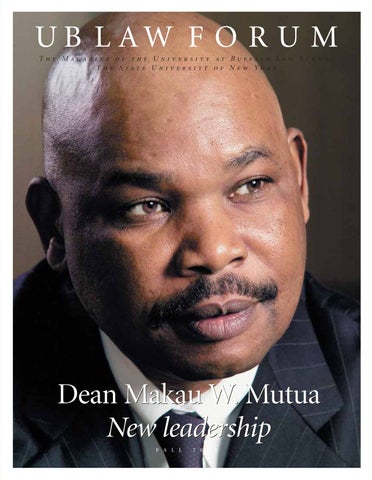
As we welcome Makau W. Mutua as 18th dean of the University at
Charles Daniels 1887 – 1897
Adelbert Moot 1897 – 1902
Christopher C. Tiedeman 1902 – 1903
Carlos C.Alden 1904 – 1936
Francis M. Shea 1936 – 1939
Mark DeWolf Howe 1940 – 1944
Philip Halpern 1945 – 1948
Louis L. Jaffe 1948 – 1950
George N. Stevens 1951 – 1952
Jacob D. Hyman 1953 – 1964
William D. Hawkland 1964 – 1971
Richard D. Schwartz 1971 – 1976
Buffalo Law School, we look back at his distinguished predecessors.
Buffalo Law School Deans 1887 — 2007
Thomas E. Headrick 1976 – 1985
Wade J. Newhouse 1986 – 1987
David B. Filvaroff 1988 – 1992
Barry B. Boyer 1992 – 1998
R. Nils Olsen 1998 – 2007
U B
2
L A W
F O R U M
•
F A L L
2 0 0 8
Message from the dean
3
our student body,and build stronger relationships with our alumni and the state.I will invest in building the Law School of the future in which technology,endowed chairs,faculty scholarship and cutting-edge education will be the centerpieces. What role can our alumni play in helping to achieve these goals? No U.S. law school has ever achieved academic greatness without a critical mass of dedicated alumni who are generous, devoted and proud of their alma mater. In this respect, philanthropic commitments by the alumni are the difference between successful and lackluster law schools. With a shrinking base of state support for education, it behooves UB Law to create a bond of partnership with its alumni. Happily, we already have active alumni. But we will have to do more to increase participation and support if we are to become competitive with our peers and be counted among the top 50 law schools in America.
ASK DEAN MUTUA A few questions for the Law School’s new leader
What are your goals as the 18th dean of UB Law School? An excellent public law school is defined by four important factors: a faculty with star scholars and great teachers; an academically strong student body; supportive alumni with a committed tradition of philanthropic giving; and a vital relationship with the central university and the state.Luckily for me,UB Law has a long history and
tradition in all these key areas,even though we have been buffeted by some challenges in the recent past.But my mission for UB Law is clear and straightforward.I will return the Law School to glory and put it among the top 50 law schools in the country by building on our strengths and addressing areas that require attention. I will recruit and hire faculty with star potential,raise the academic profile of
How can we reverse our recent decline in the national rankings? The first thing that I have done is to recognize that rankings matter to the alumni, prospective applicants, employers and the general public. Even though the matrix used to calibrate rankings is highly questionable, it would be foolhardy to pretend that they do not impact the Law School.As a law school, we operate in the marketplace with about 200 other competitors nationally. That is why I am working hard with our faculty, staff and alumni to raise our reputation by hiring more and better faculty, raising the academic profile of the students we admit, making sure that the vast majority of our graduates are placed soon after graduation, and letting the world know about the great and innovative things that are happening at UB Law. I am confident that we are doing all we can to arrest the decline and that we should see some improvement in our rankings soon.An example is the class that entered in September. It is one of the strongest we have ever admitted and is a very important step in the right direction.
How does philanthropy affect our rankings? Philanthropy is the critical factor in the development of academic excellence for a law school. Philanthropy gives the resources to invest in your academic programs and attract great faculty.It is the source of endowed chairs without which it is difficult to attract and retain faculty who are sought-after.Currently,we have no chairs at UB Law.We have two endowed professorships,which is a good start.However,chairs attract faculty who will raise our reputation in the legal academy and among practitioners.Similarly,philanthropy will allow us to give more tuition scholarships to attract students with higher LSAT scores,a variable that is critical to rankings. You have been critical of proposals to create three new law schools in New York State.Why? There cannot be an objective mind in the State of New York who thinks that we need additional law schools in the state,beyond the 13 privates and the two publics.New York has more law schools than it needs.The law schools within the state educate more lawyers annually than can be absorbed by the state economy in six years.Besides, there is not a single applicant who is qualified to go to law school who fails to gain admission within the state.In short,there is neither professional justification,nor market demand,for more law schools or lawyers in our state. Please describe your work as a leader in international human rights. This is really for others to talk about. All I can say is that I have been very fortunate to enjoy some success as a scholar and practitioner of international law and human rights. My plate in this regard is overflowing with commitments to write,speak and consult with governments,NGOs and the private sector.But for me,it is a labor of love. Will you maintain your teaching responsibilities? Of course.This year I will teach Human Rights,the International Law Colloquium and the Human Rights Externship.But I must say that I never
thought – until just last year – of becoming a dean of a law school.The thought had never,ever entered my mind.And I was very skeptical when the issue was first raised.However, service in reform of institutions is an important part of my psyche,and I treasure UB Law,which has been my intellectual home for a decade.That is why I eventually took on this responsibility. How is the state’s budget crisis affecting the Law School? Clearly,the budget crisis is a drawback for UB Law,and comes at a time when we are faced with other challenges.But it is also a wake-up call and opportunity for us to reach out to our alumni and strengthen those ties. While there will be some cuts,I do not expect them to affect our ability to hire tenure-track faculty or to interfere with our core functions.We will use our resources wisely,save where we can, stretch our dollars and emerge stronger. What have been your greatest challenges so far during your time as dean? The work itself is not really difficult, even though the volume of demands is high.I have a collegial and consultative style of governance which helps legitimize decisions and involve the entire Law School in the life of the community.I have an extremely able senior leadership,including Professor James Gardner,the vice dean for academics; James Newton,the associate dean for administration; Professor Errol Meidinger,the vice dean for research and faculty development; Professor Isabel Marcus,the director of international programs; and Professor Rebecca French,the new director of the Baldy Center for Law and Social Policy. I have delegated authority with responsibility – and clear benchmarks – to our senior staff in development, external relations,IT,career services, admissions and the registrar.Because we have a shared vision and consensus about the direction of the Law School, the job of being dean is manageable and occasionally enjoyable! But ask me again in a year,and see how I feel then.
U B
L A W
F O R U M
Contents
4
•
F A L L
2 0 0 8
5
UB L AW F O R U M The Magazine of the University at Buffalo Law School The State University of New York
BRIEFS 2 6
A message from Dean Makau Mutua Short takes on what’s up
ALUMNI PROFILES 12 14 18
Marianne Mariano ’94 heads federal defender’s office Professor Mensch ’78 retires Cindy Cooper ’03 rescues housing at risk
LAW SCHOOL REPORT 20 22 26 30 32 36 38 40 42 43 44 50 52
Six chosen as Presidential Management Fellows A bold plan to place wind turbines in the Great Lakes Law School documentary goes behind the walls at Attica Baldy Center conference looks at the culture of pro bono Fighting domestic violence here and abroad Dean’s Advisory Council focuses on our ranking Washington Day brings D.C. alumni to campus New York City program in finance and law finishes third year Incoming class among the best ever 2007 employment statistics Commencement 2008: A great beginning Students of Color celebrate their achievements Law Review Dinner marks a productive year
Fighting domestic violence
32
26
DAC focuses on rankings
36
14
FOCUS ON FACULTY 54 56 58 60 61
62 64 68 70
UB Law Alumni Association celebrates our best New boards elected Regional chapter photos Class Action: Reunions/marriages/births/deaths
AS WE GO TO PRESS 84
Professor Mensch ’78 retires
Stuart Lazar: a fascination with taxation Ruqaiijah Yearby will direct JD/MPH program Professor Rebecca French is named to head Baldy Center Errol Meidinger advocates for UB Law scholars New books by members of the UB Law faculty
LAW ALUMNI ASSOCIATION
On the scene at Guantanamo
Encountering Attica
56 Ruqaiijah Yearby will direct JD/MPH program
44 Commencement 2008
14
68 Regional events
54 Stuart Lazar: New tax prof
22
Environment and Development Clinic
6
U B
L A W
F O R U M
•
F A L L
7
2 0 0 8
Briefs U.S.tax court judge argues for more regulation In an appearance sponsored by the libertarian-leaning Federalist Society and UB Law’s Moot Court Board, a U.S. Tax Court judge played the contrarian, arguing in favor of more government regulation – at least in the tax arena. “Why Tax Regulation Is Good” was the straightforward title of Hon. Mark V. Holmes’ address, and Holmes acknowledged he was making a challenging argument. “Usually for those of us on
the right, especially for those of us of a libertarian persuasion, praising regulation seems perverse,”he said. And he recognized widespread suspicions that the complexity of tax law amounts to a full-employment act for tax attorneys. But, he said, many who specialize in tax matters are no fans of the proliferation of tax law. Instead, it is regulations – issued by taxing entities like the Internal Revenue Service rather than by legislative bodies – that tax lawyers prefer. “Judges have to use some tools to clarify the tax law’s ambiguity and apply it to the case at hand,” Holmes said. “In tax law in particular, the number of regulations that meet the precision test of a good law is likely to be very large. Precision is a criterion for good law, and it also helps to explain why regulation might be good, even better than case law.”
What are campaigns for? The common complaint, Professor James A. Gardner said, is that presidential campaigns are not thoughtful enough, not rational enough, too thin, too superficial, and driven by personality and image rather than substance. “But the question we like to ask in the Law School is,compared to what?”he said. That comparative critique of campaign styles across the centuries of the American experiment was the basis for a lecture by Gardner to nearly 200 people in the free UB This Summer lecture series. It was called “What Are Campaigns For?” and was based on Gardner’s upcoming book of that title. Sure, he said, modern voters grumble about the quality of campaigns. But a look back shows that each era of American electoral history has had its failings, some of them unthinkable by today’s standards: everything from plying the voters with whiskey to rolling giant leather balls inscribed with party slogans across the countryside.
“A tax system that tries to use precision in regulation will always need more regulation to fence in some activities and fence out others.” But even as regulation adds clarity to tax legislation, tax specialists are needed more than ever.“A tax system that tries to use precision in regulation will always need more regulation to fence in some activities and fence out others,”Holmes said.“People will shift their behavior in response to a previous round of regulation. Even bright lines will increase the demand for tax lawyers.”
Gardner said dissatisfaction with campaigns comes as campaigns fall short of reasoned persuasion and understanding, and voters fail to inform themselves about the issues. Part of the problem, he said, are the laws regulating ballot access and public campaign financing. So what are campaigns for? Mostly, Gardner said, campaigns are not about winning voters over to a candidate’s side. Instead,“they are about making sure that people vote the inclination that they brought into the campaign. Campaigns orient voters to select the candidate they should prefer. That does not mean that people are not making up their minds, they are just making them up outside of the campaign.” Therefore, he concluded, “we need to worry about something else, and that is how people form their political opinions outside the campaigns. It seems to me that we need to worry much more about inequality of access to the tools of communication and the concentration of mass media ownership.”
Our students help New Orleans after the storm he recent Hurricane Gustav refocused America’s attention briefly on the Gulf Coast, but the nation has moved on to other matters. For the residents of New Orleans still struggling to rebuild after Hurricane Katrina, however,“the storm” of three years ago is a continuing and very present reality. Beyond the city’s physical rebuilding, New Orleans’ legal system is recovering as well from the devastation that blew in from the Gulf of Mexico in August 2005. And the need for legal services – on issues both civil and criminal – has never been greater. In January, 29 second- and third-year UB Law students spent a weeklong bridge course getting a firsthand look at the recovery efforts, practicing their legal skills in a fast-paced, high-volume environment, and pitching in to help the New Orleans legal community clear some of its staggering caseload. The students worked with the city’s public defender’s office, New Orleans Legal Assistance Corp. and the Alliance for Affordable Energy. “They’re still putting out fires in terms of legal work,” said third-year student Tatiana Markel. “We were there to do whatever we could to lighten their load,” including helping with evictions and title transfers that had gotten “pushed to the bottom of the barrel.” “The biggest shock by far was the devastation still there,” Markel said.“It was as if Hurricane Katrina occurred yesterday.” “I should have known about all the legal backlog of work that needs to be done so people can rebuild their homes and reacquire their land,” said Elliot Kowalski, another third-year student who made the trip. The three-credit bridge course was the brainchild of Professors Suzanne Tomkins, Margaret Phillips and Sara Faherty. It included two weeks of classes on affordable-housing case law and the government’s role in responding to disasters.
T
C o n t i n u e d …
Areas of the lower ninth ward in New Orleans are flooded after a levy along the industrial canal was overtopped as a result of storm surge associated with Hurricane Rita on Friday, Sept. 23, 2005. The overtopping caused areas of New Orleans that were flooded during Hurricane Katrina, and since drained, to flood once again.
8
U B
L A W
F O R U M
•
F A L L
9
2 0 0 8
Briefs A light in the Atticus “The first article I published took me a year to write, and I probably threw away three-quarters of it. It took me a while to figure out how to work efficiently.”
Legal fiction very so often, Paul Goldstein says, people will approach him at a conference and say, “I read your book, and I loved it.” He knows, he says with a laugh, that they are not talking about his four-volume treatise on U.S. copyright law. More likely those readers passed a pleasant weekend with Errors and Omissions or, now, A Patent Lie (Doubleday), his second novel in the legal thriller genre. The new novel is a courtroom drama built around Goldstein’s continuing hero, Buffalo lawyer Michael Seeley, and his quest to find the truth amid the shifting allegiances of an intellectual property lawsuit. Seeley goes to San Francisco to argue on behalf of his estranged brother’s biotech company, which is defending its patent on a high-stakes AIDS vaccine against a Swiss pharmaceutical giant. As the trial progresses, Seeley begins to suspect that there is corruption all around, and his courtroom life is complicated by romantic entanglements, family drama, political activism and a mysterious murder. “Never has copyright and intellectual law been so thrilling and so dangerous,” the book’s publicity enthuses. Goldstein, who began his teaching career as a UB Law associate professor from 1967 to 1971, is an acknowledged expert in
E
IP law and now teaches at Stanford University. In addition to textbooks, casebooks and other purely academic work, he has written general-interest non-fiction books on IP and copyright law. Errors and Omissions, his first published novel, came out in 2006; he is already at work on the third in the Seeley series. With his love of literature and the movies, Goldstein said, copyright was a natural fit when he was a student at Columbia Law School. At UB Law he taught survey courses in copyright, patent law, trademarks and unfair competition. Now, of course, the field of intellectual property has exploded with the advent of the Internet, file-sharing technology and the like. Keeping up is challenge enough, so how does Goldstein find time to indulge his passion for fiction? “I have not found it overly difficult,” he says.“I am a lot more efficient in my professional writing today than I was when I started. The first article I published took me a year to write, and I probably threw away three-quarters of it. It took me a while to figure out how to work efficiently.”
Harper Lee’s beloved novel To Kill a Mockingbird, and the classic 1962 film starring Gregory Peck, got the full legal review in front of an audience at Buffalo’s Albright-Knox Art Gallery. Three UB Law School academics were part of a panel discussing the judicial aspects of Mockingbird, whose key conflict revolves around the defense by principled lawyer Atticus Finch of a black man falsely accused of raping a white woman in 1935 Alabama. The program came in conjunction with a National Endowment for the Arts program called The Big Read, which encourages entire communities to read the same book, and it preceded a showing of the film. UB Law clinical instructor Sam Magavern, moderator of the panel, began by reminding the audience of the book’s plot, centered on Atticus’ children Scout and Jem, and on their mysterious, reclusive neighbor Boo Radley. Boo, said Magavern, is a key figure in the book’s legal pedigree; he is a recluse because as a teenager he was put under house arrest after falling in with a gang, and at age 33 was briefly
locked in the courtroom basement after stabbing his father with scissors. The climax of the story explores the issue of law versus justice, when the sheriff decides not to prosecute Boo for killing a man who was threatening to hurt the children. Professor Stephanie Phillips spoke of the social and political context in which the novel was released. It was published in 1960, she noted,“at the height of the civil rights movement, and before Civil Rights Act and the Voting Rights Act. It reminded the nation of some of the issues that were on the table right then.” SUNY Distinguished Teaching Professor Elizabeth Mensch went deeper into the character of Atticus Finch, saying that he is “part of a declining Southern gentry culture” who derives his authority from that position of privilege. Nevertheless, she sees Atticus as a virtuous lawyer.“Atticus teaches the children to see in the most unlikely people a possibility, a touch of a better reality that is only partially revealed,” she said, quoting Gregory Peck’s character as saying,“People are nice if you only see them.”
New York’s clean team An environmental advocate fighting the good fight with the New York State attorney general’s office brought some war stories and some words of inspiration to a UB Law School class on public-service environmentalism. Katherine “Kit”Kennedy is special deputy attorney general for environmental protection, and chief of the state’s Environmental Protection Bureau. Kennedy detailed the work of that office.“It is an incredibly fascinating and challenging job,” she said. “The bureau has a broad range of responsibilities and duties that touch on every area of environmental law,” including enforcing state and federal environmental laws, and defending the DEC and other agencies when they are the targets of lawsuits brought on environmental grounds. The work, she said, runs the gamut
from very complex nationwide cases – such as a recent challenge by New York and other states that struck down the federal Environmental Protection Agency’s toothless regulations on mercury emissions by coal-fired pow-
er plants – to small, local law enforcement actions. Because of the ruling in the EPA case, Kennedy said, the federal agency will need to rethink its system for limiting mercury emissions by power plants.“This is a significant case in Buffalo and Western New York,” she said, “as well as in other parts of the country, because mercury affects the Great Lakes.” Other recent efforts by the Environmental Protection Bureau include lawsuits to slow global warming, clean up contaminated urban sites, improve water quality in the Bronx River, Hudson River and New York City watershed, and prevent invasive species from gaining a foothold in the Great Lakes. C o n t i n u e d …
10
U B
L A W
F O R U M
•
F A L L
11
2 0 0 8
Briefs Good for the neighborhood
The power of apology A new book by Nick Smith ’97, I Was Wrong (Cambridge University Press), explores the nature of apologies and the power of a simple statement of wrongdoing. From the apologies of politicians when they misspeak or misbehave, to collective national apologies for past offenses, to issues as intriguing as “Should I apologize to my dog for forgetting to fill his water bowl?,” the book examines the theory and practice of this most human custom. He got into the subject, Smith says, while considering the commodification of law – how harms ranging from racial discrimination to wrongful death are measured in dollar signs. Surprisingly, he found, expressions of contrition have become more common in our justice system, partly because “legal actors do in fact put a price on apologies. Studies suggest that a few words of contrition, regardless of their sincerity, can dramatically decrease the likelihood of costly litigation.” As he worked on the subject, says Smith, who now teaches philosophy at the University of New Hampshire, he came to realize that “apologies are everywhere. Just about every day I was working on the book, someone appeared in headline news apologizing for something. “Asking a few simple questions can take us to the heart of the meaning of an apology: Did the offender explain what she did with an appropriate degree of specificity? Does she accept blame? Does she make clear why her actions were wrong and identify the principles she violated? Does she promise not to do it again and
Compare and contrast Students’ opportunities to study law in a cross-cultural context will grow in the current academic year with the addition of visiting professor Antoni Abad i Ninet, who comes to Buffalo from another UB – the University of Barcelona, Spain. Dr. Abad, a specialist in constitutional law, will teach a bridge course in Ancient Constitutional Law and a spring-semester course in Compara-
F
our Western New York nonprofits scrambled for a major grant from Buffalo’s 21st Century Fund, but only one – the Massachusetts Avenue Project, with strong input from the Law School’s Community Economic Development Clinic – went home with the cash. The $100,000 grant will be used to support the creation of a Community Food Resource and Micro Enterprise Center on Buffalo’s West Side, where nearly half of residents live in poverty. The center will make affordable, nutritious food more available to residents, and increase their capacity to earn a living through business and job training. Among its features: the Rise Up Cafe and catering business, a weekly youth dinner co-op, group meeting space, a commercial kitchen and program offices. The center will function in tandem with the Mobile Market, which was established in February. “The Law School’s Community Economic Development Clinic students have represented MAP for the past 10 years,” said clinical instructor Lauren Breen. “This new center is a very exciting model to build small businesses and, in the process, physically revitalize the West Side.”
to redress the problem she caused? These questions tend to lead to further questions about the meanings of any given apology, but they are a good starting point.” So does he really apologize to his dog sometimes? “I do,” Smith says,“in part because I think my dog is an important member of my moral community. Likewise, some Native Americans give thanks to killed prey by blowing tobacco smoke into its nostrils, or ask forgiveness from a tree for harvesting its bark. Because such a worldview considers a broad scope of beings within its moral horizons, it extends opportunities for gratitude and contrition beyond most other traditions that strictly delimit the class of moral interlocutors deserving of apologies.”
“The Law School’s Community Economic Development Clinic students have represented the Massachusetts Avenue Project for the past 10 years.” — Clinical instructor Lauren Breen
“The U.S. federal system
is a mature system and a tive Constitutional Gardner. good source for the young Law. His term at “I met ProfesUB Law School is sor Gardner last Spanish constitutional under the auspices year in Athens at of the Edwin F. the World Congress system as we try to learn Jaeckle Center for of Constitutional and improve it.” State and Local Law,” Abad says.“After Democracy, and he says it the conference, I wanted grew out of a meeting of acato congratulate him on his demic minds with Professor and Vice point of view about federalism and Dean for Academic Affairs James A. subnational constitutions and to dis-
cuss other ideas from the conference. The U.S. federal system is a mature system and a good source for the young Spanish constitutional system as we try to learn and improve it. Professor Gardner is a very open-minded professor and is interested in the Spanish constitutional system and comparative constitutional law, and that makes it easy to find connections between our works. We began an In-
ternet conversation about ways we might collaborate with each other.” The result is a planned joint project by the two professors, “based in a comparison between both constitutional systems but searching for a universal and international application. I am very excited to be in a position to work with someone like Professor Gardner.” Even in his personal heritage, Abad
exemplifies the cross-cultural nature of his legal academic work. “I define myself as a Mediterranean,” he says.“I am a Catalan who was born in Valencia and grew up in Mallorca. My first surname is a Catalan name with Persian, Jewish and Arab origins – like my country, a mixture of ancestral cultures.”
U B
12
L A W
F O R U M
•
F A L L
Alumni Profiles
2 0 0 8
13 “The attorneys in our office feel privileged to serve the community by representing those least able to help themselves when faced with such serious charges.” — Marianne Mariano ’94
LEADING THE DEFENDERS Marianne Mariano ’94 heads federal public defender’s office arianne Mariano ’94 has committed herself to a career in public service, most of it with the Office of the Federal Public Defender in the Western District of New York. Now she has been appointed to head that office and its staff of 25, including 11 attorneys. The office, which covers both Buffalo and Rochester, represents people who have been accused of federal crimes and cannot afford to hire an attorney. That means a lot of cases – about 1,000 new clients each year, a number bolstered by Western New York’s proximity to the Canadian border. Mariano, who has been an assistant public defender since 1995, said the caseload is heavy with drug cases, both local trafficking cases and crossborder smuggling, as well as other border-related cases such as alien smuggling and false documentation. “We will represent a client from Day One,”she says, from an initial bail or detention hearing, through hearings on evidentiary issues, and on to trial and appeal if necessary. The office also includes a manager who coordinates the work of private attorneys appointed to represent federal defendants under the Criminal Justice Act,
M
a collaboration that Mariano hopes to strengthen. “This office enjoys an outstanding reputation for its representation of its clients,”Mariano says.“I feel so fortunate and honored to have been given this opportunity, especially so soon in my career.”She succeeds Joseph B. Mistrett ’71, who has retired. A native of Niagara Falls whose father, John E. Mariano ’60, was a Niagara Falls City Court judge, she clerked for U.S. Magistrate Judge Carol E. Heckman after graduating from the Law School.“I went to law school knowing I wanted to go into public service,”she said. She joined the Office of the Federal Public Defender at a time when it was doubling its staff to four attorneys;“I was at the right place at the right time,”she says. Her career ever since has been for the defense – a commitment so all-encompassing that she even named her dog, a Wheaton terrier,Atticus Finch, after the heroic defense lawyer in To Kill a Mockingbird. “The attorneys in our office feel privileged to serve the community by representing those least able to help themselves when faced with such serious charges,”Mariano says.“It is that commitment that make us successful.” As an assistant public defender, she
has served on the Federal Sentencing Guidelines Working Group and the Federal Defender’s National Sentencing Guideline Committee, an advisory group to the U.S. Sentencing Commission. One of the challenges of running the Western District office is managing attorneys and staff in two cities. She generally makes the 90-minute drive to Rochester once a week, and an instant messaging system keeps staffers in constant touch with each other. She will maintain her own roster of cases. The office also is charged with providing two Continuing Legal Education seminars each year for the defense bar. At UB Law School, where she graduated cum laude, Mariano served on the Moot Court Board, and honed her litigation skills in national and local moot court competitions.“That experience helped a lot,”she said. “Moot court, coupled with my oneyear clerkship, taught me that everything I learned in Law School could translate into any area of the law.”She also cites the Trial Technique program as a formative experience. In the federal Second Circuit Court of Appeals, Mariano is the first woman to head a public defender’s office.
U B
14
PROFESSOR MENSCH LOOKS TO CHILDREN’S ADVOCACY IN RETIREMENT
L A W
F O R U M
•
F A L L
Alumni Profiles
2 0 0 8
15
A TEACHER’S TEACHER PROFESSOR ELIZABETH “BETTY” MENSCH,
who has taught at UB Law School since 1985, retired at the close of the 2007-08 academic year.An acclaimed teacher – she was named a SUNY Distinguished Teaching Professor in 1994 – Mensch is a UB Law alumna as well; she graduated with the Class of 1978 before going on to Harvard to earn the master of laws degree. In her Law School tenure, Mensch has taught in the areas of torts, contracts, legal history and church/state relations, among others. Her publications include the 1993 book The Politics of Virtue: Is Abortion Debatable?, written with her husband and fellow UB Law professor,Alan Freeman, who passed away in 1995. The seventh floor of O’Brian Hall was undergoing renovation, and Mensch’s office was stripped almost to the bones, when UB Law Forum caught up with her to ask her to look back – and forward as well.
Why retirement? Why now? As the saying goes, the decision was overdetermined. I now have four grandchildren and want to move closer to them so that I can be a real grandmother, not just someone who hurriedly breezes in for visits from time to time. Moreover, I want more time for volunteer work. Initially I came to law school for the sake of gaining some extra skills related to my teaching work with secondary school students who were becoming lost and neglected within the whole educational, social and legal system. I have never forgotten my concern for such kids – it haunts me – yet I have given it far too little of my time. Finally, of course, inescapably, there is age. I am almost 66 and want to retire before I start to lose the energy and enthusiasm for big classes. I enjoyed last year’s classes immensely; yet it is good for the school to have the fresh approach and perspective that newer faculty can bring to students. In recent years we have hired some terrific new colleagues; they are adding immeasurably to the vitality of the school. Continued on page 16
U B
16
L A W
F O R U M
•
F A L L
Alumni Profiles
2 0 0 8
17
A TEACHER’S TEACHER Continued from page 14 You are an alumna of the Law School. How did you make the transition from being a UB Law student to being a UB Law professor? Much to my surprise at the time, I found studying law at UB great fun. Never had I enjoyed an intellectual challenge as much as I enjoyed law school. Professors here, who were extraordinarily generous with their time and encouragement, nudged me to pursue an academic path.At the time, there was still something of a presumption against ever returning to one’s home school as a professor. After some further study and some experience and job offers elsewhere, however, I was asked to return and was delighted to do so. By then I was convinced that the quality of the intellectual life at UB was unsurpassed anywhere; so too was the quality of the challenging but supportive environment UB provided for students. You have seen a couple of decades of students go by. Have you noticed broad changes in the students you teach? I have never found it difficult to like students. They have always amazed me with the rich variety of their experiences, the depth of their insights and the seriousness of their goals. That reality has stayed so constant that changes seem superficial. Yet it is probably fair to say that there have been changes.When I was a new teacher, students seemed less
‘‘
I came back to this school because I think it is a really special law school.
’’
worried about career opportunities and therefore more willing simply to enjoy the luxury of being in school. More were also eager to believe that legal reform could usher in sweeping progressive social transformations. Now students seem, in a sense, more realistic. They like to see a relationship between their Law School experience and the skills they will need for practice. They are also more skeptical about broad transformational goals and more interested in the specifics of concrete problem-solving; and they are more open to seeing dilemmas rather than easy answers. I do not see those changes as at all negative so long as students retain their enthusiasm and continue to enjoy the challenge of learning to do serious legal analysis.
You are known for the quality of your teaching. Have you developed a philosophy of teaching? Do you think about method, or does it just come out of who you are? I think of method not at all, although to say so might be an admission of irresponsibility. My focus has always been just on content – on helping students to uncover and grasp the basic structure and tensions within various doctrinal areas, and on helping them to use their knowledge and to fashion arguments to understand cases. I also firmly believe that students learn different things from different teachers. Our school has many strong scholars and teachers from whom students can learn a variety of different skills and perspectives. Therefore, I have always accepted my own limitations. I am not good at grilling students, for example, and I do not try, even though I think a little grilling can add a valuable edge to the class. And I would waste everyone’s time if I tried to fumble with the mechanics of visual aids or computer technologies, yet I know many teachers use them very effectively. So my “method”has probably just been a function of my own areas of ineptitude. I have always, however, tried to draw pictures on the blackboard; students have been patient in putting up with my lack of artistic ability. Students have said that you will, in the last 10 minutes of a lecture, teach on a higher level and talk to the brighter students in the room. Do you do this consciously? No, I do not think of students in terms of more or less bright. Some
are just more interested and engaged than others. But I do like to keep pointing out that questions which at one level can seem very technical (measures of damages in contract law, for example) can at another level actually embody very complex questions about the meaning of ethical responsibility. Sometimes very small questions can also be very large questions, and are best understood within that broader framework. And I do want students to keep encountering the fact that there are often no easy answers to those broader questions. That recognition leads to greater flexibility and sophistication in fashioning legal arguments. It is also a lesson about ethical responsibility: acting responsibly sometimes means choosing between conflicting ethical claims in situations where the right answer is not always obvious, or clearly decided by rules. You have written in a great number of areas: animal rights, abortion, a lot of history, advertising, even a piece about Dr. Seuss.Would you call yourself a generalist? Maybe that is a generous word to describe a pretty whimsical approach to scholarship. I have produced no systematic body of work; although I guess I have written a fair amount about various moments in the long history of theology’s simultaneous influence and challenge in relation to legal thought, there has been no fully sustained development.
How have you chosen the topics you have written about? I have followed my nose, and often the proddings of others. For example, my late husband and I wrote a book about abortion even though we had no plan to do so.We had taught a seminar on animals and then had given a few little talks on the subject, and written a couple of short articles. Our interest was in the pesky status of animals at the border of conventional ethical and legal thought. Norms for the treatment of humans did not seem wholly relevant to animals, yet the treatment of animals did seem, for most cultures and religious traditions, at least to raise a moral question. Then people kept asking whether abortion did not raise a similar “border”question. We had to admit to ourselves that it did. So, somewhat reluctantly, we switched focus. Can you talk a little more about the work that you and your husband did together? We did a lot together, often just to have fun with topics. For example, we wrote some essays for Tikkun magazine in that spirit.Alan had a sharp, lively mind, filled with knowledge, and with a knack for pithy prose. Of course I have missed him very much. Talk about your work with the Journal of Law and Religion.What has that entailed? I was chair of the editorial board for a few years, and am still on the board. The board does planning and policy setting; I can take no credit for the hard work that goes into actually producing each issue of the Journal. Nevertheless, the association with the Journal has been important to me. Our goal has been to provide a serious academic law journal which can be (and is) also read by
many outside the legal academy as well.Articles explore, from a wide variety of perspectives, the relation between law and various faith traditions. It is completely open and ecumenical in approach, and also in its spirit as a community of scholars trying to encourage others who want to work in the area of law and religion. While my association with the Journal has been deeply satisfying, I am also delighted that there is a growing number of people at the Law School and in other departments who share an interest in religion. It is an important area of study, somewhat neglected for a time at many schools. What have we forgotten to ask? I came back to this school because I think it is a really special law school. It has had a really great past in certain special ways, like the emphasis on interdisciplinary research. Some of those perspectives have been picked up by other schools, and so what used to be very distinctive about UB has become kind of ordinary. It is obvious that there is a challenge for the school. If it is going to maintain the reputation it has had in the past, it has to think about what its reputation is going to be. There are people who are doing remarkable work in terms of scholarship and also in terms of the clinical program and the New York City program.We really can move into the future in our interesting, distinctive and really impressive way, but we need to think about how to do that. I think we have a great future, and I hope we do not lose sight of that.
U B
18
L A W
F O R U M
•
F A L L
Alumni Profiles
2 0 0 8
19 “It is a matter ofthe city not assuming liability.These big companies have large portfolios,and risk is part oftheir business.On a micro level,there are going to be losses.When a company passes on that loss to someone else – in my personal opinion,I see that as corporate welfare.”
“You cannot just leave abandoned property lying around,” Cooper says.“I do not want the city getting stuck with it.So there is a triangle among the homeowner,the bank and the city,and we are trying to achieve a common goal: to get someone to do something with the home other than the city. “It is a matter of the city not assuming liability.These big companies have large portfolios,and risk is part of their business.On a micro level,there are going to be losses.When a company passes on that loss to someone else – in my personal opinion,I see that as corporate welfare.”
B
GOOD for the NEIGHBORHOOD Cindy Cooper ’03 works to rescue housing at risk
I
n the end,says Cindy Cooper ’03,she does what she does for the love of a city. The City of Buffalo,that is – so different from California,where she grew up,but a place she has treasured ever since she came to the University at Buffalo to pursue a law degree and a doctorate in sociology. She lives with her husband – Mark Schaefer ’93,a civil law attorney – in a beautiful Victorian fixer-upper on Richmond Avenue,in the stately shadow of Kleinhans Music Hall.And she works for the city’s Law Department as an assistant corporation counsel under Corporation Counsel Alisa A. Lukasiewicz ’95,prosecuting cases in
Housing Court and working to keep lenders and homeowners from abandoning their city houses in foreclosure proceedings. When lenders foreclose on a property,she explains,they are sometimes tempted to wash their hands of it,especially in depressed areas of Buffalo where homes may be worth only a few thousand dollars and reselling them is difficult.But abandoned properties rapidly fall into disrepair and,under the direction of Mayor Byron Brown, the city has already launched an aggressive effort to raze 5,000 abandoned homes in five years.In order to accelerate the city’s economic revival,Mayor Brown is committed to removing
blight and opening up shovel-ready sites for new investment. In Housing Court,Cooper insists that lenders keep the homes in good condition until a buyer can be found, donate them to community groups,or pay for demolition.When lenders ignore summonses for code violations, the city can enter a default judgment and levy fines – and then impose liens, which can hold up the lenders’other real estate deals.That threat encourages compliance. In the midst of a national housing meltdown,that special focus on holding lenders accountable has drawn media attention,including a recent cover story in Business Week magazine.
uffalo,she said,is ahead of the curve in dealing with its foreclosure problem,because it hit earlier in Western New York than elsewhere in the nation.“We have an aftermath problem right now,” Cooper says. Working with fellow UB Law alumna Mary Bowman ’02,she is in court three days a week,dealing with the fallout from predatory lending,subprime loans,and the economic ill fortune that separates city residents from their homes. “Cindy has been an asset,not only to the Department of Law but to the community in which she lives and the city that she has made her home,” says Lukasiewicz. Cooper came to Buffalo to do graduate work in sociology,the recipient of a Gilbert Moore Fellowship from the Baldy Center for Law and Social Policy to support her concurrent work in sociology and Law School.She became interested in housing issues when she worked as an intern in Judge Henry J. Nowak’s Housing Court.She then worked for two years on a grant-funded project to reconfigure the court, helping to make it more of a problemsolving institution with the goal of helping stakeholders find the resources necessary to rescue houses at risk.Her dissertation in UB’s Sociology Depart-
ment dealt with the role of banks in residential abandonment and why they should be held accountable for property code violations. She went to Law School,Cooper says,as an academic exercise,fully expecting that she would end up teaching sociology on the university level.“I was not thinking about practicing law at all,” she says.“I went to Law School to research the law and understand the law,so I could be a better sociologist. “I took a lot of seminars,” she recalls.“I liked the smaller environment, and I enjoyed writing papers.It was more like graduate school classes.I remember a great class on Law and Religion taught by Betty Mensch.There was a lot of heated debate in that class.” But in the end,she realized she was not ready to devote herself to academia.“I wanted to be engaged in the world,” she says.“I wanted to get out and get in touch with more of the real world and become more actively engaged with what people were struggling with and working on.I was living in the city and driving to Amherst every day to study the city.I finally realized that did not make sense.” She took the bar exam more than a year after her Law School commencement. Now she sees the nitty-gritty of the housing market up close,sometimes driving with a city building inspector into some of Buffalo’s roughest neighborhoods to see for herself the condition of the roof or the masonry.Her own experience in rescuing her home, encumbered by an IRS tax lien before she bought it,has given her empathy for those who struggle to repair their older homes. “I feel strongly about fixing up houses in the city and doing the best with what you have,” Cooper says. “It is a lot of work,but it has to be a labor of love.I have an old house – I know what it is like.”
U B
20
L A W
F O R U M
•
F A L L
2 0 0 8
Law School Report
21
Bright path ahead UB Law graduates chosen for prestigious Presidential Management Fellowships • • •
In good company Top five universities in Presidential Management Fellowships for law students, 2008 • Harvard University • Georgetown University • University of Maryland • College of William & Mary • University at Buffalo
A
federal program to attract the best and brightest to government service has chosen its 2008 group of Presidential Management Fellows – and six are new UB Law graduates. Only four schools nationwide had more law students win the prestigious fellowships.Lisa M.Patterson,associate dean for career services,said the achievement reflects students’broader awareness of the program’s extraordinary opportunities.From a single Presidential Management Fellow in 2006,the ranks grew to four in 2007,and to six in the current class. “This is a great opportunity,but not everyone is keyed into it,” Patterson says. “One of the drawbacks has always been that the PMF program is not geared toward lawyers specifically.The Department of Justice,the Securities and Exchange Commission and other agencies have their own programs for law graduates. And especially with our concentrations gree.“Public health is an interdisciplihere,lot of times students will have an nary degree that gives you a backidea of the government agency they ground in biostatistics,epidemiology, want to work for.But this program is a health care policy and health care fivery good foot in the door to the federal nancing,” he says.“It gives you the globsystem.” al picture of the various factors that go Because the program is open to into crafting an equitable and appropristudents in all disciplines – not just ate health care policy.” lawyers – Patterson says the work is • • • less specifically oriented to legal pracIn her Presidential Management tice.“You might come in as a policy Fellowship, EMILY CONLEY will be enanalyst or some other title,”she says, trusted with responsibility rarely given “but just because you are not called an to freshly minted lawyers:As part of the attorney does not mean you are not Asylum and Refugee Division of the doing legal work.” Office of Citizenship and Immigration Of the six,five – Harold BabcockServices,she will serve as an adjudicator, Ellis,Dan Christiansen,Emily Conley, hearing up to four asylum cases daily Glenn Howard and Brian McCarthy – and writing decisions on those petihave chosen to accept the fellowship tions. and enter government service. “I was interested in working for the • • • government when I graduated,” Conley BRIAN MCCARTHY says his postsays.“I knew I did not want to work for ing to the Office of Clinical Affairs,part a law firm and do anything too tradiof the Department of Veterans Affairs,is tional.This was just a really good way to a perfect fit for his dual degree in law get into government work. and public health.He will analyze the “And I wanted to do something that health care that the VA provides and ad- would let me travel internationally.I vocate for public policy that enables was not really interested in litigation or better care. anything formal.I wanted to be more “I am very excited about it,” Mcon the policy end of it.This program Carthy says.“I like to deal with policy as seems like a good investment in the it is implemented,to create a continulong run in myself and my career.” um of care within the veterans system. She will undergo rigorous training My office is the national office that over- before she starts hearing cases.Even so, sees everything.” she recognizes that she will hold in her The position calls on many of the hands the fate of would-be immigrants skills he learned in earning his dual deto the United States,and she knows that
emotions will run high. “My suspicion is that at first it is going to be hard to say no,” Conley says. “There will always be things that hurt your heart and things that you wish you could make work.But through my Law School training,I know that everybody does not have a legal claim. “Having a legal background gives you the ability to rationalize and see things from both sides and understand head over heart sometimes.” • • • DAN CHRISTIANSEN will join the
Department of Education,evaluating how well learning institutions implement federal educational grants.The work,he says,has elements of compliance,finance and law practice. “I always wanted to work for the government anyway,so it was something I was interested in,” Christiansen says.“I have always been interested in policy
and politics in general; I was a political science major as an undergraduate.And I have just finished the New York City program in finance,so that was really valuable experience.” • • •
For HAROLD BABCOCK-ELLIS, the fellowship will lead him to the Space and Missile Systems Center,a division of the Air Force.There he will negotiate construction contracts for equipment like satellites. “The federal government,with rare exceptions,does not hire students right out of law school,” Babcock-Ellis says.“I will not actually be a practicing attorney for this,but it is a two-year program,and I can stay on there or transfer to an attorney position in the federal government. “I consider this public service.I definitely want to give something back.”
Among the recipients of Presidential Management Fellowships: Daniel J. Christiansen ’08, Emily G. Conley ’08 and Harold T. Babcock-Ellis ’08.
U B
22
L A W
F O R U M
•
F A L L
2 0 0 8
Law School Report
23
HARNESSING LAW SCHOOL REPORT URGES WIND TURBINES IN LAKES ERIE AND ONTARIO
OFFSHORE
WIND
POWER N ew York State should take advantage of a golden opportunity to become a leader in developing clean, renewable offshore wind power, an alternative energy source that could trigger an economic renaissance and a greener image for the Western New York community, according to a report by a University at Buffalo Law School clinic. The report, prepared by the school’s Environment and Development Clinic, proposes a strategy that would capitalize on what its co-authors call “enormous”potential to harness offshore wind power. Continued on page 24
“New York’s Great Lakes offer the potential for clean, renewable energy, as well as an opportunity to develop a new industry for the 21st century.” — Robert S. Berger, UB Law School professor
U B
24
L A W
F O R U M
•
F A L L
2 0 0 8
Law School Report
25
Continued from page 16
The report outlines a blueprint for developing clean, renewable wind power from turbines located in Lakes Erie and Ontario in a prudent, efficient way that would benefit the public and individual communities. The strategy would create a demand for wind-power energy, as well as large-scale manufacturing of wind power turbines and components in Western New York. “New York’s Great Lakes offer the potential for clean, renewable energy, as well as an opportunity to develop a new industry for the 21st century,”says Robert S. Berger, UB Law School professor and director of the clinic. “Western New York’s proximity to the Great Lakes,”the report states, “provides an opportunity to again become a leader in the generation of clean, renewable energy as an engine for regional economic development and to leverage the region’s technology and manufacturing infrastructure to further an economic renaissance centered on alternative energy and a reputation as a clean, livable community.” Berger said the opportunity and interest to build these wind turbines in Lakes Erie and Ontario already exist, and stressed others will take advantage of that opportunity whether New York develops a coordinated plan or not. But his report suggests a comprehensive strategy in which New York can systematically determine how and where to put wind turbines in Lakes Erie and Ontario for the greater good of the community and its residents. “Rather than have the uncoordinated process where private developers just try to place them in whatever way they decide,”Berger says,
“we’re advocating a coordinated, comprehensive process that will allow all interested groups – citizens, environmental groups, fishermen – to come together to develop the best environmental and civic plan.” The report does not recommend how many or where the wind turbines should be built. Instead it points out the vast energy potential of an industry just beginning to have an impact on the state’s energy needs. Berger and UB clinic student Dwight Kanyuck, co-authors of the report, said a similar number of new turbines anchored in the water could produce several times the power generated by the eight turbines now operating at the Steel Winds farm located on the former site of Bethlehem Steel in Lackawanna. The eight turbines of Steel Winds are rated at 20 megawatts of power – 21⁄2 megawatts each – which supply annual power for about 9,000 homes, according to the UB Law team. If more turbines are built, the capacity to produce power increases proportionally. Even if only 10 percent of the wind power potential for Lakes Erie and Ontario was used, about 8,200 megawatts of electricity could be harnessed for private and commercial use, according to Kanyuck.
Professor Robert S.Berger, second from left, with New York State Senator Antoine Thompson, Dwight Kanyuck, an environmental attorney with The Knoer Group, and William Nowak, a 2008 alumnus of UB Law, at a news conference releasing the report.
That’s more than 400 times the capacity of the eight turbines operating at Steel Winds, enough power to meet the annual needs of about 360,000 homes, using the existing scale of demand. “Eighty-two hundred megawatts would be equivalent to adding the renewable energy capacity of more than three power plants the size of the Robert Moses Niagara Hydroelectric Plant,”according to the report. “This level of development would significantly offset the greenhouse gas, sulfur dioxide, nitrogen oxide and mercury emissions associated with coal power generation and provide a stably priced supply of energy for years to come.” The report also stresses the economic development opportunities for communities that embrace off-
shore wind power.Quebec,for example,expects to attract more than $4 billion in investment and generate 1,500 full-time jobs,with significant expansion possible,according to the authors. he report stops short of specific recommendations on how many or where the turbines should be built.And it stresses the environmental implications,including migratory bird paths,recreation and fishing,of building these wind turbines in the water. “The need for a full discussion of these issues is particularly important because wind turbines would be placed in bodies of fresh water that are sources of drinking water for millions of people,” the report states.
T
But it is unequivocal in its urgency to look at the energy and economic opportunities as soon as possible.The report also designates two agencies – New York State Energy and Research Development Authority and New York State Power Authority – as the groups that should implement the policies.The report also recommends the Wind Action Group,a local wind power organization that asked UB to prepare the report, should act as an educator and advocate to move this plan forward. “We are excited about the idea of fostering a community-based discussion of how we as a region and state can make the most of this natural resource,” says Robert Knoer,chairman of the Wind Action Group,“all in harmony with all of our other goals as a state and region.” There currently are no offshore wind facilities operating in the United States.Offshore projects are generating about 1,000 megawatts of power in Europe,according to the UB team. The UB report also urges the state to provide financial incentives and power purchase agreements to encourage the appropriate development of the state’s Great Lakes wind power. “We are suggesting that there actually be a requirement for local content that the state puts in its purchase agreement that would then jump-start a wind turbine manufacturing plant with the associated component parts,” Berger says.
Creating a Public Plan for New York’s Great Lakes Offshore Wind Power A Strategy for Energy and Economic Development • Executive Summary law.buffalo.edu/forum/fall08/windPower08.asp • Full Report on Social Science Research Network law.buffalo.edu/forum/fall08/windPowerReport08.asp
‘ The Greener Shade of Blue’ mong American colleges A and universities, the University at Buffalo is recognized as a leader in reducing energy costs through conservation measures and in promoting alternative energy sources. In 2007, the University highlighted and celebrated its environmental commitment in a semester-long observance, “The Greener Shade of Blue.” During the semester, President John B. Simpson committed UB to continuing its leadership role in fighting global warming by signing the American College and University Presidents Climate Commitment to achieve “climate neutrality.” As part of developing a comprehensive physical plan to guide the growth of its North, South and Downtown campuses in conjunction with the UB 2020 strategic plan, UB has created a Committee on Environmental Stewardship, underscoring the fact that environmental stewardship is a University-wide responsibility and effort.
U B
26
L A W
F O R U M
•
F A L L
2 0 0 8
Law School Report
27
BEHIND THE WALLS
The students are the ones with the most to gain, Miller says. They’re seeing how the effects of the laws they’re studying in class play out in the lives of real people with real stories. In this case, the men are serving long sentences, many of them for murder. Legal studies for these students become flesh and blood. And the inmates, who most people assume would welcome the chance to occupy their ample time explaining their plight to eager young law students, are the ones willing to help, at their own peril. “One of the things we’re trying to do in this documentary is to show that the law students are learning a great deal from the encounter, and for the inmates, it is risky for them to participate,”says Miller.“Other inmates hear they are participating in something like this, and they assume they are doing something with the administration, assume they are snitches or moles, and that is a dangerous label to carry in prison.” And word travels fast in the highly routinized world of Attica, Miller says. If one inmate wants to send a harsh or violent message to another for something like participating in a prison documentary, the attacker often can get to his victim. “Easily,”says Miller.“It turns out the inmates are not the lucky ones.” That’s the dramatic setting of Encountering Attica, which shows how inmates convicted of the same crime often are treated differently and receive different sentences. The documentary is part of the ongoing effort of the law school’s Projecting Law Project to demonstrate
LAW SCHOOL DOCUMENTARY CHRONICLES MEETINGS WITH ATTICA INMATES
T
ERESA MILLER, a professor in the University at Buffalo Law School specializing in criminal punishment, knows all too well the stereotypes of law students visiting prisons. People naturally assume the students are the unselfish ones, and the inmates – who have little to lose and time to waste – get all of the benefits. Encountering Attica, a documentary film that chronicles a year of meetings between a group of first-year UB law students and inmates from the Attica Correctional Facility, stands that stereotype on its head.
FROM TOP TO BOTTOM: Officer Hulse surveys the prison from atop the wall that surrounds it. Siana McLean and Teresa Miller wait patiently for the bars at the front gate to open. Inmate Matt Lemon and 1Ls Lissette Ruotolo and Siana McLean listen intently to the discussion.
Continued on page 28
U B
28
L A W
F O R U M
•
F A L L
2 0 0 8
Law School Report
29
“One ofthe things we’re trying to do in this documentary is to show that the law students are learning a great deal from the encounter,and for the inmates,it is risky for them to participate.” — Professor Teresa Miller
Continued from page 27 how new media can be used to study legal issues. “It is easy to make a judgment when you are reading about a case in a textbook or a news story,”says Siana McLean, a first-year law student from Toronto and one of three UB Law students actually going behind the bars into Attica.“When you actually hear a person telling his story, it can change your perspective. “This is not to take away blame,” says McLean,“but to actually see the effects of circumstances like growing up in poverty and preconceived notions that go along with race.As a person of color, I look at it as more of a reason to be in law school.”
“One of the reasons it is so important to do this project and study what is going on in prison is because prisons have an increasingly profound effect on every layer of society as we rely more heavily on them; we put so many people away. “So when people come out after having lived 15 or 20 or 30 years behind bars, or just having a whole population of young men that do short terms, but keep cycling in and out of jail, those institutions are forming the society we will have in the near future, the world my kids are going to grow up in.” Tim Gera, a UB graduate student in media studies and the videographer for the project, notes:“The only time we think of inmates in a positive light is in the movies when it’s Tim Robbins and Morgan Freeman. The big surprise is to go in there and connect with them so easily. There was not as much difference between us and them as you would have believed.”
preading the word has always been a big part of Miller’s work, and Encountering Attica is a prime example. She hopes to obtain permission for another digital video project next year that would look behind the walls of Albion Correctional Facility, a prison in Orleans County that houses only women. The crew making Encountering Attica showed early takes to other Law School students, and Miller took part in an assembly at Bennett High School during which she showed parts of the documentary-in-progress to students in the Law Magnet program. “The students asked very practical questions,”Miller says.“They were not completely unfamiliar with the prison system.” Which, for Miller, is exactly the point of doing the project. “The more people are put away for long, long periods of time with no thought to what they are going to be like when they get out, the more we harm the society they are released to,” she says.
S
Encountering Attica Interview with Inmate Matthew Lemon www.youtube.com/watch?v=jwWegWyhrv0 “Encountering Attica” Orientation www.youtube.com/watch?v=BsV8yWdvuEs
Inmate Matt Lemon shares some of his life experiences with the students.
The three law students and five inmates participating in the documentary are pensive as they view a rough cut of “Encountering Attica.”
Inmate Thomas Gant converses with law students Lissette Ruotolo and Siana McLean in an informal moment.
U B
30
L A W
F O R U M
•
F A L L
2 0 0 8
Law School Report
31
THE PRICE OF FREE LEGAL SERVICE
Professor Deborah Rhode of Stanford Law School gave the keynote address.
Baldy conference examines the promise and pitfalls of pro bono programs
A
long with the speakers,the location sent a message at an April 24 event kicking off a Baldy Center conference on “Private Lawyers in the Public Interest: The Evolving Role of Pro Bono in the Legal Profession.” The event,held in downtown Buffalo’s Main-Seneca Building, opened a two-day conference that explored developments in pro bono work and the opportunities and limitations of pro bono in expanding access to the justice system.Then-Baldy Center Director Lynn Mather said the downtown site was chosen in order to build the Law School’s ties to the Buffalo legal community and make it accessible to practicing lawyers. “This is the first conference in my six years as director in which we have partnered with the legal profession,” Mather told the audience in the marble lobby of the former bank building. “There are two complementary aspects to this conference: the theoretical/academic,and a real engagement with the community.We want to be working with judges and private lawyers to ask, how can we really make a difference?” Conference organizer Robert Granfield,chair of UB’s Department of Soci-
ology and an expert on the legal profession,laid out the challenge of the gathering when he said,“Pro bono often expresses what is most admirable in the profession.But a broader commitment to pro bono often is more theoretical than actual.” Introduced by Hon.Rose H. Sconiers ’73 of the New York State Supreme Court,8th Judicial District, the keynote speaker was Deborah Rhode of Stanford Law School. Rhode began by acknowledging a
truth that often goes unspoken when lawyers provide pro bono service:“In practice it has never been only about what is good for the public,but about what is good for lawyers in order to enhance their practice and reputation.” Part of the challenge,she said,is measuring pro bono work done by lawyers.“We do not really know what it is or how much there is,” she said.Only five states require lawyers to report their pro bono work,she said,“and many attorneys take considerable liberties in how it is defined.” As it is,she said,attorneys broadly average about 30 minutes weekly of pro bono work,“and much of that does not go to serve low-income clients.” Only two-fifths of lawyers at the nation’s 200 most profitable firms contribute at least 20 hours a year to pro bono work, Rhode said. Working for free does touch many attorneys’charitable impulses,she said. “Pure selflessness is an impossible ideal,” Rhode said,“but some measure of altruism is what makes the pro bono tradition so valuable to maintain.Certainly part of what individuals find rewarding in volunteer work is that they are putting private morals into action to serve a societal objective.
“We know that pro bono provides lawyers with their most tangible personal and professional benefits.It offers a way to feel like they are making a difference,and to express the values that sent them to law school in the first instance.” With such service,she said,comes increased contacts and visibility for the attorney.And there are other benefits: junior attorneys gain experience; attorneys facing retirement may continue to contribute on a less demanding schedule by doing pro bono work; such work enhances the reputation of the profession as a whole; and it increases morale within law firms.“Everyone feels they touched a life,” Rhode said,“and no office picnics or parties can match that.” But what would seem to be a winwin situation – the public benefits from free legal advice,and the attorneys who provide it feel good and help their careers – can be tainted in the execution, Rhode said.
J
unior lawyers may provide poorquality representation,she said, and law firm associates may find themselves working for the partners’favorite causes and organizations.She cited one associate who spent much of his pro bono time drafting letters to the Internal Revenue Service on behalf of the church that a senior partner attended.Most importantly,Rhode said,firms often lack a strategic focus in their pro bono work. “Most firms are strikingly unbusinesslike in the way they structure their program,” she said.“The result is missed opportunities for both the profession and the public. Seldom do they even attempt to monitor the satisfaction of their clients or the success of public initiatives.” Such lax oversight,she said,leads to a lack of accountability for the consequences of pro bono work. The conference continued the next day in O’Brian Hall at the Law School, with panel discussions on pro bono in the context of law practice; law schools’ relationship with pro bono work; pro bono as a tool for social change; and pro bono in the life of the legal profession.Attendees also heard from keynote speaker Karen Mathis,immediate past president of the American Bar Association.Mathis made encouraging pro bono work a cornerstone of her ABA term. “When lawyers serve,when we ac-
knowledge that we are part of a greater whole,and through service each of us becomes better,stronger and more valuable to the world we live in,I think we are at our highest and best use,” she said.“Whether we are lawyers or judges, scholars or students,whether we prosecute or defend,draft legislation or help our clients comply with a raft of diffiKaren Mathis
Kenneth A. Manning ’77
Hon. Rose H. Sconiers ’73
cult laws,we serve the legal system and through it our country.Through our training and our work,we do serve others.We serve because it is in our nature to serve.” The profession,she said,has made some strides toward providing such service,to address the “justice gap”between rich and poor.“But despite our best efforts,” Mathis said,“what is happening now is not enough.” A likely source of more pro bono
service,she said,is the coming of the baby boomers’retirement.Over 400,000 lawyers will retire in the next 10 to 15 years,she said,and like the rest of their generation,“they are redefining retirement,and it is changing from a time of leisure to a time of vigor and continuing involvement.” If each of those new retirees gave 50 hours a year to pro bono and volunteer work,she said,“we would have a 2 million hour resource.If each gave 80 hours,we would have nearly 3 million hours every year.This is a new alternative energy source to power our communities and serve our citizens.” Mathis acknowledged that many retired attorneys perceive barriers to doing pro bono work,but she said none of those barriers is a deal-breaker.For example: “I no longer carry malpractice insurance.” Pro bono programs,she said, generally carry such insurance for their volunteers. “I no longer have office space and administrative help.” Many firms, Mathis said,will allow retirees to continue to use office space,equipment and secretarial help for pro bono work. “Low-income people don’t need my area of specialization.” Retired lawyers can be trained to do applicable work, and can also leverage their experience by mentoring other lawyers to do pro bono service. “I do not want to keep a regular schedule.”“Pro bono work can generally accommodate an irregular schedule,” Mathis said,and legal work can be divided into discrete tasks including brief advice and counsel,mentoring,legislative advocacy,co-counsel arrangements and drafting briefs. “I have relocated and do not have the proper license.” Twenty-five states and the District of Columbia,Mathis said,have created emeritus rules,giving senior lawyers limited admission to the bar,or an exemption from the requirement of admission,for the purpose of pro bono work. As a resource,Mathis pointed to the ABA’s “Second Season of Service”campaign,launched in 2006.A Web site, www.secondseasonofservice.com, maintains a database of volunteer and pro bono opportunities. Robert Granfield and Lynn Mather are now editing the 15 papers presented at the conference and have a contract with Oxford University Press to publish the volume in 2009.
U B
32
L A W
F O R U M
•
F A L L
2 0 0 8
Law School Report
33
INTERNATIONAL FIGHT
T
wo UB Law professors have taken steps to make the school a world-renowned center for confronting what they call the epidemic of domestic violence crimes,locally and internationally. The professors, Isabel S.Marcus and Suzanne E.Tomkins, have used their teaching positions to coordinate a network of domestic violence advocacy that reaches from the classrooms of UB’s O’Brian Hall to at least two other continents. They have organized a network within the Law School of professors who share their passion for training professionals to address domestic abuse,cultivate advocacy for victims, improve the legal system’s response to domestic violence and support research on related subjects,such as women prisoners returning to society. “The issue of domestic violence is a very compelling one,and it has international as well as national and local dimensions,” says Marcus,who previously chaired UB’s Department of Women’s Studies and recently was named director of international programs at the Law School.“If you start thinking about it as a framing category for work and for thinking about the world,then you can find people who suddenly say,‘That is a topic I should include in my studies.’ “Our work and advocacy are from the ground up,” she adds. “We’re all grass-roots people,so we
all believe you do not take the structure from the top and then say,‘How does everybody fit in?’” The informal group is called “Domestic Violence: Different Voices.” Marcus and Tomkins said it is an extension of an overlapping domestic violence advocacy network – at UB,in Western New York and at the national and international levels. “We’re growing our program at the Law School to include not only more U.S.lawyers,but also young attorneys from around the world interested in violence-against-women issues.We work with our colleagues from other countries and share ideas.In that process,our law students are exposed to issues and solutions from other parts of the world,” says Tomkins,who directs UB Law’s Women,Children and Social Justice Clinic. “What we hope to accomplish
“Our work and advocacy are from the ground up. We’re all grass-roots people, so we all believe you do not take the structure from the top and then say, ‘How does everybody fit in?’ ” — Professor Isabel S. Marcus
Continued on page 34 Ve e r I n c .
Law School network combats domestic violence worldwide
U B
34
L A W
F O R U M
•
F A L L
2 0 0 8
Law School Report
35
My experience at UB Law School
Continued from page 32 eventually is to build a network made up of attorneys in the public sector and in the nongovernmental organization sector who then use their knowledge and skills in creating an effective response to domestic violence in other parts of the world.” he list of related activities organized by UB Law School professors includes: • The Women,Children and Social Justice Clinic.Students work in legal service agencies,social service agencies,and prosecutor or legislative offices,and participate in a range of legal counseling,advocacy and research.The clinic also serves as a resource throughout New York,helping communities to create a coordinated response to domestic violence. • The Domestic Violence Task Force,a volunteer organization open to UB Law students.Among the task force’s activities is an annual spa day for residents and clients of Haven House,a shelter for targets of domestic violence in Erie County. • Development of a new eight-week certificate program for international prosecutors.Participants will take UB courses on domestic violence,as well as meet with local professionals dealing with domestic violence issues.Creation of the program follows the yearlong studies of Brazilian prosecutor Eduardo Machado,who came to UB last year to study strategies to increase the effectiveness of a recently adopted domestic violence law in Brazil. • Tomkins traveled to Brazil in February for a series of presentations on domestic violence.An expected audience of several hundred people grew to 2,000,including legal professionals,law enforcement officials,medical providers,law faculty,students and people from the community.“The response was overwhelming,” Tomkins says.“I went to the women’s police sta-
By Maia Jaliashvili am a lawyer working for a human rights watchdog organization – the Georgian Young Lawyers’Association in Tbilisi, Georgia. In an international competition I was awarded a domestic violence fellowship to spend four months at UB to expand my legal theoretical knowledge about domestic violence through participation in the UB Law School Family Violence Clinic and to apply that knowledge back in Georgia. At UB Law, I took classes in domestic violence and in U.S. family law with widely recognized faculty experts in these fields in the United States. With the help of this qualified staff, I was given the chance to participate in the DV clinic, which was a great way to gain valuable practical experience. The clinic let me understand the problem as part of the whole system and learn ways of dealing with it from different perspectives. For people like me, coming from developing countries that adopted DV law only a couple of years ago, this type of education is not only impressive, but priceless. In my country, all the lawyers working in this field are self-educated. This clinic experience is the perfect way to integrate domestic violence issues in legal education and raise the awareness of new generations about these issues.And this type of clinic makes a huge change in the development of civil society and shaping its way of thinking. As a visiting scholar, I had the opportunity not only to attend classes, but also to observe the whole domestic violence intervention system in Buffalo and see how it works. To connect theory with practice, I also intensively observed the work of various officials and professionals in the family violence intervention system in Buffalo and Erie County. I have had access to social workers concerned with family violence as well as to judges and other personnel at the innovative Erie County Family Justice Center and the Integrated Domestic Violence Court. I also had a chance to visit a DV shelter in Buffalo, and I was very impressed with it.
I
T
UB Law’s involvement in the fight against domestic violence continues as the school welcomes two Domestic Violence International Scholars for the fall semester. Khalisa Shahverdiyeva, right, is a lawyer in Baku,Azerbaijan, and the founder of the Azerbaijan Women’s Bar Association. Dorota Trypens is a law student in her final year at the University of Warsaw (Poland) Faculty of Law. She works with the Center for Women’s Rights, where she specializes in domestic violence.
tions,to the slums,and met with people from the community.Everywhere I went,people would be lined up to tell me their stories or ask me whether I was aware of how many women who were victims of domestic violence were killed in a particular area.It was clear to me that the country is poised to create significant change in its response to domestic violence.” • Marcus has lectured extensively at Eastern European universities and has worked with nongovernmental organizations in that region.She established an International Visiting Scholar award for a women’s rights lawyer from the region,taking a salary reduction to help pay for the scholar to study domestic violence issues at the UB Law School.The lawyer,Maia Jaliashvili,24, from the former Soviet republic of Georgia,was “absolutely exceptional,” Marcus says. Upon her return to Georgia,Jaliashvili began planning a domestic violence clinic in a law faculty in her country.It will be the first in Georgia
and the first in the Caucasus region. Shortly after her arrival,she was asked to assist the prosecutor in representing a Peace Corps volunteer in Georgia who alleged that she was raped. “Rape and domestic violence are very subversive topics in patriarchal societies like Georgia because they challenge the way in which the state handles the most common forms of crime against women – by ignoring,dismissing or minimizing them,” Marcus says. This year,Marcus is asking her colleagues at UB to contribute money to bring three women’s rights lawyers who work with nongovernmental organizations to the Law School as visiting scholars.They are from Azerbaijan and Poland. “When you bring people together,” says Marcus,“the vision expands exponentially.” “We really don’t let anything stop us,” adds Tomkins.“This has all been built by sheer determination.”
The work done in the clinic is priceless, because there is a unique way of presenting your experience, sharing it with others and then discussing it in class that makes it so significant. With the help of the remarkable staff of the DV clinic, I also had an opportunity to participate in DV activities around the state, attending meetings and conferences to talk in person with wellknown experts in this field. The whole program was organized in such an effective way that I learned everything about DV in just four months. I think this fellowship is a unique opportunity for a lawyer, and I am fortunate to have this opportunity. Maybe after I set up this kind of DV clinic in my country, I will feel more comfortable having finally achieved the primary goal of this fellowship. Editor’s note: The late-summer conflict between Russia and the Republic of Georgia has added a level of uncertainty to Jaliashvili’s plans to open a domestic violence clinic in Georgia. Professors Isabel Marcus and Suzanne Tomkins have offered their assistance if needed.
U B
36
L A W
F O R U M
•
F A L L
2 0 0 8
Law School Report
37
Thomas E. Black Jr. ’79
Dennis R. McCoy ’77 and Brian D. Baird ’83
“Our purpose is to provide our advice to the dean on issues that the dean feels are important. The agenda for DAC meetings is set in conversation between the chair and the dean.” – Thomas E. Black Jr. ’79, DAC chairman
Mary Joanne Dowd ’80, Joseph W. Belluck ’94 and Paul J.Wessel ’87
Dean Makau W. Mutua, Thomas E. Black ’79,Associate Dean James R. Newton and Michael C. Banks ’89
A number that matters Dean’s Advisory Council focuses on our rankings chorus of soloists”is how Thomas E. Black Jr. ’79 describes the Dean’s Advisory Council, the consulting board of alumni where Black has served for six years and which he will now lead as its chair. “There is just so much talent in that room and so many very impressive people,”says Black, who will serve a two-year term.“Because it is a large group, and a diverse group of some of the most successful people who have graduated from the Law School, there
“A
are lots of opinions. The job of the chair is to keep them all singing the same song.” Black, a recipient this year of the Distinguished Alumnus Award from UB Law School, practices in the area of regulatory compliance for mortgage companies, with the firm Black, Mann & Graham in Flower Mound, Texas.A Buffalo native, he did his undergraduate work at the University of Notre Dame, and now is back at Notre Dame part time pursuing a master’s degree in business administration.
The Dean’s Advisory Council, he notes, does two things at once: It enables Dean Makau Mutua to seek the advice of alumni practitioners on issues such as curriculum, and it provides a forum for alumni who have issues or concerns they want to bring to the dean’s attention. “Our purpose,”Black says,“is to provide our advice to the dean on issues that the dean feels are important. The agenda for DAC meetings is set in conversation between the chair and the dean.”The group meets twice a year, once in New York City and once in the fall in Buffalo. Of necessity, Black says, the current Council is focused on a threepronged effort to better UB Law’s po-
Paul J. Korniczky ’86 and Diane F. Bosse ’76
sition in the controversial annual U.S. News & World Report rankings of the nation’s law schools. Despite the somewhat subjective nature of the rankings, he says,“there is a real-world impact, because that is the only rating out there. It does affect people’s perception of the school, it affects incoming students, it affects students looking for jobs, and it affects how the alumni feel about the school.” So for the DAC, he says, it is important that UB Law School rank in the top 50 on that list. The Council’s plan to help the school toward that achievement, he said, comes with three goals: • Raising the average LSAT score of incoming students.“The applicant pool we have is very strong,”Black says.“If we could recruit the people at the top end, we would do very well. We have not had the financial aid necessary to really entice those students.
We need to focus on the state, on the overall University administration getting funds to the Law School; we need to look at the income we receive from students; and we need to look to the alumni for assistance. Part of our job is to make sure all of that happens.” • Continuing to recruit and maintain a top-notch, highly respected faculty.“To do that,”Black says,“we need to have endowed professorships and endowed chairs.”The school currently has two endowed professorships but no endowed faculty chairs, a position that requires substantially more funding. • Increasing the rate of job placement for Law School alumni.“The school is producing smart and talented attorneys.We encouraging our graduates to hire a student or new graduate. This is particularly important given that U.S. News now counts people who are not seeking employment as ‘unemployed’ in their ranking
Kenneth B. Forrest ’76 and Richard S. Feldman ’76
formula. Some of our graduates choose not to work immediately, because their debt load provides this flexibility. This requires that we redouble our efforts to help the vast majority of our graduates find employment. “If we can just double our efforts, we can put those things together,” Black says.“We are starting a process of communications to make sure that all of the players are pulling together at the same time to make happen. It is realistic to say that we can be and should be among the top 50 law schools. The program that we have today delivers real value.”
U B
38
L A W
F O R U M
•
F A L L
2 0 0 8
Law School Report
39
D.C. dreaming he dream of practicing law in Washington, D.C., came to UB Law School in the spring semester with a firstof-its-kind Washington Day event. Sponsored by the Office of Career Services, the event brought students – both those on the cusp of beginning their legal careers and those pondering what specialization they should pursue in Law School – face to face with a wide range of alumni who work in the nation’s capital. In addition to professional advice, the conversations ran to such practicalities as housing, transportation and social life. “There is more and more interest from our students in working in Washington,”said James R. Newton, associate dean for national outreach and strategic planning, who organized the program.“And Washington, as the city of government, provides opportunities you cannot find anywhere else.” Washington Day included panel discussions, a closing cocktail reception, and individual mentoring meetings between students and alumni. “The day was intended to give students an insider’s track on finding a job in D.C., to receive mentoring from those alumni who have had success, and to talk about their potential job search,”Newton said. Eleven UB Law alumni took part in the event, flying to Buffalo at their own expense. They ranged from government attorneys to private practitioners to those who worked for non-profits or educational institutions. But despite that diversity, their advice for would-be Washington lawyers was remarkably similar: Work hard, network like crazy, and hope for a little luck. Said David Koehler ’94:“It can be a little bit difficult, because Buffalo is not as well-known a commodity in Washington as it is in Western New York. So use your contacts; networking is simply the idea of opening the door. It may not happen at the first instance.
ALUMNI BRING THE VOICE OF EXPERIENCE TO WASHINGTON DAY David Koehler ’94 shares his insights on working in the nation’s capital.
T
Michael J. Surgalla Jr. ’82, far left; Adam Vodraska ’89, near left, with students at the forum. Students (left to right) Kirsten A. Lerch ’09, Rachael W. Phelan ’09 and Diane S. Meldrim ’09 speak with Judith B. Ittig ’71.
The key is to be patient, lay the groundwork, and be ready for that moment when it happens.” “Give yourself the time to get your foot in the door,”advised Jane Mago ’78.“There are lots of what I call starter careers in Washington. It can be a job on Capitol Hill working in one of the congressional offices, or on a committee staff where you learn an area of expertise. It can be a job in one of the federal agencies. Interestingly, it can be a job in one of the law firms.” There are actions newly minted lawyers can take to increase their chances of finding the right niche,
these alumni said. “It is really important to develop a specialty, something you know in greater depth than most of the people around,”said Judith Ittig ’71.“People will turn to you for that expertise, and Washington is a good place to develop that.” Warned Kristin Koehler ’94:“D.C. has more lawyers per capita than any other city in the United States.We have more than 1,300 percent more lawyers than New York, and New York is the second-highest concentration.As a result, there is tremendous competition in the workplace.You have to be com-
mitted, work hard, persevere and use every possible networking opportunity you have, and you have to start now.” n the bright side, though, said Dave Franasiak ’78:“When things are bad in the country,Washington does well. The way Washington looks now, it is going to look different in five years. It is going to be bigger. The big government of Lyndon Johnson is coming back. There are going to be programs to solve some of these problems, and half of them are not going
O
to work, and half of them will work but not as they were intended to work, and there are going to be lawyers as thick as thieves every five feet.We are at the beginning of a huge lawyer boom.” The participating alumni were Leslie Darman ’94, an attorney with the Environmental Protection Agency; Dave Franasiak ’78, CFO and senior partner of Williams & Jensen; Suzanne Hill ’01, director of employment and professional development at the University of Maryland Law School; Judith Ittig ’71, partner in Ittig & Ittig; David Koehler ’94, senior staff
attorney with the Federal Trade Commission; Kristin Koehler ’94, a partner in Sidley Austin; Jane Mago ’78, senior vice president and general counsel for the National Association of Broadcasters; John Simson ’78, executive director of SoundExchange; Mike Surgalla ’82, an attorney with the Department of Justice; Bari Talente ’97, associate vice president for state and local government relations with the National MS Society; and Adam Vodraska ’89, assistant general counsel for information technology with the Government Accountability Office.
U B
40
L A W
F O R U M
•
F A L L
2 0 0 8
Law School Report
41
Amy Deen Westbrook, director of the New York City program, and Professor Philip Halpern
The law U in action New York City program in finance and law finishes third year
B Law School’s New York City Program in International Finance and Law – “the only program of its kind in the country,” according to program director Amy Deen Westbrook – completed its third year with some impressive numbers: • 25 UB Law and JD/MBA students who spent the spring semester of 2008 studying and learning hands-on about the intricacies of world financial markets. • Six student teams that,under the guidance of professional sponsors, completed real-world projects on such issues as the subprime mortgage crisis, regulation of financial instruments called derivatives,and the trading of U.S.futures contracts on foreign exchanges. • UB Law Professor Philip Halpern in residence in New York City for the whole semester and seven additional UB Law faculty members,including
Westbrook,who spent time in New York teaching in their areas of specialization. • About 60 UB Law alumni,from 2007 grads to longtime practitioners, who took part in the program as speakers,project sponsors or student mentors,plus about 15 non-alumni practitioners. It was the first year the program operated independently – in prior years it collaborated with SUNY’s Levin Graduate Institute in New York City and with the UB School of Management. “The program certainly has expanded,” Westbrook says,“though there is a limit to how far it can expand and still offer the experience we want to offer. When we take the students to a briefing or a site visit at the New York Stock Exchange,for example,we want them to learn about law and finance in action, instead of just being a big parade.” For the students,she said,one benefit of the program is their exposure to people practicing in the field – and vice
versa.“It is enormously helpful in reputational terms for the practitioners to see those students in action,” she says. “Some UB Law alumni speakers bring their colleagues,who almost always walk out saying,‘I was enormously impressed.I had no idea.’ ” Says Gerard Citera ’80,counsel at Davis,Polk and Wardwell,who sponsored a student team project on the subprime mortgage crisis,“The students did a very good job of analyzing the issues.They became very sophisticated in understanding the issues and presenting those issues in a concise and simplified manner.We have done this for three years,and each time the student groups have been very good.” Westbrook says alumni are “the backbone of the program.They help us with advice in terms of topic areas that are hot in the market or of use to new lawyers; they help us in terms of their expertise; they come and they talk.If these were topic areas we could teach easily in the classroom in Buffalo, we would.In fact, they are topic areas that it takes a practitioner to explain. “This is the only program that is a mix of practice exposure and academic academic instruction.Nobody else does this.” For the students, Dominika one benefit of the Tanianis ’06 program was the chance to practice working in teams – the way it is done in the “real world.” “There are a lot of strong personalities in every group,” says Amit Bhanot, now a third-year student at UB Law. “The beauty of this program is that it forces us to become cohesive teams and work together and be able to solve complex problems with synergy. “Our professor and sponsor feed-
Ryan MacLean ’08
back was phenomenal. They helped us to get out of our shells.” “One of the key things that we did that helped us really pull together as a cohesive group was to figure out our strengths and weaknesses as group members,”says Jordan Marks, also now entering his third year at UB Law. “It is finding that balance within the group to really work together and finding out who can lift the next person up. In our group we had four dynamic personalities that really complemented each other, and that led to our success as a group.” For others, the chance to learn some of the technical complexities of international finance and law was the program’s most rewarding aspect. “I learned a great deal from our project,”says Stephanie Seitz ’08, a JD/MBA student.“It is really interesting now to be able to turn on the news or read the Wall Street Journal and know what they are talking about. My favorite part of the program was the
practitioners who came in to speak to us. It gave me a sense of what it is really like to work on these kinds of deals.” “I learned more about futures exchanges and futures commission merchants than I ever thought I would,”says Michelle Koledi ’08.“You realize there is a light at the end of the tunnel and you can achieve these high levels of practice. In the classroom, you do not get the opportunity to apply the theories you learn to realworld projects. It really solidified my intent to service clients.”
U B
42
L A W
F O R U M
•
F A L L
2 0 0 8
Law School Report
43
STELLAR STATS Incoming class among the best ever he University at Buffalo Law School this semester welcomes one of its most accomplished and selective classes in its 120year history,a group of students Law School Dean Makau W.Mutua called a “breakthrough”for UB Law and the foundation on which to make UB one of the finest law schools in the country. The school’s Class of 2011 was chosen from a national application pool of over 2,300 applicants,an increase of 52 percent from the previous academic year. Only 31 percent of the applicants were admitted,for an enrolled class of 222, making this year’s class one of the most highly selective in recent years. “It is undoubtedly one of our strongest classes ever,” according to Mutua.“It raises our selectivity and places UB Law in a strong position to improve its reputation in the profession,in the legal academy and among prospective applicants.” The 222 first-year law students had a median LSAT score of 157,with 25 percent of those accepted scoring 160 or better.The class earned a median gradepoint average of 3.48; 25 percent of those come to UB with a 3.71 GPA or above. “This is simply a stellar class.Top credentials,fine undergraduate educations, interesting backgrounds,” said James R. Newton,associate dean for administration.“I would say that this class has it all.” Newton praised the law school’s admissions office for a “superb”job and said the credentials of this class presented an “exciting future for these students and UB’s Law School.” The students come from some of the top universities and colleges in the nation,including Duke University,University of California at Berkeley,Vassar,Georgetown University and Cornell University. The average age is 24,with 30 percent over age 25.Twelve percent of the class holds advanced academic degrees.Sixteen percent come from out of state,and 48 percent are females. “The class of 2011 is impressive and demonstrates the competitive advantage
T
An outstanding hiring record
Graduating class of 2007 employment statistics
A degree from the University at Buffalo Law School is a precursor for success in a wide variety of practice settings. Our graduates are practicing in the most prominent law firms and public interest settings across the nation, as well as holding leadership positions in all levels of government. Our Research and Writing program has been credited by employers with producing some of the best-prepared, most highly skilled graduates in the market today.We pride ourselves on teaching how to think and work like an attorney—right from the start.An employment survey of UB Law’s Class of 2007, conducted less than a year after graduation, showed that 99 percent of graduates had found a job or were pursuing advanced degrees. Starting salaries for UB Law graduates in the Class of 2007 reached a high of $160,000. Taking into consideration the practice area, employment location, and cost of attending UB Law, the return on investment is the best in New York.As a nationally renowned law school, UB Law finds its graduates at major metropolitan areas around the world.
Geographic Distribution: Last year, over 38% of our new lawyers accepted positions outside of Western New York in New York City,Washington, D.C., 22 states and four countries.
Class of 2007 salaries
Distribution Within New York State Buffalo 52%
Employment Outside New York State
Albany 3.4% Syracuse 3.4% Long Island 4%
DC 13.2%
Other 5.6%
International 11.3%
Rochester 15.8%
New York & Boroughs 15.8%
TX 7.5%
FL 7.5%
GA, MO, NC, 5.7% each
Practice Area Breakdown: Here is the breakdown of practice areas, as well as details on firm sizes for the graduate in private practice. Note that “Academic”refers to faculty and administrative positions in higher education. In addition to these charts, we had 11 grads pursuing further graduate degrees. Private Practice 54.5%
Firm Size Distribution Unknown .9% Huge (251-500) 2.6% Solo 3.5%
Military (JAG) 1.4% Academic 3.8% Public Interest 4.7%
Private Practice
AR, NJ, PA, VA, 3.8% each
CA 7.5%
Practice Areas
These graphs and more are available on the CSO Web site at www.law.buffalo.edu/cso/.
AL, AK, CT, IL, IA, LA, MO, NV, RI, SC, VT, 1.9% each
Very Small (2-10) 28%
Large (51-100) 6.1%
Firm Size
Median
501+
$160,000 $160,000
Median
High
Business & Industry
High
$58,000 $120,000
251-500
$160,000 $160,000
Government
$55,000 $81,000
101-250
$85,000
$160,000
Judicial Clerkship
$56,000 $67,000
Public Interest
$40,000 $56,000
51-100
$75,000
$87,000
26-50
$59,000
$110,000
11-25
$51,000
$95,000
2-10
$46,000
$75,000
we have in the legal education marketplace as SUNY’s only law school,” said Lillie V.Wiley-Upshaw,vice dean for admissions and financial aid.“Our students made a smart choice.We offer a high-quality legal education at an affordable tuition.They will be surrounded by other exceptional students and will earn a law degree that will allow them to fulfill their profes-
Judicial Clerk 5.7% Medium (26-50) 9.7% Corporate 14.7% Mega (501+) 13.2%
Government 15.2% Very Large (101-250) 20.2%
sional dreams – without having to mortgage their future.” Wiley-Upshaw also said UB’s Law School has increased its scholarship money by 55 percent over the previous year. Mutua said an accomplished and selective law class is central to the academic excellence and overall reputation of any law school,and is particu-
larly crucial to UB at this point in its development.“It’s the pivot on which great programs are built,” Mutua said.The increase in this year’s class statistics is a significant step toward enhancing UB’s excellence and achieving a higher awareness of that status among other academic institutions throughout the country,he said.
Small (11-25) 15.8%
Admission Class of 2011 Profile law.buffalo.edu/forum/fall08/class2011.asp CSO Hire a student law.buffalo.edu/forum/fall08/hire.asp
U B
44
L A W
F O R U M
•
F A L L
2 0 0 8
Law School Report
45 “Law is a great engine for the enhancement of autonomy and life plans, and a defense against harassment and exploitation.” — Robert W. Gordon, the Chancellor Kent Professor of Law and Legal History at Yale Law School
Michelle M. Schwach ’08 and Christina S. Kim ’08
hallenge, celebration and congratulations were the order of the day at UB Law School’s 119th Commencement, held May 17 in the Center for the Arts. Degrees were awarded to 237 J.D. candidates and 18 master of laws candidates. Professor Makau W. Mutua, just named as the Law School’s permanent dean, issued the first challenge to the newly minted lawyers amassed in the auditorium.“From today onward,”he said,“you will be forever known for your identity as a lawyer. Today begins the rest of your life, and today you must begin to contemplate in real terms the meaning of the phrase ‘the rule of law.’Whether as a judge, prosecutor, plaintiff’s attorney, criminal defense lawyer, public interest lawyer, policymaker or legal scholar, you will constantly have to ask yourself the meaning of the rule of law. “Does it mean the peaceful settlement of disputes? If so, why do we still have the death penalty? “Does it mean that we must rehabilitate those who have offended the rules of civilization so that they can become better human beings? If so, why do we have a violent prison culture that destroys instead of reforming? “Does it mean the least among us deserves to be heard in a court of law? If so, why are so many unable to get justice? “Does it mean equal justice under law? If so, why are the poor and the unpopular treated differently?” Professor Lucinda M. Finley, bear-
C THE NEXT FIRST STEP Yale legal historian urges graduates to confront ethical issues
ing greetings from the faculty as well as the University administration, urged the graduates to “join the growing ranks of Buffalo Believers”and advocate for the University’s wide-ranging expansion plan.“The ambitious UB 2020 goal of securing UB’s place as one of the great public research universities of the 21st century is interdependent with the excellence and premier status of its law alumni,”she said.“UB Law is the law school of the state of New York, and we all must work together to ensure that it has the
Lucinda M. Finley, vice provost for faculty affairs and Frank G. Raichle Professor of Trial and Appellate Advocacy, conferred the degrees.
resources and commitments, including those from the state, necessary for it to flourish in that status.” After a welcome by UB Law Alumni Association President Margaret P. Gryko ’77, the student address was given by graduating student Katie E. Woodruff. “When we take that oath to uphold the laws of the U.S. Constitution,”she said,“we are becoming part
of an iconic and fundamental system of the United States. It was lawyers who created this country and lawyers who continue to run it today.We will hold someone’s freedom, children, money, marriage or property in our hands. The one thing we can hold onto as we take this plunge into esquiredom is that UB has given us everything we need to practice. “This has been a life-altering experience. For better or for worse, we are forever changed.” She concluded with a quote from Oliver Wendell Holmes Jr.:“The world has its fling at lawyers sometimes, but its very denial is an admis-
sion. It feels, what I believe to be the truth, that of all secular professions this has the highest standards.” The keynote address was given by Robert W. Gordon, the Chancellor Kent Professor of Law and Legal History at Yale Law School. Gordon, a former newspaper reporter turned legal historian, began his teaching career at UB Law School, where he Continued on page 48
From left: Professor Susan V. Mangold, Dean Makau W. Mutua and Professor Elizabeth B. Mensch ’78
U B
46
L A W
F O R U M
•
F A L L
2 0 0 8
Law School Report
47
UB Law students receive Commencement awards JaclynA. Patrignani and Minara Uddin ’08
niversity at Buffalo Law School students received honors and awards at the school’s 119th commencement ceremony, held on May 17.The award recipients are: • Tatiana Markel of Brooklyn,the Max Koren Award,given to the graduate who exemplifies the highest standards of the profession by virtue of scholastic achievement,leadership and dedication to the ideals of the law.Markel also received the Judge William J.Regan Award for estates and surrogate’s law. • Priscilla E.Hampton of Lakewood, the John N.Bennett Achievement Award for the highest scholastic achievement in the graduating class. Hampton also received the Charles Dautch Award for real property and the Judge William J.Regan Award for estates and surrogate’s law. • Regina L.Readling of Binghamton, the Dale S.Margulis Award for having contributed the most to the UB Law School and the community. • Robert A.Crawford of Lake View,the American Law Institute-American Bar Association Scholarship and Leadership Award.
U
• Matthew D.Valauri of New Canaan, Conn.,the American Bankruptcy Institute Medal for Excellence in Bankruptcy. • Danielle E.Drayer of Bellmore,the American Bar Association/Bureau of National Affairs Award for Excellence in the Study of Health Law. • Terrance M.McGuinness of Endwell, the American Bar Association/Bureau of National Affairs Award for Excellence in the Study of Health Law. • Shelly P.Tsai of Buffalo,the American Bar Association/Bureau of National Affairs Award for Excellence in the Study of Health Law. • Kristina M.Hellman of Jamestown, the American Bar Association/Bureau of National Affairs Award for Excellence in the Study of Intellectual Property Law. • Peter M.Jay of Williamsville,the American Bar Association/Bureau of National Affairs Award for Excellence in the Study of Intellectual Property Law. • David A.Goldberg of Buffalo,the American Bar Association/Bureau of National Affairs Award for Excellence in the Study of Labor and Employment Law. • Kristi M.Rich of Cohoes,the Ameri-
can Bar Association/Bureau of National Affairs Award for Excellence in the Study of Labor and Employment Law. • Dwight E.Kanyuck of Rochester,the Birzon Prize in Clinical Legal Studies. • Christopher N.Ollinick of Buffalo, the Charles Dautch Award for real property. • Elizabeth Pascal of Clarence,the Professor Louis DelCotto Award for taxation. • Kathleen S.Weber of Cheektowaga, the Professor Louis DelCotto Award for taxation and the Justice M.Dolores Denman scholarship/award for a custodial parent. • Brittany Lee Penberthy of Tonawanda,the Maurice Frey Award for family law. • Harold T.Babcock-Ellis of Fewa Bush, the Edith and David Goldstein Award for debtor-creditor and bankruptcy law. • Jonathan H.Bard of Tonawanda,the Tom Headrick “Trees and Forest” Award for corporate finance. • Seth T.Molisani of Canandaigua,the Adolf Homburger Law Alumni Association Award for civil procedure. • Marissa A.Coheley of Buffalo,the Judge Matthew J.Jasen Appellate Practice Award for appellate advocacy.Coheley also was elected a member of the Order of Barristers,a national honor society for oralists. • Craig J.Austin of Marilla,the David Kochery Award for service to the student community and courses in procedures and remedies,and a Robert Connelly Trial Technique Award. • Mary C.Stermole of Corning,the Laidlaw Law Alumni Association Award for commercial law and the Moot Evidence Award. • Adam R.O’Brian of Arlington,Va.,the Professor Virginia Leary Award,presented in honor of Leary,SUNY Distinguished Service Professor Emerita in the UB Law School,who taught international law and developed the sequence of courses and externships in international law at the school.O’Brian also was elected a member of the Order
of Barristers,a national honor society for oralists. • Thomas M.Zambito of East Amherst,the Albert R.Mugel Award for future interests and estate planning. • Gregory P.Stein of Buffalo,the Robert J.Connelly Trial Technique Award.Stein also was elected a member of the Order of Barristers,a national honor society for oralists. • Jennifer C.Jones of Fort Wayne,Ind.,the Ryan J.Mullins Linwood Roberts Jr. ’08 and daughter Sasha Lynn Award for criminal law and the Robert J.Connelly Trial Technique Award. tional Association of Women Lawyers • Elliott H.Kowalski of Amherst,the Award. Harry A.Rachlin Prize in Real Property • Emily G.Conley of Williamsville,the Law and Real Estate Transactions. UB Law Alumni Association GOLD • Sam L.Valleriani of Rochester,the Group Award for leadership and excelJames M.Kieffer Trial Excellence Award lence. and the Robert J.Connelly Trial Tech• Lauren M.Fitzgerald of Buffalo,the nique Award. American Bar Association/Bureau of • Jennifer M.Pacella of Blasdell,the National Affairs Award for Excellence in New York State Bar Association Ethics the Study of Labor and Employment Award. Law. • Brian Holland of Amherst,the Carlos eceiving the Minority Bar C.Alden Award for service to the BuffaAssociation of Western lo Law Review. New York Award were • Jeffrey P.Gleason of Baldwinsville,the Stephanie J.Calhoun of Justice Philip Halpern Award for writBuffalo,John E.Mancebo ing on the Buffalo Law Review. of Ossining and Janelle L.Whitaker of • Amber L.Kerling of Cuba,N.Y.,the Niagara Falls. Linda S.Reynolds Award for commitThe Robert J.Connelly Trial Techment to equal justice for the poor. nique Award was presented to: • Evan Y.Bussiere of Buffalo,the Milton • Lisa A.Ball of Tonawanda. Kaplan Law and Social Development • Kristofer J.Kasnicki of Garden City. Award for exceptional commitment to • Mark R.Affronti of Depew. the study of law and social develop• Julia C.Brylinski of Orchard Park. ment in an American,comparative or • Kevin M.Habberfield of Scio. international context. • Joshua S.Hurwit of Schenectady. • Elsa Hernandez of East Elmhurst,the • André L.Lindsay of Amherst. Kenneth A.Gomez Memorial Award • James Lonano of Staten Island. for equality and justice for minorities. • Jose B.Velez Goveo of Dorado,Puerto • Alexander Y.Karsten of Buffalo,the Rico. Activist’s Gavel for progressive politics, • Linwood Roberts of Brooklyn. government accountability and social Newly elected members of the Order of activism. Barristers,a national honor society for • Candice R.Giles of Amherst,the oralists,are: Women Lawyers of Western New York • Jacqueline A.Bain of Vestal. Award. • Kimberly A.Georger of Buffalo. • Cynthia D.Gross of Snyder,the Na• Lori B.Gradwell of Buffalo.
R
• James E.Lonano of Staten Island. • Erin A.Tubbs of Buffalo. • Elliott J.Veloso of Silver Creek. • Brian Wisniewski of Lancaster. Graduating seniors who participated in UB Law’s Hurricane Katrina Service Project were recognized with Law Faculty Awards.The students studied the specific events surrounding Hurricane Katrina; legal issues in disaster preparedness,disaster response and disaster relief; and FEMA case law.During their week in New Orleans,they volunteered in three offices.Students in the New Orleans Office of the Public Defender worked on criminal cases that have been pending since before the storm.In the offices of the New Orleans Legal Assistance Corp.,students helped resolve cases involving predatory practices that were rampant in the aftermath of the hurricane.Students also volunteered at the Alliance for Affordable Energy,which leads the region’s sustainable redevelopment effort. Receiving Faculty Law Awards were: • Teia Marie Bui of Buffalo. • Timothy W.Bush of Brockport. • Jeffrey P.Gleason of Baldwinsville. • Rakshita Koirala of Woodside. • Elliot H.Kowalski of Amherst. • Tatiana Markel of Brooklyn. • Christina M.Meyers of East Amherst. • Burton W.Phillips of Baldwinsville. • Regina L.Readling of Binghamton. • Amanda L.Tuberdyck of Buffalo. • Janelle L.Whitaker of Niagara Falls. • Anne E.Wilson of Grand Island. • Gary A.Wilson of Buffalo. Graduating seniors who volunteered for “A Day of Renewal”for residents and clients of Haven House received New York State Bar Association/Law Student Bar Association Achievement Awards.The students were Emily G.Conley of Williamsville, Candice R.Giles of Amherst,Abby Oliver of Pulaski and Minara Uddin of Flushing.
U B
48
L A W
F O R U M
•
F A L L
2 0 0 8
Law School Report
49
Receiving Latin honors Summa cum laude Robert A. Crawford, Priscilla E. Hampton, Tatiana Markel, Thomas M. Zambito. Magna cum laude Jennifer L. Buchner, Marissa A. Coheley, Brian Holland, Glenn D. Howard, Courtney R. Huckle, Dwight E. Kanyuck, Kristopher J. Kasnicki, Naz Khan, Elliot H. Kowalski, Michael D. Libretto, Christine M. Meyers, Steven C. Mindy,Adam R. O’Brian, Jennifer M. Pacella, Elizabeth Pascal, Christina M. Petrella, Joseph J. Polniak Jr.,Vanessa N. Pritchard, Regina L. Readling, Kristi M. Rich, Manik J. Saini, Gregory P. Stein, Jenna S. Strazzulla, Jon R.R.Wilson.
SUNY Distinguished Teaching Professor Elizabeth B. Mensch ’78 attended her final commencement before retiring.
Continued from page 45
SUNY Distinguished Teaching Professor Kenneth F. Joyce
served from 1971 to 1977. “UB was my first job in law teaching, and I still think of it as my best job ever,”he said.“No enterprise I have been involved with since has given me such sustained excitement.” He went on to sketch out some of the professional choices the graduating class will face.“The law is very unusual in the staggering range of its opportunities and its dangers,”he said. “Practicing law gives opportunities to do both great good and great harm. The occupation of lawyer is an eminently useful one.We give practical advice at crucial moments to people who are often in much worse trouble than they deserve. Law is a great engine for the enhancement of autonomy and life plans, and a defense against harassment and exploitation.” Gordon cited two real-world ex-
University President Emeritus and Professor William R. Greiner
amples of legal situations in which lawyers had to make ethical choices: Justice Department attorneys who were asked to advise the government on the legality of severe treatment of detainees in the war on terrorism; and letters “written by eminent law firms” on behalf of the Enron Corp. – letters which enabled the sham financial transactions that eventually brought the company down and erased the pensions of thousands of stockholders.
“We are not talking about lawyers who are bottom feeders at the fringes of their profession, lawyers whose only office is a cell phone and who hang around in the back of courtrooms trying to drum up business, but lawyers with very fancy resumes and graduates of distinguished law schools,”he said. The good news, Gordon said, is that “for every instance of lawyers caving in to that pressure, there were others who did not.” “There are choices to be made in how to live in this profession,”he concluded.“Nobody ever regrets having been of concrete help to people in trouble. Nobody regrets trying to make our justice system more effective and efficient.” Prior to the awarding of prizes and degrees, Mutua recognized the Class of 1958, many of whom were in attendance on the dais, and noted that on that very day they had presented him with a gift to the Law School in the amount of $58,000. Next year, he said, they had challenged the Class of ’59 to do the math and make their own gift.
Cum laude Mark R.Affronti, Craig J.Austin, Harold T. Babcock-Ellis, Jonathan H. Bard, Elizabeth M. Barnett,Vineeta S. Baronos, Kyle P. Barrett, Julia C. Brylinski, Benjamin S. Carlisle, Jennifer S. Castaldo, Daniel J. Christiansen, Erin E. Cole, Alexander C. Collichio, Jennifer M. Donlan, Liam A. Dwyer, Shannon C. Elwell, Tara S. Evans, Joshua E. Fingold, Kimberly A. Georger, Candice R. Giles, Jeffrey P. Gleason, David A. Goldberg, Kevin M. Habberfield, Daniel T. Horner, Joshua S. Hurwit, Jennifer C. Jones,Alexander Y. Karsten, Jennifer L. Buchalter Katz,Amy L. Kedron,Amber L. Kerling, Christina S. Kim, Michelle A. Koledi, Daniel P. Kuhn, Leigh A. Asha (Kristin) Patel ’08 Kwiatek, Joseph P. Lannon, Clayton J. Lenhardt,Amanda L. Lowe, John T. Lynch, Michael H. McMahon II, Brian D. Miller, Jackson E. Minich, Ryan M. Murphy, Theo Nickerson, Sunny W. Noh, Christopher N. Ollinick,Asha (Kristin) Patel, Daniel J. Pautz,Abraham J. Platt, Robert E. Quinn, Jessica M. Seay, Stephanie R. Seitz, Robert A. Shaw, Michael D. Smith, Sarah H. Sprague, Lindsay M. Swensen, Nicholas J. Tardif, Amanda L. Tuberdyck, Sam L.Valleriani, Ehret A.Van Horn, Elliott J.Veloso, Kathleen S.Weber, John M.Wells,Anne E. Wilson, Xin L. Zhu, Rochelle K. Zimpfer. Master of Laws degree with honors Karen M.Aavik, Zongyuan Fan, Jimmine L. Haigler, Eduardo H.S. Machado, Oscar E. Miranda-Miller, Jamie Nobles, Tomasz Podstepski, Radhika P.Varavenkatamaran, Jose B.Velez Goveo.
U B
50
L A W
F O R U M
•
F A L L
2 0 0 8
Law School Report
51
THE COLOR OF ACHIEVEMENT Traditional candlelighting ceremony
Hon. Samuel L. Green ’67 addressed the students
Students of Color Dinner honors grads-to-be and community leaders
ifting as We Climb”was the theme for the 19th annual Students of Color Dinner, and with everything from music to dance to candlelight, the event lifted spirits as well as aspirations. The dinner, held in the Buffalo Niagara Marriott, celebrates the achievements of the Law School’s minority students and honors the work of community leaders. It is hosted jointly by the Black Law Students Association, the Latin American Law Students Association and the Asian American Law Students Association. Buffalo Mayor Byron Brown, in his first Law School-related appearance, gave opening remarks in which he encouraged the graduating students to consider staying in Buffalo as they be-
‘‘L
Buffalo Mayor Byron Brown and Vice Dean Ilene R. Fleischmann
gin their professional lives.“There is opportunity in this community,”he said, citing economic development projects totaling more than $4.5 billion that have been announced in the past few years.
Jodi-Kay E.Williams ’09 and Yelenis Rodriguez, winner of the Monique E. Emdin scholarship
Dancers from UB’s Latin American Students Association
“You will pass your bar exam, but what you will have to decide is where you will make your future and where you will give back,”the mayor said. “All of you graduating law students have a wonderful opportunity.You will have the opportunity to give something back to some community. It is my hope as mayor that you will use your talent, your legal education, your ability and your creativity and consider accepting a position in the City of Buffalo.” After dinner – and a spirited dance routine by members of UB’s Latin American Students Association – the students heard from Hon. Samuel L. Green ’67, senior associate justice of
the State Supreme Court’s Appellate Division, 4th Department. Green began by reflecting on his own Law School days, when he was one of only two students of color in his class and the school was located in downtown Buffalo. “You could go across the street and watch some great trials,”he said.“One thing about the practice of law in those days was that it was a real profession. However, with changes in the law and the advertising that goes on today, the law has become more of a business. It is more about the bottom line and who can make the most money. “Still, as lawyers of color, we must be forever vigilant to protect the rights
of the poor and disadvantaged. Sure, we can make money and be successful, but we have a duty to see that the rights of the poor and disadvantaged are taken care of.” The jurist went on to sketch out some lingering societal problems that he said lawyers have a duty to address, including: • Inequalities in education that disproportionately affect people of color. • Sentencing disparities in drug crimes, such as lesser sentences for powder cocaine than for crack cocaine, which is more prevalent in the black community. • The United States’expanding jail population; 1 in 9 blacks, and 1 in 36 Hispanics, are in prison, Green said. • The government’s use of waterboarding as a tool of interrogation. • The rising number of home foreclosures. “As you go out,”Green said,“especially those of you who are graduating, do not forget those you are leaving behind.You can help by mentoring; you can also help by sending back some funds every now and then.” Organizers also presented Distinguished Alumni Awards to H. Todd Bullard ’87, a partner in the Rochester law firm Harris Beech, and Hon. Betty Calvo-Torres ’98, a Buffalo City Court judge, as well as the Trailblazer Award to John M. Staley, assistant vice provost for faculty affairs at UB, and the Jacob B. Hyman Professor of the Year Award to Professor Susan Vivian Mangold. After the graduating law students were recognized individually, the dinner concluded with the groups’traditional “passing the light”candle-lighting ceremony, to the sounds of The Prayer sung by Louise Calixte ’09. Co-chairs for the Students of Color Dinner were Janelle L.Whitaker ’08 and Shereefat Balogun ’09.
U B
52
L A W
F O R U M
•
F A L L
2 0 0 8
Law School Report
53
THE BEST IN PRINT Celebrating present and future at the Buffalo Law Review dinner
Keith A. Gorgos ’09 and Christopher N. Ollinick ’08
A
Buffalo Law Review year that has looked to the journal’s future as well as its present was toasted at the 19th annual Buffalo Law Review Dinner, held at the Buffalo Club. The journal, UB Law School’s premier legal publication, released five issues during the academic year, including a special commentary devoted to the Dalai Lama’s 2006 visit to the University and the 2007 James McCormick Mitchell Lecture Issue. The journal also published articles dealing with international law, tax, religion and law, conflict resolution, corporate law, regionalism and family law. But the year was especially marked by administrative initiatives that should ensure the Law Review’s strength and quality well into the future. Under editor in chief Amy C. Frisch, the journal created an independent Alumni Board of Consultants to advise editors on short- and long-term development strategies. The goal of these efforts is to strengthen membership in the organization, increase the quality and frequency of publication, and achieve national visibility for the Law Review. “Increased alumni involvement in the Review will be the key to our organization’s continued advancement in the years to come,”Frisch said.“The outgoing Executive Board of the Buffalo Law Review is proud to have participated in the founding of the Alumni Board of Consultants, and we extend our sincerest thanks to its members for their guidance this past year.” At the dinner, two tax attorneys who graduated from UB Law a decade apart were honored for their professional achievements and for their service to the Law School. Paul A. Battaglia ’72 was a research editor for the Law Review and is now a partner in the Buffalo law firm Jaeckle, Fleischmann & Mugel. He focuses his practice on taxation, tax-exempt organizations, estate planning, corpo-
Left to right: Jennifer Pacella ’08,Amy C. Frisch ’08, Regina L. Readling ’08 and Jeffrey P. Crandall ’82
rate tax planning and international taxation. He also serves as an adjunct faculty member at the Law School. In his remarks, Battaglia noted that he has “observed over the years that most people do not have an appreciation for what it is that tax lawyers do.” That, he said, is because with all the movies and television shows about lawyers, almost invariably they feature litigators.“You would have to look long and hard to find a movie or a television program that deals with tax lawyers,”he said. But he made that search and came up with only two examples. One is Mitch McDeer, lead character in John Grisham’s book The Firm and the movie that was made from it.“The movie part was played by Tom Cruise, which I thought was quite appropriate casting,”Battaglia said.“Mitch was a tax lawyer. His problem, of course,
was that he was doing tax planning for the mob.” The only other tax lawyer in popular culture, he said, was a minor character in the old TV show L.A. Law – the tax partner in the featured firm whose claim to fame was that he died at his desk in the 1986 pilot episode. Battaglia quoted the character Stuart Markowitz’s eulogy:“ ‘When I think of Chaney, one word comes to mind: fiduciary.’And the eulogy went downhill from there.” he night’s second honoree was Jeffrey P. Crandall ’82, who was a Notes & Comment editor for the Law Review and now works in the New York City firm Shearman & Sterling, where he practices in the areas of income tax and business transactions, and serves as a willing contact for UB Law-trained job seekers. He also has lectured for the Law School’s New York City program in international finance transactions.
T
Crandall remembered the lifechanging tax course he took from Professor Lou Del Cotto – Federal Tax I. He asked a fellow student what to expect, and heard this:“ ‘With Professor Del Cotto, to do even remotely well in his course you have to do three things: know the law cold, be able to recite it particularly on an exam, and be able to go on to critique it and explain where Congress and the courts went wrong.’ By the time I was done with his course, I knew I wanted to do nothing other than become a tax lawyer. There is no doubt in my mind that I am a tax practitioner today because of the training I got at UB Law.” The evening’s student awards were as follows: The Carlos C.Alden Award, to the senior making the greatest contribution to the Law Review: Brian Holland. The Justice Philip Halpern Award, to a senior for excellence in writing: Jeffrey P. Gleason, for his article about the recruitment of international hockey players,“From Russia With Love.” Associate Publication Awards, to four associates for excellence in writing: George T. Stiefel III for “Hardball, Soft Law,”on the issue of steroids and performance-enhancing drugs in professional sports; Allyson B. Levine for “Failing to Speak for Itself,”about what happens when a child shows signs of abuse and his parents cannot explain how such injuries occurred; Jeremy Murray for “The Death of Copyright Protection in Individual Valuation,”identifying a difficult problem in commodities valuation; and Keith A. Gorgos for “Lost in Transcription,”which calls on the courts to modernize the methods they use to capture the record of court proceedings by adding video and audio recordings.
Elliott H. Kowalski ’08, Brenna C. Terry ’09 and Jeremy V. Murray ’09
Paul A. Battaglia ’72
U B
54
L A W
F O R U M
Faculty
•
F A L L
2 0 0 8
55
New prof talks tax Stuart Lazar expands program he sometimes elusive balance between teaching and scholarship is one of the factors that made UB Law School attractive to a new faculty member who specializes in what he has called “law school’s most dreaded subject.” Professor Stuart Lazar arrives from Tulane University Law School in New Orleans,where he spent an academic year as a visiting professor.Before that he taught at Thomas M.Cooley School of Law in Lansing and Rochester, Mich.,and in the Graduate Tax Program at Boston University School of Law. “I have been teaching now,either full time or as an adjunct,for about 10 years.I think I have done a good job on the teaching side,and where I want to focus my growth as an academic is on my scholarship,” Lazar says. “Buffalo offered me an opportunity, and it is a great opportunity,both in terms of the classes I am going to teach as well as the ability to do meaningful scholarship.I interviewed with a number of schools,but there was just such a wealth of so many different things at Buffalo – the personalities of the people,the intellect,the interest in scholarship.In the interview process,people from all different legal disciplines had questions and comments and suggestions about my scholarship.It was just such an amazing place to share my knowledge and my thoughts.” As for the “most dreaded subject,” it was one that captured his fascination from his first exposure to tax law at the University of Michigan Law School.(A New York City native,Lazar studied economics at Michigan as an undergraduate.He also earned an LL.M.in Taxation from New York University School of Law,attending classes at night while he was working in private practice.)
T
“I really love tax.I think it is the most fascinating area ofthe law,and I could not picture working in another area.” “Students have misperceptions of what tax lawyers do,” Lazar says.“They think it is filling out forms and working with numbers.I always find it a compliment at the end of the term when a student says to me,‘I was really afraid to take this course,but it was not that bad.’ ” “Whenever I tell people I am a lawyer,they say,‘That is really interesting,’ and then they ask,‘What area?’ When I tell them tax,it is always, ‘Ewwww.’ But I really love tax.I think it is the most fascinating area of the law, and I could not picture working in another area.” His research and writing has covered issues in income taxation,primarily in the areas of individual and business taxation,as well as an article-inprogress on the craft of teaching tax law through “active learning.” They are interests Lazar continued to explore while
he worked at Skadden,Arps,Slate, Meagher & Flom in New York City, where as a tax associate he worked with investment bankers,clients and other attorneys on mergers and acquisitions, restructuring and spin-off transactions, real estate transactions and other tax issues relating to corporations and partnerships; and at Edwards & Angell in Providence,R.I.,and Boston,where as a partner he did similar work with a focus on both corporate and partnership tax issues. He says he found the transition from practice to teaching a seamless one.“I realized that I liked the theory and teaching of tax law better than the practice of it,” he says.“My time in New England was a transition between the two,because I was teaching as well as practicing.Now,not only do I have the theoretical underpinnings but I can say, ‘This is how it happens in real life.’ ” At UB Law,Lazar will teach Corporate Tax,Corporate Reorganizations, Partnership Tax and likely some basic tax courses,such as Federal Income Taxation and Tax Policy. In his spare time,Lazar hopes to be able to spend time watching movies,a hobby that he has grown to love even more since he began doing legal work for the Newport International Film Festival back in 1997.“I am more of a film watcher than a knowledgeable connoisseur,” he says.“Growing up,I went to the movies every week.I just enjoy the experience.” If his love for writing is not quenched by his academic pursuits, Lazar will also continue to try his hand at fiction,including the “Great American Novel”that is an ongoing project – “a detective/action story featuring a tax lawyer.” And because Buffalo is just a sixhour drive from Ann Arbor,he expects to take an occasional autumn road trip back to Michigan to watch Wolverine football.“It is,” he says of the experience of spending a fall Saturday in the “Big House”, “the most amazing sight.”
U B
56
L A W
F O R U M
Faculty
•
F A L L
2 0 0 8
57
A healthy combination Ruqaiijah A. Yearby will direct J.D./MPH program “A lot ofwhat I do focuses on how we provide care to the elderly,which is a very vulnerable population.”
ith expertise and extensive experience in both law and public health,Ruqaiijah A. Yearby joins UB Law School this fall to teach and to direct the school’s J.D./master of public health program.Her appointment is jointly with the Law School and UB’s School of Public Health. “One of the goals I had set for myself was to be director of a J.D./MPH program. Thus,I am excited and honored to be joining the UB faculty,”Yearby says. “At UB,faculty members truly respect doing interdisciplinary work,which I enjoy. Moreover,I think it is a wonderful opportunity to be able to help students and to be of service to the community.” The nexus of the law and public health,she says,is becoming increasingly significant in American life.“We are going to need more people with this particular expertise as we address issues concerning bioterrorism,putting an end to the epidemic of violence,and making our food supply safe.You cannot turn on the news without seeing another food scare,” she says. An emergency,like a recall of tainted food,brings up “lots of public health law issues,such as who should take precedence in ordering such a recall,the state or the federal government? It is never
W
clear.People need to understand the laws and who actually has the authority to step in.That was one of major problems in the aftermath of Hurricane Katrina.Should the federal government have stepped in sooner? Did they have the authority to do so? You definitely need people who have expertise in law as well as public health to deal with these situations.” Yearby comes to Buffalo from Loyola University,in Chicago,where she held a joint appointment in the School of Law and the Stritch School of Medicine.A biology major as an undergraduate at the University of Michigan,she earned her master of public health degree from Johns Hopkins School of Public Health, in Baltimore,and her law degree from Georgetown University Law Center in Washington,D.C.Her resume also includes periods in private practice,as assistant regional counsel for the federal Department of Health and Human Services and a clerkship in the U.S.Court of Appeals,Seventh Circuit. t Loyola,she did extensive work in bioethics and on issues of racial disparities that affect access to health care. As part of the school’s Access to Health Care Initiative,she helped develop a course focused on increasing access to health care through health savings accounts,Medicaid and Medicare; chaired a symposium on health care access focusing on immigrants; and worked to give students more opportunities to get involved in the community. She is currently preparing a major research study examining whether race is a factor in the quality of long-term care an elderly patient receives. “A lot of what I do focuses on how we provide care to the elderly,which is a very vulnerable population,”Yearby says. “As the baby boomers age,it is going to be increasingly important to provide health care to this vulnerable population,particularly as we think about our economy.”
A
It is just one of many factors health care policy makers struggle with in a nation whose top-notch medical technology is not uniformly available to all its citizens. “The U.S.health care system was built on the basis of private insurance, and we rely on employers to provide that insurance,”Yearby says.“Nevertheless, much of the work force cannot get access to full-time jobs and those benefits,or work full time but are forced to bear the cost of health insurance.There are also issues about where you live:Do you live in a rural area,where a lot of the community hospitals have closed,or do you live in an area with a high concentration of physicians and several hospitals? “ The relationship between doctor and patient also interests her.“Does the doctor value the patient,have time to listen to the patient and answer questions? The answer may depend on what kind of health insurance you have and how your insurance pays your doctor.Additionally,the doctor-patient relationship is affected by perceptions based on gender,age,race,ethnicity or culture. “We are not going to fix this by passing a law that says everybody has health care,as evidenced by the passage of Medicaid and Medicare. These programs provide health care coverage to the indigent,disabled and elderly,yet these populations still remain without access to quality health care. Thus, granting access to health care is a continuous process.” Yearby thought about going to medical school,but changed her mind after she received a fellowship to go to South African to do public health research. “That definitely changed my outlook,” she says,“because I originally wanted to be a physician to help patients.In public health work,however,I could work on global issues and improve the lives of thousands rather than improving the health of one patient or 10 patients.” Yearby and her husband,an officer in the Navy,are parents of a 1-year-old son, Malcolm.
U B
58
L A W
F O R U M
Faculty
•
F A L L
2 0 0 8
59
U
The Baldy Center is an endowed, internationally recognized institute that supports the interdisciplinary study of law and legal institutions.
Rebecca French named to head Baldy Center
B Law Professor Rebecca Redwood French, a Roger and Karen Jones Faculty Scholar, has been named director of the Baldy Center for Law and Social Policy at the Law School, Dean Makau Mutua announced.An international authority in law and anthropology, French did her landmark research on the Buddhist legal system of Tibet. French’s appointment took effect Aug. 16. She succeeds Lynn Mather, a distinguished political scientist in the area of law and the courts, who came from Dartmouth College to Buffalo to head the Baldy Center in 2002. The Baldy Center is an endowed, internationally recognized institute that supports the interdisciplinary study of law and legal institutions. More than 100 UB faculty members from 17 academic departments participate in Baldy Center research, conference and scholarship activities, as do an increasing number of graduate students. The center maintains cooperative ties to other interdisciplinary research centers and co-sponsors a regional network of socio-legal scholars in New York State and Canada. The Baldy Center also hosts distinguished scholars from around the world as visitors, speakers and conference participants. “I am delighted that Rebecca French has agreed to lead this crucial component of the Law School’s research mission,”Mutua said.“Her experience in studying comparative law, and her enthusiasm for the possibilities of interdisciplinary approaches to the law, can only strengthen the unique mission of the Baldy Center at the University at Buffalo and beyond. As we continue to enhance UB Law School’s academic reputation nation-
ally and internationally, the Baldy Center will play an important part in our continued success.” French joined UB Law School from the University of Colorado School of Law, where she conducted the research for her groundbreaking book The Golden Yoke: The Legal Cosmology of Buddhist Tibet. The project was an outgrowth of her interest in Asian legal systems and her experience at Yale University, where she earned both the master of laws degree and a Ph.D. in anthropology.A philosophy major as an undergraduate at the University of Michigan, she earned her J.D. degree from the University of Washington Law School. She served for three years as a public defender, and for four years in general practice, in the Pacific Northwest. As an expert in Tibetan law, she has spearheaded the development of the new discipline of Law and Buddhism and has organized the first international conferences and working groups in this area. French was instrumental in bringing to UB the Dalai Lama, the exiled religious leader of the Tibetan Buddhist community, for a much-heralded three-day visit in September 2006 which included the first-ever discussion and conference with the Dalai Lama on law, Buddhism and social change. In addition, Cambridge University Press next year is publishing the first comprehensive volume on the topic, The Cambridge Companion to Law and Buddhism, edited by French.A current major research project involves bringing the tools of anthropology to bear on 2,500 cases involving religion in the United States. French also has appointed Laura Mangan, a longtime Baldy Center staff member, as deputy director of the center.
“Her experience in studying comparative law, and her enthusiasm for the possibilities of interdisciplinary approaches to the law, can only strengthen the unique mission of the Baldy Center at the University at Buffalo and beyond.” — Dean Makau W. Mutua
French was instrumental in bringing to UB the Dalai Lama, the exiled religious leader of the Tibetan Buddhist community, for a much-heralded three-day visit in September 2006 which included the first-ever discussion and conference with the Dalai Lama on law, Buddhism and social change.
U B
60
L A W
F O R U M
Faculty
•
F A L L
2 0 0 8
61
A focus on scholarship
RECOMMENDED READING
Vice Dean Meidinger advocates for UB Law scholars
Kenya’s Quest for Democracy: Taming Leviathan (L. Rienner Publishers), by Dean Makau W. Mutua
he world of law school scholarship is expanding very rapidly.All of our competitors are stressing scholarship. This makes it more important that we do a good job at disseminating our full profile, so that it is clear that in this growing cacophony of research-oriented law schools, Buffalo stands out.” So says Professor Errol Meidinger, vice dean for research and faculty development, whose administrative role increasingly is devoted to getting the word out about UB Law faculty research and publications. The research and writing that UB Law faculty members do, he says, benefits the school in two ways. “The value added that faculty bring is to develop innovative and incisive understandings of the legal system and of legal institutions,”Meidinger says.“That is why we have academic law schools. If you have professors at the cutting edge, then what students learn is that much more helpful over the long term. “Anybody can repeat the nostrums of the past. The quality of the school is heavily dependent on having faculty members who, day in and day out, are trying to develop deeper understandings.
‘‘T
“Second, faculty scholarship is the currency for respect and recognition in the larger world.What matters is that you are seen as generating new ideas and deeper understandings. But historically we have not been very good about promoting ourselves.” That is changing, especially with the now-annual publication of a UB Law faculty scholarship brochure, created in the Law School Office of Communications, that is sent to all legal academics, partners of hiring law firms, judges, students and “anyone else interested in the work that is being done here.” The brochure, Meidinger says, lists recent publications by UB Law faculty, but also describes what they are working on and where their research is headed. “It allows the reader to see what a very interesting and impressive collection of faculty members we have, how diverse their work is and how much of the broad world of legal research is represented here,”he says. Beyond the faculty scholarship brochure, the Law School has expanded its workshop series in which faculty exchange ideas about their current research; begun a Buffalo Legal Studies Series as part of the online Social Sciences Research Network; and worked to keep faculty fully informed of outside opportunities for research funding. “Scholarship benefits everybody,” Meidinger says.“A serious research program improves the teaching for students, sometimes in fairly hard-tosee ways. It is a core part of the mission of the university-based law school, and it is absolutely essential to our stature in the larger law school world.”
Faculty publications from 2002 to the present include 53 books, 140 articles, 101 book chapters, 22 book reviews, and 13 reports and electronic publications. Here is a small sampling of recent faculty scholarship:
Insanity: Murder,Madness, and the Law (Oxford University Press), by Professor Charles Patrick Ewing
Between Citizen and State: An Introduction to the Corporation (Paradigm Publishers), by Professor David A. Westbrook
Download a copy of the Faculty Scholarship brochure at law.buffalo.edu/ facultyscholarship08.pdf
Cambridge History of Law in America (Cambridge University Press), with essays by Professors Alfred Konefsky, Elizabeth B. Mensch and John Henry Schlegel
racing the trajectory of ne of the nation’s leading T postcolonial politics, Dean Oexperts on the insanity n David Westbrook’s view, hree UB Law professors – Mutua – a native of Kenya defense, Professor Ewing here I the corporation can be seen T one per volume – are repwho is intimately familiar with conveys the psychological and as theater, as a play with three resented in a project its pub-
“Faculty scholarship is the currency for respect and recognition in the larger world.”
that nation’s politics – maps the political forces that have shaped contemporary Kenya. He also critically explores efforts to reform the state by both civil society, which he sees as a key player in Kenya’s hoped-for renaissance, and the political opposition. In the wake of rioting that followed Kenya’s hotly contested December 2007 election, violence that left hundreds dead, Mutua argues that the failure to form a common national identity has hamstrung efforts to create democratic rule. The nation’s “lazy and opportunistic”political class, he says, has been unable to overcome ethnic cronyism and tribal manipulation. Analyzing the tortuous efforts that have been made to create a sustainable democratic state since the East African nation gained its independence from Great Britain, Mutua uses the struggle over constitutional reform as a window for understanding the larger struggles confronting Kenyan society.
legal drama of 10 landmark insanity cases. His case studies include “Son of Sam”killer David Berkowitz; John Gacy, who killed at least 30 boys and young men in Chicago; Jack Ruby, killer of Lee Harvey Oswald, President Kennedy’s assassin; and Andrea Yates, who drowned her five children in the family’s bathtub. The book also debunks myths of popular opinion regarding the insanity defense. “In those rare instances in which a defendant is actually found insane, the public is usually outraged,”Ewing says. “In homicide cases especially, they believe that the defendant ‘got away with murder.’ ”In reality, he says,“the defense is rarely raised, rarely applicable and even more rarely successful.And when it does succeed, the defendant usually loses his or her liberty for many years, sometimes for life.”
main characters – stockholders, directors and managers – each with their own set of complementary and conflicting motivations, goals and powers. This textbook of how corporations work, designed for law students, has garnered attention from sociologists and anthropologists seeking a window on the inner workings of the corporation. “While people do interesting and often funny things inside their companies, their actions are rarely truly surprising,”Westbrook writes.“Corporate actors have typical motivations and conflicts, and their conflicts tend to be solved in customary ways. “Corporation law tells stories, or presents plays, that people actually live through in their economic lives.What this book tries to do is make those characters and their plots accessible. If you understand the plays, then you understand some important things about how our society gets constructed, which after all is what the social sciences are all about.”
lisher calls “the most comprehensive and authoritative account possible of the history of American law.”The massive three-volume Cambridge History of Law in America seeks to summarize and synthesize the history of law in America. The UB Law contributors cover topics as diverse as law and religion in colonial America (Mensch); the nature of the legal profession in the 18th and 19th centuries (Konefsky); and the role of law in the changing American economy of the 20th century (Schlegel). Says project co-editor Christopher L. Tomlins:“It is most definitely not intended to be an encyclopedia, but rather a collaborative work of scholarship involving numerous scholars, each with the expertise to write an original synthesis of work in his or her particular field of endeavor. ... Everybody has produced very good, very original work, the kind of work you would expect from highly experienced, highly skilled scholars, for which Buffalo is well-known. The Buffalo Law School has a tremendous interest in critical and unique thinking. It is most certainly not a standard law school.”
U B
62
L A W
F O R U M
•
F A L L
2 0 0 8
Alumni Association
Among our best UB Law Alumni Association celebrates luminaries of the school
Above, left to right: Daniel T. Lukasik ’88, Francis M. Letro ’79, Dean Makau W. Mutua, Denise E. O’Donnell ’82, Hon. David J. Mahoney ’52 and Thomas E. Black Jr. ’79
long tradition of UB Law alumni gathering to enjoy each other’s company,and to salute some of the best among them,added a new chapter with the 46th Annual Dinner of the UB Law Alumni Association. Held at the Hyatt Regency Buffalo, the event culminated with the presentation of Distinguished Alumni Awards to five graduates and one non-alumnus – then-interim Dean Makau Mutua. After a welcome by Margaret P. Gryko ’77,president of the UB Law Alumni Association,Mutua spoke of the alumni as real-world examples of the Law School educational experience. “If anyone has any doubts about the quality and excellence of our faculty and our students,” he said,“all they have to do is look at our alumni.You are the best testament,the most visible evidence,of the quality of the education that UB provides.Your success,your own accomplishments,speak to the in-
A
UB Prsident John B. Simpson presented the award to Professor Makau W. Mutua, who was then interim dean.
tegrity and to the vitality of our Law School.” Mutua also spoke to the current controversy surrounding a proposal for state funding of other proposed law schools in New York State,and asked
the alumni to join in advocating that state dollars be better spent in supporting UB Law,the state’s only public law school. Robert L.Boreanaz ’89,co-chair of the Annual Dinner,detailed progress on the Law School’s Harry Rachlin ’26 Oral History Project,which collects, catalogs and indexes videotaped interviews with UB Law alumni,faculty and others to capture the rich tapestry of Buffalo legal history.He also played some clips from the project – some stirring,some with a smile – and noted that the materials are fully searchable by names and keywords.“This is truly a remarkable resource,and it is building and growing,” Boreanaz said. His Annual Dinner co-chair, Richard F.DiGiacomo ’76,recognized the many sponsors and underwriters of the event,a major fund-raiser for the Law Alumni Association.Major sponsors included Alan Fenster Associates, M&T Bank,Structured Financial Associates,Computer Task Group and LCS. Honored for “his conscientious and diligent performance in the judiciary” was Hon.David J.Mahoney ’52,retired justice of the New York State Supreme Court,8th Judicial District. “Judge Mahoney is always a gentleman,quick with a smile,a terrific sense of humor and a hearty laugh,” said Hon.E.Jeannette Ogden ’83,who introduced the honoree via a taperecorded message.“He is an avid reader and a student of history,a lover of theater,a terrific golfer,and a squash champion who works out daily at the Buffalo Athletic Club,where he is know to take a one-hour spinning class and immediately follow it with a squash match.” Ogden also cited the judge’s advocacy for the less fortunate,as chair of the Civil Right Committee of the New York State Bar Association and past president of the Erie County Bar Association.“He loves the law and lawyers,” she said. Longtime Buffalo litigator Francis M.Letro ’79, honored “for his leader-
63
ship by example as a private practitioner,”was introduced by DiGiacomo, who said Letro met all the criteria for the award, including having the respect of his fellow lawyers; presenting a positive image of the profession; knowledge and courtesy; and honesty and ethics. Citing Letro’s support for such community mainstays as Erie County Medical Center,Roswell Park Cancer Institute,Buffalo State College,the Burchfield-Penney Arts Center,the AlbrightKnox Art Gallery,the Darwin Martin House Restoration Project,the Buffalo Philharmonic Orchestra and the Boy Scouts,DiGiacomo said,“Through his efforts in these community groups and organizations,Fran displays a muchneeded positive image for our profession.” DiGiacomo also noted Letro’s major gift to build the working courtroom in O’Brian Hall:“He says he was an ordinary kid who was given an extraordinary opportunity by our Law School, and he committed $1 million to the courtroom project so he could contribute back to the Law School he had gratitude for.” Daniel T.Lukasik ’88,honored “for his many contributions to the betterment of our community,” was introduced by Gryko,who noted the honoree’s efforts on behalf of lawyers facing the illness of depression. “Lawyers are susceptible to depression,yet they do not always confront their illness,” Gryko said.“During his own recovery,Dan Lukasik was unable to find an online resource and support network geared toward lawyers facing depression.So in 2007 he launched and continues to maintain lawyerswithdepression.com,which includes articles, podcasts and resources.Subsequently Dan founded a support group for lawyers with depression in Erie County; similar groups have been formed in Albany,Rochester,New York City and elsewhere in the state. “By creating a supportive environment for lawyers to openly communicate about depression,Dan has turned a difficult experience in his own life into something positive for others.” Boreanaz introduced Denise E. O’Donnell ’82,honored for her commitment to public service.A former U.S.attorney,she now serves as commissioner of the New York State Division of Criminal Justice Services.
“Denise lives,eats and sleeps public service,” Boreanaz said.“It is truly a part of her fiber.She is an outstanding and superbly hard-working attorney who puts in a legendary 70-hour workweek.” As well,he said,“I was always struck by Denise’s demeanor.She was such a kind person,and she was such a genuine person.” In addition,he said, O’Donnell has devoted countless hours to professional bono work,was a founding member of the New York State Women’s Bar Association,and has served as president of the UB Law Alumni Association. DiGiacomo introduced Thomas E. Black Jr.’79,who received an award “for his exemplary performance and
Denise E. O’Donnell ’82 received the award for Public Service.
business.” Black is managing partner of Black,Mann & Graham in Flower Mound,Texas,practicing in the area of residential real estate law. “Many of you remember Tom and his brother Shawn as excellent real estate attorneys in Western New York,” DiGiacomo said.“Tom has always had a terrific ability to help a brother or sister lawyer in a difficult closing,but never in an offensive way,always with courtesy and often with humor.” In community service, DiGiacomo said, Black serves as board chairman of Christian Community Action and served on the board of the North Texas Food Bank.At UB Law School, he is chairman of the Dean’s Advisory Council and served as a member of the search committee for the new dean. A graduate of the University of Notre Dame,he also recently completed an MBA at Notre Dame.
UB President John B.Simpson presented the award to Professor Makau W.Mutua, who was then serving as interim dean of UB Law School.Mutua was honored for outstanding service to the university and the community by a non-alumnus. “Through UB 2020,the University is pursuing a course of sustained academic excellence that we believe will lead to UB’s being recognized as one of the great public research universities of the 21st century,” Simpson said.“Professor Mutua has contributed and will continue to contribute in outstanding ways to that mission.He has provided instrumental and timely leadership as the Law School continues its strategic pursuit of excellence.” Noting that Mutua was the founding director of the UB Human Rights Center, he said,“As one of the world’s foremost authorities in the area of human rights law, his impact has been truly global in scope, shaping human rights in political practice in the United States, in Africa and in a multinational context. In short, he has distinguished himself and our University on an international scale through his scholarship and through his profoundly meaningful application of that scholarship.” Also serving on the Annual Dinner Committee were Kenneth W.Africano ’85,Hilary C.Banker ’96,Vincent E. Doyle III ’89,Catherine E.Nagel ’98 and Donald W.O’Brien Jr.’77.
Hon. David J. Mahoney ’52, who received a Distinguished Alumnus Award at the Law Alumni Association’s Annual Dinner, passed away July 5 in a hospice facility near Buffalo. The retired New York State Supreme Court justice was 79.
U B
64
L A W
F O R U M
•
F A L L
2 0 0 8
Alumni Association
65
UB Law Alumni Association elects officers and directors for 2008-09 on. E. Jeannette Ogden ’83 has been elected 2008-09 president of the UB Law Alumni Association. Ogden was appointed to Buffalo City Court in June 1995 and has been elected twice to serve a 10-year term as a City Court judge. In January 2001, Judge Ogden was appointed an acting Erie County Court judge, handling all levels of criminal cases involving domestic violence. The appointment was expanded to acting Family Court judge in January 2003. She is the first and only African-American woman to serve Erie County Family Court. Robert L. Boreanaz ’89, senior partner at Lipsitz Green Scime Cambria, is the new president-elect.Vice presidents are: Laurie S. Bloom ’83 of Nixon Peabody; Richard F. DiGiacomo ’76 of Nesper, Ferber & DiGiacomo; and Gayle L. Eagan ’85 of Jaeckle, Fleischmann & Mugel. Treasurer is Paula M. Ciprich ’85 of National Fuel Gas Distribution Corp.; assistant treasurer is Hon. Craig D. Hannah ’95 of the Buffalo City Court; secretary is Marion K. Henderson ’65, retired; and assistant secretary is Mary Penn ’99, of Hamberger & Weiss. Immediate past president is Margaret P. Gryko ’77, of Delaware North Cos. Ilene R. Fleischmann, UB Law vice dean, continues as executive director. Lisa M. Mueller, assistant dean, serves as assistant director. New directors elected for terms ending in 2011 are: James W. Grable Jr. ’96 of Connors & Vilardo; Pietra G. Lettieri ’01 of Harris Beach; Amy Martoche ’99 of Connors & Vilardo; Gregory A. Mattacola ’98 of The Mattacola Law Firm; Kevin D. Robinson
H
Reaching out to you
Hon. E. Jeannette Ogden ’83
’92 of the U.S.Attorney General’s Office; and Lourdes M.Ventura ’98 of the Office of New York State Sen. Malcolm A. Smith. Other directors include: Lisa J. Allen ’90 of Harris Beach; Marc W. Brown ’99 of Phillips Lytle; Hon. Gail A. Donofrio ’85 of the Monroe County Family Court; Hon. Lenora B. Foote-Beavers ’97 of the Erie County Family Court; Terrence M. Gilbride ’88 of Hodgson Russ; Robert P. Heary ’91 of Hiscock & Barclay; Brian M. Melber ’96 of Personius Melber; Tasha E. Moore ’99 of the New York State Division of Human Rights; Catherine E. Nagel ’98 of Nuchereno & Nagel; Donald W. O’Brien Jr. ’77 of Woods Oviatt Gilman; Lawrence M. Ross ’79 of Hurwitz & Fine; Mark J. Stuhlmiller ’99 of Computer Task Group; and Mark M.Warren ’83 of M&T Bank.
The UB Law Alumni Association may be coming to a location near you! Regional chapters will be formed in those areas with the highest population of UB Law alumni and the greatest level of interest. Plans for Rochester and New York City chapters are already under way. Do not let your area miss out! Let us know if you are interested in helping to develop a chapter in your area, or are willing to assist with a regional event in your hometown. For more information regarding bringing UB Law to you, contact: Lisa M. Mueller Assistant Director of the UB Law Alumni Association (716) 645-3176 lmueller@buffalo.edu Front row, left to right: Mary Penn, Associate Dean for Administration James R. Newton, Executive Director and Vice Dean Ilene R. Fleischmann, Lynn A. Clarke, Marion K. Henderson, President Hon. E. Jeannette Ogden, Margaret P. Gryko and Dean Makau Mutua.
Second row, left to right: Vice Dean for Academic Affairs James A. Gardner, Hilary C. Banker, Hon. Craig D. Hannah, Pietra G. Lettieri, Hon. Lenora B. FooteBeavers and Dennis R. McCoy.
Third row, left to right: Gayle L. Eagan, Laurie Styka Bloom and Mark J. Stuhlmiller.
Fourth row, left to right: Kenneth A. Manning,Amy Martoche and Mark W.Warren.
Fifth row, left to right: Robert P. Heary, Terrence M. Gilbride, David P. Flynn, Robert L. Boreanaz, Lawrence M. Ross, Richard F. DiGiacomo, Marc W. Brown, Brian M. Melber, Kevin D. Robinson and James W. Grable Jr.
Not pictured: Lisa J.Allen, Paula M. Ciprich, Hon. Gail A. Donofrio, Gregory A. Mattacola, Tasha E. Moore, Catherine E. Nagel, Donald W. O’Brien Jr. and Lourdes M. Ventura.
U B
66
L A W
F O R U M
•
F A L L
2 0 0 8
Alumni Association
67
GOLD Group officers and directors for 2008-09
B
ethany J. Gilbert ’04 has been elected president of the 2008-09 UB Law GOLD (Graduates of the Last Decade) Group. Gilbert, an associate at Hodgson Russ, focuses her practice on health care reimbursement and regulatory and compliance matters. She is a member of the American Health Lawyers Association and serves on the editorial advisory board of Medical Devices Law & Industry Report, a publication of the Bureau of National Affairs. Jesse Baldwin ’04 of Damon & Morey is president-elect. Secretary is Molly L. Mallia ’05 of Damon & Morey; secretary-elect is Jennifer M. McCann ’04 of the Williamsville Central Schools; treasurer is Jeffrey Lloyd Kingsley ’02 of Goldberg Segalla; and treasurer-elect is Brent J. Nowicki ’06 of Hodgson Russ. The immediate past president is Pietra G. Lettieri ’01 of Harris Beach. New directors elected for terms ending in 2011 are: Stephanie J. Calhoun ’08; Matthew J. Makowski ’07 of Lippes Mathias Wexler Friedman; Carla J. Miller Montroy ’06 of the Law Office of Carla J. Miller Montroy; and Gretchen Nichols ’01 of Nesper, Ferber & DiGiacomo. Other directors are: Jessica M. Baker ’03 of Hiscock & Barclay; Natalie A. Grigg ’02 of Rupp, Baase, Pfalzgraf, Cunningham & Coppola; Scott T. Hanson ’02 of Harter Secrest & Emery; Kevin W. Hourihan ’99 of Lipsitz Green Scime Cambria; Kathleen J. MartinNieves ’99 of the Law Firm of Francis M. Letro,Attorneys at Law; Rebecca Z. McCauley ’03 of the Law Offices of Rebecca Z. McCauley; David W. Polak ’00 of the Law Offices of David W. Polak; Danielle Shainbrown ’05 of Rupp, Baase, Pfalzgraf, Cunningham & Coppola; Christopher D. Smith ’02 of the Law Office of Christopher D. Smith; Jacia T. Smith ’07 of Harris Beach; Amber Storr ’06 of Damon & Morey; Jack Trachtenberg ’02 of Hodgson Russ; and Stephanie Williams-Torres ’00 of Kaleida Health. Ilene R. Fleischmann, UB Law vice dean, continues as executive director. Patricia Warrington serves as assistant director.
Front row,left to right: Executive Director Ilene R. Fleischmann,Assistant Director Patricia Warrington,Associate Dean for Administration James R. Newton,Vice Dean for Academic Affairs James A. Gardner, Dean Makau Mutua, Jessica M. Baker and GOLD Group President Bethany J. Gilbert.
Second row,left to right: Jennifer M. McCann, Rebecca Z. McCauley and Marc W. Brown. Third row, left to right: Pietra G. Lettieri and Jesse Baldwin. Fourth row, left to right: Carla J. Miller Montroy, Gretchen Nichols and Amber Storr. Fifth row, left to right: Matthew J. Makowski, Jacia T. Smith and Christopher D. Smith. Not pictured: Stephanie J. Calhoun, Natalie A. Grigg, Scott T. Hanson, Kevin W. Hourihan, Jeffrey Lloyd Kingsley, Molly L. Mallia, Kathleen J. Martin-Nieves, Brent J. Nowicki, David W. Polak, Danielle Shainbrown, Jack Trachtenberg and Stephanie Williams-Torres.
U B
68
L A W
F O R U M
•
F A L L
2 0 0 8
Alumni Association
69
Regional grips & grins Alumni say “cheese” at Albany, New York City and Rochester
Benjamin J. Kallos ’05 and Stephanie M. Palladino ’06 Above: Michael D. Mann ’06 and Associate Dean James R. Newton
Janis Cohen ’82 and Michelle A. Crew ’94
Right: Jennifer Brace ’07, Christian R. Oliver ’07 and Assistant Director of Alumni Services Amy Hayes Atkinson
ALBANY: 74 State Street Hotel,Jan.16,2008
Above: Heather P. Behnke ’98, Kimberly Ann Fanniff ’99 and Matthew S. Lerner ’99
Above: Marc D. Ganz ’82, Elizabeth Droege and Matthew I. Mazur ’82
Renee M. Rozier ’07 and Rachel Sun ’07
ROCHESTER: Judge Van Strydonck’s chambers, Hall of Justice,Aug.19,2008 Above: Sheila R. Hand ’84 and Rachel Mac Vean ’07
Left: Keith D. Martin ’84, Patrick J. Higgins ’84 and Leonard H. Singer ’83
Above: Joshua R. Fleury ’06, Michael Kruger and spouse Nikki Baldwin ’07, and Andrew Guglielmi ’06
Elizabeth A. Fiorelli ’09, right, with her sister Pia Teresa Fiorelli
NEW YORK CITY: The Brasserie,Aug,13,2008
Above: Lawrence D. Mancuso ’11 and Caitlin E. Howe ’11 Above: Nathaniel S. Bank ’11, Hon. Eugene F. Pigott ’73 and Danielle G. Smith ’11
Above: Hon. Thomas M.Van Strydonck ’73 and Michael R.Wolford ’68 Left: Vice Dean Admissions and Financial Aid Lillie Wiley Upshaw
U B
70
L A W
F O R U M
•
F A L L
CLASS ACTION
2 0 0 8
’60s
W
ith gratitude, the Law School recognizes those alumni and friends who have given their time and energy to help organize, plan and attend their reunion event. Though every effort has been made to ensure the accuracy of the reunion pages, we apologize for any inadvertent errors or mistakes. If you have any questions or wish to report an inaccuracy, please write Amy Hayes Atkinson, assistant director of reunions and alumni services, 419 O’Brian Hall, Buffalo, N.Y. 14260-1100; call (716) 645-6224; or e-mail aatkins@buffalo.edu Thank you! We hope to see everyone at your next reunion.
Save the date for your reunion!
Classes of 1959, 1964, 1969, 1974, 1979, 1984, 1989 and 1999 We are starting planning for 2009 reunions. Reunion weekend dates are May 1 and 2, 2009, and June 5 and 6, 2009. If your class year ends in 4 or 9, please considering helping us with your reunion. We need alums to help plan functions and others to call classmates and friends – a perfect opportunity to get involved if you live outside the Buffalo area and want to see your classmates. Information will be posted at www.law.buffalo.edu/reunions. Contact Amy Hayes Atkinson at (716) 645-6224 or aatkins@buffalo.edu if you want to get involved.
’50s Hon.John J.Gruber ’52 has retired as Town of Tonawanda Court judge in Tonawanda,N.Y.Gruber served for 23 years on the bench.He was also an acting Buffalo City Court judge for the past several years. Ralph L.Halpern ’53 of Buffalo has been named a visiting professor in the faculty of law and history at Neophyte Rilsky South-Western University,in Bulgaria.Halpern is senior counsel in the business and corporate,financial services and international trade practice groups in the Buffalo office of Jaeckle Fleischmann & Mugel. Daniel T.Roach ’53 received the John Cegielski Civility Award from the Western New York Trial Lawyers Association.Roach is a partner in the Buffalo firm Roach,Brown,McCarthy & Gruber.He is a past recipient of the UB Law Alumni Association’s Distinguished Alumnus Award.
71
Gerald S.Lippes ’64 received the Knox Award for Lifetime Achievement at the Arts Council in Buffalo and Erie County’s annual Arts Award luncheon. Lippes is founder and senior partner of the Buffalo firm Lippes Mathias Wexler Friedman.He also serves on the board of directors of the Albright-Knox Art Gallery,the New York State Council on the Arts and the University at Buffalo Foundation.Lippes is a past recipient of the UB Law Alumni Association’s Jaeckle Award and Distinguished Alumnus Award.He is an emeritus member of the Law School’s Dean’s Advisory Council. Hon.Samuel L.Green ’67 was the keynote speaker for the Student’s of Color Dinner,April 3.He was honored by the Bar Association of Erie County and the Minority Bar Association of Western New York for serving for 25 years in the Appellate Division.Green is a judge of the Appellate Division,4th Department,in Buffalo.He was the first African-American Supreme Court justice to serve the 8th Judicial District and the first African-American outside the New York City area to be named to an appellate division.In addition,he is the longest-serving associate justice in the Fourth Department.Green is a former recipient of the UB Law Alumni Association’s Jaeckle Award and Distinguished Alumnus Award.He lives in Buffalo.
Gordon R.Gross ’55 has given a $1 million gift to the University at Buffalo to establish an endowed professorship for the Institute for Jewish Thought, Heritage and Culture.In addition,UB Law School has named one of the school’s most-used lecture halls the Gordon and Gretchen Gross ClassRobert P.Fine ’68 is CEO and chair of room,in recognition of their $250,000 the board of directors of the Buffalo gift to the Law School. firm Hurwitz & Fine.He preGross is a senior partner viously served as president of Look for more in the Buffalo firm Gross the UB Law Alumni Associareunion coverage Shuman Brizdle & Gilfiltion and focuses his practice in the Spring lan.He is a past recipient in business/corporate law 2009 issue of UB of the UB Law Alumni and estate planning.Fine is a Law Forum. Association’s Distinpast recipient of the UB Law guished Alumnus Award Alumni Association’s Distinand is a resident of guished Alumnus Award and Amherst,N.Y. is an adjunct faculty member at UB Law School.He lives in Williamsville, Maryann Saccomando Freedman ’58 N.Y. of Buffalo was honored by the Bar Association of Erie County for her trailGiles P.Manias ’68 has been named blazing efforts.She is the only woman president of the Bar Association of Erie to have served as president of both the County.Manias is a solo practitioner in Bar Association of Erie County and the Buffalo,where he resides.He also chairs New York State Bar Association.Freedthe bar association’s international sister man is of counsel in the Buffalo firm cities committee and holds a premier liCohen & Lombardo. cense in public international law from
Class of1958
M
embers of the Class of 1958 gathered for their 50th reunion on the weekend of May 16 and 17. On Friday, classmates met at the picturesque Westwood Country Club in Williamsville. Special guests included former professor Donald Lubick and former adjunct professor Hilary Bradford ’53. Classmates came from as far as Hawaii to get reacquainted for this milestone reunion. On Saturday afternoon, several classmates joined Dean Makau Mutua for lunch in the Law School Conference Center, on the fifth floor of O’Brian Hall.After lunch, the class was seated on stage with faculty, VIPs and other dignitaries for the Class of 2008 Commencement ceremony at UB’s Center for the Arts.As part of the ceremony, the Class of 1958 was honored for its accomplishments.
Seated – Anthony J. Colucci Jr., Diane Gaylord-Ogasawara, Maryann Saccomando Freedman, Sue Dealy Murszewski, Hon. Michael A.Amico, Richard A. Boccio. Standing – Ronald D.Anton, Harold M. Halpern, Jack L. Getman, Noel E. Bartlo, Dr. Charles S.V. Telly, Former Professor Hilary P. Bradford ’53, Former Professor Donald C. Lubick, Richard A. Grimm Jr., James N. Carlo, Nicholas J. Longo, Hon. Glenn R. Morton, Joel Brownstein, Edwin R. Ilardo, Thomas C. Hartzell Sr. Thomas C. Hartzell Sr. and Richard A. Grimm Jr.
Anthony J. Colucci Jr., Carmela Colucci and Joel Brownstein
Maryann Saccomando Freedman, Diane GaylordOgasawara and Sue Dealy Murszewski
Richard A. Boccio and Edwin R. Ilardo
Dr. Charles S.V. Telly, Ginny Amico, Hon. Michael A. Amico and Hon. Glenn R. Morton
U B
72
L A W
F O R U M
Lawrence Golden ’69 was elected president of the Oneida County Bar Association.He is a partner in the firm Lockwood & Golden in Utica,N.Y.,where he resides.
’70s Richard Ascher ’70 was elected a delegate to the Democratic National Convention on behalf of former presidential candidate Hillary Rodham Clinton. Ascher lives in San Diego.
Richard M.Miller ’76
Robert N. Convissar ’77
F A L L
Class Action the University of Brussels,Belgium.
Pamela Davis Heilman ’75
•
Hon.Richard R.Stokely ’71 was elected to a third term as county judge in Otero County Magistrate Court in Alamogordo,N.M.,where he resides. Paul A.Battaglia ’72 was honored at the Buffalo Law Review Dinner at the Buffalo Club on April 10.He is a partner in the firm Jaeckle Fleischmann & Mugel in the Amherst,N.Y.,office,and an adjunct instructor at UB Law School. Ralph Cessario ’72 has joined the Buffalo-based law firm Phillips Lytle as special counsel,specializing in products liability defense.Cessario was formerly with the law firm of Quackenbush Cessario & Hamlin in Buffalo.He lives in East Amherst,N.Y. Isaac Fromm ’72 has been appointed to the New Jersey governor’s Blue Ribbon Panel on Immigration Policy. Fromm is a partner in the firm Barst & Mukamal in New York City,practicing immigration and nationality law.He resides in Teaneck,N.J. Hon.Rose H.Sconiers ’73 received the Outstanding Jurist Award from the Bar Association of Erie County in Buffalo. She also was honored with the Judicial Excellence and Leadership Award from the Association of Justices of the Supreme Court of New York State. Sconiers is a New York State Supreme Court justice,8th Judicial District,in Buffalo,where she resides.She is a past president of the UB Law Alumni Association and a past recipient of the UB Law Alumni Association’s Distinguished Alumna Award. Mark J.Mahoney ’74,a Buffalo resident,received the Thurgood Marshall
2 0 0 8
Award for Outstanding Practitioner at the New York State Association of Criminal Defense Lawyers annual dinner in New York City.Mahoney is a partner in the Buffalo firm Harrington & Mahoney.He is a member of the board of directors of the National Association of Criminal Defense Lawyers, the first board member from Buffalo in 50 years. Douglas S.Coppola ’75 was honored with the Charles H.Dougherty Civility Award at the Bar Association of Erie County’s 121st annual dinner in May.A past president of the UB Law Alumni Association,he is a solo practitioner and resident of Buffalo. Pamela Davis Heilman ’75 has been named a member of the University at Buffalo Council,the University’s local governing council.She is a partner in the corporate and securities and international/cross-border practice group of the Buffalo firm Hodgson Russ.Heilman,a Buffalo resident,is also a member of UB Law School’s Dean’s Advisory Council. Arthur A.Herdzik ’75 spoke at a New York State Bar Association CLE program,“Introductory Strategies on Ethics and Civility in Everyday Lawyering,” and participated in a panel discussion on ethics and civility with other program faculty,at the Ramada Hotel and Conference Center in Amherst, N.Y.Herdzik is an officer of the firm Chelus Herdzik Speyer & Monte in Buffalo.He lives in Lancaster,N.Y., where he is village attorney and treasurer of the Lancaster Lions Club. Charles P.Jacobs ’75 of Eggertsville, N.Y.,was named in the 2008 edition of Chambers USA: America’s Leading Lawyers for Business.He was also named head of the business and financial services department in the Buffalo office of Nixon Peabody.Jacobs is a partner in the firm,practicing in the areas of investment funds,private equity and fund formation. Richard M.Miller ’76 has joined the firm Cowan Liebowitz & Latman as a partner in the New York City office.He will also spearhead the firm’s new office in Princeton,N.J.Miller lives in Hopewell,N.J. Robert N.Convissar ’77 has been elected vice president of the Bar Association
73 of Erie County in Buffalo and serves on the board of directors of the bar association’s assigned counsel program.He is a Buffalo solo practitioner and resides in Hamburg,N.Y. Leslie Haggstrom ’77 has been promoted to first assistant county attorney for Allegany County,N.Y.She has primary supervision of attorneys representing the Department of Social Services in child welfare matters.In addition,she serves as district lay leader for the Mountain View district of the United Methodist Church and as president of the Allegany County Area Foundation.Haggstrom lives in Angelica,N.Y. Kenneth A.Manning ’77 received the 2008 President’s Pro Bono Service Award from the New York State Bar Association.He was honored at the Bar Association of Erie County’s Law Day Luncheon in Buffalo and the New York State Bar Association Law Day Luncheon in Albany.Manning is a partner in the Buffalo-based firm Phillips Lytle. He currently serves on UB Law School’s Dean’s Advisory Council,is a past president of the UB Law Alumni Association and a past recipient of the UB Law Alumni Association’s Distinguished Alumnus Award. Hon.Marilyn O’Connor ’78 received the 2008 Distinguished Jurist Award at the Center for Dispute Settlement’s 18th annual awards luncheon in Rochester,N.Y.O’Connor is a retired Monroe County Family Court judge in Rochester. Mark G.Pearce ’78 has been elected a fellow by the College of Labor and Employment Lawyers.He also has been appointed to the New York State Industrial Board of Appeals and serves on the New York State Commission on Increasing Diversity in the State Government Workforce.Pearce is a partner in the Buffalo firm Creighton Pearce Johnson & Giroux.He is a Buffalo resident. Vikki L.Pryor ’78 delivered the commencement speech at Bronx Community College on June 6 in Bronx,N.Y., and received the 2008 Bronx Community College Presidential Medallion. Pryor,a former student at the school, was honored for her leadership,philanthropic efforts and commitment to higher education.She is president of SBLI USA Mutual Life Insurance in
Class of1983 he Class of 1983 continued its reunion tradition in grand fashion for its 25th reunion, held May 2 and 3 in Buffalo. The weekend got under way with cocktails, hors d’oeuvres and breathtaking views of Lake Erie and Buffalo’s skyline at Shanghai Red’s in the Buffalo Harbor. The night was spent mingling and swapping stories in the grand ballroom overlooking the harbor. Saturday morning, the class reconvened at the Law School for brunch, followed by a tour. Current UB Law students took the opportunity to show the alums all the changes that have taken place at the Law School. That evening, the class enjoyed dinner at the historic Mansion on Delaware, featuring music by the Thom Diina Band with lead vocalist and classmate Lynn Clarke. During the band’s intermission, classmate Rick Roberts provided additional entertainment with a comedic routine to further lighten everyone’s mood.
T
1st Row – Ann Demopoulos, Nancy J. Badeer, Kenneth R. Hiller, Hon. E. Jeannette Ogden, Judith Holender Loeb, Linda J. Nenni, Barbara L. Schifeling, Lynn A. Clarke, Ellen Yost Lafili, Julia A. Garver 2nd Row – Jeffrey S.Antin, Laurie Styka Bloom, Richard A. Roberts, Ronald P. Hart, Mark I. Reisman, Joseph A. McBride,Alan J. Bozer, Scott B. Nadel,Allen J. Zaretsky, Joseph F. Ruh Jr., J. Joseph Wilder, Carol G. Snider, Albert A. Foster Jr., Lee E. Berger, Jean Frances Niven, Hon. Mark A. Montour, Jerry A. Gambino 3rd Row – John P. Hains, Jeffrey S. Shein, Hon. Gerald J.Whalen, Louis Algios, Neil E. Higgins,Alan H. Solarz, Michael E. Marszalkowski,Andrew M. Thaler, Michael P. J. McGorry, Daniel P. Tiede, James W. Everett Jr., Stephen S. Southard
Jeffrey S. Antin, Neil E. Higgins, Louis Algios,Andrew M. Thaler
Ronald P. Hart, Paula R. Bozer, Hon. E. Jeannette Ogden,Alan J. Bozer
Above: Dan Schifeling, Albert A. Foster Jr., Mark I. Reisman
Julia A. Garver, Joseph F. Ruh Jr., Linda J. Nenni
Above: Hon. Gerald J. Whalen, J. Joseph Wilder, Jerry A. Gambino
U B
74
L A W
F O R U M
Ann E.Evanko ’79
Anna Marie Cellino ’81
F A L L
Class Action New York City,a past recipient of the UB Law Alumni Association’s Distinguished Alumna Award and a member of the UB Law School Dean’s Advisory Council.
David F.Smith ’78
•
David F.Smith ’78 of Clarence,N.Y., was elected chief executive officer of National Fuel Gas Co.in Williamsville, N.Y.Smith has been with the company since 1978 and served as president and chief operating officer since 2006.He is a member of UB Law School’s Dean’s Advisory Council. Thomas E.Black Jr.’79 was awarded the UB Law Alumni Association’s Distinguished Alumnus Award for his exemplary performance in business.He was honored at the association’s 46th Annual Meeting and Dinner on May 1 at the Hyatt Regency Buffalo.Black, chair of UB Law School’s Dean’s Advisory Council,is managing partner in the firm Black Mann & Graham in Flower Mound,Texas,where he practices residential real estate law. Ann E.Evanko ’79 of Orchard Park, N.Y.,is the recipient of the 2008 Athena Award from the Western New York Women’s Fund and the Buffalo Niagara Partnership.She has also been named president of the Buffalo firm Hurwitz & Fine.Evanko concentrates her practice in business and employment law and she is a founder and a past president of the Western New York Chapter of the Women’s Bar Association of the State of New York. Dan D.Kohane ’79 was named to the 2008 Euromoney Guide to the World’s Leading Insurance and Reinsurance Lawyers.Only 300 lawyers are selected from the United States,and Kohane was the only lawyer selected from New York State outside of New York City.He is a senior member of the Buffalo firm Hurwitz & Fine and an adjunct faculty member at UB Law School. Francis M.Letro ’79 was honored with the Distinguished Alumnus Award from the UB Law Alumni Association. He was recognized for his leadership by example as a private practitioner at the association’s 46th Annual Meeting and Dinner on May 1 at the Hyatt Regency Buffalo.Letro’s firm represents victims of personal injury and wrongful death accidents.In June 2002,Letro committed $1 million to UB Law School to establish the Francis M.Letro Courtroom,one of the first functional court-
2 0 0 8
room housed in a law school in the nation.He is a Buffalo resident. Paul M.Moskal ’79 has retired as supervisory special agent and chief division counsel of the FBI in Buffalo. Moskal began his career with the FBI as a special agent in 1979.He has been on multiple assignments,including investigations in Honolulu and the Republic of Haiti,and he also served as assistant legal attache for the FBI in the U.S.embassies in Rome and London.Moskal is leaving the FBI to work in a private/ public consortium. Ronald J.Tanski ’79 has been named president of National Fuel Gas Supply Corp.in Williamsville,N.Y.Tanski joined National Fuel Gas Co.in 1979 and will continue to serve as principal financial officer.He lives in Tonawanda, N.Y.
’80s
Gerard S.Citera ’80 has become of counsel in the New York City office of Davis Polk & Ward.He practices in the financial institutions group,advising broker-dealer clients regarding regulatory and transactional practice.Citera previously practiced in the firm Chadbourne & Parke in the New York City office. Gary DeWaal ’80 was appointed senior managing director and group general counsel for Newedge in New York City. He is a member of the 13-member executive committee that oversees Newedge and is responsible for the legal,compliance and anti-money laundering departments.DeWaal is a resident of Brooklyn,N.Y. Stuart P.Gelberg ’80,a Garden City, N.Y.,attorney,has been named the Thomas Maligno Pro Bono Attorney of the Year by the Nassau County Bar Association.
75 bourg Steindler Houston & Rosen in New York City,practicing in the creditors’rights and insolvency practice department.Cyganowski was a U.S.chief bankruptcy judge for the Eastern District of New York for 14 years and is a member of the executive committee of the commercial and federal litigation section of the New York State Bar Association.She is director of the New York Institute of Credit; vice president of its women’s division; and a past recipient of the New York Institute of Credit’s Trustee Award. Jeffrey P.Crandall ’82 was honored on April 10 at the Buffalo Law Review Dinner at the Buffalo Club.Crandall is a partner in the New York City office of Shearman & Sterling,practicing in the executive compensation and employee benefits group. Herbert J.Glose ’82 has become a partner in the Buffalo office of Hiscock & Barclay,practicing in the corporate practice group.He is chair of the municipal and school law committee of the Erie County Bar Association.Glose was previously a partner in the firm Harris Beach in Buffalo. Denise E.O’Donnell ’82 received the UB Law Alumni Association’s Distinguished Alumna Award on May 1 at the 46th Annual Meeting and Dinner in the Hyatt Regency Buffalo.She was honored for her commitment to public service.O’Donnell is commissioner for the New York State Division of Criminal Justice Services in Albany,N.Y.She is a former partner in the Buffalo firm Hodgson Russ and a former first assistant U.S.attorney for the Western District of New York.O’Donnell,a past president of the UB Law Alumni Association,is a Buffalo resident. Edward P.Yankelunas ’82 was named a partner in the Buffalo firm Underberg & Kessler.He practices in banking, creditors’rights and litigation.Yankelunas was previously a partner in the Buffalo firm Damon & Morey.He is a resident of Williamsville,N.Y.
Anna Marie Cellino ’81 has been appointed president of National Fuel Gas Distribution Corp.in Williamsville, N.Y.She previously served as senior vice president and is the first woman to lead the company.Cellino resides in West Seneca,N.Y.
Laurie S.Bloom ’83 was elected deputy treasurer of the Bar Association of Erie County.She is also a vice president of the UB Law Alumni Association and counsel in the firm Nixon Peabody in Buffalo,where she resides.
Hon.Melanie L.Cyganowski ’81 has become a member of the firm Otter-
Eric T.Boron ’83 has become a senior associate in the firm Mura & Storm in
Buffalo,practicing insurance coverage and defense litigation.Boron lives on Grand Island,N.Y. Hon.Donald F.Cerio ’83 of Canastota, N.Y.,was named New York State Court of Claims judge,6th Judicial District,in Binghamton,N.Y.Cerio was previously Madison County district attorney in Wampsville,N.Y.
Canadian Consulate General’s Export USA Mission.Joyce is a partner in the Buffalo firm Jaeckle Fleischmann & Mugel,practicing in the immigration, international business,business and corporate,and intellectual property practice groups. Karyn Vampotic ’84 is an assistant attorney general in the State of Arizona. She is one of four team leaders in an of-
Births To Jeanne-Marie Waldman ’88 and Ileen Paley, twins, Sarah Judith and Matthew Simeon Paley-Waldman, on April 7, 2008, in South Orange, N.J. To Victoria Hunter Hay ’93 and Mark E. Danziger, a daughter, Margot Kim, on May 14, 2007, in South Korea, adopted on Jan. 23, 2008. To Daniel Ullman ’97 and Erin Barclay ’98, a son, Miles Jeffrey Barclay Ullman, on Dec. 8, 2007, in Washington, D.C. To James M.Appler ’00 and Carrie Parks Appler ’03, a daughter, Olivia Ann, on Feb. 10, 2008, in Amherst, N.Y. To Marco Cercone ’02 and Kari Cercone, a daughter, Marina, on Nov. 14, 2007, in West Seneca, N.Y. To Kate L.Hill ’04 and Justin Hill, a daughter, Lauren Anne, on Jan. 25, 2008, in Buffalo.
Katherine M.Gladstone ’83 received the 2007 Hon.Michael F.Dillon Law Guardian Award from the 7th Judicial District for her work on behalf of children.Gladstone practices in Rochester, N.Y.,where she resides.
fice of 22 lawyers with the Child and Family Protection Division,Protective Services Section,where she handles cases on dependency actions and termination of parental rights trials.Vampotic lives with her husband in Tucson,Ariz.
Hon.E.Jeannette Ogden ’83 has been named president of the UB Law Alumni Association for 2008-09.Ogden,a Buffalo City Court judge,is a bridge course and trial technique instructor at UB Law School.She is also a past president of the Minority Bar Association in Buffalo,where she resides.
Paula M.Ciprich ’85 of Eggertsville, N.Y.,was elected secretary of National Fuel Gas Co.in Williamsville,N.Y. Ciprich,general counsel of the company,is also treasurer of the UB Law Alumni Association.
Perry Binder ’84 has become a member of the National Speakers Association,based on his keynote and training programs for businesses and law firms. Binder is a legal studies professor at Georgia State University in Atlanta. Daniel P.Joyce ’84 was a presenter at the 2008 New Exporters to Border States Missions Multisectoral program in Buffalo.The program was part of the
Gayle L.Eagan ’85 lectured on “Faces of Discrimination – Money Related Issues”at the June Noonday Lectures sponsored by the Erie Institute of Law in Buffalo.Eagan is a partner in the Buffalo firm Jaeckle Fleischmann & Mugel. A Buffalo resident,she is a past recipient of the UB Law Alumni Association’s Distinguished Alumna Award. John T.Kolaga ’85 presented a CLE program about the New York Oil Spill
Act (Article 12 of the New York Navigation Law) at the Lockport Country Club in Lockport,N.Y.Kolaga is a partner in the environmental practice group of the Buffalo firm Jaeckle Fleischmann & Mugel. Mark S.Mulholland ’85 is co-managing partner of the firm Ruskin Moscou Faltischek in Uniondale,N.Y.The firm has been voted “Best Law Firm on Long Island”in a reader poll conducted by Long Island Business News.Mulholland is co-chair of the firm’s litigation department.He resides in Bayport,N.Y. Hon.Lisa Bloch Rodwin ’85 has been named an Erie County family court judge in Buffalo.Rodwin was former chief of the Erie County district attorney’s office domestic violence bureau in Buffalo.She is a resident of Amherst, N.Y. Joel I.Ross ’85 has joined Riehlman Shafer & Shafer as an associate in the Tully,N.Y.,office,practicing in real estate,civil and criminal litigation,and general practice.He was previously a staff attorney with UAW-Daimler Chrysler/GM Legal Services Plans in Syracuse,N.Y.Ross is a resident of Liverpool,N.Y. E.Lee Smith ’85 was promoted to partner in the firm Thacher Proffitt & Wood in the New York City office.He focuses his practice on commercial lending and loan recovery activity from a lender’s and borrower’s perspective. Rita Hubbard-Robinson ’86 was named corporate training director at Erie County Medical Center Corp.in Buffalo,where she resides.HubbardRobinson was formerly executive director of the Buffalo Commission on Citizens’Rights and Community Relations. Ross P.Lanzafame ’86 has been elected chair of the health law section of the New York State Bar Association.He is a partner in the firm Harter Secrest & Emery in Rochester,N.Y.,where he resides.He practices in general business, health care professionals,health systems and hospitals,not-for-profit organizations and long-term care. Mark R.Multerer ’86 was named a partner in the Sugarman Law Firm in Buffalo.He counsels clients regarding personal injury claims.
U B
76
H.Todd Bullard ’87
Belina Anderson ’88
Lisa J.Allen ’90
L A W
F O R U M
•
F A L L
Class Action
2 0 0 8
77
H.Todd Bullard ’87 received the Distinguished Alumnus Award at UB Law School’s Students of Color Dinner at the Buffalo Niagara Marriott on April 3. He was also elected to the board of directors of USNY Bank,the first individually chartered community bank in New York State.Bullard is an equity member in the firm Harris Beach in the Rochester,N.Y.,office.He specializes in public finance and economic development and business and commercial litigation.
Buffalo.He was honored for his many contributions to the betterment of our community.Lukasik suffered from clinical depression and created a firstof-its-kind Web site for lawyers with depression,www.lawyerswithdepression.com.In addition,he received the Public Service Merit Award from the Bar Association of Erie County at the New York State Bar Association’s annual meeting.Lukasik is a partner in the firm Cantor Lukasik Dolce & Panepinto,in Buffalo.He lives in Lancaster,N.Y.
’90s
Paul W.Kullman ’87 was appointed town prosecutor for the Town of West Seneca,N.Y.He is a resident of West Seneca.
John S.Manning ’88 has been promoted to director,domestic planning,and senior tax counsel for Lockheed Martin Corp.in Bethesda,Md.He resides in Washington,D.C.,with his wife and their three children.
Paula M.Eade Newcomb ’90 spoke at the Bar Association of Erie County’s “Life After Law School: Basic Practice 101”seminar at Shanghai Red’s Restaurant in Buffalo.Her topic was “What Every New Lawyer Needs to Know.” She was also the guest speaker at the Youth Award Luncheon sponsored by the Lake Erie District Exchange Club at the Comfort Inn The Pointe in Niagara Falls,N.Y.Newcomb is of counsel at Bouvier Partnership in Buffalo.She is a resident of West Seneca,N.Y.
Belina Anderson ’88 joined Gilberti Stinziano Heintz & Smith as managing attorney in the New York City office. She focuses her practice on civil litigation,representing commercial clients. Anderson previously worked for the New York City Law Department,World Trade Center Unit,which handled complex litigation arising from the terrorist attacks of Sept.11,2001.She has almost 20 years of legal experience in New York City in both the public and private sectors. Molly C.Dwyer ’88 has been appointed Clerk of Court for the United States Court of Appeals,9th Circuit,in San Francisco.She will serve as chief administrative officer for the largest federal appellate court in the nation.Dwyer,a San Francisco resident,has served the court since 1988. Ryan L.Everhart ’88 spoke at the National School Boards Association’s annual conference in Orlando,Fla.He discussed emerging trends in special education litigation.Everhart is a senior associate in the Buffalo firm Hodgson Russ,practicing education and labor law with a focus on special education law. William E.Grieshober Jr.’88 has been promoted to vice president and deputy general counsel at Rich Products Corp. in Buffalo.He previously served as managing director of the company’s New Ventures Group.Grieshober lives in East Amherst,N.Y. Daniel T.Lukasik ’88 was presented with the UB Law Alumni Association’s Distinguished Alumnus Award at the association’s 46th Annual Meeting and Dinner on May 1 in the Hyatt Regency
Joseph W.Allen ’89 was the moderator at the fifth annual Western New York Bankruptcy Conference sponsored by the Bar Association of Erie County and the Monroe County Bar Association at the Hampton Inn in Batavia,N.Y.He is also a presenter for the Bankruptcy Law and Litigation Seminar sponsored by the National Business Institute at the Hyatt Regency Buffalo.Allen is a partner in the firm Jaeckle Fleischmann & Mugel in the Buffalo office and lives in East Amherst,N.Y. Marc A.Batchelor ’89 of Chantilly,Va., received the 2007 Young Alumnus Achievement Award from Buffalo State College.He is vice president of credit with Builders Bank and serves as business manager and legal counsel for Drug Free Kids:America’s Challenge Inc.,in South Riding,Va. Vincent E.Doyle III ’89 spoke at the National Football League’s club counsel seminar in Philadelphia.He discussed “Ethical Considerations for In-House Counsel.” Doyle is a partner in the Buffalo firm Connors & Villardo and a member of the board of directors of the UB Law Alumni Association. Camille Wicher ’89 was named vice president of corporate ethics and research subject protection at Roswell Park Cancer Institute in Buffalo.Wicher was previously assistant vice president for research and subject protection and scientific integrity.She lives in Depew,N.Y.
Lisa J.Allen ’90 has been appointed to the executive committee of the New York State Bar Association’s trusts and estates committee.Allen is a member of the firm Harris Beach in Buffalo,practicing in the life and asset planning practice group,and is a member of the board of directors of the UB Law Alumni Association.
Naomi L.Adler ’91 has become president and CEO of United Way of Westchester and Putnam in White Plains,N.Y.Adler was previously CEO of United Way of Rockland County. She is a former recipient of the Forty Under Forty Award and was named a “Hero of Humanity”by Rockland County for her leadership in working with underserved populations. Sean P.Beiter ’91 of Amherst,N.Y.,received the Silver Beaver Award from the Greater Niagara Frontier Council of the Boy Scouts.The award is the councillevel distinguished service award of the Boy Scouts of America.He has served as council president since April 2007. Beiter is a partner in the firm Jaeckle Fleischmann & Mugel in Buffalo. Joseline A.Peña-Melnyk ’91 was honored with the 2007 Young Alumnus Achievement Award from Buffalo State College.She serves in the Maryland House of Delegates and lives in College Park,Md. Scott B.Schwartz ’91 has served as an adjunct professor for the Drexel University Antoinette Westphal College of Media Arts and Design in Philadelphia. He is a member of the intellectual property department in the firm Cozen O’Connor in Philadelphia.
Class of 1988 he 20th reunion of the Class of 1988 was held May 2 and 3 in Buffalo.An excellent turnout of classmates and friends helped to create an ideal weekend for these alums to reconnect. On Friday, things got under way with a traditional Buffalo happy hour at Darcy McGee’s in the Chippewa District. The night provided plenty of laughs and opportunities to catch up with old friends. Saturday morning brunch brought the class together at the Law School.After the meal, class members were given a tour so that they could see firsthand how things have changed since their days in O’Brian Hall. The reunion was capped off Saturday evening at the Steer Restaurant in the University District.
T
1st Row (stairs bottom to top) – Joseph Ferraro, Michael Francis Zendan III, Richard C.Wong, Hon. John W. Goldsmith, Cindy Kaplan Bennes,Alvin M. Greene, Jane A. Conrad, Paul R. Prentiss, Holly Baum, Susan J. Gass 2nd Row (landing left to right) – Hon. Forrest Strauss, Bruce T. Frankiewich,Anne McGuirk Hurley, Daniel R.Archilla, Maryanne Courtney, Harry E.Werner III, James M. Tierney, Daniel A. Feuerstein, Caitlin M. Denecke, Maureen E. Casey, Terrance P. Flynn 3rd Row (stairs top to bottom) – Sophie I. Feal, David J. Sleight, John S. Manning, Josh B. Rosenblum, John J.Williams, Renee S. Filiatraut, Dana M.Young 4th Row (landing left to right) - Mary Jo Herrscher, Thomas F. Knab, Beth Mattimore, Carolyn Wright LaFon, Samuel J. Capizzi, Cora A.Alsante, Susan B. Collins, James L. Jarvis Jr. 5th Row (back roof) – Mark E. Brand, John J. Christopher, Helen A. Drew-Meosky, Regina A. DelVecchio,Ann Marie Fitch,William E. Grieshober Jr. Below: Carolyn Wright LaFon and John J.Williams Maureen E. Casey, Caitlin M. Denecke, Martin Denecke and Terrance P. Flynn
Richard C. Wong, Michael Francis Zendan III and Joseph Ferraro
Above: John S. Manning, Samuel J. Capizzi and Daniel A. Feuerstein
U B
78
Eric C.Nordby ’92
Jennifer M. Demert ’93
L A W
F O R U M
F A L L
Class Action Jacqueline A.Brummer ’92 was inducted into the National Federation of State High School Associations Hall of Fame at the Grand Hyatt Hotel in Washington,D.C.Brummer is a fourtime state gymnastics champion from Sweet Home High School in Amherst, N.Y.In addition,she won three NCAA championships while attending Arizona State University,was on the U.S. National Team for two years,won three Empire State Games titles and won the DDR Invitational in East Germany. Brummer,an attorney licensed to practice in California,Colorado and New York,lives in North Tonawanda,N.Y. Thomas P.Cunningham ’92 was named chair of the law and practices committee of the torts,insurance and compensation law section of the New York State Bar Association.Cunningham is a managing partner in the Buffalo firm Rupp Baase Pfalzgraf Cunningham & Coppola.He lives in East Amherst,N.Y. Brendan P.McCafferty ’92 has been named special counsel in Buffalo office of Magavern Magavern & Grimm.He practices in taxation,trusts and estates, and business law.
Frank T.Housh ’93
•
Anne M.Noble ’92 has become president/CEO of Connecticut Lottery Corp.in Rocky Hill,Conn.She previously served as deputy general counsel to Connecticut Gov.M.Jodi Rell and was a partner in the Hartford firm Robinson & Cole.Noble lives in Burlington,Conn. Eric C.Nordby ’92 received the Voluntary Service Award from the Federal Court Bar Association for the Northern District of New York.Nordby practices with Hancock & Estabrook in Syracuse, N.Y.,where he resides. Kevin D.Robinson ’92 has been named to the UB Law Alumni Association board of directors.Robinson is an assistant U.S.attorney in the U.S.attorney general’s office,Western District of New York in Buffalo,where he resides. Suzanne E.Tomkins ’92 received the “30 Years,30 Leaders Award”from the New York State Coalition Against Domestic Violence.She was recognized for her work to end violence against women.Tomkins is a professor and codirector of clinical legal education and director of the Women,Children and Social Justice Clinic at UB Law School.
2 0 0 8
Jennifer M.Demert ’93,a Buffalo native,has been named head of school at Buffalo Academy of the Sacred Heart. She was previously a partner in the Buffalo firm Cantor Lukasik Dolce Panepinto. Timothy P.Donaher ’93 has become the new Monroe County public defender in Rochester,N.Y.He was previously the assistant public defender. Donaher is a Rochester resident. Richard Holstein ’93 has been promoted to partner in the firm Hamberger & Weiss in the Buffalo office.He represents workers’compensation clients. Frank T.Housh ’93 has joined the firm Cohen & Lombardo as an associate in the Buffalo office.He counsels clients in civil litigation,special education and criminal defense.Housh lives in West Seneca,N.Y. Martha Buyer ’94 of East Aurora,N.Y., spoke on current issues in telecommunications law to members of the Society of Telecommunications Consultants and the Canadian Telecommunications Consultants Association in St.Louis. Buyer,a solo practitioner,has offices in East Aurora and Boulder,Colo. Marianne Mariano ’94 has been named acting federal public defender for Western New York in the Buffalo and Rochester,N.Y.,offices.She was previously an assistant public defender in Buffalo. Robert F.Regan ’94 is of counsel in the firm Ruskin Moscou Faltischek in Uniondale,N.Y.The firm has been voted “Best Law Firm on Long Island”in a reader poll conducted by Long Island Business News.A member of the firm’s litigation department,he resides in Garden City,N.Y. John J.Flynn ’95 has been appointed special counsel in the litigation group of the Buffalo firm Bouvier Partnership. In addition,Flynn serves as town justice in the Town of Tonawanda and is a commander in the U.S.Naval Reserve. He is a resident of Tonawanda,N.Y. Eric W.Schultz ’95 presented a seminar,“Immigration Issues and How Recent Developments Impact the Business Owner.” The seminar was part of the breakfast presentation series of the Niagara Frontier Corporate Counsel Association.Schultz is of counsel in the
79 firm Hiscock & Barclay in Buffalo, practicing U.S.immigration and nationality law.He lives in Lewiston,N.Y. Emily L.Downing ’96 has become a shareholder in the Buffalo firm Lewis & Lewis.Downing concentrates her practice on personal injury.She is a Hamburg,N.Y.,resident. Thomas Ferrazzi Ferris ’96 was elected to the Sweden Town Council in Sweden,N.Y.,for a second four-year term. He was also elected to the Brook-Lea Country Club board in Rochester,N.Y. Ferris is a partner in the firm Connors & Ferris in Rochester and resides in Brockport,N.Y. James W.Grable Jr.’96 has been elected to the board of directors of the UB Law Alumni Association.He is a partner in the Buffalo firm Connors & Vilardo and lives in East Amherst,N.Y. Tracy Kachur ’96 is an instructor at Medaille College in Buffalo.She teaches Ideas and Experiences: Introduction to Critical Thought and Expression,Business Law,Analytical Writing and College Writing II.She also has taught Employment Law,Criminal Law,Law and Ethics,and Human Relations at another local college.Kachur is a resident of Amherst,N.Y. Brian M.Melber ’96 has been named to the board of directors of the UB Law Alumni Association.He most recently served as a vice president.Melber is a partner in the Buffalo firm Personius Melber and is a trial advocacy instructor at UB Law School.He is a resident of Kenmore,N.Y. Yvan-Claude Pierre ’96 of Hartsdale, N.Y.,has joined the firm DLA Piper as a partner in the New York City office.He represents privately held and publicly traded companies,investment banks, financial institutions and venture capital clients in corporate matters.Before joining the firm,Pierre was a partner in the firm Fulbright & Jaworski in the New York City office. John L.Sinatra Jr.’96 has become a partner in the business litigation group in the firm Hodgson Russ in Buffalo. Prior to joining the firm,Sinatra worked in the general counsel’s office in the U.S.Department of Commerce, where he defended the department against congressional investigations.He lives in Amherst,N.Y.
Marriages Congratulations to the following newlyweds: Roberta A.Vallone ’96 and Emerson Polk Kellam Jr., March 29, 2008 Julie A.Atti ’03 and Brian C. Rogers,April 26, 2008 Lisa Danish ’04 and David Sharp,April 5, 2008
Holly A.Beecher ’97 has been named a partner in the firm Phillips Lytle in the Buffalo office.Beecher practices estate and trust planning and administration. She is a Buffalo resident. Hon.Lenora B.Foote ’97 was honored at the third annual Women in Leadership Recognition Award & Dinner by the Parent Council of St.Philip’s Community Center in Buffalo.Foote is Erie County Family Court support magistrate in Buffalo.She is a state director of the Women’s Bar Association of the State of New York,Western New York Chapter,a member of the board of directors of the UB Law Alumni Association and a past member of UB Law School’s GOLD Group.Foote is a Buffalo resident. Craig A.Leslie ’97 has become a partner in the Buffalo-based firm Phillips Lytle.He focuses his practice in products liability,tort litigation,commercial litigation and real property valuation dispute and tax assessment challenges. He lives in Getzville,N.Y. William McDonald ’97 is an associate in the firm Ruskin Moscou Faltischek in Uniondale,N.Y.The firm has been voted “Best Law Firm on Long Island” in a reader poll conducted by Long Island Business News.McDonald practices in the health care law and whitecollar criminal practice groups.He lives in Deer Park,N.Y. Karen Richardson ’97 was elected treasurer of the Women’s Bar Association of the State of New York for 2008-09. She is confidential law clerk to Hon.H. Kenneth Schroeder Jr.’61,magistrate judge for U.S.District Court,Western District of New York,in Buffalo. Richardson lives in Hamburg,N.Y.
Hon.Betty Calvo-Torres ’98 was honored with the Distinguished Alumna Award at UB Law School’s Students of Color Dinner on April 3 at the Buffalo Niagara Marriott.A Buffalo City Court judge,she is the first female Hispanic judge in Buffalo history. Corinne Carey ’98 authored the report “Access to Reproductive Health Care in New York State Jails”for the New York Civil Liberties Union.The report exposes that there are no uniform health care standards for incarcerated women. Carey is an attorney with the New York Civil Liberties Union’s Reproductive Rights Project in New York City. Christopher J.Centore ’98 has been promoted to partner in the Syracuse, N.Y.,office of Hiscock & Barclay.He concentrates his practice in real estate law and financing transactions.He lives in the Town of Onondaga. Darcie A.Falsioni ’98 has been named a member of Bond Schoeneck & King in the Buffalo office.She practices in employee benefits law,higher education,and tax and fiduciary matters.Falsioni lives in West Seneca,N.Y. Brian D.Gwitt ’98 has become a partner in the firm Damon & Morey in the Buffalo office.Gwitt practices in the business and litigation and insolvency departments.He was previously a partner in the firm Ice Miller in Indianapolis,and now resides in Amherst,N.Y. Thomas P.Kawalec ’98 was elected to the board of directors of the Defense Trial Lawyers Association of Western New York.He is a partner in Chelus Herdzik Speyer & Monte in Buffalo, practicing insurance defense litigation, insurance coverage,trials and appeals.
Gregory A.Mattacola ’98 was appointed to the UB Law Alumni Association board of directors.Mattacola,a solo practitioner,is a past member of the board of directors of UB Law School’s GOLD Group.He practices and resides in Rome,N.Y. Angela Zwirecki Miller ’98 has been promoted to partner in the firm Phillips Lytle in the Buffalo office.She specializes her practice in bankruptcy and creditors’rights.She also was appointed to the Town of Orchard Park, N.Y.,ethics board for a five-year term. She is an associate in the Buffalo firm Phillips Lytle,practicing commercial law. Eric C.Naegely ’98 is special counsel in the Buffalo firm Damon & Morey.He is a trial attorney in the general litigation department,defending physicians, nurses,hospitals and nursing homes in civil matters as well as defense matters involving the New York State Education Department and Department of Health. Kim Shaffer ’98 has accepted a position at Paychex Inc.in Rochester,N.Y.She is labor and employment counsel for internal matters and external products. Shaffer lives in Honeoye Falls,N.Y. Heath J.Szymczak ’98 was named chair of the New York State Bar Association’s business torts and employment litigation committee of the torts,insurance and compensation law section. Szymczak is a partner in the Buffalo firm Jaeckle Fleischmann & Mugel, handling cases involving business-related torts,complex commercial litigation and civil litigation. Lourdes M.Ventura ’98 has become a member of the board of directors of the UB Law Alumni Association.She is counsel to the minority leader of the New York State Senate,with offices in Albany and New York City. Marc W.Brown ’99 authored the article “Tax Assessment Proceedings and the Role of the Board of Assessment Review,” published in the New York State Bar Association Journal.Brown is an associate in the Buffalo firm Phillips Lytle,a member of the board of directors of the UB Law Alumni Association and a past president of UB Law School’s GOLD Group.
U B
80
L A W
F O R U M
Emilio Colaiacovo ’01
Toni L.Frain ’99 has joined the Buffalo firm Goldberg Segalla.She is an associate concentrating in commercial litigation,toxic tort litigation and personal injury.Prior to joining the firm,Frain practiced in the Buffalo firm Kavinoky Cook. Deborah A.Hagen ’99 was recognized for her work on behalf of children with the 2007 Hon.Michael F.Dillon Law Guardian Award from the 8th Judicial District.She is a solo practitioner in Pavilion,N.Y.,where she resides. Amy C.Martoche ’99 has been elected to the UB Law Alumni Association board of directors.She is a partner in the firm Connors & Vilardo in Buffalo, where she resides.
Rashondra M. Jackson ’02
F A L L
Class Action Sarah J.Delaney ’99 was named vice chair of the insurance coverage committee of the New York State Bar Association’s torts,insurance and compensation law section.She practices in the Buffalo firm Goldberg Segalla handling matters regarding insurance coverage analysis and litigation and appellate practice.Delaney lives in Amherst,N.Y.
Rafael O.Gomez ’00
•
Mary Moorman Penn ’99 has joined the firm Hamberger & Weiss in the Buffalo office.She is an associate practicing administrative law,administrative hearings and adjudication,personal injury and workers’compensation. Penn is a member of the board of directors of the UB Law Alumni Association and a past president of UB Law School’s GOLD Group.
’00s
Maureen Blake ’00 has joined Verizon Business commercial transactions team as a contract analyst.She resides in Purcellville,Va. Jorge S.deRosas ’00 has joined the Buffalo firm Mattar D’Agostino & Gottlieb as an associate.He handles matters of criminal defense,administrative law and family law.He is a Buffalo resident. Sheila Dickinson ’00 of Buffalo is a recipient of the Hon.Michael F.Dillon Law Guardian Award from the 8th Judicial District.She was honored for her advocacy on behalf of children.Dickinson practices in Buffalo.
2 0 0 8
Steven K.Erickson ’00 has completed the MIRECC fellowship at Yale University.In addition,he has accepted a visiting faculty position as a John M.Olin Fellow in Law at the University of Pennsylvania Law School for the 2008-09 academic year. Rafael O.Gomez ’00 was honored by Hispanics United of Buffalo at the annual Nuestro Orgullo Latino Gala on June 14 at the Statler Towers in Buffalo. He was honored for his professional success which has inspired the youth of the community.Gomez is a Buffalo resident. Thomas J.Sheehan ’00 has become a partner in the Buffalo-based firm Phillips Lytle.He practices in pharmaceutical and biologic products liability litigation.Sheehan is a Buffalo resident. Elizabeth B.Snyder ’00 has been promoted to associate attorney for the State of New York,Mental Hygiene Legal Service,Appellate Division,4th Department,in Utica,N.Y.,where she resides. Emilio Colaiacovo ’01 has become a partner in the firm Bouvier Partnership in the Buffalo office,practicing matrimonial and family law.Colaiacovo serves as associate counsel at the Erie County Water Authority and is counsel of the Erie County Republican Committee.He resides in Kenmore,N.Y., with his wife,Kimberly Colaiacovo ’06. Gabe DiMaio ’01 has become the program director of Classical 94.5/ WNED-FM,a station of the Western New York Public Broadcasting Association in Buffalo.He was previously assistant program director at WBFO,the University at Buffalo public radio station.DiMaio is a member of the board of directors of the Public Radio Program Directors National Association and is an adjunct faculty member at Buffalo State College and UB. Pietra G.Lettieri ’01 has been named to the board of directors of the UB Law Alumni Association.She is immediate past president of UB Law School’s GOLD Group and practices as an associate in the Buffalo office of Harris Beach.Lettieri is a resident of East Amherst,N.Y. Gretchen M.Nichols ’01 of Williamsville,N.Y.,has joined the UB Law Alumni Association board of di-
81 rectors.She is an associate in the firm Nesper Ferber & DiGiacomo in Amherst,N.Y. Shannon S.Olivier ’01 has formed the firm Notaro & Olivier.The general practice firm has offices in West Seneca and Williamsville,N.Y.Olivier is a Williamsville resident. Rashondra M.Jackson ’02 was elected president of the Rochester Black Bar Association in Rochester,N.Y.She is an associate in the Rochester office of Hiscock & Barclay,practicing in health care and human services and insurance coverage litigation.She recently made a presentation on public nuisance law at the annual meeting of the American Bar Association insurance coverage litigation committee in Tucson,Ariz.Jackson lives in Webster,N.Y. Lt.Paige Junker Ormiston ’02 completed her tour as civil law branch head at Naval Air Station Sigonella in Sicily and is serving as the assistant command judge advocate for the USS Abraham Lincoln,a Nimitz-class aircraft carrier home ported in Everett,Wash.Her duties include managing the discipline program for the crew and embarked elements of over 5,500 personnel,coordinating the tax and customs programs, and providing legal assistance such as consumer law,family law and estate planning to the crew. Michael M.Chelus ’03 has been elected to a two-year term on the board of directors of the Western New York Trial Lawyers Association.He is an associate in the firm Chelus Herdzik Speyer & Monte in Buffalo,focusing on insurance defense litigation,insurance coverage,trials and appeals. Marybeth Priore ’03 has been named president of the Western New York Chapter of the Women’s Bar Association of the State of New York,in Buffalo.Priore is an associate in the Buffalo firm Colucci & Gallaher,practicing in products liability,intellectual property and general litigation.She is a resident of East Amherst,N.Y. Michael L.Amodeo ’04 has joined the Buffalo-based firm Damon & Morey as an associate.He practices in the litigation department in the areas of automobile/trucking,premises,products and labor law litigation.Amodeo lives in West Valley,N.Y.
Class of1998
M
embers of the Class of 1998 created a memorable reunion weekend on May 2 and 3 to mark 10 years since their graduation. Classmates gathered Friday evening for a happy hour at Shanghai Red’s on the Buffalo waterfront, where they enjoyed breathtaking views of the harbor and reconnected with friends from their Law School days. On Saturday morning, alums and guests attended an O’Brian Hall reunion brunch that included all the reunion classes from 1983 through 1998.After brunch, classmates toured the Law School’s facilities and saw firsthand the advancements that the school is making. The Stillwater Restaurant was the site for the Class of 1998’s reunion dinner. Classmates enjoyed a special prepared menu and plenty of interesting conversation.
1st Row – Gregory A. Mattacola, Max T. Raterman, Michele M. Gast, Jennifer L. DeCarli, Stephen A. Sharkey, Hon. Betty Calvo-Torres, Kevin M. Doane, Brian J. Bocketti 2nd Row – Bridget Niland Gwitt, Lourdes M.Ventura, Bahaati E. Pitt, Jody Galvin, Tasha E. Moore, Joel J. Java Jr., Theresa M.Walsh, Brigid Lyons Maloney, Jodi L. Cramer 3rd Row – Jennifer C. Ruggiero, Jeff VanCollins,Andrew M.Wilson, Peter C. Trimarchi, Brian D. Gwitt, Brian C. Eckman Left: Charles F. Torres, Mark T. Raterman, Hon. Betty Calvo-Torres, Gregory A. Mattacola and Jaclyn Mattacola
Above: Claire Thomson Brookins, Darcie A. Falsioni and Stephen A. Sharkey Jody Galvin and Brigid Lyons Maloney
Standing: Charles F. Torres, Damone Berkeley, Jeff VanCollins, Rene F. Solorzano and Lourdes M.Ventura. Seated: Hon. Betty Calvo-Torres, Bahaati E. Pitt and Tasha E. Moore
U B
82
L A W
F O R U M
Sean J.Mackenzie ’04,a Lewiston,N.Y., resident,has become an associate in the firm Magavern Magavern Grimm, practicing in the Buffalo and Niagara Falls,N.Y.,offices.He specializes in corporate law,litigation and appeals. John M.Cordon Jr.’05 has accepted a position as assistant corporation counsel with Steuben Foods Inc.in Elma, N.Y.Cordon is a resident of Kenmore, N.Y.
Jessica M.Keltz ’06
Joseph M.Hanna ’05 was named Defense Research Institute Outstanding Service Young Lawyer of the Year.Hanna is an associate in Goldberg Segalla in Buffalo and resides in Amherst,N.Y. Katy Hedges ’05 has joined the Buffalo firm Chelus,Herdzik,Speyer & Monte as an associate.She will handle litigation and general practice matters. Hedges lives in Williamsville,N.Y.
James M.O’Keefe ’07
F A L L
Class Action Bethany J.Gilbert ’04 has been named president of UB Law School’s GOLD Group for 2008-09.Gilbert is an associate in the firm Hodgson Russ in Buffalo,where she resides.
Katy Hedges ’05
•
Kenneth R.Kraus ’05 has become associated with the firm Evans & Fox in Rochester,N.Y.He focuses his practice in estates and elder law.Kraus resides in Rochester. Meredith A.Conner ’06 is as an associate in the Buffalo office of Damon & Morey.She practices in the real estate and banking department.Conner is a Buffalo resident. Molly Donnelly ’06 has accepted a position with the Office of Chief Counsel at the Internal Revenue Service in Washington,D.C.,where she resides. Jennifer G.Flannery ’06 practices as an associate in the Buffalo firm Damon & Morey.Flannery concentrates her practice in trusts and estates and business and corporate law.She is a Buffalo resident. Jessica M.Keltz ’06 has become associated with the firm Damon & Morey in the Buffalo office.She practices in the real estate and banking department. Keltz was previously the downtown living coordinator for Buffalo Place Inc., where she served as the neighborhood liaison for downtown Buffalo in city housing court.She is a Buffalo resident.
2 0 0 8
Patrick J.Kennedy ’06 was hired as an associate in the firm Schottenstein Zox & Dunn in the Columbus,Ohio,office. Kennedy practices in the corporate finance and mergers and acquisitions practice areas,focusing on private equity funds,subordinated debt funds,and mergers and acquisitions.He is a Columbus resident. Alexandra Maloney ’06 has become associated with the firm Hiscock & Barclay in the Albany,N.Y.,office.Maloney deals with torts and professional liability litigation,including medical malpractice.She is a resident of Saratoga, N.Y.
83 tions and administration of medical flexible spending accounts,dependent care assistance programs and health savings accounts.She lives in Buffalo. Brian S.Bennett ’07 practices in the Rochester,N.Y.,office of Harter Secrest & Emery.He concentrates his practice in business and commercial litigation and creditors’rights.Bennett is a Rochester resident. Caroline Bala Brancatella ’07 is practicing in the Buffalo firm Jaeckle Fleischmann & Mugel as an associate.She focuses her practice in environmental law.She lives in West Seneca,N.Y.
Carla J.Miller Montroy ’06 has been elected to the board of directors of UB Law School’s GOLD Group.She is a Buffalo solo practitioner and lives in West Seneca,N.Y.
Beverley S.Braun ’07 has become an associate in the Buffalo office of Jaeckle Fleischmann & Mugel.A litigator,she received the 2007 UB Law School Faculty Award.She lives in Amherst,N.Y.
Crystal J.Rodriguez ’06 has been appointed executive director of the City of Buffalo Commission on Citizens’ Rights and Community Relations.She previously served as commissioner of the Buffalo Municipal Housing Authority.Rodriguez is a Buffalo resident.
Candace M.Curran ’07 practices as an associate in the Rochester,N.Y.,office of Harter Secrest & Emery.She advises clients regarding business and commercial litigation matters,landlord/tenant disputes,breach of contract issues, civil litigation and intellectual property prosecution.Curran lives in Rochester.
Andrew J.Wells ’06 has joined Phillips Lytle as an associate in the Buffalo office.He will handle cases involving commercial litigation,including contract and business-related disputes.In addition,Wells is a U.S.Army Reserve Civil Affairs sergeant.He lives in Cheektowaga,N.Y. Colleen M.Allen ’07 of Buffalo has accepted a position as an associate in the Buffalo office of Harter Secrest & Emery.She practices in the employee benefits group,helping clients with plan documents,summary descrip-
Kathryn A.Daly ’07 has joined Rupp Baase Pfalzgraf Cunningham & Coppola in the Buffalo office.Daly is an associate practicing insurance defense,including New York State Labor Law,automobile,premises liability and products liability claims.She is a resident of Hamburg,N.Y. Ryan A.Lown ’07 has become an associate in the Rochester,N.Y.,office of Phillips Lytle.He concentrates his practice in real estate,including commercial real estate lending and development,se-
Douglas Coppola ’75,a past president of the UB Law Alumni Association,is celebrating an Olympic medal in the family.His son Steven Coppola,a member of the men’s eight of the U.S.Olympic rowing team,returned from the Summer Games in Beijing with a bronze medal. “To have contemplated that my son would be an actual Olympic medal winner seemed like a far-off dream,” said Douglas Coppola,who maintains a solo law practice in downtown Buffalo.“But as he started competing on the national team and making the men’s eight,the reality of it was that we thought he might be in it.And then when he actually medaled, and when we found out he was the first ever from Western New York to get a rowing medal,that is when it hits you that this is really special.We could not be prouder.”
In Memoriam The Law School extends its deepest condolences to the families and friends of the following friends and alumni/ae: Albert J. Fitzgibbons Jr. ’42, Trumbull, Connecticut Marie S. Good ’50, Tonawanda, New York Hon. David J. Mahoney ’52, Buffalo Donald L. Miller ’52, Buffalo William A. Brownjohn ’59, Hamilton, New York Hon. Betsy G. Hurley ’61, Lockport, New York John T. O’Mara ’66, Live Oak, Florida Robert B. Moriarty ’68, Buffalo James S. Keysa ’70, Lancaster, New York Murray J. Grashow ’71,Williamsville, New York J. Gregory Hoelscher ’86, East Aurora, New York Nicholas S. Priore ’86, Utica, New York Monique E. Emdin ’07, Buffalo Paul Ivan Birzon passed away Aug. 30 in Rochester, New York.A nationally known specialist in matrimonial and family law, Birzon was a founding member of the U.S. Chapter of the International Academy of Matrimonial Lawyers and the Western New York Association of Matrimonial Lawyers. Birzon taught Evidence and Family Law as an adjunct for over 20 years; he retired from our faculty in 2006.
cured financing and workouts,condominium and planned unit development matters,and project development. Lown is a Rochester resident. Matthew J.Makowski ’07 has been named to UB Law School’s GOLD Group board of directors.He is an associate in the firm Lippes Mathias Wexler Friedman in Buffalo,where he resides. Michael L.Nisengard ’07 practices in the Amherst,N.Y.,office of Jaeckle Fleischmann & Mugel,focusing in real estate law.In addition,he is a member of the board of directors of the Bethesda Community Development Corp.in Buffalo, where he resides. James M.O’Keefe ’07 is an associate in the Buffalo firm Rupp Baase Pfalzgraf Cunningham & Coppola.He specializes in insurance defense,focusing on
premises liability,automobile accidents and New York Labor Law.He lives in West Seneca,N.Y. David P.Shaffer ’07 practices as an associate in the Rochester,N.Y.,office of Woods Oviatt Gilman.He focuses his practice in estate planning and estate administration and lives in Leicester,N.Y. Patrick Slade ’07 has become associated with the firm Chelus Herdzik Speyer & Monte in Buffalo.He concentrates his practice in litigation and general practice matters.Slade resides in Amherst, N.Y. Ellen Grimm Spencer ’07 was named an associate in the Buffalo firm Magavern Magavern Grimm,counseling clients regarding estates and trust matters.Spencer previously worked as a law clerk in the Town of Tonawanda legal
department in Tonawanda,N.Y.,where she resides. Elizabeth A.Steger ’07 has accepted a position as an associate in the Law Office of Edward A.Pace in Orchard Park,N.Y. She concentrates her practice in real property,matrimonial and family law, bankruptcies,business,wills,trusts and estates.Steger is a resident of Hamburg, N.Y. Trevor M.Torcello ’07 has joined the Buffalo firm Gross Shuman Brizdle & Gilfillan as an associate.He practices in corporate law and personal injury litigation.Torcello lives in Buffalo. Jason G.Ulatowski ’07 is practicing as an associate in the Buffalo office of Rupp Baase Pfalzgraf Cunningham & Coppola.Ulatowski concentrates his practice on commercial litigation and corporate matters.He is a Buffalo resident. Raymond W.Walter ’07 has accepted a position as an associate in the Buffalo office of Magavern Magavern Grimm.He advises clients on estates,trusts and elder law.Walter lives in East Amherst,N.Y. Mark J.Williams ’07 of Orchard Park, N.Y.,practices with Lewis & Lewis in Buffalo.He is an associate in the litigation department,specializing in personal injury. Donald A.Young ’07 has joined Boylan Brown Code Vigdor & Wilson in Rochester,N.Y.He practices in the litigation group,focusing on commercial litigation,creditor’s rights and taxation and lives in Rochester. Tara S.Evans ’08 has joined the firm Chelus Herdzik Speyer & Monte as an associate.She practices litigation and general practice matters in the firm’s Buffalo and Cheektowaga,N.Y.,offices. Evans is a Buffalo resident. Stephanie A.Mack ’08 has become an associate in the Buffalo firm Bouvier Partnership.She focuses her practice in personal injury involving motor vehicle accidents,slip and falls,animal bites and toxic exposures.She also handles research and writing on legal issues including motions and appeals.Mack lives in Eggertsville,N.Y.