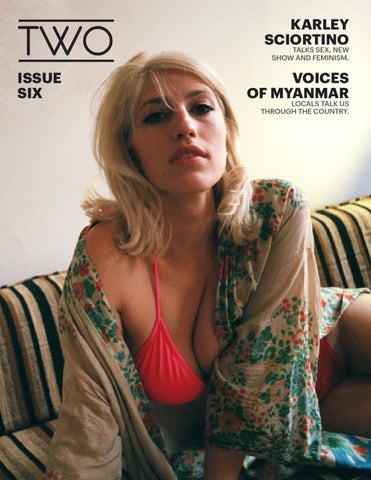
TWO ISSUE SIX
KARLEY SCIORTINO
TALKS SEX, NEW SHOW AND FEMINISM.
VOICES OF MYANMAR
LOCALS TALK US THROUGH THE COUNTRY.
CO NTENTS
14 REGULARS OPENERS SEX HOMEGROWN FACES CALENDAR THE END PIECE
4 7 17 24 32 34
FEATURES ABBEY CONTROVERSY CAMERON RUSSELL LIVING ART KARLEY SCIORTINO OSCAR CAMPAIGNS VOICES OF MYANMAR
8 10 12 14 20 22
REVIEWS FILM GAMES // LITERATURE MUSIC FILM TV ART // STAGE
26 27 28 29 30 31
Editor Henry Longden Creative Director Atalanta Copeman-Papas Deputy Editor Meadhbh McGrath Copy Editors Lola Boorman & Lily Ní Dhomhnaill Online Editor Matthew Mulligan Business Manager Sam Dunne Editorial Staff Gabija Purlytė // Issy Thompson // Louise Hynes // Eoin McCague // Sarah Lennon Galavan Cian Clynes // Alex Milne-Turner // Chris Rooke // Patrick Cremen // Lily Ní Dhomhnaill Lola Boorman // Tara Joshi // Liam Maher // Katherine Murphy // Kayla Marie Walsh Ciara Forristal // Eva Short Photo Editor Molly Rowan-Hamilton Illustrators Alice Wilson & Graham Haught Special Thanks PJ Moloney, Jennifer McCahill and the Trinity Publications Committee // Elaine McCahill & the Staff of Trinity News Mark Grehan and all at Grehans Printers // Aaron Devine // Graham Haught // Lily Ní Dhomhnaill // Suzie Bennett // Coco Young // Kelsi Carpenter // Xanthe Caldecott ISSUE SIX // 3
OPENERS
ART ON THE GREEN ART Famine by Edward Delaney. The north-eastern corner of St Stephen’s Green is, at the very least, an exciting entrance to the park. In the early 1960s a competition was held for architect and sculptor partnerships to redesign the site which had been designated for a long-planned Wolf Tone monument. The winning entry by Noel Keating included a granite screen which provides XANTHE CALDECOTT a background, not only for the monumental Tone figure, but also for the Famine group on the park side, both created by sculptor Edward Delaney in 1967. The latter sculptural composition is one of the earliest memorials to the Great Famine. Set at ground level and on a human scale, somewhat removed from its surroundings by its scenic backdrop, it is just as appealing aesthetically as it is emotionally gripping. The roughly textured bronze serves here to convey a sense of decay and death; the elongated bodies can be read as emaciated, yet they are also endowed with an undeniable grace and plasticity — note the elegant sway of the figure on the right, poised in a classical contrapposto. The sculpture was very well received, with the exception of the dog figure — though justified by contemporary Famine testimonies of dogs “well fed on human flesh”, it was seen as grossly out of context, so much so that it was stolen and hidden for a while by a particularly outraged member of the public... GABIJA PURLYTĖ
CALL ME MAYBE
GAMES Technology conferences are an awful lot like buses: you wait months and months for one, and then a whole slew arrive at once. With CES over, eyes are turning towards Barcelona and the annual Mobile World Congress at the end of February. Will Mobile World Congress reveal some brand new ideas? In short: no, although it seems that the potential announcements could still be very interesting. Two of the tech world’s newest acquisitions will be front and centre: Nokia’s first show under the control of Microsoft promises to be very interesting, and could well be the first official showing of the newest version of the Windows Phone operating system. Beyond that, it seems a brand new Windows Phone tablet could be on the cards: the first of its kind, and potentially a real contender in the tablet market for Nokia. LG and HTC are both expected to release updates to their flagship models from last year in the next few months: the LG G2 will be given a spec bump in the form of the G Pro 2, while the HTC One is likely to be replaced by a new flagship Android phone from the Korean manufacturer — although with the success and popularity of the aforementioned One, it would be odd if some spec or design decisions didn’t translate to the new model. And, never to be forgotten, after a relatively quiet January, Samsung are likely to be in full swing with phones and tablets of all shapes and sizes, specs and prices. All of the updates are very much incremental, with no truly new innovations or features. With Apple expected to release the iPhone 6 with a new design and new features later on this year, it seems odd that other phone manufacturers aren’t pre-empting that release as they have done in the past. The iPhone 6 is rumoured to be bigger, potentially with a curved screen, and is likely to include some new tech such as NFC (Near Field Communication) chips. Perhaps the tameness of this year’s MWC gives a glimpse of a fairly quiet year for mobile devices: they’ll be faster and prettier, no doubt, but perhaps there won’t be much beyond that. CHRIS ROOKE
THE START OF THE FRANCHISE FILM The 1980s offered bodacious babes, awesome action, and wardrobes and hair destined to be laughed at by future generations. Beyond the birth of the Brat Pack, the decade also brought forth the beginning of movie franchises; Batman, Terminator, Predator, Die Hard, Back to the Future, and A Nightmare on Elm Street. All of these heavyweight film enterprises began in the 80s and have spawned sequels, prequels and retellings for the last 30 years. The period was the time in which Hollywood realised people had tremendous loyalty to certain characters and storylines. Later decades gave us some decent, and some brilliant, sequels — most notably Die Hard with a Vengeance. As the audience we were happy to see our leading heroes again, and they kept coming because original ideas have long since become extinct in the realm of major studios. Why risk 80 million on something new when you know Indiana Jones 5 is going to fill seats? They may not be as exciting as the originals, but Hollywood can keep pumping away at remakes of our favorite 80s adventures — if nothing else, we are guaranteed nostalgia.
CAROL DAVEY
4 // TN2MAGAZINE.IE
OPENERS
FRONT SQUARE FASHION
ANNA O’SHEA BY MOLLY ROWAN-HAMILTON
This is a girl who knows what’s what. She knows black is the new black, covered is the new sexy, that paireddown luxe grunge is the most hotly anticipated trend for SS2014. Understated, simple, stylish, this ensemble is sultry yet sophisticated. Content with block colour, this sophister plays with texture, contrasting her skinny cropped jeans with a boxy leather jacket, toughening up her soft leather bag with a chunky pair of boots. Braving the cold to bear her ankles, this tousle-haired Social Policy and Sociology Student works her waif-like glamour in a way that would make Kate Moss weak at the knees. ISSY THOMPSON
STONE LEVITATION ALE Stone Brewing // 4.4% abv. DRINKS Having found it virtually impossible to get my hands on Stone Brewing Company beers since spending the summer in California, their recent arrival in Dublin is nothing short of amazing news. Best known for their bold and aggressive beers loaded with alcohol, Levitation Ale — a gold medal winner at the Great American Beer Festival in 2007 — is one of the few beers I’ve come across with a low alcohol content that isn’t lacking or devoid of flavor. This beer packs as much depth as countless IPAs and is brimming with hops too. Unlike many craft beers, this is one you can enjoy all night, and very easily at that. AVAILABLE AT: BAGGOT STREET WINES, THE BREW DOCK, CELTIC WHISKEY STORE. €4.29. CONOR DALEY
LITERARY MILESTONES LITERATURE February 13, 1976 Mario Vargas Llosa punches Gabriel Garcia Marquez. In 1976 one of the greatest modern literary showdowns took place in Mexico — appropriately perhaps, at a film premier — when Peruvian novelist Mario Vargas Llosa sucker punched his then best friend and contemporary, Gabriel Garcia Marquez. The story goes that, after not having seen each other for a period of time, both authors attended the film screening. When Garcia Marquez picked his colleague out of the crowd of milling Latin American intellectuals he advanced toward Vargas Llosa with arms outstretched crying “Mario!”. Vargas Llosa’s response to this gesture of Romantic companionship was a quickly administered and effective right cross which left the Columbian Nobel Prize-winner with a less-than fictional shiner. Speculations about the motivation behind Vargas Llosa’s fury have ranged from the two authors’ divergent political views (Garcia Marquez being a personal friend of Fidel Castro and Vargas Llosa drifting more decidedly to the right) and professional jealousies (Mario wasn’t happy that Gabriel was picked for the Swedish Academy’s team first). More recent illuminations have suggested a more operatic reason for the spat: an alleged and still ambiguous love triangle with Vargas Llosa’s wife Patricia. Don’t let the Nobel Prizes fool you; these authors are no strangers to the baser urges. LOLA BOORMAN
BRUNCH OF THE WEEK THE BAKEHOUSE FOOD Dubliners are spoilt for choice at the weekends for quality brunch destinations, however, such offerings are scarce come weekdays. The Bakehouse is one of the few eateries that fills this void in the market. Among the midweek brunch options, the Pork and Leek Sausage Sandwich (€6.95) and Bacon Buttie (€8.95) are, surprisingly, the highlights of the menu. Both are considerable portions and
SUZIE BENNETT
come served with signature Bakehouse relish and bloomer bread. What differentiates the Bakehouse from other Dublin brunch spots is the array of freshly baked pastries and cakes from which to choose. On open display at the front of the restaurant, these sweet treats alone make the Bakehouse worth a visit. CIAN CLYNES
ISSUE SIX // 5
OPENERS
SOUNDS OF THE CITY
MUSIC Malamulele in Limpopo, South Africa, is the mecca of what has been termed “shangaan electro” — a type of music characterised by its high BPMs, marimba based beats, and the frenetic dancing that goes along with it. It has moved from Limpopo to Soweto, which is now the shangaan hotbed, and has produced many of the artists which Honest Jons (the main label releasing shangaan) have released. The connection between the London-based label and shangaan came through the work of musicologist Will Glasspiegel, who was studying in South Africa and helped the influential shangaan kingpin, Nozinja, hook up with Damon Albarn’s label. Traditional shangaan music is a mix of flowing guitar lines on top of live drumming and is best illustrated by artists such as Thomas Chauke and General MD Shirinda, the latter of whom appeared on Paul Simon’s classic album Graceland. From its traditional roots it has moved onto the electronic version that Nozinja has popularised, with some of its tracks hitting a breakneck 180 BPM, although it took quite a few years before his take on the genre was accepted. Nozinja runs a studio from his Soweto home, where he apparently produces over 50,000 records a year and edits a stream of music videos which are mostly filmed in front of a green screen and interspersed with footage of dancers outside shangaan townships. From its humble roots, shangaan music has been introduced to the world of electronic music via Honest Jons. From here a slew of remixes followed from perennial UK producer Actress, Ricardo Villalobos and Chicago footwork dons Spinn and Rashad. Like the aforementioned footwork genre, the dances that go along with the music are an essential part of not only shangaan electro as a cultural phenomenon, but also its live component. Fast dance moves are encouraged, but anything too risque or judged to be inappropriate is jettisoned quickly. The focus of the shangaan dance for the female dancers is the waist, from which the dancers’ xibelani skirts (knee-length and covered with beads) accentuate every movement. For the males the focus is mostly on the feet. While the scene has grown exponentially over the past few years, at heart its aesthetic has changed little, and this has to do with Nozinja’s strong control over the music’s dissemination, and his firm conviction that it should stay true to its local roots. LIAM MAHER
JOIN THE CONVERSATION
@tn2magazine facebook.com/ tn2magazine 6 // TN2MAGAZINE.IE
UPPERS & DOWNERS SOCIAL CURRENCY // Opening in New York this week, the Daisy Marc Jacobs Tweet Shop is a concept pop-up store offering MJ’s products in exchange for the best tweets, Instagrams and Facebook mentions. KELELA // The LA-based R&B singer has just released The High, a slow-burning and seductively minimal follow-up single to her stunning debut mixtape
Cut 4 Me. POOL SLIDES // From the clean, athletic lines of the Adilette to the chic white Arizona Birkenstocks or the more glam golden Stine Goya version, the unexpected shoe trend from last summer is here to stay. NEW GIRL // Prince, who describes himself as a “huge fan” of the show has requested a cameo, telling execs, “I want to be involved in the show in a real way and I want to help Nick and Jess with their relationship.” TARANTINO SHELVES THE HATEFUL EIGHT // After the script for his upcoming western was leaked Tarantino decided to abandon his filming plans entirely, describing himself as, “Very, very depressed. That’s a betrayal.” THE BIG, BOUNCY BLOW-DRY // Spring 2014 is about minimalist, poker-straight hair, whether tied in a sleek ponytail, down with a centre parting, or held in place with metal barrettes.
MASHA AND NADIA SELL OUT // Following an expensive Amnesty International benefit concert hosted by the freed pair, Pussy Riot penned an open letter disowning its former members, “All this is an extreme contradiction to the very principles of Pussy Riot collective.” THE NEXT THELMA AND LOUISE // Cara Delevingne and Michelle Rodriguez are rumoured to have been cast in possibly the most unnecessary remake of all time. MEADHBH McGRATH
S
E
DIL-DO’S AND DON’TS. “WHAT CAN ADD TO A WOMAN’S ALLURE CAN DESTROY A MAN’S APPEAL, LABELLING HIM A LONELY PERVERT FOR NO GOOD REASON.”
Y
ou’re kissing in the taxi. Giggling as he fumbles with the keys. Making sure you’ve got his name right as he races you up the stairs. The room is bare, there’s a chest of drawers, the top one’s left open and something catches your eye — you freeze. “That’s just my fleshlight,” he smirks, pulling you closer. What do you do? Let’s swap the situation. Make this a woman’s house and a clumsily concealed Rampant Rabbit, and you’ve got a cele brated Sex and the City cliche and a tick in the sexual deviant box. Not so for the man in most cases. What can add to a woman’s allure can destroy a man’s appeal, labelling him a lonely pervert for no good reason. While vibrators for women have been lauded as a symbol of liberation, masturbators for men have never enjoyed the same sort of attention. They’re unfairly tossed in the same pot as creepy plastic dolls and an over-dependence on porn. If a man is looking for more than the everyday wank, he’s ostracised, despite the huge leap in toys available for solo use by men. Sex Siopa, Ireland’s own health and design focused sex shop, has a selection of products that would pique anybody’s interest — in a good way. They’re sleek and sophisticated, and are far more impressive looking than your average hot pink dildo. So why the double standard? Why the insistence that he shouldn’t be able to satisfy himself with anything but his hand or the real thing? This prejudice works against women,
X
“BUT THAT’S THE THING: THERE’S ALWAYS A DEVICE IN THE SCENARIO. WOMEN ON SCREEN ARE RARELY ALLOWED TO TAKE CONTROL OF THEIR OWN STIMULATION WITHOUT A PHALLUS IN HAND, WHILE MEN ARE CASUALLY WANKING EVERYWHERE.”
too. Take Sex and the City again. How many times a season did one of the women reach over to her nightstand for something battery-operated? How few times did we see any of the women “drop the hand”? In a show that made masturbation such a regularity for its characters, manual masturbation was still out of the ordinary. Let’s take something a little more recent. When Sketch broke into Maxxie’s room in Skins, it was always going to be freaky. However, don’t you think if she had pulled out something with bunny ears for the scene, instead of just going for it by herself, things would have been a little bit more frivolous and flirty? Catch up to 2013, and we’ve got the controversy sparked by CW’s censoring of a manual masturbation scene in an episode of Reign, a historical
fiction series notably filled with graphic and sometimes violent sex. The original depiction of the self-pleasure of a teenage girl was stripped down by the network to a few suggestive shots, despite taking place in between two explicit sex scenes. While men are restricted to their own natural resources, single women are able to have fun with whatever device they want. But that’s the thing: there’s always a device in the scenario. Women on screen are rarely allowed to take control of their own stimulation without a phallus in hand, while men are casually wanking everywhere. I must here praise HBO’s Girls, which had Marnie reaching under her dress in a public bathroom in a scene that matched Lena Dunham’s usual surprising openness. But why was it such a surprise? Why are men disclosing their weekly wanking number at the water cooler when a woman can only go so far as admitting ownership of a vibrator? Sex toys are a personal choice, and obviously the cast of SATC could afford whatever pleasures they fancied and maybe preferred a little electrical help. But wouldn’t it make sense if the playing field balanced out a little? If men could head into a sex shop for more than just a Valentine’s present for their partner, and women could open up about their real habits without displacing the power to an inanimate object? Sex toys and simpler masturbation should be openly enjoyed by anyone looking for fun.. WORDS BY HEATHER KEANE ILLUSTRATION BY GRAHAM HAUGHT WWW.GRAHAMHAUGHT.COM
ISSUE SIX // 7
MUSIC
J NOTES ON A SCANDAL KAYLA WALSH INVESTIGATES THE RECENT FEUD BETWEEN THE ABBEY THEATRE AND THE IRISH TIMES, AND REFLECTS ON HOW THE ARTS AND THE MEDIA HAVE BECOME INEXTRICABLY BOUND 8 // TN2MAGAZINE.IE
anuary was a controversial month for the arts in Ireland. It began with scandal over the policies of the board managing the Limerick City of Culture project, which saw the resignation of its artistic director, two non-staff programmers, and, eventually, its CEO. We then witnessed the appearance of Dublin’s most famous drag queen, Rory O’Neill (alias Panti Bliss) on the Saturday Night Show, during which he referenced John Waters, Breda O’Brien and The Iona Institute in a discussion about homophobia in Irish media. This sparked a backlash of complaints and threats of legal action, leading to RTÉ removing the interview from its website and handing over €85,000 in damages to the offended parties. Finally, to add to the chaos within the arts sector, 79-yearold playwright, filmmaker and peace activist Margaretta D’Arcy was sentenced to three months in prison for protesting against US military use of Shannon airport. These events attracted a huge amount of media coverage, drawing more and more people into the debate. People and institutions within the arts have always had a complicated relationship with the press. On one hand, they rely on journalists for their livelihood — to get the word out about their work, to write reviews of their shows and encourage readers to see them, or to give them feedback so they can improve. On the other hand, the press can destroy them, exposing their flaws and corruptions and deterring potential audi-
MUSIC
ences and patrons from supporting them. The power and influence held by the media has resulted in an uncomfortable situation, wherein artists court and flatter the press, giving them special treatment, while at the same time viewing them with distrust or resentment. The tension between journalists and artists can clearly be seen in the recent feud between The Irish Times and the Abbey Theatre. Last month, the newspaper published an article revealing that, according to a panel of assessors, the Abbey is failing to meet its goal of producing “world-class theatre”. The judging panel consisted of Mike Griffiths (former administrative director of the Traverse Theatre in Edinburgh), Ray Foster (a professor at Oxford University), and Nicolas Kent (an English theatre director). They were appointed by the Abbey, in conjunction with the Arts Council, which provided the national theatre with €7.1 million in funding last year — almost half of the total annual grant awarded to performing arts organisations in Ireland. The evaluations were commissioned in order to “attempt to resolve continuing tensions between The Abbey and the Arts Council”, but the results were undeniably disappointing. The panel, who assessed twelve productions in all, ranked only four as “very good” or “excellent”, while elements of some productions were determined to be of an unacceptably low professional standard. The director of the Abbey, Fiach MacConghail, penned an angry response to
the “cruel” and “unprecedented” publication of these reports, which were obtained under the Freedom of Information Act. He claimed that The Irish Times failed to provide a clear context for the evaluations, that their contents were “private” and that the process was not yet completed. Understandably, he defended his theatre, explaining the difficulties of working with diminished resources and stating that “artists should be able to create theatre and art in supportive and respectful conditions”. In his opinion, the venue is meeting its goal of engaging with and reflecting Irish life, and the newspaper had no right to jeopardise its commercial success or refuse to take into account the artistic sensitivities of the theatre practitioners involved in its productions. Other artists, journalists and writers are divided over the debate. Some have berated the Irish Times for its apparent opportunism and attempts to undermine the Abbey during the three-day Theatre of Memory of Symposium it hosted last month. Others are firmly on the side of the publication, believing that information of this nature should always be made available to its readers. The Irish Times theatre critic Peter Crawley spoke to tn2 regarding the controversy. He declared that, given that the Abbey was responsible for calling in the panel, the problem is one of the theatre’s “own creation”. Like any publicly funded institution, it must be available for public scrutiny. The
Arts Council, too, should be submitted to such an examination. The public wants to know where its money is going and whether it is being used wisely. In addition, Crawley explained how the term “world class” is problematic and unclear: “It’s about who’s asking whom. Who regulates the standards of ‘world class’ and what does that term actually mean: that a production can play as easily in Delhi or Wroclaw, Sao Paulo or Hamburg? Or does it mean that a production can play, more specifically, in London or New York? Or is it something more uncomfortable, insecure and postcolonial: the Irish National Theatre seeking ‘world class’ legitimation from the UK?” Regardless of whether or not one agrees with the publication of the reports, it is obvious that they have placed strain on the relationship between the theatre and the press. In the eyes of MacConghail, The Irish Times have launched nothing less than a malicious attack on the theatre. Taking into account the events mentioned above, this only adds to the idea that the arts are currently under siege in Ireland. In today’s society, the arts are often underappreciated, shunted aside or forgotten about in favour of “more important” issues. Newspapers and theatres are (usually) full of creative, hard-working people who want to make a difference. If you ask me, they should be working together. WORDS BY KAYLA WALSH WITH KATHERINE MURPHY ILLUSTRATION BY ALICE WILSON
ISSUE SIX // 9
A QUESTION OF BEAUTY
tn2 TALKS TO MODEL CAMERON RUSSELL, WHO DECIDED TO LAUNCH INTERRUPT MAGAZINE, A PARTICIPATORY MEDIA PROJECT, FOLLOWING HER EXTREMELY POPULAR TED TALK. Predictably, the long-legged, outspoken Amazonian, Cameron Russell, works from a crumbling office block in Brooklyn. In defiance of the allure of Manhattan with its bright lights and its billboards, Russell runs her collaborative magazine, Interrupt, from a dingy second-floor walk up. It is fitting that Russell — the Colombia-educated supermodel, Victoria’s Secret Angel and journalist — should work whilst rubbing shoulders with the gritty realities of the city. For reality, in essence, is her mission. Not content with the superficial world of high fashion, of which she is an integral part, Russell has publicly decried aesthetic elitism, and has audibly voiced her desire for change, her hopes for a society based upon equality rather than physical hierarchy. It was her nine-minute TED talk that placed Russell in the spotlight. She took to the stage — the archetype of physical perfection — wearing a thigh-skimming dress and promptly changed into a peasant skirt and dowdy pumps, in a declaration that image is superficial, image is easily changed, and image is undeniably, and dangerously, powerful. “I am on this stage because I am a model,” she declared, a poignant look on her handsome face, “I am a model, because I am a pretty white woman.” Arguing that modelling is not an aspirational industry, speaking of how it shocks her that young girls would rather pose than become the next president, Russell branded her own profession as exclusive and exploitative. She projected a picture of her at sixteen, posing in a provocative manner with a male model, her lithe back suggestively arched — “I hadn’t even had a boyfriend then,” she noted. She moved onto another picture, in which again, she exudes sexuality — “I hadn’t even got my first period”, she told the audience. Russell’s TED talk has had over 5 million hits, and the enormity of its impact, the wealth of positivity it has received, inspired the birth of Interrupt. Based on an open letter Russell wrote, in which she asked “What would you do if you had access to the mass
media?”, the magazine is her attempt to publish and project the multitude of voices that constitute reality. It rejects the inaccessible gloss of mainstream magazines, and runs features that are engaging and, crucially, tangible — real stories by real people. Each issue of the magazine is themed, and based upon an open submission policy. “We put out an open call,” Hannah, the Arts Editor of Interrupt, told tn2, “Send in what you want to talk about…it’s all about opening it up to discussion.” So Russell believes in the power of dialogue, in creating a space where a cacophony of voices can blend and clash, where, as Hannah explained, “people can be heard”. Their issue on body image was extraordinarily powerful. They attempted to gauge how the widespread worship of tall, white women makes normal women feel about themselves. Paradoxically, it is Russell trying to find the true social impact that her career has on the lives of ordinary people. The results were shocking. One contributor asked a group of young girls from the ages of four to eleven years-old how they felt about their bodies. “It was crazy,” Hannah recalled, “it sky-rocketed all over Tumblr. It was a real eye-opener of how body image deeply affects girls at such a young age.” Their next issue will be on DIY, a phenomenon that, according to Interrupt, is sweeping the Internet. “We have entered an age of instant gratification,” Hannah explained, “but people are starting to realise that they can make things at home.” It is all part of their democratic ethos — sharing, creating, trying to form something new. “It is just crazy how people will share,” they declare, “there is no limit on your age, race or sexuality. If you have an experience that you feel the world needs to know, then share it with us.” Interrupt, then, is part of Russell’s search for reality, her foray into the anxiety of a real world that is disconnected from the airbrushed sphere of fashion. Yet there is one obstacle in the way of her desire to make a change. Her laudable intentions are
undercut by the fact that she is still a practicing supermodel. She preaches equality, but practices what she deplores. She has built her reputation upon her rejection of the hierarchies of contemporary culture, but she still remains comfortably at the top, willing to expose the industry, but unwilling to give it up. And she is even less willing to talk about this glaring contradiction. An email exchange with Russell is a frustrating experience. When pressed about the discrepancies in her ideology, the brainbox of the aesthetic elite is polite, unrelentingly measured, and does not want to talk. Her response is puzzling considering the questions levelled at her were focused on the issues of body image and physical exploitation, how she reconciles modelling with her lack of faith in it — fertile ground for Russell the renegade who appears to be so passionate about the pitfalls of genetic elitism and social inequality. Russell is a complex figure. A champion of alternative forms of media, dedicated to articulating the voices of those whom society misrepresents, she is unwilling to confront or explain her contradictory ethos. Horrified by the notion that modelling is considered to be an aspirational career path by young girls, she was Elle’s cover-girl last month. She featured in an extended shoot, wrapped in layers of chiffon and silk, languishing in the desert in all her leggy glory. The shoot was accompanied by an interview, where Russell spoke of her lack of engagement with the fashion industry. The benevolence of Russell’s intentions should not be underestimated, nor the positive impact that they have had. Yet it is hard for young girls to register her belief that fashion is superficial when she is staring at them from a billboard in Manhattan; beautiful, intelligent, resoundingly perfect. Russell’s TED talk was brave and resonant, and it takes a woman of a distinctly high calibre to admit that she is the winner of a genetic lottery, but the problem is, she still seems to be capitalising on it. WORDS BY ISSY THOMPSON
ISSUE SIX // 11
CURTAINS UP GROWING UP IN AN ART INSTALLATION HAS AN EFFECT ON YOUR CHILDHOOD. MAISIE COTTELL REFLECTS ON AN EXTRAORDINARY 13 YEARS.
THIS PAGE (L-R): BACK TO FRONT, 2011; STILL LIVE, 2003. OPPOSITE (L-R): “MAISIE” IN COLLECTING TIME: THE LIVING AND THE DEAD, 2005; COLLECTING TIME: THE LIVING AND THE DEAD, 2005. ALL PHOTOS BY TERRY WATTS.
12
Ever felt you couldn’t bring your friends back to your house because you were too embarrassed? Or you simply wouldn’t know how to explain what they would find there? To this day I can count on one hand the amount of times some of my closest school friends, people I’ve known for over ten years, have been to my house. I like to think of my family as a mix of Fawlty Towers and Absolutely Fabulous: openly dysfunctional either way. My dad devours books, plays instruments and can build his own furniture. Equally he accumulates — no, hoards — antiques to a point where he has filled three sheds in the garden and we have four pianos and an organ in the house. And this is not a large house. Not to mention, in one of his finer moments, he was banned from my school parent’s evenings after turning up stoned one year and upsetting the geography teacher. My mum is your average artist who takes her kids on anti-war marches, has a perchance for asymmetri-
"IMAGINE EATING YOUR BREAKFAST IN A KITCHEN BEHIND A BLUE NET AS A PILE OF RANDOM STRANGERS STAND ON THE OTHER SIDE TAKING PHOTOGRAPHS OF YOU IN FASCINATION." cal haircuts and Dr. Martens, and loves to dance. Actually they both love to dance. All in all they are a very supportive, perhaps slightly offbeat, pair who have been known to throw a good party or two. Also, for the last thirteen years they have turned my house into an art installation. My mum is an artist who works primarily in installation, often with a live element (although she has dabbled in performance art — I once watched her stand in a UV lit room and stab herself, causing pockets of UV paint to burst from her dress, a sight for any eight -year-old). So as my dad’s burgeoning antique collection started to touch the ceiling my mum decided the best way to deal with it would be to convert the house into art. Inviting random strangers to come into our house and watch… Really, I like to think of it as a metaphor for their marriage. Whenever my dad had overstepped the mark and we once again had two layers of furniture against a wall instead of one, my mum seemed to respond with a “well I’ll just have to do an art installation then!” To be fair to her, one day I did come home from school to find my dad had taken up some floorboards in the living room and was proceeding to hide various items of taxidermy under them. And so what began as an attempt to stem a flow of cameras, old microscopes and a lot of stuff that seemed broken in the first place, from entering our house has ended up lasting thirteen years and been affectionately titled “The House Projects”. “The House Projects”, in conjunction with Cafe Gallery Projects, have involved building huge installations that have
carved through our house, operating as viewing platforms in which the audience move through the building and observe the occupants. Starting in 2001 the installations were listed in Time Out and The Guardian and every Sunday the house would be open to the public, with up to 200 people coming a day. The installations have had various reincarnations, from raised white platforms to blue netted tunnels, but what has remained constant is the separation between the viewer and the occupant. Of course the point was that the house was ours and the occupants were my sister Lulu, Dad and I. More often than not still in our pyjamas. Imagine eating your breakfast in a kitchen behind a blue net — which you’ve only managed to get to by going into the garden and climbing back in through the kitchen window — as a pile of random strangers stand on the other side taking photographs of you in fascination. Or stubbing your toe on a newly erected installation and swearing loudly as you walk into the kitchen only to find an art critic sitting at the kitchen table. An art critic who incidentally had just asked your mum how her family copes living with this, to which she’d replied, “Oh they’re fine with it.” Although my mum did generously wait till I’d come to Dublin before she decided that one of the installations should carve straight through my bedroom, a difficulty that comes with having a bedroom downstairs. We would live with these installations for months, sometimes years, at a time and so they became part of the furniture. We ate Christmas dinner on them, did our homework on them and of course they were our very own stages. Mum once heard a woman on the radio
telling her daughter that it didn’t matter what life threw at you because she could put it all in a book one day. To which, mum came straight into the living room yelling to me and Lulu, “See, you’ll put all this in a book one day!” I think we just looked up from the TV rather unimpressed both having just put on our fourth jumper as, due to a new installation, we couldn’t close any doors and it was December. Only on going back into the kitchen did she catch the rest of the radio program and realised that said woman was describing escaping civil war. Mum did admit this Christmas that perhaps the whole thing had been “a bit mad” but if I ever write that sketch show I’m not short of material. And I am sure it has, in part, led to me spending the last four years knocking round Players designing sets. Plus, although I’d never say it to her face, you do really appreciate your sibling because you realise they saw it all too. A visitor to the house who discovered me eating breakfast one Sunday morning behind the blue net once asked whether I was at art school myself. On replying that I was studying English Literature she gasped disbelievingly, “Oh god you must have no idea what’s going on then!” Restraining an urge to throw my cornflakes at her, I smiled, shrugged and allowed her, with her MA in Critical Theory to enlighten me — why were there all these people in my house? But perhaps she was right, not that I didn’t know what was going on, but that, as most people find, it has taken having distance from my house to take stock of the upbringing we had and what we lived in. In hindsight I do sometimes think someone should have called social services.
ISSUE SIX // 13
BETWEEN THE SHEETS
TV EDITOR CIARA FORRISTAL TALKS TO SLUTEVER’S KARLEY SCIORTINO ABOUT SEX, BLOGGING AND HER ROLE IN NEW COMEDY WEB-SERIES BE HERE NOWISH. “I think that as an artist, when you open yourself up to the world — when you allow yourself to be ‘naked’, so to speak — that’s when you truly connect with people.” Karley Sciortino is a sex blogger who does just that and is part of the generation of bloggers who are willing to open themselves up and expose the naked truth about sex in the infinite realm of the blogosphere. Her blog Slutever is both empowering and entertaining, maintaining the perfect balance of information and frank disclosure in a society still awash with perpetuated myths and shame regarding sexual practices. Sciortino states that “so much of what we fear and discriminate against comes from a simple lack of understanding”, and her main aims are to “humanise people who are often thought of as ‘sex freaks’ and to support all types of consensual kink”. Although the blog has become synonymous with sex, Sciortino admits that its origins were purely personal and anecdotal, focusing on the everyday, including her sexual experiences as “I’ve always been quite a sexual person, and feel comfortable and confident talking openly about sex.” Everyday life, however, was far from mundane, with Sciortino living in a south London squat where, “it wasn’t out of the ordinary to come home to a living room full of naked people on DMT conducting some sort of makeshift ritual, or to find a homeless Romanian family you’ve never met before baking bread in the kitchen”. These bohemian antics and her alternative lifestyle continue as the blog progresses, with Sciortino stating that “it organically turned into a blog that deals mainly with sex, as I got more interested in BDSM [Bondage, Discipline, Sadism and Masochism] and sex
work”. Experimentation features in her blog and Sciortino confessed that “Slutever” came from a high school friend who substituted “whatever” for “slutever” — a substitution which she remembered when creating her blog. “In hindsight it was a perfect choice, because I think it’s fun, frank and sarcastic, but also relays a pro-sex message, and I like to think the same is true about my blog.” The frankness and sarcasm that is prevalent throughout her blog is anticipated in Natalia Leite and Alexandra Roxo’s new comedy web-series Be Here Nowish, which achieved its funding through Kickstarter. The show centres on two sexually progressive New York girls who run off to LA in pursuit of a spiritual awakening. Sciortino describes it as being “similar to Portlandia, except in LA — so basically it’s a sexy show that highlights the humour in the rituals of new-age culture, things like astrology, ‘power cleanses’, yoga, and medicinal plant ceremonies — which is all very popular in LA right now.” The show aims to strike a balance between parodying these alternative cultural rituals whilst respecting people’s beliefs toward them, as Sciortino adds “Alexandra and Natalia are both very involved in new-age culture in their personal lives, so they are using the show to illustrate the humour in something that is actually very important to them.” Sciortino plays a “ditzy, yoga-loving, trust-fund lesbian”, and although she herself has not had the spiritual experiences of her co-stars, the exploration of sexuality that is a core component of the show, features heavily in her blog. “There’s threesomes, lesbian relationships, some S&M — and those experiences I could definitely relate to,”
and even if audiences had similar experiences, Sciortino believes that “anyone who is at all sexually or spiritually curious, or who has ever felt a little bit lost in the world, will definitely connect with the characters in the show.” Comparisons, of course, will be made with Lena Dunham’s Girls, which also charts the overwhelming restlessness of twentysomethings, “I feel like every time a girl creates something, people instantly compare it to other things that girls within her age group or vague social bracket have created, and I think we need to stop doing that, because it’s really lazy.” Indeed, given that Be Here Nowish focuses primarily on lesbian relationships which will also feature in the third season of Girls, how does Sciortino feel about the portrayal of homosexuality on television? “I think the portrayal of lesbians in mainstream media is often very cheesy and encourages stereotypes, so what’s
ISSUE SIX // 15
great about Be Here Nowish is that it’s real, honest and also is a self-aware portrayal of the gay communities in New York and LA.” Now based primarily in New York herself, Sciortino admits that with a liberal circle of friends it is easy to “sometimes feel like I live in a bubble”. However, having grown up in a strict Catholic family she is well aware of the realities for many queer people, especially homosexuals, as she herself “can’t talk about having a girlfriend, and I can’t bring my girlfriend home for the holidays or anything like that”. With liberal attitudes in her blog, columns and artistic endeavours, there is no doubt that she has ruffled a few feathers along the way, particularly in her attitudes toward sexuality and feminism. One such instance is her dismissal from feminist blog Jezebel for which she wrote an advice column. The reason for her departure? “I got a lot of hate comments from their readers, for being too irreverent about sexuality and feminism.” Sciortino herself is wary of the term “feminist” and the connotations it bestows, admitting that although she identifies as a feminist, she states that “I’ve always said that I think that what I do is more a product of what feminism has achieved than an avid act of feminism itself.” With the constant debate surrounding the hyper-sexualised imagery of women in today’s society, Sciortino adds that there is still a double standard within society, with the practice of slut-shaming alongside the open discussion of promiscuity and masturbation. Sciortino hopes that a middle ground is found “where girls feel comfortable and confident enough to dress and act as slutty or as prudish as make themselves happy, and don’t feel pressure to act in one way or another in order to please other people”. Indeed, Sciortino’s blog
“EVERY TIME A GIRL CREATES SOMETHING, PEOPLE INSTANTLY COMPARE IT TO OTHER THINGS THAT GIRLS WITHIN HER AGE GROUP OR VAGUE SOCIAL BRACKET HAVE CREATED.” encourages readers to feel comfortable in their sexual exploration and she highlights the experiences of women whose sexual preferences and practices might lie outside the realm of conventional norms. Sciortino mentions her interview with Sarah, a quadriplegic dwarf who is bedridden and permanently on a ventilator and who interacts and lives vicariously through her avatar in the virtual world of Second Life. The interview had a profound impact on Sciortino who states that “I found it really inspiring that she found a way to overcome her disability, and in the interview she talks about losing her virginity, getting her first job, and doing all the stuff normal young girls do, just in her own unique, virtual way.” Interviews such as this, highlight Sciortino’s ability to highlight and humanise the sexual practices of society, both within and outside the realm of conventionality in a non-judgemental and thought-provoking fashion, and Sciortino believes that “people appreciate the honesty”. PREVIOUS PAGE (CLOCKWISE L-R): PHOTOGRAPH BY COCO YOUNG, THREE PHOTOGRAPHS BY KELSI CARPENTER. THIS PAGE: ALL PHOTOGRAPHS BY STACEY MARK
16 // TN2MAGAZINE.IE
HOM EGR OWN Soul is not normally a term one would associate with the Irish music scene. But then again, Danny Groenland and his band, the Major 7ths, don’t work in a way that is comparable to other bands. All the material for their debut album, due to be released this year, was recorded after having only performed one gig. As Groenland himself elaborated, “we work the opposite way to most bands in that we did one live gig and started recording immediately. My idea was to assemble a crack team of musicians and get them in a studio as soon as I could and record because they’re all so busy with different projects.” The album was recorded by his father Jack Groenland, and “has a very family feel to it”. The interaction between the members’ various side projects and what they bring to the Major 7ths is an essential part of what forms their distinctive blend of soul, funk, jazz, hip hop and African music. For Groenland himself, joining a Gospel choir two years ago has influenced his “harmonies, harmony blending and voice leading, even if it’s a subconscious thing”. Having grown up listening to artists like The Beatles and Crosby, Still and Nash — bands whose material often has three and four part vocal harmonies — he moved on to the Motown sound, which had “a groove behind that base”, and quickly a whole new obsession began. Groenland’s main influences are “Marvin Gaye, Motown and more recently D’Angelo and other current soul singers”. Drummer Dennis Cassidy comes from the hip hop school of thought while Groenland’s brother Paddy is a jazz guitarist. The pianist Johnny Taylor also shares a jazz background and “has a real feel for accompaniment”, while bassist Graham Heaney is a funk musician
through and through, having played in groups such as The Candidates. When it comes to writing material for the group, ideas generally come to Groenland as he walks about Dublin: “I don’t have an MP3 player and I walk everywhere so I’m usually singing something, either hooks or new ideas. Then I record them on my phone and if any of them are any good I’ll record them with a guitar on to GarageBand along with some harmonies when I get home.” After this initial burst of inspiration, the next step is bringing in his brother Paddy and his “encyclopaedic knowledge of chords, harmonies and jazz theory”. At the base of things however, Groenland’s material tends to retain a pop structure. With this base in place, the material is brought to the band who add their own take to it, bar vocal harmonies which Groenland laughingly admits to being “a bit of a control freak” about. Luckily all the vocalists in the group are professional singers in their own right, so this rarely causes much difficulty. One of the things that you notice when listening to the band’s material is the strong hip hop and neo-soul feel that dominates a lot of their material. This distinctive quality has mostly to do with “the production and the layered beats”, something that lends these more recent soul recordings “a more hip hop feel”. Drummer Dennis Cassidy was one of the first members that Groenland hunted down for his project as having played in various bands around Dublin for years, he began to realise that “the most important person in the band is the drummer, keeping everything glued and in check”. Choosing an album for a first release is a risky move in today’s musical climate, something that Groenland was advised against by various people who suggested releasing an EP in order to build a market for the album — advice he chose to ignore. The record has “a real narrative to it” and Groenland is keen to “release it in as many forms as possible”. After hearing some of the material from it I can confidently assert that this is the case, and would highly recommend readers checking it out — along with the band members’ various side projects such as Mixtapes From The Underground, The Animators, Zaska, Creamy Goodness, Butter and singers Miss Kate and Deady. WORDS BY LIAM MAHER
ISSUE SIX // 17
PLAYING UP TO THE CAMERA
DURING AWARDS SEASON, STUDIOS EXECUTE LENGTHY, EXPENSIVE CAMPAIGNS FOR THEIR FILMS IN AN ATTEMPT TO INFLUENCE OSCAR VOTERS. tn2 INVESTIGATES THE PHENOMENON AND THIS YEAR’S MOST AGGRESSIVE CAMPAIGNS.
18 // TN2MAGAZINE.IE
The whispers began weeks before its debut. Analysts armed themselves, preparing for a systemic shift in bookies’s odds, while other studios recalculated their marketing accordingly. For days there was radio silence, followed by the vocal pundits; it couldn’t be that good, they claimed, could it? Then finally the news was confirmed in Telluride. It was over, time for the competitors to go home. 12 Years a Slave had the Oscar race sewn-up. It was 30 August 2013, 194 days until the statues would be handed out in Dolby Theatre and already the mechanisms of the beast that is the awards season campaign trail were in full swing. Director Steve McQueen along with actors Chiwetel Ejiofor and Lupita Nyong’o were instantly ubiquitous. McQueen’s past as an art-school rebel was unearthed and thrashed around the media, while the influence of
everything from his Ghanaian ancestry to his residence in Amsterdam on his film was rigorously deconstructed on the internet. Nyong’o quickly emerged as a style icon, and was embraced by the fashion world, appearing on the covers of Dazed & Confused, Vogue Italia and Vanity Fair, as well as the Miu Miu Spring 2014 campaign. Ejiofor meanwhile was suddenly everyone’s dark horse; “the most underrated actor of his generation” adorned the cover of numerous magazines as everybody claimed to have spotted him first. Only one man stood apart from the hysteria that surrounded the package that 12 Years a Slave had become, Michael Fassbender. Clearly (and justifiably) bitter from his 2011 Oscar shutout wherein he campaigned tirelessly for a Best Actor nod for his work in Shame, Fassbender, while appearing at every press junket to heap praise on his director and co-stars, adamantly declared he will stay apart from the circus that is the
campaign trail. But it’s not a circus; if anything, the 2014 Oscar race has shown it’s a slaughterhouse. A Best Original Song nomination for Alone Yet Not Alone, a film released in only nine American cities? How could this little known composition emerge from seemingly nowhere to join the ranks of U2 and Pharrell Williams, while denying the likes of Lana Del Rey and Taylor Swift their first nominations? Once it was revealed that Bruce Broughton, a long time Academy member of the music branch, was the song’s composer the answer became clear. Understanding (better than most) the major financial boost an Oscar nomination can bring to a film even if it has little chance of winning, it emerged that Broughton had sent personalised emails to roughly 70 of the branch’s 239 members. For the first time in its history, the Academy revoked an Oscar nomination, citing improper campaigning by Broughton. The composer has recently cried foul in the press, stating he was merely drawing attention to the gulf that has emerged between Hollywood studios and independent financiers in terms of campaigning on the awards season trail. “They had previews and parties and huge promotions,” Broughton said of his (former) fellow nominees. “We had no budget. There’s no Oscar campaign.” But it’s not enough to just have a campaign in this slaughterhouse. You have to be prepared to roll with the punches. Pick up any recent interview with Best Actor frontrunner Matthew McConaughey and you will invariably find him dismissing allegations that Ronald Woodroof was bisexual and probably contracted AIDS through homosexual sex. McConaughey’s Dallas Buyers Club portrays Woodroof as a homophobe who contracted the disease through intravenous drug use. This hasn’t dampened the desires of rival studios to tarnish the film’s chances in March. Similar claims of factual error were also made by the family of William Ford, a slave owner portrayed by Benedict Cumberbatch. They argue the film was innacurately represented their ancestor, described in Solomon Northup’s autobiography as a kind, caring, Christian man who just so happened to condone slavery. The 12 Years camp has yet to respond to these allegations. It is impossible to talk about awards season hysteria without mentioning one man, but surprisingly 2013 was a quiet year for the pioneer of the modern Oscar
campaign, Harvey Weinstein. His bag of tricks for securing nominations is legendary (this is the man who once got Shakespeare in Love enough votes to beat Saving Private Ryan for Best Picture) and the results speak for themselves, with his films securing more than 300 Academy Award nominations to date. His first big campaign came in 1989 with Jim Sheridan’s My Left Foot, wherein he convinced Sheridan and producer Noel Pearson to move to L.A. from Dublin, so that they could more easily attend the numerous meet-and-greets with Academy members. He even persuaded Best Actor nominee Daniel Day-Lewis to testify in the Senate for the Disability Act (ironically Day-Lewis also presented his film Lincoln to Congress last year in a bid for publicity). In 2009 when Slumdog Millionaire was suddenly hit with negative press implying the filmmakers had exploited the movie’s Indian child actors, many assumed Weinstein (who was backing The Reader) was behind it. Last year, he secretly hired Obama’s deputy campaign manager to help with the campaign for David O. Russell’s Silver Linings Playbook. Weinstein’s only player for Best Picture this year is the dark horse Philomena, expected to trouble John Ridley’s (12 Years a Slave) clean sweep of Best Adapted Screenplay awards, but little else. Instead, 2013 saw the rise of a new super producer, Megan Ellison, daughter of billionaire Larry Ellison. Ellison’s Annapurna Pictures for years now has quietly been churning high-quality, auteur-driven films that contemporary Hollywood studios are frankly too scared to finance. With two Best Picture nominees in Her and American Hustle, the 28-year-old has announced her presence on the world stage in a big way. Only time will tell if she will adopt Weinstein’s proven methods of whisper campaigns and old-school cold calling in her bid for Oscar glory. And maybe she shouldn’t. Perhaps the campaigning should be left to the politicians and we should adopt a Woody Allen-like approach to the “circus”. Perhaps we should keep in mind what Ejiofor recently said when commenting on his film’s campaigning and buzz, “I love the film. I think it’s a really strong piece of work. But I also want people to come to it without all the buzz and the hype and this and that. I do feel it needs to be engaged within its own quiet, reflective way.” WORDS BY EOIN McCAGUE ILLUSTRATIONS BY ALICE WILSON
ISSUE SIX // 19
VOICES FROM MYANMAR When trying to depict the spirit of a country, the traveller has to necessarily retreat either to the narration of their personal responses and opinions or rely on the most objective source of information available — the people inhabiting the land. Believing in the possibility of a more or less objective presentation of the Republic of the Union of Myanmar, the author of this article, thus, eliminated her voice from it. Instead of describing Myanmar from an external perspective, she recorded the voices of four strangers whom she was privileged to have discussion on the matters of religion, agriculture, politics and art respectively. In such a way, what the article displays is the mosaic of a few impressions belonging to Myanmar people whose short speeches, each in its own manner, shed some light on the life of their country, beautiful and mysterious to the eyes of a passer-by.
BY DOCUMENTING THE ACCOUNTS OF FOUR MYANMAR PEOPLE, MARIA ROMANOVA-HYNES OFFERS A MOSAIC OF VOICES REPRESENTING THIS INTRIGUING AND BEAUTIFUL COUNTRY.
Yot Kham (Farmer & Sword Maker), Kyaing Tong:
I don’t know where to begin. As a child I never doubted religion. Neither do I now. The Myanmar form of Buddhism is very peaceful and you can see it reflected in the people (he gets comfortable on a bench and smiles). But as for becoming a monk I found it very difficult. When I was ten I went to a monastery and in two weeks time I was back on the farm. It did not prove itself an easy life because of the discipline that governs it: you wake up before the sunrise and after a long day of study and prayer you are prohibited from having a dinner. Not all children can obey the rules and I too preferred play to pray. Although when my child gets a little older I will also send him to a monastery for two weeks to let him learn what I have learnt: life isn’t simple. I would like to see him becoming a monk but I feel that the chances of my son following the path of the Buddha are slim (he laughs). Monks are highly respected in our society, however when compared to nuns’ devotion, their regulations appear to be less strict. Whereas Buddhist nuns have over three hundred
rules to follow, monks are subject to only two hundred and thirty. Well I suppose I can say I am a free man.
Phyo Phyo (Tracking Guide), Inle Lake: I have
a funny name, it means Firefly. Every two weeks I return to my home village and bring my parents the money I’ve earned. They’re getting old fast and my elder sister is disabled so she can’t work. I love walking, that’s why I always wanted to work as a guide. So I went to a monastery for a while to learn English and started giving tours a year ago after finishing my course. Apart from English I speak five local languages (Inn Thay, Poho, Shan, Tan Nu, Touye Yoe) and the official Myanmar language. There are twenty languages in total in this country. We learn local dialects as children whilst the Buddha, Myanmar and English tongues are taught at school. Like in China, the dialects vary significantly so without knowing them we cannot understand each other. Everybody speaks Myanmar, though (taking a cigarette from his pocket). Now, look at this cheroot. It is totally natural: the tobacco, or sharuli leaf, is taken from a plantation, and the filter is made from corn husk. Mountain people never use chemicals, not even washing powder: we utilise mountain eggplant for soap. It can also serve as a medicine. Myanmar is an agricultural society: we produce sugar, black and green teas, rice, tobacco, nemgen bean [used for soya and tofu]. We grow avocado, papaya, mango harvesting in June or July and banana that gives fruits twice a year. There are also many flower plantations where flowers are cultivated in order to be donated to Buddha and also sold in the city. The donation is usually made either in the form of money for becoming rich in the second life or in the form of flowers for beauty. That plant on the top of the hill, by the way (he points upwards), is called “chicken head flower” because of its bright red flower head. It is also donated to Buddha: people bed it in front of their homes and later bring it to a Stupa [a dome-shaped Buddhist shrine] for prayer. ISSUE SIX // 21
“MYANMAR USED TO BE A VERY RICH COUNTRY, BUT WE’VE BECOME SO POOR I JUST HOPE THAT IT WILL BE EASIER FOR MY CHILDREN. WHEN I WAS THEIR AGE I HOPED FOR A CAREER BUT NOW I HAVE TO APPROACH TOURISTS LIKE A BEGGAR."
Maung Maung (B.Sc Mathematics, Taxi Driver), Mandalay: I’m not a happy man, maybe I didn’t pray enough
in my previous life. I got my degree in Myanmar when I was young and taught children mathematics at school. But you see I like telling anecdotes… so one day after I’d given a speech at a demonstration against the General [Saw Maung] and made a few jokes about him I lost my job and ever since I haven’t been able to get an official position. I decided to become a taxi driver then and move to Mandalay because it is easier to meet tourists here. I realised that my only advantage over other taxi drivers would be the knowledge of English so I began learning it by myself. I’m old now but I still believe in the possibility of democratic reforms and look forward to the 2015 elections. I am a supporter of Aung San Suu Kyi and I am ready to fight for her: if Thein Sein [the president of Myanmar] fixes the elections this time there will be a revolt. We call San Suu Kyi “Mother” for she has given her life for us, the people. He is referred to simply as “the General” because he is not in our hearts. Myanmar used to be a very rich country, but we’ve become so poor and I just hope that it will be easier for my childre n. When I was their age I hoped for a career but now I have to approach tourists like a beggar. Anyway, I still love telling anecdotes… (and he tells a few).
Mr. Han (Cafe Owner & Art Collector), Bagan: My
art collection is limited to a few artists: my grandfather [U Hla
Han], his teacher and disciples. Look at that painting on the wall, for example (he points to a dark corner of the room where he keeps his collection). You know how much that’s worth? One hundred and fifty thousand dollars (it was painted by my grandfather’s teacher who is now long gone) but I have no intention of selling it. I just love art very much, especially watercolours. For that reason I usually set a higher price for them. Although it’s completely subjective and one of my grandfather’s oil paintings, titled La-ta-baung [Tabaung, the last month of Myanmar lunar calendar], is displayed at the National Museum. His style can be defined as pastoral but he also paints Buddhist temples and pagodas. You can see his Bagan artworks here (he takes out a large folder with sketches). There are about 2200 temples and stupas in Bagan so he didn’t need to go far to find the scene. Once, when Bagan was the centre of the Pagan Empire, the people in this region were so wealthy that even a widow with no financial support could build a stupa for her late husband or herself. Now we are surrounded by history… One more painting and I promise I will let you go! Look into that frame: you see those trees, those people and their huts, their cattle, country roads and mountains? And how they all overlap with each other creating a kind of pastiche, a backdrop out of which the face of the Buddha emerges? Well, this is Myanmar and the kind of paintings my grandfather creates. RECORDED AND PHOTOGRAPHED BY MARIA ROMANOVA-HYNES
ISSUE SIX // 23
F A C E S
BY MOLLY ROWANHAMILTON
ART // T EC H // MU S I C // F I L M T V // L IT E R AT U R E // GA M E S
REVIEWS
FEATURING JDIFF BY SARAH LENNON GALAVAN
REVIEWS
JDIFF
CITYWIDE FILM February 13th marks the return of the Jameson Dublin International Film Festival, once again bringing the best international and homegrown releases to Irish screens for a glorious ten day period. With over 135 films, workshops and high profile guests such as Richard Dreyfuss and Terry Gilliam; deciding what to see certainly poses a challenge. Receiving the most hype among the Irish offerings is closing film, The Stag. A raucous tale of pre-nuptial male bonding, the real selling point is Andrew Scott, best known for his electrifying turn as Sherlock villain Moriarty. Despite being marketed as an Irish take on The Hangover, The Stag is actually a much more nuanced exploration of what it means to be a man in contemporary Ireland, irreverently destabilising notions of traditional masculinity. Although shot in the rolling countryside beloved of Oirish narratives, the film is Ireland as from an insiders’ perspective, representative in its tone and humour (some of the best jokes are jabs at Bono and U2). Although its primary function is to highlight what is often a frustratingly overlooked native cinematic culture, JDIFF also offers the chance to see the best in international film months before they crawl into Irish theatres. Wes Anderson’s The Grand Budapest Hotel is tipped to be a confident and surprisingly dark caper, heavily influenced by Austrian writer Stefan Zwig and resplendent in an expansive illustration of the director’s distinctive style. Jim Jarmush’s Only Lovers Left Alive, described as an existential vampire film, follows supernatural lovers Tilda Swinton and Tom Hiddleston in a heady tribute to music and philosophical musing. Stranger by the Lake, the other, darker LGBT film that set Cannes alight, focuses on the connection between love and death against the background of 26 // TN2MAGAZINE.IE
gay cruising culture. The organisers of the festival have highlighted the fact that this year’s selection is of a particularly literary bent. JDIFF is set to showcase a swath of adaptations ranging from innovative perspectives on the work of canonical authors to realising the latest literary smashes on film for the first time. Actor/director Richard Ayoade, having made a unexpectedly deft debut with coming-of-age Britflick Submarine, looks set to silence accusations of beginner’s luck with his comedic take on Dostoevsky’s The Double. Starring Jesse Eisenberg as both the protagonist and his eponymous doppelganger, Ayoade reportedly situates the dystopian narrative somewhere between Orson Welles adapting Kafka, David Lynch and contemporary Nordic comedy. Michael Polish’s Big Sur straddles the line between adaptation and biopic. Removing all vestiges of fictionality from a highly autobiographical Kerouac text, it creates an intimate portrait of the author’s life post fame and incorporates his distinctive prose through voice-over. In the realm of contemporary fiction, the fresh and powerful voice of writer Chimamanda Ngozi Adichie has distinctive resonance, going as far as to be sampled in a recent Beyonce track. The film adaptation of her novel Half of a Yellow Sun, which features the Oscar-nominated Chiwetel Ejiofar and is directed by Nigerian playwright Biyi Bandele, charts the divergent lives of two sisters during the Biafran war. With so many excellent films and a time frame of just two weeks, there is one way to approach JDIFF — openly. Whatever you choose to see, the experience of watching a film surrounded by fellow obsessives, and perhaps a celebrity or two, is one to be cherished. WORDS BY SARAH LENNON GALAVAN
REVIEWS
THE WOLF AMONG US TELLTALE GAMES GAMES Telltale Games’ The Wolf Among Us has a difficult act to follow. The Walking Dead, the studio’s previous title, was lauded for revitalising the point-and-click adventure genre. This new, episodic adventure attempts to distinguish itself from the previous title while also recreating whatever magic was at work the first time round. The end result is an engaging and well-written, if flawed, narrative experience. Much like The Walking Dead before it, The Wolf Among Us takes inspiration from another successful comic book series, Bill Willingham’s Fables. The premise is that various fictional characters from classic myths and stories — as familiar as Snow White and as obscure as the Donkeyskin girl — are all living in a sleazy, neonoir version of present day New York. The result is an interesting blend between the camp and the sinister, playing with the tropes of the fairytale and the hard-boiled detective mystery in equal measure. You play as the sheriff of Fabletown, Bigby Wolf (formerly “Big Bad”), following a classically murky and sinister plot through the mean streets of magical New York. The grim greys, browns, and yellows of The Walking Dead’s palette are replaced by harsh, neon greens and purples, presented in sharp chiaroscuro lighting obscured by tendrils of smoke. Bleak landscapes and melancholic desolation are replaced by a seedy underbelly coloured by fabular iconography which, while initially humorous, is played so straight that it becomes surprisingly compelling. The game dabbles with this mixture of supernatural underpin-
II.1
IN THE WOLF 'S MOUTH ADAM FOULDS
LITERATURE Adam Foulds’ latest offering, In the Wolf ’s Mouth, is an ambitious attempt to capture both the immediate horrors of violent conflict as well as the latent effect it has on the lives of soldiers and ordinary citizens. Set in North Africa and Sicily towards the end of the Second World War, the novel examines the brutal inaccuracies of battle to powerful effect. The preface opens in a small Sicilian village oppressed by local Mafia. Descriptions of a peaceful landscape contrast with the helplessness of the villagers, introducing issues of power, violence and corruption that run throughout the novel. The first section is set in North Africa and details the experiences of two soldiers, Will and Ray, both of whom have different interpretations and understandings of war. The horrors of combat and their long-lasting effects are shown through bloody descriptions of merciless conflict as well as brief insights into the lives of the native people who have seen their lives destroyed. The rendering of descriptions of war into poeticallly inflected narrative reflects the chaotic experiences of the characters. The dehumanising experiences of those in conflict is profoundly affecting and raw, however as Will’s interpretation and experience of war is less emotive than Ray’s, the novel is prevented from becoming trite and repetitive. Although at first Will is less affected by the horrors which surround him, by the end both characters are left with deep emotional scars. Through eloquent and sensitive descriptions of battle, Foulds emphasises the confusion and chaos of conflict, and through the development of his two characters proves the ines-
II.1
nings and rough-and-tumble noir sensibilities by indulging in large, spectacular fight scenes. While exciting these rob some of the narrative gravity that The Walking Dead held onto by generally avoiding these genre conventions. The game also falters in its inclusion of very simplistic puzzles, condescendingly congratulating the player for solving them while obvious clues scream in their face. Similarly simplified are the game’s moral choices. As with most video game morality systems, this boils down to a binary “good vs. evil” scenario, in this case a “good cop/bad cop” one. The narrative’s structure has an interesting relationship with the episodic form. Episode endings, rather than leaving the player with a sense of closure, often raise more questions than they answer. While this fits the narrative form of the detective story, the trope does not function as well as part of a story delivered over large spaces of time, especially considering the four month delay between episodes one and two. The Wolf Among Us is another enthralling narrative from the studio that brought back the adventure game, and is well worth your time, but it might be worth holding off purchase until it has been released in its entirety. WORDS BY EOIN LIVINGSTON
capable trauma of war. The second half of the novel returns to Sicily. Foulds turns his focus to exploring the tensions between the newly arrived Allied troops and the previously existing Mafia hierarchy in the aftermath of the war is fascinating and well handled, although it is somewhat at odds with the first section. The same characters are still present but the extensive development they were afforded in the first half now seems somewhat irrelevant particularly when the new characters are given little more than a paragraph of introduction. The focus here seems to be more on plot and although this is not a bad thing, the contrast with the carefully constructed and lyrical first half is too sharp to sit easily.The fast-paced plot, with a multitude of characters and suspense comes as somewhat of a shock after the lengthy poetic descriptions, intense character development and meandering plot experienced thus far. Foulds rose to fame as a poet, and it seems as though he is still experimenting with the best methods of combining narrative and language. If he had taken each half of In the Wolf ’s Mouth, extended and developed them fully as novels in their own right, he would have been better off. Both halves of the novel are excellent. The writing is for the most part superb and the plots original and well handled. They are simply too different in style and aim to be reconciled within the same dust jacket. WORDS BY RACHEL FLEMING
ISSUE SIX // 27
REVIEWS
B O M B AY B I C YC L E CLUB SO LONG, SEE YOU TOMORROW MUSIC Perhaps known best for the romantic, hearts-on-sleeve indie pop of first album, I Had The Blues But I Shook Them Loose, to say that Bombay Bicycle Club’s fourth album, So Long, See You Tomorrow, showcases a change would be something of an understatement. It would perhaps be disingenuous to say that these new stylings are entirely out of the blue, with nods to the band’s love of dance music coming as early as album number one. What’s more, everything is still topped off with Jack Steadman’s sweet tremulous vocals and often romantic lyricism, but it is the instrumentation that has evolved into something quite new. Supposedly influenced by the
rich with honeyed brass while strange swathes of synth arabesque around the sonically-tinged vocals, only to die down again at the end into a slow piano number. It is an ambitious track, though one that the band just about pull off. Eyes Off You does something similar, if more effectively, but while it is a beautiful standalone track with Steadman’s charming, sincere falsetto intertwining seamlessly with Lucy Rose’s stunning voice — “I can’t take my eyes off you / And I bathe in the light you gave” — there is something about it that doesn’t quite gel with its placement in the album, highlighting an overall problem of a lack of cohesion.
singer’s Asian travels of the past few years, the album plays host to some sublime, twinkling oriental vibes and even a smattering of wonderful Bollywood samples. Album opener, Overdone, comes to life in a crescendo of spiralling strings and airy light percussion, building a sense of glitchy euphoria that effervesces throughout the whole record. With its uplifting brass and vocal harmonies, It’s Alright Now sounds a bit like Sufjan Stevens gone electro, while the urban beats and pretty piano arpeggios of Home By Now seem to recall 90s R&B. Singles Carry Me and Luna are certainly amongst the best songs on the album — the former with its wild propulsive melodies and looping vocals, and the latter with its sparkling tabla beats with their almost 80s feel, not to mention gorgeous guest vocals from Rae Morris. The slow start of Whenever, Wherever seems somewhat incongruous placed in the middle of the album, but it builds into another cheery number,
Feel is a standout track on the record, with its lithe, heady rush and refrain of “Just one feeling” dancing on top of glorious Bollywood samples. “I can see you with my eyes shut / you’re running in my head and I can’t keep up”, Steadman romantically quips over the delightful instrumentation, and it’s somehow all a bit Disney (in the best possible way). Come To seems like a return to a more conservative guitar rock sound, until the squelchy synths and siren-like strings come in, while the closing title track seems to encapsulate the sound of the album as a whole — slow ambience building into strange, euphoric dance pop. Individually, most tracks on the album are genuinely a delight to listen to, but overall doesn’t quite seem to fit together, as though Bombay are getting a little too ambitious to fit onto just one LP. But for those brilliant, heady moments of perfectly encapsulated euphoria, this is certainly an album worth getting hold of.
II.1
28 // TN2MAGAZINE.IE
WORDS BY TARA JOSHI
HANDS // THE SOUL IS QUICK After last year’s dark turn on Cupid’s Head, it is perhaps not surprising that The Field’s Alex Willner has released an album of dense, hypnotic electronic ambience under another new alias, Hands. It makes for a disconcerting listen, with its slow-burning atmospheric dissonance and strangely slow rhythms — a sentiment emphasised when considering that all four tracks are named after the Beelitz-Heilstätten, a 19th century sanatorium and tuberculosis clinic in Berlin. With this in mind, there’s certainly an eerie, almost-cinematic vibe to the LP, and any moment of relative warmth — a murmur of conversation, a brush of whispering, rattling percussion — is quickly washed over in swathes of darkness. Ominous and nightmarish, it’s a record that seems to tease with the notion of a forgiving crescendo, only to descend into further despair. A beautiful album. TARA JOSHI
SPEEDY ORTIZ // REAL HAIR EP While Massachusetts band Speedy Ortiz have, in interviews, tried to distance themselves from throwback associations, listening to their Real Hair EP it’s hard to not hear the blatant comparisons with 90s US alt-rock. This is no bad thing, with that familiar fuzzy yet melodic sound pervading the record, complemented by the deep, deadpan yet nasal style of Sadie Dupuis’s vocals. “I hear he’s pretty and swell / but I don’t get aroused” she laments over the swirling guitars on Shine Theory, addressing a common theme on the record: wanting the sort of boys that she shouldn’t want, and disregarding those that she should. Boy troubles are addressed too in darker tracks like Oxygal and Everything’s Bigger. It’s not the most original material, and I’d argue that there are bands doing the same thing but better — but if you take it as merely a homage to an era of alt-rock then Speedy Ortiz have done a good job with this EP. TARA JOSHI
REVIEWS
HER SPIKE JONZE FILM An air of loneliness and sadness has pervaded Spike Jonze’s films, from his 1999 breakthrough Being John Malkovich right through to 2009’s adaptation of Maurice Sendak’s Where the Wild Things Are. Her is the story of a computer nerd who falls in love with his iOS, and while this brief synopsis would appear to buck his world-weary trend with a plotline seemingly ripped from a Judd Apatow vehicle, the result doesn’t veer too far from Jonze’s comfort zone. And thank God for that. Set in a faintly Blade Runner-influenced LA some undisclosed time in the near future, Her centres around Theodore Twombly (Joaquin Phoenix), a ghost writer of personalised love cards, who is reeling from the break-up of his marriage (heartbreakingly shown in near silent flashbacks between Phoenix and on-screen wife Rooney Mara). Isolated in an overcrowded city, Theodore spends his nights alone in his apartment playing video games and shunning human contact. After updating his PC’s operating system with the intuitive and curious artificial intelligence “Samantha” (Scarlett Johansson), Theodore slowly emerges from his hermetic shell and falls in love once again. Much has been written of Jonze’s decision to forgo Samantha Morton’s vocal performance in post-production, bringing in Johansson at the 11th hour. She is simply a revelation. Often typecast as the brainless bombshell or leather-clad super heroine, Johansson is finally gifted the first role post-Lost in Translation that truly showcases her immense talents. Despite never setting foot on set, her chemistry with Phoenix is palpable, and with only the use of that sultry, husky voice she has managed to craft her most three dimen-
I
sional character to date. Had the Academy revised its rather arbitrary rules regarding what constitutes a “performance”, she would have been a deserved frontrunner for the Best Supporting Actress gong. Thankfully Jonze, serving as his own screenwriter, is less interested in the sci-fi aspect of a man falling in love with his computer than the emotional one. Supported by an astonishing score from Arcade Fire’s Win Butler, Jonze has crafted perhaps the 21st century’s first wholly original take on the romantic comedy. Despite a predictable conclusion, the director’s ability to maintain tone and inject real emotion into a laughable concept is astonishing. The deserving front runner for this year’s Best Original Screenplay, Her flips romantic and filmmaking conventions on their heads, resulting in Jonze’s best work to date. WORDS BY EOIN McCAGUE
O N LY L O V E R S LEFT ALIVE
DA L L AS BUYERS CLUB
FILM Bohemian culture, vampires and romance seems like an odd combination, but director Jim Jarmusch successfully melds the three in his latest feature, Only Lovers Left Alive. Starring a kooky yet accessible Tilda Swinton as an ancient vampire and a moody Tom Hiddleston as her great love, the film tells their story. Later on, a wild Mia Wasikowska brings life to a film that occasionally teeters into pretentious ridiculousness. The film is a loving ode to art and the avant-garde, mixing music and style with heavy references to pioneering writers and musicians. Hiddleston and Swinton’s Adam and Eve seem like typical bohemians — a musician and a lover of books, living in urban Detroit and exotic Tangiers respectively. Dependent on “clean blood” to survive, the film attempts to make a political point here about drug culture, but this gets lost in the narrative. In fact, blood actually operates as a substitute to heroin for these creatures, resulting in a drug-like fuzz that also hangs over the film. This prevents the viewer from really connecting with the narrative, but nonetheless keeps them pretty damn happy. Plot development is slow and inconclusive and one is really unsure what the film is about. This matters not, however. The best way to watch Only Lovers Left Alive is to dive in and soak up the magical world Jarmusch creates.
FILM Saturated in muted pastels evocative of faded photographs, the Texas of Jean-Marc Vallée’s Dallas Buyers Club is an aggressively masculine space. Women are for sex, drinking straight whiskey in public goes without comment and AIDS is something that happens to far-off “queers” like Rock Hudson. This is certainly the world inhabited by Ron Woodroof (Matthew McConaughey) until he finds that he himself has contracted the virus. Based on a true story, the film follows his efforts to circumvent mercenary drug companies and the inertia of the medical establishment by selling smuggled medicine to members of his eponymous club. The deservedly lauded central performance makes the film. McConaughey has limited range but his swaggering Southern screen persona works wonderfully here as we watch Woodruff ’s changing attitude to his fellow sufferers, moving from a position of opposition to one of empathy. Through his relationships with free spirited trans woman Rayon (Jared Leto) and conflicted doctor Eve (Jennifer Garner), Woodroof turns a death sentence into his life’s purpose, never forgoing his politically incorrect charm. While Woodroof's story is well told, the choice to depict a definitive period in LGBT history from the perspective of a straight man is inherently problematic. Woodroof's vigorous heterosexuality is emphasised through multiple sex scenes. He is the straight saviour, revitalising a gay community depicted as passive and powerless. Dallas Buyers Club may be an engaging look at a controversial topic but it is not a particularly brave one.
II.1
WORDS BY AINE O'CONNELL
II.1
WORDS BY SARAH LENNON GALAVAN
ISSUE SIX // 29
REVIEWS
t LOOKING SKY ATLANTIC
TRUE DETECTIVE SKY ATLANTIC TV If there is anything our generation can be thankful for it is that we are entering adulthood in what is truly the Golden Age of Television. There's a consensus that within the last five years the calibre of programming is outstanding. Amid a sea of riveting, well-crafted television shows it can be difficult to know which series are truly worth one's time. In the case of True Detective however, the answer is clear: begin watching now, as it will undoubtedly become a fixture in the annals of television history. Detectives Martin Hart (Woody Harrelson) and Rustin Cohle (Matthew McConaughey) once worked together as partners in the Louisiana Homicide Department. The show jumps between 1995 and 2012, documenting the two periods in equal measure. In 1995, the two are investigating a series of occultist killings in the Louisiana backwoods. Years on, both are being questioned separately about these killings when the murderer they assumed had been caught appears to have resurfaced. Through slow and masterful execution, we begin to see the investigation unfurl in the flashbacks while gaining a perspective into how the young men working a case in 1995 became the wizened individuals being interrogated about it years later. There are two terms which best describe this eight-part feature: "refined" and "bleak". Refined in the sense that while this show elegantly engages familiar detective and noir tropes, it manages not to fall into the trap of relying on cli-
ches. These tropes are reworked with understated, softly lit visuals and faultless dialogue. Quality, however, is not all that makes creator Nic Pizzolatto's show eminently fascinating; it is the sense of dread, somehow irresistible in its unrelenting pessimism, that makes this show unique. This dread is created both by the muted yet desolate setting and what is probably the show's most fascinating character, Rustin Cohle. Cohle — excellently portrayed by McConaughey in yet another "McConnaissance" performance — is an intellectual, a talented detective who believes that the human consciousness is a "tragic misstep in human evolution". He frequently espouses the view that mankind should collectively refuse to reproduce and allow themselves to opt out of the "raw deal" of existence within one generation. While Cohle's more domestic and narrow-minded partner Martin responds with frustration at this revelation along with the other profound and bleak statements Cohle makes, the spectator cannot help but be taken in, nodding along with McConaughey's sober Texan drawl. True Detective is televisual art, taking its place alongside The Wire, Breaking Bad and The Sopranos as one of the shows that proved to the world that television as a medium is not just for vapid reality shows and trifling sitcoms, but a form that can be utilised by the literary and directorial geniuses of our time.
I
30 // TN2MAGAZINE.IE
STARTS ON 22ND FEBRUARY // SATURDAYS @ 9PM WORDS BY EVA SHORT
Looking follows the lives of three gay friends in San Francisco: 29-year-old video game designer Patrick (Glee’s Jonathan Groff ), his best friend Agustín, an artist who doesn’t actually make any art, and Dom, an impressively mustached waiter approaching his forties and anxious that his dreams of opening a restaurant are slipping away. As the first mainstream series focusing exclusively on gay characters since The L Word finished in 2009, Looking has been left with the impossible demand of offering an all-encompassing representation of the LGBT community. The series has inevitably been met with criticism for disregarding queer women and transgender people, focusing mainly on the gay characters that audiences are used to seeing populating the sidelines on network sitcoms embodied in conventionally good-looking, middle-class white guys. However, over time, these characters are shown to have significant depths. The pilot opens with Patrick fumbling through a hand job in a park (“Cold hands!” he cries), a moment that offers an amusing insight to a character trying to figure out who he is and what he wants. The series continues to explore the tension between commitment-free hook-ups and long-term relationships with Agustín, who, after moving in with his boyfriend, immediately rebels against everything that move towards domesticity stands for. The series has been described as “the gay Girls”, yet Looking feels more like an indie film (like creator Andrew Haigh’s superb 2011 film Weekend) than a sitcom. Looking favours a subtle observational humour; in one scene, Patrick, browsing OKCupid, complains, “Instagram filters have ruined everything and I can’t tell if this guy is hot or not.” Looking also comes across as less self-conscious about being “transgressive” — while the show contains scenes of threesomes and visits to a bathhouse, such scenes are included as unremarkable aspects of everyday life. What is refreshing about Looking is that it doesn’t present itself as a series about what it means to be gay, but rather a series about a group of men who just happen to be gay. MEADHBH McGRATH
REVIEWS
T H E E N C L AV E // RICHARD MOSSE RHA ART & DESIGN How does an artist represent the ongoing conflict in eastern Congo — a humanitarian tragedy that has caused the death of over 5 million people since 1998 — in a way that might make even jaded tweens posting snuff film stills on Tumblr blink? Richard Mosse dyed it magenta. The Enclave is a 40 minute long film installation bodied by fleeting impressions: rebel groups prowling, water either rippled by wind or falling from heights, dancers/amateur wrestling in a communal space fringed by an eager audience, children performing for the camera twinned by camouflaged shadows performing drills. Lifting out of disused Second World War technology for reconnaissance and surveillance that is sensitive to infrared light, Mosse and his cinematographer Trevor Tweeten render the Congolese landscape alien. It seems to have been bleached of all colour and then stained, so that things once green are now grades of purple and red, achieving a hybrid look between M.I.A.’s baile funk-y music video for Bucky Done Gun and a histological sample in a lab seen through a microscope. The film is not played in one uninterrupted cut but in fragments, on six double-sided screens suspended in the darkened Gallery II of the RHA. It is a self-consciously handled interpretation of the situation in Congo, eschewing the cautious toe-dipping realism of war photography for an unharnessed imaginative leap into a war
zone dotted by shrubs of civilians and armed militia. The screens are so large that something stirring always tugs at the peripheral vision, one never knows where to look, and no one narrative is given importance over the others. Screens whizz alive as abruptly as others shut off, leaving whiplash and calculated kneecapping blows of incomprehension in their wake. The Enclave is a hopscotch of jagged shards rather than a neat whole that would sit still in pockets without snagging the edges. It represented Ireland last year at the 55th International Art Exhibition — La Biennale di Venezia, and the RHA hosts the exhibition’s first showing in the country. RICHARD MOSSE’S THE ENCLAVE RUNS UNTIL 12 MARCH WORDS BY OLEN BAJARIAS
I
A TENDER THING PROJECT ART CENTRE THEATRE A Tender Thing is a game of “what if ”: What if the star crossed lovers had survived? And in the fatigued and weathered faces of old age the audience can see the lifetime of memories, joyful and painful, that answer this very question. Olwen Fouéré (RIVERRUN, Dublin Theatre Festival) brings an impish quality to an elderly Juliet. Her arc is dramatic as she declines in health in a highly physicalised manner, ranging from shallow breathing, to difficulty swallowing, and a devastating instance of incontinence. However, she maintains a light grace and elegance that is balanced by the more grounded Owen Roe (King Lear, Abbey Theatre). His Romeo is loyal and staid, not so physical but just as emotionally present. Selina Cartmell’s direction is stark and unflinchingly honest in its portrait of social care (especially considering the ongoing debate concerning assisted suicide). Romeo talks of his love being “too flattering sweet to be substantial”, but this production uses the weight of those divisive topics to balance the sentimentality of their words. In Ben Powers’ adaptation these words seem more realistic coming from people who have lived a lifetime, rather than lovelorn teens. There were hints of this in Pan Pan’s 2012 production of Everyone is King Lear in His Own Home, in which the play was also stripped to a cast of two. In both, they played friends, carers and lovers. Monica Frawley’s set is versatile, incorporating the fantasy of the
II.1
initial romance with the utility of old age. The constructed proscenium arch is slightly askew, working in tandem with a script that is both familiar and unrecognisable. However, Cartmell’s decision to reveal the moving bed at an early stage disrupts what would have been a more pleasant surprise at the end. Sinead Wallace’s lighting design is subtle, but works well within the set. Liz Roche’s movement is wonderfully restrained and expertly choreographed, suiting the age profile of the cast. When the line comes it is not fresh, not new, not weighed down by meaning. It is left unfinished: “Parting is...” It’s not fleeting or momentary this time. When Juliet departs, she departs the world for good. Yes, it’s full of sorrow but it’s still sweet. WORDS BY KATHERINE MURPHY
ISSUE SIX // 31
7 DAYS FRI
HOUSE OF CARDS // SEASON 2 The wait is finally over for the highly anticipated second series of Netflix’s original show House of Cards. The stakes are even higher for Kevin Spacey’s Frank Underwood who has successfully maneuvered himself into the vice-presidency, emboldening him to delve further into the abyss of political intrigue, conspiracy and power-plays. With a new position comes new opponents and allies, forever blurred by the mercurial nature of politics and ambition, particularly from the president’s confidante Raymond Tusk (Gerald MacRaney) and third-term congresswoman Jacqueline Sharp (Molly Parker). Robin Wright reprises her Golden Globe-winning role as Claire Underwood who struggles to stay afloat amidst
the even greater scrutiny of her less than illustrious private life and whose resolve is questioned when the dynamics of power in her marriage turn overwhelmingly in favour of Frank’s ruthless ambition. Meanwhile, the secret surrounding the death of Peter Russo threatens to spill out onto the political stage, with journalist and Frank’s former mistress Zoe Barnes (Kate Mara) determined to pursue the truth even in the face of intimidation, fear tactics and threat of occupational ruin. Having achieved new heights in his career, Frank’s fall from grace would be spectacular, giving him all the more reason to protect and defend it, but will it be enough to prevent his precarious position from crashing down all around him? All episodes of House of Cards season two will be available on Netflix on 14 February CF.
SAT 1 5TH
S U N 16TH
TROPICAL POPICAL SOUTH WILLIAM STREET
AGAINST THE ENAMEL TEMPLE BAR GALLERY
Head up South William Street to Tropical Popical, a bright, garish nail-bar that aims to provide high-quality nail care at low prices. Inspired by the abundance of drop-in nail salons in New York, Tropical Popical provides a manicure for just €7, and a mani-pedi for €30. It is also known for its notorious Disco Bar, where you can get your hair styled for the weekend. As well as offering a standard blow dry for €15, it also caters for those who are more daring. Try the retro style disco-crimp, or clip in some extensions for the night. Boys need not worry, they too are provided for, and can get a blow dry for a steal at €10. IT.
Against the Enamel is an exhibition of newly commissioned work by Portuguese artist Priscila Fernandez. Taking its title from one of the more peculiar neo-impressionist paintings by Paul Signac, it brings together references to early twentieth century art education, changing labour conditions, scientific discovery, anarchistic utopianism, and spectacle. Fernandez sets the psychedelic background of Signac's painting into spiralling motion on a LED video wall, whose radiating light reveals five cast iron sculptures. Their shapes, inspired by art textbooks of the time, and their materiality speak of an era where industrial production called for the creation of good working habits: a sense of effort, patience and perseverance in the students. 7 February until 29 March. Admission free. GP.
IN DUBLIN M O N 17 TH
TU E S 1 8TH
WE D 1 9TH
TH U R 2 0TH
WHAT DIFFERENCE DOES IT MAKE?
THE VORTEX GATE THEATRE
A VISION: A LIFE OF W.B. YEATS
DJ RASHAD TWISTED PEPPER
Featuring Brian Eno, Nile Rodgers, Richie Hawtin and James Murphy, the Red Bull Music Academy’s first full-length feature will be a treat to anyone fascinated by those who make music their life. They have teamed up with award-winning director Ralf Schmerberg to shoot interviews at the 2013 RBMA Awards in New York. It aims to capture the atmosphere of the multi-genred institution it hopes it has become after 15 years in action. Bringing legendary musicians to a different city each year, it follows artists which the academy have inspired since it started in 1998. The film brings them all together for a reunion at its anniversary last year. The Sugar Club will once again put on a great show, with tiered seating and cheap pitchers.
If Pride and Prejudice became the fastest selling show in the Gate’s history then the theatre’s new venture, Noel Coward’s The Vortex — called the “theatrical shock of the jazz age” — is risque indeed. Florence, a fading beauty and socialite, is having an affair with Tom, a much younger man. But when her son Nicky returns from Paris with a fiancé, the fabric of these relationships are torn apart. The talented Annabelle Comyn (The House, Pygmalion) directs a solid cast in a show that balances the elegance and pomp of the Gate with the debauched world of sex addiction and cocaine. In the author’s words, it’s still “un peu shocking”. Previews: 13-17 February. Shows until 22 March. Tickets from €25 KM.
The life of this hugely influential 20th century literary figure has been well documented, but so far no account has taken the form of a “film-poem”. A Vision: The Life of WB Yeats foregoes details of his public life in favour of an exploration of his mind. Blending biography and artistic tribute, the project combines Yeats’ own words with hallucinatory visuals to “take the viewer on a cinematic journey of sorts into Yeats’ extraordinary imagination”. An ambitious and intriguing venture funded by the Arts Council’s Reel Art scheme and screened as part of JDIFF. 6.30pm, Tickets €13 LND.
Footwork don DJ Rashad will bring one of Chicago’s most explosive musical forms to Dublin’s Twisted Pepper while touring in support of his latest LP Double Cup released on Kode 9’s Hyperdub label. This release has been receiving rave reviews from various media, as have Rashad’s DJ sets with the likes of DJ Spinn, Traxman, RP Boo and the members of the Teklife Crew. Support on the night comes from Dublin’s own Bentley Riddims and Well Known, while Funkin’ N Skankin’ deliver reggae and funk in the bar. In the basement Sunil Sharpe, Sonel Ali and Clu will be keeping the techno and bass coming thick and fast for an event that will not soon be forgotten. 10pm, Tickets €10 LM.
Screening at 7.30pm HL.
THE END PIECE
Je an Babilée , ballet-dancer, resistance fighter.
“AMONG ALL HIS QUALITIES THE ONE HE WAS LOVED FOR, HIS REPOSEFUL VIOLENCE, IS STILL THERE. IN THE MIDST OF A SPASM HIS CENTER IS ALWAYS CALM. AND IN THE MIDST OF CALM HE APPEARS READY TO EXPLODE.” Jean Babilée, experimental dancer and Jewish resistance fighter in Vichy France, died on 30 September at the age of 90. He grew up in the 40s, as France fought and gained independence, and a sudden load of freedom affected the spirit and creativity of its people. For Babilée, this resulted in a liberation for male dancing and an organic mode of expression. But what struck audiences most was the presence of an existential angst present in much of his work. During the occupation his family made a wise decision and changed his name from his father’s Jewish “Guttman”, to the less provocative “Babilée” — his mother’s maiden name. However, this was not enough to curb the growing anti-semitic temperament, and he was forced to leave the Paris Opera Ballet for Monte Carlo in his early teens. His return to Paris saw him narrowly miss the Vel d’Hiv arrests, in which an estimated 12,884 Jews were deported to death camps in Eastern Europe. He joined the rural resistance group, Marquis, and trained as a guerrilla sniper in Touraine. His skills as a marksman were respected; a combination of calm and precision. After sovereignty was won, he reportedly forced his way back to Paris, by holding a car up at gunpoint, returning to an arts world that was redefining itself. Babilée’s most famous role was grounded in the aftermath of such tragedy. Roland
34 // TN2MAGAZINE.IE
Petit’s Le jeune homme et la mort (overseen by Jean Cocteau) presented a young man waiting in anguish for a woman to visit. Her arrival brings both ridicule and insult, which eventually pushes him to suicide. The drawn out wait for death was performed by Babilée over 200 times in the four decades that followed. The play struck a chord with a generation whose youth was defined by existential threat. He once commented on how he feared for death on the opening night, as the makeshift set left his arm alone in relieving his neck from from the strain of a real noose. Experimentation and bursts of ferocious freedom took shape as Babilée dissolved the boundaries of the male role in ballet. Many commented on how he had a classically perfect technique, but chose to spring free of it, leaping recklessly into the air. He was applauded for his role as Bluebird in the classical The Sleeping Beauty, but soon progressed to build a reputation as the most extraordinary dancer in the 50s. He also acted on stage and in films, such as in Tennessee Williams Orpheus Descending and Jean Genet’s The Balcony. His style was matched by his physique — a packed torso would spring aggressively from a relaxed gait, wanderings would turn to remarkable acrobatics. The ballet critic Arlene Croce once wrote that “among all his qualities the one he was loved for,
his reposeful violence, is still there. In the midst of a spasm his center is always calm. And in the midst of calm he appears ready to explode.” A life of rebellion and itchy feet went alongside his remarkable career. Born 2 February 1923, his family was ingrained in the arts. His father was an eye-doctor, amateur painter, ballet enthusiast and friend of Picasso. He was sent to ballet school — the best — at 13, and within a context of anti-semitism departed for Monte Carlo where he led his troupe by the age of 16. Paris remained his home and artistic base throughout his life, but he would leave spontaneously to go travelling on his motorbike. These trips would last for days and occasionally his cat would accompany him. He rode until he was 85, once crossing the Maghreb Desert in North Africa. He would regularly be seen turning up at the rehearsal studio in a leather jacket saying “without fun, there is no dance”. Whether his passion was directed towards resistance, exploration or dance, he was able to channel a revolutionary edge to every part of his life. Like many, his spirit engaged with death in the aftermath of military threat, and through his skill and creativity, it affected so many who witnessed its expression. WORDS BY HENRY LONGDEN
Offer includes a small salad box, cookie & small tea/coffee or bottle of water Available in all four locations Nassau Street, Pearse Street, Dame Street and St Stephens Green during the academic year.