Montessori Leadership
In This Issue‌ Creating the Montessori Foundation’s Model School Not a Good Fit: How to Reject Applications Positively & Compassionately Testing the Test Protecting the Three-Hour Work Cycle Strengthening School Communities with Relationship Intelligence
Keynote speakers include:
Harvey Hallenberg Wendy LaRue Larry Schaefer Tim Seldin 2010 Montessori Leadership Institute OnLine! Term 3 Oct. 11 – Dec. 27, 2010
Finding The Perfect Match: Recruit & Retain Your Ideal November 4-7, 2010 Enrollment The Montessori Foundation Building a World-Class The International Montessori Council Montessori School & The Peace Academy An Overview of Montessori are pleased to present our Principles & Curriculum from Infant/Toddler 14th Annual International through High School C Conference o New Program in Somoni!ng Nurturing & Sustaining Community Montessori Leadership Certification Location: Your office or home, on your computer! Instructors: Tim Seldin & Sharon Caldwell, The Montessori Foundation Special discount for IMC members and multiple attendees from the same school.
Spend the weekend being rejuvenated and revitalized. Recommit yourself to a Montessori way of teaching and living. Attendees coming to the full conference and staying for the three conference nights at the Hyatt Sarasota are automatically entered into our drawing to win a free night’s stay. In addition, receive a $10 off coupon to one of Sarasota’s best restaurants Saturday evening. See details online (www.montessori.org).
Hyatt Resort
Sarasota, Florida, USA
For complete information, visit the Montessori Leadership Institute wing on our website:
www.montessori.org or call 941-729-9565 (toll-free: 800-655-5843).
Check our website for a complete list of presenters, topics, & schedule: www.montessori.org
Montessori Leadership
Montessori Leadership is the official magazine of the International Montessori Council, a non-profit organization. The opinions expressed in Montessori Leadership editorials, columns, and features are those of the authors and do not necessarily represent the position of the magazine or the IMC. Acceptance of advertising does not represent endorsement of any product or service. The International Montessori Council does NOT grant permission to reprint material from Montessori Leadership in any other form (e.g., book, newsletter, journal). Copies of this issue or back issues are available for purchase online at www.montessori.org
September 2010
FEATURES 5
Creating The Montessori Foundation’s Model School: Location, Location, Location by Joyce St. Giermaine
8 9
Calendar
13
Not a Good Fit: How to Reject Applications Positively & Compassionately by Sharon Caldwell
15
Better Butterflying by Dane L. Peters
16
Protecting the Three-Hour Work Cycle by Maren Schmidt
21
Strengthening School Communities with Relationship Intelligence by Sura Hart & Victoria Kindle Hodson
Tomorrow’s Child Online: The Montessori Family Connection – Lorna McGrath:
25
The Montessori Way Reviewed by Marsha Enright
Phone: 941-729-9565/1-800-655-5843 Fax: 941-745-3111; email: lornamcgrath@montessori.org
27
Testing the Test by Paul Epstein, Ph.D.
Copyright 2010 by The International Montessori Council. All rights reserved.
CHAIR: Tim Seldin, M.Ed.
Editorial Review Committee Sharon Caldwell, Editor, East London, South Africa John Moncure, Ph.D., Chair, Camden, SC, USA Joao Barosso, Beijng, China Paul Epstein, Ph.D., Rochester, MN, USA Murielle Lefevbre, Mouxy, Savoie, France Pete Juds, Tokyo, Japan Eva Nislev, Brisbane, Australia Liz Webster, Dunedin, New Zealand Margaret Whitley, London, Ontario, Canada Editorial – Sharon Caldwell: email: sharoncaldwell@montessori.org Conferences & Workshops, Membership – Margot Garfield-Anderson: Phone: 941-309-3961/Toll Free: 800-6324121/Fax: 941-359-8166 email: margot@montessori.org
The Importance of Creating a National Model Montessori School by Tim Seldin
Past Issues, Books & CD Orders - Michael Anderson: For immediate service, use our secure online bookstore at www.montessori.org For questions regarding an order, email: michaelanderson@montessori.org
Subscriptions & Bookkeeping - Don Dinsmore: Phone: 941-729-9565/1-800-655-5843 Fax: 941-745-3111; email: dondinsmore@montessori.org Classified & Display Advertising - Chelsea Howe: Phone: 410-504-3872/Fax: 941-745-3111 tcmag@montessori.org www.montessori.org/imc
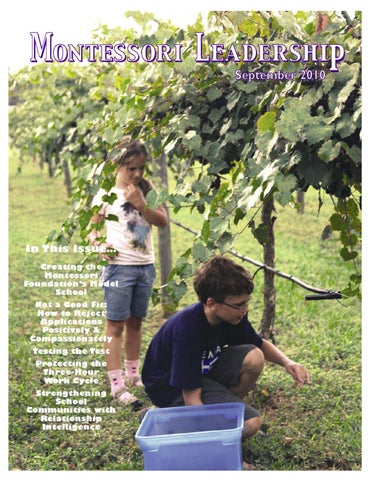
Cover photo taken at the “Winery,” The Montessori Foundation’s land lab in Bradenton, Florida. © MONTESSORI LEADERSHIP / SEPTEMBER 2010
3
4
© MONTESSORI LEADERSHIP / SEPTEMBER 2010
www.montessori.org/imc
THE FOUNDATION’S MODEL SCHOOL
Creating The Montessori Foundation’s Model School STEP ONE: LOCATION, LOCATION, LOCATION Wanting a Montessori school is not enough. Finding the right place to put one is something else entirely. BY JOYCE ST. GIERMAINE Executive Director, The Montessori Foundtion
Spoiler Alert: By now, you probably know that the Foundation did, in fact, found a model school called The Field School, which was scheduled to open this August in temporary facilities with a modest little program for early childhood through elementary-aged children … in Sarasota, Florida, which is also the location of the NewGate School, which the Foundation had developed and led for many years before parting ways ten years ago. Are you following this? So … about three weeks before the start of school, it was a surprise to everyone when the boards of trustees of New Gate and The Foundation decided to collaborate rather than compete, and a merger took place, becoming The NewGateField School, placing both schools under the leadership of The Montessori Foundation. The newly combined school opened on August 23, 2010, with classes for toddlers through the twelfth grade. Classes are held at the school’s beautiful 100+ acre property in a country setting as well as at its smaller, closer-in 4-acre location. If you attend our November conference in Sarasota, tours will be available to see both campuses, and visitors are always welcome if your travels bring you to Florida. www.montessori.org/imc
M
ontessori Leadership is primarily read by Montessori administrators, teachers, committed parents, and board members. That being said, it is probably a reasonable assumption that, at some point, many people reading this article have shared a similar thought: Wouldn’t it be great to start a Montessori school? If you are a non-Montessori spouse/partner/friend of the person who receives this magazine, someone who has expressed this thought or acted upon it, it’s perfectly OK to take a moment to roll your eyes to heaven and sigh deeply. Creating a Montessori school from the ground up is hard work for everyone. So, when Tim Seldin (President of The Montessori Foundation and Head of The NewGate-Field School) and Lorna McGrath (The Montessori Foundation’s Director of Parent Education and Associate Head of The NewGate-Field School) announced that the Foundation really needed a model school once more, I must admit, there probably was a moment where the Bambi-in-the-headlights look came across my face. Oh no! Not again! As the Executive Director of
© MONTESSORI LEADERSHIP / SEPTEMBER 2010
5
LEADERSHIP
The search: some of the faces of The Montessori Foundation’s Model School that might have been ...
The Montessori Foundation, I have aided and abetted Montessorians in the work of starting and sustaining schools for the past 18 years, and I have an all-too realistic appreciation of the challenges involved in the process. After much discussion, while we considered the obvious cons (We’re in the middle of a recession; We have no facilities, limited financial resources, and no teachers [or students for that matter]. We have no Montessori materials.), the pros won. It’s true: The Foundation needs a model school to develop, demonstrate, and share best practices with Montessori educators around the world. When we announced this decision to the worldwide Montessori community, we promised to share our challenges and successes as we moved through this process, and so we shall. This article is about finding a place to put the school. How hard could that be? As it turns out, it was a lot harder than we thought! The Spoiler Alert on the first page of this article is an extremely abridged version of events. However, going back to the pros and cons, we now have teachers, students, Montessori materials, furniture, and facilities. However, the recession hasn’t gone away; the beautiful campus comes with a big debt; the smaller, older campus needs renovation; and our limited financial resources are still limited and getting more limited as the days go by. The biggest plus, however, is that we are light years ahead of where we expected to be at this date in terms of program and curriculum development. The challenges of just the last month (before school even started) provide enough material to spawn articles for many issues, including: the pitfalls of parent-run boards; staying true to a Montessori blueprint; balancing the budget during a tough economy; creating partnership with two distinct groups of faculties, parents, and students—not to mention two campuses; getting the word out through guerilla PR and marketing; implementing last-minute recruitment strategies; introducing a second language into each classroom; creating natural playscapes; transporting students; accommodating the needs of working parents; coordinating volunteers; holding Montessori-style town meetings; putting the ‘fun’ back into fundraising; and the list goes on and on. Starting a Montessori school is not for the faint of heart … The staff and advisors of The Montessori Foundation have logged in way too many years of collective experience to tabulate. Even with all this know-how, this has been a very challenging experience. Behind every school, no doubt, there is a war story to tell about the trials and tribulations of finding a place to call home, and we are no exception. Unlike the public perception that Montessori schools are franchise opportunities just waiting to happen, anyone who has ever helped create a Montessori school knows that this is certainly not the case. Visit any Subway™ restaurant anywhere in the US (and probably worldwide), and you’ll see the same décor, menu, and pricing. If only it were that easy for Montessori schools. It is so true that there are many different faces to Montessori, with schools that can be found on 100-acre country campuses, in elegant downtown brownstones, church basements, public school facilities, office buildings, charter schools, or migrant worker camps. While the stories may differ, the fundamental principle behind the creation of each school seems to be a genuine desire on the
6
© MONTESSORI LEADERSHIP / SEPTEMBER 2010
www.montessori.org/imcrg
THE FOUNDATION’S MODEL SCHOOL
Finally ... The New Gate-Field School finds a home at New Gate’s Sarasota, Florida campuses
part of adults in a community to provide something worthy and wonderful for their children. While the pieces may fall easily into place for some new schools, more often this is not the case. Frankly, it has been a humbling experience. For all of you who have gone through this ‘birthing’ process with a Montessori school, you should be commended for your tenacious spirit and commitment to the children in your lives. Location, location, location … Looking back to the time that the Foundation decided to create a model school (more than two years ago), we could never have imagined that we would merge with NewGate and have the facilities that we now call ‘home.’ What now seems like a simple, logical conclusion was anything but that. Initially, we thought we could create a school at what we call “the Winery,” 20 acres in Bradenton, Florida that is the headquarters of The Montessori Foundation. We call it “the Winery” because grapes are grown here (not because we drink wine all day … although there have been times when that might have been the best idea). So, we got an architect involved, and he came up with some very expensive drawings of classroom buildings. Then we found out that we couldn’t use much of the property due to wetland issues. Then there was the matter of installing a bridge to go over the creek that would be wide enough for fire trucks, then the bottom dropped out of the economy, and the price of gas went over $5 per gallon. The Winery will still serve as our land-lab campus (see the front cover), but we had to give up on the idea of creating a school here. Option number two was a small, run-down little building … kind of an old, abandoned, one-room schoolhouse, conveniently located in downtown Sarasota, that was probably being held together by the termites holding hands. Despite many phone calls, we couldn’t even find the owner to inquire about its use (probably just as well). Then there was a gorgeous property owned by a local non-profit. Except for the beauty of the grounds and the downtown location, nothing was right about that situation. Cross that one of the list. There was a nice one-story building with great light and in a good location, except for the fact that it was across the street from an electric power plant, behind a pond that we were not allowed to fence, and bordering a busy street. Move on. www.montessori.org/imc
© MONTESSORI LEADERSHIP / SEPTEMBER 2010
7
LEADERSHIP
There was an empty building that had been used as a preschool, so at least the zoning was right and we could get a quick occupancy permit. As a temporary solution, we could probably get over the pepto-pink, glow-in-the-dark orange, and key-lime green interior walls and the fact that there was no playground area, but the religious facility next door decided we were too much of a threat to their nursery school program and wouldn’t allow us to use their share of the driveway and parking area. Oh well. Then, we really thought we had found THE building. It had been a school and had more than 22,000 square feet. The fact that it had been vacant for so long that homeless persons and others looking for a place to sell drugs was not the main problem. The landlord was involved in litigation with his former tenant and subtenant and wasn’t able to lease the property to us in time for start of school. There was also the fact that there had been a lot of water damage, coupled with lack of air conditioning in the heat of Florida, which had pretty much turned the building’s interior ‘green’ … but not in a good way. We searched the newspaper, Craig’s List, and became members of www.loopnet.com, all of which I highly recommend if you’re looking for commercial real estate. We worked with real-estate agents. We talked to parents, friends, and members of the local chambers of commerce. By March of 2010, it had become clear that we were running out of possibilities and time. We started calling every non-profit organization in the Sarasota area, practically begging them to take us in for the 2010/11 school year, which would give the owner of the vacant school building time to resolve his legal issues and make repairs. It seemed that there was always some problem that prevented us from moving forward. We were becoming discouraged and falling far behind in our day-to-day work, as we spent huge blocks of time touring properties. Finally, a local non-profit, Girls, Incorporated, came to our rescue, agreeing to lease us the use of their building for the school year. This organization provides after-school activities for girls in the Sarasota area, and they have wonderful facilities, including an indoor swimming pool, soccer fields, gymnasiums, and art rooms. There were several problems, however. Our school day needed to end by 2:15 pm, so that we could pack up each classroom and prepare the space for the incoming after-school students, which meant that each morning, our teachers would need to come in extra early and set up their classrooms all over again. It also meant that only girls needing after-school care could stay on at Girls, Inc. We would need to find an afterschool place for the boys, along with a way to get them there. Despite the inconvenience, we were grateful to have a place to open the Field School, and we were prepared to make the best of it. While we were in the process of searching for used school buses to handle our transportation needs, the NewGate board contacted us about the possibility of merging.
8
After close to two years of looking, after all the false starts and near misses, our model school is now in the one place we never thought it would be. We couldn’t have planned it this way. It just worked out. The Lesson Whether you are an existing school administrator or board member looking for a new site or a parent or teacher planning to create your own school, you need to give yourself much more time than you think that you will ever need. Find out what local regulations require for each level of children you hope to enroll. Maybe the most vigorous regulations in your area pertain to “kindergarten-aged children.” What does that mean? Maybe you’ll be allowed to have elementary-aged children on the second floor of a building in your area. Maybe not. Are you leasing or buying the property? Is VPK an option? If there’s a body of water on the property, will you be allowed to fence it, or will you be violating a wetland issue? If the zoning is OK, will you need to install a sidewalk, even if nobody will ever use it? How much will that cost? How about a left-turn lane? Become friendly with the folks who regulate schools, early childhood programs, the zoning commission, and the fire department. By the time you read this, everyone will have settled into The NewGate-Field School here in Sarasota. Now we can turn our attention to the other important issues involved in creating a model Montessori program. Maybe it was just as well that all our earlier efforts to find a home for the Field School were unsuccessful, but it sure didn’t feel that way at the time. If you are committed to starting a Montessori school, finding the right location takes perseverance, ingenuity, and sometimes just dumb luck.
Calendar October 11 - December 27, 2010 Montessori Foundation Montessori Leadership Institute: Term 3 (800) 655-5843 (see inside front cover) www.montessori.org
Ne Dat w es
October 22 - 24, 2010 - AMS 2010 Fall Conference San Diego, CA (212) 358-1250 • www.amshq.org November 4 - 7, 2010 Montessori Foundation & IMC 14th Annual International Conference Sarasota, FL (800) 632-4121 www.montessori.org margot@montessori.org February 18 - 21, 2011 - NAMTA 2011 Annual Adolescent Conference Long Beach, CA (440) 834-4011 • www.montessori-namta.org March 17 - 21, 2011 Montessori Foundation & IMC 8th Annual West Coast Conference San Jose, CA (800) 632-4121 www.montessori.org • margot@montessori.org March 24 - 27, 2011 - AMS 2011 Annual Conference Chicago, IL (212) 358-1250 • www.amshq.org
If you have a conference or event you’d like to promote, please email information to: tcmag@montessori.org.
© MONTESSORI LEADERSHIP / SEPTEMBER 2010
www.montessori.org/imc
NATIONAL MODEL SCHOOL
enrollment and increasing expenses, Montessori schools in the USA and abroad have, in fact, been in a period of transition and upheaval for the past twenty years. Why now?
The Importance of Creating a National Montessori Model School by Tim Seldin
Chair, International Montessori Council Head, NewGate-Field School
W
e established The Montessori Foundation in 1992, recognizing that two major, and several smaller, Montessori societies have been well established in the United States and abroad for many years. In fact, most of the group that founded The Montessori Foundation had been long-term leaders of The American Montessori Society. Our years of experience, responding to member schools that faced major challenges, gave us the perspective to understand that the existing organizations were more focused on Montessori teacher training and professional development than on addressing the needs of Montessori schools as holistic institutions and the preparation of new generations of effective Montessori school leaders and boards. We created The Montessori Foundation to nurture, inspire, and support Montessori schools and Montessori education as a
www.montessori.org/imc
movement in the US and around the world through a wide range of programs, services, publications, conferences, and professional education programs. Rather than continue to focus on our own school(s), we made a commitment to serve Montessori schools and Montessori education everywhere, regardless of affiliation with any particular branch of the Montessori community. Over the last 18 years, we have worked with thousands of schools, always focusing on the core principles of what makes a school Montessori from top to bottom, as well as those programs and strategies that seem to lead some schools to tremendous success.
The Montessori Method has been in existence for more than 100 years; however, after a flash of attention and rapid expansion in the US in the years between 1908 and the 1930s, the movement receded and virtually disappeared in North America. Montessori didn’t really re-emerge until the 1960s, when a resurgence of interest in early childhood development led to a surge of attention and the development of thousands of new Montessori schools by the early 1970s. In most cases, a Montessori educator would establish a small, one-classroom school for preschool children. Soon, the word got out, and more small Montessori schools began to proliferate across the country. Not only were there more schools, but the existing schools began to grow, expanding to two, three, and often more early childhood classrooms. More gradually, schools began to expand into the elementary grades. By the 1980s, middle school programs were emerging, and a small number of high schools began to be officially recognized and accredited, beginning with my own alma mater, The Barrie School in Silver Spring, Maryland. By this time, in the mid 1980s, something unexpected began to occur: more and more Montessori schools were becoming successful! Enrollments were reaching two hundred or more. A smaller number of schools
The Challenges of Growth While we most recently can point our finger at the recession as the major cause of concern regarding fluctuating
Š MONTESSORI LEADERSHIP / SEPTEMBER 2010
9
LEADERSHIP
reached enrollments of five hundred students and continued to grow.
passion, and dedication of the founding head.
With this success came the demand for more Montessori-trained teachers, which meant that existing Montessori organizations were challenged to respond to the need with training programs that were reputable, affordable, and reasonable in terms of training time. Eventually, the training programs themselves began to develop different approaches and relatively diverse interpretations on core Montessori principles. This created a divergence in Montessori practice and theoretical understanding about what makes a program ‘Montessori,’ which exists to this day.
In Montessori schools, these founding heads are typically Montessori teachers or parents, not business people. It is not unusual to find that founding heads often have a love/hate relationship with budgets and money, which has nothing to do with their innate intelligence or skills; rather it is their desire to focus on children, instead of the bottom line, that has driven them to work seven days a week for so many years. Their schools are not simply businesses that can be measured in dollars and cents. They are labors of love. Speaking as the son of one of these founding heads, Frances Littman Seldin, my friends and colleagues who shared a similar childhood often joke: There’s another child in this family—the school!’
During this same period, from the early 1980s to the present, as Montessori schools continued to grow, we noted a disturbing trend as the schools’ original founders began to grow weary and overwhelmed by the day-to-day effort of running larger and more complex schools. After all, many of these founding heads had been running schools for 20, 30, or more years. Instead of retiring, closing, or selling their schools, many original founders reached out to parents and chose to become 501(c)3 non-profits, often with unfortunate results. Those of us who follow such things have seen so many founding heads driven out of their own schools that it is almost a predictable pattern. By the way, this is not only true in Montessori schools. We have seen it happen in one independent school after another, to the degree that there are few founding heads left running schools. Most Montessori schools are now led by a fine administrator, who works for the parent board, and then moves on within three to five years to the next position. We have paid a great price for this pattern, despite the common belief that entrepreneurs or founders outgrow their usefulness after a time and need to be replaced by ‘managers.’ Independent school are not like other businesses, even though they need to be led in a business-like way. Most are idiosyncratic. What made them special and appealing was based on the vision, 10
As small Montessori schools grow into Montessori businesses, governed by boards of trustees, made up almost always by school parents, disagreements typically begin to form among the parents, the board, and the founding head. New ideas and expectations are brought to the table. Founding heads may chafe at their new role as an employee of the school, or the board might decide that someone with a different skill set should lead the school through the next period of expansion. No matter what the underlying reason, by the mid-1980s, we began to see a large number of Montessori schools that replaced their founding head with new leadership, few of whom were experienced or truly committed to authentic Montessori principles and practices. Instead of becoming more successful, as one might expect, many have jumped from the frying pan into the fire, now facing seriously declining enrollment, budgets that cannot be balanced, high levels of student and teacher attrition, and a loss of clarity and commitment to what made them Montessori in the first place! It is not uncommon to find schools that need to hire a new head every two or three years. When a Montessori school needs to replace its founding head, the board usually chooses to proceed in one of three ways: © MONTESSORI LEADERSHIP / SEPTEMBER 2010
1. Hire a traditional headmaster. Why not hire someone who has experience running a large school and coordinating large projects? Someone who is good at administration, policy, procedure, and oversight. Although this choice seems to make a lot of sense, more often than not, the Foundation has spent the last 18 years helping many of these schools undo the damage caused by this decision and get back on track. The model for traditional schools (adult-dominated, teacherdirected) just doesn’t work well in a Montessori school that struggles to maintain its authenticity. I like to refer to the Montessori community as a “circle of equals,” people who come together in search of a different way of living and learning that is not found in traditional schools. 2. Some schools choose to select a teacher to become head of school. In making this choice, the board usually turns to the most experienced and most charismatic teacher on staff. Sometimes this works, if the teacher has the skills to develop and sustain a school through the decades. More often than not, the children in the school lose a great teacher, the board may be disappointed, and the teacher (who is now the head and faces full responsibility for every aspect of the school) may be upset as she, or he, realizes that she, or he, is not living up to the board’s expectations. 3. The third option that some Montessori schools choose is to find a ‘true mother.’ I say ‘mother,’ but it could be a father or anyone associated with the school, even if not Montessori trained. His or her commitment to authentic Montessori must be unequivocal, and he or she will need a lot of help. This is normally not a forever position, but it will ‘buy’ time. The most important outcome of this choice is that the non-Montessori trained head do no harm. At The Montessori Foundation, one of our most important projects is the Center for Montessori School Leadership. The programs that we offer are as intensive as Montessori teacher training and are designed to www.montessori.org/imc
NATIONAL MODEL SCHOOL
offer future heads the big picture of how Montessori schools work as a system or integrated systems. We go into depth, show how every aspect of a school ties together, and provide practical strategies for how schools can journey from where they are now to where they ultimately want to go. Why a National Model School in Sarasota? I am a Washingtonian, and I lived almost all of my life immersed in the dynamic international community that is the nation’s capitol. I was the head of the Barrie School in Silver Spring, Maryland for 25 years following the death of my mother, who founded the school in 1932. While at Barrie, I founded the Institute for Advanced Montessori Studies, a major AMS teacher training program that offered graduate-level programs for Montessori educators from early childhood through high school. During most of that same period, I served on the Board of the American Montessori Society. In my various roles, leading what was considered the ‘flagship’ Montessori school in the US, I found myself speaking daily with administrators and board members whose schools were growing larger and were in crisis. I realized that, despite the best efforts of existing Montessori organizations, not enough was being done to help schools navigate the problems they were experiencing. I also realized that Barrie was successful in many ways that other Montessori schools were not, which is what inspired us to establish a new organization, The Montes-sori Foundation, to address these needs. No one school can be good at everything, and over these many years, we have studied cases, presented symposia, developed online leadership workshops, all of which are components of a major series that we call “Developing a WorldClass Montessori School.” When I retired from Barrie and founded The Montessori Foundation, it wasn’t long before I was asked to consult with a group of people from a small Montessori school in Sarasota, Florida: www.montessori.org/imc
Countryside Montessori. Back then, it had about 85 students and had just expanded to include an elementary program. I was impressed by the vision of its founder, Katherine “Kitty” Williams (now Bravo), which was echoed by the faculty and parents. My visits became more frequent. The school transitioned into a 501(c)3 and changed its name to The New Gate School. Kitty Williams Bravo became a member of the newly created board of trustees and left the day-to-day management of the school to pursue other career opportunities. The board asked the Foundation to take over the school’s leadership, and with the invaluable assistance of Lorna McGrath (a Montessori teacher, who became my Assistant Head), we turned New Gate into the model school of The Montessori Foundation. Throughout this process, we shared our successes and challenges with the readers of Tomorrow’s Child, and Montessori Leadership, as well as through our online workshops, conferences, and books. During this process, I developed a completely different understanding of the challenges facing small schools (Barrie had about 500 families) and the difference between being a consultant, who could go home at the end of the day, and once again assuming the role of serving as the head of a school, who had to translate theory into practice. The Montessori Foundation managed NewGate from 1994 to 2000. During this period, we stabilized the enrollment, developed new curricula, expanded programs, and raised the first $2 million that allowed the school to purchase the 100+ acres that would eventually become home to a Montessori high school. We worked tirelessly, and watched our vision develop into tangible form day by day. And then, one day, the leading parents of the school realized that they really preferred to retain control of the board, and we, at The Montessori Foundation, realized that we could not compromise the integrity of our vision. After all, the very definition of a model, lab, or demonstration school is that it is led and controlled on an enduring basis by © MONTESSORI LEADERSHIP / SEPTEMBER 2010
an organization whose mission is to use it as the basis for developing new programs and a replicable model. In short, we parted as friends, returned to our offices in the Washington, DC, area, and set aside all thoughts of having a school of our own once more. After NewGate and the Foundation went their separate ways, we continued our national and international work with Montessori schools, which many of you have followed. Our mission continues to be to inspire a passion for remaining true to core principles of Montessori best practice, and we have worked with several hundred more schools and just as many school administrators and board members. We’ve traveled around the world, set up offices in several far-flung countries, and run conferences. However, about two years ago, we realized that we were becoming stale, sharing past experiences rather than the fresh challenges of what we are working on today. We needed a Montessori school of our own to stay fresh. Joyce St. Giermaine, Executive Director of the Foundation, describes the process we experienced in our efforts to start the Field School in the lead article in this issue. If our old friends at the NewGate School had not approached us in July with the proposal of a merger, we would still be sharing the challenges and opportunities of launching a new school in temporary facilities, but we now have a different story to tell and a lot more to share in the years ahead. The NewGate and Field School are now one, and it is fair to say that a school that we loved, nurtured, and developed for many years is once more the Model School of The Montessori Foundation. But no school goes ten years without changing. In this case, we have new challenges: a school that spent several years trying to redefine itself; great debt; a much smaller enrollment; some traditions that remain the same; and some traditions that are very different from what we practice and teach. We have our work cut out for us as we merge the two schools into one and address each challenge along the way. As the process unfolds, we will document what we do, what works, and what doesn’t. That’s what it means to be a national model school. 11
LEADERSHIP
How does a national Model Montessori School benefit all Montessori schools? If you are reading this article, the odds are that you are involved in the leadership of a Montessori school, and yours is probably one of the thousands of Montessori schools in 50 countries around the world that turn to The Montessori Foundation as a resource. To this day, 18 years after founding, our mission remains the same: to help and inspire strong, stable Montessori schools that educate students from preschool through the twelfth grade. While there is no one ‘right’ way to run a Montessori school, we know that we can help schools refine the skills that each unique Montessori school community brings to the table. 1. A national Model Montessori school tells a story. The Montessori Foundation has a replicable model in which we have total confidence. Through our publications, videos, workshops, and conferences we are able to blend practical business applications with authentic practices in the day-to-day classroom and business of running a successful Montessori school.
2. The books, white pages, and manuals that have already come from our previous NewGate experience are considerable. We plan to increase dissemination of important information and practical application of everything from new classroom resources to sustainable agriculture to guerrilla marketing, and energy efficiency. If we can find a way to go ‘off the grid,’ we will share that and everything else with you. 3. As a lab school, we welcome visitors. At Barrie, we had a steady stream of visitors from around the world. At New Gate-Field School, our doors will always be open, and we will use state-of-theart technology to share symposia and videos with everyone who wants to see what is going on in our classrooms. In this way, we hope to provide practical help to leaders who wish to integrate similar programs into their schools. 4. A national school should be spotlighted. Not every school can have 100 acres. We expect to make the New Gate-Field School a world-famous destination, which has value to all Montessori schools. We hope to attract educational leaders and policy makers who have the power to improve the lives of children.
5. Ultimately, we hope to pick up where we left off, with our plan to establish a national research center and a graduate school of education that focuses entirely on preparing top Montessori educators and Montessori school leaders to serve the finest Montessori schools everywhere. We hope that you wish us well on our journey. Along the way, we will need your help, and we will ask for it. This model school really belongs to all of us, and its legacy will benefit every Montessori school. We are here to help, serve, inspire, support, and nurture Montessori schools just like yours. Tim Seldin is Chair of the International Montessori Council; President of The Montessori Foundation; Head of The NewGate-Field School; author of How to Raise An Amazing Child and World in the Palm of Her Hand; Co-author of The Montessori Way and Celebrations of Life. He can be reached at timseldin@montessori.org.
If you are planning a trip to Florida and would like to visit the NewGate-Field School, please contact Tim Seldin at timseldin@montessori.org or call the school office at 941-922-4949.
Share Montessori Leadership with a friend or colleague ... Become a member of the International Montessori Council Use our publication center at www.montessori.org/imc and go through our webstore or call our membership office at 1-800-632-4121. ❍ Individual Membership ($45 US/year) ❍ School Membership ($250 US/year) ❍ Business Membership ($250 US/year) ❍ Teacher Education Center Membership ($250 US/year) ❍ Montessori Organization Member ($250 US/year)
12
© MONTESSORI LEADERSHIP / SEPTEMBER 2010
www.montessori.org/imc
NOT A GOOD FIT
Not a Good Fit How to Reject Applications Positively & Compassionately by Sharon Caldwell
Sharon Caldwell, Editor of Montessori Leadership, is the Director of The Montessori Foundation and The International Montessori Council’s office in Africa. She is a Montessori educator, consultant and an instructional guide for the Montessori Leadership Institute. She resides in East London, South Africa with her husband and two sons. www.montessori.org/imc
E
very interaction you, or your staff, has with a member of the public is potentially an opportunity to create good publicity for your school. It also has the potential to undermine the school’s public image.
For a number of years The Montessori Foundation has been running two very popular online courses for school leaders entitled Building a World-Class Montessori School and Finding the Perfect Match. Both these courses promote the idea that Montessori schools should actively seek out those families that will love and support the school, rather than pursuing an enrollment policy based simply on filling available spaces. When I first encountered the idea, at that stage running a small and financially unviable school, the notion seemed little short of absurd. Once I began to apply Tim Seldin’s suggestions, I found that enrollment grew slightly but retention sky-rocketed. Finding families that will stay, rather than merely upping enrollment numbers, was a key factor in growing a school. Choosing which families to enroll is not, however, the only part of this scenario. Knowing how to reject enrollments is as important as discerning whom to reject. I discovered, somewhat accidentally, that a number of families whose applications we declined became strong advocates of our school and good friends. The same principle, by the way, applies in the case of families who may be enrolled, but who need to be ‘counseled out’ of your school. The bottom line is simply that dissatisfied families, children who are not progressing and parents who are only able to see weaknesses and mistakes rather than successes in your approach, are bad for the school. They will, whether deliberately or otherwise, undermine community and sow doubt amongst otherwise supportive parents. This does not mean that you encourage families to leave at the first signs of unhappiness. Families who are generally happy may be discouraged from raising small grievances through fear of being asked to leave. It is important to create an atmosphere where families can feel confident that this will not happen. © MONTESSORI LEADERSHIP / SEPTEMBER 2010
13
ADMINISTRATION
Just as a successful marriage is based on the ability of both partners to work through all the small day-to-day disagreements to the benefit of the family as a whole, so the happiness and success of individuals depends on the honesty and clear-sightedness that allows both partners to acknowledge when a relationship no longer meets the needs of one or both of them. Just like marriage, it is also better if the mismatch between needs and the ability of participants to meet those needs becomes clear before, rather than after, the contract is signed and sealed. Hence the approach recommended by The Montessori Foundation is that time and effort is invested in ascertaining a good match. Not only should you be finding out whether the child and his family will be a good match for your school community, from the point of view of the school, but you should sincerely be helping the family to make an informed decision as to whether the school will meet the short- and long-term needs, both of the child and the family as a whole. This is a fundamentally different approach to that adopted by most schools—simply trying to convince parents to enroll their children in that particular school. Many schools adopt the policy: If we can just get them to enroll, we can convince them to stay. While this may sometimes happen, more often than not, the opposite is the case. Parents who enroll their children in a school based on inaccurate expectations may leave before the end of a cycle, often taking other families with them. This is what an effective enrollment policy will avoid. There are a number of reasons why So how to reject families may apply to your school. If a family’s appli- you have an effective marketing camcation without paign, your school is attracting way more applications than you can ever causing resentaccommodate. This scenario is benement and the ficial only if you have mechanisms in concomitant bad place to sift out those families you publicity? The really want to enroll.
key is empathy and clear, compassionate communication.
The first step is clarity. Ensure that all your school’s publicity materials and all the information materials you hand to new applicants accurately represents your school in all its aspects. For example, a school that talks of high academic standards, intellectual rigor, and excellence should not be surprised if it attracts families who put a high emphasis on measurable achievement and test scores, while failing to attract those families looking for a more rounded and holistic approach to the education of their children. In the early stages of the enrollment process, a large number of families will decide for themselves that your school is not for them. This is the first point at which you can create a positive off-spin. Follow up on every family that chooses not to enroll their child. This can be done with a short telephone call or email thanking the family for taking the time to find out about your school. Wish them well in the future, being sure to refer to their child by name, and ask if they would like to remain on your mailing list to hear about school events that are open to the general public. Ask them what it is about your school that does
14
not suit their needs—not in order to try to convince them otherwise, but to enable you to get a clearer sense of the market to which your school caters. It also helps to highlight those areas where your school may be sending out mixed messages, or where your enrollment process is sloppy or misleading. The really challenging part of the process is when a family wishes to continue with the enrollment process, but the head of school, admissions officer, or other staff members involved in the process arrive at the conclusion that a family is not a good match for the school. There are a number of reasons why this may be the case, and this article does not presume to cover them all. Firstly, a family may be laboring under a mistaken impression of what your school really offers. If you sense this is the case, you can help them gain clarity by leading them to clearly express their needs and showing how your school does not meet them. For example, a parent who is placing high value on test scores could be helped to verbalize this. Even if your school does participate in standardized testing, you may not want to have families who evaluate your school and their child on test results. In this case, you ask the parent how he sees success. When he states that he would like to see his daughter score in the upper 10 percent in the group, you can ask how he would feel if she did not do so? You could then explain that the school does not specifically prepare children for the tests and discourages parents from test prep drills. Rather than going into long explanations of why tests are not a good indicator of achievement, you can help the parent to clarify his own beliefs one way or another and make his own decision about the suitability of your school for their child. A second scenario is when a family is desperate to find a school for a child who may have special needs and challenges. Sometimes these families can, nonetheless, be a good fit, and other times, not. You need to get a sense of whether this family would choose your school even if they had a wide range of other schools happy to accept them. A good indicator that a family is using your school as a last resort is when they want you to take one child, while her siblings are enrolled elsewhere. At my own school, I did accept children whose older siblings were elsewhere but seldom accepted children whose younger siblings were enrolled at other schools or were on the waiting lists for those schools. In every case where I allowed myself to be convinced to enroll such a child, it turned out that the families did not stay at our school for very long. Simply put, a family that is completely comfortable with having a child in a conventional classroom is unlikely to be completely comfortable with an authentic Montessori classroom. They will be constantly holding up one as a benchmark against which to measure the other. Perhaps the Montessori school becomes the standard against which they evaluate the conventional school. We would expect this to be the case, as we have chosen Montessori because we believe it to be the better option. Unfortunately, the pressure to conform to what is known, what is comfortable, where the outcomes are measureable and predictable, is more persuasive to many families than is often realized, and families with one or more children in regular schools
© MONTESSORI LEADERSHIP / SEPTEMBER 2010
www.montessori.org/imc
NOT A GOOD FIT
are more inclined to question Montessori than they are to question the conventional setting, even if their own observations indicate that the child in Montessori is happier and learning in a more holistic way than a child in the conventional school. Simply put, parents who have children in vastly different schools are often inclined to play the one off against the other, using the example of the (often) bigger and more conventional school to highlight the perceived deficiencies of the smaller more alternative school. Where you feel this is the case, you may want to help the parent arrive at these comparisons before accepting the enrollment. Knowing that other children in the family are enrolled at another school, gently ask why the parents have not chosen that same school for this child. Ask why they have not chosen your school for their other children. Help them to reach the point where they are able to, themselves, state the reasons why your school does not meet their family’s educational expectations. At this point, you can clearly sum up their needs and expectations and explain why your school would not be a good fit. Keep in mind always that while Montessori and your school may be able to accommodate any child, you are not enrolling only the child, but his whole family. No school can meet the needs and aspirations of every family. The message to convey is that you are not rejecting an individual child, but that your goal is to ascertain whether you can satisfy the family’s expectations. This is the point at which you can really help both the family and your school’s public image. Ensure that you know all the other schools in your area well. If you have a good relationship with those schools you will have a good sense of which schools may be a good match for the family and the child. You can pick up the phone there and then and make an appointment for the family to meet the admissions officer at a school which would be a good fit for them. Another strategy to help parents make a decision is to suggest that before finally deciding on your school they visit a few other schools in the area to get a clearer idea of what they are looking for. This may sound counter-intuitive, but if your school is really the superior option, comparison will show that. You can ask a parent what they liked or disliked about other schools they visited and honestly represent your school’s approach to those issues. For example, if a family was impressed by the uniforms worn at a rival school, and your school does not have a uniform and encourages individuality, you could address this issue when explaining how your school may not be a good fit. By engaging in honest and frank conversation, by showing empathy and compassion, while at the same time holding firmly to making enrollment decisions which take into account the needs of the school community and the new child and his family, it is possible to build and sustain enrolment. If done well, you can simultaneously enhance the image of your school within the community at large with a reputation for caring more about helping families find good matches than simply increasing your own numbers. Ironically, this has the beneficial effect of increasing enrollment in the long run. www.montessori.org/imc
Better Butterflying by Dane L. Peters
I
’ve always loved flying and the freedom to escape the traditional life we live on earth. Paper airplanes as a kid, private pilot license in college, and F4 jets in the military kept me fueled for the first 30 years; but once I made the transition to teaching, flying—as we know it —left my life. During a recent stroll in the park, while plugged into my iPod™, I mused about flying and education as a butterfly landed on my arm. Instantly, I connected my career to the life stages of a butterfly. From egg, to caterpillar, to chrysalis, to a butterfly, I thought about the early stage when, as a new teacher, I made plenty of mistakes, learning how to live beyond college, be a husband and a father, and teach children. There was not much going on in the caterpillar stage except growth through mistakes and receiving lots of mentoring and patience. Eventually, I learned to protect myself by staying wrapped in my work and family and grew stronger through trial and error, reading, writing, and experienced educators having faith in me. This kind of nourishment garnered me sustenance and confidence—enough to become a head of school, but still safe within the independent school cocoon. Before I could wrestle my way out of the white pupae, I would have to muster the strength to break free and fly in a direction that went beyond convention, the known, and a comfortable, predictable way of living. After 14 years of teaching and administration in three independent schools, and after 11 years of heading a New England day school, in March of 2001, I decided to explore a philosophy and world outside of traditional education. At age 54, I interviewed at a Montessori school. Intrigued by the philosophy and the way it holds the child in such high esteem and provides the child freedom to explore within a well-defined structure, I eventually found myself interviewing at three Montessori schools. So, after 25 years in traditional schools, there was no doubt in my mind that I could live without dress codes, ability tracking, report cards, being addressed as “Mr. Peters,” with prizes to the most accomplished student at graduation. I signed on with an independent urban Montessori school that supports children two years old through eighth grade.
© MONTESSORI LEADERSHIP / SEPTEMBER 2010
15
IN THE CLASSROOM
I was flying again; metaphorically though it was, I felt like a butterfly when it begins first flight. Now, with eight years of heading a Montessori school under my belt, I am enjoying my metamorphosis into a beautiful educational environment where toddlers (two-yearolds) walk by my office each morning at 10:20 on their way to the rooftop playground and say, one at a time, “Hi, Dane.” Middle school children, who also address me by my first name, demonstrate their appreciation when we walk to a nearby park to have lunch together. Sixth-graders on a three-day overnight trip treat each other like brothers and sisters. Teachers welcome the youngest children into their laps at assembly. Never a voice is raised in the building, and children learn on their own without being measured by grades. Flying this spontaneously conceived educational route has helped me reach a philosophical match, yet it is important to point out that an airport needs to be in sight, as I carefully navigate my work with the board, parent anxiety, budget demands, and what sometimes feels like a fragile, weekto-week tenure. In my world as a head, all of that remains the same, whether cocoon or butterfly, traditional or Montessori. For now, the child-centered environment more than makes up for the work we heads do to keep our schools working. It is better butterflying. Dane Peters is the head of Brooklyn Heights Montessori School (New York). You can visit him at his blog: http://danesedblog.blogspot.com/.
16
“The reward for work well done is the opportunity to do more.” — Jonas Salk
Protecting the ThreeHour Work Cycle by Maren Stark Schmidt
Maren Schmidt, an AMI trained elementary teacher, founded and directed a Montessori school. Maren currently writes the award winning newspaper column, Kids Talk™. She is author of Understanding Montessori: A Guide for Parents, and Building Cathedrals Not Walls. Contact her at Maren @KidsTalkNews.comVisit www.MarenSchmidt.com.
© MONTESSORI LEADERSHIP / SEPTEMBER 2010
O
ne of the key components of an authentic early childhood Montessori classroom is each child’s creation of personal three-hour work cycles. A work cycle consists of choosing an activity, doing it, achieving some internal satisfaction, returning the activity to original order, followed by the selection of the next activity. The Montessori classroom is a vibrant and dynamic learning environment, with each child selecting his or her activity, doing it, and returning the activity to the shelf. After successful completion of a task, there is a period of self-satisfaction and reflection, and then the child chooses the next activity. Montessorians call this rhythm of activity a work cycle. Stephen Covey, in The Seven Habits of Highly Effective People, refers to the habit of a work cycle as creating an upward spiral of growth and change. Covey describes a dynamic process of “learn-commit-do” that empowers us to move toward con-
www.montessori.org/imc
THE THREE-HOUR WORK CYCLE
tinuous improvement, both as children and adults. Montessori saw the threehour work cycle as a critical vehicle for aiding normal development in the human being, a process Montessori called “normalization.” Three-hour work period allows for a three-hour work cycle. A three-hour work period is a protected work time, where the children in a Montessori early childhood classroom can complete multiple work cycles, eventually creating a three-hour or longer work cycle. Children, as well as adults, develop concentration in two basic ways: 1) doing a series of short activities for longer periods of time; or 2) doing one activity for successively longer durations. The Discovery of False Fatigue. Traditional preschools are structured around 15- to 20-minute activity periods based on the observation that children of three, four and five years of age have a 15- to 20-minute attention span. What Dr. Maria Montessori discovered through observation, and we can replicate this with our own note taking, is that given a consistent, uninterrupted three-hour work period, young children will choose three or four familiar activities, lasting 15 to 20 minutes each and then enter into a period of restlessness, which Montessori called “false fatigue.” In traditional schools this is when recess is scheduled. Dr. Montessori noticed that if the adults working with the children waited out this period of false fatigue, which lasts ten to fifteen minutes, the children will select an activity that constitutes challenging work or new learning and concentrate on that activity for an hour or more. Dr. Montessori noted that at the end of the three-hour work cycle, the child experiences a period of calm and sociability.
Once a child has developed a morning three-hour work cycle, children as young as three or four years old will begin a second work period in the afternoon. Adults, elementary students, and teens, may have developed two, three, or even four three-hour work cycles in their day. Another later phenomenon of the work cycle is that the older child’s concentration level begins at the point where false fatigue initially began, and that concentration level may be maintained over three hours. This ongoing development of concentration can be observed and charted. Example of a child’s work cycle.
Example of an adult’s work cycle. Here is an example of an adult’s threehour work cycle on a Saturday morning.
Check schedule. See that the morning is free until 1 pm. Clean kitchen, 15 minutes. Start laundry, 15 minutes. Make phone calls for appointments, 20 minutes. Vacuum, 20 minutes. Feeling of restlessness, What to do next? (False fatigue) Cup of coffee, 10 minutes.
A four-and-a-half-year-old’s three-hour work cycle might look like this:
Work puzzle, 10 minutes. Build with blocks, 15 minutes. Water plants, 20 minutes. Sweep floor, 10 minutes. Walk up and down steps, 5 minutes (false fatigue) Prepare and eat snack, 15 minutes Visit with classmate, 10 minutes. Do 100 piece puzzle, 45 minutes. Practice tying shoes, 45 minutes. Help younger students put shoes on, 15 minutes (Period of sociability) Completing a three-hour work cycle gives the child, or adult, a sense of accomplishment followed by calm composure, along with the desire to do more work. The three-hour work cycle may be a misnomer in the fact that we need to have more than three hours of time to contain the work periods. Having a safeguarded three-and-ahalf to four-hour period is recommended.
Balance bank statements, pay bills, 90 minutes. Fix lunch, 15 minutes. Eat with family and visit 30 minutes. (Period of sociability.) Adults, as well as children, benefit from a protected work period. Due to various circumstances, some Montessori schools do not offer a three-hour work period for the children. These schools may have good programs without a three-hour work cycle, with happy children and families, but I hope this article will help school administrators, teachers, and others understand that protecting a threehour work cycle for their children can help their programs go from good to great. What keeps a school from offering three-hour work periods? The factors that keep schools from offering a three-hour work period are numerous. Some obstacles are inherent in the structure of our schools, in the preparation of the teachers, and in the readiness of the children.
Three Key Components of Authentic Montessori Classrooms
1. Well-trained Montessori teachers, certified at age level being taught 2. Specially prepared environments for each three-year stage of development 3. Children’s free choice of activity within a protected three-hour work period www.montessori.org/imc
© MONTESSORI LEADERSHIP / SEPTEMBER 2010
17
IN THE CLASSROOM
School Factors
Normal Development or Normalization By observing human behavior, Dr. Montessori gave us a scientific method and basis for understanding positive and normal human development. When watching normal development we see these four attributes:
In established schools, the three-hour work period may have been whittled away due to a variety of factors that range from having specialists come into the classroom, meeting childcare licensing requirements, trying to serve lunch to the entire school, having policies that are lenient on tardiness and absenteeism, running two- or three-day-aweek programs, or offering morning- or afternoon-only programs. Using Specialists.
1. 2. 3. 4.
Love of work or activity Concentration Self-discipline Sociability seen in joyful work, mutual aid, and cooperation.
These four characteristics in a person’s behavior provide the evidence that natural or normal process of human development, or normalization, is occurring unimpeded. When normal development meets an obstacle, the human being’s natural tendencies for work, concentration, self-discipline, and sociability become misdirected, affecting mental, moral, and psychological growth. This misdirection leaves the personality weakened and unstable and allows detours, or deviations, to occur in a person’s character development. These diversions to normal development will be seen as behaviors that include, but aren’t limited to, the following: timidity, need to be entertained, indolence, fantasy, laziness, passivity, lack of focus, capriciousness, disorderliness, violence, rage, possessiveness, disrespect, and disobedience. The child’s work in a threehour work cycle strengthens the child’s personality and becomes the healing agent. Joyful work is the main sign of normal development.
18
Special instructors for art, music, physical education, second languages, and more, who come into the classroom and instruct the entire class, interrupt the work cycle. Or, perhaps, the entire class moves out of the classroom to the art or music room, gym or language or computer lab, thus disrupting the children’s work cycles. If specialists are used, try to schedule their sessions at the beginning or the end of the three-hour work period. Another possibility is to make the specialists’ time in the classroom a freechoice activity, which can flow into each child’s work cycle by using a ‘necklace’ approach for art or music lessons. When the art or music teacher is available, an announcement is made and special necklaces are placed in a basket or on a hook. If a child desires to go to art, he or she takes a necklace and goes to the lesson. The art or music teacher gives individual or small-group lessons in the art or music room. The teachers give lessons, and the children come and go as they finish their activities, replacing their necklace to signal lesson availability to other children. A child might choose to spend a few minutes in a lesson or create an individual three-hour work cycle in the specialist’s lesson.
room teacher can also choose to join in, can help teachers learn new skills and become confident in becoming the wellrounded generalist that will help our teachers create an uninterrupted work period in their classrooms. Also, using specialists in the classroom may have started due to requests from parents to offer these enriching subjects. In our schools, we need to ask ourselves—administrators, teachers, and parents—does having specialists truly serve the needs of our children? If so, are we using our specialists in the best way to serve the needs of the children? Do specialists enhance or hinder the child’s development of a three-hour work cycle? Childcare Licensing. Some states’ preschool licensing requirements are such that facilities must offer a rest time and outdoor time if the children stay over three hours a day. Many childcare licensing programs require that outdoor time be offered before lunch instead of after lunch. These situations create difficulties in scheduling a three-hour work period. School administrators should visit with childcare licensing agents and explain the workings of a three-hour work cycle and request special needs in the school’s licensing requirements. Lunch Jams. Larger schools have difficulty getting lunch served and start serving lunch at 11 am or earlier in order to get everyone fed. Some schools have remedied this by eating lunch in their classrooms or by extending their half-day program to include lunch. A lunch routine that includes the entire community allows the children to have time to enjoy the sociability that is an after-effect of completing a three-hour work cycle. Policies on Tardiness and Absenteeism.
Using specialists in a Montessori school is a response to creating consistency in a learning component in which the school’s teachers may feel inadequate. Granted, we can’t expect every teacher to have an expertise in art, music, dance, and our school’s second language. Using specialists in the classroom as a free-choice activity, where the class© MONTESSORI LEADERSHIP / SEPTEMBER 2010
Many children don’t get a three-hour work cycle because they arrive to school late, have excessive absences, or leave before the end of the school day. Private school administrators report that the average rate per student for tardiness is five times or less during a 180-day school year. The absentee rate is less than 10 www.montessori.org/imc
THE THREE-HOUR WORK CYCLE
days per school year and early dismissals are five or less per year. When rules on tardiness, early dismissal, and excessive absences are not monitored or enforced, a school may experience 5 to 10 percent of its population involved in escalated tardiness and absentee rates; for example, tardiness in excess of 90 times per year, more than 40 days absent, and early pick-ups of 90 times a year. These children do not get a consistent three-hour work period but also disrupt the workings of the classroom and prevent other children from creating a successful work cycle. Make sure your school has enforceable expectations about tardiness, absences, and early dismissals. Two- and Three-Day Programs. In response to parent requests over the years, many schools have two- or threeday-a-week programs. Children in twoand three-day-a-week programs have difficulty creating consistent three-hour work cycles and attaining the levels of concentration and independence seen in students in five-day-a-week programs. If at all possible, a school’s program structure should encourage all students to attend five days a week. Afternoon Preschool. Numerous schools have inherited morning and afternoon preschool programs based on what public schools offer in their areas. Time blocks might look like this, and don’t offer a possibility of a three-hour period:
Morning session from 8:30 to 11:00 am. Afternoon session from 12:30 to 3:00 pm. Running a morning and afternoon program can be financially advantageous to a school and, in high rent districts, may be essential for the school’s viability. In addition, many families enjoy the flexibility that an afternoon preschool option gives them. If running morning and afternoon sessions are essential to your school’s sustainability, work to lengthen each session so that there is time for a three-hour work cycle to be developed. www.montessori.org/imc
Alertness and the ability to learn new things are strongest between 8 am to noon because of factors such as circadian cycles and blood sugar levels. Our programs need, whenever possible, to help our children take advantage of this natural learning time. Preparation of the Teacher As well as internal policies within a school structure, there are factors inside the classroom that can make it difficult to create a three-hour work period. If the school administration doesn’t safeguard the three-hour work period and doesn’t have a policy to train and help teachers create three-hour work cycles for each child, a teacher may or may not have the understanding, ability, or opportunity to create a threehour work cycle in his or her classroom. Also, some Montessori teachers report that the importance of the three-hour work cycle was not emphasized in their training. By not having a three-hour work cycle, a teacher may observe the children having the initial work period leading up to false fatigue. The restless period of false fatigue is noisy and chaotic. Most of us would happily send the children outdoors. Sending the class out for recess at this moment, though, destroys the second and most important part of the work cycle, where the child initiates true and new learning. A teacher or school administrator, seeing this false fatigue, may think having a recess or giving more lessons are the keys to restoring order in a classroom. If we observe the children during this period of restlessness, we should see that, in less than 15 minutes, the children begin to choose personally challenging work. With our observations, we should see that the children do not need a break, or more lessons. Instead, the children need the luxury of the time in a three-hour work period to increase concentration and independent skills. School administration should help their teachers understand and protect © MONTESSORI LEADERSHIP / SEPTEMBER 2010
three-hour work periods for the children. Teachers should work with school administration to establish sustainable policies and practices for creating and maintaining three-hour work periods. Parents should encourage the establishment of policies that protect three-hour work periods for every child. Child Readiness Even when school administration, teachers, and parents work together and develop strategies to protect threehour work periods, the children themselves can create an obstacle to success. When a child is undergoing some emotional stress, of which there may be many causes (personal illness, family turmoil, moving to a new house, or a new sibling, to name only a few), concentration within the child may diminish, and a sort of agitation may settle over the child, preventing the child from establishing a productive work period. The obstacles that prevent a child from being ready to tap into the success cycle of choose-commit-do are as varied as the individuals that make up your school community. This is one reason that the teacher’s observation of the children at work is so essential to the workings of a Montessori classroom. Obstacles that can prevent the creation of a successful work cycle can be divided into two basic categories: 1 Difficulties that are external to the child 2. Internal factors, such as personality, knowledge, experience, attitude, character, etc. create other obstructions. External factors. A child may be unable to create a work cycle due to allergens in the environment, illness, learning or perceptual differences, hearing, vision, diet, sleep, changes in routine, visitors in the house, family member out of town, death in the family, birth of a sibling, arguments in the family, along 19
IN THE CLASSROOM
with excessive television viewing or playing of video/computer games. Internal factors. A child’s personality can affect his or her ability to tap into a work cycle. Being an optimist or a pessimist is a factor. A child with an optimistic perspective is more likely to finish or resume a difficult task; whereas, a pessimistic child might give up too easily. Being an introvert or an extrovert contributes to the development of concentration and independence. An introvert, on one hand, may quietly
What you can do to help create three-hour work periods: School Administrators: Create schedules and policies that support three-hour work periods. Create open dialogue in your school community about best practices. Teachers: Have faith in the child to construct a work cycle if given the time. Observe the child at work. Recognize false fatigue. Avoid predictable daily activities, such as snack time, story time, etc. Parents: At School:
Make sure your child arrives on time ready to choose an activity. Make sure absences are limited and adhere to your school’s policies. At Home:
Create predictable three-hour blocks of time for your child to create a work cycle.
20
focus on an activity. Concentration, on the other hand, may be a problem for the introverted child, who reverts to daydreaming. The extroverted child may be more concerned about visiting with classmates but may be more willing to choose personally challenging work. This is where the art of observation helps in creating a work cycle. A child’s point of development on the human growth continuum affects his or her work cycles. Children who are not developmentally ready for a certain Montessori learning environment may flounder in the incorrect setting. For example, a two-and-a-half year old may, or may not, be ready to join a Montessori early childhood classroom, depending on language and movement development. A six-year-old may, or may not, have acquired the psychological characteristics of needing group work to learn, a trait necessary for success in a Montessori elementary class, in contrast with the need of the three- to sixyear-old for individual work. At each point of development, the human being taps into a work cycle in differing ways.
programs are for twelve- to fifteen- and fifteen- to eighteen-year-olds. There are many obstacles to creating a three-hour work cycle for our children. When obstacles are eliminated, we see the levels of the children’s concentration and independence rise. As the work cycle lengthens, teachers, school administrators, and parents report happier and sunnier dispositions in their children. Creating Solutions How can our schools and classrooms create, maintain, and protect our children’s three-hour work cycles? To protect three-hour work cycles, it is vital that all adults—school administrators, teachers, and parents––work together to prepare an environment, where each child can create personal activities that lead to every individual’s normal and natural development of concentration and independence. All school community members need to work together to remove the obstacles encountered in creating and safeguarding three-hour work periods for our children.
Too Many New Students When a classroom has more than onethird of its population as new students, the newcomers’ disturbances can diminish the work cycle of the other children. The older children in a classroom, for example, the four- and five-year-olds in an early childhood classroom, provide a stabilizing foundation for the three-year-old beginners to develop a work cycle. The older children who have a three-hour work cycle contribute significantly to the success of the beginning three-yearold.
To carve out the necessary time our children need, we must continually reassess the way we schedule our school day and our specialty classes. We need to carefully observe our children at work and play in order to recognize and remove obstacles to their development. By working together— school administration, teachers, and parents—to ensure a three-hour work period for every child, we can take our children, our families, our classrooms, our schools, and our world, from good to great. REFERENCES
A key concept for a well-working Montessori classroom is to have a three-year age span within the group, with one-third of the group being one age. Therefore, the early childhood classroom is for three- to six-year-olds; lower elementary is for six- to nineyear-olds; upper elementary is for nine- to twelve-year-olds; adolescent © MONTESSORI LEADERSHIP / SEPTEMBER 2010
Lillard, Angeline Stoll. Montessori: The Science Behind the Genius. New York: Oxford University Press, 2005. 108-110, 112, 300, 304, 324. Montessori, Maria. The Advanced Montessori Method, Volume I.Oxford, England: ABC-Clio, Ltd, 1991 (1918). 75-86. Montessori, Maria. The Secret of Childhood. New York: Ballantine Books, 1966. 154-173. www.montessori.org/imc
RELATIOHSHHIP INTELLIGENCE
I
n our coaching and training sessions, teachers and school administrators tell us it’s not difficult to build relationships of respect and trust with students. What’s difficult is connecting with the adults. Adult to adult, we are often afraid to speak honestly with one another. Teachers can become defensive when parents express concerns. Parents may hold back from expressing concerns because they are afraid the teacher will take it personally, or even hold it against their child. One Montessori teacher we know, Dan, confided that he used to absolutely dread talking with parents. This is not surprising. Most teacher training programs focus solely on the teacher’s relationship to the children—how to observe them, recognize their developmental stages, identify their learning needs, and interact with them respectfully. Consequently, respect and connection generally characterize teacher-student relationships in Montessori schools.
Strengthening School Communities with Relationship Intelligence Sura Hart & Victoria Kindle Hodson www.montessori.org/imc
Unfortunately, formal teacher training often doesn’t include how to interact and communicate with faculty members and parents. What does it cost a learning community when adult members feel uneasy connecting with each other? We pay a high price in misunderstandings, mistaken assumptions, and suspicion between teachers, between teachers and administrators, and between school personnel and parents. Sometimes, even the best efforts and intentions result not only in misunderstandings but in defensiveness, criticism, blame, and arguments. What if administrators, teachers, classroom assistants, and parents were able to bring the same care and respect to their interactions with each other that they bring to their interactions with young people? This is the question that set us on a path to foster Relationship Intelligence Quotient (RIQ) school-wide—to strengthen relationships between adults as well as between adults and children. © MONTESSORI LEADERSHIP / SEPTEMBER 2010
Here’s a glimpse of the new possibilities that open up when teachers develop RIQ skills. The first dialogue below shows the sort of conversation Dan, a Montessori teacher, used to have with parents. The second dialogue reveals how these conversations proceed now, since he developed his Relationship Intelligence skills. Take 1: Teacher-Parent Meeting Emily (a mother): I don’t think Sandy is learning enough this year. Dan’s chest and shoulders tighten as his thoughts steam through his head. Here we go again. More complaining. Parents just don’t get it. Then fear rises. This is the second time they’ve talked to me about Sandy. What if they want to withdraw her this time? Admin is clear that we can’t afford to lose another student. They will be very upset. And Sandy is doing so well, considering how she came in. I have to calm her mom down. Dan: (tries to reassure and give evidence) You know, Sandy’s come a long way this year. Just take a look at where she started in math and where she is now. Emily: Well, one of Sandy’s best friends goes to the public school, and she’s already doing multiplication. I don’t see Sandy learning multiplication. I can see that if we had to put her in public school, she would be behind. Dan: (attempts to correct and educate) Well, you have to understand that our approach to math is different. It’s welldocumented that when students have a firmer grasp of skip counting and addition facts, they transition more easily and naturally into multiplication. Emily: Well, but we both know that Sandy’s a bright girl, and she can move faster than most students. There’s nothing wrong with giving her some motivation to challenge herself. All you have to do is expect it of her, and she’ll do it. Dan: (attempts to educate further) It’s our policy to take cues from the students about when they’re ready to move on, and I see Sandy enjoying what she’s 21
LEADERSHIP
currently doing and continuing to learn from it. Emily: That’s what I mean. Sandy just does what’s easy for her and doesn’t get on with what she really needs to know. If I transferred her to public school, I think she’d be way behind. Dan: (gives advice) Well, there’s no reason to do that; it would be a disruption for her that she doesn’t need. As I said before, she’s doing very well now that she has settled in. Emily: I don’t think you’re hearing me at all. I want some action. I guess I’ll talk to the principal.
Dan takes a deep breath, noticing and releasing any tension or negative reaction to Emily’s request. He checks in with himself and confirms the needs and intentions he had identified when he received the request earlier in the day: for connection and mutual understanding. Dan: I’m glad you came in. I hope you know that I welcome parents sharing concerns with me. I want to know what’s on your mind. Emily: Thank you. That’s one of the many things I appreciate about being part of this school. But, what’s concerning me is that I’m worried Sandy isn’t learning enough this year.
The result? The parent is dissatisfied, the teacher is still tense, and the situation has escalated. Sandy’s mom is now on her way to talk to the principal.
Dan: Uh huh, so it’s your dedication to Sandy’s learning that brings you in today.
Take 2: Teacher-Parent Meeting
Emily nods.
Emily: I’d like to talk with you about Sandy.
Dan: I’m grateful you are so dedicated. I’m also dedicated to Sandy learning all
she can. Please tell me what you’re observing that leads you to think that maybe she’s not learning as much as she could. Emily: Well, one of Sandy’s best friends who goes to the public school is already doing multiplication. I don’t see Sandy learning it here. Dan: (checks out the accuracy of what he is hearing and empathizes with Emily) So, if I’m hearing you correctly, you’re saying that when you see Sandy’s best friend moving on to more complex concepts, you question whether Sandy is getting what she needs? Emily: (relaxes noticeably and appears to feel comfortable sharing more) Yes. And, we might not be able to afford this school someday, and then if we transferred her to public school, she would be behind. Dan: (checks out the accuracy of his understanding and continues to empathize, resisting the temptation to defend himself or tell Emily that everything is under control) So, it sounds as if you’re also feeling anxious when you think that a transfer to public school might be necessary someday, and Sandy might not be prepared. Am I hearing your concern accurately? Emily: Yes, that’s right. In this economy you never know from one day to the next whether you will have a job or not. Dan: (continues to confirm that he is hearing correctly, give empathy, and guess Emily’s need) I’m hearing that uncertainty about the future has you feeling worried, and you want some assurance that Sandy would be ready to handle a different learning situation if necessary. Is that right? Emily: Yes! What if we have to transfer, will she be okay? Dan: I’d like to share several reasons I think that Sandy would be able to successfully transfer to a public school. Would that be helpful to you? Emily: Yes. I’d like to hear that.
22
© MONTESSORI LEADERSHIP / SEPTEMBER 2010
www.montessori.org/imc
RELATIONSHIP INTELLIGENCE
Dan transformed this conversation from one of fear on both sides into one that created trust and allowed him to provide valuable information about his perceptions of Sandy. It also gave Dan the opportunity to talk about when multiplication will be introduced to Sandy, because Emily is now receptive to hearing new information. The result? The parent is relaxed, reassured, and ready to hear more. The teacher is also relaxed and interested in continuing the conversation. This conversation has moved both parent and teacher to a place of strengthened connection, mutual understanding, and greater ongoing support for the child. Imagine New Possibilities Can you imagine dialogues between teachers, and between administrators and teachers, fostering the same respect and trust as did the second version of Dan and Emily’s conversation? Imagine the impact this would have on how the school runs and the impact it would have on the children who observe these interactions and benefit from them. Imagine creating an environment, where mutually respectful interactions were commonplace—where people were not afraid to bring up concerns because they knew they would be treated with care and the desire to understand. What would it take to prepare a school environment that fosters Relationship Intelligence in adults to the same degree it fosters cognitive development in children? While this is not yet the norm in schools, it is entirely possible. We see it happening. This sort of environment is, after all, in alignment with people’s deepest longings for authenticity, cooperation, and peace. It also draws upon our natural instinct and capacity to care for life. What it takes is replacing old habits of communicating that disconnect us with new Relationship Intelligence skills. www.montessori.org/imc
What Is Relationship Intelligence? We define Relationship Intelligence as a natural capacity we all have to engage power with each other for mutual wellbeing. RIQ comprises a set of capacities that we are born with, but that are rarely developed to the level of competencies. The ability to relate intelligently is deeply encoded in the DNA of human potential: We are social beings and our survival depends on it. To foster Relationship Intelligence, think about developing these four skills: ■ to take responsibility and care for one’s own needs ■ to care about others’ needs ■ to value all needs equally ■ to find strategies that can meet everyone’s needs Let’s explore these skills by examining the shift between Dan and Emily’s first exchange, before Dan learned about the skills, and their second exchange. Taking Responsibility and Care for One’s Own Needs In the first exchange, Dan reacts automatically to images, fears, and judgments regarding parents. His fear increases, as he imagines a future in which Emily might withdraw her child and set into play a series of financial difficulties for the school. Additional fearful thoughts include that Emily’s dissatisfaction could threaten his standing at the school and his job security. All these fears further decrease Dan’s ability to be present for the conversation. When Dan assumes a protective, defensive stance, with tight chest and shoulders and fear on the rise, he cannot find the spaciousness to be present to Emily and her concerns. “I don’t think you’re hearing me at all,” she says. Dan was also unaware of his own deeper needs—for mutual understanding and for connection with his student’s mother. In the second exchange, Dan is able to observe his automatic thoughts and judgments and the fear that is ready to © MONTESSORI LEADERSHIP / SEPTEMBER 2010
take over. But this time, he checks in with himself to be very clear about his own needs. He knows he wants to create a connection with Emily, and with all his parents, that allows them to feel comfortable enough to say what’s important to them. This would also give him the opportunity to share more about Montessori education—something he believes would contribute to Emily and to her daughter. It is Dan’s growing awareness and understanding of universal human needs* that makes the biggest difference in his interactions. Now that he has learned to look for (and identify) needs as the motivators for all behavior, he can direct his attention to the underlying motivating needs in any situation. This takes him to the heart of the matter and simultaneously helps him cut through the habitual judgments and fearful projections that can so quickly send us off course from our best intentions and from understanding one another. Most importantly, Dan now knows to look, first, to his own needs. He remembers to ground himself in what’s most important to him in the situation, and let this intention guide his actions. Caring about Others’ Needs In the first exchange, Dan is not aware of needs and so is not able to penetrate beneath the surface of what he hears as complaints and accusations. “Parents just don’t get it,” he thinks. He sees Emily as someone who is threatening his security: “Admin is clear that we can’t afford to lose another student. They will be very upset.” When we hear and see other people this way, it is easy to create enemy images, which then stimulate knee-jerk reactions of fear, and defensiveness or attack.
*Universal human needs refers to the essential requirements for human thriving, such as: honesty, empathy, care, understanding, respect, learning, companions, play, challenge, celebration, meaning. While there is no definite list of universal human needs, you can see a more complete list at our website (www.thenofaultzone.com).
23
LEADERSHIP
In the second exchange, Dan, grounded in his desire for connection and mutual understanding, is able to be present and hear Emily’s concerns and her needs with genuine interest. Sensing this openness, she relaxes, feeling safe to share. Dan is easily able to hear Emily’s desire for her daughter to be learning as much as possible. He has the same desire: for Sandy to be learning. He also hears Emily’s need for reassurance. Perhaps she needs to understand how progress is observed and evaluated in his classroom. As he hears her needs, no different from his own, he positions himself next to her, on the same team, holding Sandy’s learning with care. When we listen for (and connect with) others’ needs, before we attempt to correct information or present our position, people relax. Listening first lets people know their needs matter to us. And space for more dialogue opens up. “Yes. I’d like to hear that.” Valuing All Needs Equally In the first exchange, Dan and Emily are both in fear, clinging to their positions. Neither one is connected to needs, either their own or the other’s. Dan attempts to educate and give advice. (“You have to understand that… It’s our policy to….”) Emily argues. (“There’s nothing wrong with giving her some motivation to challenge herself.”) In the second exchange, as Dan demonstrates caring for both his own needs and Emily’s needs, they find themselves sitting on the same team, or “getting to ‘we.’” They feel open (“Yes!”) to the solutions that Dan is confident they will find together. Dan’s confidence didn’t come overnight. It took practice over time for his skills to develop and for him to see every time he is able to keep his focus on what truly matters to him and what matters to the other person, a dialogic process opens up and carries them forward, to greater understanding and results that work well for everyone. 24
Finding Strategies That Can Meet Everyone’s Needs The first exchange ended far short of this destination. Dan and Emily ended the conversation feeling more disconnected and fearful about meeting their needs than they had when they started. This kind of experience leads to discouragement. In future encounters, both parties will be even less confident that fruitful conversations about things that matter are possible or worth initiating. In the second exchange, the openness and trust Dan established by connecting with both his and Emily’s needs created an opportunity for Dan to share more about the Montessori approach to math. He also found a way to provide the reassurance Emily was wanting that Sandy was, indeed, learning (and, as it turned out, learning a lot more than Emily had previously recognized as possible). They also came up with a way for Emily to stay informed of what Sandy was learning in math. The experience left both Dan and Emily more confident about initiating conversations in the future and more trusting of the process. The Flowering of Relationship Intelligence The skill development evident in Dan’s second exchange is empowering educators like Dan to lead the way toward the flowering of Relationship Intelligence in their respective school communities. Connected conversations like Dan’s steadily build the relationships of trust, respect, and honesty that become the foundation for strong and vibrant school communities. These skills and the pivotal understanding of universal human needs have been developed and taught worldwide for over thirty years, largely via Marshall Rosenberg’s Nonviolent CommunicationSM process. We have been students, teachers, and practitioners of Nonviolent Communication for twenty years; Nonviolent Communication infuses our lives and our work with schools. We continue to teach Nonviolent Communication to © MONTESSORI LEADERSHIP / SEPTEMBER 2010
teachers, administrators, and parents. We also support the implementation of classroom and school-wide strategies that help create learning communities where everyone’s needs matter and adults, as well as children, are developing Relationship Intelligence skills. We see these school communities actively working towards the fulfillment of what Maria Montessori called the true purpose of education: lasting peace. Here is a short list of the strategies we see helping schools move toward lasting peace: ■ Practice Nonviolent Communication. ■ Create and maintain No-Fault Zones, where people can express concerns, be heard, and hear the needs of others. ■ Implement effective No-Fault discipline procedures. ■ Create many ways to celebrate together when needs are met: nourish the community with appreciation, gratitude, and celebration. ■ Construct Peace Tables throughout the school, where people (adults as well as students) can go to find peace within themselves and make peace with others. ■ Use classroom curricula that foster Relationship Intelligence. ■ Prepare the school environment with materials that support Relationship Intelligence skill de-velopment. Schools that are implementing these strategies report these rewarding results: ■ an increased sense of safety and trust ■ an increase in authentic communication ■ increased respect, mutual understanding and care www.montessori.org/imc
THE MONTESSORI WAY
■ a decrease in discipline problems and conflicts and an increase in engaged learning
The Montessori Way
■ effective conflict resolution among all ages
Reviewed by Marsha Enright
■ efficient, productive meetings ■ increased participation and cooperation. We hope this article inspires in you some new possibilities for improving adult relationships at your school, thereby creating a more trusting, cooperative, and vital school community—a model for our children of how the world can be. Sura Hart and Victoria Kindle Hodson are educators, co-founders of KindleHart Communication, creators of the No-Fault Zone Game, and authors of The Compassionate Classroom: Relationship-Bases Teaching and Learning, The NoFault Classroom: Tools to Resolve Conflict and Foster Relationship Intelligence; and Respectful Parents, Respectful Kids: 7 Keys to Turn Family Conflict Into Co-operation. www.thenofaultzone.com. Their work is based on the principles and concepts of Nonviolent Communication developed by Marshall Rosenberg.
If you’d like more information about our Relationship Intelligence curricula and other NoFault Zone® Solutions for Schools, please visit our website, www.thenofaultzone.com, or contact us at contact@thenofaultzone.com. www.montessori.org/imc
by Tim Seldin & Paul Epstein, Ph.D. Head of Council Oak Montessori School Chicago, Illinois
W
hen I was in grammar school in the late 50s, I loved school. I eagerly looked forward to learning every day. But, by the time I was eight, I noticed this wasn’t true for everyone. No. In fact, many, many of the other children were confused, defiant, scared, or just plain bored. I could understand the confusion of children who were having trouble keeping up with what was being taught—although I didn’t understand why they were having trouble. And I was simply outraged at the kids who got their jollies from picking on other children. But what really puzzled me were the smart kids who just hated to come to school and who caused all kinds of trouble. Why didn’t they find learning fun? Why did they misbehave constantly, rather than focus on their school work? Why were they so bad?! Why was school such a miserable experience for so many of my schoolmates? What was wrong? I vowed that I would not let this happen to my own future children and that they would go to a school that they loved. That vow sent me on a decades-long mission to discover a better way of education. In 1971, I had the good fortune to read an article on the deepest problems of modernist education, in which the author recommended the Montessori Method as a brilliant alternative1. This led me to read Beatrice Hessen’s article “The Montessori Method,”2 and I was hooked! The deepest insight Dr. Montessori taught me was: Don’t blame the children; question your assumptions. In other words, when you see unhappy children, misbehaving in school and having difficulty learning the material, ask yourself: What should I do differently? What is frustrating that child?” It’s a simple question that any gardener asks when her plants don’t thrive. This is exactly what Maria asked herself in the first years of the 20th century—and answered by careful, scientific observation of children. And this is the essence of the Montessori Method. But we don’t seem to have learned that lesson well enough. After twenty-plus years of crisis, education pundits are still dithering over what’s wrong. Activists want to throw ever more money into a failing system. And politicians demand we revert to old methods of rote learning and testing. But scientific research shows these very methods are merely mediocre in judging learning, achievement, and potential! Ironically, it was the failures of traditional systems that led to the early 20th century explorations in education of John Dewey, Rudolph Steiner, and Maria Montessori more than one hundred years ago. What most parents and even most educators don’t know is that the traditional method of education is based on the factory model. Centuries ago, mainly the rich were educated, because their families could hire private tutors for one-on-one lessons. With the advent of the US as a democratic republic, a need arose for mass education to ensure that citizens had enough knowledge and understanding to effectively participate in a free society. Most people couldn’t afford to hire their own teachers, so factories for learning were set up all around the country. Large numbers of children were taught to learn the same thing at the same time in the same way: letters, numbers, reading, and history lessons “by the book.” To facilitate mass production in education, children were ranked by the same system as shoes: in grades.3 This helped many to acquire basic skills in reading and arithmetic, history and geography, mathematics, and maybe a little science. Bright, but poor, children were at least exposed to the realms of knowledge through these schools, and many bootstrapped themselves to later success. The wellto-do were able to get a richer education in private schools. However, wherever traditional methods were used, the emphasis was (and is) on acquiring as much information as possible. The systematic growth and development of the individual was usually left to chance. © MONTESSORI LEADERSHIP / SEPTEMBER 2010
25
RESOURCES
A century ago, most jobs required rote learning and rote work— in factories and farms. Today is a far, far different story. More than ever, working individuals need to be highly motivated and capable learners, able to find out what they need to know and figure out what to do with that information. They need to be able to think well and to judge complex situations, using the latest technology. And they need to interact with people all over the world in the vast global markets.
These are the reasons many more parents and teachers need to understand the Montessori Way. Fortunately, The Montessori Way, the book by Tim Seldin and Paul Epstein can help them. This book does a brilliant job of translating Dr. Montessori’s deep insights into 21st century terms for parents, teachers, and educators of all kinds. It relays the Method’s exciting history and successes as well as recent research that supports her findings and the century of experience at Montessori schools around the world.
Most jobs today require knowledge workers, not just arms or legs to put parts on an assembly line. Our factory workers use some of the most complicated, computerized equipment the world has ever seen. The phenomenal productivity of the factory worker is made possible by his or her ability to run the complex machines that now do the physical labor. Even artists need to learn technology—for animation, sculpture, film—a whole host of media. How can people of widely varying abilities and intellects get a solid educational foundation of knowledge and still be able to develop their individual gifts to the fullest? How can we expect to consistently nurture capable, knowledgeable, highly motivated individuals in a factory system? What education needs today is a truly innovative approach to individual education.
It shows how Montessori practices enable each individual child to develop his or her own unique powers while respecting others. It illustrates why a good Montessori school is one of the best environments for children to learn the responsibilities that come with freedom and the respect of others that is necessary for true independence.
What’s really needed is right in our backyard, thriving since the early 60s through a grassroots movement but largely ignored by educational theorists. It requires an entirely new way of thinking about education, a way that recognizes and respects the needs of the individual child. And that is the Montessori Way.
26
This book is written in very clear, accessible language, with beautiful illustrations and photos. And it is comprehensive in its scope. Anyone unfamiliar with Montessori should be able to come away from reading this book with a clear picture of what the Montessori Way is about and how it works. With all its advantages, why hasn’t the Montessori Method swept the country as a model of educational reform? There are several concrete answers to that question which the authors, Tim Seldin and Paul Epstein, explore. But one of the deepest reasons is a matter of outlook: To understand the Montessori Method requires a change in thinking as revolutionary as the United States War for Independence.
© MONTESSORI LEADERSHIP / SEPTEMBER 2010
www.montessori.org/imc
TESTING THE TEST
T
That war was fought for a new idea of humankind: the idea that life was best lived when all human beings had the right to determine their own choices and actions and follow their own path. It was a war for the freedom of the individual over the tyranny of others.
est taking and test scores have become the singularity of education. Teacher performance and, in turn, school house performance, is validated primarily through children’s test scores. The rationale is that teachers are teaching, performing if, and only if children achieve high test scores. The justification is, finally, if children achieve high test scores, Americans will retain our position as the economic superpower. Perhaps prayer does help. Nevertheless, I propose to test this logic—to test the test.
The Montessori Way requires a similar revolution in thinking about the individual with equally revolutionary consequences. It requires parents and teachers to understand that all children have a principle of self-growth and selfdetermination within them. This principle will lead them to shrivel or to flower, depending on their educational environment. Just like a garden, if we make the physical and psychological environment serve the needs of individual children, they will thrive.
Montessori schools in private settings are not immune. Many (if not most) enrolled parents, and prospective parents, insist on testing their children. The belief is that somehow taking a test better readies their children for the ‘real’ world. Somehow, test scores validate their children and validate what their children have learned. In the public school arena, the test score has political power. It is the test score instead of understanding, and then educating, children’s unique capabilities and human potentials. It is the test score instead of empowering children to develop their natural strengths, interests, curiosities, and human passions. It is the test score instead of investing in optimal classroom materials and learning environments. It is the test score instead of fully developing children’s natural capabilities to explore and learn through inquiry and discovery. It is the test score instead of readying children for adult lives in a 21st century already hallmarked as ever changing. It is the test score, instead of children, that defines political rhetoric, educational policy, and economic expenditures. This, claim our politicians, is what we should believe; we should believe that high test scores are our economic savior. For example:
It is truly an “Education for a New World.”4 Parents and teachers here in the “New World” and everywhere around the world need it more than ever to help children become productive, effective individuals, capable of working happily at the highest levels of creativity and success. This book should go a long way to showing why the Montessori Way can make that happen. This book is available directly from the publisher, The Montessori Foundation in the bookstore of its website, www.montessori.org, or by calling 800-632-4121.
REFERENCES 1
Rand, Ayn. 1971. The New Left: The AntiIndustrial Revolution. New York: New American Library.
2
Chattin-McNichols, John P., ed. 1983. Montessori Schools In America. Lexington: Ginn Custom Printing.
3
William Farish: The World’s Most Famous Lazy Teacher, http://www.addcoach4u. com/teachingstudents/otherartteachers.ht ml
4
Montessori, Maria. 1946, 1989. Education for a New World. Clio Press: Oxford.
www.montessori.org/imc
❍ Testing the Test ❍ The Tyranny of Testing ❍ Both of the above
by Paul Epstein, Ph.D. Paul Epstein, Ph.D. is Head of Rochester Montessori School in Rochester, MN and co-author of The Montessori Way.
A billboard in my town proclaims: School’s open. Tests happen. Prayer helps.
© MONTESSORI LEADERSHIP / SEPTEMBER 2010
“[Our] future as a nation depends on our commitment to ensuring that every student – not just the select few – achieves far higher levels of math and science learning. We’ve learned in this economic crises that the old ways of doing business just don’t work anymore …. [We] must begin a renewed effort aimed at innovative reform of the education system for our students and for the future prosperity of this nation.”1 Why does the fate of our nation rest upon our children’s test scores on math and science achievement tests? Does the former secretary of education sincerely seek innovation and reform of the education system, or is his intent comparable to those of the past thirty years; namely, more test scores? And if so, why should we believe that this renewed effort to innovate education will succeed when similarly focused efforts have not? The 1983 publication of A Nation at Risk also proclaimed that our future freedoms were at stake. Subtitled, The Imperative for Educational Reform, Americans were warned: “Our Nation is at risk. Our once unchallenged preeminence in commerce, industry, science, and technological innovation is being overtaken by competitors throughout the world. This report is concerned with only one of the many causes and dimensions of the problem, but it is the one that undergirds American prosperity, security, and civility. We report to the American people
27
PEDAGOGY
that, while we can take justifiable pride in what our schools and colleges have historically accomplished and contributed to the United States and the wellbeing of its people, the educational foundations of our society are presently being eroded by a rising tide of mediocrity that threatens our very future as a nation and a people. What was unimaginable a generation ago has begun to occur – others are matching and surpassing our educational attainments. If an unfriendly foreign power had attempted to impose on America the mediocre educational performance that exists today, we might well have viewed it as an act of war. As it stands, we have allowed this to happen to ourselves. We have even squandered the gains in student achievement made in the wake of the Sputnik challenge. Moreover, we have dismantled essential support systems which helped make those gains possible. We have, in effect, been committing an act of unthinking, unilateral educational disarmament. Our society and its educational institutions seem to have lost sight of the basic purposes of schooling and of the high expectations and disciplined effort needed to attain them.”2 A Nation at Risk further asserted that, “Knowledge, learning, information, and skilled intelligence are the new raw materials of international commerce.”3 The end of the industrial era economy was apparent 27 years ago, and the economic supremacy of Japan, Korea, and European nations at that time was evident while we battled the effects of a gripping recession. Political rhetoric then, as now, urged the American work force to recapture its competitive edge by becoming the top ranked educated force. “Edu-nomics” seeks to trump childhood. What brought this about were the results of international testing. America’s children had not had the right stuff for 37 years. A Nation at Risk lamented, “International comparisons of student achievement, completed a decade ago, reveal that on 19 academic tests, American students were never first or second and, in comparison with other industrialized nations, were last 7 times.”4 A Nation at Risk published additional alarming reports such as 17 years of steady declines in SAT scores as well as continual declines in test scores from other types of standardized testing. High school drop-out rates had increased and so, too, did the numbers of students enrolled in remedial courses while in school and later when employed. During the past 30 years, American industrialists sent manufacturing oversees, not because of failing American test scores, but because third-world uneducated labor was (and is) cheaper. Nevertheless, a new knowledgebased economy was emerging; today it is
28
global, and it is competitive. The political rhetoric then was clear: It was time to retool. If America were to remain economically secure and, therefore, politically free, American students would have to become welleducated, and well-educated for a new kind of economy. During the 1980s and 1990s, American corporations retooled for the knowledge-based economy. American schools followed suit; the business of schools was business. Schools, like corporations, developed vision statements, mission statements, high performance expectations, goals, and performance standards. Successful businesses stayed in business only when consumers rewarded them economically through repeat purchases. What made a business successful was excellence and a total quality-service orientation. Similarly, a school would become excellent when it produced high test scores. Parents would reward those schools by choosing to send their children to them. Other schools, like bad businesses, would close. That rationale is today’s rhetoric: “Whether it’s in rural Alaska or inner-city Detroit, everyone everywhere shares a common belief that education is America's economic salvation. They see education as the one true path out of poverty—the great equalizer that overcomes differences in background, culture and privilege. It’s the only way to secure our common future in a competitive global economy….Everyone wants the best for their children and they are willing to take greater responsibility. Nobody questions our purpose.”5 I question their purpose. Today we are at war, and not only in Iraq and Afghanistan. We are at war against children and the very nature of childhood. A Nation At Risk was a call for mobilization for education reform in anticipation of a new kind of economy. The call came, however, when government determined to bankrupt the former Soviet Union through a star war’s defense. The funds were simply not there for a full-scale corporate-style educational makeover. Since 1983, educational excellence reform efforts have included creating a variety of total quality management systems for schools and evolving state and national student performance standards. Enacted in 1992, the first President Bush established America 2000, which included the goal of American students becoming first in math and science test scores. President Clinton adopted those same goals in 1994 with the enactment of the Goals 2000 Educate Americans Act. Despite the economic boom of the 1990s, and today’s re-emerging economy, the premise then, and now, was that a quality K-12 education would determine America’s economic success. 2000 came and © MONTESSORI LEADERSHIP / SEPTEMBER 2010
went; Y2K2 claimed national attention instead of the failed achievement goal of American children becoming first in the world. Did this failure and falling test scores bring about the crashing housing market and the current great recession? More than test scores have fallen; throughout the past three decades, the walls and ceilings of too many American schoolhouses also fell.6 Perhaps the singular focus on test scores was (and still is) more economically prudent; we cannot fund federal debt, brought on in part from war, and rebuild schools. The current variation of the testing directive is called No Child Left Behind (NCLB). The rationale is again the same, and it is still rooted in the outdated premises of an industrial era, factory-mode model of learning: One approach works best for everyone. The teacher, as supervisor, oversees production; as practiced, production in the schoolhouse means adults select what to learn, when it is to be learned, and how to learn. The school as factory implements quality controls — standards — to assure uniform production of the products (the children). In keeping with the factory model, better national and state standards of academic excellence, like factory controls, should guarantee production of better quality students. This has been the solution for 30 years, and, despite all efforts, costs, and rhetoric, accountability through acceptable test scores, as reported in March 2010, is difficult to come by. “Today’s results once again show that the achievement of American students isn’t growing fast enough. After modest gains in recent years, 4th grade reading scores are flat and 8th grade scores were up just one point. The achievement gap didn’t narrow by a statistically significant amount in either grade. Like the NAEP 2009 math scores released last fall, the reading scores demonstrate that students aren’t making the progress necessary to compete in the global economy. We shouldn’t be satisfied with these results. By this, and many other measures, our students aren’t on a path to graduate high school ready to succeed in college and the workplace.”7 While a successful education for all children is essential, the current politically determined approach is not. And, as the high school dropout rate continues to rise, an increasing number of students may be telling us they have had enough of business (schooling) as usual. The politically determined solution myopically insists one method works best for all. This has not, and will not, work. Factories produce things, and factories implement standard controls to assure production results with uniform and quality products. We do want, for example, to know that chairs will hold up to the standards for carrying weight. We do want our car brakes to hold to the standards designed www.montessori.org/imc
TESTING THE TEST
to ensure we will be able to stop in traffic. We want our food and water to be uniformly safe. But this logic is inappropriate and wrong for children. Children, simply, are not things. They do not adhere to the metrics of things. Children deserve, instead, their childhoods. Being uniform and the same defies the designs of life: growth, change, difference, uniqueness, and possibility. Children are unique individuals. Children mature at different times; how they learn during one stage of childhood differs from other stages. Children possess unique capabilities and potentials for becoming who they are meant to be; parents with more than one child know this to be true. The testing focus fails on several additional factors. In its current form, No Child Left Behind (NCLB) assumes that equal test scores equate with educational equality; if all children score well, they must have learned equally. However, some children are adept test takers while other children are not. Some children process information with better memory retention than others. Some children contend with additional learning issues, sensory-integration disorders, and a variety of attention deficits. Still, NCLB requires that schools demonstrate overall adequate yearly progress (AYP), higher test scores this year as compared with last year’s, without consideration for the needs of individual learners. But why should we conclude learning has occurred if, and only if, test scores are higher? Surely, children do learn even though test scores decline. Even when scores go up, what have children really learned if they forget tomorrow what they had previously memorized? NCLB further assumes that monetary rewards for higher test scores and punitive sanctions for low test scores will cause school improvement. Nevertheless, 30 percent of the nation’s schools failed to demonstrate AYP in 2006. The number of schools failing to meet NCLB standards increased to 50 percent in 2008, and there were no significant gains in 2009. During this same time period, states reduced their education budgets in response to the negative effects of the great recession, while investing in multiple-choice testing which costs less.8 Calling it accountability, the political system has fired teachers and administrators who do not cause children to produce adequate test scores. If jobs are at stake, are we not exploiting children? Is the use of children to produce test scores to verify adult performance not morally unconscionable, reprehensible, and tragic? www.montessori.org/imc
This prevailing politic has introduced stress and fear into the classroom without regard for its effects on learning. Children cannot optimally learn in such conditions. Children require learning environments that nurture and support risk taking and mistake making, two critical aspects in the learning process. When afraid and stressed, the human brain struggles to access its higher thinking and problem-solving functions. As fear and stress increase, our brains retreat into a more primitive mode of flight, fight, and freeze. I have no evidence of causation, but surely it is not just coincidence. Education, as test taking, has additional costs. Teachers, motivated to keep their jobs, teach to the test. Defaulting to industrial-era practice, students are drilled; instruction consists of memorization instead of higher-order thinking and learning how to identify and solve problems. In too many classrooms, time for teaching the test occurs by eliminating instructional time for art, music, dance, recess, and physical education. Some schools have reduced, and in some cases eliminated, time for history and science instruction. Yet, these subjects and experiences support a more complete child development that is essential for the opportunities of the knowledge-based economy. Creativity, and not 19th/20th century style memorization is the currency of the day. Time for test practice is not time for children’s interests or authentic problems; no time to be a child; no time to tune children in to the challenging issues of their adulthoods. Tests, once taken, do not alter instructional practice, and there is a critical time lag until the scores are reported. The test scores become archeological artifacts; crucial decisions about jobs and school efficacies are rendered based on these artifacts. Caution should guide archeological analyses and conclusions if, for no other reason, than that children continue to learn and grow since taking the test. Decisions based upon who they were, and what they did, mask who children have become and what they are capable of today. Test scores are, finally, too narrow. Being a child, and the experience of learning, involves complex related factors such as brain development, personality, temperament, emotional states, school and community environments, and racial, ethnic, and cultural matters. Learning is far more than a test performance. Learning is a way of life. It is time to confess: Children are not the economic saviors of the nation. After all these decades, what is the evidence for pre© MONTESSORI LEADERSHIP / SEPTEMBER 2010
suming children’s test scores correlate with future national economic security? Sadly, A Nation at Risk urged the nation to eliminate the factory approach to schooling. What is urgently needed now is a knowledgebased approach to education. What is urgently needed, instead, is accountability for the factors involved in how children actually learn, such as maturation, multiple intelligences, gender differences, unique capabilities, and strengths. Instead, the current industrial orientation, to ready by teaching the test and then testing children, denies them their childhood in school. Children require opportunities to play, explore, think, fail, discover, and create. These are necessary activities if children are to develop their cognitive capabilities for executive functioning. These are essential capabilities if children are to succeed as adults in the emerging global knowledge-based economy. When, then, will we let children grow and learn for their own benefits rather than for society’s? How do we end the political regime’s control over our children? Perhaps it is as simple as this: Parents, take back your children! Tell your politicians enough is enough! Remind your politicians that they represent and work for you. If we must assure ourselves that children are learning and teachers are teaching through testing, then tell political leaders to implement teaching and testing suitable for the 21st century. The current design gives a test score meaning only when compared against other scores. A child is scored as “proficient” because another child is not. We need now a new kind of metric. Insist that everyday classroom experiences consist of knowledge-based learning. Hold teachers accountable for differentiating instruction based on their knowledge of each child’s strengths and learning capabilities. Demand testing for the kinds of lifelong learning habits and skills children will need as adults in the knowledge-based economy such as problem solving, creativity, design abilities, communication effectiveness, and effectiveness with working in teams. Other characteristics include “initiative, creativity, imagination, conceptual thinking, curiosity, effort, irony, judgment, commitment, nuance, good will, ethical reflection, or a host of other valuable dispositions and attributes.”9 These are some of the essential 21st century knowledge and skill requirements. Montessori education begins with an intention to discover each child. By taking into account each child’s unique capabilities and strengths, a Montessori education empowers children to learn how to learn. Becoming self-reliant and knowing how to engage in lifelong education
29
PEDAGOGY
is very different from memorizing to take tests. How successful is this approach? It happens that children enrolled in public Montessori schools today outscore their non-Montessori peers on standardized state-mandated testing. Children enrolled in private Montessori schools also achieve high scores on nationally normed standardized tests such as the California, Iowa, and Stanford. To discover each child, Montessori teachers listen to, and do not disturb, children’s first quiet moments of concentration. This is when they reveal their learning styles and strengths. Montessori also taught us to watch for the beginnings of self-discipline as children engage in repetition with the learning materials. In a delightful collection of essays, Montessori wrote: “Instead of trying to teach him our ways, let us give him freedom to live his own little life in his own way; then, perhaps, we shall learn something about the ways of childhood, if we are observant. Those of us who have tried to learn the ways of childhood from children (instead of from our own ideas) have been amazed at the discoveries we have made. And there is one point on which we all agree—children live in a world of their own interests, and the work they do there must be respected, for, though many childish activities may seem pointless to grown-ups, nature is using them for her own ends. The greatest help you can give your children is to give them the freedom to go about their work in their own way, for in this matter your child knows better than you”. 10 Montessori’s premise is huge: A discoverybased approach to education promises to assist and guide each child towards the full development of her or his unique human potential. Simply, how a child learns will influence who they will become. Children in Montessori schools demonstrate enormous capacity for intellectual accomplishment. Children, when ready, write, read, and think mathematically. Rather than looking to external rewards for motivation, these children find intrinsic joy and love in the very process of work. Work leads the child to growth and self-mastery. Over time, the child develops an inner discipline and peaceful serenity.11 Montessori teachers today help children become independent and self-disciplined through child-study and by designing classroom and outdoor environments in which children find engaging activities that help them develop habits of lifelong learning, for example: concentration, investigation, collaboration, problem solving, and communication. The Montessori approach stands in marked contrast to the national determination to sub-
30
stitute practices of adult accountability for the experiences of childhood. Montessori education embraces the essential fact that each life is precious and must be cherished rather than molded. A child is ready only when she or he is ready, and children do not develop or learn uniformly at the same standard pace. Truthfully, children can only learn when they do. A child will talk, walk, and balance a bicycle only when she is ready. A child will understand numbers, operations with fractions, equivalencies between geometric figures, causes of historical events—only when she is ready. A child will blend visual symbols for language (c – a – t) and read cat only when she is ready. When respected and given dignity to be who you are supposed to be, the outcomes of a Montessori education are nothing less than the passions of life itself. As proclaimed by Montessori in 1940: “A perfect development that brings forward man as he can and is destined to be: conscious of the society he will become part of; master, not slave, of the infinite means that civilization put at his disposal; equally developed in his moral and social powers as in his physical and intellectual ones; aware of his task which requires the collaboration and unanimous effort of the whole of mankind.”12 To declare that each child has unique capabilities is to proclaim each child has genius. As we assist or serve each child in fulfilling her, or his, potential, our task includes learning to overcome our own biases and prejudices and to see clearly the possibilities within each child. We can anticipate that our children will face as adults known problems with as yet unknown solutions: dwindling non-renewable energy supplies and environmental degradation, including the destruction of rainforests, the loss of topsoil, species extinction, and pollution. Other likely challenges facing our children include human migration, hunger, and terrorism. Our children will surely face unknown problems as well. Against these demands and challenges for existence, Montessori education is a philosophy for peaceful co-existence, and we need this now more than ever before. A Montessori education promotes within children attitudes of respect and encouragement for each human being, no matter how young or how old. A Montessori education empowers children to become confident in themselves and comfortable with others. It is a sense of partnership rather than power and authority.
© MONTESSORI LEADERSHIP / SEPTEMBER 2010
Children who graduate from Montessori elementary and secondary programs have experienced: ■
Integrated and in-depth studies.
■
Thinking systemically.
■
Choosing and engaging for long periods of time in work that is personally fulfilling.
■
Learning to respect and restore the natural environment.
■
Community service and knowing how to contribute to others.
■
Understanding cultural and racial differences as a call for celebration rather than a cause for fear.
■
Developing self-discipline and responsible choice making.
■
Entrepreneurial thought and practice.
■
Managing time and knowing how to initiate and complete projects.
■
Working effectively in teams.
By acquiescing to the political regime, we fail to account for the effects of a testing regime on a child’s individual and unique human potential. By questioning the political regime’s industrial-era orientation to schooling, we question their purposes for education. It is past time for the Montessori community to take a public stand in service of the child. Presidents will ask Congress to appropriate trillions of dollars for children and their education only when mothers and fathers persuade their representatives of the priority of childhood. Children require our representation. They cannot alone tell the world of their inner beings. This is our work; this is our charge— to tell the world about the human potential of children and to make safe and empowering environments in which children can stand and announce, “Here I am.” This is the emerging political partnership between parents and teachers.
REFERENCES 1 Dick Riley, former U.S. Secretary of Education, 1993-2001.
“It’s Time to Do School Differently”. The Greenville News, June 7, 2009.
2 A Nation atRisk http://www2.ed.gov/pubs/
NatAtRisk/risk.html.
3 Ibid. 4 Ibid. 5 Arne Duncan. “Reauthorization of ESEA: Why We Can’t
Wait” http://www2.ed.gov/news/speeches/2009/09/09242009.html
6 For example, Jonathan Kozel. Savage Inequalities, 1991. 7 Department of Education. Education secretary Duncan
issues statement on the nation's report card in reading for 4th, 8th graders. http://www2.ed.gov/ news/pressreleases/2010/03/03242010.html 8 NCLB After Six Years: Confronting the myths of No Child Left Behind. http://www.fairtest.org/confronting-myths-nochild-left-behind 9 Bill Ayers, quoted in C.M. England (2003). None of Our Business. Why business Models Don’t Work in Schools, p. 8.. Portsmouth, NH: Heinemann. 10 Maria Montessori. The Child, Society and the World. Unpublished speeches and writings, pp. 5-6. Oxford, England: Clio Press. 1995 11 Kathleen Futrell. The Normalized Child. Cleveland: NAMTA. 1998. 12 Retrieved August 5, 2003, from the AMI website http://www.montessori-ami.org/ami.htm www.montessori.org/imc
Announcing 3 NEW titles for our popular parent education pamphlet series
Ever wish for something to hand out at community events or open houses that easily explained or visually showed some aspect of Montessori that didn’t overwhelm the reader? Who better than the people who wrote the book, The Montessori Way, to introduce such a product! NINE Montessori pamphlets now available. Use the form below to order.
Each pamphlet bundle contains 50 of the same title and is incredibly affordable at $15 USD per bundle plus postage. The items are in stock and ready to ship. They may be purchased the following ways: 1. Through our online publication center located at the Foundation’s website: www.montessori.org (go to ‘Publications,’ then to ‘bookstore’) 2. By calling Margot at 800 632 4121 (IMC school members receive a discount on this item and will need to call with credit card. Should your IMC school membership need to be renewed, we will do that at the same time.) 3. Use this order form and either mail or fax your order. Make checks payable to: The Montessori Foundation and mail to 19600 E State Road 64, Bradenton, FL 34212 USA. Fax number is 941 359 8166. Please select: USPS Flat Rate Priority or expedited courier service, such as FEDEX/UPS, which can be substantially more expensive (price is determined by weight and location by the courier). We will estimate this for you before charging out). Couriers cannot deliver to a PO BOX. 1. What is Montessori?
_____#of bundles @$15
Total due $_______
2. Why would you start your three-year-old in school?
_____#of bundles @$15
Total due $_______
3. Montessori Nurtures Curiosity, Creativity &Imagination
_____#of bundles @$15
Total due $_______
4. What can Montessori offer our infants & toddlers?
_____#of bundles @$15
Total due $_______
5. Creating a Culture of Partnership, Kindness, Respect & Peace _____#of bundles @$15
Total due $_______
6. The Importance of Montessori for the Kindergarten Year
_____#of bundles @$15
Total due $______
7. Joyful Scholars: Montessori for the Elementary Years
_____#of bundles @$15
Total due $______
8. Research & Montessori
_____#of bundles @$15
Total due $______
9. Montessori in the Home _____#of bundles @$15 Total due $______ Shipping Method: ❑ USPS FLAT RATE PRIORITY ❑ COURIER (FedEx/UPS) Shipping Amount $______ ❑ 1 - 3 bundles $5.95 ❑ 4 - 12 bundles $10.95 ❑ 13+ bundles $12.95 TOTAL DUE $______ IMC membership number ___________ for discounted pricing of $12.50 per bundle. To obtain shipping-cost information for orders outside US, call 941-309-3961 or email: margot@montessori.org. (Note: We do not accept Discover cards.) Credit card#___________________________ Name on Card____________________________________Exp. date_________ EMAIL address where receipt should be sent___________________________________________________ (please print clearly) Mailing address and name of contact person___________________________________________________ (please print clearly) Phone number in case we have a question(_____) ______________________________________________ SAMPLES ARE
$1.00 EACH PLUS $1.44 POSTAGE ($1.44 APPLIES FOR UP TO NINE BROCHURES). CIRCLE: 1 2 3 4 5 6 7 8 9
The International Montessori Council 19600 E SR 64• Bradenton, FL 34212
Non-Profit Org U. S. Postage PAID St. Petersburg, FL PERMIT # 597