Opinion
Analysis
Global view
Education
Learn from the best
Life after a leader
Rule the world
Theory meets reality
The best in business tell us their highs and lows of leadership | Page 5
How do businesses move on after the departure of a great leader? | Page 6
Does leadership style and perception alter depending on the country? | Page 11
The seven most important skills taught at business schools | Page 12
December 2012 | business-reporter.co.uk
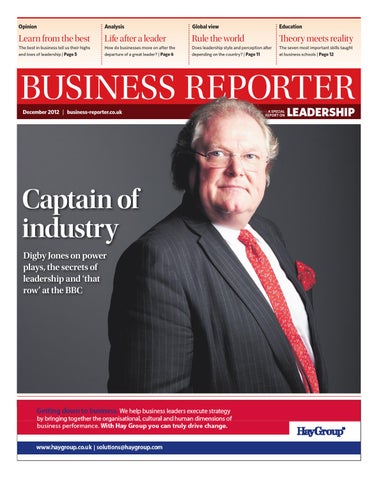
Captain of industry Digby Jones on power plays, the secrets of leadership and ‘that row’ at the BBC
Distributed within the Sunday Telegraph, produced and published by Lyonsdown which takes sole responsibility for the contents
LEADERSHIP
Business Reporter · December 2012
Leadership
Find us online: business-reporter.co.uk
Publisher Bradley Scheffer info@lyonsdown.co.uk
Project Managers Tom Turnbull tom@lyonsdown.co.uk
Editor Ellen Bennett editor@lyonsdown.co.uk
Jamie Flanagan jamie@lyonsdown.co.uk
Production Editor Amy Dickson amy@lyonsdown.co.uk Production Assistant Fleur Hollett production@lyonsdown.co.uk
Follow us on twitter: @biznessreporter
In brief
For more information on any of our supplements please contact us: Telephone 020 8349 4363 Email info@lyonsdown.co.uk
Best of the blogs
2
an independent report from lyonsdown, distributed with the sunday telegraph
Who? As A Leader by Pete Ashby What? Pete Ashby’s blog is a behindthe-scenes resource for leaders from all walks of life with exceptional aspirations. The apparent success story of so many leaders as seen from a distance (he says) doesn’t quite square up with the version of events as lived by them. It says: “Most leaders only become interested in the term feedback once they see it as linked to them realising their own leadership ambitions. Then the discussion becomes hugely positive and they are keen to talk through how they might make best use of our three-page script for a face-to-face feedback conversation…” Where? asaleader.com/category/blog/
Who? Fresh Tracks What? Do you think Yoda was a motivating leader or a coaching leader? Find the answer in the analysis of the different styles of leadership on this blog. Fresh Tracks covers serious leadership issues with humour and panache. You also will find interviews with successful leaders. It says: “This Christmas children will be pleading for the latest toy and many families will dust off their Monopoly sets
and rediscover the simple joy of playing a game together. But should we limit our game-playing to childhood and holidays, or can play help us in our work, our thinking and our leadership?” Where? freshtracks.co.uk/ourblog/
Who? Financial Mail Women’s Forum What? Andrew Leigh, founder of the management training and leadership development business Maynard Leigh and author of more than a dozen books on management, writes a weekly blog for the Financial Mail Women’s Forum. Leigh’s posts highlight, with his expert consultant’s eye, the main issues of leadership in our century. It says: “What all these cases point to is the importance of what can be called leadership character. This has nothing to do with charisma, which is often mistakenly viewed as an essential requirement for leadership. It is far more to do with individuality, integrity, resilience and capability. None of these is easily measured and convincing metrics of successful leadership remain elusive.” Where? fmwf.com/author/andrew-leigh/ Who? Leadership Freak What? Dan Rockwell, the author of
Leadership Freak, blogs daily with hints and tips on practical business leadership, in under 300 words. These easily digestible snippets take little time to read and leave you with suggestions to improve your day. It says: “Show me a leader who is happy with everything and I’ll show you a loser. The gift of young leaders is unhappiness. The tragedy of old leaders is contentment. Unhappiness and discontent ignite passion for change. Slime pits of ingratitude lie just beyond unhappiness. Nothing de-motivates like churlish ungratefulness. On the other hand, gratitude provides rich feedback that motivates forward movement.” Where? leadershipfreak.wordpress.com
Who? Body Language of Leadership by Mark Walsh What? Business trainer Mark Walsh speaks on the secrets of body and leadership at the Nowhere Group’s leadership dialogue and training event last year. Walsh gives some practical examples of how to extend your influence by adopting certain postures and poses. Where? youtube.com/ watch?v=FocbzSag7qg
Business Reporter · December 2012
an independent report from lyonsdown, distributed with the sunday telegraph
Like us: facebook.com/business-reporter
3
Leadership
Find us online: business-reporter.co.uk
What’s inside? Best in the game: sporting leaders
How do businesses carry on after a great leader has gone? Page 6
Sir Alex Ferguson
Martin Johnson
Age: 70
Age: 42
Leadership style: The Manchester United
Leadership style: Johnson is less media-
manager, who has been something
friendly than some, but his leadership
of a club icon since taking the helm in
– almost eclipsed by the star power of
1986, has become known in part for a
Jonny Wilkinson – proved decisive to
traditional disciplinarian streak.
England’s 2003 Rugby World Cup win.
Part of Ferguson’s style is to drive players
Rather than issuing orders, Johnson led
hard and keep them in line with his short
by example through his dedication on the
temper: players from Dwight Yorke to
field, as well as talking his team through
David Beckham have faced his screaming
games to keep them motivated and
fits, dubbed “the hairdryer” treatment.
performing at their best.
Andrew Strauss
Sebastian Coe
Age: 35
Age: 56
Leadership style: Andrew Strauss,
Leadership style: His athletic days
who led England’s cricket team to
may be behind him, but Sebastian Coe
victory at the Ashes in 2009, made his
– who won four Olympic medals as a
mark through meticulous planning and a
middle-distance runner in the 1980s –
focus on teamwork.
has displayed leadership at the helm of
Digby Jones reveals what it takes to make a top commander Page 8 Leadership styles around the world Page 11
London’s 2012 Olympic Games. In advance of the Australian leg of the 2010-2011 Ashes
In his book, The Winning Mind, he argues
series, strategy was developed on
that leadership involves honest, open
everything from intense fitness training
communication and letting people make
to how to deal with the Australian press.
their own decisions where possible.
What are business schools teaching MBA students today? Page 12
BEST APPS FOR LEADERS
FREE
Citrix GoToMeeting
LogMeIn
Todo for iPad
This free, universal app allows business partners and executives to launch a meeting when an idea strikes, with video conference tools and the ability to share and view documents.
Using this remote access app, users can control their PCs and Macs over WiFi/3G. With LogMeIn you can access important files, applications and information on the move.
Todo for iPad is a work planner that will keep you on top of all your projects. Todo also allows you to sync your work planner across any other Apple devices via iCloud.
FREE
On the record
“
The Nature of Leadership By John Antonakis, Dr. Anna T. Cianciolo and Robert J. Sternberg £40.84, Amazon
As we look ahead into the next century, leaders will be those who empower others. Bill Gates
Effective leadership is not about making speeches or being liked; leadership is defined by results not attributes. Peter Drucker
“
”
I start with the premise that the function of leadership is to produce more leaders, not more followers. Ralph Nader
”
“
It is better to lead from behind and put others in front. You take the front line when there is danger. Then people will appreciate your leadership. Nelson Mandela
”
Back in the office: reading list
”
“
£2.99
Becoming a Strong Instructional Leader: Saying No to Business as Usual By Alan Clarke Jones £25.95, Amazon The 7 Habits of Highly Effective People By Stephen R. Covey £9.59, Amazon
With thanks to the following organisation:
Transform your career with the UK’s most successful MBA No.1 UK university for overall student satisfaction*
Request your prospectus
www.openuniversity.co.uk/succeed INSPIRING LEARNING * National Student Survey 2012. The Open University is incorporated by Royal Charter (RC 000391), an exempt charity in England and Wales and a charity registered in Scotland (SC 038302).
62690_OU_Business_Reporter_On_Leadership_Ad.indd 1
21/11/2012 12:16
Business Reporter · December 2012
4
an independent report from lyonsdown, distributed with the sunday telegraph
Leadership
Find us online: business-reporter.co.uk
Follow us on twitter: @biznessreporter
Growing the talent garden Firms must create a nurturing and healthy environment for talent to grow, in order to produce a strong generation of leaders The talent managment process
R
Hardy perennials There is a wealth of evidence to indicate that developing home-grown talent drives better performance. Various Hay Group research findings demonstrate that CEOs at high-performing organisations typically spend long periods of time at their companies before taking the helm. This suggests that they are carefully developed and nurtured over a sustained period by the firms they eventually lead, as their companies pay close attention to leadership. On the 2012 World’s Most Admired Companies (WMAC) list – produced annually by Hay Group and FORTUNE magazine – the chief executives at the top 20 companies by overall industry score boast an average length-in-service at their organisations of more than 25 years (see table). By contrast, CEOs among the lower ranks have been at their firms on average for just over 10 years. Similarly, length-in service averages over 28 years for CEOs of organisations identified by Hay Group as the 2011 Best Companies for Leadership (BCL). In addition, the
So?
The talent management process
Home-grown talent When it comes to selecting a new CEO, organisations that emphasise talent management inevitably have a richer pool of home-grown potential to draw from. They are better placed to source the right leader at the right time from among their own. And while internal hiring may not always automatically be the best solution, it remains the preferred practice of high-performing companies: l While more than 90 per cent of the 2012 WMACs have well-defined CEO and executive succession plans, only 65 per cent of peer group companies are making plans to ensure top-team continuity. l 100 per cent of the 2011 BCL companies have a sufficient number of qualified internal candidates who are ready to assume leadership positions compared to just 44 per cent at peer companies. A long-time servant of an organisation will inevitably possess a detailed understanding of its unique intricacies that an external hire would take many years to acquire. The long-serving executive will have a ready grasp of the firm’s history, culture and structure; its all-important relationships with stakeholders, such as staff, customers, suppliers and shareholders; and the complex market environment in which it operates.
Nurturing potential Jack Welch – who grew GE’s share price by 4,000 per cent during 20 years in charge – described himself as a gardener, providing water and nourishment to his top 750 people. He encapsulated his main duty as chief
CEO length-in-organisational service at the top 20 WMAC (in order by overall WMAC industry score) Company
Industry rank
Apple McDonald’s Philip Morris Int Koç Holding Walt Disney Procter & Gamble Nestlé Chevron Caterpillar Exxon Mobil Starbucks Sistema Intel IBM Ralph Lauren Wyndham Worldwide British American Tobacco Google Qualcomm
1 1 1 1 1 1 1 1 1 2 2 2 1 1 1 1 2 1 1
Tim Cook Don Thompson Louis Camilleri Dr Bülent Bulgurlu Robert Iger Robert McDonald Paul Bulcke John Watson Douglas Oberhelman Rex Tillerson Howard Schultz Mikhail Shamolin Paul Otellini Ginni Rometty Ralph Lauren Stephen Holmes Nicandro Durante Larry Page Dr Paul Jacobs
Chief Executive
14 22 34 16 16 27 33 22 37 37 30 1 38 31 45 6 31 14 22
Wynn Resorts
2
Stephen Wynn
31
AVERAGE
Length in service
25.4
Ask, ‘potential for what?’
Expose high potentials to strategic roles
Identify high potentials
Know
ecent months have seen the spotlight cast firmly on company performance, and the pressure that shareholders are placing on results has seen a number of UK companies on the hunt for a new CEO. While some organisations inevitably need to look externally for their next CEO, those that take leadership seriously have suitable internal candidates ready and waiting in the wings to take the helm. It’s what the best organisations do: they care about talent, are focused on their current and future needs, and devote time, energy and resources to developing leadership throughout the company.
highest-performing senior executives in Hay Group’s global leadership competency database have been with their firms for more than 20 years on average.
Flow
INDUSTRY VIEW
Develop high potentials
G ro w executive of GE in two fitting words: “Developing talent.” But how do firms create a structured framework for successful talent development, in order to produce a healthy leadership pipeline? The answer will differ between organisations. But in essence, the solution is a rigorous process of planning for the future needs of the organisation, rather than short-term wins, so as to align talent management with long-term strategic requirements. But this is where many companies fall short. Fixated on quarterly results, they stop at asking: “What do we need today?” They fail to define a blueprint for the future. This entails looking 10-20 years ahead to understand the strategic demands on future leaders, what the CEO role will look like as a result, and the profile of the person needed to fulfil that role. Some of the organisations most adept at talent management map out this procedure in a step-by-step leadership development manual. Broadly speaking, the talent management process should entail four key steps: l So? Organisations need to ask: potential for what? What will success look like – now and in the future? What strategies will be needed? What skills, attributes and traits will be needed in a leader to deliver these? This must be considered under various scenarios, which will demand different strategies, requiring different CEO capabilities and behaviours. One strategy may necessitate a marketing guru to create a brand that will engage new customers. Another might mean a cost focus, calling for an efficiency drive. l Know Next, organisations need to measure the depth of the talent pool available to them against what they need. It is vital to identify high potentials early on, along with each of
their key growth factors and potential derailers. Some organisations do this by scoring talented individuals on an ongoing basis – being careful to measure potential, not current performance. l Grow The next stage is to create a development process for people with high potential, taking their growth factors and derailers into account. This is not just about a series of modules (though these can help), but structured experiences that help leaders realise their potential, such as – the next step – job assignments. l Flow This is succession planning in action. Designing these development processes means understanding the roles that each individual needs to experience and the lessons they need to take from each role, and “flowing” people around the organisation accordingly.
Inside, out? As noted, this isn’t to suggest that CEOs must always be hired internally. But a word to the wise: whether hiring internally or externally, firms should also seek independent support with strategic scenario planning, identifying what future strategies mean for the CEO role, and assessing a candidates’ fit with that role to ensure the right decision is made. That said, for organisations that take talent management seriously, the advantages of being able to rely on home-grown talent, not to mention the positive impact on business performance, are clearly evident. Yvonne Sell, above, is director of leadership and talent at Hay Group yvonne.sell@haygroup.com www.haygroup.co.uk
Business Reporter · December 2012
an independent report from lyonsdown, distributed with the sunday telegraph
Like us: facebook.com/business-reporter
Leadership
Find us online: business-reporter.co.uk
5
Take my advice... Business Reporter speaks to the businessmen and women who have been there, done it and worn the proverbial T-shirt, to ask what they have learnt about leadership
Sir James Dyson, founder of Dyson My idea of leadership is to encourage Dyson engineers to make mistakes. We put our faith in bright, inexperienced graduates who are unafraid to fail. It is failure that ultimately shows us a better way to solve a problem. It is an approach I learnt from the late Jeremy Fry when I was studying at the Royal College of Art. He acted as an engineering mentor and taught me how to develop an idea. We worked together on a high-speed landing craft known as the Sea Truck. I learnt by doing. Jeremy was keen on prototyping: creating something and testing it before refining it and trying again. Today I encourage my Dyson engineers take the same iterative approach, changing one variable at a time until a piece of technology works perfectly.
Richard Reed, co-founder, innocent Thirteen years ago, I set up innocent with my two best friends. We are now the number one smoothie company in the UK, and have 250 people working across Europe. We have a turnover of £200m each year. It hasn’t been easy, but I’ve loved every minute – and learnt a huge amount. You have to focus on the important stuff. Share the big ambitions throughout the business, get people figuring out how they can do their bit to make it happen, encourage change and development and be completely transparent with everyone about their role and performance. Don’t forget to do some of the soft stuff too. We want to make innocent a great place to work so we do things like
Celia Adams, freelance turnaround director and member of the Institute for Turnaround In my leadership experience I have learnt that it’s all about the people and getting the people on board with what needs to be done. It’s about changing minds and hearts. It is endemic that companies get into a rut and leaders can go off the boil – but my job is to change this. The problem is that if leaders don’t get the right signals and things get difficult, people can lose it a bit. A big part of my role is to get people involved in the sculpturing of their own destiny and believing they can influence that when there are so many external factors. I have learnt that leadership is about keeping people involved and on track. So as a leader I need to be that one ray of light that’s still there and still has its value – and you need to stay true to your values and be consistent so that people believe in you.
provide free breakfast (a healthy brea k fa st gets your b r a i n work i ng) and the i n no c e nt scholarship w h i c h awards people £1,000 to go and do something they really want to do. These shouldn’t take the place of the important priorities, but a little bit of the softer stuff will help keep people motivated and happy.
Mike Corner-Jones, managing director with Alvarez & Marsal In my years at Alvarez & Marsal I have found myself in situations where a company is in need of fast solutions to complex situations. The stakes are often high. The tension higher. And often different players have locked-in positions. At such times, leadership has never been about barking orders and laying
down the law. More effective has been t he patience to listen; the experience to see new ways forward; and the determination to win a consensus around mutual outcomes.
“It is failure that ultimately shows us a better way to solve a problem” – Sir James Dyson Martin Davidson, CMG, chief executive of the British Council Respect must be earned. There’s a difference in being told you are somebody’s boss and people feeling you are and treating you as such. Therefore you need two things for effective leadership: one is a passion for the mission and the other is the ability to hold two contradictory things in your mind at the same time. A good combination of skills is also important; you have to demonstrate theoretical grasp, but it’s frontline experience on the ground that makes the difference. You have to love what you’re doing and the values of your organisation. When dealing with downsizing, which is the worst thing about leadership, I’ve noticed that people are able to accept that the company may no longer have a place for them, provided they feel that the things they value are being held on to. The best thing about leadership is being able to give people the space and the opportunities to flourish.
Brad Smith, president and CEO of Intuit At Intuit we rally our employees around this mantra – fall in love with the problem, not the solution. If you never lose sight of the problem, the solution can be attacked in a more flexible and iterative way, meaning it’s more likely to succeed. We are asking all of our leaders to create and embrace systems that empower any employee to run fast, cheap experiments. When you make decisions through experiment, the best idea can show itself. It’s human nature to love our own ideas, but sometimes this means that we hang on to them for too long. Along the innovation journey, every innovator must ask: “Are we making sufficient progress to believe that our original hypothesis is correct, or do we need to make a change?” The best leaders don’t need to have all of the answers. They just ask the r i g h t questions.
Business Reporter · December 2012
6
an independent report from lyonsdown, distributed with the sunday telegraph
Leadership
Find us online: business-reporter.co.uk
Follow us on twitter: @biznessreporter
Greatest expectations After a successful leader leaves after making their mark within a company, how does a business put the pieces back together and move on? By Bonnie Gardiner Earlier this year in the wake of the media inquiry by Lord Justice Leveson, media mogul Rupert Murdoch announced plans to resign as director of News International, as part of a string of resignations from News Corporation boards across the globe. For decades, the Murdoch empire has dominated the world’s news providers, becoming a household name for his leadership of top global publications. However, as he now distances himself from his newspaper investments, what kind of changes can we expect to the industry, and News Corporation? Great leaders will often present a dual brand: the company’s and their own. But a prominent company will outlive the single reign of its founder, with multiple big names stepping down throughout history to make way for a successor. But this can be a very risky transition, with the pressure for new individuals to build their own reputation until it equals or outshines the last. For example Steve Jobs of Apple – after passing away in late 2011 – not only left behind a great legacy, but giant shoes to fill. But despite this challenge, it is possible to remember the old, and appreciate the new. Moving on In the likely event that a leader’s departure is
There is a general belief of consumers that Apple will never be the same following the loss of its visionary leader planned, the first step is of course to name a successor. While it is suspected that Rupert Murdoch has long planned his son James’ takeover of News Corp, if a business is not family owned, leaders will either promote someone already within the business or look externally for a good fit. Internal colleagues must possess the right qualities to get the whole company behind them, while external candidates need to build relationships and familiarise themselves with organisational structure and the networks and cultures within in. Then of course there is the third stakeholder – the public. There is a general belief of consumers that Apple will never be the same following the loss of its visionary leader. However, Jobs’ passion for the company combined with his timely exit should be enough to ensure that the promotion and subsequent priming of new CEO Tim Cook was meticulously done, as by his very nature Jobs was attuned to making difficult decisions while striving for success. Perhaps most
importantly though, is whether a new leader maintains that taught behaviour, understanding exactly what made the company shine in the first instance, and how that reputation can be upheld both now and into the future. Staying strong The world was waiting with baited breath when the newly led Apple team unveiled the iPhone 5 in September, followed closely by the iPad mini in November. The alteration to two already existing products, as well as the critically received
update to the Apple Maps app to replace the popular Google model, unsurprisingly did little to impress consumers. Apple’s success has always been measured by its continual innovation and its focus on ground-breaking technology, rather than simply outdoing the competition. It was also revealed that Jobs himself, who embraced the partnership with Google, was intolerant of mediocre products and against the idea of a 7-inch tablet, believing the size was not sufficient for apps. This may signal that the company has already begun to
Winning hearts and minds Why better leadership matters today more than ever INDUSTRY VIEW
I
n the past year, several hundred managers from different sectors and parts of the world have worked with the Leadership Trust. Many are making the same observation – that demands on their leadership are becoming more challenging than ever as they position their organisations to meet the fast-moving requirements of the 21st century. They say change is the only constant in their lives and that responding to the needs created by change is the challenge that keeps them awake most at night. Globalisation, societal changes, major technological advances, talent management and the aspirations of
“Leadership isn’t just about charisma”
the next generation all demand inspirational and motivational leadership to help steer organisations through this new and evolving landscape. Get it wrong and you could lose your competitive edge, the commitment of your people and suffer serious financial losses. What else is putting pressure on organisations? The quest for more ethical practices prompted by the business, public, and banking scandals of the last few years is one thing. But there is also the growing realisation that we cannot continue to raid our world’s natural resources without considering its future sustainability.
Competitive advantage Leaders who understand these pressures and navigate their teams through them are increasingly at a premium, as organisations seek to respond to this pace of change and gain competitive advantage. Interestingly, the IBM CEO study 2012 found that 73 per cent of those who surpassed industry peers in terms of revenue and profitability excelled at managing change. But you don’t have to acquire a new leader to enforce change; you
can develop your people to ensure you have a supply of current and future leaders to build resilience and implement strategic leadership, to respond to today’s and tomorrow’s turbulent business environment. Working with the right partner to help with this development is critical. For 37 years The Leadership Trust has been helping organisations to develop their leadership talent, observing how leaders, both experienced and aspiring, apply the learning from their training back in the workplace. In fact, some of the core elements of successful leadership remain as appropriate today as they were when the organisation was founded. The Leadership Trust believes that leaders need to understand
themselves deeply first, before they can successfully lead others. In essence, leadership is about winning the hearts and minds of people in order to achieve a common purpose. Leadership today is not just about leading from the front or charisma. It’s much more about ‘distributed leadership’.
Learning culture Increasingly, it is about coaching and mentoring to help others take an active leadership role regardless of
their position or status. It’s about developing a learning culture with devolved responsibility and it’s crucial you find the right training partner to help you get to grips with the challenges that change brings. Leadership today has become the most vital source of competitive advantage that an organisation can develop. Astute businesses know this, and are already investing in their present and future leadership talent. Are you? Professor Sharon Turnbull 01989 767 667 www.leadership.org.uk
Business Reporter · December 2012
an independent report from lyonsdown, distributed with the sunday telegraph
Like us: facebook.com/business-reporter
Leadership
Find us online: business-reporter.co.uk
The fall of Microsoft
As a company that was once powered by innovation, Microsoft has fallen behind the herd since Bill Gates stepped down as CEO in 2000 and handed the reigns over to Steve Ballmer. Ballmer was a businessman rather than a technology expert and sought to make his own mark, which led shares to halve in value in the first year. In August this year a Vanity Fair article lifted the lid on Microsoft’s “lost decade”, as past Microsoft execs told the magazine that endless meetings and red tape stifled swift creation. Ballmer was also publicly accused by past employees of being “out of touch”, with claims that he laughed off the iPhone, saying it would never get market share. Ballmer remains dedicated to recognising and attracting talent however, and despite rough patches he has continued to modify the structure of the company and the employees throughout his tenure. 30 30
Looking ahead Despite somewhat lacklustre developments by Apple’s new leadership team, it is still early days for the company following the end of the Steve Jobs era. With the loss of any visionary, there are bound to be some bumps in the road as the company and the new leadership team make
2012
2011
2010
2009
2007
2008
2005
2006
2003
2004
2001
1515
2002
20 20
2000
Leading by example Disney is an example of a company that has steered off course following the departure of an iconic leader, undoubtedly impacting on the brand itself. Founded by Walt Disney and his brother Roy in the 1920s, the Walt Disney Company grew into a global brand, single-handedly transforming the animation industry by introducing featurelength cartoons, extending its media domain into television and, of course, the creation of Disneyland theme parks. After Walt Disney died in 1966, the company was placed in the hands of his brother and co-founder Roy, who intimately understood his business ideals and fostered Walt’s vision through some of the company’s better years. Michael Eisner’s rise to CEO in 1984 helped Disney to re-emerge as a powerful force following a slump in the 1970s; however, Eisner’s reign followed too long after the Disney brothers, and his business practices steered far from their original vision. Displaying astute business flair, Eisner saw the company through numerous large-scale acquisitions, such as Marvel Entertainment, Miramax Films and ABC News. However, these buy-outs didn’t always fit Disney’s family friendly image. Focus was lost, and the widespread assets of the company became too much to handle. Internal squabbles with key people caused the costly defection of many key executives, as well as the public tension with companies such as Pixar Animation, which led to the termination of their contract. Shareholders became disgruntled with this breakdown, blaming Eisner for the company’s underperforming stock and later voted that Eisner be removed as chairman and CEO, which was encouraged by Roy Disney and former board member Stanley Gold.
25 25
US $
peel away from Jobs’ vision, and these unveilings – particularly the inferior mapping app which turned Google from an ally to a rival – could be the canary in the coal mine.
Microsoft share price average (2000 - 2012)
Honda inspires leaders
Some of Honda Motor Company’s most innovative vehicles and greatest market successes came after founder – Soichiro Honda (below) – retired in 1973. The company’s tagline, The Power of Dreams, encapsulates the company’s history; making Soichiro an international “ragsto-riches” success story through his talent, ingenuity and passion. After 25 years, he stood down and Kiyoshi Kawashima was named the new president. Following this, Honda continually produce several significant model concepts and innovative new designs that have kept the company rolling, with its position of leadership and company values – the commitment to customer satisfaction, pioneering technology, community involvement and corporate success shared with associates – is followed worldwide. what is no doubt a challenging adjustment. For now we can have faith that Jobs had selected a suitable successor after great deliberation, and his influential mentoring. In fact it is very likely that, as you are reading this, Apple techies are working diligently on the next big breakthrough. But as Jobs has frequently been compared to Walt Disney, who had just as much faith in his own successor, Roy Disney, we can only wonder – what vision will guide Apple 10 or 20 years from now? Time will tell.
7
Power to the people What can strategic leadership bring to an organisation? INDUSTRY VIEW
P
eople are the essence of strategic leadership. If that sounds obvious, I make no apology because as chairman of IFT, Europe’s professional body for accredited leaders in company transformation, time and time again I see organisations whose challenges derive from a failure to grasp and act on this fundamental principle. The common denominators of fast but sustainable changes are part structural and part project-driven but most importantly, are about the human factors in business. In my experience, the true nature of institutional and personal character comes to light when it is tested under pressure. Fear is a powerful contaminant of corporate culture and in stressful situations I have seen extremes of unproductive behaviour. Strategic leadership is required to deal with the breakdown in financial structure, relationships and multiple conflicts of interest. Leadership needs to be open but commercial; constructive but learning from experiences; and decisive but as fair as possible.
Customer satisfaction The company, its customers and its competitive advantage must be kept at the centre of all discussions. Without customers being satisfied profitably, whether the company is financially stressed or just failing to meet industry benchmarks, it has no compelling reason to exist. The leader’s role is to align management and team with business objectives that are focused, simple to understand and communicate – and to implement them rapidly and effectively. Management must be motivated and incentivised in ways that support the commercial goals. Each stakeholder group needs to be brought to a position where it is realistic, pragmatic and playing an appropriate and constructive part in moving the plan forward. Too often vested or selfish interests dominate decision-making, but it can be overcome. The people who have the answers to what a business needs to achieve fast growth or deal with an operational, market or financial challenge includes management – though not exclusively. Having listened to them, the leader and change driver has to be decisive. For example, I went in as CEO to sports nutrition company, Maximuscle. Once we recruited, I became chairman. Maximuscle needed to achieve profound and radical change in a short period of time to meet its business plan aspirations.
Turning a business around Its value creation strategy was focused on three areas: investing in the management talent and infrastructure needed to build a scalable business; investing in new brands and products to address specifically identified consumer segments within the sports nutrition market; and expanding the business internationally with sales coming from more than 20 countries. In just over three years, sales and profits doubled and
The leader’s role is to align management and team with business objectives the business significantly increased in value from a £75m investment to a £162m return. For the businesses that have hung on through the economic reset, congratulations on another 12 months of hard graft. Now is the time to think about and invest in the future and set a new goal to reach before next Christmas. Focus on simplicity and speed, and put personal integrity and people at the heart of all decision making. In tough times leaders need to build and protect the levels of motivation, commitment and resilience. This is the essence of strategic leadership. Iain MacRitchie is chairman of the IFT 020 7324 6244 www.instituteforturnaround.com
Business Reporter · December 2012
8
an independent report from lyonsdown, distributed with the sunday telegraph
Leadership
Find us online: business-reporter.co.uk
Follow us on twitter: @biznessreporter
(High)
HT/HR
S3
S2
S4
S1
eg
ng
at
in
g
li Tel
Relationship behaviour
g
ng lli Se
Partic ipa tin
HR/LT
D
el
LR/LT (Low)
HT/LR
Task behaviour
(High)
The Situational Leadership® model
Taking the lead Whatever your business, get the most from your leaders with a tried and tested training programme INDUSTRY VIEW
T
he need for effective leadership is greater than ever. Focusing on performance and keeping staff engaged is crucial for survival and future growth, yet a recent CMI report found that nearly half of UK managers were thought to be ineffective by their staff. Situational Leadership® from GBS Corporate Training is a proven model of effective leadership that has endured. It is a practical way to help a business’s people be effective in the achievement of goals and shows how a leader needs to respond to their performance requirements. So why does Situational Leadership® stand the test of time? First, its is a very well researched and practical model which provides a framework that allows people to know precisely how and when to deliver the behaviours required to demonstrate successful and effective team leadership. It also gives people a common language and an easy-to-understand approach which, when implemented consistently, helps people to realise their potential. As Situational Leadership® focuses on performance targets, it ensures that leadership skills development is firmly within the context of performance achievement and growth for everyone.
Identifying needs The model also gives a framework to consistently analyse present performance against required performance, teaching and developing specific behaviours required to match identified needs. Situational Leadership® is used by many organisations to underpin a coaching culture. It recognises that coaching needs to include interventions ranging from more directive styles to build competence to less directive styles to support appropriate autonomy for high performers. Effectively and consistently implemented, these skills really help people develop in their jobs. Situational Leadership® transcends cultural and generational differences with a success rate that speaks for itself – 70 per cent of Fortune 500 companies consider the model a core, common and critical component of their leadership development strategy. More than ever the world needs better leaders – and so do employees. www.gbscorporate.com
‘Leaders are born, not made’
Business Reporter · December 2012
an independent report from lyonsdown, distributed with the sunday telegraph
Like us: facebook.com/business-reporter
Leadership
Find us online: business-reporter.co.uk
From the battlefield to the boardoom, former CBI chief Digby Jones knows what it takes to be a leader – and isn’t afraid to say it By Dave Baxter “You are probably days away from war. Would you choose a teetotalling vegetarian or an alcoholic depressive as your leader? The teetotalling vegetarian was Hitler, and the alcoholic depressive was Churchill.” It’s a grim, rain-lashed November afternoon and from the basement of the City’s luxurious Grange Tower Bridge Hotel, former CBI chief, ex-government minister, ser v ing peer and business grandee Digby Jones is making an impassioned case for good leadership – and giving Business Reporter a crash course in military history. Leaning eagerly forward in a dark suit, white shirt and a prominent red tie, Jones has an excited glimmer in his eye as he draws from history to list some of its greatest leaders: 18th century soldier the Duke of Marlborough, who led a disparate coalition of international forces deep into southern Germany to rout the French; wartime leader Winston Churchill; and naval hero Horatio Nelson, who trained his forces to sail, unwavering, into the face of enemy guns in a daring bid to outmanoeuvre the French and Spanish. Coloured history This opening salvo of military awe is unsurprising: after running through a string of different accolades, Jones’ CV coyly notes he holds “more than a passing interest” in military history, something which makes sense given his background. Before moving on to spend more than 20 years at a Birmingham law firm, where he worked his way up to become senior partner, he started his career with a three-year university cadetship in the Royal Navy. More than 40 years on from such beginnings, an impressive collection of leadership and
business experience has brought him to this moment. The neat suit and the flash venue – where Jones is earmarked to give a talk on manufacturing to a crowd of 650 at an industry dinner – are aptly matched by his track record, which includes six years leading selfproclaimed “voice of business” the CBI, an 18-month tenure as a trade minister in Gordon Brown’s government, a slew of corporate advisory positions and membership of the House of Lords. And though he offers a glut of opinions on what makes a good leader – the need to communicate, engender a sense of teamwork in a group and inspire individuals to maximise their potential, even at the danger of making yourself redundant when they outperform you
“There’s a massive difference between leadership and management – you get some good managers who aren’t any good at leading” – Jones – it is the way he demonstrates this that explains his own success as a boss. Infectious enthusiasm Jones seems to bring out the best in people, simply by remaining calm, amicable and engaged: he listens attentively to questions, never breaks eye contact and gives his answers in a frank, considered fashion without losing his composure – and t hose around him, f rom t he photographer he patiently poses for to a previously irritable hotel employee, seem to v isibly warm to this. It also helps that he has an infectious ent husiasm when it comes to making his points – particularly
on the rarity of leaders and the distinction between these and managers. “There’s a massive difference between leadership and management – you get some good managers who aren’t any good at leading,” he begins earnestly, after a pause. “You can teach management – you can say what you do in a certain set of circumstances, and that’s management. “Leadership is the something special; the little bit of intangible, the gold dust – and leaders are born, not made.” Entwistle not a leader Compared to his public profile, Jones is surprisingly pleasant: on TV, radio and his own blog – something he quotes freely, mid-interview – he offers a rallying cry for enterprise, sometimes to the point of appearing outspoken and derogatory, from criticising the EU to civil servants and idle youngsters. And he is happy to speak on contentious issues, such as the resignation of BBC boss George Entwistle following a disastrous interview with John Humphries over the Jimmy Savile fiasco. “I listened to George Entwistle on the Saturday morning (during the John Humphires interview) – and as I listened to it, I told my wife: ‘I’m listening to a manager, not a leader,” he says. “I think that George Entwistle, all through his 26 years at the BBC, had shown signs of a good manager. “I’m not too sure about Savile and Newsnight and McAlpine, but I’m certain that he displayed all the signs of a manager and none of the signs of a leader.” Anxious of business And Jones – whose business card proudly bears the slogan: “You never made a poor man rich by making a rich man poor” – is keen to attack antibusiness practice, particularly in politics. He says he is anxious to see business “at the centre of society” – and engaged more in communities – but that the Jones: Business success being washed out by negative media
Performance that lasts A fresh approach to improving business results INDUSTRY VIEW
T
he business model most companies use to develop new leaders is flawed. They look for people who are exceptional at their job and promote them. Therein lies the problem. We are taking people out of the very thing they are good at and expecting them to be equally successful as a leader of others. Today’s businesses are too complex and specialised for that to work. Matrix organisations, cross-functional working and advancing technology all conspire to make leading in today’s world more difficult. Leaders require a different skill set – skills
that enable them to get things done through others and bring out their team’s best performance. Setting expectations, motivating people, handling conflict and monitoring performance are all part of this new role. Many leaders feel ill equipped and unprepared. Leadership courses over a few days aren’t
the answer. Most people have difficulty putting concepts into practical use. Research confirms that changing behaviour takes intentional practice over a period of time. So, even after this type of training they continue to struggle and are frustrated because their team is not meeting their goals. RLG International bring a fresh approach
9
Digby Jones’ CV l Serves in a number of corporate roles, including chairman of Triumph Motorcycles, senior advisor to HSBC and corporate advisor to JCB l Lives in Marylebone and Warwickshire with his wife, Pat l Director general of the Confederation of British Industry (CBI), January 2000 to June 2006 l Minister of state for trade and investment July 2007 to October 2008 l Interests include football, rugby, cricket, theatre and skiing
benefits of enterprise are being drowned out by anti-business sentiment in UK politics, media and public opinion. “We have a media in Britain where if business does well, people talk about fat cats, but if they create jobs and tax, the news ends up somewhere between the greyhound results and the births, deaths and marriages,” he says. And he is equally dismissive of Business Secretary Vince Cable. “I think Vince Cable is a decent human being. He’s a good man and has a good set of values, and you believe he is sincere,” he says. “I just don’t believe it’s in his DNA that he looks in the mirror and gives three cheers for wealth creation every day.” And with that, the polemic is over: after an hour of fielding questions, Jones is on the move again and heading to his hotel room – to prepare for a talk on UK industry, and carry on leading the charge for British business.
Leaders and teams can build an engaged and involved workforce
to improving business results. It provides performance coaches on site, collaborating with leaders and their teams every day to tackle real business issues – not theoretical problems. Together, these teams and leaders build an engaged and involved workforce, increase communication and establish an Operating Rhythm™ to review performance and identify ways to improve. The skills and capabilities of both leaders and their teams are broadened in parallel. So if you want to create leaders for the future who are able to improve safety, production, cost or quality through your existing workforce, then consider RLG. It will help you gain a quantifiable shift in your business measures, and create a high-performance culture that is sustainable – connecting your front line to the bottom line. 01224 56 26 56 www.RLGInternational.com
Business Reporter · December 2012
10
an independent report from lyonsdown, distributed with the sunday telegraph
Leadership
Find us online: business-reporter.co.uk
Follow us on twitter: @biznessreporter
Sky’s the limit University collaboration turbo-charges future RAF leaders INDUSTRY VIEW
T
he University of Portsmouth Business School has won a £5.3m contract to help train the Royal Air Force’s future leaders. Over the next five to seven years, leadership and management experts with specialist knowledge of the military will help develop thousands of RAF personnel every year as part of both initial officer training and senior officer development.
Programmes for industry For more than 20 years Portsmouth Business School has undertaken significant research on leadership and developed specialist tailor-made leadership and management training programmes for the Royal Navy,
Hewlett-Packard, the NHS, Vestas and Serco, among others. The bespoke training for the RAF will focus on international security and defence leadership. It will be delivered in collaboration with the RAF’s own in-house training programme and in partnership with Cranfield University. Officers with middle to senior management responsibilities will take part in order to bring a new perspective and enhanced levels of skills and knowledge into the RAF. Nick Capon of Portsmouth Business School says: “We have particular experience designing and delivering corporate courses in leadership. We start by acknowledging the leadership training and experience already undertaken and selectively adding only what is valuable to
Leading C by example
INDUSTRY VIEW
Are the UK’s organisations geared up to create tomorrow’s leaders?
reating tomorrow’s leaders is about recognising that leaders exist today, and that we don’t have to wait until tomorrow. Fundamentally, leaders are people who put leadership into practice. Good leadership comes from what a leader believes, how they behave and how they operate. However, the problem is that organisations do not develop future leaders to understand who they are and how they impact on others. They give leaders knowledge and expect them to change their core beliefs and behaviours as a result. This will not happen. Training departments are asked to evaluate courses, which are knowledge-based interventions. Stop measuring
Is any of this familiar to you?
build towards latest global good practice. What we are doing with the RAF is a very good example of this.”
Commitment to the future Air commodore David Stubbs, commandant of the Royal Air Force College Cranwell and director of recruitment and initial training at the RAF, said: “This contract demonstrates the RAF’s commitment to developing our people to be among the best leaders of their generation. “Senior officers will be challenged to bring their wealth of experience back to the academic environment in order to thrash out the big issues surrounding the future of national and international defence and air power, thus institutionalising the culture of
these outputs; the number of people on courses, the quality of taught learning, the number of courses run each year, or training spent per head. Stop spending training budgets on improving knowledge about leadership and spend it on putting mechanisms in place to ensure that thinking turns into action. Focus on the 80 per cent of learning that comes through practice, on-the-job experience, feedback, coaching, and mentoring. At the heart of every organisation there should be a stringent follow-up process, strong performance managers and coaching networks. We must use the leaders of today to create the leaders of tomorrow. Leadership
The Red Arrows flying over RAF College Cranwell, Lincolnshire strategic thinking that is called for by today’s ever more complex military-political landscape.” www.port.ac.uk/departments/faculties/ portsmouthbusinessschool/
“Good leadership comes from what a leader believes, how they behave and how they operate” – Amoss behaviours are often cited as being difficult to develop. This is because core competencies often exist for staff but leadership competencies are reserved for managers, as is leadership development. Subscribe to the belief that a leader can exist without being a manager, and then leadership skills and results can be developed
from the start of a career. At Complete Leadership, we open up leadership development to all staff. We help employees understand who they are and how they impact on others, and we measure leadership thinking and actions in performance management processes. We treat leadership as a natural ability and not a bolt-on to management skills. The earlier an organisation recognises the need to develop leaders through encouraging leadership at all levels, then the easier it will be to create the managers who can actually lead. Denise Amoss, left, is the managing director at Complete Leadership denise@completeleadership. co.uk www.completeleadership. co.uk
• Frustration: you don’t seem to be able to do things easily • Disconnects: processes don’t seem to be clearly understood across the organisation • Confusion: no-one really seems to know what’s going on • Hassle: there are always fires to put out and too much to do • Performance isn’t stable or predictable • Complaints: you’re spending too much time dealing with unhappy customers • Getting new products and services to market seems to take too long • You aren’t seeing enough innovation in new products and services Catalyst enables results by helping organisations address these types of issue, and successfully achieve their objectives through effective strategy deployment and everyday operational excellence.
For more information about Catalyst Consulting please call us on +44 (0)845 345 2282, visit our website at www.catalystconsulting.co.uk or email us at info@catalystconsulting.co.uk
Business Reporter · December 2012
an independent report from lyonsdown, distributed with the sunday telegraph
Like us: facebook.com/business-reporter
Leadership
Find us online: business-reporter.co.uk
11
Living the American dream or death by Karoshi? From ‘salarymen’ to Swedish innovators, leadership not only differs within companies – but countries, too By Dave Baxter Japan Japan has a number of unsettling stereotypes. For example, the term “salaryman” describes a white-collar worker in a large organisation, known for working dangerously long overtime and practicing a lemming-like obedience – there is even the idea of “Karoshi”, or death by overwork. Japan tends to be associated with hands-on but benevolent leadership. This includes the concept of “Genchi genbutsu” – a Japanese ph rase mea n i ng to “go see something yourself”, or “get your hands dirty” – where leaders, even at the top level of a company, are expected to help with problems right down to the ground level. There is also a focus on mentor ing, teamwork and communication – but critics could perceive the hands-on approach as micromanagement. China A s academic journal Graziado Business Review discussed in a 2009 volume, China’s corporate culture – and with it the leadership model – has unusual, contradictory traits. While Chinese companies tend to have a set hierarchy, lending any leader a distanced, authoritarian position over the employees, the country also has a widespread cultural dynamic known as “Guanxi” which boils down to the benefits
and importance of developing and maintaining personal connections – and can, for instance, oblige a boss to help out an inferior if asked. So leaders are powerful and therefore must have an assertive style – but this is confused by the “Guanxi” effect, which can see them reduced to an equal footing with people lower down the ladder. But as increased personal wealth leads to a more individualistic generation, Chinese dynamics – and leadership traits – may be affected and move to a more western model. America The USA – often promoted as a haven for aspirant, entrepreneurial types – has seen various leadership styles come and go. Different forms of delegation, participation and interaction have been adopted in the country, but one standout trend is the emergence of some very charismatic CEOs, such as Starbucks’s Howard Schultz, who become almost a celebrity in their own right. Other superstar US leaders in business include Jack Welch – who was at the helm of General Electric between 1981 and 2001 – and former HewlettPackard boss Carly Fiorina. But charisma is not limited to American leaders, as hot shots such as Britain’s Richard Branson would attest – and a s Fior i n a’s 2 0 05 ou s t i ng f r om H P suggests, charisma is not a guarantee for leadership success.
Germany A popular style in Europe’s biggest economy – though it has as much to do with corporate structure of those in charge – is known as the participative, or democratic, model. Here, rather than running a firm by relying on charisma, aggression or delegating through a hierarchy, a boss will offer employees the chance to get involved in the running of the business. So workers can have an input into the decision process and directly affect the direction of the firm. The argument goes that this can lead to happier, more productive workers and a more cohesive firm – but some say that this is a gimmick, and rarely genuinely implemented. France French corporate culture is plagued by stereotypes – the long lunches, a more relaxed attitude to doing business and an everpresent threat of strikes – but it also has some key characteristics that affect the form of leadership used. French companies often tend to have a very rigid hierarchical structure, meaning a decision will begin with the chief before being disseminated down the line, where junior management will put it into action. This style, described as directive, is more traditional than that of participation, and it has drawbacks – it could hurt staff morale, and
means that in times of crisis it can be difficult to react swiftly because instructions take time to reach workers. Russia Maxim Nogotkov, the president of Russian mobile phone retailer Svyaznoy and winner of Ernst & Young’s national 2010 Entrepreneur of the Year award, is one example of a possible flux in leadership styles in the country – in that he is attempting to imitate some western firms by encouraging staff participation in the business. Modern Russia, a forum dedicated to monitoring the country’s economic and social development, argues that many successful Russian entrepreneurs are taking on an “open” leadership style – stressing co-operation and individual achievement from workers. This clashes with the previous, Soviet-era image of Russian leadership as being controlling, centralised and hierarchical.
Many successful Russian entrepreneurs are taking on an “open” leadership style Sweden Sweden, which the Pro Inno index – part of a European Commission initiative – rates as one of the Europe’s top innovators, also has a line in creative leadership: bosses and managers are known for being involved in the day-to-day work of the business, meaning they can react quickly to fresh developments. But, as a 2010 volume of the Iranian Journal of Management Studies argues, Swedish leaders are also at home among fastpaced change, keen to take risks and follow their instinct when making decisions; something which leads to a pragmatic business approach, but cou ld lead to a number of risks under the wrong leader.
Business schools mean business Academia and industry must work together to develop leaders of the future INDUSTRY VIEW
T
he Association of Business Schools (ABS) is the voice for the UK’s business schools and independent management colleges, setting the agenda for business and management education in the UK within an increasingly international environment. It develops influential
policies and promotes, One such example is at Aston communicates and lobbies on these University. The university is at local, regional, national and running a voucher scheme, international levels. designed to facilitate Vouchers Business schools are knowledge transfer worth developing the leaders of between academics and tomorrow and must work SMEs in order to stimulate £3,000 with businesses to ensure innovation. Aston each given that degree programmes Business School designed to SMEs and research are relevant and and managed a brokerage linked directly to industry. that distributed 661 vouchers, worth £3,000 each, to West Midlands SMEs, which used the voucher to Agenda for growth purchase academic expertise. The ABS has recently set up its The brokerage recruited SMEs innovation taskforce, to provide and facilitated the selection of an evidence of how UK business academic member from one of schools are supporting the the 13 universities in the West government’s agenda in the Midlands region. Department for Business Innovation In October 2011, Loughborough and Skills report, Innovation and University set up the Glendonbrook Research for Growth.
Centre for Enterprise Education. The vision of the centre is to embed enterprise and innovation across the university, ensuring that undergraduate and postgraduate students not only acquire academic knowhow, but also develop enterprise skills to put their knowledge and expertise to good use.
Key competencies Entrepreneurial behaviour is a key competency required by a growing number of graduate employers and business, and management is a popular study choice with one in seven students choosing it as a subject. Business schools offer student placements, internships,
consultancy; knowledge transfers partnerships, business mentors, incubators and much more. Get in touch with your local university to find out what they can offer in your local area. www.associationofbusiness schools.org Twitter: @londonabs
Business Reporter · December 2012
12
an independent report from lyonsdown, distributed with the sunday telegraph
Leadership
Find us online: business-reporter.co.uk
What skills can a business school teach you? Building strategy
1
For most MBAs, the course is not about knowing, but about doing. “At Saïd, we don’t tell people ‘we are giving you the knowledge’, we say ‘we are teaching you how to think, how to debate, how to question things’,” explains Kathy Harvey, programme director of the Executive MBA at Saïd Business School. “If you look at the kind of strategic conversations held within a company, and the things that are debated between members of an executive board, we expect our students to reach the point where they can have a voice in those conversations.” Harvard Business School in the US relies heavily on what they call the case method, where students are presented with real business problems from real companies. Complete with the constraints and incomplete information found in actual business issues, students are placed in the role of the decisionmaker when there are no simple solutions. Yet through the dynamic process, students become adept at dissecting the issues, exercising judgment, and making difficult decisions—the hallmarks of skillful leadership.
In today’s fast-paced technological world, leadership is often born from innovation and entrepreneurial skills rather than degrees. However, for many young people who want to make it in the world of business, there is also the Masters of Business Administration (MBA). While some top guns such as Steve Jobs and Sir Richard Branson never relied on university, business schools have sculpted the careers of countless business men and women who went on to become leaders of major companies, regions and even entire nations. UK-based and international business schools alike have been influential over the years, each developing their own MBA core curriculum to shape and mould the leaders of tomorrow.
Broadening of perspective Students are encouraged to get involved in an eclectic assortment of work environments, with many departmental and sectorial options being explored. Cass Business School in London offers this variety, with students working with a large, corporate organisation such as KPMG one week, then developing new insights for thriving SMEs the next. By experiencing each different challenge for
Follow us on twitter: @biznessreporter
More than ever, it’s about what you know – not who you know. Bonnie Gardiner finds out what the best MBAs can offer
2
Collaborative skills To consistently deliver outstanding results in a business of any size or direction, these days you won’t get very far on your journey without having interpersonal skills. Collaborative working and effective teambuilding is often a crucial facet of any MBA programme, with schools such as Cass ensuring students work in multidisciplinary and multicultural teams throughout the course. This method aims to create what they refer to as a
themselves, students can constantly evolve and mould their career path. Sionade Robinson, associate dean of the Cass MBA Programme explains: “Quite often the process of going through an MBA is supposed to open lots of doors and opportunities; it’s not just a means to an end. “Especially now with the economy being the way that it is, people have to be open to opportunities and to recognise that what they thought was going to be their dream job may not actually be the right thing for them.”
creative or positive friction as they learn to negotiate with one another, showing tolerance, influence and collaboration. Wharton Business School, as part of the University of Pennsylvania, also holds team learning retreats for working groups, which include two day campsite challenges and other outdoor activities to experience teambuilding challenges in a fun and unusual environment.
3
Business Reporter · December 2012
an independent report from lyonsdown, distributed with the sunday telegraph
Like us: facebook.com/business-reporter
Entrepreneurial skills
4
Being an entrepreneur means working fast, hard and better than the competition, so many schools aim to simulate this experience to prepare their students for the challenge. Insead International Business School, with campuses in Europe, Asia and the Middle East, provides projects where participants are put directly into the shoes of an entrepreneurial team competing in a consumer-driven market. From creating and pitching ideas, to managing and financing a new venture, there is an inherent focus on realism that requires fast thinking and tactical decision-making, combined with tight deadlines, strong competition and significant uncertainty. Saïd Business School also embraces a strong focus on entrepreneurial finance, helping students to explore means of attaining venture capital, along with a pitching project that includes a panel of professional advisors providing feedback on presentations. “That’s an extremely valuable insight to how you project yourself as a leader,” says Harvey.
Leadership
Find us online: business-reporter.co.uk
Bringing it together
As Cass points out in its school brochure, business issues do not come neatly labeled; however a very important facet of the MBA experience is understanding how each of the fundamental disciplines relate. Various schools offer integration courses and retreats where individuals and groups face more simulations to stretch their abilities and test their creativity. With solutions ranging from combinations such as finance, policy, and risk management to marketing, ICT, and human resources, students can develop a more universal perspective that allows them a more thorough approach to management.
6
Working globally As an extension of collaboration skills, when aiming for the growth of any company, leaders will need to understand the importance of a global perspective to provide unique insight into management, plus knowledge surrounding how business is handled within diverse cultures.
Schools such as Insead rely heavily on this for their MBA programmes, being revered for its multi-lingual international groups that encourage leadership through cultural sensitivity and providing a wide range of differing perspectives and challenges for one business problem. UK-based schools are also becoming
s Looking forward
While each individual module of an MBA can be crucial to the development of future leaders, it isn’t until students can implement an integrated strategy that they become a truly resilient, multi-skilled and confident business leader.
increasingly global in scope, with Cass’s London students now being made up of approximately 45 nationalities, with almost 9 in 10 students coming from outside the UK. Many schools also offer a practical global approach, with students required to tackle overseas business issues for a company that is
5
A style R that suits Managers must find a leadership style that fits their personality, their role, and the workplace they’re in
Student engagement A new student experience team are focused on improving every aspect of student engagement. A business engagement, alumni and careers team has also been implemented to provide more support for students seeking placements and internships and increased
7
With constant new developments often rendering old skills redundant, many MBA programmes today are challenging students to look beyond the present, keep their eyes on the horizon, and to be prepared for the unexpected. Themes such as climate change, varying demographics, growing populations and technological advancements are all discussed at the Saïd Business School at Oxford University. “These are big issues and questions that are affecting businesses and society as a whole, and we bring these questions into the classroom,” explains Harvey. “We use a combination of group work, case studies, interactive lectures and guest speakers, and we bring in colleagues from around the university who are looking at some of the big issues that are facing not just one business area but the business world as a whole.”
either attempting to expand into the emerging markets, or operate within volatile economies, as well as within other regions of the developed world.
development of new masters programmes in global marketing management, entrepreneurship and leadership. In many respects the skills the latter two programmes teach are the same skills used in moving the school forward, such as the ability to inspire, engage and motivate. As a leading Russell Group University, teaching in the management school draws on leading edge research to inform the development of practical skills that can be applied effectively in the workplace.
INDUSTRY VIEW
ecent years have seen significant developments for the University of Sheffield Management School. In the past 12 months, the management school has gained triple accreditation, which means it joins a global elite of just 57 schools with prestigious awards from the Association of MBAs, European Quality Improvement System and The Association to Advance Collegiate Schools of Business. The combination of all three awards is a real achievement as they are evidence that the school has been peer-reviewed and found to meet stringent quality guidelines across the board in areas including: quality of research and teaching, business engagement, careers support and alumni relations. Under the leadership of Dean Professor Keith Glaister, the school has increased staff numbers by 20 per cent over the past two years. This expansion has enabled expertise to be built in leadership, entrepreneurship, marketing, finance and accounting, as well as in the school’s world-class work psychology institute. A root and branch review of professional services staff has resulted in a restructure that is designed to support the school’s future ambitions for increased excellence.
13
Essential skills
employability skills. An exciting programme of alumni events and services is in place to continue to build the school’s community and external links. In April 2013, the school will move to newly refurbished state-of-the-art facilities on a leafy site just ten minutes from the main university campus. The new premises include an employability hub with space for employer workshops and access to career guidance and resources for students. An executive suite will maximise opportunities for corporate engagement such as guest lectures and business events and provide a forum where students and business partners can meet and exchange ideas. Recent months have also seen the
To lead effectively, skills are required in strategic and interpersonal leadership; analysis and decision-making; and entrepreneurship. Interpersonal skills are essential for developing and sustaining relations with team members to encourage and motivate them while resolving any issues. Few factors impact employee motivation, wellbeing and performance as strongly as leaders do. To succeed it is imperative for leaders to find the authentic style that suits them, their personality and role. Our world and marketplaces are more dynamic and fast-paced than at any time in previous history. Leaders need to be equipped for this and able to leverage them for organisational advantage. To do so, they must engage effectively with the workforce. For organisations to succeed, it is important that leaders find an authentic leadership style that fits their personality, their role, and the context and the challenges they face. +44 (0) 114 222 3346 www.sheffield.ac.uk/management
Business Reporter · December 2012
14
an independent report from lyonsdown, distributed with the sunday telegraph
Leadership
Find us online: business-reporter.co.uk
Follow us on twitter: @biznessreporter
The good life Successful leaders engage with people effectively to achieve an organisation’s goals INDUSTRY VIEW
Does leadership matter? In some quarters profit is a dirty word. Yet without profit, activities are not sustainable. The leadership challenge we’re faced with is how profit is generated and how it is distributed. Continuous innovation in the production and distribution of goods and services at a profit is the foundation of modern societies, because it enables quality of life for more and more people. However, resources are always limited in relation to wants. Effective and thoughtful leadership from people in all industries is slowly and steadily accepting responsibility for producing the competitive productivity and profits, quality of life, ecosystems sustainability, and progressive innovations that make life worthwhile. According to David Beech (right) co-founder of professional services company Cambridge Leadership Development, this enables the 4P outcomes – profit, people, planet,and progress –that define the good life.
What do effective leaders do? Everyone can make a leadership contribution; how managers do this varies greatly, as does the impact they have. Effective leaders are needed at all levels across the business to achieve the 4P outcomes, because they establish and gain commitment to company values that are based on goals and direction consistent with the business strategy. Their passion, commitment and communication skills energise people to engage in the alignment of company-wide implementation activities that deliver strategic goals. These leaders also sponsor and proactively contribute to methods of achieving continuous learning that is reflective, and creates a culture of improvement, change and renewal. According to Beech, effective leaders achieve DEAR outputs – direction, engagement, alignment, and renewal – which enable 4P mutual benefit outcomes.
Renewal is the vital function of leadership Everyday learning and
knowhow happens naturally in the activities of people throughout the company. Sometimes it is not noticed or acknowledged as an asset, but it drives continuous incremental change extending to customer service, supply chains and competitor networks. Effective leaders sponsor and promote this learning, and proactively encourage sharing, so that everyone from the reception desk to the executive desk has the opportunity to make a contribution to change, which may be radical over time. This is the source of company-wide engagement, commitment, alignment and renewal that delivers significant added value throughout the business.
Developing leadership capabilities Successful companies know that developing the leadership capabilities of their managers is a constant, not a one-off event. When firms embed a leadership development strategy into their business strategy they derive the greatest impact from their investment in those people: successful implementation of their business strategy throughout the company. David Beech is co-founder of Cambridge Leadership Development www.cambridgeleadership development.com
Are you one of the 47,000 who have experienced our services? Get the edge you need to succeed.
We believe effective leadership is the key enabler to ending the current period of austerity.
•
Study at one of the top 1% Management Schools in the world.
•
Take advantage of our new executive learning and teaching environment.
•
Make a real difference in your field with our full-time MBA.
We know you are busy, but we want to hear how you are tackling this big challenge. This is important and could make a real difference.
•
Choose from our 14 specialist MSc programmes including Entrepreneurship, Leadership and Global Marketing Management.
Please join us and help to mobilise leadership skills in the UK to higher levels of success.
Join us in 2013 to achieve the edge you need to succeed in your career.
Tel: +44 (0)1989 767667 (Ask for Jill McVann)
Scholarships are available.
www.leadership.org.uk
www.sheffield.ac.uk/management
Extraordinary leadership development Scan here to find out more
High impact leadership coaching services, tailored programmes, open courses, facilitation at all levels including Board, and feedback tools
Business Reporter · December 2012
an independent report from lyonsdown, distributed with the sunday telegraph
Like us: facebook.com/business-reporter
Leadership
Find us online: business-reporter.co.uk
15
Learn from the best
Invest in your people
Explore what makes good leadership at one innovative institution
Staff development gives organisations the competitive edge
INDUSTRY VIEW
A
t University Campus Suffolk (UCS) leadership forms a key focus of both research and teaching. The School of Business, Leadership and Enterprise, headed up by Professor David Weir – himself a foundation fellow of the Leadership Trust – prides itself on understanding what organisations need in order to develop leaders of the future. The school has built successful partnerships with major businesses such as BT and Willis in order to achieve this and enjoys strong links with multi-national companies based in the East of England, ensuring that UCS’ leadership research and teaching is grounded in business reality. When studying management at UCS, both at undergraduate and postgraduate level, a key component of the course is examining what makes ‘good’ leadership in both senses: that of morally good leadership – guided by ethical principles; and of technically good leadership – effective at getting the job done. UCS has developed a portfolio that offers a number of specialist masters courses focusing on the subject of leadership in the contemporary world, including sustainable development, community leadership and leadership for SMEs, as well as our successful
A key component of the course is examining what makes ‘good’ leadership foundation degree in leadership and management, which is offered in partnership with the Suffolk Chamber of Commerce. These opportunities complement the school’s flagship undergraduate degree suites in business management and events, tourism, hospitality and leisure management, as well as the long-established and respected executive MBA. Academics in the school of business have an impressive track record in research and publication on the subject of leadership, focusing on areas such as leadership development in the Arab world, servant leadership and leadership on the sports field, and even contributing to a recently-published book, Leaders in Fiction. In addition, the school regularly welcomes world-class visiting professors and senior fellows from business and industry, providing students with opportunities for a stimulating challenge to the leadership debate. www.ucs.ac.uk/business
INDUSTRY VIEW
I
n times of cutbacks, prioritising spending on learning and development can make a difference to organisational success, but only if it is tailored to both the individual’s and the organisation’s needs. Developing individuals helps to retain talent, while simultaneously creating flexible and responsive managers that can apply new thinking to the traditional challenges of their role. An academic learning environment gives future leaders a safe space to explore theory, wider context thinking and their own ideas, creating opportunities to thrive in their work environment. But to do this away from the workplace can create a disconnect.
There is a mindset The Open University Business School learning model ensures that new ways of thinking are relevant to the individual and their organisation, while embedding that learning throughout their day-to-day job, in work-based projects and assignments. This process ensures knowledge is shared and
“These programmes can deliver benefits to the organisation and the individual from the beginning” – Hinton cross-functional learning and collaboration optimised. More is learnt than just theory, skills and practice; there is a mindset. Jacky Hinton, Assistant Associate Dean, Curriculum Solutions, of The Open University Business School believes that combining academic experience with
organisation-specific expertise is a safe bet for learning and development spend in challenging times: “Recessions don’t make staff development requirements disappear; they will often highlight areas of need. When academic programmes can build on the learning and development work already done by organisations, the outcome can be even more powerful.
Partnering organisations “We have recently partnered with a number of organisations, including Airbus and ACAS, to combine their unique knowledge with our extensive business and management content and learning expertise to create solutions that are relevant and objective-driven. “These programmes can deliver benefits to the organisation and the individual from the beginning, but will continue to have an impact long after the qualification is achieved.” Universities and business working together in the future can provide the flexible, responsive, high-quality learning experience that organisations need, while developing highly skilled and agile leaders of the future. 0845 366 6035 www.oubs.open.ac.uk
The personality test Do you have what the interpersonal skills and talent it takes to lead a team? INDUSTRY VIEW
I
t’s estimated that businesses spent approximately $60 billion (£37.4bn) on leadership training in 2011. The important question is: is this money well spent? In his whitepaper, Re-thinking Leadership Training, American psychologist Robert Hogan states that leadership should be defined and evaluated in terms of the performance of the followers and that in business this is usually
specified in terms of profitability. A impacts on those involved. Bad person can rise among the leadership damages these company ranks while ruining the interactions and subsequent teams they lead, but someone organisational output. who leads a team to victory Personality plays a is in fact a leader. significant part in spent on Empirical research predicting leadership; who leadership training in shows that leadership we are is how we lead and 2011 greatly impacts on the this information can be performance of an used to select future leaders or organisation. The leader’s improve current performance. personality influences the culture Effective leadership training and dynamics of the senior reflects this thinking, and management team, which in turn reinforces that leaders should be influences organisational trained to act with integrity, performance. exercise good judgement, become business experts and be able to successfully build and lead their Positive impact teams. Hogan maintains that Good leadership endorses “coachability” is key in leadership successful team operation and development because it performance, which positively
£60bn
demonstrates a strong desire to improve your performance as well as the ability to respond to critical feedback. This analysis also suggests that training is best invested in people who have a talent for leadership and are coachable.
Global system Hogan Assessment Systems publishes a globally validated system for assessing the psychological domains, behaviours and values which predict these two qualities. An organisation considering leadership development should be
looking at how they can measure and interpret this information in their future training programmes to ensure a worthwhile investment. 0845 130 5927 www.3minutemile.co.uk
Business Reporter · December 2012
16
an independent report from lyonsdown, distributed with the sunday telegraph
Leadership
Bosses with bite Trends come and go. Gurus rise and fall. But truly effective leaders outlast the fads and market cycles, says Keil Hubert
Find us online: business-reporter.co.uk
Ambitious people eagerly identify with grandiose, swaggering heroes. Whether on the pitch, in the ranks or at the podium, fellows seeking power and adoration picture themselves exhorting their warriors forward to victory and glory. To train young men to be effective leaders, however, invoke quiet, clever and cunning characters instead, for example, John le Carré’s George Smiley. Motivational business speakers tell us that success comes from leaders who inspire greatness (true), who capitalise on opportunities (also true), who inspire us through passionate rhetoric (sometimes true) and who sport larger-than-life personalities (rarely true). This idea sounds believable; people enjoy inspiring speeches and confident direction. Defining success What motivational speakers often don’t do is to define “success.” They look to corporate CEOs, politicians and celebrities as examples to emulate – the kind of people that 99 per cent of us are not, and will never be. Almost everyone is called upon to lead, especially in the workplace. In any group of three or more people, one of them has to set the group’s direction. This can be achieved by any combination of
coercion, intimidation, whinging or bribery. No matter how, someone has to lead or else the group stalls. The larger the group, the more compelling the context, and the more leadership is required to achieve the desired outcome. The functional definition of leadership is, after all, compelling others to do something that they will not or cannot do of their own accord. A time and place Effective leadership, then, is the art of getting others to achieve your
Follow us on twitter: @biznessreporter
objective with a minimum of drama and wasted effort. In business, there is a time and a place for the blustering, incendiary and controversial demagogue. Top executives and other entertainers benefit from presenting a caricature that resonates with their audience. These people occupy a special niche – they distract, persuade and inspire in small, intense doses. They provide the stinging slap that short-circuits a hysterical moment, whether in a market or in a boardroom. This is sometimes useful, but suboptimal for daily operations. Would you actually want to work a r ou n d a howl i n g tyrannosaurus all day? Odds are, no. Tent revival Effective operations require rational and considered insight. Strong emotion thrills, but quickly fades; quiet, consistent wisdom sustains production and growth over very long periods. That’s why ‘tent revival’style business speakers rarely make any lasting impact on the businesses they visit. Could you face this on a Monday morning?
‘Effective leadership is the art of getting others to achieve your objective with a minimum of drama and wasted effort’ Trends come and go. Gurus rise and fall. Truly effective leaders outlast the fads and market cycles. Know your people The best leaders thoroughly understand their jobs and faithfully know their people. They secure their strategic objectives via meticulous planning and constant, gentle course corrections. There’s no screaming, no collateral damage, no drama and no wasted efforts. When you decide to grow your leaders in your company, choose your role models carefully. People will conform to whichever examples you revere. Ask yourself first: who would you trust to lead your company through its next existential crisis: a raging iconoclast, or a patient, unerring sniper? One is a hero, the other gets things done. Keil Hubert is a business, security and technology operations consultant in Texas. Read more from Keil by visiting www.biztechreport.co.uk