How AI in Software Development is Revolutionizing the Future of Coding
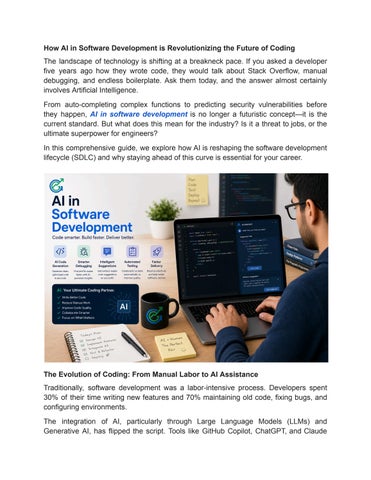
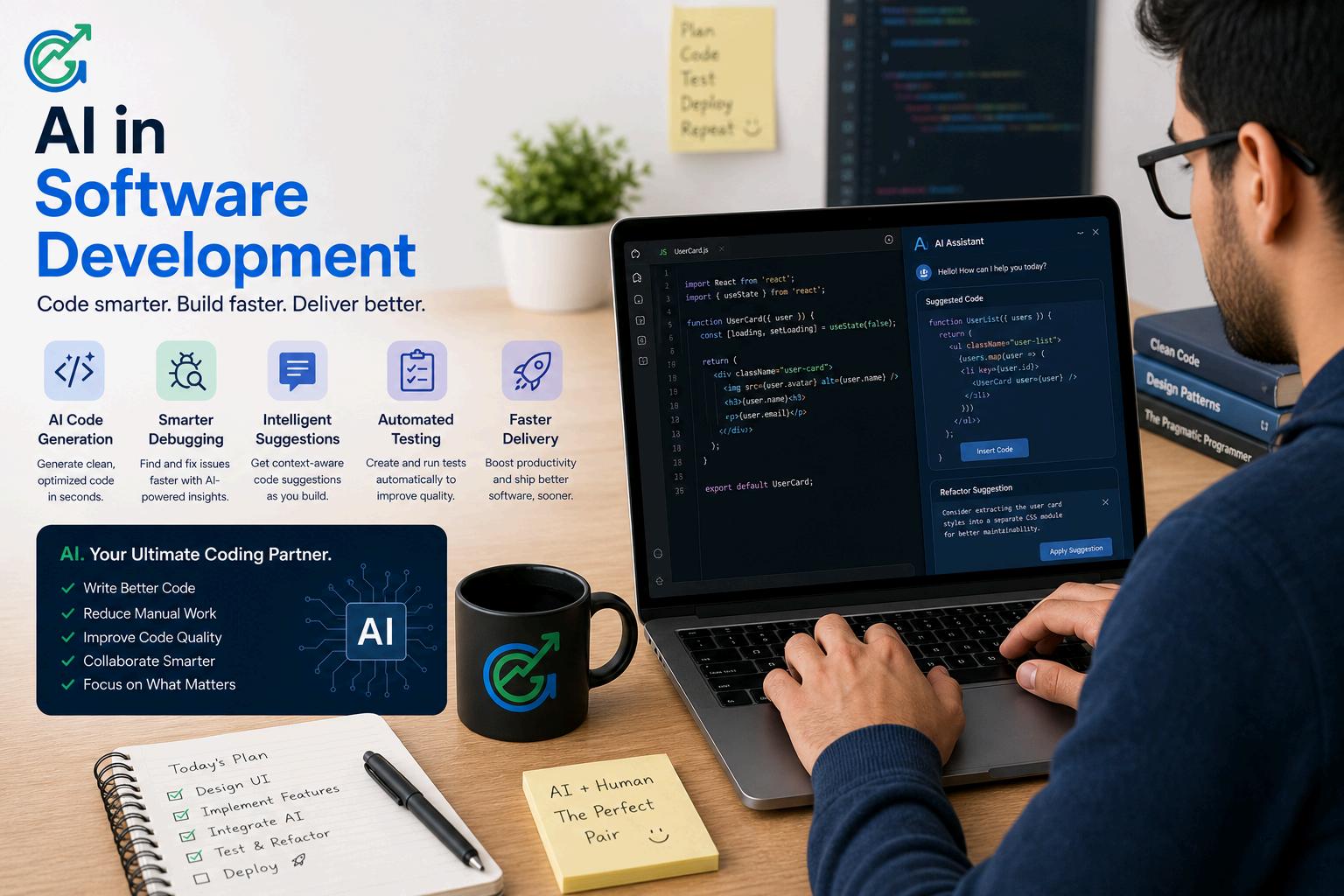
The landscape of technology is shifting at a breakneck pace. If you asked a developer five years ago how they wrote code, they would talk about Stack Overflow, manual debugging, and endless boilerplate. Ask them today, and the answer almost certainly involves Artificial Intelligence.
From auto-completing complex functions to predicting security vulnerabilities before they happen, AI in software development is no longer a futuristic concept—it is the current standard. But what does this mean for the industry? Is it a threat to jobs, or the ultimate superpower for engineers?
In this comprehensive guide, we explore how AI is reshaping the software development lifecycle (SDLC) and why staying ahead of this curve is essential for your career.
The Evolution of Coding: From Manual Labor to AI Assistance
Traditionally, software development was a labor-intensive process. Developers spent 30% of their time writing new features and 70% maintaining old code, fixing bugs, and configuring environments.
The integration of AI, particularly through Large Language Models (LLMs) and Generative AI, has flipped the script. Tools like GitHub Copilot, ChatGPT, and Claude
are now acting as "pair programmers." They don't just suggest the next word; they understand the context of entire repositories, allowing developers to focus on high-level architecture rather than syntax.
Key Areas Where AI is Transforming Software Development
1. Automated Code Generation
One of the most visible impacts of AI is code generation. Modern AI models can translate natural language prompts into functional code in dozens of programming languages. Whether you need a Python script for data analysis or a React component for a web app, AI can generate a draft in seconds.
● Benefit: Reduces "boilerplate" code fatigue.
● Keywords: AI code generators, automated programming, Generative AI for developers.
2. Intelligent Debugging and Error Detection
Debugging is often the most frustrating part of development. AI-powered tools can now scan thousands of lines of code to identify logical errors or syntax flaws that a human eye might miss. More importantly, they provide suggestions on how to fix them, significantly reducing the Mean Time to Repair (MTTR).
3. Enhancing Software Testing (QA)
AI is a game-changer for Quality Assurance. AI-driven testing tools can automatically generate test cases, perform regression testing, and even simulate user behavior to find edge-case bugs. This ensures a higher quality of software with much faster release cycles.
4. Predictive Analytics in Project Management
AI isn't just for writing code; it’s for managing it. By analyzing historical data from Jira or GitHub, AI can predict how long a feature will take to develop, identify potential bottlenecks in the workflow, and help managers allocate resources more effectively.
Is AI a Threat to Software Engineering Jobs?
The most common question asked today is: “Will AI replace software developers?”
The short answer is: No.
AI is an assistant, not a replacement. While AI can write code, it lacks the ability to understand complex business requirements, empathy for user experience, and the creative problem-solving skills required for system design.
However, the role of the developer is evolving. We are moving from "Coders" to "Architects." The developers who will thrive are those who know how to prompt AI effectively and audit the code it produces. To stay competitive in this new era, continuous learning is vital. If you are looking to pivot your tech career or strengthen your foundational knowledge, exploring specialized fields is a great move. For instance, understanding the security side of these AI systems is crucial; you can learn more about entering that field in this step-by-step guide AI career for beginners.
Top AI Tools for Developers in 2024
If you want to boost your productivity, these are the AI tools you should be using:
1. GitHub Copilot: The industry leader for real-time code suggestions.
2. Tabnine: An AI assistant that prioritizes privacy and local code learning.
3. Amazon CodeWhisperer: Excellent for developers working within the AWS ecosystem.
4. Snyk: An AI-driven security tool that finds and fixes vulnerabilities in real-time.
The Security Challenges of AI in Coding
With great power comes great responsibility Using AI in software development introduces new risks:
● Insecure Code: AI models are trained on public data, which might include insecure coding practices.
● Intellectual Property Issues: There are ongoing debates about the copyright of AI-generated code.
● Data Privacy: Feeding proprietary company code into public AI models can lead to data leaks.

This is why companies are now hiring "AI Security Specialists" to ensure that the speed of AI doesn't come at the cost of safety
The Future: What’s Next for AI and DevOps?
We are heading toward a "No-Code" or "Low-Code" era driven by AI, where non-technical stakeholders might be able to build functional prototypes using only voice commands.
In the world of DevOps, we are seeing the rise of AIOps This involves using AI to monitor system health, automatically scale server resources, and self-heal infrastructure when a crash occurs. The goal is a seamless, autonomous development environment.
Conclusion: Embracing the AI Revolution
AI in software development is not a passing trend; it is a fundamental shift in how human beings interact with machines. By automating the mundane, AI allows developers to reclaim their time for innovation, creativity, and solving the world’s most complex problems.
The key to success in this new age is Gradus—it’s about the gradual and consistent step-up in your skill set. Whether you are learning to use AI tools or pivoting into a
related field like Cyber Security, the best time to start was yesterday. The second best time is now.
FAQ: Frequently Asked Questions
Q1: Can AI write a full application on its own?
Currently, AI can write snippets and modules, but it requires human intervention to assemble, architect, and deploy a full-scale, secure application.
Q2: What programming language is best for AI development?
Python remains the king of AI due to its extensive libraries like TensorFlow and PyTorch. However, AI tools support almost every major language, including JavaScript, Java, and C++.
Q3: How can I start a career in tech amidst the AI boom?
Focus on the fundamentals of logic, learn how to collaborate with AI tools, and specialize in high-demand areas like Cloud Computing or Cyber Security