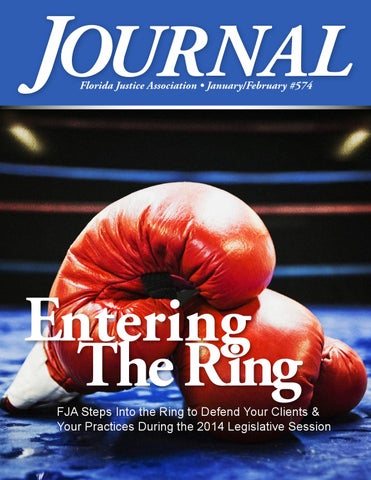
JOURNAL Florida Justice Association • January/February #574
Entering The Ring
FJA Steps Into the Ring to Defend Your Clients & Your Practices During the 2014 Legislative Session
We navigate the complex waters of resolution and compliance so you can focus on what you do best.
GRG RESOLUTION & COMPLIANCE PROGRAM
HEALTHCARE LIEN RESOLUTION
MEDICARE SET-ASIDES
MSP & MANDATORY INSURER REPORTING
COMPLEX SETTLEMENT ADMINISTRATION
Settlement obligations produce an overwhelming sea of paperwork as you chart your way to closure. Employing GRG’s firm-wide Resolution & Compliance Program allows you to expedite the process and achieve more favorable results. Moreover, our systems and specialists significantly lower your internal costs while eliminating post-settlement liability by ensuring compliance.
To learn more about GRG’s Resolution & Compliance Program visit garretsongroup.com or call toll-free at 888-556-7526.
©2012 Garretson Resolution Group.
January/February 2014 No. 574
Contents Highlights 6
On the Cover:
Executive Director Debra Henley spells out FJA’s 2014 Legislative Strategies
AR1
Get involved! The FJA wants your help in reviewing proposed legislation
16
Service of the notice of intent on an offshore physician in a teleradiography medical malpractice case
20
The intoxication defense and why the toxicology report in a fuelfed fire incident to an auto collision may be wrong
22
Contrary to what you might think, an attorney can be a witness
29
Is evidence of auto case defendant’s intoxication admissible in the compensatory phase of a bifurcated damages trial?
34
Don’t overlook statutory causes of action for violation of the rights of the developmentally disabled
AR3
2014 Legislative Preview
In This Issue 6 President’s Message – Paul M. Anderson 8 Cases and Commentaries – Kenneth D. Kranz 10 Legislative Notes 12 Government Torts 13 Procedure 16 Medical Malpractice – Scott R. McMillen and Allison McMillen 20 Products Liability – Adam J. Langino and Theodore J. Leopold 22 Appellate Practice – Bard Rockenbach and Adam Richardson 26 Insurance – Richard M. Benrubi 29 Tips for Auto Practitioners – Dale M. Swope 32 Workers’ Compensation – Michael Winer 34 Young Lawyers – Jonathan T. Gilbert
Adam J. Langino & Theodore J. Leopold discuss the intoxication defense in a fuel-fed fire in an auto collision case
20
FJA Action Report (Section in middle of the Journal) AR1 Executive Director’s Message AR3 Communications AR8 CLE AR11 EAGLE Report AR15 Membership www.FloridaJusticeAssociation.org | January/February 2014 | 3
2013-14 FJA OFFICERS, EXECUTIVE COMMITTEE AND BOARD OF DIRECTORS President Paul M. Anderson President-Elect Troy Rafferty Treasurer Todd E. Copeland Secretary James W. Gustafson, Jr. Immediate Past President Gary M. Farmer
Executive Director Debra Henley Executive Committee Stephen F. Cain Zander Clem Leslie Mitchell Kroeger Christopher N. Ligori Lake H. (Trey) Lytal, III
DIRECTORS 2013-2015 William T. Cotterall Tiffany M. Faddis Philip A. Gold Jason F. Lamoureux Lake H. (Trey) Lytal, III James L. Magazine Todd J. Michaels Brent C. Miller Joseph N. Nusbaum Chad M. Pilon H.K. Skip Pita Gregory M. Yaffa
DIRECTORS AT LARGE Stephen F. Cain William M. Chanfrau, Jr. David C. Dismuke William J. McAfee M. Alex Reboso Kenneth J. Sobel Steve Watrel
DIRECTORS 2012-2014 Bobby (Brad) Bradford Nathan P. Carter Christopher Chestnut Clifton C. Curry, Jr. Kimberly A. Driggers Leslie Scott Jean-Bart Cameron M. Kennedy Leslie Mitchell Kroeger Christopher N. Ligori Matthew N. Posgay Eric Romano Sean M. Shaw
FJA COMMITTEES AND SECTIONS Phil Burlington (Amicus Curiae Committee) Bard Rockenbach (Appellate Practice Section) Laurie Briggs (Women’s Caucus) Elizabeth Finizio (Women’s Caucus) Paolo Longo, Jr. (Workers’ Compensation Section) Jarrett L. DeLuca (Young Lawyers Section) Jason Whittemore (Young Lawyers Section)
PRESIDENTIAL APPOINTMENTS Ricardo Martinez-Cid Michael D. Walrath
LOCAL TLA REPRESENTATIVES Mitzi Sommer Carr Stephen Jaffe Dean LeBoeuf Albert H. Lechner Seth Miles Jason Mulholland Scott Smith Bernie Walsh AAJ OFFICER Julie Braman Kane AAJ BOARD OF GOVERNORS Sean C. Domnick (2016) Brenda Fulmer (2014) Rodney G. Gregory (2016) Michael A. Haggard (2015) Stephen A. Marino, Jr. (2015) Herman J. Russomanno (2014) Aaron Watson (2014) Andrew Weinstein (2014) Jean Marie Whalen (2014) Edward H. Zebersky (2016) AAJ STATE DELEGATES Tom Young (2015) Clancey Bounds (2014) Daryl D. Parks (2014)
JOURNAL STAFF Editor-In-Chief Kenneth D. Kranz Marketing Coordinator Kalon Hopkins
Journal Coordinator Jan Brown
Communications Coordinator Susan McComas
YOUR TRUSTED PARTNER
Knowledge to C l O S e
yO u r CaS e
Synergy Settlement Services will resolve the most complex settlement related issues for your firm so you can focus on being a trial lawyer. Our team of highly skilled professionals includes attorneys, Certified Financial Planners, certified Medicare set aside consultants, subrogation experts, nurse consultants and case managers. We handle the difficult issues such as Medicare Secondary Payer compliance, public benefit preservation, lien resolution, structured settlements and complex settlement planning questions allowing you to concentrate on what you do best. Call us today to see how we can help.
Contact Us Today at 877.242.0022 www.synergysettlements.com
// Complex Settlement Planning & Consulting // Lien Resolution // Medicare Set Aside & MSP Services // // Medicare Set Aside Administration // Settlement Asset Management Services // Pooled Trust Services //
Corporate Headquarters: 4025 Edgewater Drive, Orlando, Florida 32804
PRESIDENT’SMESSAGE
Be a Part of FJA’s
Committee Process I
by Paul M. Anderson
wrote some months back about the Florida Legislature meeting on a regular basis in the months leading up to the annual legislative session. While we have more than a month to go to the start of the 2014 legislative session, we have already experienced six weeks of interim meetings and we have another three weeks of pre-session interim meetings to go.
The fact that the annual session of the Florida Legislature is more than a month away has not stopped legislators from considering and voting on substantive bills that impact our clients’ lives and our practices. While the Legislature won’t pass these substantive bills before the session begins, they sure have teed’ some of them up for quick passage by having the bills heard and passed out of various legislative committees. I’ll leave the specifics on the bills to our Executive Director (it gives her something to write about). Let me simply note that bills have been filed by tort reform advocates longing for bad faith reform, nursing home reform, medical damages reform, workers’ compensation reform, property insurance reform and any reform that grants immunity from suit to any private entity that might be deservedly be the target of a negligence or wrongful death claim. The objective in the myriad of bills proposed by tort “deform” special interest groups is not good public policy. The bills are not about fair play. They are not about taking responsibility for bad conduct. And they most certainly are not about making individuals injured by negligence or other wrongful conduct whole. These bills are intended to permit bad actors to avoid taking responsibility. They are an effort to find ways – call them legislative loopholes – to avoid paying damages to persons who have suffered injury or to compensate the loved ones of persons who have died due to negligent conduct. Your FJA staff, your Executive Committee and numerous board members have already given of their time to educate legislators on the dangers associated with some of the bills already filed. They have met with legislators in Tallahassee and around the state. They have testified before committees that have considered some of the bills. In short, we have used the committee meeting weeks and the pre-session months to spread the truth about these bad bills. One of the misconceptions about the FJA is that some select group – presumably the FJA’s elected leaders – make all the decisions on 6 | January/February 2014 | www.FloridaJusticeAssociation.org
bills. The idea that some select group decides what bills the FJA will support and what bills the FJA will oppose. Nothing could be further from the truth. Every aspect of FJA practice life is represented through the FJA committee structure. Member practitioners who, having knowledge and experience in an area of practice, volunteer their time to assist the FJA in developing positions on bills, in drafting talking points in favor or against bills, in researching applicable law, in preparing amendments to bills and, importantly, in lobbying the Florida Legislature. To provide you a personal example on how your leaders work, my firm does not handle medical malpractice or nursing home cases. I would be a fool to not seek out the opinions of members who practice in those areas to assist in making sure the FJA does everything it can to protect the rights of victims and to preserve these practice areas for our members. Their input is invaluable. Not every member can or is willing to come to Tallahassee to lobby the Florida Legislature. But every one of you has some time you can devote to help your clients and your practice by serving on an FJA committee. Whether your practice involves medical malpractice, nursing home, auto, premises liability, property insurance, product defect, workers’ compensation or mass tort litigation, there is a committee you can serve on. A committee you can contribute to - even by telephone from your office. A committee where your input is welcomed and valued. For those of you who can come to Tallahassee during session, you will never forget the experience. It is eye-opening. You will wonder how anything positive is ever accomplished for the State of Florida. And you will understand the value of being part of the FJA. You may or may not appreciate this fact, but a significant number of those members who run for a spot on the FJA Board of Directors do so after coming to Tallahassee during a legislative session. We don’t ask any member drink the Kool-Aid. They typically volunteer to do so after experiencing Tallahassee during session. They gain, as I did, a greater appreciation for how tenuous our practice lives are. The areas we focus our practice lives on today might well be gone tomorrow but for the efforts of the FJA staff and FJA member volunteers. For more established members, that might not inspire you to act. But for those of you who are younger practitioners, your professional future and your ability to provide for your family might well ride on whether the Florida Legislature passes or does not pass a given bill proposed by those who hate what we do and what we stand for as trial lawyers. So I ask you to participate in the FJA. Participate in the FJA committee of your choice. Just call Lee Phillips or Lynn McCartney at the FJA and they will make sure you are noticed on committee calls. Participate in FJA’s lobbying efforts. Come to Tallahassee and see what it is about. The first cocktail is on me.
TOTALMD A TOTAL CARE ORGANIZATION
MEDICAL CENTER O F T H E PA L M B E A C H E S
Urgent Care + Family Medicine A TOTAL CARE ORGANIZATION
NOW
TOTALMD a total care organization
A Total Care Organization, our TCO board-certified doctors and providers are at the center of your clients’ comprehensive medical and injury care. TotalMD treats, organizes and documents the total spectrum of your clients’ medical care.
Total Care – All Under One Roof
THIS IS TotalMD
• Urgent Care 365 days a year • Family Medicine • General & Spine Orthopedic Medicine • Orthopedic Surgery • Neurosurgery • Physical Medicine & Interventional Pain • Chiropractic Medicine • Occupational Medicine • Imaging & MRI • Physical Therapy
West Palm Beach
Your clients • Receive superior medical care • Seen and treated immediately • Have a single source for all medical needs
Boca Raton Coral Springs Ft. Lauderdale Port Saint Lucie Kissimmee Longwood/Orlando Sarasota Fort Myers Tampa Lake & Lee County A total care organization.
Florida Justice Association members now have a single medical resource and point of contact.
TotalMD Corporate Office 4623 Forest Hill Boulevard Suite 101 West Palm Beach, FL 33415 P: (561)967-8888 F: (561)641-8303 www.thetotalmd.com
CASES&COMMENTARIES
In Brief T
“[T]here is no unbending right for legislators and legislative staff members to hide behind a broad assertion of legislative privilege to prevent the discovery of relevant evidence necessary to vindicate the explicit state constitutional prohibition against unconstitutional partisan political gerrymandering and improper discriminatory intent.” The League of Women Voters of Fla. v. The Fla. House of Representatives, So.3d , 38 FLW S895 (Fla. 12-13-2013). In a suit challenging the validity of the 2012 congressional reapportionment plan enacted by the legislature under the redistricting standards adopted in the 2010 “Fair Districts” amendments, the Court recognized that a legislative privilege exists, but it is not absolute: “In this opinion, we decide for the first time that Florida should recognize a legislative privilege founded on the constitutional principle of separation of powers … We also hold, however, that this privilege is not absolute where, as in this case, the purposes underlying the privilege are outweighed by the compelling, competing interest of effectuating the explicit constitutional mandate that prohibits partisan political gerrymandering and improper discriminatory intent in redistricting. We therefore reject the Legislature’s argument that requiring the testimony of individual legislators and legislative staff members will have a ‘chilling effect’ among legislators in discussion and participation in the reapportionment process as this type of ‘chilling effect’ was the precise purpose of the constitutional amendment outlawing partisan political gerrymandering and improper discriminatory intent.” The Court approved the lower court’s order permitting the discovery of information and communications, including the testimony of legislators and the discovery of draft apportionment plans and supporting documents, directly relevant to whether the legislature drew the reapportionment plans with unconstitutional partisan or discriminatory intent. The Supreme Court certified to the legislature the need for fortysix additional trial court judges (seven circuit court judges and thirty-nine county court judges) and three additional district court judges (two in the Second DCA and one in the Fifth DCA) for FY 8 | January/February 2014 | www.FloridaJusticeAssociation.org
BY KENNETH D. KRANZ FJA JOURNAL EDITOR-IN-CHIEF
2014-15. In re: Certification of Need for Additional Judges, 38 FLW S905 (Fla. FLW 2-19-2013).
So.3d ,
The trial court erred in granting summary judgment in favor of a contractor that was constructing a residence where a tile setter who had been asked by one of the defendant’s construction supervisors to inspect tile work tripped over construction debris and was injured when entering the residence. Skala v. Lyons Heritage Corp., So.3d , 38 FLW D2485 (Fla. 2nd DCA 11-27-2013). As the plaintiff approached the partially constructed home, he saw that there was debris in the front yard and a trim carpenter was working at the front door, so he decided to enter the home through the garage as it was the most direct route. Upon entering, he saw debris and building material throughout the garage. As he proceeded he tripped and fell on some of the construction debris, suffering complex fractures of both arms. He sued the contractor, who was in control of the premises at the time, alleging negligence in its failure to maintain the premises in a reasonably safe condition. The trial court granted defendants’ motion for summary judgment on the grounds that the conditions were open and obvious. The Second DCA reversed, noting that while as a general principle the defendants would not be liable for harm caused by open and obvious dangers, an exception exists if the facts show that the defendants should have anticipated the harm despite its known or obvious nature. It found that here there was a genuine issue of material fact as to whether the contractor “should have anticipated that the plaintiff would choose to encounter the obvious peril of entering the home through the garage scattered with debris because the advantages of entering the house to complete his job outweighed the risks associated with navigating the garage in that condition.” It noted that the plaintiff’s apparent recognition of the open dangers within the garage would factor into the jury’s determination of comparative negligence. In a wrongful death action against the security company hired to patrol a gated community based upon the murder of a resident by a burglar, the trial court did not err in denying the defendant’s
motion for a new trial where there was competent substantial evidence, including the murderer’s sworn statement to police, that sufficiently linked the crime to the time and place where a breakdown in security patrols occurred. 50 State Security Service, Inc. v. Giangrandi, So.3d , 38 FLW D2515 (Fla. 3rd DCA 11-272013). The evidence showed that the perpetrator did not intentionally target the decedent, but rather entered the neighborhood on a bicycle looking for a target of opportunity. He chose the decedent’s house after noticing a small window that was open a few inches. He waited outside the home for two hours trying to decide whether to break in. Finally upon deciding to proceed, he cut the screen on that window and entered the home. Unfortunately, he unexpectedly encountered the decedent while he was in the course of stealing her credit cards and other items, and he strangled her to keep her silent. The evidence showed that the guard who by company protocol was supposed to be continuously patrolling the neighborhood had been derelict in his duties during the two-hour period while the assailant was lurking outside the decedent’s home. The plaintiff sued both the security company and the alarm company, alleging that the alarm did not go off when the intruder entered through the window because it had been improperly installed. The alarm company settled prior to trial, and the jury found both the alarm company (as a Fabre defendant) and the security company equally at fault. The security company moved for a new trial, arguing that the verdict was against the manifest weight of the evidence. The motion was denied, and the present appeal ensued. The Third DCA noted that the issue of causation turned on whether there was sufficient evidence presented upon which the jury could have found that the security company’s breach of its duty to patrol continuously was the proximate cause of the the decedent’s death: “In negligent security cases like this one, which involve a crime inside a dwelling, the presence or absence of a jury issue on causation usually turns on whether sufficient evidence has been presented that connects the negligent security to the perpetrator’s entry into the victim’s residence. Even if a breach of the duty to provide security is clearly established, Florida courts have held that no jury question on causation is presented where a plaintiff cannot establish how the perpetrator gained access to the dwelling. … But, Florida courts have found a jury question on the issue of causation where a plaintiff presents sufficient evidence for a jury to find that the perpetrator gained access to a dwelling in a manner that would have been detected or deterred had the breach in security not occurred.” Here, the court found, the plaintiff presented sufficient evidence for the jury to find that the murderer gained access to the decedent’s home in a manner that probably would have been detected or deterred had the breach in security not occurred, and the sworn statement of the murderer provided the necessary temporal and physical connection that liked the failure in security to his entry into the home. “Because the purpose of a roving patrol is to either detect or deter crime, the jury could reasonably infer that the failure to patrol outside the home during the critical time period created the opportunity for the murderer to break into [decedent’s] window, and therefore that the security company’s breach was the proximate cause of [decedent’s] murder.” Affirmed. Second DCA addresses the admissibility of prior incidents to establish forseeability and risk of harm in the context of a premises liability action in which a person was attacked and beaten inside a restaurant and beach bar by one or more intoxicated persons who had been drinking there for several hours prior to “last call.”
Bellevue v. Frenchy’s South Beach Cafe, Inc., So.3d , 38 FLW D2537 (Fla. 2nd DCA 12-4-2013). The plaintiff brought suit against the restaurant for her injuries, alleging that the restaurant was on notice that its patrons had a propensity to become rowdy or violent and that it failed to maintain adequate security to protect its patrons. In support, the plaintiff sought to introduce evidence of sixty incidents that occurred either in the restaurant or near its premises over the previous four-and-a-half years. It was her intention to elicit testimony from her security expert that based upon the nature and volume of these prior incidents, the restaurant was negligent in not taking adequate measures to prevent the type of attack she had suffered. The defendant moved in limine, contending that the incidents were inadmissible because they were not similar crimes or were not probative of the issue of foreseeability. The trial court ruled that to only those incidents that involved damage to persons or property and that started on, ended on, or involved the restaurant premises were admissible. As a result, the trial court ruled that evidence of only twelve of the sixty incidents was admissible. In reversing, the Second DCA examined Supreme Court decisions as well as those from other districts and concluded that the trial court’s approach was too restrictive by not only depriving the jury of knowing about the other incidents but also by preventing plaintiff’s expert from discussing the incidents and providing an opinion based upon them. “Because the jury is the ultimate arbiter of foreseeability and, in this case, whether [the restaurant] was negligent in not providing sufficient security on the evening in question, it was entitled to consider evidence that ‘based on past experience, a proprietor knew of or should have recognized the likelihood of disorderly conduct by third persons in general which might endanger the safety of the proprietor’s patrons.’ … [W]e are not mandating that all sixty incidents [plaintiff] listed should be admitted into evidence. Rather, the trial court must consider each incident based on whether it occurred within the four walls of [the restaurant] or whether it was similar to what occurred in this case. Rather, it must be based on whether or not the event put [the restaurant] on notice that the attack resulting in [plaintiff’s] injury was foreseeable.” “[A]n interlocutory order of the trial court striking an expert witness is not amenable to certiorari review because it is the sort of trial error that usually does not cause irreparable harm, and can be remedied on appeal.” State Farm Mutual Automobile Ins. Co., v. Pace, So.3d , 38 FLW D2568 (Fla. 5th DCA 12-6-2013). The basis for the motion to strike was that the expert had not formulated any opinions as of the date of his deposition. The party retaining the expert explained the expert’s lack of opinions was due to the other party refusing to produce the information the expert needed to analyze the claims and formulate an opinion. A waiver and release of liability form for patrons of a go-kart track was ineffective in precluding an action against the track operator where the release did not expressly state that it included the track operator’s negligence, and, when the document was considered in its totality, it was not clear that negligence of the sort involved in the case was intended to be within the scope of the release. Gillette v. All Pro Sports, LLC, So.3d , 38 FLW D2573 (Fla. 5th DCA 12-6-2013). The plaintiff contended that a track employee negligently increased the kart’s speed during a race, which caused the plaintiff to lose control of the kart and crash into the railing. The court noted that “[c]lauses that purport to deny an injured party the right www.FloridaJusticeAssociation.org | January/February 2014 | 9
CASES&COMMENTARIES
to recover damages from another who negligently causes injury are strictly construed against the party seeking to be relieved of liability. … To be effective, the wording of such clauses must be so clear and understandable that an ordinary and knowledgeable person will know what he or she is contracting away.” The agreement at issue primarily emphasized the signatory’s assumption of the risk of injury caused by the negligence of the signatory or another kart driver on the track. Where, in legal malpractice action, the jury found the defendant liable, but returned a zero verdict, the trial court erred in granting plaintiff’s motion for additur in the form of nominal damages, and then granting plaintiff’s motion for a new trial based on the plaintiff’s rejection of the amount of the additur. Bluth v. Blake, So.3d , 38 FLW D2614 (Fla. 4th DCA 12-11-2013). The Fourth DCA found four problems with the trial court’s additur for nominal damages: 1) neither the plaintiff’s motion for additur, the trial court’s
Legislative Notes
B
y the time you receive this issue, interim committee meetings will be nearly over and the start of the 2014 Session rapidly approaching. While many bills have already been filed for consideration during the Session, the actual filing deadline for membersponsored bills is not until Session opening day on March 4. However, that doesn’t cut off the list of issues that could come up in 2014. Legislative committee meetings will continue to be held throughout most of the 60-day Session along with the Senate and House floor sessions, and new issues can — and frequently do — appear seemingly out of nowhere for the first time in these venues. Issues can come up in the form of new bills proposed by the committees themselves or through the amendatory process both in committee and on the floor. Often some of the most far-reaching and harmful proposals are saved for these last minute attacks, as those who are behind them know the process very well and understand that such sneak attacks can, if they are lucky, catch the unwary off guard and at the very least severely limit the amount of time opponents have to lobby against them. To make matters worse, amendments can be filed 24 hours a day, and as the the Session clock runs down the notice requirements for filing amendments shorten to the point where the time for detection, analysis and response drops from a couple days to a matter of hours. Constant — literally around-the-clock — vigilance and the ability to execute a lightning-quick response to threats is required from the opening bell until the “hankie drops” at the symbolic end-of-Session closing ceremony. In this multi-front battle against a wide array of special interests who are armed with hordes of lobbyists and nearly unlimited financial resources, it takes an all-out effort by a dedicated and experienced cadre of professionals working alongside FJA members who step up to contribute their expertise, time and resources. It is only through this joint effort that the FJA can take to the field year after year with one of the very best teams in the business. There are many ways you can help, so get involved — your future, and that of your clients, is at stake.
10 | January/February 2014 | www.FloridaJusticeAssociation.org
order granting the additur nor the record indicated the existence of any of the criteria set forth in §768.74(5), Fla. Stat.; 2) the jury could have reached its verdict of zero damages in a manner consistent with the evidence because the plaintiffs failed to offer evidence of damages specifically resulting from the attorney’s alleged negligence and did not make any argument as to damages during closing; 3) it is not clear that nominal damages are even available in a legal malpractice action; and 4) even if nominal damages are available for a legal malpractice claim, the plaintiffs waived entitlement because they did not request a jury instruction regarding same or request nominal damages during closing. Because the trial court erred in granting the additur, it followed that there was no legal basis for the granting of a new trial based on the plaintiff’s rejection of the additur. A defendant who objects to the amount of a remittitur as being insufficient to cure the excessiveness of a verdict is an “adversely affected party” within the context of §768.74(4), Fla. Stat., and is entitled to a new trial on damages. R.J. Reynolds Tobacco Co. v.
So far, several significant anti-consumer bills have been-filed for 2014: HB 187 (Passidomo) would give insurance companies a right-to-cure safe harbor from bad faith actions; HB 379 (Hood) would place limitations on the amount of medical damages that can be presented to juries; SB 670 (Thrasher) & HB 589 (M Gaetz) limit the conditions under which a nursing home resident has a cause of action against a management company and make it harder to establish a claim for punitive damages; and SB 396 (Bean) & HB 277 (Spano) would limit the liability of school boards when they allow schools to engage in joint use agreements for use of their facilities. (Note that one bill reported on last time — HB 197 (Stone), relating to manufacturer and retailer liability for exploding consumer gas cans — has since been withdrawn from consideration.) We still expect to see a bill to implement a “Patients Compensation System” that would replace the right to trial by jury in medical malpractice cases with a mandatory arbitration scheme along with the usual handful of surprises. Also of note, the House Civil Justice Committee held a workshop last fall on conforming Florida’s summary judgment rules and procedure to the federal rules, but it remains to be seen whether they intend to pursue this issue further. Keep up with the latest legislative developments on the FJA website.
2013-14 Legislative Schedule Interim Committee Meetings: February 10-14, 2014 February 17-21, 2014 2014 Regular Session: March 4-May 2, 2014
Webb, So.3d , 38 FLW D2637 (Fla. 1st DCA 12-17-2013). The converse is also true—a plaintiff who objects to the inadequacy of an additur is entitled to a new trial. See Waste Management, Inc. v. Mora, 940 So.2d 1105 (Fla. 2006), in which the Supreme Court addressed identical statutory language in §768.043, Fla. Stat., and also noted that its decision “means that only when the parties agree with the trial court’s amount of remittitur or additur will the remittitur or additur be enforced in lieu of a new trial.” Section 409.910, Fla. Stat., is unenforceable to the extent that it allows the state to recover through its Medicaid lien more than what the plaintiff’s settlement allocated for past medical expenses. Davis v. Roberts, So.3d , 39 FLW D1 (Fla. 5th DCA 12-202013). “[Arkansas Dept. of Health & Human Servs. v. Ahlborn, 547 U.S. 268 (2006) and Wos v. E.M.A. Ex rel. Johnson, 133 S.Ct. 1391 (2013)] make clear that section 409.910(11)(f ) is preempted by the federal Medicaid statute’s anti-lien provision to the extent that it creates an irrebuttable presumption and permits recovery beyond that portion of the Medicaid recipient’s third-party recovery representing compensation for past medical expenses. Accordingly, we agree with the fourth district...that [the allocation formula specified in] section 409.910(11)(f ) is a ‘default allocation’...and hold that a Medicaid recipient ‘should be afforded the opportunity to seek the reduction of a Medicaid lien amount by demonstrating, with evidence, that the lien amount [established by section 409.910(11)(f )] exceeds the amount recovered for medical expenses.’” The court also noted that the legislature has since amended §409.910 to allow the Medicaid recipient an opportunity to challenge the amount of the lien in an administrative hearing under §409.910(17). “In order to successfully challenge the amount payable to the agency, the recipient must prove, by clear and convincing evidence, that a lesser portion of the total recovery should be allocated as reimbursement for past and future medical expenses than the amount calculated by the agency pursuant to the formula set forth in paragraph (11)(f ) or that Medicaid provided a lesser amount of medical assistance than that asserted by the agency.” See also State of Fla., Agency for Health Care Administration v. Williams, So.3d , 38 FLW D2545 (Fla. 4th DCA 12-4-2013), and Dillard v. Agency for Health Care Administration, So.3d , 38 FLW D2586 (Fla. 2nd DCA 11-27-2013).
Where the defendant in a case arising from an auto collision admitted that he was negligent and the sole proximate cause of the collision, and further admitted that he acted with gross negligence and conceded that the plaintiff was entitled to punitive damages, the trial court erred in allowing evidence of the defendant’s drug use to be admitted in the compensatory damages portion of the bifurcated trial. Swanson v. Robles, So.3d , 39 FLW D13 (Fla. 2nd DCA 12-20-2013). The court noted that normally, when a defendant admits liability in an auto negligence case and the only remaining issue is the amount of compensatory damages, evidence regarding the defendant’s sobriety should not be admitted into evidence. Here, the trial court’s ruling was based on the plaintiff’s assertion that the defendant’s drug use was relevant to the decedent’s wife’s compensatory damages because knowing that the defendant had engaged in such conduct and gone unpunished had increased her pain and suffering. The Second DCA found that it was not clear at trial that the wife was even aware of the defendant’s drug use. It held that, while evidence of his drug use would be admissible in the second phase of the bifurcated trial, as it is relevant to the amount of punitive damages, its admission in the first phase was highly prejudicial and irrelevant based on the wife’s concessions. The court certified conflict with Dessanti v. Contreras, 695 So.2d 845 (Fla. 4th DCA 1997). An attorney’s fee award under the Florida Deceptive and Unfair Trade Practices Act requires that the plaintiff prevail by recovering a judgment, and, if there are counterclaims, by recovering a net judgment in the entire case; there is no express requirement of proportionality between the amount of the judgment and the attorney’s fees and costs incurred in obtaining that judgment. Bull Motors, LLC v. Borders, So.3d , 39 FLW D28 (Fla. 3rd DCA 12-26-2013). Once the statute of limitations ran on a former Engle class member’s individual claim for tobacco-related wrongful death, the claim became forever barred. Gaff v. R.J. Reynolds Tobacco Co., So.3d , 39 FLW D57 (Fla. 12-31-2013). Here, the plaintiff had opted out of the Engle class ten years before filing the complaint in the instant action. He argued unsuccessfully that the notice to opt out had been ineffective.
FJA CLE Anytime Anywhere The FJA Continues to be a Premier Provider of CLE Audio Products Visit the FJA Website and Check Out our Complete Online Audio Catalog.
www.FloridaJusticeAssociation.org | January/February 2014 | 11
CASES&COMMENTARIES
Government Torts
A
public hospital’s inability to produce certain adverse incident reports that were required to be filed by state and federal law and related to a surgical procedure that allegedly resulted in the patient’s death was held insufficient under the facts of the case to support a claim under 42 U.S.C. §1983 for denial of access to courts based on the alleged frustration of plaintiff’s ability to bring a potential product liability action. Burgess v. North Broward Hospital District, So.3d , 38 FLW D2358 (Fla. 4th DCA 11-13-2013). The plaintiff argued that the defendants had “spoliated evidence” or “intentionally concealed true facts” concerning the medical device used during the surgery and thus denied her access to court to sue the manufacturers, distributors and others involved in the distribution of the device. The court held that the trial court properly dismissed the complaint for failure to state a §1983 claim for denial of access to courts as it did not demonstrate the existence of a “non-frivolous” and “arguable” products liability claim. The court noted that to pursue a claim for an alleged denial that results in the loss of a meritorious suit that cannot now be tried, a party must identify: (1) a “nonfrivolous,” “arguable” underlying claim, whether anticipated or lost; (2) the official acts frustrating the litigation; and (3) a remedy that may be awarded as recompense, but that is not otherwise available in a future suit. It also noted that negligent acts or omissions are insufficient to support a federal cause of action under §1983. Here, the court found, the alleged acts by the hospital—the failure to file the reports or to provide them to the plaintiff—raised, at best, the possibility of negligence or misfeasance. The court also found that the complaint failed to allege any element of the product liability suit that had been arguably foreclosed and there was furthermore nothing to indicate that the defendants’ actions impeded or foreclosed all reasonable avenues that the plaintiff had to explore the merits of a potential product liability suit. A state university was not authorized to implement a statutory waiver provision available to school districts that relates to storage of firearms in cars parked on campus. Florida Carry, Inc. v. Univ. of North Fla., So.3d , 38 FLW D2592 (Fla. 1st DCA 12-10-2013). Section 790.115(2)(a), Fla. Stat., provides that a person may not possess a firearm on school property unless part of a school-sponsored event. The statute provides an exception to the effect that a person may carry a firearm in a vehicle so long as it is securely encased. However, the statute also provides that “school districts may adopt written and published policies that waive the exception … for purposes of student and campus parking privileges” in effect allowing school districts to
prohibit firearms in cars parked on campus. In defense of its adopted policy prohibiting encased firearms in cars in university parking lots, the university contended that the legislature intended “school districts” to be broadly interpreted to include a state university board of trustees. The First DCA disagreed, holding that the legislature had preempted firearm regulation and neither the explicit language of the statute nor the university’s independent authority under Art. IX, Sec. 7, Fla. Const., allowed the university to adopt such a policy. The en banc decision generated several concurring opinions and a strong dissent from Judge Padovano, who commented that: “This remarkable conclusion is not supported in the law and, with due respect for my colleagues, I believe that it defies common sense.” The Florida Department of Transportation unsuccessfully attempted to repudiate a railroad crossing indemnity agreement executed between the predecessor State Road Department and a predecessor railroad; caps inapplicable; questions certified. Dept. of Transportation v. CSX Transportation, Inc., So.3d , 38 FLW D2616 (Fla. 12-11-2013). The action arose out of a collision between a car and a trailer that disconnected when the truck pulling it traversed a rough grade crossing owned by the railroad. The indemnity agreement had been executed between the SRD and the railroad in 1936, and it was the sole consideration provided by the state to the railroad for allowing the state to build a road across its tracks. The court found that the SRD had the authority to enter into contracts necessary to build and maintain the road, and “the use of a limited indemnity agreement as the sole consideration for the contract to obtain right-of-way did not render it unenforceable when a condition requiring indemnity finally occurred.” The court also rejected DOT’s assertion that its liability is limited to the limited waiver of sovereign immunity under §768.28(5), Fla. Stat., holding that the statutes limiting the state’s liability under that section apply “only to judgments recovering damages for tort, not to judgments recovering damages under legal theories that may be analogous to torts.” Recognizing that the decision could apply to other similar long-standing railroad crossing and sidetrack agreements throughout Florida and could affect commerce, the court certified questions on both issues: “Is DOT bound by a railroad crossing agreement under which it received a revocable license to use land as right-of-way if the sole consideration for the license was an agreement to indemnify the railroad for losses arising out of DOT’s activity on the land? If so, is DOT’s liability under the cross agreement limited by Section 768.28(5), Florida Statutes (2002)?”
DID You KNOW
?
You Can Edit Your Online FJA Profile
Simply go to the floridajusticeassociation.org home page, click on Member Benefits tab and navigate to “Edit Your Profile” to get stareted! 12 | January/February 2014 | www.FloridaJusticeAssociation.org
Procedure F
lorida Supreme Court declines to adopt as procedural rules three legislative changes to the Evidence Code, including the 2011 provision creating §766.102(12), Fla. Stat., that requires an expert witnesses in a medical malpractice action to have an expert witness certificate if the expert is not a Florida-licensed physician. In re: Amendments to the Florida Evidence Code, So.3d , 38 FLW S889 (Fla. 12-12-2013). Regarding the expert witness certificate provision, the Court stated: “The [Florida Bar Code and Rules of Evidence] Committee voted 14-13 to recommend that the provision be adopted as a rule of procedure to the extent that it is procedural. The Board of Governors voted 34-5 to recommend that the Court reject the Committee’s proposal, on the grounds that the provision is unconstitutional, will have a chilling effect on the ability to obtain expert witnesses, and is prejudicial to the administration of justice. Numerous comments were filed with respect to this proposal, all in opposition to its adoption. After hearing oral argument in light of those comments, we decline to follow this recommendation due to the comments raised.” Several FJA members were among those who participated by filing comments with the Court. The other legislative changes that the Court declined to adopt relate to legislation establishing a “fiduciary lawyer-client privilege” in §90.5021, Fla. Stat., and an amendment to §90.804, Fla. Stat., to include a hearsay exception for a statement offered against a party that wrongfully caused the declarant’s unavailability.
that a proposal may not be served earlier than ninety days after the action has been commenced, runs from the date a defendant is first added in an amended complaint, rather than the date of filing of the initial complaint. The court certified conflict with the Third District’s opinions in Shoppes of Liberty City, LLC v. Sotolongo, 932 So.3d 468 (Fla. 3rd DCA 2006), and Kuvin v. Keller Ladders, Inc., 797 So.2d 611 (Fla. 3rd DCA 2001), to the extent those cases allowed an exception to the plain language timing requirements of the rule. “Florida law clearly distinguishes between void judgments, which a party may move to vacate at any tie, and voidable judgments, which a party must move to vacate within one year of the entry of the judgment.” Kathleen G. Lozinski, P.A. v. Phillips, So.3d , 38 FLW D2410 (Fla. 4th DCA 11-20-2013). The court explained that a total lack of service of process renders a judgment void, not voidable, while defective service of process renders a judgment voidable. See Fla.R.Civ.P. 1.540(b). The failure [of a trial court] to make provision for the cost to a nonparty to produce subpoenaed documents constitutes a departure from the essential requirement of law.” First Call Ventures LLC v.
“Where an expert has been specifically employed in preparation of litigation but is not to be called as a witness at trial, the facts known or opinions held are deemed to be work product and may be discovered only by a showing of exceptional circumstances, as mandated by [Fla.R.Civ.P.] 1.280.” Rocca v. Rones, So.3d , 38 FLW D2378 (Fla. 3rd DCA 11-13-2013). The court noted that the protection provided applies in a situation, such as that presented in this case, where the expert was initially disclosed as a testifying witness and later withdrawn. The exceptional circumstance allowed by Rule 1.280(b)(5)(B) provides for discovery of factual information where a party makes a showing that it cannot acquire the relevant information from any other means. Here, the record indicated that the expert apparently had no independent factual knowledge of the case and had been hired to examine the data and provide an expert opinion only on information furnished to him by the party. The court noted that should the trial court determine that the expert did in fact have pertinent independent information, or that the exceptional circumstances existed, it could order his deposition for those limited purposes. Under the plain language of Fla.R.Civ.P. 1.442, any premature offer is an invalid offer, regardless of whether it is made by the plaintiff or the defendant, and the rule does not provide an exception for a harmless or mere technical violation of the procedural timing requirements; conflict certified. Regions Bank v. Rhodes, So.3d , 38 FLW D2400 (Fla. 4th DCA 11-20-2013). The court also held that the time period specified in Rule 1.442(b), which provides www.FloridaJusticeAssociation.org | January/February 2014 | 13
CASES&COMMENTARIES
Nationwide Relocation Services, Inc., So.3d , 38 FLW D2431 (Fla. 4th DCA 11-20-2013). Here, a non-party filed affidavits showing that the production of the requested documents would be unduly burdensome and require $50,000 of employee time, but the trial court made no provision for the payment of those costs. Because it was a non-party, plenary relief was not available, so certiorari review was appropriate. Under Fla.R.Civ.P. 1.420(e), even a filing that was effectively a nullity and did not advance the litigation was sufficient to preclude dismissal for failure to prosecute. Kendry v. Meadowlark Real Estate, LLC, So.3d , 38 FLW D2435 (Fla. 1st DCA 11-20-2013). Here, after issuance of a notice of proposed dismissal, the plaintiff filed a notice of trial and writ of habeas corpus ad testificandum. The trial court concluded that because the case was not at issue these filings were nullities and did not move the case forward. In reversing, the court noted that the Supreme Court has expressly rejected the distinction between active and passive record activity, and that now any filing is sufficient to avoid dismissal. In a Florida Deceptive and Unfair Trade Practices Act action, the defendant who successfully pursued a counterclaim for breach of contact waived its claim for attorney’s fees under §501.2105, Fla. Stat., where it filed the motion for fees after the trial court had granted summary judgment on the FDUTPA claims. Preusler & Assoc., Inc. v. Restoration Specialists, So.3d , 38 FLW D2436 (Fla. 1st DCA 11-20-2013). First DCA holds an order vacating an arbitration award was subject to certiorari review where the circuit court departed from the essential requirements of law when it failed to apply the proper test under §682.12(1)(b), Fla. Stat., in determining that an arbitrator’s non-disclosure unfairly affected the rights of the complaining party; conflict certified. Heart Surgery Center v. Bixler, So.3d , 38 FLW D2441 (Fla. 1st DCA 11-20-2013). The court found that the vacation of the arbitration award, which deprived the petitioners of an award to which they were entitled and subjected them to a future arbitration which might result in an entirely different result, constituted irreparable injury not remediable on appeal. The court certified conflict with Zabawa v. Penna, 868 So.2d 1292 (Fla. 5th DCA 2004), in which the Fifth DCA held that a party could not obtain certiorari review of an order vacating an arbitration award pursuant to Fla.R.App.P. 9.030(b) (2)(A) because time and money expended on additional arbitration does not equate to irreparable harm that cannot be remedied on appeal. An order entering a default judgment on liability only is a non-final, non-appealable order under the current version of Fla.R.App.P. 9.130. Kogan v. Mildenberger, So.3d , 38 FLW D2510 (Fla. 3rd DCA 11-27-2013). The court noted that Rule 9.130(a)(3) authorizes interlocutory review of a limited number of non-final orders, and while orders like the one in the present case used to be appealable, that portion of the rule was deleted in 2001. Although a trial court may award liquidated damages in conjunction with a default judgment without notice, it is fundamental error for the court to award unliquidated damages without providing 14 | January/February 2014 | www.FloridaJusticeAssociation.org
the thirty-day notice required by Fla.R.Civ.P. 1.440(c), proof of damages and an opportunity for the opposing party to be heard regarding the damages. BOYI, LLC v. Premiere American Bank, So.3d , 38 FLW D2548 (Fla. 4th DCA 12-34-2013). Even though the record established a “persistent pattern of footdragging and failure to comply with court orders,” and the trial court in granting a default judgment stated that the defendants “willfully disobeyed” court orders, “testified falsely,” and “made false representations,” the absence of of an evidentiary record, the lack of explicit findings as to one of the defendants and the failure to analyze the Kozel factors as they applied to that defendant and his counsel rendered the trial court’s order fatally insufficient and prevented meaningful review to determine whether the sanction was commensurate with the conduct of the defendant. Toll v. Korge, So.3d , 38 FLW D2552 (Fla. 3rd DCA 12-4-2013). There must be a legally permissible basis for denying admission pro hac vice, and a trial court’s failure to grant a motion for defense counsel to appear pro hac vice that complied with the requirements of Fla.R.Jud.Admin. 2.510(b) required a new trial. Trans Health Management, Inc. v. Webb, So.3d , 38 FLW D2585 (Fla. 1st DCA 12-10-2013). The motion to appear pro hac vice was filed on the morning of trial along with a motion to vacate a default and a motion for continuance. The trial judge denied the motion to appear, stating that waiting until the last minute was “frankly unacceptable.” The three-day trial then proceeded with the defendant nursing home unrepresented and resulted in a substantial jury verdict awarding compensatory and punitive damages to the plaintiff. The court noted that the trial court relied on none of the five circumstances specified in Rule 2.510 under which a foreign attorney is not permitted to appear and that it could not find any appellate decision holding or suggesting that the filing of a motion to appear pro hac vice on the day of trial is a legally permissible basis upon which to deny such a motion. When there is an error or omission in the return of service, personal jurisdiction is suspended and “lies dormant” until proper proof of valid service is submitted, and during this period of dormancy, the trial clerk and the clerk are without authority to enter a default. Chigurupati v. Progressive American Ins. Co., So.3d , 38 FLW D2613 (Fla. 4th DCA 12-11-2013). Here, the process server filled out, signed and filed a return of service that for each out-of-state defendant that outlined the time, manner and place of service; however the returns were not notarized as required by §48.194, Fla. Stat. Subsequently, the plaintiff moved for a clerk’s default against the defendants for failure to serve or file any paper, and the clerk entered the default three days later. Plaintiffs then filed a motion to quash service and vacate default because the returns were not notarized. In response, the plaintiff filed amended returns of service that were notarized. The trial court denied the motion to quash and the motion to vacate, ruling that requiring a notary seal on the returns put form over substance and that any defect had been cured when the plaintiff filed the amended returns. The Fourth DCA held that the statute is to be strictly construed, and thus the clerk erred in entering default when it did. It found no error in the denial of the motion to quash because the plaintiff eventually established proper service on the defendants.
Where plaintiff filed and then voluntarily dismissed an action against a defendant in Palm Beach County and then later filed a similar action against the defendant in Hillsborough County, the trial court in the second action erred by ordering the plaintiff to pay costs incurred by one of the defendants in the prior action and abating the action until payment was made. Rohleder v. Wiberg, So.3d , 38 FLW D2631 (Fla. 2nd DCA 12-13-2013). The defendant did not seek or obtain a judgment for costs in the first action and was at that point time-barred from doing so. The court noted that Fla.R.Civ.P. 1.420(d) provides that where the plaintiff’s first action was dismissed and refiled again, only the first court has the authority to assess costs incurred by the defendant in the first case. Certiorari was appropriate because the stay effectively denied the plaintiff his day in court without any adequate remedy on appeal. Plaintiff in a wrongful death action against a nursing home was entitled to discover the names and contact information of all of the defendant’s residents at the time of the decedent death where the discovery was sought for purposes of identifying all individuals who either witnessed or had the opportunity to witness the circumstances relevant to the facts and issues in the case. Sovereign Healthcare of Port St. Lucie, LLC v. Fernandes, So.3d , 38 FLW D2651 (Fla. 4th DCA 12-18-2013). The defendant objected to the request on the grounds that it was overbroad, unduly burdensome and irrelevant, and that it asked for the disclosure of the residents’ protected health information. The trial court granted the plaintiff’s motion to compel but ordered that the disclosure was protected and was to remain confidential for any purpose other than for the preparation of prosecution of the litigation. Petitioning for certiorari review, the defendant argued that the disclosure violated the residents’ constitutional right to privacy under Art. I, Sec. 23, Fla. Const., and the records confidentiality provisions of §400.022(1)(m), Fla. Stat. The court held that the constitutional issue had not been raised below and discovery of the names and contact information of non-party fact witnesses was proper under Fla.R.Civ.P. 1.280(b)(1), which defines the general scope of discovery as including the “identity and location of persons having knowledge of any discoverable matter.” “[D]iscovery conducted after a final judgment has been entered and pursuant to a motion to vacate will normally be permitted only if the motion is supported by sworn proof of the allegations contained therein.” US Bank National Association v. Rivera, So.3d , 38 FLW D2662 (Fla. 3rd DCA 12-18-2013). At issue was a discovery order relating to a motion to vacate on the grounds of fraud upon the court by the opposing party’s counsel. The court also held that the materials sought by the discovery were protected by the attorneyclient privilege.
Ken Kranz, FJA Journal Editor-in-Chief Mr. Kranz is Editor-In-Chief and columnist for the FJA’s monthly Journal. Mr. Kranz has 40 years of legislative experience and formerly served as the Senior Legislative Counsel with various responsibilities related to the FJA legislative activities.
VIRTUAL LAW OFFICE FJA’s Virtual Law Office (VLO) is a Free LEGAL DATABASE, where members can download over 300 legal documents for virtually every type of case! Save time and money with FREE access to legal documents from the most experienced trial attorneys throughout Florida.
SUBMIT YOUR DOCUMENTS TODAY!
The same way we band together to protect our civil justice system, we must band together to help grow our VLO. Contact Member Services at membership@ floridajusticeassociation.org, or go online to submit your documents today!
www.FloridaJusticeAssociation.org | January/February 2014 | 15
MEDICALMALPRACTICE
M B
y
EDICAL ALPRACTICE
S
econd District holds presuit notice of intent timely sent to some defendants imputed to co-defendants with whom they had legal relationship. Young v. Naples Community Hospital, Inc., So.3d , 39 FLW D72 (Fla. 2d DCA 1-314). The plaintiff in a medical malpractice suit alleged that a misread CT scan while she was in the hospital caused injury. The hospital had contracted with a local radiology group to provide exclusive coverage for radiology interpretation at the hospital. The local radiology group then subcontracted with an outside radiology group to provide radiology interpretations during the nighttime, with the scans to be interpreted remotely, over the internet. The alleged misread was done remotely by a nighttime radiologist, and neither he nor his group was included in the initial notice of intent to sue. The trial court dismissed the claim against the nighttime radiologist and group on the grounds that the notice to them had not been timely. The Second District reversed on appeal, holding that the radiologist’s independent contractor relationship with the nighttime group, and the nighttime group’s admitted written contract with the local radiology group, constituted a “legal relationship” for purposes of Florida Rule of Civil Procedure 1.650(b), such that notice to the local radiology group was also notice to the nighttime group and the radiologist. 16 | January/February 2014 | www.FloridaJusticeAssociation.org
by Scott R. McMillen & Allison McMillen
Second District dismisses certiorari petition and appeal by doctor trying to stop her insurance company from settling with plaintiff. McLaughlin v. Lara, So.3d , 39 FLW D44 (Fla. 2d DCA 12-2713). The defendant doctor in a medical malpractice suit, who was also a licensed attorney, filed a notice of appearance to represent herself and her professional association as co-counsel with the attorney that her liability insurance company had retained to represent her. Her behavior eventually led the trial court to issue an order restricting her activities in the case. The doctor petitioned the Second District Court of Appeal for a writ of common law certiorari, contending that the trial court’s order deprived her of the right to represent herself and prevented her business from hiring the attorney of its choice. While that action was pending, the doctor’s insurance company settled the underlying medical malpractice case with the plaintiffs, and the Second District ordered the parties to show cause why the petition for certiorari should not be dismissed as moot. In the meantime, the plaintiffs filed a petition in the trial court seeking approval of the settlement, because it was for a minor. The doctor filed an objection in the trial court to the plaintiffs’ petition on the grounds that she had not consented to the settlement. After a hearing at which the insurance company was permitted to intervene, the trial court issued orders denying the doctor’s
objection and approving the settlement. The plaintiffs voluntarily dismissed their case pursuant to the settlement, and the doctor appealed the trial court’s orders. The Second District consolidated the two cases, and dismissed the original certiorari proceeding as moot in light of the voluntary dismissal below. On the direct appeal, the Second District explained that the order denying the doctor’s objection was not a final, appealable order or an appealable interlocutory order. To the extent that the order enforced the settlement, it did not require the doctor to take any action or make any payment. Although the order approving the settlement was appealable, the purpose of such an order “is not to protect any legal right a defendant may have to control settlement but instead… to protect the interests of the minor and the guardian and to ensure that any release given on behalf of the minor is legally effective.” Thus, the doctor was not “actually aggrieved” by the order. If the doctor believed her insurance company had breached its contract with her or broken the law, the Court observed, the proper remedy was to bring an action against the insurance company. Fifth District reverses summary judgment on statute of limitations where doctor led patient to believe injury was normal result of surgery and would improve over time. Baxter v. Northrup, So.3d , 39 FLW D4 (Fla. 5th DCA 12-20-13). A patient who suffered foot drop after a hip replacement surgery sued the surgeon and hospital for medical malpractice. The trial court agreed with the defendants that the statute of limitations period had begun to run when the plaintiff learned about his foot drop, and granted the defendants’ motion for summary judgment on a statute of limitations defense. The Fifth District reversed, holding that summary judgment was improper because the plaintiff testified that the surgeon had led him to believe the foot drop was a normal result of the surgery and would get better with time and physical therapy. The Fifth District also noted that the surgeon himself had testified at deposition that he did not know the reason for the foot drop, and a defense expert had testified that it was a known risk of the surgery and not due to negligence. The Fifth District maintained that “[i]t is difficult to envision how a layperson can be charged with the knowledge that particular symptoms suggest an act of negligence when medical professionals, who scrutinize the case with the clarity of hindsight, conclude that the symptoms are the product of unexplained, natural causes.” The Fifth District also quoted Cunningham v. Lowery, 724 So.2d 176, 180-181 (Fla. 5th DCA 1999), in which it had held, “it would seem that if the law is to place on a layperson… the burden of appreciating malpractice at… [a particular moment when the statute is said to commence], then the law must by rights impose on the physician a concomitant duty of disclosure.” Defendants also argued that, even taking the date
proposed by the plaintiff as the beginning of the statute of limitations period, the plaintiff’s presuit notice of intent was untimely because the defendants received it two days after the two-year period had ended. The Fifth District rejected this argument, noting that under Florida Rule of Civil Procedure 1.650, the tolling period begins when the notice is mailed, not when it is received. Second and Fifth Districts hold trial courts erred in ordering plaintiffs to pay Medicaid liens in accordance with statutory formula without taking into consideration whether liens exceeded amounts recovered for past medical expenses. Dillard v. Agency foreHealth Care Administration, So.3d , 38 FLW D2486 (Fla. 2d DCA 11-27-13); Davis v. Roberts, So.3d , 39 FLW D1 (Fla. 5th DCA 12-20-13). Both opinions held that, under Arkansas Department of Health & Human Services v. Ahlborn, 547 U.S. 268, 276 (2006), plaintiffs “should be afforded an opportunity to seek the reduction of a Medicaid lien amount by demonstrating, with evidence, that the lien amount exceeds the amount recovered for medical expenses.” Both opinions quoted the recent United States Supreme Court case Wos v. E.M.A. ex rel. Johnson, 133 S. Ct. 1391, 1401-2 (2013), which held that an “irrebuttable, one-size-fits-all statutory presumption is incompatible with the Medicaid Act’s clear mandate that a State may not demand any portion of a beneficiary’s tort recovery except the share that is attributable to medical expenses.” The Second District noted that Florida’s Medicaid lien law, §409.910, Florida Statutes, has recently been amended and now provides for a hearing to determine the amount of a plaintiff’s recovery attributable to past medical expenses, as envisioned in Wos and similar cases. First District holds attachment to complaint which contradicted allegations did not negate those allegations so as to require dismissal for failure to state a cause of action. Andrew v. Shands at Lake Shore, Inc., So.3d , 39 FLW D2643 (Fla. 1st DCA 12-17-13). Plaintiffs in a medical malpractice case sued a hospital for a radiologist’s alleged negligence, claiming that the radiologist was an employee, servant, apparent agent, or independent contractor of the hospital. Attached to the complaint was a hospital “Certification and Authorization” form, which stated in part that the patient acknowledged that he might receive care from radiologists who were not employees or agents of the hospital. The trial court granted the hospital’s motion to dismiss on the grounds that the plaintiffs had failed to state a cause of action against the hospital because the notice in the form refuted the plaintiffs’ vicarious liability allegations. The First District reversed, holding that, “since the allegations in the… complaint should be taken as true without regard to Appellants’ ability to prove them, the facts alleged
WE KNOW YOUR PARALEGAL / LEGAL ASSISTANT
WEARS MULTIPLE HATS!
The FJA provides your paralegal/legal assistant with numerous benefits to support them with their professional duties. Sign them up today to gain instant access!
Sign Them Up Today For $210 CALL: FJA Member Services (850) 521-1093 www.FloridaJusticeAssociation.org | January/February 2014 | 17 JOIN ONLINE: FloridaJusticeAssociation.org FAX: an application to (850) 224-4254
MEDICALMALPRACTICE
stated a cause of action” against the hospital. The Court noted that “the relationship between hospital and doctor… is often unclear and raises a question for the jury.” Fifth District holds plaintiff should have been permitted to amend complaint to allege comparative negligence; also error to admit DCF shelter orders without hearsay exception. Hartong v. Bernhart, So.3d , 38 FLW D2571 (Fla. 5th DCA 12-6-13). In a medical malpractice wrongful death case, defendants raised the decedent’s comparative negligence as an affirmative defense, arguing throughout trial that the drugs and alcohol in her system contributed to her death. During the trial, the judge took judicial notice, over the plaintiff’s objection, of two DCF shelter orders containing findings about the decedent’s substance abuse and other problems. After the defendants rested, they withdrew their comparative negligence defense. The plaintiff moved to amend her complaint to conform to the evidence and allege comparative negligence so that she could obtain a jury instruction on the issue, but the trial court denied the motion. They jury found that there was no negligence on the part of the defendants that contributed to the death. The Fifth District reversed, holding that the trial court erred in not permitting the plaintiff to amend her complaint and obtain a jury instruction on comparative negligence. According to the Court, this left the jury with an “all-or-nothing approach” equivalent to the old contributory negligence rule. The Court also held that the trial court had erred in admitting the DCF orders into evidence to prove the truth of the matter asserted in them without a hearsay exception.
Second District holds trial court erred in issuing blanket discovery order without in camera review in Amendment 7 discovery dispute. Bartow HMA, LLC v. Kirkland, So.3d , 38 FLW D2384 (Fla. 2d DCA 11-15-13). The plaintiff in a medical malpractice case served requests for production on the defendant hospital, some of which specifically asked for documents relating to “adverse medical incidents” as defined by Article X, §25(a) of the Florida Constitution (commonly referred to as “Amendment 7” or “Patient’s Right to Know”). The hospital objected to many of the requests and filed several privilege logs. At a hearing on the plaintiff’s motion to compel production, the hospital requested that the trial court conduct an in camera review of the documents to determine which ones fell under the scope of Amendment 7, and which ones were privileged. The plaintiff argued that all of the documents at issue were discoverable under Amendment 7 and that most of the privileges claimed by the defendant did not apply to Amendment 7 discovery. However, the plaintiff acknowledged that a few of the documents might be protected by the attorney-client privilege, and requested that the court review those documents in camera. Without conducting any in camera review, the trial court issued a blanket order requiring the production of all the documents listed in the privilege logs. The Second District granted the hospital’s petition for writ of certiorari, finding that the hospital met the threshold of showing “irreparable harm” because the trial court’s order might cause irreparable harm by requiring the hospital to produce privileged documents that did not fall under Amendment 7. The Second District continued its analysis by reviewing Florida’s case law regarding Amendment 7 discovery, noting that most of the privileges asserted by the hospital do not apply in an Amendment 7 context. However, the Second District held, the trial court’s order departed from the essential requirements of the law because it ordered the production of all the documents in the privilege logs without first determining whether they related to adverse medical incidents within the meaning of Amendment 7. On remand, the Second District directed the trial court to conduct an in camera review “to the extent necessary to resolve whether certain documents concern adverse medical incidents and whether and to what extent the asserted privileges apply.” Although not dispositive, the Second District also rejected the plaintiff’s assertion that every case in which a cholecystectomy is converted from a laparoscopic procedure to an open one is, by definition, an “adverse medical incident.” Scott R. McMillen is the founder of McMillen Law Firm, P.A, with a principal office in Orlando and satellite offices around the state and in Atlanta, Georgia. He is currently a member of Florida Bar Board of Governors, and a past President of the Central Florida Trial Lawyers Association, The Orange County Bar Association and The Legal Aid Society of the Orange County Bar Association. Mr. McMillen has been representing medical negligence victims throughout Florida and Georgia for nearly 30 years.
Allison McMillen graduated magna cum laude from the University of Miami School of Law in 2007. Ms. McMillen is a member of The Order of the Coif, the Central Florida Trial Lawyers Association, the Central Florida Association for Women Lawyers, and the George C. Young First Central Florida American Inns of Court. She practices with the McMillen Law Firm, P.A., in its Orlando office.
18 | January/February 2014 | www.FloridaJusticeAssociation.org
FJA MEDICAL MALPRACTICE WORKGROUP CHALLENGE TO EX PARTE LEGISLATION Attorney’s Name: Attorney’s E-mail: Attorney’s Phone No: Claimant’s Pseudonym: Date SOL Expires: Circuit Where Case Will Be Filed: Check and Fill-in All that Apply o This case is not in Presuit o I have or am expecting a corroborating affidavit no later than: o This case will be ready to have an NOI mailed on o This case is in Presuit, with a NOI filed on:
Brief Description of the Case, including negligence, causation and damages, e.g., physical, psychological, etc.
Brief Description of Non-Relevant health care records which you do not want disclosed in an ex parte interview
Is your client willing to be named as a plaintiff in an action for declaratory and injunctive relief which challenges the new ex parte laws?
o Yes o No
Would your client agree to having a team of FJA attorneys work on this issue of their case free of charge?
o Yes o No
Comments:
Instructions:
Your FJA is looking for the right plaintiff whose standing will enable us to challenge the ex parte statutes recently passed and signed into law by the Governor under SB 1792. We are asking that you review your case list and determine whether you have a case which meets or comes close to meeting the following: • •
A claimant who wants to file a medical malpractice claim but does no longer want to because he/ she does not want their unrelated, private health information revealed, e.g., a history of sexual abuse, psychological, psychiatric, marriage counseling, sexual abuse, reproductive issues, etc. A claimant who is ready to file a Notice of Intent and who has a distinct medical malpractice injury which is unrelated to an evaluation, diagnosis or treatment they have received or will be receiving at any time starting two years prior to the malpractice and/or into the future.
Please scan and return this form to: gcmurray@FloridaJusticeAssociation.org www.FloridaJusticeAssociation.org | January/February 2014 | 19
PRODUCTSLIABILITY
THE
INTOXICATION DEFENSE
I
by Adam J. Langino & Theodore J. Leopold
In automobile fuel-fed fire product liability matters where the testimony disputes the toxicology test results that show intoxication, the following considerations may just save your case from §768.36, Florida Statutes, and other arguments of comparative negligence. The intoxication defense, provided in §768.36, Florida Statutes, has become a strong tool for defendants, allowing them to close the door on any recovery should the jury find that the plaintiff was primarily at fault for his or her own injuries as a result of intoxication. Section 768.36, entitled “Alcohol or drug defense,” provides that: (2) In any civil action, a plaintiff may not recover any damages for loss or injury to his or her person or property if the trier of fact finds that, at the time the plaintiff was injured:
20 | January/February 2014 | www.FloridaJusticeAssociation.org
(a) The plaintiff was under the influence of any alcoholic beverage or drug to the extent that the plaintiff’s normal faculties were impaired or the plaintiff had a blood or breath alcohol level of 0.08 percent or higher; and (b) As a result of the influence of such alcoholic beverage or drug the plaintiff was more than 50 percent at fault for his or her own harm. Despite the teeth afforded to defendants by §768.36, Florida Statutes, an elevated blood alcohol reading, in and of itself, may not warrant the statute’s application. Fuel-fed fires in automobile crashes are never clean. The driver is often deceased and the damage to both the vehicle and person is often severe. In many instances, the driver remains in the vehicle or on-scene for hours before his or her body is properly
stored. For those reasons, evaluating intoxication in these matters requires special attention. In Florida, if you drive with a blood alcohol level above 0.08 percent, you are considered driving impaired having violated §316.193, Florida Statues. As we all know, alcoholic beverages, such as a beer, wine, or spirits, are drinks that contain ethanol. However, gasoline can contain ethanol too. E-10 gasoline is a fuel mixture of 10 percent ethanol and 90 percent gasoline. Since Florida agreed to an E-10 mandate in 2006, E-10 gasoline has become increasingly popular. By 2009, 29 percent of all gasoline in Florida was E-10 gasoline while the remaining gasoline being sold, even if not E-10, still contains ethanol alcohol to varying degrees. In E-10 based fuel-fed fires, the ethanol contained within the gasoline has the potential to contaminate the deceased’s blood when the deceased has sufficient open wounds to allow that contamination. This E-10 contamination is often left undetected. When hospitals or medical examiners measure a deceased’s blood alcohol level they are determining the level of ethanol in that deceased’s blood. More often than not, the blood analysis is performed by an outside laboratory utilizing a process called gas chromatography-mass spectrometry (“GCMS”). GCMS is a process where a sample (e.g., a person’s blood) is volatized for a period of time allowing the elements contained therein to be specifically identified based upon the time it takes for each element to elute. If that sounds too confusing, imagine GCMS as a foot race with each runner finishing at different times – the distinct finish times allow the scientists to identify the particular elements. GCMS is considered the “gold standard” for forensic identification. However, GCMS is ill-equipped to rule-out E-10 gasoline contamination because most forensic laboratories run their GCMS machines for less than five minutes. This shortened run time prevents GCMS from detecting the elements contained within the sample that would have “finished the race” after five minutes. The vast majority of elements contained within E-10 gasoline take longer than five minutes to elute. However, the ethanol contained in E-10 elutes at the same time as ethanol contained within any drinking alcohol. This provides the potential for the “gold standard” GCMS blood alcohol level reading to be “artificially spiked” by the ethanol contained in undetected E-10 gasoline.
the body to microbial infection by bacteria and yeast that is inherently present in the environment. Due to its humid climate, Florida has an exceptionally high level of microbial organisms in its ambient atmosphere. Post-mortem microbial fermentation is a phenomenon where micro-organisms, such as fungus, yeast, and mold, all present in Florida’s atmosphere, attack the deceased’s open wounds. Within mere hours the microbes putrefy causing the rapid production of ethanol. The ethanol produced by post-mortem microbial fermentation is not distinguishable by GCMS from the ethanol produced by drinking alcohol. This too has the potential to “artificially spike” a GCMS reading. For those reasons, in E-10 based fuel-fed fire product liability actions, great attention to detail must be emphasized during fact discovery. Obviously, you will need facts to establish that the deceased’s drinking history does not correlate with the GCMS blood alcohol level reading. For instance, did the last person who saw the deceased observe slurring speech, blood shot or watery eyes, unsteadiness, or an odor of alcohol? What do the deceased’s credit card statements reveal? Before the crash, was the deceased driving a safe speed, stopping for stop lights and stop signs, maintaining his or her lane, and driving for a substantial period of time without issue? While not all inclusive, answering those questions will help you and your expert toxicologist establish a timeline leading up to the crash, which in turn will help you educate the jury why that “gold standard” GCMS result is wrong. The above considerations should be taken into account in any fuel-fed fire product liability action. Florida Statute §768.36 should not deter plaintiffs from holding corporations accountable for their actions in those instances where the testimonial evidence does not support intoxication despite the GCMS findings.
Adam J. Langino is with the Leopold Law firm. He is a 2006 Cum Laude graduate of the University of Minnesota School of Law. He received his Bachelor’s degree with Honors in Government and Politics and graduated Magna Cum Laude from the University of Maryland in College Park, MD. He is also an active member in the Palm Beach County Bar Association, and Florida Justice Association. Theodore J. Leopold Mr. Leopold is a managing partner of Leopold Law, P.A. has a national practice specializing in consumer justice litigation with a focus on complex products liability, managed care, catastrophic injury, automotive crashworthiness, wrongful death and class action litigation. For many consecutive years, Mr. Leopold has been profiled in The Best Lawyers in America.
In fuel-fed fires, the deceased’s epidermis is often burned off. Due to the severity of damage to the car and body the deceased often remains on-scene for hours before being placed in a climate controlled contaminant free location. A time lapse as small as a few hours opens
Maintain Access To Your FJA Benefits
Maintain access to your exclusive FJA member benefits by staying current on your membership dues. It’s simple! Conveniently pay your dues online using your FJA website, single login password. And if you prefer making your payments over the phone, or have any questions about your membership status contact the membership department at 850.521.1028 www.FloridaJusticeAssociation.org | January/February 2014 | 21
APPELLATEPRACTICE
Contrary
TO WHAT YOU MIGHT THINK
A Lawyer Can Be A Witness by Bard Rockenbach & Adam Richardson
M
ost trial attorneys have a steadfast rule – a lawyer who becomes a witness is automatically disqualified. It’s an easy rule to remember – but it is also wrong.
The governing rule is Rule Regulating the Florida Bar 4-3.7, which prohibits an attorney from representing a party at trial where “the lawyer is likely to be a necessary witness on behalf of the client.” The Fourth District recently upheld a trial attorney’s ability to be both witness and lawyer in Steinberg v. Winn-Dixie Stores, Inc., 121 So. 3d 622 (Fla. 4th DCA 2013) (on rehearing), where it quashed an order disqualifying a personal-injury attorney who investigated his client’s 22 | January/February 2014 | www.FloridaJusticeAssociation.org
case. The opinion provides a useful framework for evaluating whether an attorney-witness should be disqualified. The district courts have “repeatedly and unequivocally” held that disqualification of a party’s chosen attorney is an extraordinary remedy that should be employed very rarely.1 To determine whether disqualification is appropriate, it must be tested against the standards imposed by the Rules Regulating the Florida Bar.2 Rule 4-3.7(a) governs situations involving the lawyer-witness: (a) When Lawyer May Testify. A lawyer shall not act as advocate at a trial in which the lawyer is likely to be a necessary witness on behalf of the client unless:
(1) the testimony relates to an uncontested issue; (2) the testimony will relate solely to a matter of formality and there is no reason to believe that substantial evidence will be offered in opposition to the testimony; (3) the testimony relates to the nature and value of legal services rendered in the case; or (4) disqualification of the lawyer would work substantial hardship on the client. Thus, Rule 4-3.7(a) would forbid an attorney from representing his client at trial only if he was likely to be (1) a necessary witness (2) on her behalf, and the situation does not fall within the listed exceptions. The party seeking the lawyer’s disqualification has the burden of showing both requirements.3 The first requirement is easy: If the client states he will not call his attorney as a trial witness in the case, the defendant cannot show that the attorney is likely to be a witness “on behalf of the client.” If the defendant argues that it or another defendant might call the attorney, the defendant has failed to satisfy the requirement. A contrary rule would result in the forced disassociation between a party and his or her chosen lawyer, and would be an open invitation to mischief, especially in cases involving multiple defendants.4 That was the situation in Steinberg, where the plaintiff’s attorney went to the entrance of a Winn-Dixie store at which the client fell. The attorney, accompanied by his investigator, examined the cause of the fall, a hole in the ground where a guardrail had been removed from a handicap access ramp. He was also able to talk to an assistant manager. The attorney testified in his deposition that the manager told him he knew the railing had been removed and personally removed it, statements which the manager denied making in his deposition. The investigator corroborated the attorney’s testimony, and took notes during the conversation.” The manager’s statements would be helpful to the co-defendant, the shopping center owner and management company, which had a claim for indemnity against Winn-Dixie. Both Winn-Dixie and the shopping center owner moved to disqualify the plaintiff’s attorney. Even though the client argued that Rule 4-3.7 did not apply because her attorney would testify only if called by one of the defendants, and then only to prove liability of the other defendant, the trial court disqualified the attorney. On certiorari review, the Fourth District rejected the owner’s and manager’s argument “that the trial court properly entered the disqualification order because they intend to call Steinberg’s attorney as a critical witness in their own behalf to establish that their co-defendant, Winn-Dixie, had the primary responsibility for any negligence.” The Fourth District held that Rule 4-3.7 did not bar the attorney from representing the client because she “does not intend to call her trial counsel as a witness on her behalf.” The Fourth District relied on its earlier opinion in Arcara v. Philip M. Warren, P.A., where a law firm sued a former client for fees for services it rendered in an eviction suit. During that eviction suit, the plaintiff firm had been replaced by another law firm. The client retained the second firm to represent him in the subsequent lawsuit over the attorney’s fees. In response, the plaintiff firm moved to disqualify the
second firm on the ground that one of the firm’s partners would be a witness in the case. The trial court ordered the disqualification. The client petitioned the Fourth District for a writ of certiorari. On review, the court quashed the order. It noted that the client “stat[ed] that he does not intend to call any members of the [second] firm to testify on his behalf.” The plaintiff firm, “however, insist[ed] that he will call [the partner in the second firm] to testify about how and why the eviction suit was settled, and therefore the [second] firm should be disqualified.” The Fourth District held that the partner was not an essential witness in the case and that a lawyer should not be disqualified merely because he would be called by an opposing party. See also AlliedSignal Recovery Trust v. AlliedSignal, Inc., 934 So. 2d 675 (Fla. 2d DCA 2006) (attorney who might be a witness could represent client where the client disclaimed any intention of calling the lawyer as a witness on its behalf ). Even if the client intends to call her attorney as a witness at trial it does not mean the attorney should be disqualified. The second requirement the defendant must satisfy is that the attorney is a necessary witness. The attorney is not a necessary witness within the meaning of Rule 4-3.7 if his testimony would only be cumulative. In Steinberg, for example, trial counsel was not an essential witness because the investigator was present during the conversation between counsel and the Winn-Dixie manager, and therefore the investigator could testify concerning the admission. The court wrote: “A lawyer is not a necessary witness when there are other witnesses available to testify to the same information.”5 The lesson here is that if you are going to investigate your prospective client’s case, bring someone along in case a dispute later arises. While the defendant could argue the credibility of the other person at trial, the presence of the other person would foreclose the argument that the attorney is a necessary witness. The testimonies of the attorney and the other person do not need to be identical. That is, the defendant is not entitled to what it perceives as its best witness. As long as the other person can testify to the same basic facts—the important ones—the defendant will have to make do. Similar to Steinberg is a case cited by the Fourth District in that case, Allstate Insurance Co. v. English. There, the plaintiffs brought an action against their insurer for breach of an insurance policy; the insurer moved for summary judgment based, in part, on the plaintiffs’ alleged impairment of the insurer’s subrogation rights under the policy.6 Attached to the motion was a letter written by the insurer’s lawyer, in which he advised the plaintiffs that any impairment of the insurer’s subrogation rights could jeopardize a claim under the policy. The plaintiffs moved to disqualify the lawyer because, they alleged, they intended to depose the lawyer on the letter and call him as a witness at trial to establish a material fact. The trial court granted the motion. The Second District quashed the order. It held, inter alia, that the plaintiffs “have not demonstrated that [the insurer’s lawyer] is an essential or indispensable witness in this proceeding.” This was because “there are other witnesses available to testify to the same information.” See also Laura McCarthy, Inc., where the lawyer was not an essential witness to a conversation because the content of the conversation could be established by calling the other person in the www.FloridaJusticeAssociation.org | January/February 2014 | 23
APPELLATEPRACTICE
conversation as a witness. The First and Fifth districts have reached the same conclusion.7 So, when will an attorney be considered a necessary witness? A lawyer may be considered a necessary witness when he was a witness to or a participant in the events giving rise to the cause of action itself, not ancillary events such as an investigation. See Cerillo v. Highley, 797 So. 2d 1288 (Fla. 4th DCA 2001) (lawyer could not try a civil battery action because he was witness to subject battery); Springtree Country Club Plaza, Ltd. v. Blaut, 642 So. 2d 27 (Fla. 4th DCA 1994) (disqualifying lawyer from representing, in personal injury lawsuit, his wife and himself; he had brought claim for loss of consortium). These holdings make sense. Disqualifying trial counsel because he investigated the case is inconsistent with the spirit of the professional rule imposing on a lawyer the duty to inform himself of the facts of a client’s case,8 and it “would hinder a lawyer’s practice of investigating any potential case for his client.”9 It is important to note an apparently unresolved issue. In applying Rule 4-3.7(a), some opinions have indicated that an attorney can be disqualified not only if he will be a “necessary” witness, but if he will be a “material” witness.10 There is a world of difference between the two words. The plain language of Rule 4-3.7(a) requires disqualification only if the attorney will be a “necessary” witness, which is much narrower than “material.” Thus, you should be alert to defense counsel attempting to argue you should be disqualified because you will be a mere material witness. ___________________ 1
See Pascucci v. Pascucci, 679 So.2d 1311, 1312 (Fla. 4th DCA 1996). See City of Lauderdale Lakes v. Enter. Leasing Co., 654 So.2d 645, 646 (Fla. 4th DCA 1995); Cazares v. Church of Scientology of Cal., Inc., 429 So.2d 348, 349 (Fla. 5th DCA 1983). 3 See Hiatt v. Estate of Hiatt, 837 So.2d 1132, 1133 (Fla. 4th DCA 2003) (“Absent the personal representative’s showing that [the attorney] will be a necessary witness or that his testimony would be adverse to [his client’s] position, the court departed from the essential requirements of the law in granting the motion to discharge counsel.” (citations omitted)). 2
4
See Arcara v. Philip M. Warren, P.A., 574 So.2d 325, 326 (Fla. 4th DCA 1991) (“[T]he rule requiring a lawyer to withdraw when he expects to be a witness in a case ‘was not designed to permit a lawyer to call opposing counsel as a witness and thereby disqualify him … .’ ” (citations omitted)). 5 Id. at 624-25 (citing Allstate Ins. Co. v. English, 588 So.2d 294, 295 (Fla. 2d DCA 1991); Laura McCarthy, Inc. v. Merrill–Lynch Realty/ Cousins, Inc., 516 So.2d 23, 23-24 (Fla. 3d DCA 1987)). 6 English, 588 So.2d at 295. 7 See Ray v. Stuckey, 491 So.2d 1211, 1214 (Fla. 1st DCA 1986) (disqualification improper where lawyer was not an indispensable witness because “the only factual issues could be testified to by other witnesses”); Cazares, 429 So. 2d at 352 (quashing order disqualifying lawyer where clients claimed, inter alia, “that any information [lawyer] possesses could be presented through the testimony of others”). 8 See R. Reg. Fla. Bar 4-3. 9 Columbo v. Puig, 745 So. 2d 1106 (Fla. 3d DCA 1999). 10 See, e.g., Quality Air Conditioning Co., Inc. v. Vrastil, 895 So.2d 1236 (Fla. 4th DCA 2005); Graves v. Lapi, 834 So.2d 359 (Fla. 4th DCA 2003); Therriault v. Berghmans, 788 So.2d 1119 (Fla. 2d DCA 2001); Saud v. Arzumanian, 745 So.2d 544, 545 (Fla. 4th DCA 1999) (mem.) (Polen, J., concurring specially); Pascussi v. Pascussi, 679 So.2d 1311 (Fla. 4th DCA 1996).
Bard Rockenbach Mr. Rockenbach is a civil appellate attorney with Burlington & Rockenbach, P.A. in West Palm Beach. He is currently Chair of the Appellate Practice Section and serves on the FJA Amicus Committee.
Adam Richardson Mr. Richardson is an associate with Burlington & Rockenbach. Prior to joining the firm he was a staff attorney for Judge Robert Gross of the Fourth District Court of Appeal.
2014
LOBBY DAYS Sign Up Online Today!
24 | January/February 2014 | www.FloridaJusticeAssociation.org
ActionReport Volume 22 | Number 1 | Issue No. 574
Entering the Ring 2014 Session
by Executive Director Debra Henley Boxing is a combat sport in which two competitors engage in a contest of strength, speed, reflexes, endurance and will.
“As we approach this legislative session, be mindful that the laws you are mastering or know so well can change”
The Florida Justice Association will once again step into the ring to defend your clients and your practices during the 2014 legislative session. Although boxing is a great analogy for the legislative battles in which we engage, it really is not a boxing match. For in one corner stands the FJA pumped up and ready to engage, and in the opposite corner facing us are the likes of the US Chamber and the Florida Chamber, aka the Civil Justice Reform Institute, the Florida Medical Association and related medical specialty groups, the insurance industry, the Retail Federation, Disney, Publix, the Nursing Home Industry, and countless other individual corporate interests —all poised to rip at the fabric that weaves together our inviolable democracy. Certainly not a fair fight or a clean fight much of the time, but, having been through it for decades with our leaders, veteran staff and lobbyists such as our General Counsel Paul Jess and the Dean of our lobbying team Reggie Garcia, we have come to expect being outnumbered. Our legislative team is led with the focus, energy and skill of Jeff Porter, who is also no rookie to the rough and tumble world of Florida politics. Notwithstanding the incredible credentials and talent of our legislative team, (SPOILER ALERT), legislative battles are seldom won on the merits. I find that the legislative experience in this regard is quite different than in the court room where the merits of the case matter very much. You may well ask why, and I can only answer with the following quote:
January/February 2014 | Action Report |
1
EXECUTIVE DIRECTOR’S MESSAGE “Few men have the virtue to withstand the highest bidder.” – George Washington, 1779 The father of our country said it, I didn’t! Leaving that dark thought for a moment, on the bright side, the time and financial resources our members provide enable us to go blow for blow with the most powerful moneyed interests. However, we want to do better than that for you and your clients. The simple truth is that if EVERY FJA member would give some of their time, and the financial resources that they can reasonably contribute to FJA and the FJ PAC, we could do far more than cover and clinch — we would counterpunch. And counterpunch we must, for if we fail to do so the practice of law as you know it will not endure. World renowned trial lawyer Gerry Spence eloquently stated at the American Association for Justice annual convention this past summer in San Francisco, “most people think justice is there for the asking. Unfortunately it is a myth.” You are out there every day, scratching and clawing your way to justice for your clients (and it’s getting awful hard on the nails). You are successful in obtaining justice for your clients in many instances because of the laws as they are now. You have studied, researched and worked very hard to know those laws and apply them to the case at hand. As we approach this legislative session, be mindful that the laws you are mastering or know so well can change. Change can come slowly each session, as the legislature washes away a remedy here, erects a barrier to recovery there — or they can change suddenly and drastically — eclipsing everything you know, everything your practice is currently set up to do for your clients. This has already occurred, in differing degrees, to lawyers in the practice areas of workers’ compensation, medical malpractice and personal injury protection (auto) practice. Just ask our President Paul Anderson, who had to change his practice significantly when workers’ compensation was decimated. Although there are times when we have allies on a given issue, I can state with certainty that there is nothing but the Florida Justice Association and, at the national level, the American Association for Justice standing in the way of all of it being dismantled. The worst that can happen is worse than you think. Consider the current threats to the civil justice system and your
2
| Action Report | January/February 2014
practice that have been proposed for this session and in the past few years: • Federal Standard for Summary Judgment in State Courts • Insurer Bad Faith “Safe Harbor” • Limitations in Medical Payments (LIMP) • Retailer Immunity Product Liability • Administrative Patient Compensation System • Supreme Court Split / Civil and Criminal The details on these bills and proposals can be found on the FJA website: floridajusticeassociation.org/issues. The reason the FJA has been able to head off these serious attacks on the civil justice system is because we care more. Your leaders, staff and lobbyists believe in what you do and want to do all we can to protect access to the courts for the clients you fight for each day. Again from Gerry Spence: “We have the power because we care and you can’t fake caring.” Caring and putting your time and resources on the line — that is what it takes to defeat the most draconian proposals out of Tallahassee. So, ask yourself, what would it be like to not to have to deal with the constant threats from the unfriendly legislators in the state capitol? Does it need to get any harder for you to bring a case, settle a case or win a jury trial? How much are you willing to invest to change this annual assault on your livelihood? For those of you who can respond with your time and financial resources – I submit that you have the responsibility to respond. “You must because you can,” (Gerry Spence). I promise you that the Florida Justice Association will go twelve rounds for your practice, and we will never throw in the towel. Work with us this session and in the 2014 elections to ensure that we don’t lose the match by legislative decision. We have three more interim committee weeks in February before regular session begins. Please consider coming to Tallahassee during the interim committee weeks, February 3rd, 10th and 17th, and for session, March 4th. We are climbing into the ring— we need you standing in our corner. AR
COMMUNICATIONS
LegislativePreview 2014 Issues Guide – Defensive Legislation
Overview Through the January interim committee meetings many bills have been filed for the 2014 Legislative Session and our FJA executive team, legislative team, lobbyists and visiting members have been meeting with legislators and government leaders in order to ensure your clients’ rights are protected. The following is a preview of the issues we are anticipating this Session. Insurance Bad Faith Representative Passidomo has filed HB 187, which is this year’s version of insurance Bad Faith “reform.” The bill has been referred to the House Civil Justice Subcommittee, Insurance and Banking Subcommittee, and the Judiciary Committee, which are the same references received in the 2013 session. This bill would give insurance companies a “get out of jail free card” when they treat their insureds in bad faith. The modification to this year’s bill is that it would give a safe harbor to an insurer for 45 days from the date of written notice of loss. Limitations In Medical Payments Representative Hood has filed HB 379 which we call LIMP – Limitations In Medical Payments. The proponents of this bill call it “Accuracy in Damages.” This is a very bad bill for claimants with medical injuries, doctors and hospitals. The bill seeks to limit the admission of evidence to juries regarding medical damages. The Chamber, Publix, Disney and the insurance industry are still the major proponents of this and continue to make a significant push to change these laws. The bill also interferes with letters of protection and
seeks to contest medical necessity of treatment at trial. We are working with health care providers to defeat this legislation before it develops momentum. Patients Compensation System HB 739 by Rep. Jason Brodeur is a bill that will eliminate the right to trial by jury in malpractice cases and substitute an arbitration panel made up of health care providers. It will allegedly compensate more patients, but it also would impose an arbitrary damages schedule on all victims of medical negligence. Retailer and Manufacturer Immunity HB 197, Representative Stone’s Portable Consumer Fuel Containers bill (exploding gas cans) was withdrawn from further consideration. This bill would have immunized manufacturers and sellers of dangerous gas cans from any product liability causes of action. Nursing Home Litigation This week, Senator Thrasher has filed a harmful nursing home bill for 2014. The bill, SB 670, seeks to insulate corporations that control nursing homes from liability and make it more difficult to get punitive damages. Representative Gaetz has filed a similar bill, HB 569, which more narrowly focuses on investor immunity. FJA Leaders and staff have been working on pro-resident language to amend the bills and will continue to educate legislators on the harmful business practices of nursing homes and why these bills should not pass as filed.
January/February 2014 | Action Report |
3
COMMUNICATIONS
2014 Issues Guide – Defensive Legislation (cont.) Consumer Credit Practices Representative Santiago filed HB 413 dealing with debt collections. This legislation as filed would have the effect of eliminating causes of action for harassment and other unscrupulous debtor tactics to only debt collection companies. Property Insurance On the property insurance front, Senator Simpson has filed SB 416 regarding sinkhole coverage that would limit consumer choice when choosing a contractor to repair their
property. FJA members voiced major concerns with the bill and were ready to testify when the bill was agendaed. Amid numerous questions by legislators, the bill was Temporarily Postponed but will be voted on the week of February 3rd in the Senate Banking and Insurance Committee. Tampa member Nicole Vinson testified before the House Insurance Committee regarding Citizens Property Insurance Corporation’s (CPIC) proposed “voluntary” managed repair sinkhole program, which is similar to what SB 416 proposes.
2014 Issues Guide – Proactive Legislation Medical Malpractice/NICA Instead of pitting NICA against the claimants as adversaries, we support legislation clarifying that the true mission of NICA and the claims process is to promote and protect the health and best interests of the catastrophically injured children who are beneficiaries of the NICA plan. FJA supports legislation to add family-friendly members to the NICA Board of Directors. Deceased Nursing Home Resident Records Access Under Florida Law, family members of a nursing home resident previously had access to resident records of care and treatment, but a new federal law has hindered this access. Now when a nursing home resident dies, his or her children are required to hire a probate attorney and open an estate. Legislation granting access to records of care and treatment for the family members should be passed to allow review for potential abuse or neglect. Sen. Elleanor Sobel and Rep. Ray Rodriguez are likely to be the sponsors of this legislation in 2014. Rental Car Liability The Florida Justice Association supports a “Graves Fix”, which will allow states to impose a financial responsibility requirement on rental car companies that will not be preempted by Federal Law.
4
| Action Report | January/February 2014
Flood Insurance FJA has also been very active on SB542, an alternative to the national program to provide lower cost flood insurance to Floridians. Sen. Brandes, the bill sponsor, has been receptive to our concerns and we will continue to work with her to ensure policy holders benefit from the coverage for which they pay. Auto Insurance HB 267, sponsored by Rep. Carlos Tujullo, seeks to require Mandatory Bodily Injury liability auto insurance (MBI) with limits of $25,000/$50,000. We hope the bill will be heard in the House Insurance and Banking Subcommittee. We continue to do research to explore med pay statutes in other states, and FJA Board Member, Kim Driggers, and the FJA Auto Insurance Med Pay Subcommittee she chairs, have been working hard to find appropriate language to offer to legislators on a med pay component to complement MBI.
For more information about the 2014 Issues go online to floridajusticeassociation.org/issues, Like Us on Facebook [facebook.com/floridajusticeassociation], or Follow Us on Twitter [@floridajustice]
COMMUNICATIONS
FJA OUTREACH FJA is continuing its annual statewide membership appreciation receptions and meetings with local trial lawyer associations to brief our members on the serious challenges we face in the 2014 Legislative Session and provide an update on the Fall Elections. We want to thank our Business Legacy EAGLE members for their annual contributions that help sponsor these events: NFP Structured Settlements, Sabadell United Bank and TotalMD. Events held in January are summarized below.
FJA/CFTLA Membership Appreciation Reception FJA Executive Director Debra Henley and FJA Treasurer Todd Copeland attended the monthly meeting of the Central Florida Trial Lawyer Association on Thursday, January 16, 2014, at Hannibal’s on the Square in Winter Park. They were warmly received and excited to brief the CFTLA on the upcoming Legislative Session.
FJA Executive Director Debra Henley
FJA Treasurer Todd Copeland and FJA Executive Director Debra Henley
Ocala Membership Appreciation Luncheon FJA Treasurer Todd Copeland and FJ PAC Operations Director Kevin Sweeny briefed members at a luncheon held at the Braised Onion Restaurant in Ocala on Wednesday, January 22, 2014. FJA thanks our local sponsor, King Law Firm, and our Business EAGLE Founder Synergy Settlement Services for their generous underwriting of this event.
January/February 2014 | Action Report |
5
COMMUNICATIONS
Daytona Membership Appreciation Reception FJA Legislative Director Jeff Porter and FJ PAC Political Operations Director Kevin Sweeny gave a briefing to our Daytona area members on Thursday, January 23, 2014, at Vince Carter’s Restaurant. Thank you to our local Host Committee members: Damore, Delgado, Romanik & Rawlins, PLC; and Politis & Matovina, P.A. Also, another thank you to our Business EAGLE Event Sponsors: Synergy Settlement Services and Millennium Settlements.
FJA Legislative Director Jeff Porter
Melbourne Membership Appreciation Reception FJA Deputy Executive Director and General Counsel Paul Jess and FJ PAC Political Operations Director Kevin Sweeny briefed our Brevard area members at the River Rocks Restaurant on Wednesday, January 22, 2014. We would like to thank our local Host Committee: Alpizar Law, LLC, Charpentier Law Firm, Law Offices of Donoghue & Holland, Moletteire Injury Law, P.A., Telfer, Faherty, Anderson & Hawkins, P.L. Also, a special thank you to FJA Business EAGLE members Synergy Settlement Services and Millennium Settlements for their continued support of the FJA.
FJA Deputy Executive Director and General Counsel Paul Jess
Guests at the MAR
FJA/MDJA Reception The Florida Justice Association and the Miami-Dade Justice Association held a joint reception on January 23, 2014, at the Fado Irish Pub & Restaurant in Miami. MDJA 2014 President Doug McCarron and FJA President Paul Anderson briefed the attendees. The FJA and MDJA were pleased to welcome guest speaker Sen. Miguel Diaz de la Portilla to the reception. Thank you to the local Host Committee for making this event such a success: Colson Hicks Eidson, Grossman Roth, The Haggard Law Firm, Ratzan Law Group, Stewart Tilghman Fox Bianchi & Cain, P.A.. We would also like to recognize our Business EAGLE members: U.S. Legal Support, Inc., Injury Funds Now, Synergy Settlement Services and Peachtree Pre-Settlement Funding.
6
| Action Report | January/February 2014
COMMUNICATIONS
FJA members, Virginia M. Buchanan, David L. Rodziewicz and Michael Harshman at the The Florida Bar President’s Pro Bono Service Awards.
FJA SPOTLIGHT Florida Bar President’s Pro Bono Service Award
Every year, the Chief Justice of the Florida Supreme Court and the President of the Florida Bar convene in Tallahassee to recognize lawyers who have made substantial pro bono contributions. One of the awards, created by the President of The Florida Bar, is given to one member from each judicial circuit that has provided exceptional and special services for the poor. This year, Chief Justice Ricky Polston and Florida Bar President Eugene K. Pettis presented the pro bono awards in Tallahassee, on January 30, 2014, at 3:30 p.m., and FJA members, Virginia M. Buchanan, David L. Rodziewicz, and Michael Harshman were recognized for their service. The Florida Bar President’s Pro Bono Service Awards were established in 1981. They are intended to encourage lawyers to volunteer free legal services to the poor by recognizing those who make public service commitments and to raise public awareness of the substantial volunteer services provided by Florida lawyers to those who cannot afford legal fees. The awards recognize pro bono service in the 20 judicial circuits and one Bar member practicing outside Florida. They are presented annually in conjunction with the Tobias Simon Pro Bono Service Award. Virginia Buchanan, Levin, Papantonio, Thomas, Mitchell, Rafferty & Proctor, P.A., Pensacola, was nominated by the Director of Northwest Florida Legal Services (NWFLS), which meant such a great deal to her, since NWFLS and its employees’ mission is to provide quality legal representation to the underprivileged. “I was honored to have worked with
NWFLS in its free clinic and in court to assist clients with serious legal needs. Injustice happens all the time, and we cannot always prevent it, but we can do what we can to reduce it,” said Virginia. David Rodziewicz, Rodziewicz Law, P.L., Ormond Beach, is also honored to be receiving the Bar Presidents award for 7th Circuit Pro Bono Attorney of the Year, especially after having been recognized as the Community Legal Service of Mid Florida’s 2013 Pro Bono Attorney of the Year. “In five words or less,” he said, “pro bono facilitates justice locally.” For David giving back to his community is a core value with which he was raised, and that value was reinforced in his education by the Jesuits and remains fundamental for him today. “A half hour of my time could improve the trajectory of someone’s life. Who wouldn’t want to do that?” asked David. Michael Harshman, Najmy-Thompson law firm, Lakewood Ranch, is especially proud to have served the Legal Aid of Manasota, helping provide legal aid to over 100 clients facing foreclosure, divorce, custody matters, paternity and victims of domestic violence seeking orders of protection. In the past three years Michael has been awarded a pro bono intake award and from Legal Aid of Manasota and the Florida Supreme Court gold pin for over 100 hours of pro bono services in one year. We are so proud to have Virginia, David and Michael representing the FJA. January/February 2014 | Action Report |
7
2014
SIX-MONTH CALENDAR JANUARY
FEBRUARY
Feb. 3-7, 10-14, 17-21, 2014 Legislative Committee Week
January 6-10, 2014
Legislative Committee Week
February 14, 2014 Case Law Insider
February 18-21, 2014
January 17, 2014
FJA Workhorse Seminar & Board of Director’s Meeting: Disney’s Grand Floridian Resort & Spa, Lake Buena Vista
Webinar Series: The Expert Advantage
January 13-17, 2014
Legislative Committee Week
SEMINAR Disney’s Grand Floridian Resort & Spa • February 18-21, 2014
MARCH
February 21, 2014
Webinar Series: The Expert Advantage #2
APRIL
March 4, 2014 First Day of Legislative Session
April 18, 2014
March 11-13, 2014
Webinar Series: The Expert Advantage #4
Lobby Days
March 21, 2014
Webinar Series: The Expert Advantage #3
March 21-24, 2014
FJA Ski CLE Seminar: The Canyons Grand Summit and Silverado Lodge, Park City Utah
FJA
April 24, 2014
CLE Seminar
Collateral Sources Webinar
March 21-24, 2014 • The Canyons Grand Summit and Silverado Lodge
MAY
JUNE June 11-14, 2014
FJA Annual Convention The Breakers Palm Beach Includes Advanced Trial Skill Seminar, Legislative and Case Law Update Seminar, and Paralegal/Legal Assistants Seminar Brochure Coming Soon!
May 2, 2014
Last Day of Legislative Session
May 9, 2014
Case Law Insider
May 16, 2014
Webinar Series: The Expert Advantage #5
8
| Action Report | January/February 2014
2014 ANNUAL CONVENTION & EXPO
June 20, 2014
Webinar Series: The Expert Advantage #6
Join the Movement floridajusticeassociation.org/jointhemovement
EAT. LEARN. NETWORK. Social Justice; Attorneys Making A Difference One Person At A Time.” The Florida Justice Association invites you to come network with leading trial lawyers at law schools throughout the state. The Spring Tour kicked off at Cooley Law School in Tampa, FL and will head to Florida International University College of Law and Florida State College of Law. The programs will feature panelists of trial lawyers to answer students’ questions on civil justice issues and what it is like being a plaintiff lawyer AND we show students several short videos from Public Justice covering issues on nursing home and the water system. The program started April 11, 2012, at FSU College of Law. Students and faculty were invited to a private screening of the award winning HBO documentary “Hot Coffee”, and afterwards continued the conversation while enjoying dessert and drinks. The reception was fully sponsored by member Attorneys, and created a forum for students to network with FJA leaders, make connections within the community, and most importantly, have fun! Because of the positive feedback we received from Attorneys and students who attended our first event, we hosted an additional six events in the Fall of 2012, and have continued to host events through 2013 and the upcoming year! Without the generous support of our members these receptions would not be possible. To make a contribution to LSO, simply visit our website.
FloridaJusticeAssociaiton.org/SponsorTheMovement
yM
er
v ld E
He
ida rd Fr y3
ly
th on
2014 WEBINAR SERIES: THE EXPERT ADVANTAGE
How To Select, Utilize & Defend Yours & How To Best Approach Theirs
TOPICS: This webinar series is great for the younger attorney just starting out as well as experienced attorneys looking to sharpen their skills and increase their knowledge.
Upcoming webinars include: • Daubert • Katzman • Discovering Bias of Defense Experts
• Radiology Experts • Orthopedic experts
Go online to see the full list of webinar topics on the CLE Calendar at FloridaJusticeAssociation.org
NEXT WEBINAR: February 21, 2014 PRICE:
Only $39 Per Webinar or $399 for the 12-part Series (Documents Included) REGISTER: Call the CLE Department at (850) 521-1029 for more information or go online at floridajusticeassociation.org
EAGLE
EAGLE – Culture of Commitment
We offer a special THANK YOU to the EAGLE members who have fulfilled their commitments by honoring their pledges in December 2013 – January 2014
EAGLE Benefactor - $10,000 Virginia M. Buchanan, Pensacola Fred A. Cunningham, Palm Beach Gardens Gary M. Farmer, Jr., Fort Lauderdale Eric Pintaluga, Boynton Beach Richard J. Roselli, Boca Raton Michael S. Rywant, Gainesville John J. Uustal, Fort Lauderdale Business EAGLE Benefactor - $10,000 BEC Consulting, LLC, Tallahassee EAGLE Patron - $5,000 Timothy G. Anderson, Tampa Elie Anidjar, Fort Lauderdale Marc Anidjar, Fort Lauderdale Samuel W. Bearman, Pensacola Steven G. Calamusa, Palm Beach Gardens Jay Cohen, Fort Lauderdale William W. Corry, Tallahassee Thomas A. Culmo, Coral Gables William Andrew Dean, Aventura Adam S. Doner, Palm Beach Gardens Tiffany M. Faddis, Orlando Jeffrey C. Fox, Fort Lauderdale John W. Frost, II, Bartow Philip M. Gerson, Miami Alan Goldfarb, Miami Robert E. Gordon, Palm Beach Gardens Robert T. Joyce, Tampa Gary S. Lesser, West Palm Beach Glen B. Levine, Fort Lauderdale Jeffrey M. Liggio, West Palm Beach Christopher Ligori, Tampa James Lawrence Magazine, New Port Richey Damian B. Mallard, Sarasota Stephen L. Malove, Fort Lauderdale William J. McAfee, Fort Lauderdale Scott R. McMillen, Orlando Chad Mitchell Pilon, Tampa Lillian J. Reyes-Joyce, Tampa Herman J. Russomanno, Miami Jeanmarie Whalen, Palm Beach Gardens Kent G. Whittemore, Saint Petersburg
EAGLE Sponsor - $3,000 Kimberly Lambert Adams, Pensacola Thomas J. Ali, Jupiter Heather Barnes, Tampa Eric S. Block, Jacksonville Ian Boettcher, Palm Beach Gardens Randy R. Briggs, Ocala Stephen K. Brooks, Winter Haven Eric G. Canter, Boca Raton William M. Chanfrau, Jr., Daytona Beach Kelly H. Chanfrau, Daytona Beach W. M. Chanfrau, Sr., Daytona Beach Matthew R. Danahy, Tampa James Ross Davis, Orlando David D. Dickey, Tampa Carlos R. Diez-Arguelles, Orlando Gary J. Drucker, Boca Raton Michael D. Eriksen, West Palm Beach Katherine W. Ezell, Miami Manuel J. Fernandez, Tampa Stephen M. Fernandez, Sarasota Robert J. Fiore, Miami Scott Mitchell Fischer, Palm Beach Gardens Ralph L. Gonzalez, Tampa John Gravante, III, Miami William Andrew Haggard, Coral Gables Andrew C. Hall, Miami Thomas S. Harmon, Tampa Corinne C. Hodak, Jacksonville Robert C. Josefsberg, Miami Darryl B. Kogan, Boynton Beach Jason F. Lamoureux, Brandon Charles R. Lipcon, Miami Daniel R. Maier, Fort Lauderdale Julio C. Martinez, Jr., Kissimmee Kenneth N. Metnick, Delray Beach David B. Mishael, Miami David Cabel Murray, Tampa H. L. (Larry) Perry, Panama City Aaron S. Podhurst, Miami Howard L. Pomerantz, Sunrise Peter Prieto, Miami Ramon Alvaro Rasco, Miami Eric Romano, Lake Worth Rob K. Roy, Tampa Joseph H. Saunders, Pinellas Park Gloria Seidule, Stuart Richard Michael Shapiro, Bradenton Tracy R. Sharpe, West Palm Beach Maria Tejedor, Orlando Ty Tison, Tampa
200
EAGLE Founder - $25,000 H. Scott Bates, Orlando Stuart Z. Grossman, Coral Gables Michael Andrew Haggard, Coral Gables Fredric G. Levin, Pensacola Neal A. Roth, Coral Gables
Alan F. Wagner, Tampa Bernard F. Walsh, Bradenton Randy Marc Weber, Miami Scott Wm. Weinstein, Fort Myers Daniel G. Williams, Palm Beach Gardens Steven Ward Wingo, Ocala Gregory M. Yaffa, Palm Beach Gardens Evan J. Yegelwel, Jacksonville Elizabeth A. Zwibel, Saint Petersburg EAGLE Associate - $1,200 Riccardo D. Arcaro, Sarasota Scott Arthur, Tampa Ronald Bogani, Delray Beach Thomas C. Chase, Fort Myers Shane M. Dean, Pensacola Eric W. Deming, Orlando Elisabeth Ann DeWitt, Bradenton James J. Dye, Orlando Leland E. Garvin, Fort Myers Barbara H. Gormley, Sarasota Brian Guralnick, West Palm Beach Thomas D. Hippelheuser, Tavares Scott R. Jeeves, Saint Petersburg Jarrod King, Ocala Sarah R. Kinnett, Tampa Gregory C. Maaswinkel, Orlando Scott T. McCullough, Davie Michael Vincent McGrail, Fort Walton Beach Michael T. Murphy, Sarasota Randy V. Pelham, Tallahassee Thomas A. Robes, Delray Beach Joshua H. Rosen, Sarasota David Sampedro, Miami George Alan Stagmeier, Jr., Orlando Wayne Cameron Stephenson, Pensacola Nicholas R. Thompson, Davie Joseph M. Touger, Tampa Lea P. Valdivia, Miami Keith C. Warnock, Daytona Beach Matthew Weinshall, Miami Soaring EAGLE - $900 Beth Walker Finizio, Fort Lauderdale W. Clay Mitchell, Jr., Orlando Soaring EAGLE - $700 Chris Frohlich, Port Charlotte Eric Milles, Tallahassee
January/February 2014 | Action Report |
11
EAGLE
WELCOME NEW EAGLES PATRON | $5,000
FOUNDER | $25,000
Tiffany M. Faddis
Faddis & Faddis, P.A. recruited by Todd E. Copeland
Stuart Z. Grossman
Grossman Roth, P.A. upgraded by Christian D. Searcy
Joseph A. Zarzaur, Jr.
Zarzaur Law, P.A. recruited by Brent Bradley
Neal A. Roth
Grossman Roth, P.A. upgraded by Christian D. Searcy
SPONSOR | $3,000
12
Eric S. Block Law Offices of Eric S. Block, P.A. recruited by Matthew Nichols Posgay
Michael G. Haire, Jr. Perry & Young recruited by H.L. (Larry) Perry
Peter Prieto Podhurst Orseck, P.A. recruited by Christian D. Searcy
Eric G. Canter Law Offices of Eric G. Canter, P.A. recruited by Fred A. Cunningham
Corinne C. Hodak Corinne C. Hodak, P. A. recruited by Stephen Watrel
Ramon Alvaro Rasco Podhurst Orseck, P.A. recruited by Christian D. Searcy
Jeffrey R. Davis Jeffrey R. Davis, P.A. recruited by H.K. Skip Pita
Robert C. Josefsberg Podhurst Orseck, P.A. recruited by Christian D. Searcy
Brian W. Smith Smith & Vanture, LLP recruited by Gary M. Farmer, Jr.
Carlos R. Diez-Arguelles Diez-Arguelles & Tejedor, P.A. recruited by Todd E. Copeland
Herbert Lester McFatter, Jr. Perry & Young recruited by H.L. (Larry) Perry
Maria Tejedor Diez-Arguelles & Tejedor, P.A. recruited by Todd E. Copeland
Katherine W. Ezell Podhurst Orseck, P.A. recruited by Christian D. Searcy
Aaron S. Podhurst Podhurst Orseck, P.A. recruited by Christian D. Searcy
Ty Tison Tison Law Group, P.A. recruited by Eric Romano
John Gravante, III Podhurst Orseck, P.A. recruited by Christian D. Searcy
Gillis E. Powell, Jr. Powell, Powell & Powell recruited by Troy Rafferty
| Action Report | January/February 2014
Correction: In the December issue, credit for recruiting Gary J. Boynton was incorrectly attributed to Tiffany M. Faddis; Michael J. Damaso, II should have been listed as the recruiter.
EAGLE
WELCOME NEW EAGLES BUSINESS SPONSOR | $3,000
Client Legal Funding
Coast To Coast Legal Funding recruited by Joseph N. Nusbaum
RD Legal Funding
ASSOCIATE | $1,500
Riccardo D. Arcaro Riccardo D. Arcaro, PL upgraded by Damian B. Mallard Rutledge MacDonald Bradford Bradford Cederberg, P.A. recruited by Kimberly A. Driggers Dereck Gabriel Capaz Capaz Law Firm, P.A. recruited by Damian B. Mallard Elisabeth Ann DeWitt Shapiro, Goldman, Babboni & Walsh Barbara H. Gormley Barbara H. Gormley, P.A. recruited by Damian B. Mallard
Albert H. Lechner Terrell Hogan Yegelwel, P.A. recruited by Matthew Nichols Posgay Michael T. Murphy The Mallard Law Firm recruited by Damian B. Mallard Randy V. Pelham The Pelham Law Firm recruited by Kimberly A. Driggers Joshua H. Rosen Law Office Of Joshua H. Rosen, Chartered recruited by Damian B. Mallard
Lea P. Valdivia Podhurst Orseck, P.A. recruited by Christian D. Searcy Matthew Weinshall Podhurst Orseck, P.A. recruited by Christian D. Searcy Richard L. Weldon, II Weldon & Rothman, PL recruited by H.K. Skip Pita F. Scott Westheimer Syprett, Meshad, Resnick, Lieb, Dumbaugh, Jones, Krotec & Westheimer, P.A. recruited by Damian B. Mallard
SOARING | $725 Jeffrey S. Benjamin Jeffrey S. Benjamin, P.A. recruited by H.K. Skip Pita
Chris Frohlich Frohlich, Gordon, & Beason, P.A. recruited by W. Cort Frohlich
Jennifer M. Lipinski Domnick & Shevin, P.L. recruited by Leslie Mitchell Kroeger
Michael Brevda Domnick & Shevin, P.L. recruited by Leslie Mitchell Kroeger
Chris Lancaster The Mallard Law Firm recruited by Damian B. Mallard
Eric Milles Milles Law January/February 2014 | Action Report |
13
EAGLE
2013-2014 EAGLE Recruiting Champions Recruiter Name
Recruiting Value
Christian D. Searcy Todd E. Copeland Troy Rafferty Fred A. Cunningham Tiffany M. Faddis William J. McAfee H.K. Skip Pita Jason Mulholland Gary M. Farmer, Jr. Debra Henley Stephen Watrel Jason D. Weisser Leslie Mitchell Kroeger Todd Jordan Michaels David Corey Dismuke Matthew Nichols Posgay Joseph N. Nusbaum H. L. (Larry) Perry Damian B. Mallard Brent Bradley Stephen F. Cain William M. Chanfrau, Jr. Steven C. Marks Eric Romano Bernard F. Walsh
$72,000 $34,500 $31,000 $29,000 $20,900 $19,000 $15,700 $15,500 $13,000 $10,500 $10,200 $10,000 $ 9,900 $ 9,000 $ 8,000 $ 7,500 $ 6,200 $ 6,000 $ 5,700 $ 5,000 $ 5,000 $ 5,000 $ 5,000 $ 4,500 $ 4,000
# of Recruits 13 5 5 6 8 5 7 4 2 1 4 1 5 3 1 4 2 2 4 1 2 1 1 2 1
Recruiter Name
Recruiting Value
F. Catfish Abbott Mitzi Sommer Carr Michael J. Damaso, II Kimberly A. Driggers Christopher Ligori Lake H. Lytal, III Stuart N. Ratzan Kenneth J. Sobel David J. Zappitell Sean M. Shaw Laurie J. Briggs Douglas K. Burnetti Jason F. Lamoureux Jarrett Lee DeLuca Nicholas I. Gerson Anthony T. Martino Daniel Newlin Hendrik Uiterwyk Timothy G. Anderson Beth Walker Finizio W. Cort Frohlich Greg King Marcus J. Michles, II Jason Kyle Whittemore Jeffrey R. Garvin
$3,000 $3,000 $3,000 $3,000 $3,000 $3,000 $3,000 $3,000 $3,000 $2,400 $2,000 $2,000 $1,800 $1,500 $1,500 $1,500 $1,500 $1,500 $1,200 $1,200 $1,200 $1,200 $1,200 $1,200 $1,000
# of Recruits 1 1 1 2 1 1 1 1 1 2 2 1 1 1 1 1 1 1 1 1 1 1 1 1 1
Since May 1, 2013
14
| Action Report | January/February 2014
MEMBERSHIP
NEW MEMBERS
We Welcome Our New Members Who Have Joined Us In Protecting the Civil Justice System Regular Voting Members
Mutagee Akbar, Tallahassee Sponsor: Kimberly A. Driggers Krista M. Anderson, Wesley Chapel Sponsor: P. Hutchison Brock, II Michael Cecere, Sunrise Sponsor: Paolo Longo, Jr. Jack T. Cook, Orlando Sponsor: Carlos R. Diez-Arguelles Felipe B. Fulgencio, Tampa Sponsor: A. Woodson Isom, Jr.
Zachary C. Smith, Saint Petersburg Sponsor: Scott R. Jeeves Morgan W. Streetman, Tampa Sponsor: Brian P. Rush Andrew J. Vargas, Miami Sponsor: Samuel Aaron Coffey Stephanie Williams, Miami Sponsor: Mark D. Stone
Paralegal Members
Laura Brown, Daytona Beach Sponsor: William M. Chanfrau, Jr.
Rachel Wagner Furst, Coral Gables Sponsor: Seth E. Miles
Doria Diaz, Bradenton Sponsor: Edwin T. Mulock
Nicole L. Goheen, Panama City Sponsor: William B. Price
Sylvia Fonseca, Sarasota Sponsor: Jeffrey Luhrsen
Jeremy Keich, Miramar Beach Sponsor: Coy H. Browning
Lisa D. French, West Palm Beach Sponsor: Lance C. Ivey
Skip E. Lynch, Ocala Sponsor: Bruce R. Kaster
Carrie Griffith, Pensacola Sponsor: Robert G. Kerrigan
Patrick Stephen McArdle, Sarasota Sponsor: William E. Partridge
Holly A. Kapinos, Daytona Beach Sponsor: William M. Chanfrau, Jr.
Julia N. McGrath, Clearwater Sponsor: Matthew A. Dolman
Deborah M. Knapp, West Palm Beach Sponsor: Brenda S. Fulmer
Elizabeth Munro, Clearwater Sponsor: Matthew A. Dolman
Amanda B. Manley, Daytona Beach Sponsor: William M. Chanfrau, Jr.
Todd M. Norbraten, Fort Pierce Sponsor: Stephen P. Hoskins
Monique Nelson, Melbourne Sponsor: James B. Coulter, III
David Novack, Lake Mary Sponsor: James G. Vickaryous
Greg Olsen, Daytona Beach Sponsor: William M. Chanfrau, Jr.
Stefano Portigliatti, Jacksonville Sponsor: Joseph V. Camerlengo, Jr.
Frank Padron, Miami Sponsor: Michael Daniel Walrath
Nicholas A. Primrose, Orlando Sponsor: Michael J. Damaso, II
Cheyla Pandal, Orlando Sponsor: Tony C. Francis
Jeffrey Gordon Rothwell, St. Petersburg Sponsor: Thomas W. Carey
Cathy Russell, Palm Beach Gardens Sponsor: Leslie Mitchell Kroeger
John Patrick Sacks, Saint Petersburg Sponsor: Scott R. Jeeves
Colleen Smith, Daytona Beach Sponsor: William M. Chanfrau, Jr.
Jocelyn Santana, Miami Sponsor: Judd G. Rosen
Megan E. Watts, Winter Park Sponsor: Nicholas P. Panagakis
Joseph Erick Santana, Sunrise Sponsor: Paolo Longo, Jr.
Student Members
Nicholas Seidule, Orlando Sponsor: Kenneth J. McKenna
Janelle Barriero, Riverview Mike Bebeau, Lutz Meghan DeTemple, Odessa Katelynn Dunwell, Gulfport
Lauren Eliopoulos, Gulfport Franklin Farago, Gulfport Ian Fels, Aventura Mark J. Finizio, Fort Lauderdale Santino Finizio, Fort Lauderdale Elizabeth Chantel Greene, St. Petersburg Maryann Jaghab, Gulfport Daniel J. Kavanaugh, Gulfport Brian Keisacker, Sarasota Yesica Liposky, Clearwater Robert Lowe, Gulfport Ryan David Mitchell, Tampa Olumide Olaloye, Jacksonville Michou Phenelus, Gulfport Michael Brandon Robinson, St. Petersburg Carter Scott, Tallahassee Phillip Silitschanu, Tampa Samantha Sobel, St. Petersburg Lauren Todd, Jacksonville Ryan Whittemore, Tampa Nicholas Wolfmeyer, St. Petersburg
Reinstated Voting Members Wayne W. Bilsky, Winter Park Sponsor: Robert Fenster
Paul S. Boone, Jacksonville Sponsor: Thomas S. Edwards, Jr. Diana I. Castrillon, Sunrise Sponsor: Paolo Longo, Jr. David Robert Ellis, Largo Sponsor: Clifford Keith Wells Barbara H. Gormley, Sarasota Sponsor: Damian B. Mallard Cary A. Hardee, II, Madison Sponsor: Cary A. Hardee, III Hunter Higdon, St. Petersburg Sponsor: Derrick R. Connell William B. Price, Panama City Sponsor: Clayton Taylor Ramon M. Rodriguez, Miami Sponsor: Scott W. Leeds Matthew W. Sowell, Jacksonville Sponsor: Wayne Hogan Reinstated Paralegal Members Kathy Ambros, Miami Sponsor: Stuart N. Ratzan Debra R. Malone, Jacksonville Sponsor: John M. Phillips Jacqueline Roberts, Melbourne Sponsor: Sammy M. Cacciatore
11/16/13-1/15/14 January/February 2014 | Action Report |
15
Spend Spring Break Skiing With the FJA!
FJA SKI SEMINAR
The Canyons Grand Summit Resort & Silverado Lodge • Park City, Utah • March 21-24, 2014 Earn CLE Credit and Enjoy the Slopes in Utah at the 2014 FJA Ski CLE Seminar Planned by Bill Chanfrau, Jr., Trey Lytal & Eric Romano Hotel Rooms, One, Two and Three Bedroom Condos Available at Either Location Discounts on ski lift tickets and equipment rental
Call the CLE Department at (850) 521-1029 for more information
(866) 269-0061
INSURANCE
by Richard Benrubi
INSURANCE DECISIONS From Around the State
T
rial court erred in denying domestic insurance company’s motion to transfer venue of action to recover under homeowner’s policy from Miami-Dade to Palm Beach County, where the insured property was located, where the insurer’s only office for the transaction of business was in Duval County. Sunshine State Insurance v. Munoz-Upton, So.3d , 38 FLW D2514 (Fla. 3rd DCA 11-27-2013). Plaintiff brought this case in Miami, to recover under an insurance policy issued by the insurer for damage to their home. The plaintiff’s home is located in Palm Beach County. In their unverified complaint, the plaintiffs represented that Sunshine State did business in the entire State of Florida, maintaining its administrative offices, home office, mailing address, etc., in Miami-Dade County. Sunshine State moved to transfer venue claiming the allegations were false, and supported its motion with an affidavit. It noted that its only 26 | January/February 2014 | www.FloridaJusticeAssociation.org
office for the transaction of business was in Jacksonville. The insurer argued that while venue was not proper in Miami, it was proper in Palm Beach. The plaintiffs countered that because the defendant promotes and sells policies through offices in Miami, it was proper there too. While a plaintiff has the prerogative of selecting a venue in which to bring suit, the selection must fall within §47.051 governing venue actions against corporations. Cases against domestic corporations in Florida may be brought in one of three places: where the corporation has an office for the transaction of customary business, where the cause of action accrued, or where the property is located. The unrebutted record in this case was that the only office the insurer kept for transaction of customary business was in Duval and not in Miami-Dade. The court reversed the denial of the transfer of venue from Miami-Dade of Palm Beach.
Admission of insurer’s consent order with Florida Department of Financial Services admissible to prove routine practice. People’s Trust Insurance Co. v. Roddy, So. 3d , 38 FLW D2401 (Fla. 4th DCA 11-20-2013) After his home was destroyed by a fire, appellee Raymond Roddy filed a claim with his insurer, appellant People’s Trust Insurance Company. People’s denied coverage for numerous reasons, one being the claim that Roddy had made material misrepresentations on his application for insurance. The case was submitted to a jury, which awarded Roddy $766,258.06 in damages. There was no signed, written insurance application, nor did Roddy ever receive a copy of the policy in the mail. Roddy applied for insurance over the phone. People’s telephone representative did not remember speaking with Roddy, but she testified to her usual practice in processing applications and said that she checked boxes on her computer based on Roddy’s answers to her questions. One such box indicated that Roddy’s home had a burglar alarm, a fact that was not true. Roddy denied saying that his home had a burglar alarm. There was no recording of the phone conversation between Roddy and the People’s telephone representative. At trial, Roddy sought admission of a Consent Order that People’s Trust had entered into with the Florida Department of Financial Services. A witness from the Department testified about the conduct that led to the consent order, including the assertion that People’s was “advertising rates that were much too low” so that “there was no way that they could support them.” In addition, unlicensed agents were giving quotes “based on every available discount”; People’s software auto-populated the discounts whether or not an applicant claimed to have a device that would warrant a discount. On appeal, People’s attacked the admission of the consent order and the testimony of the Department witness as being unduly prejudicial under §90.403, Florida Statutes (2012). The Fourth District found the evidence to be relevant to the issue of whether Roddy made a misrepresentation in applying for insurance. “To prove how the application was made, People’s relied on its usual business practice, where telephone agents always check application boxes to reflect information provided by an applicant. To counter this evidence, Roddy was entitled to present evidence of a contrary business practice embedded in the company’s software.” The Court concluded that this evidence went to the heart of the case and was not “unduly prejudicial” under §90.403.
DID You KNOW
Insured not entitled to discovery of defense counsel’s billing records. GEICO General Insurance Co. v. Paton, So.3d , 39 FLW D132 (Fla. 4th DCA 1-8-2014) After obtaining a jury verdict finding GEICO acted in bad faith in the settlement of its insured’s UM claim, the insured sought attorney’s fees pursuant to F.S. §624.155. As GEICO contested the number of hours the insured’s counsel reasonably expended, as well as the applicability of a risk factor multiplier, the insured sought the production of the billing records of GEICO’s defense counsel. The trial court compelled production, over GEICO’s relevancy objections. GEICO took a Writ of Certiorari despite clear precedent which holds that the Fourth District does not review by certiorari discovery orders requiring production where the only argument is relevancy, Brown Distrib. Co. of W. Palm Beach v. Marcel, 866 So.2d 160 (Fla. 4th DCA 2004). The Fourth DCA accepted certiorari (without explanation) and quashed the order under review. The Fourth DCA found the issue to be controlled by the recent Estelien v. Dyda decision, 93 So.3d 1186 (Fla. 4th DCA 2012) which held: “[W]here the billing records of opposing counsel are sought solely for the purposes of supporting a claim for attorney’s fees, [t]he party seeking production must establish that the requested material is actually relevant to a disputed issue, that the records sought are needed to prepare for the attorney’s fee hearing, and that substantially equivalent material cannot be obtained from another source.” Unlike Estelien, where the moving attorney sought the defense attorney’s billing records to recreate his own time as he failed to keep any, here the records were not sought solely for the purpose of supporting a claim for attorney’s fees. Rather, they were sought to rebut GEICO’s arguments that the insured’s counsel’s hours were excessive and that a multiplier was not warranted. Despite the insured’s extensive assertion of these “relevancy” arguments in her Response Brief, the Fourth District (again without explanation) merely concluded that the insured failed to make the showing required by Estelien.
Richard M. Benrubi a partner of Liggio Benrubi, P.A. in West Palm Beach, has over 20 years experience representing and counseling clients in the areas of insurance coverage, insurance bad faith, personal injury and wrongful death. He has been a Board Certified Civil Trial Lawyer since 1995 and has been named a top Florida Lawyer annually since 2005.
?
We Have Just Released Our Premier 2014 Ethics Series This popular audio program is available for FJA Members on audio CD, CD-ROM, DVD and online streaming. Visit www.FloridaJusticeAssociation.org and check out this audio program and other audio offerings in our online audio catalog. www.FloridaJusticeAssociation.org | January/February 2014 | 27
TIPSFORAUTOPRACTITIONERS
Plaintiff’s Own Testimony A Swing & A Miss by Dale Swope
B
efore a case gets to trial, it has “lived” with its lawyers and their staff for two or three years; some, maybe more. The initial interview includes pretty much all the same questions they will be asked at trial. So does the deposition. The plaintiff hears it all over again at the mediation, where they see not only how their testimony fits into the case, but also how the defense intends to use any misstatements or mistakes. They hear the opening arguments. They are told about what to wear, how to sit, the importance of making eye contact with jurors – and of keeping their hands up where people can see them, because some neuroscience article we read said that will make the jury trust them more. They go over their same testimony so many times that they secretly start to wonder why their daft lawyers need so much practice before a trial. They think, I bet the guy on TV doesn’t need to do this. But then, all too often, when the big moment comes and they get the slow-pitched softball question they have been asked so many times, instead of hitting it out of the park, they foul it up by the dugout. Or they strike out looking, never lifting bat from shoulder. That might have been what happened in Swanson v. Robles, So.3d , 39 FLW D13a, (Fla. 2d DCA 12-20-2013). The defendant was clearly at fault for the accident that killed an innocent man. The defendant was also late to his appointment at the methadone clinic, and had generic Xanax and a metabolite of pot in his blood. 28 | January/February 2014 | www.FloridaJusticeAssociation.org
The defense went as far as admitting both full liability and that the plaintiff was entitled to recover punitive damages - just to keep this evidence from a jury. Based on holdings in a solid line of cases, including Neering v. Johnson, 390 So.2d 742 (Fla. 4th DCA 1980), and Metro. Dade Cnty. v. Cox, 453 So.2d 1171 (Fla. 3d DCA 1984), the defendant argued that the drug use wasn’t relevant to any contested issue in the first phase of the trial. They were right…except, the plaintiff contends, that the facts of this case demonstrated that the intoxication was actually relevant to the compensatory damages suffered by the plaintiff. The plaintiff argued that she actually suffered significantly enhanced grief from knowing that her husband was killed by an intoxicated driver who had not been punished. Though this approach has been attempted several times before, this appears to be the first reported decision in Florida in which the argument actually prevailed at the trial level. The plaintiff was allowed to present extensive evidence of the defendant’s drug use. Then, with bases loaded, the plaintiff herself stepped up to the plate and knocked the clay off her cleats.
Work Product Reclaimed The Third District granted cert and quashed orders that would have required an expert to disclose work product after the expert was dropped from the witness list. Because the expert was employed for litigation but would not be called, the facts known or opinions held by him constituted work product that was discoverable only on a showing of exceptional circumstances. Rocca v. Rones, So.3d , 38 FLW D2378a (Fla. 3d DCA 11-13-2013). Amendment to PFS Rule Adopted Scraps “Identify the Claim” Language The Florida Supreme Court adopted amendments to the Florida Rules of Civil Procedures, including those to Rule 1.442 (Proposals for Settlement); the change deletes the previous requirement that the proposal “identify the claim or claims the proposal is attempting to resolve,” and states instead that a proposal must “state that [it] resolves all damages that would otherwise be awarded in a final judgment in the action.” In re Amendments to Fla. R. Civ. P., So.3d , 38 FLW S836a, (Fla. 11-14-2013). This column has discussed the failings of our PFS rules for years. Section 768.79 is simple, easy, and could not be clearer than it is. Unfortunately, the courts’ perpetual attempts to “clarify” the statute have long resulted in inconsistent rulings, uncertainty, and seemingly boundless collateral litigation.
Then came the pitch…and it was all downhill from there.
The Supreme Court, in an attempt to bring Rule 1.442 in line with §768.79, is nixing the opportunity to serve more than one OJ in any given case – for example, one for past medicals, one for future medicals, one for pain and suffering, etc. As long as you beat the offer on at least one of these OJs, you had a shot at getting fees. But the rule amendment totally misses the mark in terms of correcting the mess that Florida courts created because there’s nothing in the amended rule to prevent the imposition of outrageous non-economic conditions.
According to the opinion, when plaintiff’s counsel asked her whether she was affected by how her husband died, her answer was simply that her husband meant everything to her. She didn’t suggest any special impact caused by the manner in which he died. In fact, the opinion says, it was unclear at trial that she even knew of the defendant’s drug use.
I don’t anticipate the amendment bringing us any closer to reducing unnecessary litigation of PFS issues. And as far as nipping this pesky business of lawyers serving multiple OJs in a single case… let’s not forget that a consortium claim, for instance, could technically result in a separate judgment.
Naturally, the six million dollar verdict was reversed and the case remanded for a bifurcated trial with the intoxication evidence admissible only in the second phase, on punitives, which are subject to remittitur. Really, it was a heck of a good legal theory ruined only by the testimony of the plaintiff herself. As Dizzy Dean might say, it was “swung on and missed.”
Medicaid’s Attempt to Take Money from Paralyzed Child Thwarted For a long time, practitioners believed that Florida’s Medicaid lien formula was the be-all and end-all for determining the amount of reimbursement AHCA was entitled to. The Fifth DCA is only the most recent jurisdiction to smash this misconception to bits based on federal preemption. Davis v. Roberts, So.3d , 39 FLW D1b (Fla. 5th DCA 12-20-2013); Agency for Health Care Admin. v. Riley, 119 So.3d 514 (Fla. 2d DCA 2013); Roberts v. Albertson’s Inc., 119 So.3d 457 (Fla. 4th DCA 2012).
It’s still unclear if a plaintiff can introduce intoxication evidence at the compensatory phase if similar “enhanced pain and suffering” testimony is available, but the Second District’s decision here did not rule that out, at least.
In Davis, the court reversed a trial court’s order holding that the court lacked discretion to reduce the amount of an AHCA lien against a www.FloridaJusticeAssociation.org | January/February 2014 | 29
TIPSFORAUTOPRACTITIONERS
settlement for a nine-year-old quadriplegic. It reiterated what the Fourth said in Roberts, that Medicaid recipients have the right to seek a reduction of the lien amount by proving that the lien exceeded the amount recovered for medical expenses, only this time, the court actually required the lien reduction.
to the most obvious sources for discovery: the claimants’ attorneys’ files in the underlying suit. Its subpoena was textbook overreaching, seeking “any and all” documents and ESI related to the underlying claims, and injuries, and the underlying lawsuit from November 2006 to the date of final judgment.
What the lawyers in Davis did right is that they defined, as part of the settlement, what portion of the settlement amount was meant to compensate for past medicals, making it easy for the plaintiffs to meet their burden.
When challenged by the plaintiff, non-party lawyers, and court to explain how the entire files were relevant, Geico said only that they were “clearly relevant as to GEICO handled all claims from the loss under the totality of the circumstances.” Thankfully, no one agreed.
AHCA isn’t taking this all lying down, though. The newly-created §409.910(17), which became effective in July 2013, requires a recipient seeking a reduction in the Medicaid lien to file a petition with DOAH and prove entitlement to a reduction by clear and convincing evidence. This new statutory scheme is the “[e]xclusive method for challenging the amount of third-party benefits payable to the agency,” and of course, the beneficiary bears the burden of all fees and costs. §409.910(17) (a), Fla. Stat.
The court went on to note that the subpoenas were also overbroad and managed to seek out largely irrelevant information while simultaneously seeking some materials that were privileged or protected.
One Causation Inference Does Not Equal an Impermissible Stack of Inferences Where a party’s theory of the case rests on a single inference regarding causation, that party, to avoid summary judgment, doesn’t need to establish that the sole causation inference is the only reasonable inference the factfinder could make. O’Malley v. Ranger Constr. Indus., Inc., So.3d , 39 FLW D130b (Fla. 4th DCA 1-8-2014). Court Quashes Insurer’s Subpoenas Seeking Everything from Every Lawyer Abruscato v. Geico Gen. Ins. Co., Case No. 3:13-cv-00962-UAMH-JBT, is a bad faith action proceeding in the Middle District of Florida. This case arose out of a car crash that killed one adult and two children. A jury verdict ended in a verdict against Plaintiff Abruscato for more than $4 million. Plaintiff ultimately sued Geico for failure to settle.
After granting the MPOs, sustaining the objections, and quashing the subpoenas, the court held that Geico could try to serve more narrowlytailored subpoenas to the attorneys. But if any party or non-party did not consent to the subpoena, then Geico would have to file a motion and secure court approval before issuing the subpoena. As welcome as it is to see the court rejecting absurdly overbroad subpoenas, it nevertheless decided against sanctions, finding that Geico’s position was substantially justified though the court was “not without doubt.” That’s pretty generous, considering The Dude of Big Lebowski fame would probably have tried harder, and more persuasively, than Geico did to defend the overreaching subpoenas. The order is at Doc. 38, Case No. 3:13-cv-00962-UAMH-JBT (M.D. Fla. Dec. 20, 2013). Dale M. Swope is the founder of Swope, Rodante, P.A. in Tampa. He is a member and senior fellow of the FJA Executive Committee and founder and past President of the Tampa Bay Trial Lawyers Association. He specializes in cases involving catastrophic personal injury, wrongful death and insurance bad faith claims.
Because the focus in such a bad faith case is on the actions of the insurer in fulfilling its obligations to the insured, Geico immediately looked
TLEL
A POWERFUL WAY TO CONNECT The Trial Lawyers Email List (TLEL) provides access to the ideas, experience and wisdom of hundreds of fellow civil justice attorneys inlcuding some of the FJA’s most experienced practitiners and appellate litigators. For more information on TLEL and how to apply for participation, go online at www.floridajusticeassociation.org and click on the member benefits tab, or call (850) 521-1093 30 | January/February 2014 | www.FloridaJusticeAssociation.org
Structured Settlements. Financial Planning. Special Needs Trusts. Settlement Preservation Trusts. Medicare Set-Aside Trusts. Settlement Consulting. Qualified Settlement Funds.
20 Years of experience in structured settlements, insurance and Financial services #1 structured settlement Producer nationally for last 9 consecutive Years nationally Prominent and a leading authority in the Field highly creative, Responsive and Professional industry leader nFP has been ranked no. 8 in Business insurance’s “100 largest Brokers of U.s. Business” and no. 9 in Best’s Review’s “Top Global insurance Brokers.” Michael W. GoodMan, esq.
certified structured settlement consultant
Passionate Advocates. Proven Approach. 800-229-2228 AtlAntA
www.nFPstructures.com
ChArleston ClevelAnd hArrisburg los Angeles Pittsburgh
Fort lAuderdAle tAmPA
www.FloridaJusticeAssociation.org | January/February 2014 | 31
WORKERS’COMPENSATION
W ORKERS’ COMPENSATION I
by Michael B. Winer
t has been a quiet month on the workers’ compensation front. We are still waiting for the Florida Supreme Court to accept jurisdiction on a certified question in the case of Castellanos v. Next Door Co./Amerisure, So.3d , 38 FLW D2232 (Fla.1st DCA 10-23-13), which implicates the right to reasonable attorney fees when a carrier wrongfully denies benefits and the case is forced into ligation. Optimism for review abounds. Because of significant public and media interest in this matter, this case has been designated as a high profile case by the court. In another case, the Florida Supreme Court has accepted jurisdiction in Westphal, which involved a dispute over how many weeks of temporary disability benefits an injured firefighter could receive. The Supreme Court of Florida is hopefully showing an interest in hearing some cases that provide real life examples of the inequity that pervades the current workers’ compensation system. Here are your summaries for now: Lopez v. All Star Investigations Inc. and Travelers Insurance Company, So.3d , 38 FLW D2639 (Fla. 1st DCA 12-13-2013). Carriers are business entities focused on profits. Because of that, they are always looking for ways to evade responsibility for benefits. One of the more common defenses as of late is that the employee was injured due to an “idiopathic” condition (i.e., arising spontaneously or from an obscure or unknown cause.) Here, the claimant appealed the JCC’s Order which found that his fall while on patrol as a security guard was a noncompensable accident. The claimant initially fell a few days before the work accident. The E/C denied any responsibility for the injuries, taking the position that claimant’s April 19 fall was caused by an “idiopathic” condition, namely, the left knee injury. Claimant asserted that the E/C’s defense that he had a preexisting or idiopathic condition required proof, and the evidence did not support the presence of such a condition. The JCC found that the claimant had a preexisting or idiopathic condition and denied benefits. The First DCA noted that there was no dispute by the E/C that the claimant was engaged in work activities on the date of accident nor was there a dispute that there were serious injuries to the knees. Therefore, the First DCA determined that the JCC had a duty to thoroughly examine the evidence to determine whether the claimant’s April 19th fall was caused by a preexisting condition. If there is no preexisting condition that contributed to the accident or injury, and the accident occurred while the claimant was engaged in work activities, then the claimant 32 | January/February 2014 | www.FloridaJusticeAssociation.org
cases of note
has established occupational causation. See Ross v. Charlotte Cnty. Pub. Sch., 100 So.3d 781, 782 (Fla. 1st DCA 2012). Because the JCC failed to complete the necessary legal analysis to resolve the issues before him, the First DCA remanded the case to the JCC to complete the analysis as to whether a preexisting condition barred the claimant’s claim under workers’ compensation law. The lesson here is that the Carrier must establish proof of its affirmative defense. Stahl v. Hialeah Hospital v. Sedgwick CMS, D2646 (Fla. 1st DCA 12-17-2013).
So.3d
, 38 FLW
Claimant filed a petition for writ of certiorari review of an order of the Judge of Compensation Claims granting the Employer/Carrier’s motion to compel an independent medical examination. The E/C filed a Motion to Compel Independent Medical Examination with Dr. Jonathan Hyde. The E/C had originally indicated that it sought an Independent Medical Examination and named Dr. Diaz as its IME in its pretrial stipulation. The JCC agreed that an IME with Dr. Hyde was appropriate. The claimant had two objections to the Order. First, was an independent medical examination warranted? The First DCA noted that under F.S. 440.13(5)(a), the criteria to allow for an IME is a dispute between the parties. The First DCA identified that there was a dispute based on the claimant’s request for indemnity benefits and the E/C’s denial of same as listed in the pretrial stipulation. The second issue was whether the choice of examiner was appropriate. Because the E/C had already previously chosen Dr. Diaz (a psychiatrist), the claimant asserted that the E/C could not now use Dr. Hyde. Section 440.13(5)(a), Florida Statutes (2003), provides in part that “[t}he employer and employee shall be entitled to only one independent medical examination per accident and not one independent medical examination per medical specialty.” The First DCA noted that the only way the E/C would have been able to change IME providers would be if there was some criteria to justify an “alternate examiner” for the E/C under F.S. 440.13 (5)(b). However, the E/C did not raise the same as a basis for another IME in its Motion nor did the JCC acknowledge this argument. As there was no evidence that the paragraph (5)(b) requirements were met, there was no reason to allow a new IME for the E/C. Specifically, the mere fact that Dr. Diaz is a psychiatrist does not establish that he is unqualified to render an opinion on claimant’s physical condition as a matter of law. As such, the claimant’s petition
was granted with the Order being quashed. The lesson here is clear for claimants – if you want another IME with a different doctor, be prepared to show proof to justify an “alternate examiner” by showing that either: 1. The examiner is not qualified to render an opinion upon an aspect of the employee’s illness or injury which is material to the claim or petition for benefits; 2. The examiner ceases to practice in the specialty relevant to the employee’s condition; 3. The examiner is unavailable due to injury, death, or relocation outside a reasonably accessible geographic area; or 4. The parties agree to an alternate examiner. If opposing a second IME by the carrier, the claimant should require the E/C to establish these facts. Moya v. Trucks & Parts of Tampa, Inc. and Ameritrust Insurance Corporation, So.3d , 39 FLW D23 (Fla. 1st DCA 12-20-2013). Claimant appealed a JCC’s summary final Order denying authorization for a right shoulder MRI based on the claimant’s failure to prove the existence of a material factual dispute, which would have allowed the JCC to consider compensability of the shoulder. The claimant filed a Petition for Benefits, citing asserted repetitive trauma. The JCC issued an order and denied the claimant’s requests for treatment of the cervical spine and his shoulder, but allowed for treatment of a preexisting bilateral carpal tunnel syndrome. The claimant later filed a Petition for Benefits on December 27, 2012 for authorization of a right shoulder
MRI pursuant to a prescription from his authorized physician. The E/C filed a response denying the request, and, subsequently, a Motion for Summary Final Order asserting that res judicata prohibited relitigation of the compensability of the right shoulder. The JCC agreed and did not find any evidence that the recommendation of the MRI negated the prior finding by the doctor that the claimant did not require any additional treatment for his workrelated accident. In affirming the JCC’s opinion, the First DCA determined that claimant submitted no affidavits, depositions, or other evidence to substantiate a material issue of fact that would preclude application of res judicata to his claim. Instead, he merely suggested the existence of such facts, providing no supporting evidence as required by rule 60Q6.120(3), and represented that Dr. Aird’s deposition would be set, but giving no date or timeframe, and seeking no extension of time. The lack of specific evidence to show a dispute over a material fact led the First DCA to uphold the JCC’s decision. Michael J. Winer of The Law Office of Michael J. Winer, P.A. practices in the areas of plaintiff’s workers’ compensation and appeals, personal injury, insurance disputes, and business litigation. Since 2002, Mr. Winer has been Board Certified in Workers’ Compensation Law, having been re-certified in 2007.
BOOKS for SALE FJA CLE Has Course Books Available From 2012-2013 Seminars Prices range from $30-$50 depending on the seminar. These books make a great addition to your firm library. To order a course book, please contact the FJA CLE Department at (850) 521-1097.
www.FloridaJusticeAssociation.org | January/February 2014 | 33
YOUNGLAWYERS
FASSY V . CROWLEY & the Bill of Rights of Persons Who Are Developmentally Disabled by Jonathan T. Gilbert
W
ithin the public health chapters of the Florida Statutes (Chapters 381-408) there exist several healthcarerelated causes of action that are independent of the Medical Malpractice Act.1 The most commonly known of these is a claim for nursing home abuse under Chapter 400. However, another cause of action exists in Chapter 393, providing for the rights of developmentally disabled persons. Specifically, a cause of action is provided under Florida Statute 393.13, which section is referred to as the Bill of Rights of Persons Who Are Developmentally Disabled.2
contending the cause of action was essentially a medical negligence action that required presuit notice and screening before proceeding with the action.8
Chapter 393 was enacted by the Florida Legislature to combat programs which “often unnecessarily place clients in institutions, are unreasonably costly, are ineffective in bringing the individual client to his or her maximum potential, and are in fact debilitating to many clients” and to promote “programs that prevent or reduce the severity of developmental disabilities.”3 In doing so, the statute details a series of rights afforded to developmentally disabled persons.
The Fassy court found there are two types of cases of alleged negligence in a medical care setting that are not subject to the Medical Malpractice Act’s presuit notice and screening requirements.11 The first situation is where the alleged action sounds in ordinary negligence, despite occurring in a medical setting.12 There are numerous examples of this in Florida case law.13
Specifically, Fla. Stat. 393.13 includes two different subsections defining rights. The first is for “all persons with developmental disabilities”, and the second is for “clients”.4 The distinction between these two sets of rights is crucial to determining whether a cause of action exists for a potential plaintiff. In Fassy v. Crowley,5 the issue was presented on appeal whether the plaintiff could bring an action under the Bill of Rights of Persons Who Are Developmentally Disabled. The plaintiff argued that §393.13 provided developmentally disabled persons with “a right to be free from harm, including unnecessary physical, chemical, or mechanical restraint, isolation, excessive medication, abuse, or neglect.”6 The plaintiff was using the language from the Bill of Rights to allege a cause of action where Julia Morgan, a developmentally disabled person, “was excessively medicated through an implanted pain medication pump, causing her death.”7 On the other hand, the defendants, a physician and her professional association, moved to dismiss the complaint,
34 | January/February 2014 | www.FloridaJusticeAssociation.org
Prior to being heard by the Second DCA, the circuit court judge in Sarasota County had denied the motion to dismiss, finding that a cause of action had been properly alleged under §393.13(4)(c) that was independent of a medical malpractice action.9 The defendants filed a petition for writ of certiorari seeking review of the order denying the motion to dismiss.10
The second type is where “the statute under which suit is brought provides its own standard of care independent of chapter 766.14 A prime example of this is nursing home abuse litigation, governed by chapter 400. In Integrated Health Care Services, Inc. v. Lang-Redway,15 the Florida Supreme Court considered whether a claim under section 400.022 was subject to the medical malpractice presuit requirements of section 766.106.16 The court found that §400.022 created twenty-two unique statutory requirements applicable to nursing homes that, if violated, allowed a resident to initiate an action against the nursing home.17 The plaintiff had alleged a violation of some of the statutory requirements under §400.022 and had followed the presuit requirements provided within chapter 400, as opposed to those within chapter 766.18 The Florida Supreme Court determined that the Legislature clearly intended a nursing home to be liable for violations of the statutory requirements within §400.022 as a distinct cause of action.19 Thus, the court found that the plaintiff was not required to follow the presuit requirements of
a medical malpractice action, and it did not dismiss the case to order the parties to undergo medical malpractice presuit.20 In Fassy, the plaintiff contended that the situation was analogous to Integrated in that the Legislature sought to protect a specific class by creating unique statutory protections for that class.21 The circuit court had agreed with the plaintiff’s contention, and it had even cited to Integrated in support of its holding that the cause of action alleged under §393.13 was proper and independent of a medical malpractice action.22 However, on appeal, the Fassy court pointed out that a cause of action under subsection (4) requires the disabled person to be a “client”, which is defined under §393.063(4)(c) as any person determined eligible by the Department of Children and Family Services for developmental services.23 That is different, the court held, that “persons who are developmentally disabled”, whose specific rights are covered under subsection (3).24 This distinction was carried forward to the liability provision in §393.13(5), which only provided a cause of action for treatment of a “client”.25 By contrast, the Fassy court found that the rights of all developmentally disabled persons provided within §393.13(3) amounted to a “general liability provision” in §393.13(5).26 Since the plaintiff had not alleged that Julia Morgan was a “client”, and nothing in the record suggested she was, the complaint failed to state a cause of action under §393.13(4), the subsection under which the complaint was pled.27 Thus, §393.13(4) did not provide a cause of action for the plaintiff, since Julia Morgan was a “nonclient” according to the statute.28 Although that meant the complaint was dismissed for that individual case and that presuit notice and screening requirements under the Medical Malpractice Act would be required,29 the Court still found that a cause of action could be had under §393.13(4), since the statute “provides its own standard of care independent of chapter 766.”30 Moreover, the Fassy court limited its holding to that specific lawsuit and explained that it would not rule on whether medical malpractice presuit notice and screening requirements apply to causes of action under §§393.13(3) or 393.13(4), and if so, under what circumstances.31 Thus, the Second DCA’s ruling only dealt with a limited portion of the trial court’s order.32 That §393.13 provides a private cause of action had been decided well before the Fassy court’s ruling. In Baumstein v. Sunrise Community, Inc.,33 the Third DCA considered a trial court’s order dismissing a complaint brought pursuant to §393.13 because it held that no private cause of action existed within that section.34 In reversing the trial court’s order, the Third DCA held that, although the corporate health care facility made some “imaginative attempts” to claim the statute did not
provide a private cause of action, the statutory language was perfectly clear.35 Accordingly, the matter proceeded forward with the standard of care being applied pursuant to section 393.13.36 The Fassy court’s ruling was a 2-1 decision with a dissent opinion by Judge Covington, who stated that the misapplication of the definition of “client” to Julia Morgan by the circuit court did “not rise to the level of a departure from the essential requirements of law meriting a writ of certiorari” as to the nonfinal order denying the motion to dismiss. Yet, a consideration of the potential differences between a medical malpractice lawsuit and a cause of action outside of the Medical Malpractice Act may suggest otherwise. Should a plaintiff successfully allege a cause of action under Chapter 393.13, there would be several differences in litigating the case, some of which may be beneficial to a plaintiff. Obviously, a plaintiff would not be required to expend time, money and resources complying with presuit notice and screening requirements, including expert affidavits, unsworn statements, or presuit requests for information. Moreover, a plaintiff would not be subject to medical malpractice caps for recovery on non-economic damages, which means larger potential recoveries.37 There is also, generally speaking, a more favorable statute of limitations for actions alleging negligence, as opposed to medical malpractice specifically.38 Finally, a death action under §393.13 may not be limited to recovery only on behalf of the “survivors” as narrowly defined under the wrongful death statute.39 At this point, an action under §393.13 is relatively uncommon due to the restrictive language and the judicial interpretation that a private cause of action is only afforded to a “client”. However, in circumstances where an action can be made under this statute, it may yield benefits, as many “tort reform” efforts have been focused on actions arising under Florida’s Medical Malpractice Act, as opposed to the more tertiary healthcare statutes. _______ Among other requirements for an action to be medical negligence, the prospective defendant must be a healthcare provider, which is explicitly limited to certain types of licensed entities and individuals. See Fla. Stat. §766.202(4). 2 See Fla. Stat. §393.13(1). 3 Fla. Stat. §393.062. The ultimate goal behind this bill of rights is to help developmentally disabled persons “achieve their greatest potential for independent and productive living, enable them to live in their own homes or in residences located in their own communities, and permit them to be diverted or removed from unnecessary institutional placements.” Id. 4 Fla. Stat. §393.13(3). 1
www.FloridaJusticeAssociation.org | January/February 2014 | 35
YOUNGLAWYERS
884 So.2d 359 (Fla. 2d DCA 2004). Id. at 362; see also Fla. Stat. §393.13(3)(g). Section 393.13 provides numerous different statutory rights aside from this specific language, but paragraph (3)(g) is uniquely linked to the facts of the case. 7 Fassy, 884 So.2d at 362. The plaintiff was Julia Crowley, who had been appointed as personal representative of the estate of the deceased Julia Morgan. 8 Id. 9 Id. 10 Id. Despite that an order denying a motion to dismiss is a nonfinal order, certiorari can be granted if it is demonstrated that the trial court order departed from the essential requirements of law resulting in material injury that cannot be corrected on appeal. Id. 11 Id. at 365. 12 Id. 13 See Tenet St. Mary’s Inc. v. Serratore, 869 So.2d 729, 731 (Fla. 4th DCA 2004) (medical center employee allegedly kicked patient’s foot while attempting to kick chair’s footrest); Lake Shore Hosp., Inc. v. Clarke, 768 So.2d 1251, 1252 (Fla. 1st DCA 2000) (slip and fall at a hospital). 14 Fassy, 884 So. 2d at 365. 15 840 So.2d 974 (Fla. 2002). 16 Id. at 975. The plaintiff alleged the decedent had sustained pressure sores resulting in leg and toe amputations, suffered from poor nutrition and infection, and ultimately died. Id. 17 Id. at 979. 18 Id. at 980. 19 Id. 20 Id. 21 Fassy, 884 So.2d at 362. 22 23 Id. at 365. 24 Id. 25 Id. at 369-70. 26 Id. at 369. 27 Id. at 370. 28 Id. at 371. Even though this was a nonfinal order, the Second DCA granted the writ and quashed the circuit court’s order, since the ruling amounted to a departure from the essential requirements of 5 6
36 | January/February 2014 | www.FloridaJusticeAssociation.org
law by ruling that §393.13(4)(c) provided a cause of action that was applicable to the lawsuit. Id. at 362. 29 Id. at 371. 30 Id. at 365. 31 Id. at 371. 32 Id. at 369. The Fassy court simply found “that the provisions of section 393.13(3) and section 393.13(4) cannot logically be combined in a lawsuit seeking to enforce the rights of a developmentally disabled person who is not a client.” Id. Thus, rights unique to a “client”, the court held, could not be alleged by a “nonclient” to pursue an action. Id. at 370. 33 738 So.2d 420 (Fla. 3d DCA 1999). 34 Id. at 421. 35 Id. 36 Id. at 421-22. 37 Section 393.13(5) provides that one found liable under this bill of rights “is liable for damages as determined by law.” Seemingly, this would allow a recovery independent of the statutory caps instituted in F.S. §766.118. 38 A caveat on this point would be to also preserve the medical malpractice cause of action, if possible; for, if it is determined that the action does not meet the requirements under §393.13, and must be filed as a medical malpractice action, there may be no case at all if the statute of limitations for a medical malpractice lawsuit had run up in the meantime. 39 In fact, this is precisely why counsel for the plaintiff in Fassy had elected to pursue a claim under §393.13 rather than through Florida’s Medical Malpractice Act: there were no statutory survivors under Florida’s Wrongful Death Act.
Jonathan T. Gilbert Mr. Gilbert is an attorney at Colling Gilbert Wright & Carter, in Orlando. Jon practices in the areas of personal injury, medical malpractice and nursing home abuse. He is currently serving in his second term as a Director on the Board for the FJA Young Lawyers Section.
INDEX
Index Access to Courts, §1983 suit against public hospital based upon failure to produce required adverse incident reports identifying medical device, frustration of potential product liability action…12 Appeals, default judgment on liability only, non-appealable…14 Arbitration, vacation of award, necessity to re-arbitrate constitutes irreparable harm and serves as basis for certiorari review…14 Attorneys disqualification, circumstances when attorney can serve as witness on behalf of client...22 fees, FDUTPA, fee claim waived where motion not filed until after summary judgment granted…13 fees, FDUTPA, recovery of net judgment in entire case entitles plaintiff to fee award…11 fees, insurance bad faith, discovery of defense counsel’s billing records...27 fees, proposal for settlement, rule amendments...29 pro hac vice, legally sufficient motion should be approved unless there is a legally permissible basis for denying it…14 Causation, inference, summary judgment... 30 Costs, case filed, voluntarily dismissed and refiled in another county, error for court in second case to order payment of costs in first case and abate action…14 Damages additur, nominal damages additur after zero verdict and new trial on basis of rejection of same improper…10 default, error to award unliquidated damages without notice, proof and opportunity to be heard…14 remittitur, defendant who objects to remittitur as insufficient to cure excessiveness entitled to new trial…10 Default, discovery violations, lack of evidentiary record and failure to analyze Kozel factors…14 Developmentally Disabled, statutory cause of action, alternative to medical malpractice... 34 Discovery bad faith, auto insurer’s attempt to discover claimant’s attorney’s files in underlying suit...30 cost of production by nonparty, error not to provide for payment of costs…13 nursing home, plaintiff entitled to discover names and contact information of residents who were potential fact witnesses to circumstances relevant to case…14
Discovery (Continued) post-judgment, discovery in support of motion to vacate normally permitted only if motion supported by sworn proof of allegations…15 work product privilege, expert who is not to be called as a witness at trial…13 work product privilege, expert who is not to be called as a witness at trial...29 Dismissal, failure to prosecute, filing that was a nullity sufficient to avoid dismissal…13 DOT, railroad crossing, 1936 indemnity agreement enforceable against DOT, caps inapplicable, questions certified…12 Evidence defendant’s intoxication, admissibility in compensatory damages phase of bifurcated trial...29 punitive damages, where liability for punitive damages conceded, it was error to admit evidence of defendant’s drug use in compensatory damages portion of bifurcated trial…11 Exculpatory Clauses, strict construction, negligence of go kart track operator was not expressly covered in release form…9 Expert Witnesses, interlocutory order striking, generally not subject to certiorari review…9 Insurance admission of consent order with DFS, admissible to prove routine practice...26 property, venue...26 Judges, certification for need of additional trial and appellate judges…8 Judgments, void vs. voidable, lack of service vs. defective service…13 Legislation, interim committee meeting schedule...10 Legislature, challenge to reapportionment plan under “Fair Districts” standards, privilege exists but is not an absolute shield against discovery of information directly related to constitutional issues…8 Medicaid, lien on third-party recoveries, statutory lien formula is a default allocation, plaintiff entitled to prove a lesser amount should be payable…10, 30 Medicaid Liens, reduction...17 Medical Malpractice discovery, Amendment 7...17 expert witness certificates, Supreme Court declines to adopt as a procedural rule…13
www.FloridaJusticeAssociation.org | January/February 2014 | 37
INDEX
Medical Malpractice presuit notice, imputed...16 presuit notice, timeliness..16,17 settlement, defendant disagreement with insurance company...16 statute of limitations... 17 Negligence, comparative...17 Negligent Security, murder incident to residential burglary, sufficient evidence for jury to find proximate cause from failure of a security company to conduct continuous patrols…8 Pleading amendment to conform to evidence...17 attachment to...17 failure to state a cause of action...17 Premises Liability, attack on a third party by patrons in a restaurant, admissibility of prior incidents at restaurant re foreseeability…9 open and obvious danger, exception exists when defendant should have anticipated harm notwithstanding the obvious danger…8 Products Liability, intoxication defense in auto collisions involving fuel-fed fires, why toxicology reports may be wrong...20
Service, error or omission, personal jurisdiction lies dormant until proof of valid service is submitted…14 Settlement Proposals, Rule 1.442, no exception to procedural timing requirements, conflict certified…13 State Universities, firearm regulation on campus, preempted by state law, universities may not ban firearms in cars parked on campus…12 Tobacco, statute of limitations, former Engle class member’s claim time barred…11 Workers’ Compensation Idiopathic conditions, the JCC had a duty to complete the analysis as to whether a pre-existing condition barred the claimant’s claim under workers’ compensation…32 IME, to obtain a change in IME providers, a party must meet the criteria to justify an “alternate examiner” for the E/C under F.S. 440.13 (5)(b)… 32 Summary Final Order, res judicata will apply to previous findings of a JCC unless the claimant can show new material evidence of a disputed fact…33
ADVERTISERS Index ADR Services
Upchurch, Watson, White & Max......................... inside back cover
Lawyer Computer Games
TransMedia, Inc..................................................... 18
Lien Resolution
Garretson Firm Resolution Group.......................... inside front cover
Litigation Funding
Peachtree Financial Solutions................................. 25
38 | January/February 2014 | www.FloridaJusticeAssociation.org
Structured Settlements
NFP Structured Settlements................................... 31 Synergy Settlement Services.................................... 5
Health Care Services
Total MD............................................................... 7
Video Production
Video Law Services................................................. 13
Upchurch Watson White & Max proudly announces South Florida team members and new locations. O U R M E D I AT O R S Judy Bass A self-proclaimed “people person,� Judy delights in guiding litigants and pre-litigants to self-determined resolutions. Dominic Brandy Since 2003, Dom has mediated full-time in areas he litigated in state and federal courts for 30 years. Alvin Capp Al limited his practice to ADR in 2002 and has served in more than 7,000 federal and state civil cases. Ricardo Cata Ricardo will join UWWM in January 2014. He has experience in representing Latin American clients in U.S. litigation. Sam Heller After 40 years as a successful trial attorney, Sam is now 4,500 mediations into his career as a neutral facilitator. Chuck Mancuso As lead chair, Chuck has litigated more than 2,400 cases, and he has provided mediation services since 1994. Charles Tetunic His goal is to bring passion, compassion and a sense of humor to each of his mediations, now numbering more than 6,000. Bob Zwicky An experienced trial lawyer and mediator, Bob strives to be professional, pro-active and empathetic in every mediation.
OUR NEW OFFICES Plantation: West Palm Beach: Clearlake Executive Suites Royal Palm II at Southpointe 500 Australian Ave. South, 900 South Pine Island Road, Suite 410 Suite 541 M E D I AT I O N
Miami: Biscayne Building 19 West Flagler Street, Suite 507
| A R B I T R AT I O N | E - D I S C O V E R Y | S P E C I A L M A S T E R S | C O N S U LTA N T S
Solely Focused on Conflict Resolution in Florida, Alabama and Nationwide 800-863-1462 | READ MORE & SCHEDULE: WWW.UWW-ADR.COM
CALL TOLL FREE:
linkedin.com/company/upchurch-watson-white-&-max
www.facebook.com/UWWMMediation
@UWWMmediation
JOURNAL
PRSRT STD U.S. Postage PAID Tallahassee, FL Permit #111
Florida Justice Association 218 South Monroe Street Tallahassee, Florida 32301 (850) 224-9403 Change Service Requested
2014 FJA ANNUAL CONVENTION & EXPO
JUNE 11-14, 2014 • THE BREAKERS, PALM BEACH STEP INTO THE SPOTLIGHT at our 2014 FJA Annual Convention in Palm Beach. With more than 10 events and 23 seminar speakers, the Annual Convention is the place to be for any plaintiffs’ attorney in June. Recharge your career and practice with premier CLE seminars, vital networking and lively social events.
THREE PREMIER SEMINARS: Perfecting Your Competitive Edge: Advanced Trial Skills
Civil Litigation for Paralegal and Legal Assistants
Annual Review: 2014 Legislative Changes & Notable Cases
Come For CLE, Stay & Play! For more information: visit online at floridajusticeassociation.org or call the FJA CLE Department at 850-521-1097