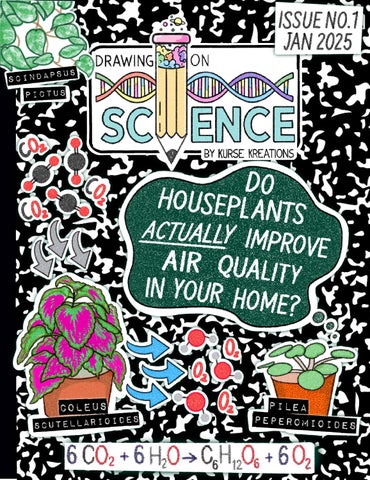
Drawing On Science is a biweekly zine series that bridges the gap between art and science, offering visually engaging and accessible explorations of scientific topics.
Hi! I'm Mere Kinsella, the artist, owner of Kurse Kreations and a research scientist with a Master's degree in biochemistry. This zine series is my passion project and a way to combine my love for illustration with approachable, in-depth explanations to spark curiosity and a love for learning.
From the intricate chemistry of life to unraveling the secrets behind everyday things that spark your curiosity... like whether houseplants actually clean the air, or why do some foods glow under UV light? In each issue, I aim to transform complex scientific concepts into captivating visual stories, making science both beautiful and understandable. The best part? I get to dive into any topic that sparks my curiosity! Simple or complex, I get to follow the dopamine.
This project is pay-what-you-can because I believe everyone should have access to trustworthy, peerreviewed information, regardless of their financial circumstances. Your contributions enable me to research deeply, illustrate passionately, and share thoughtfully. It also lets me uphold my commitment to using safe, sustainable practices and amplifying LGBTQ+ voices and other underrepresented perspectives in science. And yes, like everyone else, I’m navigating the challenges of a capitalist world where passion alone won't pay the bills.
Thank you for being here and for supporting this journey of discovery and creativity. Your encouragement, whether through kind words, contributions, or simply following along, means more than I can express. It allows me to turn my curiosity and love for science into something I can share with the world. Together, we can explore fascinating topics, spark new questions, and celebrate the beauty of learning.
So this first issue is a bit of a mess.
I’m playing around with ideas and figuring out the format and writing style I want to use. What I DO know is that I’m not trying to write another dry science paper, but I am definitely prone to the occasional ADHD ramble. Let me tell you how I ended up here…
It all started when I was going to bed and having one of those imaginary conversations. I was talking to an old co-worker, telling them how glad I was to be unemployed and finally pursue all of my creative business adventures. I started explaining how I don’t even care how good of a scientist I am anymore because I had freedom. Then
the idea hit me:
I could create little informational zines about science topics, formatted however I want, and cover whatever fascinated me most. I could finally use my science degree and illustration background “for good” (instead of evil ).
Then my partner asked me about their plant babies, and I decided to tackle this question for the first issue:
Do house plants actually improve air quality in your home?
The short, TLDR answer: Not in the way you’ve possibly been lead to think. Not in any significant or noticeable amount, at least not for any reasonable number of houseplants.
But hold on! I’m not saying plants don’t filter things from air. We all learned about photosynthesis in elementary school, right? Plants take in CO2‚ and release O2. If you need a refresher, check out Khan Academy’s photosynthesis resources.
And you’ve probably heard the claim that talking to plants helps them grow? ….I spent 30 minutes trying to track down the original study and only found about 50+ blogs and news posts referencing a 2009 Royal Horticultural Society (RHS) experiment with 10 tomato plants BUT NO SOURCE!
Here’s a an interesting source: Probing Question: Does talking to plants help them grow? by Alexa Stevenson, PennState, August 24, 2008
Sound perception in plants (DOI: 10.1016/j.semcdb.2019.03.006)
Ok, let’s get back on track…
Ok so why is my short answer basically NO? Because plants just can’t filter indoor air fast enough to make a noticeable difference in your home’s air quality. If you want cleaner air, you’re better off getting an air purifier with a HEPA filter.
Not So Fun Fact: Did you know that people spend 86.9% of their time indoors?
KLEPEIS, N., NELSON, W., OTT, W. et al. The National Human Activity Pattern Survey (NHAPS): a resource for assessing exposure to environmental pollutants. J Expo Sci Environ Epidemiol 11, 231-252 (2001). https://doi.org/10.1038/sj.jea.7500165
(Here’s a link to a DIY box fan air purifier!)
Where does this myth come from? Most posts citing houseplants as air purifiers reference the 1989 NASA Clean Air Study, conducted with the ALCA (Associated Landscape Contractors of America). The 2 year study explored air filtration methods for closed system environments in space, not real-life homes. The conditions tested were completely unrealistic for typical living spaces.
Not only would you need an absurd number of plants per square foot to see a difference, but let’s be real, none of us live in a sealed-off vacuum.
Separating Fact from Fiction Growing up in the dial-up internet era (90’s kid), the phrase “Don’t believe everything you read online” is burned into my brain (right alongside The truth is, anyone can say anything and misrepresent science, even with facts in hand. I've seen countless misleading posts from content creators and plant enthusiasts claiming you need a certain number of houseplants for clean air. I even found a beautifully designed Reddit infographic called “NASA Guide to Air-Filtering Houseplants.” While the data presented was factually accurate, the context was wildly misleading. I'm not here to reinvent the wheel. Plenty of blogs have already explored how this study has been misrepresented. But I don’t want to just repeat what they say, and I don't want you to take my word for it either.
Let’s go straight to the source Together, we’re going to break down NASA’s “A Study of Interior Landscape Plants for Indoor Air Pollution Abatement” (1989) and explore what it actually says.
Whenever I read a paper, I have a specific process:
upload PDF to tablet
(Goodnotes)
cut/ paste all text into 2-4 columns a page
gather tables & figures
quick read through & highlights
then indepth read through & notes
A total of 12 primary plants were tested for their ability to remove pollutants, with some additional species included for comparison:
You can find th ese plant “stic kers” scattered thro ughout this zi ne!
Additional Plants Used for Comparative Analysis: • Golden Pothos (Scindapsus aureus) • Heart Leaf Philodendron (Philodendron oxycardium) dium) • Elephant Ear Philodendron (Philodendron domesticum) mesticum) • Green Spider Plant (Chlorophytum elatum)
Testing Environment and Conditions Plants obtained from a local nursery were maintained in their original nursery pots with standard potting soil. Stern's Miracle-Gro fertilizer was used to ensure healthy plant conditions. Experiments were conducted in a sealed, airtight Plexiglas chamber (they had 4). Based on what is described in the paper, I have drawn what one of the chamber set ups may have looked like (without the plant inside).
Chamber dimensions:
TWO Smaller chambers: 30 x 30 x 30 inches TWO Larger chambers: 30 x 30 x 60 inches
Constant illumination was provided using Damar Gro-lights (125-150 footcandles). From The Light Design Lab and Energy Trust of Oregon “A footcandle is defined as the illuminance on a one square foot surface from a uniform source of light.“
Each chamber had copper coil water cooling system (7*C) inside to prevent heat buildup from grow lights.
A small fan was used in each chamber to circulate air.
Each chamber had 2 removable ports for introducing test material and taking air samples.
The 3 chemicals tested were selected based on their common presence in indoor environments and their potential health risks: Benzene: Found in gasoline, paints, inks, plastics, and rubber.
Trichloroethylene (TCE): Used mainly in metal degreasing and dry cleaning but also printing inks, paints, lacquers, varnishes and adhesives.
Formaldehyde: Found in virtually all indoor environments from particle board or pressed wood products, foam insulation, and cleaning agents. Links to SDS (Safety Data Sheets)
Directly from paper :
How many plants does it take to clean the air? This article from Molekule discusses the limited effectiveness of houseplants in purifying indoor air. It references the 30 year old NASA study and discusses more recent research that indicates that in real-world settings, the impact of plants on indoor air quality is minimal. A review of 196 experiments showed that a single plant cleans only about 0.062 cubic meters of air per hour, while a human breathes approximately 0.5 cubic meters in the same time.
This means an impractically large number of plants would be required to match human respiration rates. While plants offer aesthetic and psychological benefits, they should not be relied upon for significant air purification. For effective air purification, mechanical air purifiers with HEPA filters remain a more practical and scientifically supported choice.
When I finally began writing this zine on New Year's day 2025, I searched “Plants” in my TV browser to find something on topic to play in the background and stumbled upon a cute documentary called "Tiny Garden" directed by Kenneth Cheong & Victor Manggunio on Tubi. There are five ~ 11 min episodes featuring Singapore based interior designers and architects who are also gardeners and botany enthusiasts. In this series, they share their personal stories while beautifully presenting their gardening tips and crafts. “Tiny Garden," directed by Kenneth Cheong & Victor Manggunio [Camp Up Studio, Singapore, 2020]
SIDE QUESTS AND OTHER THINGS I GOT CURIOUS ABOUT… My partner asks: • What do red leaves mean (biologically/chemically)? • How does photosynthesis work then? • Is red better for certain light conditions? I saw a Stella Calathea and now I’m curious about the genes involved in the white splotches. Peacock Fern
An excerpt from House Plants - an RD Home Handbook, from contributing editor John Brookes