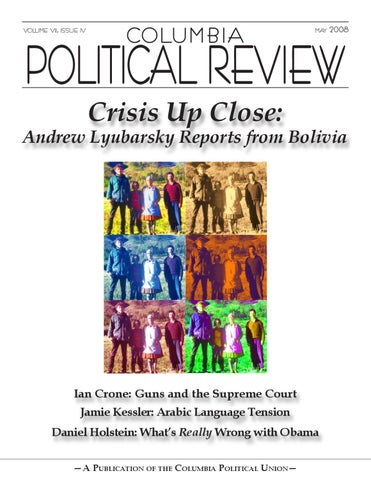
volume vii, issue iv
CO LU M B I A
may
2008
POLITICAL REVIEW Crisis Up Close:
Andrew Lyubarsky Reports from Bolivia
Ian Crone: Guns and the Supreme Court Jamie Kessler: Arabic Language Tension Daniel Holstein: What’s Really Wrong with Obama —A Publication of the Columbia Political Union—
Student Body Poll
T HIS ISSUE’S TOPIC:
Political Ethics
Poll analysis by Nicolas Alvear Do you think that there has been a decline in politicians’ ethical standards?
Are you more likely to endorse a political leader with strong, well-articulated religious beliefs?
CC students, Republicans, and males are more likely to vote No.
CC students, females, and Democrats are more likely to vote No. Republicans are more likely to vote Yes.
* * * * * * * * * * * * * * * * *
* * * * * * * * * * * * * * * * *
Do you expect your elected officials to set an example of moral and ethical conduct?
If a public official commits an act in private life that you find immoral or unethical, do you trust him or her to still have sound judgment on other public matters?
* * * * * * * * * * * * * * * * *
* * * * * * * * * * * * * * * * *
Would you vote for a candidate who holds political ideas with which you agree but who also has a pattern of corruption?
Does the Constitution guarantee all citizens the right to a private life?
Barnard students, Republicans, and males are more likely to vote Yes. 320 students were polled; margin of error +/- 5.3% Poll conducted with the assistance of Erin Conway and Gene Kaskiv. 2 | Columbia Political Review
CONTENTS www.columbiapoliticalreview.com
EDITOR-IN-CHIEF
Mark Krotov PUBLISHER
Michelle Diamond MANAGING EDITORS
Seth Berliner Karen Leung
Student Body Poll.........................2 Illogic and Rhetoric Seth Berliner and Mark Krotov
CAMPUS EDITORS
Andrew Gershon Victoria Gerstman ART EDITOR
Stacy Chu
DESIGN EDITORS
Maria Insalaco (cover art) Kate Quenzer
(My) Impending Healthcare Crisis.........................14 Timothy de Swardt
Universal Jurisdiction Candidates Tackle Undergrads, Part II.......................4 and the ICC’s Growing Sway.............................17 COVER STORY
SENIOR EDITORS
Nicolas Alvear Michael Brener Ian Crone Eric Lukas Sara Vogel Rob Wile
Tracy Chung
Jamie Kessler
The Critical Language Gap......18
Andrew Lyubarsky
Crisis Up Close...................................6 Eva Fortes and Gabriel Grados
Crossword Puzzle........................10 Ian Crone
Much Ammo About Nothing.....12
Daniel Holstein
What’s Wrong With Obama.....21 Florence Lui and Mark Krotov
Interview with Bruce Robbins..............................23
Shaina Rubin
Politics in Pictures......................13
IDEAS EDITOR
Sara Doskow
BUSINESS DIRECTORS
Jacob Shapiro
DEPUTY PUBLISHER
Sajaa Ahmed
HEAD COPY EDITOR
Annie Ma
Letters to the Editor The Columbia Political Review welcomes letters to the editor. They should be sent to cpureview@columbia.edu and should not exceed 150 words. Letters for publication must include the author’s name, contact information and Columbia affiliation. The Columbia Political Review reserves the right to edit content.
COPY EDITORS
Ben Small Eugenio Suarez STAFF ARTISTS
Taimur Malik Cristina Politano Shaina Rubin Olivia Shih Cassie Spodak WEBMASTER
Christopher Chan The Columbia Political Review is the magazine of the Columbia Political Union, a non-partisan student organization seeking to enhance involvement in the political process and foster political discourse. The CPU does not endorse the ideas contained herein; their worth is for our readers to determine.
Sponsored [in part] by the Arts Initiative at Columbia University. This funding is made possible through a generous gift from The Gatsby Charitable Foundation. Columbia Political Review | 3
In our April issue, the Columbia Political Review shed light on University President Lee Bollinger’s plan to bring candidates for the American presidency to campus. The unexpected revelations of Tom Tancredo, John Edwards, and Rudolph Giuliani’s syllabi elicited such a positive response from the student body and the faculty that the President’s office has leaked some more information regarding the 2008 World Non-Leaders Forum to the Columbia Political Review. Class registration will begin in the fall, but especially eager students are urged to send self-deprecating letters directly to the professors, who currently have hours of free time. Instructor: Bill Richardson Course Number: POLS W2049 Course Name: Weight in the West Wing: Fat Men and the Presidency How fat is too fat? This class is all about fitness—for office, that is! William Howard Taft got stuck in the White House bathtub; Professor Richardson never even made it that far. This class will use President Taft and Prof. Richardson as case studies in political imagemaking and will highlight the ways in which the obese and overweight suffer from the visual saturation of American culture. Mixing popular culture and political science, Prof. Richardson will lead engaging lectures punctuated by donut breaks. Particular attention will be paid to the selection of wardrobes and the strategic deployment of facial hair. While written assignments will mainly present photographs of candidates to students with simple multiple-choice questions (eg. “Do I look fat in this?”) , Prof. Richardson welcomes classroom
4 | Columbia Political Review
participation, and in every class, he will assess an individual student’s readiness for office, based on his or her physical appearance. Tissues will be provided.
Instructor: Mike Huckabee Course Number: ENGL W4943 Course Name: Tales of the American South: Storytelling with Uncle Mike “South Carolina’s a great place for me. I mean, I know how to eat grits and speak the language. We even know how to talk about eating fried squirrel and stuff like that, so we’re on the same wavelength ... When I was in college, we used to take a popcorn popper, because that was the only thing they would let us use in the dorm, and we would fry squirrels in a popcorn popper in the dorm room.” Using a deeply ethical close reading practice known as “sympathetic insight,” students will spend the first three weeks of this upperlevel seminar exploring Professor Huckabee’s enigmatic, poetic, riveting statement, which he uttered
unprovoked on national television. Prof. Huckabee will parse his words along with students, offering a truly unique opportunity to confront a poet in a reflective, academic setting. In the remaining nine weeks of the class, Prof. Huckabee will confound and enlighten students with many other recollections—both fictional and historically accurate— from his childhood, adolescence, and young adulthood. Possible story topics include “that time I fell off a tractor,” “that time my friends and I got lost in a forest and had to burn down a lot of trees because we didn’t have a flare gun,” and “that silly, absurd time when I ran for President and people took me seriously.”
Instructor: Joseph Biden Course Number: ENGL 1000 Course Name: Communications 101: Introduction to Propriety Professor Biden will investigate and explore the lost, hidden, and now—that is, in this day and
ILLOGIC AND RHETORIC age—foredoomed art and practice of elocution, speech-making, and rhetoric. Having spent a goodly portion of his life and times in public, political life, Prof. Biden draws on, has accumulated, and will talk (and talk and talk and talk) about the many experiences, happenings, and occurrences that have in a multitude of varieties of ways formed and shaped his loquacious logorrhea. Students will be asked to write or type and then deliver a 5,000 word (minimum) speech; works plagiarized from Englishmen will be welcomed, received, and accepted.
Instructor: Fred Dalton Thompson Course Number: CLEN W4902 Course Name: Introduction to Literary Theory In his initial announcement, President Bollinger emphasized the pedagogical importance of Professor Thompson’s lecture with particular enthusiasm, and his emphasis was not misplaced: Thompson’s vigorous, innovative reinterpretation of recent canonical works of literary theory announces the arrival of a transformative intellectual mind on Columbia’s campus. Though Prof. Thompson’s soporific predilections have thus far made a consistent schedule a challenge (at press time, Columbia’s registrar told the Columbia Political Review that the class will meet “once or twice a week, between Prof. Thompson’s naps”), students will undoubtedly tackle major theoretical works with great fervency. In his readings of great thinkers, Prof. Thompson will transpose the informative, open-minded directness of his
political rhetoric onto the academy, offering his analyses of Deleuze (“too French”), Derrida (“way too French”), Foucault (“I’m not for cussing in the classroom”), and Althusser (“how the hell do you pronounce that?”). The result will be an exciting and fruitful fusion of post-structuralism and “straight talk,” which is known for its remarkable evasions and displacements. Homework assignments will be limited, but weekly viewings of Law & Order are mandatory.
Master Class Instructor: Ron Paul Course Number: REVL W4000 Course Name: Seminar in Revolution Studies Columbia’s legendarily regressive bureaucracy approaches the formation of a new academic department with understandable hesitation, but the arrival of Professor Paul has compelled the administration to scramble with urgency and excitement. The result of its hard work is a new Institute for Revolution Studies, which will be headquartered on the steps in front of Thomas Jefferson’s statue. Prof. Paul will teach the Institute’s new Master Class, which will address many important questions, including: What exactly constitutes a revolution? Can a revolution be centered on the gold standard? Must revolutionaries have beards? Can it still be called a revolution if nothing actually happens?
Instructor: Dennis Kucinich Course Number: SOCI W3102 Course Name: Vegans, UFOs, and Peace: Fringe beliefs in American society As an unlikely mayor, an unlikely congressman, an unlikely two-time presidential candidate, and an unlikely husband of an attractive wife, Professor Kucinich is well-versed in the transformative power of the mystical and in the profound impact of the unbelievable. In this introductory lecture, Prof. Kucinich will explore the unknown and unreal forces that have propelled him toward such unexpected, radical events, and he will attempt to create a narrative of the unlikely in American history. How is it that people refuse to eat animal products? How can aliens ably pilot large saucer-shaped machines? How can anyone think that people can actually stop fighting one another? Prof. Kucinich’s historiographic response is eloquent and succinct: “look at me. Anything is possible.” Students will be graded on the openness of their minds and their willingness to kneel down whenever Prof. Kucinich stands next to them. While classroom space has yet to be determined, Prof. Kucinich is in negotiations with facilities management to hold his lectures in the Pupin planetarium, which will provide unmediated access to the unexplained mysteries above. Students are encouraged to bring their rabbits’ feet and silver dollars, as Prof. Kucinich makes the impossible possible. -Mark Krotov and Seth Berliner
Columbia Political Review | 5
cover story “In the United Status, you have Socialism (MAS) party. The final frontation. a very different conception of crisis than we do in Bolivia. For you, it is something bad that comes along every couple years, gets resolved, finished and forgotten about. For us, crisis is permanent. Crisis is our way of life. We breathe it and we feed from it. It is part of our consciousness.” To knowing smiles around the room, sociologist Alberto Rivera provided me this introduction to Bolivian politics. After spending just over a month and a half in the country, this perception of a nation unable to define itself, tottering on the precipice between revolution and disintegration, seems accurate to me. For the first time
document produced by an assembly dominated overwhelmingly by MAS, would provide indigenous groups with unprecedented levels of control over natural resources and self-governance and calls for an agrarian reform on large estates concentrated in the eastern region of the country. The opposition has rallied behind a parallel project that would allow resource-wealthy eastern provinces to exercise regional autonomy which would seriously challenge the redistributive capacity of the central government. Both the government and the opposition were slated to put their proposals to a popular vote
But in a situation where nobody can identify an exit from the political crisis that does not risk triggering civil war, civil society is remarkably mobilized, and—to risk repeating an aphorism that has grown trite in our days—is moved by hope, not fear. The students, union leaders, movement activists, NGO workers and government politicians may bicker endlessly amongst themselves; but they share a profound belief that they live in historic times in which Bolivia has the chance to emancipate itself from an outdated colonial structure that has made the country the poorest in South America. To understand
Crisis Up Close: Andrew Lyubarsky Reports from Bolivia in its history, the overwhelmingly indigenous majority in Bolivia elected an indigenous president with strong backing by popular social movements. Evo Morales sought to recover Bolivia’s natural resources—privatized under prior years of neoliberal governance—and proposed a Constituent Assembly to rewrite the country’s constitution to reflect its indigenous composition. The response of the right-wing opposition party, PODEMOS, has been to boycott these proceedings and then declare the new Constitution the dictatorial product of a left-wing ruling clique dominated by Morales’s Movement Towards
6 | Columbia Political Review |
on May 4th, until the National Electoral Court declared the processes to be illegal. While the government abided by this decision and delayed voting, the autonomist movement based in Santa Cruz has defied the ruling and carried on with the referendum. Although all signs point to an overwhelming victory for the regional referendum, the government has called the referendum anti-democratic and has pledged to ignore the results of the voting. Attempts by the church, the OAS, and various regional actors to mediate have fallen on deaf ears, and militants on both sides have started to beat the drums of con-
why, one must understand the dramatic shifts of Bolivian political life in the last eight years. Jim Schultz, the founder and director of the Cochabamba-based NGO Democracy Center, is part of a small army of progressive foreign professionals who have affiliated themselves with the process of change in Bolivia. Schultz was in the streets of Cochabamba during the so-called “Water War”, in which the population of the city rose up to expel Aguas de Tunari, a private consortium dominated by the US energy giant Bechtel. A massive wave of protests lasting from January to April of that year functionally shut down the
cover story city, and forced the government presidential administration man- of their life for this moment and to renationalize what was viewed as a key public resource. According to Schultz, what was perhaps a parochial battle in the overall scheme of Bolivia’s economy resulted in a tremendous symbolic victory against policies that had been proclaimed to be the natural and inevitable evolution of the free market. This interruption in the grand narrative of market-oriented reform pushed by international financial institutions led to the events that would definitively rupture the old system of governance. After barely edging out Evo Morales for the presidency in the 2002 elections, right-wing politician Gonzalo Sanchez de Lozada found himself in charge of a country that had become virtually ungovernable. During his first presidency in the early 1990s, Sanchez de Lozada had been the architect of the package of privatization, trade liberalization and price deregulation that characterized structural adjustment policies in Latin America. His policies met with broad public support. In his second term, an IMF-sponsored attempt to raise taxes to lower the state deficit resulted in a prolonged gun battle between rioting police officers and the army in the streets of the capital La Paz. 34 died. In October 2003, Sanchez de Lozada’s proposal to export gas through a Chilean port in a manner which would allow multinational corporations to earn tremendous profits resulted in a full-scale blockade of the capital based in its indigenous sister-city, El Alto. The president ordered troops to break the siege by force, and more than 60 perished in the bloodshed. In less than one year in office, a democratically elected
aged to kill more people than seven years of military dictatorship in the 1970s. The glory days of globalization were over in Bolivia. The long-marginalized but highly organized social movements of the country were set to go from protesta to propuesta—that is, from a purely oppositional stance
“For us, crisis is permanent. Crisis is our way of life. We breathe it and we feed from it. It is part of our consciouness.” to the governance of the country. Whatever romance the election of Evo Morales may hold for Western activists, it is too tempting to paint it as a cheap morality tale, that of a humble, indigenous, leftist David triumphing over the voracious Goliath of multinational capital. It is clear that the Morales administration is well aware of the appeal it holds with progressives outside, and is eager to promote that image abroad. Evo is frequently quoted as saying that his government is based in the principles of the simple Quechua saying from Incan times: ama suwa, ama qhella, ama llulla, or “don’t lie, don’t steal, don’t be lazy.” Evo’s public image is suprapolitical and humble, An indigenous government based on moral principles over profit. Such a simplistic representation of the situation is accepted by nobody on the ground in Bolivia. This includes the people of the social movements who gave years
claim they would rather die than see his government overthrown. Nearly everyone in this sector is extremely supportive of the political project of the MAS government, but it is a support tempered by fierce criticism. According to Schultz, the Morales administration has made two grave mistakes. First, it has governed incompetently, utilizing a combination of indigenous leaders and union leaders with strong political beliefs but insufficient educational training to administer government ministries, and non-indigenous economists that were trained in and still believe in the old neoliberal model. This has led to a sometimes incoherent policy. Second, the Morales administration’s incendiary rhetoric and lack of political tact has alienated a great part of the middle-class electorate. The broad class alliance supporting many of his policy proposals— such as the renegotiation of natural gas contracts, reasonable land reform, and a re-evaluation of the Constitution—has been shattered by pronouncements in which Morales seems only concerned with his Quechua- and Aymaraspeaking indigenous base in the nation’s western highlands. The right-wing opposition has exploited these rhetorical excesses by dividing the country on regional lines. In addition to the autonomy referenda, it has successfully slashed Morales’s power base in the mostly indigenous department of Chuquisaca by proposing the movement of the government apparatus from La Paz to the historic capital city of Sucre and sparking violent antigovernment demonstrations in what was once a MAS stronghold. According to
Columbia Political Review | 7
cover story Schultz, the government’s clumsy that the Morales government’s governing palaces of La Paz and and sometimes heavy-handed response to these provocations has cost it significant support. However, in a country where class contradictions are so strong and are ethnically marked by indigenous or white identity, it may be naïve to believe that a broadbased reform project in the name of the dispossessed majority can be carried out without alienating certain middle-class sectors, or without explicitly appealing to the indigenous identities that are still fundamental for a majority of Bolivians. The necessary rhetorical emphasis on Bolivia’s indigenous majority as the motor of the country’s history can come as a dramatic blow to the psyche of a society that has had its white and mestizo ruling class glorified for its entire history, and can be easily exploited by an opposition eager to encourage rifts in the government’s support. Furthermore, a self-described “government of the social movements” is under considerable obligation to respond to the demands of its backers. Aside from Evo Morales, Oscar Olivera is perhaps the best-known figure of the Bolivian left internationally. Rising to prominence as the leader of resistance to the water privatization scheme in Cochabamba, Olivera has obtained a permanent place in the transnational activist pantheon for directing one of the few campaigns against a major corporation that actually proved successful. Standing with Oscar on the same balcony over the main plaza where he declared victory to an adulatory crowd eight years ago, I received a very different portrayal of the current situation. Contrary to Schultz’s assertion
8 | Columbia Political Review
problem was polarization at the expense of solidifying his base, Olivera claimed that Morales was systematically distancing himself from the demands of the social movements that elected him and which form his praetorian guard against the opposition. Comparing Evo to Tabaré Vasquez of Uruguay and Lula Ignacio da Silva of Brazil—leaders elected on the back of popular and even radical organizations but who have since been perceived as aligning themselves with more moderate policies consonant with the exigencies of global capital – Olivera believes that the Morales administration fears unleashing a genuinely transformative process. The two cardinal sins of the Morales administration are the rejection of the social movement demand for the nationalization of Bolivia’s hydrocarbons, and the lack of a national dialogue on the redistribution of resources. “Where in the new constitution does it touch the interests of the rich?” Olivera demanded. “Where are the proposals for worker cogovernment in our factories? As long as the new constitution is based on the sanctity of private property as a foundation, we have not fully freed ourselves from neoliberalism. The line of the government against the oligarchic interests of this country is weak.” Paradoxically, Olivera says that the election of the Morales government has dramatically weakened and demobilized the country’s social movements. Whereas the movements were fully able to survive the stick of repression, they are having many more problems with the carrot of cooptation. Locally-rooted leaders have become party bureaucrats in the
organizations once fully independent and oriented towards the interests of their members have become incorporated as political tools of the state. When mobilizations do occur, they tend to be in support of existing government policies. The current juncture, when the social movements are supposedly “in power,” is a most difficult point in their historical development, for an autonomy lost can rarely be recovered. Of his personal relationship with the government, Olivera commented, “When we go to union meetings, some of our compañeros still call Evo their brother. I do not think he is my brother anymore. He is something else now.” Factually, Olivera’s critique rings true. Aside from a clause in the new constitution that would limit the maximum size of land ownership in the eastern provinces, the new constitution and the general policies of the Morales government are more indigenist than socialist. However, the policies that Olivera calls for would more closely approximate a revolutionary platform than the reform process to which the government has committed itself. This would aggravate the already explosive regional and class tensions to the breaking point, quite possibly sparking a low-intensity civil war. While one can argue that it is necessary to break the power of the eastern elite to restructure the country justly, even at the cost of bloodshed and potential national disintegration, that is not a step the Morales government is willing to take at this time But coming down from the balcony into the main plaza itself, yet a different perspective emerges. “Oscar Olivera is a bureaucrat,”
cover story mutters Ramiro Saravia. “If you has standing among social movewant to know what the Bolivian ment leadership, it is clear that his people think, just ask them. They prominence has slipped. Several are here in the plaza.” Saravia heads the Red Tinku Juvenil, a small but boisterous youth movement that also came out of the 2000 Water War. The organization sets up panels of news stories with left-wing commentary in the plaza with an intent to stimulate discussion of the nation’s trajectory. The result is rather impressive – at any given moment during the day, there tend to be around fifty people standing in a circle, engaging in sometimes confrontational but always peaceful debate. Saravia claims that Olivera has exploited his status as an internationally renowned activist and has abandoned any claim to authentically represent Bolivian social movements. Interestingly, Saravia accuses Olivera of gutting the Coordinadora de Agua, the grassroots committee in charge of leading the opposition to the privatization scheme, and restructuring it under a far less accountable but more financially lucrative NGO model. “This new NGO culture is nothing more than a petitbourgeois revolutionary game,” Saravia says. “These people sit in coffee shops and discuss social change and revolution. They are not rooted in the masses and have nothing to do with them.” The Red Tinku once shared an office with Olivera’s union apparatus, but apparently were evicted unceremoniously several years ago. “Evo Morales may make mistakes, but he has the support of the base of the population. When is the last time you have seen Oscar Olivera leading a major street demonstration? Eight years ago?” Although Olivera can still rouse a crowd with his oratory and still
days after hearing this critique, I attended a demonstration of the Central Obrera Departamental, called to protest against perceived speculation in basic necessities by eastern business interests politically designed to destabilize the Morales government. Like most political phenomena in Bolivia, it was a rowdy occasion, culminating with the burning of the provincial governor in effigy and the beating of the flaming carcass with leather belts. However, there was clear disaffection with the union establishment voiced by the crowd, which constantly heckled the union representatives and urged them to take more drastic actions. The march was a response to one organized by the right wing the day before, which had blamed the rise in the price of commodities on the central government and burned Evo in effigy. While the mood was positive, there were some murmurings about the union’s inability to mobilize as many people as it had in the past. Though doubts and contradictions plague any process of social change, and the viability of Bolivian social movements is being thrown into question, the participants in these movements remain determined to make sure that the country does not slip back into the hands of the neoliberal technocrats that form the opposition. While there may be disagreement as to what the new structure will look like, the ideological hegemony of the neoliberal model has been definitively ruptured. Current activism is an experiment in combining an indigenist worldview with vestiges of the old redistributive state
apparatus in new ways. But in the meantime, Bolivia is in crisis, and both government allies and the right-wing opposition have begun digging in their trenches. A student leader who had participated in the 2003 street battles in La Paz and El Alto told me that El Alto had served as the vanguard of the nation at the cost of the lives of tens of students, and would not hesitate to do so again if the gains of the government were threatened. But perhaps the most evocative statement came from a fisherman from Achacachi, a small Aymara town near Lake Titicaca with a fighting tradition of resistance to prior Bolivian states. “It is nice to meet you, young man. Yes, for us this is a battle. It is a battle to the death.” As such, perhaps it is improper to speak of Bolivia leaving the intractable situation it will find itself in when the referenda of May reveal the future of the nation. The contradictions of the country may be too grave to be resolved hygienically as we like crises to be resolved in the United States: in a grand compromise that is acceptable to all parties. Crisis is not always a state of exception – it can also be a state of being. But in this crisis there is an opening, a potentiality for something better that compels people forward into an inevitable confrontation from which they can detect no exit. Divided they may stand now, but the ranks will close when the bonfires of springtime beckon. Andrew Lyubarsky is a junior in the College, majoring in Spanish with a concentration in anthropology. He is spending this semester studying abroad in Bolivia, splitting his time between Cochabamba and Santa Cruz de la Sierra. He can be reached at al2386@columbia.edu.
Columbia Political Review | 9
Crossword Puzzle: Peru’s Quest for Linguistic Representation
“Indian peasants live in such a primitive way that communication is practically impossible… The price they must pay for integration is high-renunciation of their culture, their language; their beliefs, their traditions and customs, and the adoption of the culture of their ancient masters… Perhaps there is no realistic way to integrate our societies other than asking the Indians to pay that price…” - Mario Vargas Llosa by Eva fortes and Gabriel Grados
10 | Columbia Political Review
cal promise to require all Peruvians to learn indigenous languages. As much as Humala represented a radical approach, his reasons were fair. Two groups broadly characterize Peruvian society: the economically important, politically represented and relatively wealthy Spanish speakers, and the country’s larger population, which does not master Spanish and lives mostly in marginalized conditions in the country’s biggest cities, or in remote settlements deep in the mountains or the jungle. To Virginia Zavala, professor of sociolinguistics in Lima, “We are a country unable to imagine itself as a community.” However, attempting to amend the situation by inverting the privileging of one language over another cannot be recommended. Such an inversion would most likely make the path to social and linguistic unification much harder: the tensions between the two groups, far from being ameliorated, would only be intensified as the most powerful political circles resisted such drastic change. The 2006 presidential elections evidenced Peru’s need for social inclusion in the future, but a more balanced overture, such as the
SHAINA RUBIN
The debate over linguistic policy in Peru is as old as the conquest. In the 16th century, the Spanish used language to control the indigenous population by limiting its political participation. Making Spanish the official language of the government prevented indigenous people from accessing necessary political institutions and services like health care, police protection, and education— a disparity that continues even today. The ruling elite has thereby perpetuated its advantage over an undereducated and underserved class, and present economic growth has only exacerbated this inequality. Language barriers between Quechua-speaking producers and Spanish-speaking exporters, as well as between marginalized rural communities and the central government, continue to widen the income gap. “Our country, Peru, doesn’t really develop,” explained Roody Cáceres Torres, advisor to Congresswoman María Sumire, “precisely because one great barrier is the language. [It is] a barrier for the exchange of products, for the
sale of the same, for the production....” Peru lacks communication between the country’s ethnic groups, and it lacks the inclusion of the country’s most destitute sectors in national and global economic trends. At present, the ruling elite is characterized by its adherence to the Spanish language, which only the well-off classes tend to speak. Given that approximately 50% of the country still lives below or immediately above the poverty line—the same percentage that either lacks Spanish education or suffers from discrimination due to lack of Spanish fluency—the room for improvement is significant and the potential instability worrisome. But the situation remains the same as a vicious circle develops since these people are unable to obtain political power and hence do not intervene in the country’s management. In other words, the political elite do not voice the concerns of the country’s poorest, creating discontent and resentment. Recently, a populist presidential candidate brought the language issue to the forefront. In the 2006 election, opposition candidate Ollanta Humala obtained widespread support from the country’s poorest regions with a radi-
educational policy suggested by the new law, would be more conducive to easing social tensions and attaining linguistic representation. To address this issue, the Peruvian Congress is currently debating the Law for the Preservation and Use of Native Languages. Despite its alleged lack of specificity and support from certain factions of Congress, the law is a conscientious effort toward enfranchising hitherto marginalized communities and creating a more egalitarian society. Moreover—in contrast to its Constitutional predecessor, which named Quechua as an official language and stagnated thereafter—it aims to implement educational policies that promise a gradual reappraisal of the importance of indigenous languages in Peru. The significance of linguistic representation transcends questions of political disenfranchisement and social stratification. At this moment, a fair linguistic legislation could greatly benefit Peru’s economic development. Not only would it appease the political climate, but it would also open markets to the country’s poorest. This means that a truly representative government would implement economic policies to include and protect those who are not currently prosperous. While the recent FTA agreement with the US, for instance, favors the higher social strata, it excludes the non-Spanish speakers. Better intra-country communication policies would foster a larger and more competitive internal market. The law in question tackles precisely this issue of inequality by language discrimination. Title I of the law declares “specify[ing] the scope of individual and collective rights and guarantees” as its object. These rights, already established in Article 48 of the Constitution, give Quechua and other indigenous languages the status of official languages “in the zones in which they predominate.” The vagueness of this description, however, has previously made the law impossible to observe. While the new law does not aim to bestow new
rights upon the affected citizens, it does aim to redefine previous legislation to make it effective in extending pre-existing rights and privileges—including access to institutions of power—to nonSpanish speakers or speakers of Spanish as a second language. The specific issue of linguistic rights predominates in the fourth article of the law. “Every person,” it states, “and every linguistic community has the right to ... be attended in his/her/its maternal language ... in State Organizations or Instances....” This key point, which demands that non-Spanish speaking persons be attended in their maternal language, could expand access to the basic medical or police services that have been unavailable to second Spanish speaking Peruvians. The implementation of such an ambitious policy, however, remains far from certain, inspiring several debates. In one session, Congresswoman María Balta Salazar raised the question, “How are we going to make the translation and publication of legal codes so that the villagers can know and understand them if these same villagers don’t even know how to write their own language?” To address this query, the law includes a requirement for oral translation in addition to written translation. Additionally, the law outlines specific rights to bilingual and bicultural education. Title I, Article 4, for example, stipulates rights “To receive education in one’s mother tongue and in one’s own culture, with an intercultural focus” and “To learn Spanish as the language of common usage in the Peruvian territory.” Further on, the law proclaims that the State should guarantee and promote the teaching of indigenous languages at all levels of schooling, rendering such objections obsolete in the future. The emphasis on the intercultural aspect of education seeks to address the problem of disorientation, which arises, for instance, when children who live and work on a rural farm are taught in Spanish about airports, airplanes, and
other concepts that might be unfamiliar. Bilingual, bicultural education also intends to minimize the discrimination suffered by many children who have a distinct Andean accent or employ malapropisms rooted in an incomplete education. Many of these children can avoid being held back in school from failing math or science by learning the concepts in a language they are comfortable with, before being exhorted to understanding them in the nation’s dominant language. Advocates of the law go as far as stating that more than closing the gap between elite Spanish speakers and disadvantaged indigenous language speakers, a bilingual-bicultural education “disseminates the patrimony and oral tradition of Peru as the essence of the cosmovision and identity of the native cultures of the country, with the goal of raising awareness of the importance of being a pluricultural and multilingual country and to foment a culture of dialogue and tolerance.” Although there are many obstacles to Peru’s becoming a developed country, one of the greatest barriers is the linguistic divide within the nation itself, which perpetuates socioeconomic inequality. By addressing the linguistic basis of this class divide, the new Law for the Preservation and Use of Native Languages promises to close the gap between the Peruvian elite and the rest of the country, eventually leading to unification and economic growth. It is therefore imperative that the Peruvian Congress expedite its approval rather than—once again—filing it in the archives of oblivion. Eva Fortes is a junior in the College, majoring in Comparative Literature and Society and concentrating in Linguistics. She spent the fall semester studying abroad in Peru, where she did field work on linguistic policy and sociolinguistics. Gabriel Grados is a junior in the College, majoring in Economics-Mathematics. He can be reached at gg2191@columbia.edu, and Fortes can be reached at esf2110@columbia.edu.
Columbia Political Review | 11
MUCH AMMO
ABOUT NOTHING
by IAN CRONE
12 | Columbia Political Review
the legal question addressed in Heller. Both sides of the case have presented arguments rooted in interpretations of the original meaning of the Amendment —not in the view that the interpretation must change to meet changing social conditions or statistical evidence. The essential problem, then, is whether that first clause of the Amendment— which reads, “A well regulated Militia, being necessary to the security of a free State, the right of the people to keep and bear Arms, shall not be infringed”—is more important than the second. That is, whether the amendment is primarily discussing a militia, or a more general right to bear arms. Proponents of gun control argue that “keep and bear arms” was only intended to protect firearms insofar as they were necessary for militias. No militia, no need for guns. They have been supported by decisions such as 1984’s United States v. Kozerski, in which the opinion declared, “the right guaranteed by the Second Amendment is a collective right to bear arms rather than an individual right, and has application only to the right of the state to maintain a militia and not the individual’s right to bear arms.” On the other hand, the decision in Parker v D.C., the case immediately preceding Heller, defined a militia as “an organized military body —such as the National Guard,” which would seem to indicate that militias are not as defunct as gun control advocates would like to believe. Of course, one of the original intentions of the Second Amendment per-
SHAINA RUBIN
Few issues bring forth such bilious bombast as the firefight between gun advocates and anti-gun activists. Shootings at Northern Illinois University and Virginia Tech recently brought questions of gun control back into the public consciousness. Now, as the Supreme Court prepares in this summer’s District of Columbia v. Heller to address the 2nd Amendment for the first time since 1939’s U.S. v. Miller, the bile is rising once more. But all the hoopla may turn out to be for naught if the Supremes turn in a narrow ruling, one which confines its scope to the specific law in question: a prohibition on operable guns (i.e. capable of discharge) in private residences in the District of Columbia. Although both sides are working themselves into a lather over the case, it’s probable that the ruling will leave them disappointed. Given the current composition of the court—which hinges on the moderately conservative Justice Anthony Kennedy —the Nine will almost certainly rule that gun ownership is an inalienable right, but one that can be regulated. In any event, how we got to this point merits a discussion of the battle over the 2nd Amendment. Those who seek to strengthen controls on private ownership of firearms point to the United States’ high level of gun crime compared to other industrialized nations: approximately 7 murders using firearms (75% of all murders) per
100,000 people in the United States, compared to an average of .35 per 100,000 in Europe, and .75 in Canada. By comparison, the rate in Russia is about 20 per 100,000 and in Colombia 60 per 100,000. Additionally, 53% of all suicides in the United State are with guns. Add it up, and groups like the Brady Campaign and the Coalition to Stop Gun Violence believe they have a compelling statistical case in favor of strict limits on who can own guns and where gun owners can take them. Some claim that statistics alone should invalidate any claims made to a personal right to own firearms – that empirical evidence pointing out the greater public good garnered from restrictions on gun ownership, or even a ban on private firearms, should outweigh an antiquated piece of parchment. Yet statistical arguments made by both sides have proven problematic. John Lott, author of More Guns, Less Crime, has argued that “shall-issue” laws—which require that any citizen be issued a handgun license upon request —correlate to lower rates of violent crime. But in its review of the book, the New England Journal of Medicine noted that Lott failed to adopt proper statistical controls when comparing crime rates in such disparate areas as Idaho and New York City. In urban areas, more guns lead to more crime, while in rural areas, where gun ownership is more prevalent, violent crime rates are lower. This evidence, however—even if it supports gun control—is irrelevant to
ceived by gun rights defenders, that of allowing the people an ultimate recourse against a tyrannical government, rings a bit hollow these days. When the government can oppose citizens’ hunting rifles with stealth bombers, aircraft carriers, and Abrams tanks, the futility of such an argument becomes apparent. The Minutemen as a militia could form a fighting force not much different from that of the British redcoats; it seems improbable that the average NRA chapter would stand ten seconds against a modern military. A greater flaw lies in the argument made by those seeking to uphold the DC gun ban, which completely negates individuals’ rights to bear arms purely for self-defense on one’s property. Justice Anthony Kennedy made the point somewhat comically when he raised a hypothetical case in which a settler on the frontier would need to defend himself from a grizzly bear attack. He might not be a member of a militia, but surely the Second Amendment was intended to guarantee his ability to defend himself and his family. Opponents of the “collective rights” doctrine point out
that the other amendments in the Bill of Rights guarantee individual rights and ask why the Second should be any different. With four solid conservative votes in Justices Clarence Thomas, Samuel Alito, Antonin Scalia, and Chief Justice John Roberts, and the swing vote—Kennedy —obviously sympathetic to the plaintiff, it is almost certain that the D.C. regulation will be struck down, and that an individual—rather than collective—right to bear arms affirmed. In his analysis of Heller, constitutional scholar Randy Barnett concluded that while the court is likely to rule that the Second Amendment provides for an individual right, its ruling will be so limited as to indicate that most existing gun regulations would likely be upheld. At the same time, because the District of Columbia isn’t a state—it’s technically under Congressional jurisdiction—and because its gun ban is far more extreme than those elsewhere, the ruling in Heller will not be a final answer to the question of gun control in the United States. Much, then, remains to be determined. A proper balance must still
be sought between the moral right to self-defense and the troubling abundance of weapons in American society —an estimated 235,000,000 firearms for 300,000,000 people. Nor can the court decide the effectiveness of the gun regulations it rules constitutional. It also cannot arbitrate the sticky electoral side of the issue—Barack Obama recently came under fire for suggesting that poor rural Americans “cling” to guns (and religion), the first time in the ‘08 cycle that the issue has been raised, since both Democratic candidates evade it as a “third rail.” And, ultimately, Heller cannot even decide the law—or though stare decisis, deference to previous decisions, may guide the Court, it cannot override the express will of the people. The debate on gun control—not one of rhetoric and bloviation, but a real, substantive discourse—must continue. Ian Crone is a sophomore in the College, majoring in International Relations and American History. His last article, “The Corn Conundrum,” appeared in the December issue. He can be reached at ipc2101@ columbia.edu.
POLITICS IN PICTURES by Shaina Rubin
inion, Obama In my independent op
s!
makes empty promise
Columbia Political Review | 13
(My) Impending Healthcare Crisis
by TRACY CHUNG
When I broke the news to my parents this past Thanksgiving that I would not be seeking conventional employment after graduating this May, I was met with a surprising reaction: “You realize that you’re not going to be covered under our health insurance policy.” For a long time, I had been constructing a plan to show my parents that my decision not to work an office job was a viable path. Their revelation threw a wrench into my strategy to show that I could be financially independent. Why was I, a soon-to-be Columbia graduate with a world of opportunity at my fingers, worried that I would suddenly be without healthcare? Many of us think that our Columbia education has given us the flexibility to pursue what we want. And most of us will probably be seeking conventional employment where healthcare comes with the salary. But what happens when you want to take a year off to travel or to pursue a career in the arts? Or, suppose your dream job isn’t hiring – take, for instance, the unfortunate and unexpected loss of your previously-thought-to-be stable job at Bear Stearns – and you have to look for alternative employment. What happens to your health insurance? Unemployment that won’t last more than a couple of months is too short to warrant the paperwork and fees of a single-rider insurance policy. But what if you get in an accident and accrue astronomical medi-
14 | Columbia Political Review
cal costs? The truth of the matter is that healthcare in this country is not only about the old people and the unemployed. There is a serious and fundamental flaw in the system that bears down on each and every American citizen. The good news is that the inefficiency in the system can be mitigated. The bad news is that there have been numerous attempts to fix it with very few positive results. The issue of healthcare has plagued our nation for the past century. The relatively little progress that has been made on this issue proves that the struggle for universal healthcare is one of the greatest tests for our nation. At the root of this quandary lies a fundamental tension of ethos in the American dream: the contradiction between an individual-based, frontier mentality and the expectation of protection and security from the richest and strongest federal government in the world. President Franklin D. Roosevelt recognized the falseness of the dichotomy between liberty and security, and between freedom and equality, in the mid-twentieth century. His biographer, James MacGregor Burns, puts Roosevelt’s belief this way: “Individual political liberty and collective welfare were not only compatible, but they were mutually fortifying.” The unsolved domestic quandary of universal healthcare shows that Americans have not yet realized that individual political liberty and collective welfare are connected, indeed, “mutually fortifying.” History suggests that the notion of
collective governance does not come naturally to humans; there must be driving forces that make it desirable and logical for the majority to come together and agree that a collective effort is more beneficial than an individual one. With the issue of healthcare topping the domestic agenda of the 2008 presidential election, the dynamics of the issue may be coming to a head. The primary catalyst seems to be the country’s changing employment demographics, which have shaken the employer-based health insurance system to the point where its sustainability is seriously questionable. The debate over health insurance has existed since the idea and practice of organized medicine came about at the turn of the 20th century. From the time that progressive reformers were gaining support for their health insurance advocacy, physicians and other interest groups have opposed the initiative for national healthcare. Throughout the twentieth century, the American health insurance reform movement has infiltrated the national conversation. But complicatedly, national and international politics have influenced and shaped the debate, forestalling the necessary reforms. For instance, the progressive debate was effectively buried as the U.S. entered World War I. When the Great Depression hit, the priorities of reform were shifted, placing greater emphasis on unemployment insurance and old age benefits. Consequently, the Social Security Act
passed without including health insurance. Presidents Franklin D. Roosevelt through Bill Clinton brought us Medicare and Medicaid, the rise of a “health maintenance organization” (HMO) system, and other revisions, but healthcare still fails to cover all who need it. The healthcare crisis has come to a head in the twenty-first century, with the costs of healthcare growing disproportionately to the wage/inflation rate. Furthermore, the nation’s employment demographics have changed vastly. In light of these changes, many, including myself, believe that the employerbased system of insurance cannot last. The structure of our health insurance still looks like it did in the 1940s, when the United States was an industrial, working class nation driven by those with middling incomes. But the population has changed; how can the system of health insurance that worked sixty years ago be effective now? The American public presses this question today, making healthcare one of the foremost domestic issues of the 2008 presidential election. The Democratic presidential candidates, Hillary Clinton and Barack Obama, confront the issue head on because they believe that healthcare in America is in crisis and will only get worse. They both believe that distributing responsibility between individuals, a private healthcare sector, and the federal government creates a more effective
healthcare industry. They believe investing in the working population will provide Americans with economic prosperity. What the two candidates dispute is the role that the federal government should play as an intermediary force. Meanwhile, Republican candidate John McCain believes in a business-as-usual strategy that only seeks to tweak some of the existing problems of healthcare. Senator Clinton’s proposed plan for nationalized healthcare is the most specific, and lays the foundation for a viable system; but it is not by any means a panacea. She proposes that the federal government act as the primary intermediary in a federal healthcare system. Her program, the American Choices Plan, is based on the principle of shared responsibility. The plan offers three choices: Keep your existing coverage through your employer or through individual coverage; choose from private health care options that “members of Congress enjoy” via a Health Choices Menu that includes a number of high-quality health insurance options; or, choose a quality public plan option like Medicare. The plan would depend on the purchasing power of millions of Americans choosing the second option, the Health Choices Menu. This would provide the large influx of capital needed for the federal government to facilitate an overhaul of the medical system. A newly efficient and modernized sys-
A History of Failed Healthcare Reform FDR Administration In the 1930s, health insurance is a high priority for the Roosevelt Administration but is superseded by other, more pressing priorities following the Great Depression. In the 1940s, Roosevelt formally asks Congress for an “economic bill of rights,” including the right to adequate medical care. Truman Administration Following Roosevelt’s lead, Truman offers a national health program plan: a single system that would include all of American society. But in the throes of WWII, his plan is called a Communist plot by a House subcommittee and denounced by the American Medical Association (AMA). Johnson Administration By the 1960s, the societal norm is set: American health insurance is a system of private insurance - for those who can afford it - and welfare services for the old and poor. President Lyndon Johnson formally codifies federal responsibility for the poor and old by signing Medicare and Medicaid into law. Nixon Administration Health insurance is still a struggle for most Americans and does not even come close to covering the majority. Moreover, healthcare costs are skyrocketing. Nixon’s program turns to prepaid group health care plans. He renames them “health maintenance organizations” (HMOs) and adds legislation providing federal endorsement, certification, and assistance. Liberals and labor unions reject Nixon’s national health insurance plan. Reagan Administration By the 1980s, the costs of Medicare are looming. President Reagan seeks to fix the problem by shifting Medicare to a system of “payment by diagnosis” (DRG) instead of treatment. Private insurance plans quickly do the same. Clinton Administration In 1993, federal health care reform legislation once again fails to pass in the U.S. Congress.
Columbia Political Review | 15
tem would result in future savings. Obama, like Clinton, also sees the Moreover, health insurers, forced into high cost of healthcare as the result negotiating with the federal govern- of systemic inefficiency. His goal is ment, would no longer be able to not to provide or ensure universal strong-arm individuals into choos- coverage, but to focus on children, ing their plans. This would elimi- prevention and public health. His nate egregious discriminations that plan offers three choices: Cover the are currently taking place. Howev- uninsured through guaranteed eligier, Clinton’s proposal is opposed by bility in a federal program; provide drug and insurance companies wor- Americans with additional private ried about the lack of a check on im- plan options through a National mense federal power and troubled Health Insurance E x by a record of federal bureaucracy. change; or work Moreover, much of the financing would be shifted to those making over $250,000 annually—effectively reversing the Bush administration’s tax cut and directing it towards the national healthcare initiative—and to large insurers who would cristina politano be expected to provide a certain standard of health insur- through statel e d ance or contribute to the cost of health care reforms currently taking national coverage. What is promis- place in some states . ing, though, is that Clinton clearly He does not identify where the fisees what currently is not working nancing will come from. Moreover, and therefore proposes to phase out Obama’s proposal to provide subexcessive Medicare overpayments sidies to the uninsured who do not to HMOs and other managed-care qualify for Medicaid or SCHIP seems plans, resulting in net savings of $10 alarmingly implausible, without a billion. more detailed strategy for funding. Senator Barack Obama’s proposed Republican candidate John Mcplan is less specific, merely outlin- Cain does not pursue universal ing principles that he finds impor- healthcare as a goal; he would not tant to uphold. He sees the federal seek to require Americans to carry government serving not as an active health insurance, though he does intermediary, but as a facilitator or acknowledge the need for extensive a watchdog that would reform the reform. McCain proposes to expand private insurance market by creating access for individuals and families rules and standards to ensure fair- by allowing people to buy health ness and to make individual cover- insurance nationwide (rather than age more affordable and accessible. only in-state) and permit them to
16 | Columbia Political Review
buy through any organization or association of their choice. He also supports different methods of delivering care, which would develop routes for cheaper generic versions of drugs to enter the U.S. market. And of course, he calls for better options and benefits for our nation’s veterans. But the McCain platform fails to adequately address the current insurance program’s systemic inefficiencies, and it does not address the financial capture that results in stress on the individuals. As the longstanding debate over healthcare shows, many impediments rooted in our national personality stand in the way of a national healthcare system. One of the reasons that employer-based healthcare has remained intact is that we do not want a country of loafers. By attaching health insurance to employment, politicians killed two birds with one stone: they provided a compelling incentive for people to seek and keep employment, and these people received health insurance. But too many of us characterize America as a free market society where individuals are responsible for themselves, both in failure and in success. Let’s face reality: individuals can live out the American Dream, pursuing their goals and flourishing, when the federal government provides a fertile environment that allows them to do so. American citizens have not yet embraced the principle of shared responsibility. Part of the reason we have been unable to solve the healthcare quandary is that there is no such thing as hitting rock bottom, like a stock market crash, which would
demand a restructuring of the market. The costs remain diffuse because there are many parties. However, those costs now disproportionately weigh down on individuals, which is why the issue has become such a high priority. History has shown that the electorate is quite short-sighted; no politician has been able to frame healthcare reform in such a way
as to persuade the electorate to see that long-term benefits outweigh the perceived difficulties of putting an overarching system in place. At the end of the day, the division between those on the side of universal healthcare and those against is the difference between entering a hospital for medical treatment and waiting at the door, unable to afford the care inside.
That image may have easily been cast aside even a couple of years ago, but these increasingly uncertain times insist that we remember. Tracy Chung is a senior in the College, majoring in Political Science - International Affairs. She reviewed Taxi to the Dark Side in the April issue. She can be reached at tc2170@columbia.edu.
Universal Jurisdiction and the ICC’s Growing Global Sway by timothy de swardt On May 6, 2002, the Bush Administration took the unusual action of ‘unsigning’ an international treaty. Equally unusually, Bill Clinton had signed this treaty on his last day in office more than two years earlier. The treaty in question was the Rome Statute, the founding document of the International Criminal Court (ICC). The debate within America over the ICC mirrors a larger discussion underway in academic and political circles across the world. Does it go too far? Not far enough? In academia, one school of thought maintains that the ICC represents the end of the Westphalian order, perhaps even the “onset of global governance.” Political supporters such as Kofi Annan believe the establishment of the Court to be “a historic moment … a giant step forward in the march towards universal human rights and the rule of law.” Other scholars contend that the Court is essentially irrelevant.
Spyros Economides, an International Relations and European Politics lecturer at the London School of Economics, has argued that the Court’s independence and capacity to act have been “sacrificed… at the altar of state sovereignty.” And in some diplomatic circles, critics like Henry Kissinger argue the other extreme —that the ICC is too powerful. The truth probably lies somewhere in the middle. It is unlikely that the ICC will dramatically or directly change international relations. At the same time, the Court is not irrelevant. The ICC’s greatest impact will spring from its “secondary functions,” that is, the ways in which the ICC will influence state behavior indirectly. The main impact in this regard will be to increase both the quantity and the quality of war crimes trials. This includes—indeed primarily refers to—war crimes trials not conducted at the ICC. In 1998, the Coalition for the International Criminal Court, an umbrella organization of NGOs campaigning for the ICC’s es-
tablishment, argued that “…the ICC will cause the greatest strengthening of national prosecution of crimes against humanity.” There are three fundamental reasons for the indirect effects of the ICC. The first concerns why more trials will happen: the ICC allows for an independent prosecutor who can initiate trials absent authorization from a state or the Security Council. The second is that the trials will likely not be conducted at the ICC due to ‘complementarity—meaning that the ICC’s jurisdiction is not superior, but complementary, to national jurisdictions. Any state can take over an investigation commenced at the ICC, and the Court cannot pursue a case already being investigated by a domestic court. And the third—why the trials would reach a higher standard of impartiality, transparency, and efficiency—derives from the Rome Statute’s authorization of the ICC to retain control of any investigation or prosecution if it concludes the State in question is “unable or unwilling genuinely” to conduct the trial.
Columbia Political Review | 17
The second point, complementarity, has not elicited as much controversy as have the first and third. For instance, the Bush Administration’s opposition to the ICC is largely based on its concerns over the prosecutor’s power and the ICC’s authority to determine domestic judicial ability and effectiveness.
history of the ICC resulted from such pressure. The Democratic Republic of Congo (DRC) referred the violence in Ituri to the ICC for investigation only after the Prosecutor threatened to initiate an investigation himself, and the DRC acted to avoid the public embarrassment of being investigated by the ICC against its will.
More Trials The independence of the prosecutor allows for high levels of access to the ICC: any individual, organization or state can refer situations to the prosecutor for investigation. Consequently, the number of cases likely to be pursued by the ICC is higher than would be the case if only states had referral rights. This point is evidenced by comparison with other international courts, especially the European Court of Justice (ECJ) and the European Court of Human Rights (ECHR). Where the access levels are low, the number of cases is low; where high, the number of cases is high. One should reasonably expect to see a greater number of investigations by the ICC than if there was no independent prosecutor. Most of these investigations will likely be initiated by the prosecutor at the request of individuals and organizations, as has been the case with ECJ and ECHR, not by states. Although these investigations will probably be taken over by national courts, under the complementarity system, the net result is still the same: there will be more war crimes trials. It should also be noted that the mere possibility of the prosecutor’s initiating an investigation may pressure states into commencing war crimes trials, either nationally or at the ICC. Indeed, the first cases in the
Fairer Trials Prior to the Rome Conference, several states and NGOs were concerned that the complementarity system would make the ICC self-defeating: it would never actually try a case because states would take over cases
18 | Columbia Political Review
clarified by precedents set by the ICC as it hears more cases. Since it is the ICC, not states, which assesses state ability or unwillingness to bring defendants to justice, the Court has de facto judicial review powers. One can expect that if the ICC was to determine a state “unable or unwilling” to conduct a fair trial, it would come as a significant embarrassment to that country. In order to avoid that embarrassment, states are more likely to conduct more transparent and more impartial trials.
Conclusion While the ICC may not have a significant or direct impact on international relations in its primary functions, it will likely have a strong, if indirect, normative impact over time. More war crimes trials will likely take place than would absent the ICC’s independent prosecutor. Even if such trials are not conducted at the ICC, the Court could still be said to make a significant impact. The first prosecutor of the ICC, Luis Moreno-Ocampo, noted, “As a consequence of complementarity, the number of cases that reach the Court should not be a measure its efficiency. On the contrary, the absence of trials before this Court, as a consequence of the regular functioning of national institaimur malik tutions, would be a major success.” Second, the ICC will exercise a de facto judicial review every time the ICC initiated them, function. This will pressure states to shielding perpetrators. Eventually, adopt standards of transparency, imstates granted the ICC the power partiality and efficiency determined to hold trials at the Court, should a by the ICC itself. state be “unable or unwilling genuinely to carry out the investigation Timothy de Swardt is a senior in the or prosecution.” The specific crite- College, majoring in Political Science. ria for making such a determination He is writing his honors thesis on the are laid out in Article 17 of the Rome International Criminal Court and can be Statute. These criteria will be further contacted at tpd2104@columbia.edu.
The Critical Language Gap by jamie kessler A little problem with language in the past In 2006, President Bush delivered a speech unveiling the National Security Language Initiative. Delivering the speech to a crowd that included then-Secretary of Defense Donald Rumsfeld, Secretary of Education Margaret Spellings, and Director of National Intelligence John Negroponte, President Bush began in a lighthearted manner. “I’ve had a little problem with the language in the past,” he joked, “so—if you’ve got room in the initiative for me, let me know.” Had President Bush changed that first “I” to “we,” he would have made an equally true but infinitely more powerful statement. Americans certainly have had problems with language in the past—any language other than English, that is. Since the first major wave of immigrants arrived in the late 1800s, speaking anything but English in the United States has been disdained. During the days of the Industrial Revolution, language was used as a way to cheat immigrants out of the few dollars they had earned in the factories. In the south, literacy tests were administered to bar African Americans from voting. Despite the fact that over 300 languages are spoken in the United States, two-thirds of all high school students graduate without studying a foreign language. The United States has no official language, but speaking Eng-
lish has consistently been at the core of the “American” identity. A gesture of interest While working for CNN a few years ago, Laura Weinberg covered a story about the lack of Arabic speakers in the United States. She was “shocked and saddened” to report that, according to the Iraq Study Group Report, only six people at the American embassy in Baghdad spoke Arabic fluently. At the time, 1,000 people were employed, though the ISG Report also noted that the embassy employed 33 non-fluent Arabic speakers. The story about the American Embassy in Baghdad may be consistent with Americans’ attitude towards languages. But while the number of people who speak Arabic fluently is extraordinarily low, the number of new students taking on the challenging language has surged. In fact, Weinberg’s response to her own reportage may be characteristic of these new, politically invested Arabic students: “Since I wanted to work in facilitating Middle Eastern-US relations,” she says, “it was incredibly important that I learn the language of the region.” At George Washington University’s Elliot School of International Affairs, students are required to take a language. When faced with the task of choosing one, freshman Mara Leff saw Arabic as an opportunity to break with the Romance languages she had studied in high school. Yet she also felt that “As an American, and a Jewish Ameri-
can in particular, studying Arabic in today’s world is imperative to shrinking the vast cultural, religious and ethnic divides between the different cultures that have been the root of devastating conflict.” In 2006, the Modern Language Association estimated that 20,000 Americans were studying Arabic, and the numbers have only risen since. That is a 127% increase from 2002, making Arabic one of the top ten most-studied languages in the United States. Columbia University is no stranger to this trend. According to Professor Taoufik Ben Amor in the Middle East and Asian Languages and Cultures department, in 2000, the University invested enough in the Arabic program to employ two full-time professors and three adjunct faculty members; as of next fall, the program will have eight full-time professors. Though the growth in number of students is not as extreme at Columbia as at many other universities, the program has expanded significantly in recent years. Students from a wide array of ethnic backgrounds choose the Arabic program at Columbia University, but Ben Amor notes a few consistent types among students. The ones who appear in his classes, he says, “are generally students who speak Hebrew, heritage students, SIPA students, graduate students.” He also mentions, of course, those who are interested in politics. Students who take Arabic seem to consistently do so for rea-
Columbia Political Review | 19
sons other than filling a language requirement. The marriage between postSeptember 11th events and rising numbers of Arabic students is hard to miss. And because interest in Arabic has escalated in light of controversial political events, the reasons that students are learning the language are crucial to examine. While the current administration’s actions in the Middle East have been deplorable, the reality is that the United States has made an enormous mark on the region; the need for Americans to learn Arabic is undeniable. The question, then, is not whether American students should take Arabic, but rather how to approach the language. Defense of the country, the diplomacy of the country, the intelligence to defense our country, and the education of our people. Around the same time that Laura Weinberg reported her story, President Bush received a pamphlet from the Iraq Study Group that, among other suggestions, stressed the importance of training Arabic speakers. Under an umbrella program—The National Language Security Initiative—the Bush administration launched a series of language training programs designed to send undergraduates to the Middle East and other “critical” regions. According to Bush, the program stresses education and security as “a broad-gauged initiative that deals with the defense of the country, the diplomacy of the country, the intelligence to defend our country, and the education of our people.” Though they offer incredible opportunities to study abroad, the programs’ ultimate intentions may eerily distort the value of learning Arabic. The National Security Education Program (NSEP) is a language initiative that provides scholarships to students studying 20 | Columbia Political Review
languages “critical to U.S. interests.” These languages unsurprisingly hail from Africa, Asia, Eastern Europe, Eurasia, Latin America and the Caribbean, and the Middle East. While most initiatives of the same genre require only that the recipient continue studying the language, NSEP actually involves a year of government service upon graduation. Christopher Powers, the director of the Education Abroad Programs, views the service requirement as a way to repay the government for the scholarship. “Fellows commit to a year of public service in exchange for their scholarship,” he writes by email. Arguably, many students who study “critical” languages do desire a career in politics anyway. Yet the connection that NSEP draws between learning Arabic and national security is so direct that the two objectives are difficult to separate. There is no doubt that for Americans, Arabic is closely tied to politics. Even students’ idealistic intentions have been shaped by the current events. But Powers notes, “not only is foreign language proficiency important for national security and international business, but also in order to deal effectively with global health and environmental issues and many other issues that affect the entire planet.” There is something missing in both Power’s and Bush’s statements: the notion of culture. There might be value in learning another language—and reading magazines, watching
television, and listening to the radio in another language—for reasons that are not instrumental to current American political aims. Currently, federally run Arabic language programs disregard those reasons in a terrifying way. People need to be convinced President Bush’s mission for the National Language Security Initiative was clear: to spread democracy. “You see, we got to convince people of the benefits of a free society. I believe everybody desires to be free. But I also know people need to be convincing—convinced.” While the programs do expose Americans to other cultures, they do so only because those cultures pose a threat to the United States. NSLI does not hide this fact: “NSEP was designed to provide Americans with the resources and encouragement they need to acquire skills and experiences in areas of the world critical to the future security of our national Security,” asserts the program’s home page. The suggestion is that these “critical” cultures need to change, and that by learning the language, Americans can help them to do so. Teaching our kids how to speak important languages When Professor Ben Amor looks to the future of the Arabic language program at Columbia University, a single question persists: “ W i t h such rapid expansion, how do you [as a department] plan
STACY CHU
ahead?” Inevitably, interest in learning Arabic will fall. Perhaps not in the foreseeable future, but the War on Terror will end, our troops will leave Iraq, headlines will turn their attention to other parts of the world, and the United States government will have little need for Arabic speakers. Once Arabic is no longer a “critical language,” will those who wish to study in Egypt be able to apply for a Critical Language Scholarship? The answer is obvious. According to Foreign Policy magazine, NSLI has a budget of 24 million dollars. Not bad, but miniscule compared to $206 million Foreign Policy reports Bush requested for his abstinence-only programs. The program is intended to be short-
lived. The value of learning Arabic is fleeting in the eyes of the Bush administration. But though it may be easy to blame the current administration for distorting the significance of learning the language, the American people are not entirely innocent either. As a student of Arabic myself, I do not intend to suggest that those who take Arabic do so only to “spread democracy”—or that spreading democracy is an innocent practice. Two semesters in the program has debunked that notion in the best of ways. But we cannot ignore that Arabic has been popularized at the government level in the aftermath of 9/11. Admittedly, learning a language
at the height of its political importance is exciting. Arabic has pierced our daily life, and being intrigued by its complexity is only natural. However, being excited about a language only because it is “critical” is troubling. Current American interest in foreign languages is directly related to their significance in relation to the United States. But foreign relations are fluid; our interests are constantly changing. That gives us little time to understand the history and the culture of a region – perhaps the very thing that can prevent our misinterpretation of the world.
We seem to love to consume the myth that some man will lead us to the promised land absent any real struggle or sacrifice on our part. In this, as in other aspects, Barack Obama is a product of the politics of our day. We not only adore the myth that a man will give us a good speech and lead us to progress, we adore the idea that we won’t be required to do any real work or make any real sacrifice ourselves. In fact, with Obama we seem to get the ecstatic feelings that accompany the success of great change without any of the costs. This, of course, is a clear description of the state of our culture: we customarily demand instant gratification without the great costs and great work required to bring it about. In addition to great change - or rather, Change - Obama promises us a unity that will subsume the partisan rancor of the past few years. Sure, we detest that partisanship. (Unless, of course, you were one of the factions that benefited, in which case partisanship has been the vehicle with which you realized your particular special interest.) But does detestation of partisanship mean that good
articulation will suffice to change it? The national political discourse of the past twenty-five years has taken two specific ideas as an acceptable starting point for debate: supply-side economics and limited social responsibility of the government. It will require a great deal of work, and probably partisan struggle, to enact a progressive legis-
the Supreme Court to rule in favor of meaningful campaign finance reform, and it is not going to convince the oil industry that fossil fuels may, in fact, be an environmentally unsustainable energy solution. Obama’s ‘message of hope’ is a stump speech designed to win votes. And boy is it effective. We are, as a nation, starved for hope. But what will we do if this hope does not materialize into substantive policy changes? Because those speeches are not going to change either the policy agenda or systemic functionality of the federal government. That would demand significant commitment by a large number of individuals working for change on a grassroots level. This grassroots context for great change is characteristically omitted when we return to tell the story of that change in the ages that follow. It is customary to focus on the spokesman instead of the many individuals who made the spokesman relevant. The most pertinent example from the last fifty years is the civil rights movement.
ESSAY What’s Wrong with Obama? BY DANIEL HOLSTEIN
lative agenda that addresses the longstanding dominance of those ideas. Obama’s ‘message of hope’ is not going to persuade the lobbying industry to forego over one billion dollars a month in revenue, it is not going to persuade
Jamie Kessler is a first-year at Barnard College. She can be reached at jk2866@barnard.edu.
Columbia Political Review | 21
an activist training school in the hills of Tennessee. In other words, she had done preparatory work. She, along with many others, was dedicated to righting unjust policies. As pivotal as King was, his speaking would have gone unnoticed if there had not been individuals committed to fighting for progress. Progressive change is a result of many, many individuals coming together in their conviction that another world is possible. The extent of that change is often proportional to the amount of time and energy dedicated to holding the government accountable to the public will. No single man can compensate for the power of a focused group of citizens organizing and mobilizing for positive change. It is neither plausible nor desirable that a single individual be expected to lead the body politic to the promised land of civic salvation. Obama is right; we are the Change we have been waiting for.
a soccer coach and the fastest high-volume bartender on the face of the planet. He can be reached at dlh2119@columbia.edu.
CASSIE SPODAK
The myth that has been engendered is that Rev. Dr. Martin Luther King, Jr. is eponymous with the civil rights movement, beginning with the Montgomery Bus Boycott. In fact, King was chosen to be the spokesperson for that boycott primarily because he was a young novice and consequently had no enemies in Montgomery who would resist his visible role on personal grounds. As the civil rights movement grew in the public consciousness, King’s role as spokesman grew along with it, evolving into a leadership role more akin to how he is depicted today. However, a quick glance at photos of the Edmund Pettus Bridge on Bloody Sunday or of the National Mall during the March for Jobs and Freedom reminds us that the movement was far more than a man gifted in oratory. The movement consisted of hundreds of thousands of individuals, fed up with a system that did not represent the noblest possibilities of human life. Rosa Parks is a perfect example of this duality between the myth of a man as the movement versus the reality of the work of committed activists. Rosa Parks was not a bone-tired black woman who’d had a particularly long day at work. She was a sick-and-tired political activist who had recently emerged from
Daniel Holstein is a junior(ish) in G.S., majoring in Economics and Intellectual History. He has previously been an E.M.T., a political activist,
Bruce Robbins is a professor of English and Comparative Literature at Columbia. His most recent book is Upward Mobility and the Common Good: Toward a Literary History of the Welfare State (Princeton, 2007). Florence Lui and Mark Krotov spoke to him about contemporary litearature and its production, promotion, translation, distribution, and consumption, as well as the legacy of the culture wars of the 1990s. On the literary marketplace: “Capitalism is a bad thing to be distinguished from the market. If there’s a market for Karl Marx’s work, it will be sold. The market does not exclude things that are subversive—even subversive to itself.”
22 | Columbia Political Review
INTERVIEW Bruce Robbins “The contradiction is, if you want something to sell, you need dis-
tinctive characteristics, on a purely pragmatic level. Ben Okri, in writing African novels, has been really different from other novelists. And he’s been a market success.”
****** On globalization of literature:
“Literarily speaking, I’m not sure the world market today is going through anything substantially different from what the market went through in the 19th century with regional literature. Walter Scott of Scotland, for example, sold to an English, Anglophone readership. He can be seen as something of a traitor to the vulnerable Scottish population he is writing about, translating it into something an English readership will understand. At the same time, the English readership is vulnerable to be seen as traitorous to an English public sphere.” “There is a structural possibility for any regional writer to mediate … it is in the nature of the task of the metropolitan writer to mediate—writing between a metropolitan readership and a group seen as distinct.” “We’re getting a world scale version of the same thing, except that national borders versus regional borders mean there is the introduction of a different language.” “But given advances in transportation—is the distance real? What’s distance, exactly?”
****** On the possible homogenization of literature as it becomes globalized: “A number of questions [come] from a concern that the new market of world literature involves too much flattery of the prejudices and complacencies of the American market. Things are being produced for that market and a kind of homogenization results … I think these are good things to be worried about.” “The funny thing about [a January Magazine interview with novelist Kazuo Ishiguro, in which he states, “I stop myself writing cer-
tain things because I think, for instance, that it wouldn’t work once it’s translated out of English.”] is: it’s a metropolitan writer worrying about it, which suggests there is a similar pressure on people everywhere.”
****** On the translation issue: “There is an Italian expression—traduttore, traditore—which translates to, “the translator is a traitor.” There’s no such thing as a translation without betrayal. But it is an argument against translation? I don’t think so.” “I’m content with a processural model where inevitably you get things wrong, but as long as there’s follow-up, there is a possibility of correcting your errors.” “In the Museum of Contemporary Art in Sydney, there is a video playing in perpetuity called Barbecue Area, in which aboriginals discover an all-white Australia: “I hereby name this Barbecue Area.” A whole lot of translation starts with barbecue area. It doesn’t stay there, though.”
****** On literary celebrity: “Is it a question of capitalism, or the dynamics of celebrity? The Latin America boom in the 60s, for example—definitely not just Marquez. It doesn’t seem to me that the nature of celebrity or distribution means there’s only very limited room for authors from country x or y. When people get excited about Marquez, they will be more willing to read Allende, etc.” “The frustration is that there are so many more people that are good than the market will pay attention
to. Perhaps the real problem is that we don’t read as much as we used to.”
****** On university vs. market canonization: “The university has a trickledown effect, as it did with Toni Morrison’s Beloved, in which college-educated students became high school teachers who taught it. The power the academy has is only relative, but it does have some.”
****** On the legacy of the culture wars: “They charged that there is a zero-sum game of canonization. For something that is added, something comes out (i.e. “No one teaches Shakespeare anymore, only Toni Morrison”). That turned out not to be true.” “We no longer read Longfellow, but in the 19th century, no one read Dickinson or Melville. Canons change and are in flux all the time.” “The culture wars are not really over, but have subsided for now. One cynical explanation is that this is a softening-up operation to prepare for a Reagan-style systematic defunding of public education. To make the public think higher education is not good, propel them to pull money back, make it dependent on private funding.” “These were the same years in which CUNY system had huge cutbacks, as did library systems on which young scholars totally depend. The pressure to work on something that a larger number of people outside the academy will want to read is greater.”
Columbia Political Review | 23
Closest Supermarket to Columbia and Barnard! • 9Wj[h_d] • ;nj[di_l[ :[b_ • Fh[fWh[Z <eeZi • Iki^_ 8Wh • >[Wbj^ <eeZi • Aei^[h I[Yj_ed • 8[[h A[]i • 9^Wh][ 7YYekdji • <h[[ ?dj[hd[j >ej Ifej • 9Wcfki WdZ D[_]^Xeh^eeZ :[b_l[ho
2941 Broadway (between 115th & 116th Street)
Phone: 212-666-4190 • Fax: 212-864-1904• university@mortonwilliams.com
Open 24 Hours a Day • 7 Days a Week
<?D7BI M;;A
<?D7BI M;;A
ENJOY A FREE CUP OF COFFEE AND A BAGEL
ENJOY A FREE CUP OF COFFEE AND A BAGEL
2941 Broadway (between 115th & 116th) 212-666-4190 university@mortonwilliams.com
2941 Broadway (between 115th & 116th) 212-666-4190 university@mortonwilliams.com
December 14 – 21, 2007
Morton Williams University Supermarket
Must present original coupon
May 3 – 10, 2008
Morton Williams University Supermarket
Must present original coupon