cpr
volume x, no. 3
COLUMBIA POLITICAL REVIEW
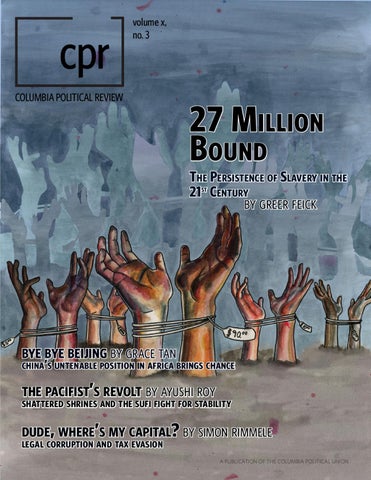
27 MILLION BOUND
THE PERSISTENCE OF SLAVERY IN THE 21ST CENTURY BY GREER FEICK
BYE BYE BEIJING BY GRACE TAN CHINA’S UNTENABLE POSITION IN AFRICA BRINGS CHANCE THE PACIFIST’S REVOLT BY AYUSHI ROY
SHATTERED SHRINES AND THE SUFI FIGHT FOR STABILITY
DUDE, WHERE’S MY CAPITAL? BY SIMON RIMMELE LEGAL CORRUPTION AND TAX EVASION
A PUBLICATION OF THE COLUMBIA POLITICAL UNION March 2011
1
cpr
volume x, no. 3
Editor-in-Chief
Mark Hay
Publisher
Iman Nanji
Managing Editors
Senior Editors
Arts Editor Staff Artists
Copy Chief
Pooja Reddy Ethan Wong Greer Feick Shane Ferro Puya Gerami Tommy Hill Leslie Huang Sarah Ngu Narayan Subramanian Anne Park Weihui Lu Stephanie Mannheim Ian Marshall Mary Claire Nemeth Cindy Pan Amalia Rinehart Igor Simic Hannah Laymon
Assistant Copy Editors
Ayushi roy Taylor Thompson
Layout Editor
Megan McGregor
Web Editor
Cindy Zhang
Editor’s Note I’ve taken up an old habit again recently—I’ve found someone on this campus to play a good round of billiards with (or pool, or snooker, or what have you). And it has been the most enlightening experience of my recent collegiate career. Humor me here, friends, and read along. Writing is a limited medium: we can only present a singular strain at a time for the sake of coherency, clarity, focus, development and a thousand other things my editors scream at me when I indulge a sickening predilection for tangents. So what do we accomplish with this magazine? When we are so limited by space and time, when we can’t publish everything that deserves to have its time in the sun, when we can’t even present every facet of one side of an argument, much less a full debate—what purpose do we serve and why should you care to read our works at all? Our use is in our infuriating limitation. I read articles and I get downright pissed at the writer for failing to explore a facet of the issue. I whine and moan about it to anyone who will listen to me. Very few of them will engage me, but the presentation of an issue in one light without much of a chance for engagement does get me ranting and raving, and that is a start. But all of that pent up rage and opinion (and I have a lot of it) just goes to waste. Well, usually it goes to yelling at the TV show I’m watching alone in my room on a Saturday night, so not quite a waste—perhaps worse. And it’s in part, I suspect, because we’re bowling alone. That’s right, I’m referencing that ubiquitous Robert Putnam schlock almost all of us have to read at one point or another here, the argument that the loss of civil society leads us to be less informed, less democratically active citizens. But it’s true— though we spend a good deal of time together, and though most of us are very socially involved, we’ve formalized so much of our leisure. It’s harder to just rand away with people, and even harder at this place, sometimes, to find people willing to be more than just echo chambers or sounding boards for your moanings and groanings. And this is why I like my billiards buddy. While taking a shot, we jabber on about this and that, and we can jabber about almost anything. There’s no ordering, no prescribed actions or topics, and, brilliantly, we disagree on many things In a class or a club, it’s at times hard for me to have a good argument, to find someone crass and opinionated and uninhibited enough to really go at it with. But I can fight with my billiards buddy, get my ass whipped in a game of eight ball as well as in an argument, and in the respect I have for her as a player—not an opponent but just someone I enjoy being around—I take her dissenting views seriously. And I bring up these articles at times. We fight, and I provide the point-counterpoint that I felt so conspicuously missing in the articles. So that is our purpose. We are a fuel, sometimes to stoke the fires of your own opinions, but more often than not, I should hope, to light a fire under your ass to rage and rant about how wrong we are. About how wrong Greer Feick is about the way to end slavery (6) or how wrong Simon Rimmele is about the evils of tax havens (28). And it is my hope that you’ll take the rage with you when you “go bowling,” or what have you, that you’ll bring us in your mind, into your casual conversations, and gain something more, something intangibly but significantly different than you could through class discussion by it. In summary, I hope this issue pisses you off. And I hope you run your mouth off about it over a beer and a good bar game. And I hope you love every minute of it. Mark Hay Editor-in-Chief
2
COLUMBIA POLITICAL REVIEW cpreview.org
MARCH.2011 table of contents humor 4
features | national HR-666, The Tea Party Demands
19
By Nina Pedrad
By Mingming Feng
cover story 6
27 Million Bound The Persistence of Slavery in the 21st Century
22
features | international
13
Evolution and Revolution Pan-Arabism and the Modern Arab Protests
interview 24
A New Currency for Climate Change A Conversation with Bill McKibben
By Hadi Elzayn
modest proposal
Bye Bye Beijing China’s Untenable Position in Africa Brings Chance
28
By Grace Tan 16
Of Anchor Babies and Welfare Queens Immigration as a Women’s Issue By Ivette Sanchez
By Greer Feick
10
Made in the U.S.A. A Proxy War on Gay Rights in Uganda
Dude, Where My Capital? Legal Coruption and Tax Evasion By Simon Rimmele
The Pacifist’s Revolt Shattered Shrines and the Sufi Fight for Stability By Ayushi Roy
COVER ART BY AMALIA RINEHART March 2011
3
HR-666, THE TEA PARTY DEMANDS By Nina Pedrad
We, the members of the Congressional Tea Party caucus, present our first formal list of demands, which we will soon introduce on the floor as HR-666. Our nation is in peril and for it we can no longer stand. We face mounting debts at the state and national level, we have government entering every home, school and church in America, and we need change. Not the change that we got in 2008. A different change. A change that is less about change and more about tradition. A return to the unchanged. OUR DEMANDS: Guns Whereby the Second Amendment gives us the right to bear arms, be they Uzi or semi-automatic, we resolve that we have an inalienable right to have a room full of any kind of guns we want (see Article I of the Constitution, the Cheney Pantry clause). Furthermore, we want Hummers to be made again, we want to place our guns on top of them, and we want to drive them down local roads and boulevards (Everyman Rambo clause, also Article I). That is our right. It’s in the Constitution. It’s there—feel free to look it up. Furthermore, we’d like to expand the reach of the Second Amendment so that all Americans may purchase a gun at any time, anywhere, without any purpose. There’s no reason why a sharp four-year-old boy needs to face age discrimination when trying to purchase a rifle in the 21st century. God Whereby we are one nation under God, we resolve to institute a national prayer law. If we do not pray to Jesus, our Lord, every day, as it says to do in the Constitution, we will burn in hell along with atheists and Jews. But we’d like people of the Jewish faith to pray with us because they are the gatekeepers. And we’d like to take this time to express our never-ending support for the state of Israel. We propose that such a law be instituted at previously existing government outposts like the DMV or post office, to save taxpayers the additional cost of building 4
COLUMBIA POLITICAL REVIEW cpreview.org
district prayer offices. Now we may exalt our God when He deserves it the most, before bureaucratic transactions. The Constitution Whereby the Constitution is the legislative foundation of this great nation, we resolve to celebrate it in every facet of American life, all XXII Articles and accompanying graphs. We want it read in classrooms, at the beginning of every legislative meeting. We want it read in full, in its entirety, in original form. Every day. We want it on the ticker of every news station. We want it to be liked on The Facebook. We want it to sponsor every entertainment or sporting event in America, including but not limited to food competitions. We endorse any means necessary to spread the messages inherent in that 54page papyrus Genesis, because we know the men and women and children that slaved for twenty years crossing the Atlantic on the Queen Mary to write that Constitution by moonlight
[humor] Stop It Just stop it. Everyone’s doing a lot of stuff, causing a lot of ruckus, so we just want people to Stop It. Families We want a return to traditional family values. That means parents handling the parenting instead of child protective services entering a home and disrupting a perfectly good chicken dinner to take a scotch-loving man from his children because of a fistful of mishaps. Whether it’s drug use or domestic violence, it stays in the home. That also goes for poor families—the government will no longer be galloping into their shanty Obamaville tenements with a welfare check and a box of Russell Stovers. The huddled masses must find time when they’re not working overtime to pick themselves up by their own tattered bootstraps, should they be lucky enough to own boots. Enough Already We’ve had enough, so, see above: Stop It.
(because there was no sun in those days) deserve to have their document read aloud. After all, that’s how it was documented— orally. Any Texas or Virginia American history textbook can tell the layman that. Smaller Government Whereby government has swollen to an unmanageable size, we resolve to institute dramatic and far-reaching slash and burn policies, or our great nation will be slashed and burned. We propose cuts in social programs, education, Medicaid and Medicare. We also propose cuts in pensions, foreign aid and domestic aid. We also propose cuts in environment planning, the space program, and social security. We also propose cuts in agriculture, justice, transportation and urban development. We do not propose cuts in defense, national security or spending to promote defense at NASCAR. That is our inalienable right, and it’s written in the Constitution. Article XVI. It’s right in there, so don’t bother reading it.
Gays We don’t understand them. We want them to write a list of their practice, meet us in a field and hand them to us. The field has to be neutral, a neutral location. Why do they favor certain colors over others and how did they train fairies? Similarly, what is the significance of rainbows in their culture, and are Lucky Charms the homosexual cereal? Additionally, what kind of weaponry does gaydar detect and does the army have access to such intelligence? Furthermore, in what states are their “closets” located? Are they like terror cells? Is there a head of their closets? What is the signal Illustration by for their leader to tell them to exit it? Is the Anne Park coming out party like a quinceañera? Why do they dance and sing? What happened to Jack’s arc in the final season of Will & Grace? We need these questions and many more to be answered. Lattes They are un-American and should be banned. Horse milk and crack laced with Pabst Blue Ribbon and Smarties have been sold in liberal coffee houses across America right under the FDA’s nose. Disgusting. For more on the FDA, see below. Abolish Everything This one is pretty much common sense.
Nina Pedrad (CC ‘11) is double concentrating in History and Political Science. She peaked in middle school, and it’s been an inevitable decline ever since. March 2011
5
27 MILLION BOUND The Persistence of Slavery in the 21st Century
“Tario was kept in leg irons during slavery. [...]”
By Greer Feick
In July 2009, President Barack Obama made his first presidential visit to sub-Saharan Africa and took his wife and daughters to the Cape Coast Castle, a ghostly whitewashed fort in Ghana that was used to hold and ship Africans to the Americas during the time of the Atlantic slave trade. In an interview with Anderson Cooper, Obama compared visiting Cape Coast to visiting Birkenau: “The experience of slavery is like the experience of the Holocaust.” Obama explained that when he discussed slavery with his children, he emphasized that it is important to “use [these] extraordinary moments to widen the lens to focus on the issues of Darfur, the violence in the Congo, sexual violence and other instances of contemporary human cruelty.” Yet, Obama neglected to include the problem of slavery itself. In 2011, Slavery still has significant contemporary relevance because it still exists. Tragically, slavery is not a single historical moment that has been comfortably confined to the past. Today there are an estimated 27 million slaves globally, more than during the 350 years of the Atlantic slave trade. The stories that modern slaves have lived to tell are harrowing. Rambho Kumar, a 13year old boy in India, was forced to work 19 hours a day at a carpet loom. When his fingers bled from overwork, his owner would dip them into oil and light a match. At age 23, Beatrice Fernando, a woman from Sri Lanka, accepted a “job” in Leba-
6
COLUMBIA POLITICAL REVIEW cpreview.org
non, only to be forced into the house of an abusive employer who completely cut her off from the outside world. In Bucharest, a slave owner offered to sell one of his prostitutes, a young girl with Down syndrome in exchange for a used car. In Texas, a woman smuggled a 12-year-old Mexican girl across the border, with the promise of a “good education” in America. She was chained to a fence daily, made to do domestic service work, and was sexually abused with gardening tools. Slavery is illegal everywhere—finally banned in Saudi Arabia in 1962 and in Mauritania in 1981. There are now over 300 international treaties outlawing slavery. However, the institution of slavery still exists everywhere, not just in the places where it was recently abolished. How is this possible, and what can we do to end it? Defining Modern Slavery One of the biggest challenges in the fight against modern slavery is arguing that modern slavery is still slavery. Kevin Bales, the world’s expert on contemporary slavery and president of Free the Slaves, has defined slavery as a situation in which an individual is forced to work
without pay under the threat of violence. Bales has used this definition to consult on the International Labor Organization’s statistics on slavery, and to independently conclude that there are currently over 27 million people in bondage. The historical memory of the term slavery poses a unique hurdle in the present-day fight against it. Contemporary slavery is often qualified as “modern slavery” or “borderline slavery” or “forced labor” or “human trafficking,” in order to separate it linguistically from the historical memory of the Atlantic slave trade when Africans were shipped en masse to the New World. U.S. Ambassador John Miller, former Director of the Office to Monitor and Combat Trafficking in Persons, has explained that these new terms have an “anesthetic effect,” and he calls the phrase human trafficking “bloodless” and “bureaucratic.” As Miller explains, today’s slaves are not usually carted off in chains, and the shipment and transaction process is different from the Atlantic slave trade, but contemporary slaves still endure the same oppressive conditions as historical slaves. The first important step in the fight against slavery is a careful “verbal inflation” of the word slavery to
[cover story] refer to present-day atrocities. It should be used narrowly (low-paying jobs that people accept voluntarily are not slavery, and calling these conditions slavery is insulting to the hardships that millions of Africans endured during the Atlantic slave trade) and purposefully (to help ordinary citizens realize how devastating the situation still is so that they can pressure their governments to increase funding for anti-slavery research and policy). Reclaiming the word “slavery” will not end slavery by itself, but it is an important step creating rhetorical campaigns that can be used to inspire large-scale change. If we rightfully accept that modern slavery is slavery, the contemporary situation contains all the horrors that the name implies. Today’s slaves are from a variety of ethnic and national backgrounds, with no unifying racial identity. There are now at least 17,500 slaves in the U.S., and there may be up to 50,000. There are an estimated 10 million slaves in India, where historical conventions of “debt bondage” have resulted in conditions where millions of people are forced to work without pay and subjected to violence. There are also significant numbers of slaves in Africa and Latin America. 80 percent of slaves are female and are forced to work in domestic labor or prostitution, and a large percentage of slaves are children. Because slavery is illegal, the trade is often conducted through networks of organized crime. However, in Haiti antislavery laws are so little enforced that according to journalist Ben Skinner, the
sale of children in slave markets occurs in public and in broad daylight. Today’s slaves are also, arguably, more expendable than at any time in history. Using historical data to look at slavery throughout the Atlantic slave trade, Bales concluded that when owning a slave was a “status symbol,” during the years of the Atlantic slave trade, the average price of a slave was $40,000, adjusted to today’s currency, and a slave represented a significant investment. Today, the average price of a slave on the world market is $90. In North America, a slave can range between $3,000 and $8,000, and in India and Nepal, slaves are a mere five to ten dollars. While at one time you had to pay the equivalent of a year’s tuition at Columbia University to get a slave, now you can buy a human being for the price of a Starbucks coffee. According to Bales, “People have stopped being capital and have become like a Styrofoam cup. You buy them cheaply, you use them up, and when you’re done, you throw them away.” The Modern Fight Against Slavery In the 1990s, the seeds of a new abolitionist movement were sown. The end of the Cold War and the drastic economic liberalization of Eastern Europe brought more visibility to the issue of human trafficking across the borders of new postSoviet states. Pioneering academics like Bales, who was a sociology professor at Roehampton University in London at the time, developed the methodology to “count” modern slaves. At the very end of
the Clinton administration, the U.S. government passed its first comprehensive anti-slavery law, the Trafficking Victims Protection Act of 2000 (HR 3244), which strengthened existing trafficking laws in the United States by defining minimum standards for enforcement and focused on “protection, prevention, and prosecution.” Under the TVPA, the U.S. government had the authority to rank countries based on their efforts to eliminate slavery. Three months on a low “Tier Three” ranking could result in economic sanctions. During the first term of the Bush administration, “anti-slavery” became a priority of the religious right, in part because of the moral issues associated with slavery. Michael Horowitz became a passionate advocate for increased U.S. government funding for policies that would fight international sex slavery—a focus that brought attention to slavery but limited the scope of the anti-slavery movement by focusing on just one aspect of the problem. John Miller, a former Republican congressman and human trafficking ambassador for the U.S. State Department, worked tirelessly to increase U.S. funding for anti-slavery efforts. Provisions in the 2000 TVPA were strengthened in 2003 and again in 2007 to create border shelters for trafficking victims and to coordinate trafficking media alerts. Ben Skinner has pointed out that these policies were important policy steps, and he even claims that because of this legislation, “George Bush freed more slaves than any other U.S. president,” but
“The rice paddies of the Ganges River Delta are a trafficking hotspot. Lured by false promises of good jobs, impoverished villagers send family members to Indian cities to earn money. Many discover it’s a slave trap.” March 2011
7
that during the second term of the Bush administration, anti-slavery became less of a priority as the religious right began to focus on other issues, like gay marriage. So far, President Obama’s attention to slavery has been lackluster. In 2008, Rick Warren pressured Obama to put an end to modern slavery, and Obama agreed it was a “top priority.” To date, Obama has made several prudent appointments; Luis CdeBaca, who was instrumental in crafting Clinton’s approach to the Trafficking Victims Protection Act, and Hillary Clinton, who has strongly supported anti-slavery legislation for over a decade. In 2010, Clinton approached the president’s cabinet and called for a re-definition of trafficking: “Let’s call it what it is, a modern form of slavery.” Nevertheless, Obama’s anti-slavery commitment could be much stronger. Even if the Obama administration has officially begun to use the term “modern slavery,” the issue is still not a priority and is rarely mentioned in press conferences or speeches. Funding for anti-slavery has been stagnant over the last three years. Skinner has suggested that the recession affected funding because government resources were directed mainly towards job creation and economic development policies in the United States. Despite the recent achievements of the TVPA and its successors, the U.S. gov-
ernment is just in the beginning stages of coordinating effective anti-slavery action. By way of comparison, we are much farther along in the fight against “drug trafficking” than we are in the fight against slavery. The statistics on drug trafficking are more comprehensive—drug trafficking information is organized in multidimensional databases that look at the entire value-added chain. Similar data has not yet been collected on the scope of slavery. Part of this is politics—the Indian government is adamant that the number of slaves in their country is 10 million fewer than what researchers estimate. The other reason relates to resources— drug trafficking has received more funding. The amount that the American government spends each day in policing drug trafficking ($10 million) is equivalent to the annual budget of the State Department’s human trafficking department. Compiling more comprehensive statistics on slavery is crucial. We need to know exactly where to concentrate our efforts. Ironically, though the United States is leading the developed world on antislavery policy (however, it is worth noting that there are important anti-slavery initiatives in other countries, including the Anti-Slavery International NGO in Britain). American persistence would be instrumental in convincing the governments of developing countries to implement stricter anti-slavery policies. For
“Sina consoles survivors like Pross Long, whose eye was gouged out by a brothel owner.”
8
COLUMBIA POLITICAL REVIEW cpreview.org
example, in March 2006, John Miller tried to pressure the Bush administration to demote India —the country with one of the highest numbers of slaves in the world—to a “Tier Three” in the hierarchy of anti-slavery countries and to vote against India’s development requests to the World Bank. Condoleezza Rice refused the proposal, but the initial pressure was an important starting point. The US State Department estimates that there are over 2 million sex slaves in India, but the Indian government has not reported a single sex slavery conviction. The Indian government has increased border controls, but Indian policy makes it abundantly clear that anti-slavery policy is not a priority. Skeptics might argue that the sad truth of international politics is that it is often pragmatic to value strategic alliances over humanitarian concerns, no matter how tragic a human rights issue like slavery may be. However, the greatest lesson to be learned from the recent protests in the Middle East is that in 2011, it is nïave to underestimate the strength of liberal democratic idealism or the desire of ordinary citizens for fundamental social change. The anti-slavery cause benefits from the fact that every country in the world has already declared slavery illegal, and has agreed that it is wrong. It is time for the United States to use its clout—as the world’s superpower and as a country with its own tragic history of slavery—to nudge developing countries toward living up to agreements and laws they have already signed. Notwithstanding the heroic efforts of a handful of individuals, on the grassroots level, the modern anti-slavery movement in America is still severly limited. Free the Slaves is the leading American anti-slavery organization. While their work is admirable, the anti-slavery movement could benefit from additional perspectives and greater collaboration with other human rights organizations, including the American Civil Liberties
[cover story] Union, Amnesty International, UNICEF and Human Rights Watch. These larger human rights organizations do focus on some slavery cases, but they often refer to them with the softer rhetoric of “trafficking” or “child labor.” Part of the reason for the limited accomplishments in modern abolitionism, is the fact that the movement has also not successfully penetrated the mainstream American consciousness. There have been several recent artistic depictions of contemporary slavery, such as the “Florida Modern Slavery Museum,” a cargo truck with exhibits on slavery that tours the country. In the fall of 2010, the National Underground Railroad Freedom Center in Cincinnati curated an exhibit on modern slavery, and it was reviewed in the New York Times. Former slaves from India and Africa give speaking tours across the country. However, the reach of these important public awareness campaigns is relatively small. The fight against slavery has not yet resonated with Hollywood yet, where a great potential for mainstream exposure lies. There have been no blockbuster documentaries on contemporary slavery along the lines of Fahrenheit 911 or Inconvenient Truth. American movies, like the film Taken, starring Liam Neeson, which is about a beautiful American tourist who is sold into sex slavery, often just reinforce stereotypes. Kevin Bales has argued that the modern anti-slavery movement could use a new Uncle Tom’s Cabin to bring awareness to the problem. Bales notes that “the point of great literature is that it’s not about the social issue. War and Peace is not about war and peace, but the families caught up in the issues of war and peace. Uncle Tom’s Cabin is not about slavery, it’s about the families that are ripped apart by slavery. No one has grasped that difference today in popular culture.” Whether books are still capable of packing the same punch is debatable, but one killer book endorsed by Oprah’s Book Club that captures the essence of the slave experience could go a long way. How to End Slavery On a government level here in the U.S., there is a need for a more coordinated, dare we say bipartisan, response to the issue, and there is a desperate need for increased funding. We need to pres-
sure our government to more rigorously enforce existing anti-trafficking and anti-slavery legislation. We can also learn from some successful international models. Even though company-based slavery is just one part of the problem, we can tighten controls to eliminate slavery in economic production. There is a very successful pilot program in Brazil, where the government investigates and rates each step of the supply chain in key industries with just this in mind. Any company found using slave labor is subject to a fierce public relations campaign to destroy its business. Creating this sort of oversight would be instrumental in engaging Western consumer power. This is approach is currently being tested in California, with the “California Transparency in Supply Chains Act of 2010” (CA SB 657), which aims to eliminate slavery from any step of the production process in the state. The good news is that the cost of ending slavery is relatively cheap. Bales has estimated the average cost of liberating a single slave at $400, which includes all costs of a comprehensive and “sustainable freedom,” with medical care and job training. In India, it costs only $150 to liberate a family of four. Globally, this means that $10.8 billion, combined with more rigorous enforcement of existing international anti-trafficking laws, would be enough to liberate every slave on the planet. Harnessing the energy of micro-finance would be a boon to the modern abolitionist movement. There are effective abolitionist organizations to partner with. Free the Slaves focuses on empowering villages to eradicate slavery and diligently evaluates on-the-ground partners, to ensure effectiveness. Free the Slaves partners literally knock down doors to help slaves escape from bondage in the developing world. We all have the opportunity to be part of the fight—working to increase awareness of this pressing human rights issue and transforming awareness into concrete action. Bales suggests that “the fundamental need of the movement is two things: increased public awareness and resources. It’s cyclical.” According to Bales, it is within the scope of our capabilities as individuals to advance these goals. So far, the anti-slavery movement has not used social media effectively. Of course, online activism should be
approached with caveats. As Malcolm Gladwell rightly argued in a recent New Yorker article on activism, social change cannot happen without a sustained commitment. Gladwell points out that “the Facebook page of the Save Darfur Coalition has 1,282,339 members, who have donated an average of nine cents apiece… Facebook activism succeeds not by motivating people to make a real sacrifice but by motivating them to do the things that people do when they are not motivated enough to make a real sacrifice.” At the same time, public awareness of slavery is so minimal that even Facebook-level awareness of slavery would be a step in the right direction to foster a greater political will. In some cases, too, online organizing has had remarkable results—the Obama campaign set a precedent for successful online organizing, and the anti-slavery movement could benefit from finding its own Chris Hughes. International microfinance has also proven that individuals can make a phenomenal difference. If, by 2006, ordinary citizens were able to provide over $25 billion in small loans to entrepreneurs in developing countries, the same can be done to fight slavery. A small donation to an anti-slavery organization is not insignificant if all it takes is $150 to provide the infrastructural support to free a human being and also to give them the launch-pad to a secure economic future. The American abolitionist Frederick Douglass once said, “No man can put a chain about the ankle of his fellow man without at last finding the other end fastened about his own neck.” Even if we are not directly affected by slavery on a dayto-day basis, at a basic level, if we live in a world where slavery is still allowed to flourish, what is the value of our own liberty? Slavery is one of the most pressing human rights issues of our generation, and we could be the generation to finally end it.
Greer Feick, CC ’11, is a history major and art history concentrator. She developed an interest in modern slavery when she coordinated student fundraising initiatives to support street children in Colombia. She is writing her senior thesis on the League of Nations investigation of slavery in Liberia. She can be reached at gcf2106@columbia.edu March 2011
9
EVOLUTION AND REVOLUTION
Pan-Arabism and the Modern Arab Protests By Hadi Elzayn
The age of the Arab dictator is over. The current wave of unrest sweeping the Middle East has deposed two dictators, spilt much blood and fundamentally shaken the status quo. Already, the movement that began with a few street demonstrations in Tunis has led to a regime change in Egypt and threatens to overthrow the monarchy in Bahrain, a military regime in Libya, a dictatorship in Yemen and many other governments throughout the region. What could possibly have caused this stunning political shockwave across the Arab world? One popular explanation is the resurrection of pan-Arabism. Pan-Arabism, in the original sense of the term, rose to prominence during the Cold War as a brief glimmer of hope in the short period between the nascent postindependence era (when artificial national identities first began to be constructed) and the current era of unipolarity. Modern Arab philosophy and literature were instrumental in the development of this ideology. Significantly, the first real pan-Arab ideology, Ba’athism, was largely secular, although not atheistic, and rooted in French revolutionary rhetoric and Marxist theory. The core founders of this movement included Christians as well as Muslims, and the movement was not driven so much by uniform religious concerns as by a common identity that considered Arabs from Morocco to Iraq to be one people with a shared history, language, culture and political interest. They saw the Arab people as a civilization that had suffered from a steady but temporary decline since the Golden Age, a decline explained by exter-
10
COLUMBIA POLITICAL REVIEW cpreview.org
nal forces like colonialism. The solution was a unified, socialist Arab nation with strong leadership at the helm and a populace willing to sacrifice everything for the good of the state. This dream was entertained by millions, and it was this emotion that propelled personality cult leaders like Egyptian President Abdel Nasser to rule while Arab governments began to play power politics between the U.S. and the USSR. The recent events in the Middle East signal a resurrection of pan-Arabism. However, this neo-Arabism, intertwined with the core motivations of these related revolutions, is not the same political ideology that gripped the Arab world during the 1950s. Although the present movement is influenced by the optimistic empowerment latently in pan-Arabist thought, in a variety of important ways, it represents the fundamental maturation of the political consciousness of the Arab people. Significantly, the neo-Arabism animating popular movements in the region has been born out of the collective despair, political repression and social misery shared by the Arab majority. This shared consciousness has galvanized uprisings that demand the end of state tyranny and the introduction of transparent, open democracy (though perhaps not the liberal democratic model used in the West). NeoArabism is certainly not a codified dogma or theory, nor should it be—the Arabs have only seen such ideas betray them. Rather, neo-Arabism represents a renewed confidence among the Arab people in their determination to dismantle oppressive
political regimes. In order to understand recent events and to formulate a rational, comprehensive U.S. foreign policy with respect to these democratic uprisings, we must dissect this new, nuanced pan-Arabism and the central motivations of these young revolutionaries. A taste of history is essential in appreciating the magnitude of this momentous shift in Arab politics. For many Americans, the first salient experience of the Arab and Muslim world came through the shocking images of smoke billowing from landmarks that were seen as symbols of freedom, modernity, and the triumph of democracy on September 11, 2001. Since then, the consequent stream of conflict in the Middle East has fomented enormous anger among the people of the Arab world, adding to the resentment that had already existed. To a passive Western outsider looking at the Arab regimes and the systematic subjugation of their peoples, the brutality and futility of violent terrorism, and the persistence of social ills and norms far removed from their own, it may have seemed that Arabs were irrational or unprepared for democracy. But history stretches back far beyond 2001 and proves that the currents of history are everywhere driven as much by emotion as they are by pure reason. Much has been written about the role of pride in the apparently monolithic Arab culture, as if it were some anomalous force whose existence exceptionally defied the laws of nature. It is true that pride has played a role in the Arab psyche, but to criticize the Arabs for this—when American exceptionalism has guided U.S. for-
[features] eign policy for centuries—smacks not only of racism but also of irrelevance. What is important to understand about the Arab people is not their pervasive pride but their present condition of despair. It is the collective despair of a people who have been reduced from heights of wealth and knowledge to live in inequitable presentday societies in which rulers squander the countries’ resources while the majority wallows in squalor and poverty. After the Golden Age, which lasted until the mid-13th century C.E., the Middle East was subjected to invader after invader, from the Mongols and Ottomans to the colonial British and French empires. After the partition of the Ottoman Empire, the artificial lines carved in the sand by Orientalist mapmakers during the early twentieth century formed the basis for modern nation-states cutting across geographic boundaries, religious cleavages and ethnic and tribal enmities to impose a foreign political concept on a people who were not accustomed to this organizational model. In addition, the establishment of Israel resulted in the displacement of hundreds of thousands of people and endless conflict. Most frustrating was the hypocrisy of Western rhetoric: When corrupt generals or vicious tyrants seized control of these invented states from their colonial occupiers, the West called for de-
mocracy and human rights. When experiments in democracy were conducted and human rights respected, however, the U.S. overthrew those with whom it disagreed and replaced them with well-funded dictatorships. During the mid-twentieth century, pan-Arabist governments attempting to establish regional unity and break free from external power faced numerous challenges and obstacles. All attempts at transnational union failed under the weight of competing domestic and international interests. In turn, optimistic expectations allowed autocratic leaders to manipulate the Arab people and stifled dissent in the name of patriotism and pan-Arabism, and the Orwellian regimes that existed across the region deflected the responsibility of solving internal problems through rhetoric aimed at blaming external enemies. Even now, brutal tyrants and kleptocrats continue to enrich themselves while blaming the poverty of their people on the U.S., Israel and the West. For decades, this approach allowed these dictators to successfully avoid true accountability. As Rashid Khalidi, the Edward Said Professor of Modern Arab Studies at Columbia University, has previously argued, the idea of a broad-based unity between Arab countries based on a unified popular culture and shared set of interests was
shattered by the failures of the past, the repeated and humiliating defeats in wars with Israel, crushing and sustained poverty, and, finally, the squabbling and irreconcilable divisions that caused each of the regional unions to collapse. Then, the only real unity that existed beyond an official language was the uniform presence of secret police. These feared intelligence agencies, known as the Mukhabarat, operate under the aegis of almost every Arab regime and are infamous for their role in committing human rights violations, instilling fear of neighbors and friends and repressing any hints of public dissent. While state television stations portray glimmering images of beloved leaders and foment personality cults by indoctrinating younger generations, free-thinkers are tortured by the hammer and electrode and the masses wallow in poverty. But strikingly, such leaders seem to know that their stability depends on the integrity of this system as a whole. When Tunisia’s Zine El Abidine Ben Ali fell, Libya’s Muammar Gaddafi and Egypt’s Hosni Mubarak both condemned the people’s revolution as a shortsighted mistake. Mubarak did everything in his power to prevent the loss of international and internal support: releasing prisoners to attack people on the streets, encouraging supporters to systematically
Illustration by Marie Claire Nemeth
March 2011
11
target foreign journalists and portraying the Muslim Brotherhood as an organized, powerful and dangerous fundamentalist group. This fictitious specter has been demolished even in the fundamentalist-wary West, where President Obama’s Director of National Intelligence James Clapper called the Muslim Brotherhood a “heterogeneous group” with a “largely secular” political agenda, which has “eschewed violence and decried Al Qaeda.” This condition of repression and despair is no longer sustainable: the universally shared experience of the popular majority is building the basis of a new form of pan-Arabism. This fundamental experience of alienation from their own governments and subjugation by foreign powers, coupled with the vast inequality both within civil society and relative to the developed world, has produced longfestering discontent. According to Juan Cole, a historian specializing in the modern Middle East, the actual revolutions were sparked by current economic conditions, while Mona El-Ghobashy, assistant professor of political science at Barnard College, characterizes the protests as a response to increasing levels of political corruption and oppression. In the era of mass communication, satellite television and the internet, this discontent was translated into the realization that a better system could exist. While it is important to emphasize the grassroots nature of the movements in the Middle East, it is equally important to emphasize that they were initiated by Arabs and are in conformity with Arab, as opposed to Western, free-market, liberal democratic ideology. The fact that the West provided inspiration for slogans such as “a’ish, hurriya, karama insaniya,” or “bread, freedom, human dignity,” certainly should be recognized. All across the Middle East, the most important demands were political freedom and economic security, and both are important to the educated, intellectual classes who are tired of the corruption and the silencing of dissent, as well as the extreme poor, who have also suffered from the crushing pains of hunger and deprivation. The old, failed tactics of violent revolution were rejected in favor of peaceful protest, civil disobedience and million-man marches that, in the end, proved far more powerful than guns, bullets and the tactics of fear and division that had been used by the secret police.
12
COLUMBIA POLITICAL REVIEW cpreview.org
Mass media, from satellite television and mobile phones to Twitter and Facebook, were used to coordinate and fuel the youth-centered revolution. Without the seeming strength of centralized leadership, there was no one to assassinate, nor anyone with whom to negotiatie and reach an early settlement. Thus, the protests retained a momentum that was impossible to stop. After Ben Ali fell, few expected the discontent to spread substantially, yet already the idea that an Arab nation could successfully overthrow an entrenched tyrant had been conceived. After Egypt, the traditional leader of the Arab world, deposed its dictator, the real power of the movement was unleashed. Revolts in Yemen, Libya and Bahrain currently seem to pose real threats to the legitimacy and existence of the current regimes. The regional protests demonstrated the belief that if one Arab nation could do it, all Arab nations could. And the tyrants who learned from Mubarak have realized that it is the beginning of the end. Already, the fact that it took a matter of a few weeks to overthrow these dictators, often using little more than non-violent protest methods, has shown that the fall of these tyrants is inevitable. Just as weeds may regrow until excised from the roots, these old regimes will require more than just the overthrow of their current dictators. But the resignation of Tunisian Prime Minister Mohamed Ghannouchi and the amendments to the Egyptian constitution that enforces presidential term limits and judicial oversight of elections show that progress is being made. It will take time to eestablish a democracy, and they may not necessarily look like the completely secular, freemarket liberal democracy employed in the West. Democracies in the Arab world likely will not follow American policy prescriptions as they had before and will not allow the U.S. and Israel to enforce their political interests. But in any event, the principles of human rights and freedom of expression are now flourishing, and the tide can never be turned back. What, then, is the sum of neo-Arabism? The common strain animating popular discontent now is the notion that all Arabs are as capable and as potent as their counterparts in other countries and that they, like their brothers and sisters, will soon see their demands met. It is cou-
pled with a feeling of unity founded in the shared values of liberation, empowerment, freedom, and a general sense of goodwill. It lies in the demands for freedoms: the freedom of press, peaceful assembly, the freedom to vote and the right to form political parties—ironically, the same values that Americans were told their foreign enemies hated. It is not an idealistic or impractical movement for a centralized, politically unified rule over a vast group of nations, but rather a reasonable expectation of national and popular self-determination. If there is ever again an attempt at an Arab Union, it may look similar to the European Union today, grounded both on a common Arab identity and a sense of political pragmatism. Neo-Arabism is not driven by an attempt to gain sectarian advantage, but is steeped instead in pluralism, as peace and nondiscrimination benefit all. In fact, as Jean-Pierre Filiu, Gilles Kepel’s Middle East chair at Paris, argues, the success of a democratic alternative undermines any attempts at religious interference in politics. The Arab states may not begin democratic representation tomorrow, but the struggle for democracy, and the neo-Arab unity behind it, warrants the support of the United States, not only to atone for its past sins in supporting a number of dictatorships in the Middle East but also to ensure that this hopeful movement bears the fruit of democracy and freedom for the whole region. Never again will any leader forget what happened in Tunis and Cairo, Alexandria and Aqaba, Manama and Sana’a, Benghazi and Algiers. The sun is rising over the Arab world. After decades of political repression and draconian rule, the popular majority, armed with a sense of collective agency, is successfully dismantling one dictatorship after another across the region. The systems of hereditary rule, lifelong presidential terms, personality cults and organized repression are falling before the power of popular democratic organization. Out of the ashes of a shared misery, neo-Arabism has emerged as a renewed beacon of empowerment and political hope for the people, and for the first time in decades, the Arab future seems bright. Hadi Elzayn, CC ’13, is an economicsmathematics major. He is also an undergraduate scholar at the Institute for Social and Economic Research and Policy. He can be reached at hse2102@columbia.edu.
[features]
BYE BYE BEIJING
China’s Untenable Position in Africa Brings Chance By Grace Tan
China’s recent activity in Africa goes beyond the mere muscle-flexing and oilgrabbing tendencies of an emerging global power. In the last five years, media reports of China’s growing presence in Africa have increasingly reinforced and intensified Western fears of an unrestrainable imperialist state. Articles brandishing headlines such as “China’s Economic Invasion of Africa” and “Africa: China’s New Backyard” depict Africa as the victim of China’s rapacious neo-imperialism. The Chinese government, however, denies these allegations of political colonization, rallying behind the official Chinese Communist Party foreignpolicy slogan—“peaceful development.” Yet, contrary to the belief perpetuated by the mainstream media and Western states, Chinese influence in Africa is not likely to expand. And as the Chinese stay on the continent, perhaps starting to wane, the onus falls on African states to take advantage of the situation China’s “Five Principles of Peaceful Coexistence”—adopted in 1954 to mark the end of Sino-Indian disputes—clearly, but carefully states its intentions to support “sovereignty and territorial integrity, mutual non-aggression, and non-interference in [other countries’] internal affairs”. Broadening the Five Principles to apply to general international engagements, China largely uses its official foreign policy stance as a veil to justify questionable activities and dealmaking in Africa. The policy’s explicit lack of an ideological agenda is an adept move allowing China to operate without appearing to directly challenge regional U.S. security interests, but also covertly promoting multi-polarity by endorsing sovereign rights for pariah states. Though China’s pronouncement of non-interference suggests that it merely intends to solidify trade
Power plant construction in Taiyuan http://www.flickr.com/photos/zilpho/
relations and consolidate its “One-China” support base, Western nations view China’s growing economic activity in Africa and its impact on the continent with unease. While swathed in assurances of “mutual development,” China’s foreign aid and economic policy is undeniably driven by its need for natural resources, with Chinese interests placed first and foremost and African concerns placed at a distant second. Already the world’s largest consumer of coal and steel, China increasingly depends on imported petroleum, aluminum, copper, and other raw commodities as its growing domestic consumer forces expand production. In the past 15 years, China’s mineral oil imports have more than quadrupled, with Africa supplying nearly one-third of China’s needs. China’s tremendous appetite for natural resources indicates and propagates its rapid economic growth. But as China pursues an extended relationship with Africa, China will find its long-term objectives challenged by the effects of irresponsible deal-making and exploitative policies. Resistance to Chinese expansion in Africa may present itself in a combination of three fronts: pressures from an unsupportive international community, unstable environments of extraction and Chinese domestic discontent.
Regardless of its intent or future, the Chinese system of foreign aid is currently progressive in its comprehensive approach. Spanning human resources development to generous debt repayment plans, China’s aid packages appear to have potential to animate African development. China’s low-interest, prescription-free loans do not necessitate the market liberalization requirements that the International Monetary Fund and the World Bank stipulate, which means that funds can be directed toward more project-based, rather than capacity-building, development objectives. China has built much-needed railroads and mobile telephone networks in Kenya, Rwanda and Nigeria with varying success. Sweetening its deals, China also allows its trading partners to side step transparency and good governance requirements, unlike those stipulated in Western-dominated international aid institutions. According to the Pew Global Attitudes Project, African governments have responded enthusiastically, with approval ratings for China and Chinese actions reaching 71 percent across Sub-Saharan Africa, compared to 43 percent in the Western bloc. However, China’s politically indiscriminate and, at times, nontransparent partnerships with pariah states have increasingly provoked protests March 2011
13
Thundersky/Winston batteries in Guangdong http://www.flickr.com/photos/zilpho/
from the international community and human rights organizations. Ultimately, China’s long-term objectives of trade expansion in Africa will be complicated, if not entirely subverted, by their short-term endeavors. An adroit massaging of its Five Principles conveniently justifies China’s operations within states heavily denounced for their human rights violations. China’s current relations with pariah regimes, such as those under Omar al-Bashir of Sudan and Robert Mugabe of Zimbabwe, visibly elicit dissatisfaction from organizations such as Human Rights Watch. China’s supplying of tanks, fighter planes, bombers, helicopters, and machine guns to Sudan’s Arab militia in Darfur chas sparked criticism from the United Nations.
14
COLUMBIA POLITICAL REVIEW cpreview.org
Though China has had ample experience operating outside of international norms, China’s increasing integration into the global economy will make it costly for the regime to extend its irresponsible economic collaborations. Furthermore, the United States is unlikely to watch idly while pariah regimes, propped up by Chinese aid, challenge its security and economic interests. For the time being, China seems prepared to weather damages to its reputation in the international community. Though the global community has, in a sense, patiently endured the idiosyncrasies of China’s foreign aid policy, there is little evidence that China will be able to continue its African policies in its current transgressive form uncontested.
Apart from eliciting international dissatisfaction, the strategy of peaceful development may ironically dismantle China’s natural resource projects in Africa, though it has largely allowed China to access regimes wary of liberal economic ideology and Western infringement on state sovereignty. China’s extractive activity depends on social and political stability, which enables the regular transport and production of resources. Though currently highly lucrative, China’s African policy will become increasingly difficult to sustain, as recurring civil instability provoked by pariah regimes disrupts the trading process. Other aspects of Chinese “goodwill” have also proven problematic, and even unapologetically damaging. Chinese construction companies and contractors displace workers by the hundreds of thousands by stipulating unfair quotas that predominantly employ Chinese laborers. Pledging agricultural and medical transfers, Chinese technicians and doctors often exclusively use Chinese products, which are largely unaffordable and unavailable in rural areas. Chinese products have also flooded African markets, outcompeting local manufacturers across the Sub-Saharan production sectors and monopolizing local consumer markets. Dominating African markets, cheaply made Chinese goods ranging from hardware to sundries make it difficult for African consumers to access high-quality local products. In practice, China’s policy exhibits a lack of sensitivity shocking to both international and local constituencies. China’s growing negative reputation in African states will, in the long run, fundamentally hamper its maneuverability in the continent’s industries and oil fields. Though news reports highlight the enthusiasm of “Africans” toward Chinese involvement, these reports almost exclusively refer to African governments and not the African populace. Dissatisfaction with inferior Chinese products and Chinese aid to pariah regimes effectively hinders civilian reform in social and political realms. Making little to no effort to curry favor with the African populace, China negotiates transactions with little concern of what effect their policies may produce in the civil sphere. Growing impatient with China’s backhanded policies, workers’ revolts against Chinese businesses in Zambia and Nigeria point towards a future of hostile and unproductive Sino-African relations. Ultimately, China’s
[features] dismissing attitude towards its African constituency may prove fatal for its trade interests. Looming domestic dissatisfaction in China with the government’s increasingly hefty foreign aid commitments also complicate China’s dilemma. While China’s growing middle class endures job insecurity, stagnant living standards and low wages, the Chinese government publicly pledges an extension of its African foreign aid to reach $10 billion in soft loans and grants in the near future. China’s preoccupation with advancing Sino-African relations will be increasingly interpreted as domestic negligence. Though China’s reserve of $2.5 trillion can easily sustain China’s global ventures, a resentful domestic population will likely demand that the Chinese government take care of its own constituencies before bolstering a foreign market for increased Chinese investment. As its citizens grow increasingly conscious of their own economic inequality, Beijing will be hard-pressed to continue its current African policy. China will be recalled to address domestic problems before advancing international engagements. While China will necessarily grapple with waning, or at least shifting, influence in Africa, African states are presented with a unique opportunity. Largely protected by Western counter interests and the hawkeyed supervision of international organizations, Africa is unlikely to be subject to
2006 China-Africa Forum in Beijing http://www.flickr.com/photos/jilldruschke/
Chinese imperialism, at least not the imperialism of historic tradition. Moreover, African states stand in a position to benefit from China’s presence in their communities if they can reappropriate Chinese development strategies and successfully negotiate trading terms to maneuver in a global capitalist economy. To Africa, China’s worth does not lie solely in its inclusive aid packages and infrastructure projects. Instead, the symbolic and historic Sino-African relationship possibly heralds prolonged gains for Africans by identifying a new conduit for economic growth. Sharing the same ideological transformation and accompanying developmental issues, China could act as a more viable model of development for African states than the highly formulaic, privatization- and liberalization-focused, top-down approach of the World Bank and the International Monetary Fund. Monitoring the modern Sino-African relationship from its launch in the early 1950s shows the correlation between Chinese and African economic growth. Surmounting similar socialist experiments and developmental roadblocks, China and many African states have exhibited impressive leaps in their yearly gross domestic product since their initial trading agreements. China’s approach of instituting citizenexchange programs, protectionist trade barriers and public-private sector partnerships, stands a better chance of creating
sustainable, autonomous trading and production institutions in Africa. By studying the Chinese model of development as an alternative to the West’s liberal “Washington Consensus” policies, African states can benefit from China’s similar experience in liberalizing its economy. Increased communication between African and Chinese governments could bring systematic, coordinated dissemination of technological and agricultural knowledge that would help production sectors across African states. Particularly, Chinese agricultural practices, revealed through studies conducted by the University of Stellenbosch in South Africa, have the potential to revolutionize African smallholder farming by introducing superior plant breeding techniques, specified fertilizers and drip-irrigation systems. By implementing Chinese research on plant genetics and soil composition and transferring agricultural technology, African states could dramatically improve food quality and harvest. Though China’s involvement in Africa is far from over and far from “mutually beneficial,” African states still stand to gain from China’s presence in the continent. Media reports dramatize China’s hold on the continent—China’s grip is neither pervasive nor absolute. However, the media’s sensationalizing of Sino-African relations inflicts the most damage—not through misinformation but through misconstruction. Exploiting the profitable trope of victimaggressor dynamism, reports illustrate an antagonistic China encroaching upon a passive Africa. This context effectively disenfranchises and demeans the African position, and perpetuates earlier debates of centrism and peripherialism. African states can possess a significant amount of control in its relationship with China. Before Africa can reclaim its position at the global negotiating table, dialogue surrounding SinoAfrican relations must not preemptively discount the African prerogative and the continent’s sovereignty. In anticipation of weakening Chinese influence, African governments and their constituencies would do best by capitalizing on this moment of informational and technological exchange and accepting Chinese aid with a cautious eye. Grace Tan, CC ‘11, is majoring in Political Science with a concentration in Middle Eastern, South Asian, and African Studies. March 2011
15
THE PACIFIST’S REVOLT Shattered Shrines and the Sufi Fight for Stability By Ayushi Roy
On October 7, 2010 the peace of the Sufi shrine in Karachi, a building with green and white mosaics ascending to a cupola, shattered in a double explosion from two suicide bombers, killing seven civilians and injuring 65 others. As the shrine’s tiles lay smashed in the street, the destroyed temple provided a visual symbol of a derelict Pakistani government torn apart by a new wave of violent domestic terrorism. Since 2005, militant organizations including the Pakistani Taliban and Lashkar-e-Islam have targeted the shrines of Sufi Saints in two provinces of North West Pakistan, Balochistan and Khyber Pakhtunkhwa. Since November 2010, Pakistan has witnessed a startling increase in the intensity of attacks on Sufi shrines throughout the country, striking popular shrines in urban areas at times when thousands of visitors were present. In less than three years, more than 6,000 people have been killed in nearly 200 explosions, the last attack as recent as February 3, 2011. This escalating violence has repercussions that extend far beyond even the lives tragically lost in the explosions—it has deepened the rift between different branches of Islam, which may spur a new wave of domestic anti-terrorism policy in Pakistan. While we often associate terrorism with violent attacks by Islamic extremists on Western states, predominantly Muslim states in the Middle East are just as vulnerable—terrorists often consider different Islamic sects to be just as foreign and heretical as the religions of the Western world. Recently, Sufi Muslims have become some of the hardest-hit victims of terrorism in Pakistan. As Dr. Peter Awn, professor of religion at Columbia University, explained, conservative Islamic
16
COLUMBIA POLITICAL REVIEW cpreview.org
sects see Sufism as a threat because of its acceptance of pluralism and its willingness to break down the barriers between multiple sects. The moderate, more flexible blend of Sufi Islam practiced by most Pakistanis challenges the strict traditionalist revivalism extolled by fundamentalists, such as the politically vocal minority Deobandi Sunni sect. Its adherents, including the Taliban and allied militant groups in both Afghanistan and Pakistan, follow a hard-line, Saudi-inspired version of Islam. Sufism heresy, especially because of the sect’s veneration of saints and its devotional singing and dancing, and militants have bombed dozens of Sufi shrines and killed hundreds of worshippers since 2005. Sufism, with its focus on harmony and homogeneity is an easy target for militants looking to exacerbate the divide between strict traditionalists and modern, more passive Muslims. The most pressing threat to Pakistan’s national security is “home-grown” domestic terrorism. The politically motivated killings, near the Afghan border and in the largest city centers of Islamabad and Karachi, of civilians from various Islamic sects, police officials and foreigners have destabilized key areas of the country. This current violence is an outgrowth of events that occurred in the 1980s, when Pakistani President, General Muhammad Zia ul-Haq began to support the Mujahideen terrorist movement during the Soviet invasion of Afghanistan. The Mujahideen originated as the local warlord resistance movement against Soviet intervention but became more sophisticated as regional coordination and government support through arms funding increased. Pakistan’s Inter-Services Intelligence in By with Henry Wells conjunction the CIA, its American counterpart, armed and encouraged the
Mujahideen to fight the Soviet Union. However, after the proxy war, Mujahideen extremists were never pressured to disarm. Instead, the Pakistani government realized that the Mujahideen would be useful agents to help achieve Pakistan’s goals of increased land control, and the Pakistani government continued to encourage the Mujahideen Illustrati to wield violent guerilla warfare against Cindy Pa “foreign threats” and civilian forces in Kashmir and Afghanistan. Three decades later, the numbers of armed Mujahideen extremists has only grown, and they have perpetuated widespread domestic violence. The Pakistani government’s alignment with the United States in the “War on Terror” has also contributed to the escalation of domestic terrorism in Paki-
ion by an
[features] stan. The Obama administration has established a security assistance package of $2 billion over the next five years to help Pakistan fight extremists on its Afghan border. This aid package is on top of the billions of dollars in military aid the U.S. already provides plus a $7.5 billion aid package over five years in non-military counter-terrorism assistance approved by Congress in 2009. The
Pakistani state’s new affirmation of and cooperation with the West has set off a conservative Islamic backlash against the modernization of cultural values. As Dr. Karen Barkey, director of the sociology department at Columbia University, explained, the underlying mission of many Muslim fundamentalists is to purge the “ignorant” world of jahiliyyah —the condition of non-believers of Islam. The United States’ anti-terror funding in Pakistan, although supportive of the Pakistani government’s counterterrorism efforts, is also represnative of
Western intervention in an otherwise ideologically conservative state. Due to this Western involvement, Sufi Muslims have become the scapegoats of anti-Western sentiment in Pakistan, which compounds extremists’ preexisting anti-Sufi views. After a series of violent attacks of gradually growing scale, Sufi Muslims are slowly beginning to rethink their characteristic passivity in Pakistani politics. The major turning point in Sufi attitudes was the twin suicide bombings in July 2010 at one of the oldest Muslim shrines on the subcontinent—Lahore’s revered Data Darbar shrine. The loss of 44 lives and 180 sustained injuries mobilized a nonviolent resistant movement. The Sunni Ittehad Council, a grouping of Barelvi organizations—which accommodate many of the rites and practices of Sufism—was formed in May last year to fight the growing “Talibanization” of Pakistan. In only nine months, the SIC has flourished from the eight parties at its launch to 60 parties and counting. Sayyed Safdar Shah Gilani, a Sufi cleric and the central chief organizer of the SIC, said in an ultimate presentation of Sufi grounding and congeniality, “We’re thankful to them, those who started destroying things like the shrines, because they forced us to wake up, come together and confront them, God willing.” Barelvi clerics, who have traditionally shunned politics, have now realized that innocent Sufis will be continue to be killed if the leading figures of the Sufi sect do not take action. Barelvis have realized the need for a direct voice in Parliament and are taking a greater role in Parliament by organizing candidates to field in the next parliamentary elections in 2013. However, since the election is still years away, the council coordinated a nationwide awareness campaign to politically engage followers and raise awareness about the evils of Taliban ideology. Thousands of members of the Sufi community staged a march in Lahore—the capital of the largest province of Punjab and the second largest city in Pakistan. The “Save Pakistan” march, also known as the “Long March,” that took place on November 27, 2010, has been the highlight of the campaign thus far. The march had consequences that lasted far beyond that November morning: Pakistanis today, across multiple Sunni Islamic sects, have
been re-energized bythe nonviolent cause of the Sufis toact upon their anti-Taliban and anti-alQaeda sentiments. The clearest example of their new dynamism has been their willingness to band across religious differences. Sufi fervor against religious terrorism among Pakistani civilians, especially in light of the recent political activism seen in Tunisia, Egypt and Bahrain, has led many analysts to question whether the Sufi shrine bombings, given widespread popular sympathy and identification with Sufi culture and ideals, could have unified various Islamic sects and even non-Muslims and set off a chain of internal change. The thousands of supporters that took to the streets for the Long March placed new pressure on the Pakistani government to take action. The SIC is openly pushing for a nationwide ban on incendiary Deobandi literature, a clampdown on extremist groups that are ostensibly banned but continue to operate freely in Pakistan, and the monitoring of Pakistanis who have fought in Afghanistan. The Barelvis have also called for stronger police and judicial action against terrorism suspects and for the establishment of an internal police unit to root out officers suspected of helping terrorists. Some of Pakistan’s most pertinent challenges in dealing with budding terrorist organizations include a burgeoning youth population, inadequate education resources and high unemployment. Simultaneously, there is the growing Talibanization of Pakistan because of terrorist havens in the Federally Administered Tribal Areas at the border between Afghanistan and Pakistan. The government has had prior difficulty in confronting these issues primarily because of the lack of support from their own young, easilybribable population. But the Sufi shrine bombings seem to have served as a sort of wake-up call for Sufis as well as the vast majority of non-extremist Pakistani Muslims in favor of keeping the peace in their homeland. This domestic pressure for new antiterrorism policy has the potential to mark the advent of longer-lasting anti-terrorism efforts. Internal change from the bottomup is often more permanent and effective than an invasive top-down, externally forced change. Exporting democracy through war contradicts the very nature of the democratic process, which requires March 2011
17
democracy to be built from below and not from above. At first glance, the internal fervor following religious divisions would destabilize society rather than create unified change. Sectarian strife and domestic unrest would create a haven for terrorists, who might benefit by setting up bases and sanctuaries in cities. “Obviously, the purpose of the [mosque] bombing was to create chaos, uncertainty, to challenge the state authority and weaken people’s confidence in the state,” Hasan Askari Rizvi, a Lahore-based political analyst told The Washington Times. However, the Barelvi movement has been a unifying force for Pakistani Muslims. Still, in a dichotomy of forces, the strength in numbers is simultaneously providing a megaphone to a previously silent majority and shaking the foundation of Pakistani society. The current national spirit in the greater Middle East and Pakistan challenges recent discourse on government reform in two important ways. Previously, change was never thought to be im-
mediate, but rather attained through incremental, long-term reforms. Events in North Africa and the Middle East over the last two weeks suggest that such norms may not always apply when popular grass roots action takes the stage—just 18 days of relentless pressure from street demonstrations brought an end to Mubarak’s 30-year rule over Egypt. Such evidence of the power of a unified people has driven Pakistanis to defend elements of pluralism in their own home nation. Minority groups, including Christian and Hindu groups, have joined in the anti-terrorism riots. The events organized through the SIC have become the inchoate sign for cross-community mobilization. In a manner that escapes the predictions of statisticians and the lessons learned of development agencies, Tunisia, Egypt, and the recently riot-filled Yemen institute the chain of reform in governance that has literally taken the region by storm. As Dr. Awn further noted, it is likely for Pakistanis to rally to reform their government
under President Asif Zardari but without dethroning the current administration. However, whether this cycle of change is an aftershock to the Tunisia regime change or the beginning of a tsunami has yet to be seen. A series of traumatic events, the increasingly violent bombings of Sufi shrines, has, in a twist of constructive irony, become one of the most positive driving forces for Pakistani civilians vying for peace. Whether Pakistan is indeed on a new upturn against Islamic terrorism and sectarian violence has yet to be seen. Nonetheless, Pakistan has set a new precedent for dealing with terrorism peacefully through the strength of Sunni majorities tired of victimization by fundamentalists and the politicization of Islam. Ayushi Roy, CC ’14, has a strong interest in studying the intersection between Islam and democracy in the non-Arab world, but has not yet set her major. She can be reached at akr2131@columbia.edu.
Illustration by Weihui Lu
18
COLUMBIA POLITICAL REVIEW cpreview.org
[features]
MADE IN THE U.S.A.
A Proxy War on Gay Rights in Uganda By Mingming Feng
In 1948, the Kinsey Report was published in the United States, bringing homosexuality into the popular American lexicon and allowing the concerns of homosexuals to become a publicly addressed issue. From this point on, the country has been inching in the direction of recognizing homosexuals as equal in all respects to other American citizens. In November 2010, for example, Congress repealed the Don’t Ask, Don’t Tell policy, which has been a thorn in the side of gay rights advocates for years. While there are certainly still communities in which homosexuality is regarded harshly, there is a growing American population that believes homosexuals deserve equality. However, the progress in America is not mirrored in many of the places where America wields influence. The increased attention to homosexual rights in the U.S. has come at the expense of homosexuals elsewhere as anti-gay rights activists move their operations to countries where their influence on debates over homosexuality has resulted in harsh antigay laws and brutality. On January 26, a Ugandan gay rights advocate was beaten to death with a hammer. The murder of David Kato shook people across the globe and served as a reminder that there are still many places where homosexuals are treated with vicious cruelty. There are numerous African countries that have harsh laws against homosexuality, where punishment can range from imprisonment to stoning. However, Uganda has become one of the most contentious battlegrounds
Illustration by Ian Marshall
for American gay rights activists working abroad and their often evangelical Christian anti-gay rights counterparts. Gay rights, a fundamentally nonpolitical human rights project, has become entangled in the web of American politics, and this has raised the stakes of a local Ugandan issue that was already heated in its own right. Conservative Christian groups have been very successful in acquiring authority and promoting anti-gay agendas abroad. This has resulted in a fierce response
from gay rights activists who have tried to counteract the predominant and spreading anti-gay attitude in Uganda. The evangelical Christian groups’ struggle to establish their values as in Uganda has been a crucial goal of these groups because Uganda has influential political connections throughout Africa and would serve as an example for other countries to follow. March 2011
19
Kato was one of the few openly gay men in Uganda and also one of the most vocal supporters of gay rights in the country. His position on gay rights made him the target of a string of death threats—in October 2010, Rolling Stone, a Ugandan newspaper, printed a picture of Kato on the front page, under the words “Hang Them,” complemented by extremely homophobic rhetoric. Clearly, Kato was a marked man and the violence of the consequent murder, paired with his prominent position in the public eye make a convincing case for linking Kato’s murder to anti-gay hate crimes. Regardless of the specifics of Kato’s murder itself, the conversation and finger-pointing it has since sparked revolve around the larger issue of gay rights. Both sides, the antigay and gay rights advocates, have used this event as a soapbox for pushing their respective messages. While homosexuality is a divisive issue all over the world, opposing sides may see the outcome of this particular debate as an indication of the comparative strength and authority of American interest groups active in Uganda. There is a covertly active homosexuality community in Uganda, and they have been bearing the full heat of the struggle between pro- and anti-gay rights campaigns waged by American actors in their nation. Gay people in Uganda face intense discrimination, best exemplified by a bill recently passed by the Ugandan government making homosexuality a crime subject to capital punishment. The national government is not the only body at fault in this situation, however: American anti-gay groups and gay advocacy groups in Uganda have encouraged continued debate on homosexuality, carrying their proxy battle into the legislature and affecting the
life of Uganda’s gay population. In March 2009, a group of American evangelical Christians traveled to Uganda to give a series of talks on homosexuality. They had been invited to speak by Ugandan leaders espousing anti-homosexual agendas. According to Jeffrey Gettleman of the New York Times, “For three days […] thousands of Ugandans, including police officers, teachers and national politicians, listened raptly to the Americans, who were presented as experts on homosexuality.” Their talks were colored with homophobic language and ultimately served to tip the scales in favor of the anti-homosexuality bill condemning homosexuals to life imprisonment or, in some cases, even the death penalty. The magnitude of their influence on the passage of the bill and rising anti-gay sentiments remains ambiguous, but their nationality should be a cause for concern within the U.S. According to Stephen Langa, the Ugandan organizer, the theme of the event was “the gay agenda.” Much of the rhetoric used by these proselytizers—reflected in the language of the bill—was based on the idea that homosexuality could be “unlearned,” a practice espoused by many Christian groups in the U.S. Uganda is, for these organizations, an opportunity to gain momentum in the anti-gay movement because Uganda could currently go either way, and there are many eyes watching this close policy battle as it unfolds. As Cathleen Falsani reports for the Religion News Service, the representatives on the evangelical side for this round of the battle in Uganda were Scott Lively, who promotes the notion that a secret gay cabal orchestrated the Holocaust, Caleb Lee Brundidge, a self-proclaimed formerly gay man and sexual reorientation coach, and
Don Schmierer, another anti-gay author. While it cannot be stated with certainty that these people have turned to Uganda to promote their message directly as a result of their declining popularity in the U.S., it is certain that their message and their organizations are not moving further into the U.S. national consciousness. Lively’s organization is categorized as a hate group by the Southern Poverty Law Center, a nonprofit civil rights organization in America. Their activities are increasingly viewed as extremist and have less of a place in American discourse. Thus Uganda, where all three received a warm reception, may appear as a more accepting stage for these American groups to perpetuate their operations and spread their ideals. There are several Ugandanbased Western groups such as Exodus International, Integrity Uganda and the Fellowship Foundation that actively Christian doctrine and the often spread complementary anti-gay agenda. The Fellowship Foundation, also known as the “Family,” is a particularly far-reaching group that has had a role in shaping Ugandan politics. It claims that “the basic guiding principle is that all the activities among the poor, with youth, in prisons, for widows and orphans, among political and civic leaders and in any segment of communities, states or nations be done in the spirit and example of Jesus.” Clearly, their target demographics are those who may feel disenfranchised within the system and need support, whether financial or emotional, from a third party. This steps into a role overlooked by the government and perhaps less emphasized by nongovernmental organizations. Thus, the organization has adopted the responsibility of helping the poor “without precondition”
“There is a covertly active homosexuality community in Uganda, and they have been bearing the full heat of the struggle between pro- and anti-gay rights campaigns waged by American actors in their nation.”
20
COLUMBIA POLITICAL REVIEW cpreview.org
[features] by “befriending and mentoring children in poor areas of the U.S. and other countries to keep them in school and out of trouble. Mentoring at-risk young people and providing shelter, food, life skills, and training for literacy, vocations, and service to their communities. Assisting single mothers, reconciling between races, economic classes and generations, and connecting those with needs to those with resources.” This organization appears to be providing very tangible support for those in need and linking that tangible and well received service closely to its mission of proselytizing. While the foundation’s mission statement may not explicitly address its policy towards homosexuals, the connections it has to various prominent figures, including David Bahati, the author of the anti-homosexuality bill, is indicative of the direction in which it is pulling Uganda. This influence relied on personal connections of the sort that other NGOs often fail to cultivate and the resulting actions, perhaps more than the mission statement, of the foundation have significantly influenced Ugandan lawmakers to adopt a decidedly antihomosexual agenda. And then there is the ever-present issue of aid. It might appear as though aid-providing countries that take a gay rights advocacy stance could easily use the carrot-and-stick method to withhold aid if Uganda continues its violent and discriminatory treatment toward homosexuals. After the passage of the anti-homosexuality bill, Andrew Aylward of the San Francisco Chronicle reported that Sweden “promised to withdraw its $50 million in annual aid” and that there were “similar threats by the European Parliament and other international donors, who contribute about a third of Uganda’s budget.” The slap on the hand that this is intended to be is not as powerful as it may appear. There are countries, such as China, that provide unconditional aid to Uganda, and therefore the actions of Sweden and the European Union do not take away enough aid to hurt Uganda. Indeed, they may even be providing an opening for existing or additional anti-gay groups to step up and fill this aid gap while advancing the agenda that caused aid withdrawal in the first place. The threat of stemming the flow of aid is not a particularly effective deterrent for the Ugandan government and initiates
a vicious cycle wherein aid is cut due to anti-gay policies, anti-gay groups make up the deficit while publicizing their agenda, and conditional aid-providing countries become even more reluctant to provide aid. Anti-gay groups are not the only ones culpable in agitating the issue of gay rights in Uganda; gay advocacy groups play a part as well. Human Rights Watch, Astrae, and Uganda Gender Resource Centre are groups that have a primary and respected goal of aid and human rights work, including the promotion of gay rights. However, their work could be backfiring. Working on the frame of intolerance laid by proponents of Christian agendas and the policies of the Ugandan government itself, these NGOs may be using the wrong tactics to address anti-gay sentiment in Uganda. By continually pushing the agenda of equality, they may be agitating an issue in a harmful way. As evidenced by the passage of the anti-homosexuality bill, the Ugandan government clearly does not want to have a visible gay presence in the country, and the work of the NGOs is directly contradictory to its policy. In describing its mission and approach, Human Rights Watch writes, “We challenge governments and those who hold power to end abusive practices and respect international human rights law. We enlist the public and the international community to support the cause of human rights for all.” This tactic of confrontational and vocal advocacy has produced success stories, but largely due to intervention or acquiescence by non-Ugandan national governments and lawmakers pursuing policy changes. NGOs may not see the same success rate if they pursue the same policy within Uganda because they face a more hostile and uninterested government. Christian antihomosexual groups, on the other hand, have been largely focused on establishing relations with Ugandan citizens and have influenced law and national policy through indirect influence, not necessarily because of active lobbying. None of this is to say that gay rights would have been a moot point in Ugandan politics had it not been for Americans, but it is evident that Americans play a large role in shaping the nature of the gay rights debate in Uganda. As Michael Spencer of the Christian Science Monitor explains, “Within two generations, evangelicalism will be a house deserted of half its
occupants. (Between 25 and 35 percent of Americans today are evangelicals.) In the ‘Protestant’ 20th century, evangelicals flourished. But they will soon be living in a very secular and religiously antagonistic 21st century.” With anti-gay organizations losing much of the attention they used to enjoy in the U.S., the battlefront is being moved elsewhere and both sides are overeager to take up their weapons. The potential for either group to succeed is high, and this has only served to increase the energy with which each side takes on the issue of gay rights in their new proxy wars. The atrocities in Uganda are in part an extension of American politics, and to thrust our problems into an entirely different and more volatile context is dangerous for everyone involved. The future of gay rights looks hopeful in the U.S., but it is no longer enough to look only within our borders to assess progress. Perhaps it is time for both the human rights and gay advocacy groups to reassess their position in Ugandan society. A turning point in Ugandan gay rights was the passage of the antihomosexuality bill in 2009, but this is the very sort of politicization of the issue that is incredibly detrimental to humanitarian progress. American organizations should refrain from directly challenging Ugandan politicians and from positioning themselves as aggressive, demanding outsiders. Instead, it is important for the U.S. and its representative organizations to de-emphasize the political stakes in the issue of gay rights. Of course, this is not an easy thing to ask for, but advocacy and human rights groups should attempt to pose less of an imperialist threat to Ugandan leaders and offer a softer hand by utilizing and strengthening a grassroots, bottom-up model of influence. Instead of admonishing government leaders, they should work with the people and seek to aid and educate them on a civilian level, providing services and gaining trust and influence like their anti-gay counterparts. By forging connection with the Ugandan people instead of lampooning legislators, perhapsthe will persuade someone to listen. Mingming Feng, CC ’14, has not decided upon a major, but she is looking into Political Science or History. She can be reached at mf2719@columbia.edu. March 2011
21
OF ANCHOR BABIES AND WELFARE QUEENS Immigration as a Women’s Issue
By Ivette Sanchez
In his January 25, 2011 State of the Union address, President Barack Obama identified the unsolved issue of illegal immigration as an obstacle to winning the future. Referring to the recently blocked DREAM Act, which would have offered children of undocumented immigrants the opportunity to attain legal status,2he called for an end to the expulsion of “talented, responsible young people... who could be further enriching this nation.” A few days earlier, a Sioux Falls legislator, Manny Steele, R-S.D., had pejoratively referred to the children of undocumented immigrants as “anchor babies.” These children were apparently “anchors” who could pull in a host of relatives and grant them permanent US residency status. Although both Obama’s and Steele’s comments were driven by presumably different intentions, the rhetoric of both evidences the disproportionate focus on children and youth in the supposedly ungendered immigration debate. Behind every “anchor baby” is an immigrant woman. Since 2009, women have comprised a full 50 percent of immigrants from Latin America, but their experiences are rarely mentioned in the public debate. The vulnerabilities that women face in crossing the border, in finding safety as undocumented immigrants, and in the deportation or detention process are vastly under-recognized. (These vulnerabilities that uniquely affect women merit labeling
22
immigration, among other things, a women’s issue.) Crossing the Border Approximately 4.1 million undocumented women live in the U.S., a number which, in 2006, constituted 42 percent of the unauthorized migrant population. Although men outnumber women, illegal immigrant women are more at risk than men for sexual assault. “Rape is considered the price you pay for crossing the border,” stated Teresa Rodriguez, regional director of the United Nations Development Fund for Women, in an Associated Press article. In the same article, Jesus Aguilar, a migrant rights activist in El Salvador, explained, “The normal rule, according to who migrate(s), is that before leaving their countries they have to take the pill for at least one to three months to ensure that they will not get pregnant after a rape. [...] The risk of rape is very high, not only by smugglers or by men in their same group, but also by criminals on public buses or on the cargo trains.” The lack of access to legal protection is especially harmful for immigrant women due to their high risk of sexual assault. The only sort of legal interaction they receive is with the U.S. Border Patrol who frequently deports them at night to violent border towns in Mexico, despite a 1996 U.S.-Mexico agreement that promised women and children would only be returned in daylight hours, according to an Associated Press article in the Boston Globe.
COLUMBIA POLITICAL REVIEW cpreview.org
Informal Economy To further compound the problem, immigrant women are overwhelmingly represented in the informal economy as child care workers, elder and home health care providers and domestic workers. Participation in these informal and often hidden job sectors, together with lack of legal status and language proficiency, often results in the same unsafe working conditions and lack of benefits that men experience but also in increased vulnerability to sexual harassment, discrimination, s e x u a l ex p l o i t a t i o n a n d mistreatment. 77 percent of Latina immigrant workers, for instance, report that sexual harassment is a major problem at work. Moreover, these informal and low-
[features]
p a y i n g industries p r o v i d e undocumented workers with neither health benefits nor the income needed to purchase private insurance plans for themselves or their families. In addition to being unable to access private health care, undocumented women do not qualify for public programs such as Medicaid in most cases. These Illustration by restrictions make access to basic reproductive health Anne Park care, such as regular Pap smears, contraceptive supplies, and abortion services difficult, if not impossible. Detention Women make up 10 percent of the total detainee population nationwide, a number that is increasing yearly. A 2009 study by the University of Arizona documented the dangerous delays in health care and widespread mistreatment of over 300 women held in immigration detention centers in Arizona. Researchers examined the conditions facing women in the process of deportation at three immigration centers in Arizona and
concluded that, considering the low flight risk that these women posed, migration authorities were overly aggressive in their detainment of women. Women experienced difficulties such as a lack of prenatal care and treatment for cancer, ovarian cysts and other serious medical conditions. There were several cases of women who had suffered miscarriages while in detention as well. Meghan Rhoad, researcher in the women’s rights division at Human Rights Watch, stated that “women in detention described violations such as shackling pregnant detainees or failing to follow up on signs of breast and cervical cancer.” Women in Immigration Discourse Despite the unique difficulties immigrant women face, the discussion surrounding immigration remains relatively ungendered. Women are, to be fair, implicitly addressed in the “anchor babies” discussion, but in a negative light that recalls the sensational reporting on welfare fraud that began during the early 1960s. This concept of a welfare queen was introduced then to refer to a mother who collected welfare payments through fraud or manipulation. The catchphrase ran: “welfare queens driving in welfare Cadillacs.” Franklin Gilliam, the author of a famous study titled “The ‘Welfare Queen’ Experiment,” concluded that images of welfare queens stamped poverty with a racial and female face, that of the African American woman who is portrayed as lazy, uncontrollably sexual and craftily manipulative of the legal system. The rhetoric of “anchor babies” similarly paints a picture of immigrant mothers as excessively fertile, irresponsible breeders and exploiters of the “ystem. Senator Lindsey Graham, R-S.C., asserted this same picture last August when he said, “People come here to have babies. They come here to drop a child— it’s called drop and leave. To have a child in America, they cross the border, they go to an emergency room, have a child and that child is automatically an American citizen.” In addition, The Nation reported that the head of an anti-immigrant group in Virginia had called for an investigation into “whether or not illegal aliens have a preferred breeding season.” Countless studies have suggested that the anchor babies phenomenon is exaggerated. For example, the accusation that immigrant women enter the United
States to give birth and reap the benefits of U.S. citizenship and service programs is unfounded. A citizen must be 21 years old in order to sponsor the permanent residency application of a parent or immediate relative. The applicant must then show documentation proving that he or she has not been in the United States unlawfully for more than one year. Without such proof, the parent must return to the country of origin for ten years before being allowed to lawfully re-enter the United States and resume the application process. This practice, commonly referred to as the “touchback rule,” is among the major restrictions placed on the naturalization process in the Illegal Immigration Reform and Immigrant Responsibility Act of 1996. This effectively means that if undocumented immigrant men and women were to exploit their children for citizenship status, they will effectively be punished with a ten-year separation from their families. Moreover, according to a 2010 report by University of California, Berkeley and University of California, Davis, when undocumented parents were deported, their children, who had permanent residencies, had no choice but to go along. “We are de facto deporting American citizens,” points out Representative José Serrano, D-N.Y. Unlike the welfare debate that began in the 1960s, the immigration debate faces the additional burden of the anti-immigrant lens of the post-September 11 world. Texas State Representative Debbie Riddle warned of terrorist strategies wherein pregnant women from abroad travel to America as tourists in order to give birth, only to then raise the children as “little terrorists.” A new, unlikely figure has been added to the line-up of stock images of male day laborers, terrorists and gang members crossing the border: the pregnant mother. To call immigration a women’s issue is to highlight the implicit images of women in public rhetoric and the unique vulnerabilities that immigrant women face. It is not to deny the legitimate experiences of men, children or any other demographic group in the immigration experience. It is one step in humanizing the experience of largely faceless immigrants in order to lay the ground for a more precise and productive conversation. Ivette Sanchez, CC ’11, is a history major with a specialization in the history of medicine and public health. She can be reached at is2258@columbia.edu. March 2011
23
A NEW CURRENCY FOR CLIMATE CHANGE A Conversation with Bill McKibben
Bill McKibben, one of the most prominent environmental activists and journalists today, has been at the forefront of the climate change movement since its inception. He wrote the first book on climate change, The End of Nature, in 1989. In 2007, he founded 350. org, an international organization committed to
reducing
global
CO2
atmospheric
concentration levels to 350 parts per million— the level scientists agree is environmentally safe. In 2009, under McKibben’s leadership, 350. org coordinated what many news organizations claimed to be the largest globally coordinated rally in history. McKibben and 350.org went on to throw a “Global Work Party” on October 10, 2010 involving over 7,000 events in every country around the world except North Korea. Highly acclaimed for his passion and vision, McKibben continues to be a leading force in the movement against climate change. The Columbia Political Review sat down with McKibben to discuss the future of the climate change movement. 24
COLUMBIA POLITICAL REVIEW cpreview.org
Illustration by Anne Park
[interview] Columbia Political Review: There seems to be a very marked difference in the tone of your new book, Eaarth ,compared to your previous works. You say that global warming is no longer a threat we need to deal with but one we need to cope with. Where do you think the rest of the world stands on this at the moment? Bill McKibben: I think most people around the world have an idea that global warming is real and dangerous. I think that comparatively few, especially in the United States, realize how quickly its bearing down upon us. I think most people still think that it’s something that’s supposed to occur in the future, not something that’s happening with a vengeance already. CPR: In Eaarth, you cite an alarming statistic that even the most
beginning now, then we have a shot at it but as the past year illustrates, we’re already under heavy water, climatically. CPR: Do you think that when people hear a statement like that, they are far too discouraged to change their actions at all? BM: No, we wondered about that when we started 350[.org], but the opposite has been the case even though the entire premise of the campaign is based on the idea that we’ve already put too much carbon in the atmosphere and already over the place where we need to be. It seems to motivate people instead of the opposite. I think it’s akin to going to the doctor and learning that your cholestrol is much too high. Very few people would just say ‘Well I’m throwing in the towel,’ and die soon. Most people would take that as the
bill didn’t even come up for a vote in the Senate. So I’d say it’s overall just a really discouraging picture. CPR: On the note of the Copenhagen Conference, the conference was deemed to be an overwhelming failure because of its inability to produce a binding agreement. Interestingly, however, the recent Cancun Conference in December 2010 ended with a standing ovation after reiterating many of the same goals as Copenhagen. Why do you think that was the case? Have our expectations worldwide just been lowered? BM: I think that’s probably a large part of it. You know, nothing that came out of Cancun is a real big step towards addressing the scientific reality. They were sort of just pleased with themselves for keeping the process going forward and that’s about all that
“I think that you’ll probably see more civil disobedience in the movement as the year goes on. We can’t shut down the fossil fuel system that way though. It’s too big. We can, however, make them a moral witness.” optimistic estimates based on pledges of emissions reductions would only get us to 600 ppm [parts per million— acceptable levels would be 350 ppm] CO2 by 2100. To compound that, you cited a study that predicts that it would take up to a millennium for the climate to reach its old equilibrium even if we stopped emitting tomorrow. What are your thoughts on those two statistics? BM: Clearly, we’ve already raised the global temperature by one degree. And we’ve probably already bought ourselves another degree, or pretty close to it, with carbon that we’ve already released into the atmosphere. So the question now is not ‘can we prevent global warming?’ — the question is ‘can we hold it to a level that we can at least live to cope with as a planet?’ And that’s a very open question and a very difficult one. If we do everything right
moment to begin taking action. CPR: The climate movement seems to have had a perennial PR issue until Inconvenient Truth came out in 2007. According to a recent study conducted by dailyclimate.org, the climate coverage in 2010 apparently dropped back down to 2005 (pre-Inconvenient Truth levels). With the effects of climate change increasing, with 2010 being one of the warmest years on record, and climate science becoming more robust, why do you think this is the case? BM: I really don’t know. I think that there was probably less coverage in 2010 than the year before because we didn’t have the Copenhagen climate conference, which became such a huge focus of attention. I think that there was also very little legislative activity. The year before there had been a bill that passed the House, and in 2010, the
there can be said about it at this point I think. CPR: What kind of role did 350 play at the conference? BM: We were sort of the busiest hub in the NGO space there. Our work isn’t really centered around these conferences. What we do is in between. By the time you get these conferences, it’s really too late to affect policy. What you got to do is build a group in the meantime, big enough to convince politicians that there’s some reason to take this issue seriously. So that’s what we try to do. We try to build big movements. Clearly, we haven’t built one big enough yet. Given our resources and scale, we’ve done okay though. We’ve put on — two years in a row—what CNN called the most widespread day of political action in its history. CPR: Were there any specific March 2011
25
initiatives that you’ve seen in the last year that reaffirmed your faith in the movement? BM: I think that the movement is growing pretty powerfully. We basically had action on every country on earth except for North Korea. People in the poorest parts of the world were involved. There were lots of groups participating in the Work Party in the flooded parts of Pakistan. People began to rebuild there, doing it under the banner of 350 with the hope that they wouldn’t be flooded out again. There were dozens of big events in Bangladesh even though they were having flooding so severe that half a million people were out of their homes that weekend. When there are people in every corner of the planet, especially the poorest and most vulnerable, that are joining in, it gives me at least a little hope. CPR: On the note of vulnerable people, you cited a statistic in Eaarth about how there currently are 50 million climate refugees and by 2050 that number is supposed to rise to 750 million. Let alone trying to solve climate change, this seems to be an even more imminent issue. BM: The only way to really prevent this in the large scale is to slow down the rate of warming on the planet. That’s what we need to do. And if we don’t, there’ll be a whole number of destabilizing things. We’re already seeing effects on agricultural production. We’re seeing effects on people needing to migrate. We’re seeing effects on health especially in the worst parts of the world. All these things sort of snowball into chaotic and miserable situations. Dealing with those symptoms might be all but impossible because of their scale. We still have some time to prevent them from getting any worse than they have to get and that’s job number one right now. CPR: Countries such as the Maldives or Marshall Islands are definitely going to be under water or going to have huge environmental issues in the coming years. What kind of things do you think that a 350-type movement can do to make sure that these countries are at least supported
26
and definitely taken care of when they endure the effects of climate change? BM: Well, these are the places where many of our strongest allies are. Far from demanding to be taken care of, they’re really leading the way in dealing with these issues. Take the Maldives, not only are they at the forefront of the political fight for solutions, but they’re also hard at work to become the world’s first carbon neutral nation by 2020. They’re doing everything they possibly can to set a powerful example despite
“So the question now is not ‘can we prevent global warming?’-the question is ‘can we hold it to a level that we can at least live to cope with as a planet?’”
their poverty. Standing in solidarity with them is one of the most important things that we can do. Figuring out ways to take their voice and amplify it for people around the world to hear. That’s what they ask of us. CPR: When trying to sell the idea of moving towards “green” technology or “green” practices, do you think it’s justified to coax people with an economic incentive? BM: The arguments that I think are important are less about coaxing people
COLUMBIA POLITICAL REVIEW cpreview.org
with possibilities of more economic growth and more about appealing to our deep desires for security, stability, resilience, and durability—all the things that we realize our society is lacking, especially in the wake of the financial crisis. I think many people are intuitively worried that our banks aren’t the only things that are “too big to fail.” CPR: Can you elaborate more on how the “too big to fail” concept would relate to the environmental crisis? BM: I’d say our agricultural system is a pretty clear one in that it’s highly centralized the same way our capital markets are or were. It’s also highly dependent on a few inputs, especially cheap fossil fuel, which we’re beginning to understand is not one for this world. Our energy system itself is really the same way. It relies on a few countries around the world with oil and gas deposits. In both cases, I think people can viscerally understand that there’s something appealing about a world with sustainable energy and agricultural infrastructure. CPR: Is a spiritual shift towards the idea what we really need? BM: I don’t think a spiritual shift is what we need. I think what we need are changes in our everyday lives. I think that by far the easiest vehicle to achieve those changes is a serious price on carbon—a price that reflects the damage that it does on the atmosphere. If we have that, then we wouldn’t be making spiritual shifts, we’d be making common sense economic decisions everyday. Whatever shift we’re going to get will be led by our behavior as economic actors. That’s what our daily lives are largely about. CPR: On that note, what do you think the best type of legislation would like? BM: I think in an ideal world, the best type of legislation we can have in this country would be what people call “fee and dividend.” You put a serious tax or fee on producers of fossil fuel, they pass the price on to the pump and your gas bill goes way up so you get rid of the SUV. But you take the money collected from that fee and split it up and send everyone in the country
[interview] a check every six months or so. Most people come out ahead from this so they’re not bankrupted by that. I think it’s probably the fairest and quickest way to make economic change on this scale. CPR: What are your thoughts on the various regional bills such as the Regional Greenhouse Gas Initiative on the East Coast, which is a nascent capand-trade system amongst northeast states? BM: I think they are interesting experiments that are unlikely to produce really large-scale change simply because, operating out of the national context, it’s really difficult to make it happen. CPR: So you believe that some kind of national legislation is absolutely necessary to have the kind of large change that’s needed? BM: I think we’re going to have to work both nationally and internationally if we’re going to have change on the scale that we need to get in the short time that we have. I wish it were otherwise. Given a hundred years, we’d do things very differently. We’d slowly and patiently work from the bottom-up and that would be much better. But in this case, physics and chemistry are setting the pace and they don’t seem to be giving us anywhere near that amount of time. CPR: Based on the new political atmosphere in Washington, what do you think our trajectory is for climate change legislation in this country for the next two years? BM: I think there’s no chance of significant legislation in the next two years. CPR: What are some actions that you propose that are within our limits? BM: I think we need to build a whopping big movement so that the next time we have a political opening, we can just use it. CPR: Because this is a collegiate publication, we’re obligated to ask: How potent do you think the collegiate community is in the climate movement? BM: Essentially, very much so! I’m looking forward to Power Shift [an upcoming rally of over 10,000 young leaders in Washington, DC, for sustainable energy sources] in April. If it’s anything like two years
ago, the last time that conference ran, there were about 15,000 or so young climate activists from campuses all over the country. The most impressive gathering around global warming in this country so far. So one hopes for a repeat and more. Campuses have been a big part of the work that we do at 350. We had issued something called the “Great Power Race” in China, India and the U.S., and by the end I think we had about over a thousand campuses that had interesting sustainability projects of all kinds. CPR: When [the Columbia Political
“[…] our deep desires for security, stability, resilience, and durability—all the things that we realize our society is lacking, especially in the wake of the financial crisis. I think many people are intuitively worried that our banks aren’t the only things that are “too big to fail.” Review] got a chance to sit down with Mark Rudd, the guy who started the 1968 Vietnam War protests at Columbia, he actually likened the climate crisis to the Vietnam crisis saying the only way the climate crisis could be solved was through a vigorous collegiate movement of some sort. How do you react to that analogy? BM: I think there’s probably something to it. I think what’s interesting about the climate movement is that many of the young people
involved are not ideological in the sense that people in the 1960s seemed to be. I don’t know many people who are trying to restructure all the world’s ways and economies and things. […] In certain ways, [it’s] quite a conservative one [movement]. It’s aimed at things from changing too much. I think that makes it at least a little different than the 1960s. CPR: A few years ago, you had written an article about how you were ready to go to jail to prevent a specific coal plant from being fired up. You wrote pretty forcefully about civil disobedience. Do you still hold similar views? BM: Yeah, I think that you’ll probably see more civil disobedience in the movement as the year goes on. We can’t shut down the fossil fuel system that way though. It’s too big. We can, however, make them a moral witness. CPR: What do you think the climate movement has in store for the rest of 2011? BM: I hope what it has in store is becoming bigger, stronger and more unified. I think that’s what it’s going to take because we’re up against the enormous financial power of the fossil fuel industry. We’re not going to be able to compete dollar-for-dollar. We need a different currency—bodies, passion and creativity are probably it. So I hope we’ll be able to muster them. We’ll certainly try to do our part at 350 as the year goes on. I think we’ll have another big global mobilization and I think this one may revolve around bicycles, one of the few tools that rich and poor around the world both use. It’s a potent symbol of the kind of solutions we need and just a source of great pleasure anyway! CPR: Do you have any final thoughts that you’d like to add? BM: It seems that those of us in the rich world are somewhat obligated to do this kind of work because people in the poor world are wiling to do it and are doing it. If you go to 350, you can see the thousands of pictures from the poorest parts of the world. You’ll be left thinking, if these people are still willing to engage with those of us that caused this problem, then we really have no moral choice but to do all that we can. And I think that sense of international solidarity is very, very important. March 2011
27
DUDE, WHERE’S MY CAPITAL? Legal Corruption and Tax Evasion By Simon Rimmele
Early this January, international man of mystery Julian Assange held an extravagant press conference in Geneva. With cameras flanking him on all sides, the WikiLeaks founder was handed two discs of secret banking data from a disgruntled former employee of Julius Baer, a prominent Swiss financial institution. After the release of hundreds of thousands of diplomatic cables, Mr. Assange and his source were now planning to expose the details of international tax evasion. The source himself voiced his desire to “let society know how [the offshore banking] system works.” Of course, the practice of massive international tax evasion by major multinational corporations is already more or less an open secret. It should come as a surprise to no one that many wealthy people and corporations keep their money in Switzerland or in one of the many lesserknown countries that qualify as tax havens (countries with nominal or no taxes levied, in a fairly deliberate attempt to leverage the international market for tax evasion). What is surprising, though, is that the international community has for so long lacked a strong, unified voice against tax evasion in the developed world. The good-governance and anticorruption movement—spearheaded by Transparency International, by most accounts the most influential international monitor of corrupt practices —have developed a double standard on an issue
28
D e f i n i n g corruption in the international Illustration by community has Stephanie Mannheim always been a slippery business. Transparency International that deprives states, developing and attempts to define advanced alike, of much-needed and corruption as “the abuse of entrusted deserved tax revenue. The movement has power for private gain.” Unfortunately, this been vocal when free capital flows and lax concise appraisal is not watertight. Paying accounting standards enable autocrats (like a bureaucrat to grant a favor is clearly Tunisia’s recently deposed president Zine corrupt, even if the bribe only succeeds El Abidine Ben Ali) to abscond criminally in coaxing the official to do his job in the with millions of their countries’ public first place. When a building inspector in funds. But when those same mechanisms Indonesia takes a bribe to overlook the allow functioning First World corporations shoddy materials being used to build a and individuals to avoid tax regulations in public school and the savings go into the their countries of operation, the response contractor’s pocket, the actions are illegal has been underwhelming. Tax evasion and and corrupt. When a billionaire rock star, long-term capital flight —as practiced by a corporate heiress or even an entire many of the world’s largest corporations, corporation moves its legally acquired headquartered overwhelmingly in the assets to the Cayman Islands, thereby developed world— are often quasi- or cheating the home government out of tax completely legal, and seemingly out of revenue that might have built a public bounds for much of the anti-corruption school, the theft is clearly on a much larger movement. scale. But TI often limits itself to studying
COLUMBIA POLITICAL REVIEW cpreview.org
[modest proposal] corruption that is strictly illegal. Attempts to calculate the extent of tax evasion yield staggering figures. Switzerland and the Cayman Islands each hold about $1.5 trillion in assets. The Isle of Man holds another trillion, and Liechtenstein, Monaco and the Virgin Islands hold an additional trillion dollars between them. According to a 2008 Christian Aid report, somewhere between five and seven trillion dollars are currently sitting “offshore.” As a point of comparison, this total is more than twice the gross domestic product of the United Kingdom. The amount of money in Liechtenstein’s banks comes to 30 times its national GDP. There is no way to know exactly what percentage of this money is ultimately being hidden from another authority, but there are few other compelling reasons to do one’s banking on a small Caribbean island. Transparency International has devoted some investigative power to the issue of tax evasion, estimating that close to $1 trillion disappear from developing countries every year. Anybody looking to make foreign aid more effective would do well to plug the leakage. The other $750 trillion dollars that are estimated to move through tax havens every year come from countries in the developed world. Recouping the losses nations suffer to tax evasion would make any austerity budget a great deal less austere. In fact, the grassroots movement UK Uncut is arguing just that in organizing sit-ins and protests of major multinational retailers engaged in these schemes. Considering the obvious benefits of a unified push against tax evasion, the relative lack of attention paid to the issue by Transparency International— not to mention national political groups —is puzzling. But this is not to say that the international community as a whole has been silent on the issue. Smaller advocacy groups such as Global Financial Integrity are devoted solely to the study of, and advocacy against, damaging transnational capital flows. “That’s for the most part a good thing,” said Nathaniel Heller, managing director at Global Integrity (no relation to GFI), another prominent anti-corruption watchdog. According to Heller, smaller groups with a focus on specific issues and countries can report more comprehensively and with a deep understanding of regional practices and
institutions. GFI, for example, focuses heavily on money that disappears from developing economies and their associated aid budgets while also recognizing that even legal business transactions can be siphoned through the same system. Groups like GFI, however, usually lack the capacity to present their case to a larger audience. Advocacy of major rule-making organizations and broad public awareness campaigns are exactly where larger groups such as TI have a comparative advantage, but their devotion to the issues has been less than commensurate to their importance. Despite the piles of wealth sitting in Liechtenstein, Transparency International has yet to assign a rating to the country’s governance practices. Of course, the tax haven countries tend to be tiny, both in terms of territory and population and one could argue that TI and other major advocacy groups lack the time to cover every base. But with countries like Liechtenstein, which according to its own commercial registry has about twice as many businesses as people, failing to pay attention to disproportionate economic footprints in a world of free capital flow would be an enormous omission in anticorruption monitoring. This is where the potential value of closer coordination between TI and smaller, more focused advocacy organizations becomes clear. Smaller groups have done much of the legwork in identifying specific problems in particular places. Tax Justice
Network, for example, recently condemned Google for using a complicated scheme to report its international ad sales in Bermuda, thereby cheating the U.S. government out of more than one billion dollars a year in revenue —this from a company whose creed is “Don’t be evil.” Groups with the clout to publicize larger issues, TI chief among them, should now be able to connect the dots and ultimately make sure that the G20 and the Organization for Economic Co-operation and Development see the larger picture of massive and pervasive revenue losses for governments around the world. Why has this not happened yet? One possible answer may lie in TI’s list of donors. non-governmental organizationss are inherently reliant on private donors for funding, which that contributors can often have at least indirect influence over the issues that make it onto their recipient organizations’ agenda. The concern is that organizations can be compelled, benignly or otherwise, to follow the priorities and whims of their donors. The validity of this concern was brought to light in March 2010, thanks to the investigative work of The Nation journalist Johann Hari. Hari uncovered the chilling financial ties between major environmental advocacy groups and environmentally unfriendly corporations, focusing particularly on the bonds between BP and the Nature Conservancy and the limits those bonds placed upon the NGO’s ability to criticize the
Illustration by Igor Simic March 2011
29
destructive practices of its donor. A look at TI’s list of donors illustrates why this concern might be equally valid in the issue of tax evasion. Among the firms on the TI steering committee are BP, Shell, HSB, and Price Waterhouse Coopers (PwC). BP, Shell and HSBC were recently singled out in a Financial Mail investigation as each having 40 to 80 subsidiaries listed offshore, outside of the jurisdiction of U.K. tax authorities. PwC is one of the world’s foremost accounting firms, with enormous business presence in certain small island principalities. TI, in response to public perceptions of the sticky ethical situation which its donor list seems to create, has been ardent in defending its donor policies to the public. The group insists that they do not pull any punches or make special considerations when donors have behaved in suspect ways. From TI’s website: “TI works within the private sector in an attempt to reduce supply-side bribery and it is not TI’s aim to condemn companies with a questionable past. The stronger their commitment to a no-bribes future, the better for everyone.” But, the truth is, TI currently receives funding not just from companies with a questionable past. Its list of donors includes those who have continued their corrupt practices into the present, such as BP, which still funnels much of its profitsinto offshore tax havens. From TI’s statement, it is clear that the group continues to conflate bribery alone with the whole practice of corruption while missing the larger implications of legal
corruption. The fact is, despite stating otherwise, TI has been silent on issues it should care deeply about—seemingly because those issues involve some of their donors. There is no need to jump to overblown conspiratorial conclusions, as it is all but impossible to discern the types of subtle internal pressures that determine a group’s priorities in relation to its donors. But the fact remains that there is a grave and possibly crippling conflict of interest when advocacy groups rely on funding from donors who are known to engage in practices that contradict the group’s purpose. And it is for this, critical reason that smaller advocacy groups merit greater public attention. Groups such as Global Integrity, an advocacy organization far smaller than TI, refuse to accept funding from groups that would put them in this position and attempt to refrain from accepting donations large enough to allow donors to dictate policy. This adherence to principles, though, comes with a cost: a dearth of funding. The best-funded organizations, like TI, tend to be those with the loudest voices and the widest reach. Meanwhile, the groups that have largely rejected relationships with the corporate world have remained small relative to TI, their activities garnering a far smaller share of public interest. Conflicts of interest can arise out of the best of intentions, and this could have very feasibly occurred in the good governance
Illustration by Igor Simic
30
COLUMBIA POLITICAL REVIEW cpreview.org
movement. Heller makes sure to point out that the movement is internally “well aware” of possible donor conflicts—not surprising since groups are typically transparent about their funding. While this is good to hear, the movement ultimately exists to spread its message beyond an NGO echo chamber. It is now up to TI to remove its blinders and call attention to very real, but legal, forms of corruption. Smaller groups, such as Global Financial Integrity, and even the independently funded and operated national chapters of TI itself have
done an excellent job of spotting local misbehavior. Transparency International and other groups of similar size and clout should be responsible for magnifying the voice of these smaller groups, so that these issues ultimately end up on the official agenda at the G20 or OECD: groups with the cooperative power that the task of addressing legal corruption requires. In a promising development that took place this last March, TI raised its voice on the “stolen assets” of recently deposed Middle Eastern leaders. Crucially, TI called on the G20 to establish financial transparency and cooperation within the world’s financial centers. Even though legal tax evasion was again left off the table, at least TI is now aiming in the right direction. Dissuading tax evaders by relying on the detective work and finger-wagging of a small but dedicated community is bound to be futile. It would be much more effective to pressure the supply side of tax evasion around the globe. For the anti-corruption movement, this means pushing for greater transparency in the financial system, quite possibly by pressuring the countries and corporations that create effective hiding places for assets. An alternative might be to forge international measures against tax evasion in a forum like the United Nations or OECD, which would resolve the issue in one fell swoop. The point is not to hunt individual perpetrators of tax evasion but to expose the larger lack of oversight that allows them to do so. None of these tasks, however, would be possible without the ardent strategizing and advocacy of major groups like TI. Expanding TI’s current anti-corruption advocacy to include issues of tax evasion by major corporations would go a long way in revising the current perception of corruption as synonymous with greased palms in the developing world. A more accurate perspective would recognize the corruption that hides behind the laws, regulations and practices of the very nations and companies currently dictate the gospel of good governance to the rest of the world.
Simon Rimmele, CC ’12, majors in economics and German. He spends his free time worrying about the future and messing with his hair. He can be reached at sar2160@columbia.edu.
Call for Pitches: May 2011 Issue The Columbia Political Review will be accepting article pitches from now until March 27, 2011! All students at the University are welcome to submit their idea(s) for an article, and we encourage everyone, no matter their backgrounds in writing or politics, to submit a pitch if he or she feels passionately about a topic.
Illustration by Anne Park
We will be accepting ideas for articles throughout the coming weeks—you may submit any and all pitches that come to your mind up until 11:59 PM on Sunday, March 27. Please e-mail your article ideas to pitches. cpreview@gmail.com You may submit multiple pitches. We look forward to seeing your ideas! To pitch us an idea for an article, please send: 1. Your name, school, year, and phone number. 2. One or two sentences explaining what you want to write about and why. What is your idea, your view? This can be just a thought that you’ve been kicking around for some time—our editorial staff will help you develop that idea into a feature article you can be proud of. 3. If you would like to expand upon your idea, or tell us the specific argument you intend to take, you may spend another paragraph detailing your thoughts. This is NOT REQUIRED, though we do smile upon it. CPR has an active website for pieces that are either too short or cannot fit to the magazine’s editorial deadline. So do not worry about the length of your pitch, or the piece it may become, or your time constraints—send us your ideas and we will work with you to figure out where and how your thoughts can best turn into a piece. If you are interested in doing illustrations or photography for CPR, please send an e-mail with the subject line “Art Submission.” If you have any questions about the pitching process, the magazine, or even just the world in general, do not hesitate to e-mail us. March 2011
31
L6I8= 9:BD8G68N
I6@: =DA9 >C I=:
B>99A: :6HI
L=>A: BJC8=>C< 6I
BDGIDC L>AA>6BH ™!Catering ™!Extensive Deli ™!Prepared Foods ™!Sushi Bar ™!Health Foods
™!Kosher Section ™!Beer Kegs ™!Charge Accounts ™!Free Internet Hot Spot ™!Campus and Neighborhood Delivery
8ADH:HI HJE:GB6G@:I ID 8DAJB7>6 6C9 76GC6G9
BDGIDC L>AA>6BH HJE:GB6G@:IH '.)& 7GD69L6N
(between 115th & 116th Street) 1IPOF t 'BY t̓VOJWFSTJUZ!NPSUPOXJMMJBNT DPN 32
DE:C ') =DJGH 6 96N ™ , 96NH 6 L::@
COLUMBIA POLITICAL REVIEW cpreview.org