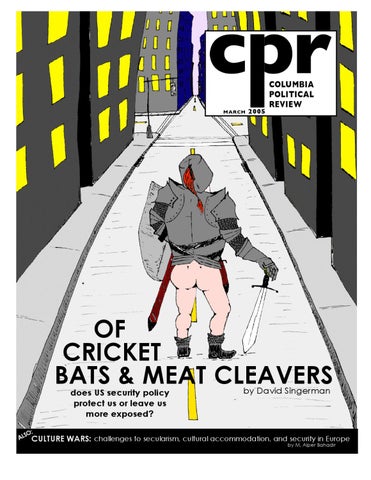
cpr MARCH
2005
CO LU M B I A POLITICAL R E V I EW
OF CRICKET BATS & MEAT CLEAVERS does US security policy protect us or leave us more exposed?
by David Singerman
CULTURE WARS: challenges to secularism, cultural accommodation, and security in Europe by M. Alper Bahadir
The Columbia Political Review would like to thank the Student Governing Board of Earl Hall for generously supporting this issue. Advertisers and sponsors support the Columbia Political Review without prior knowledge of the articles that will appear. They do not necessarily endorse the opinions that those articles contain.
2
columbia political review
MARCH 2005
cpr MARCH 2005
contents volume iv, number iii
CO LU M B I A POLITICAL R E V I EW
features
off the record.........................4 letter to the editor.................5
DAVID SINGERMAN
Editor-in-Chief
good for a gaffe...................5 of cricket bats and meat cleavers
Benjamin Levitan
positions & partisans
Managing Editor
Alex Rolfe
Senior Editors
Matthew Christiansen Al Prescott-Couch Justin Slaughter Marc Tracy Avi Zenilman
how fear of terrorism undermines security......................13
MATTHEW CHRISTIANSEN
east meets west
Georgia in a bind.........................16
DIEGO LASERNA
Bolívar’s unexpected aid
Bush unites South America– against the North ..........................6
don’t step on the crack
Paul Sonne
culture wars
challenges to secularism, cultural accommodation, and security in Europe..................18
SUSAN MILLENKY
Design Editor
M. ALPER BAHADIR
in Camden’s drug war, drugs fight back........................................7
Art Editor
PAUL SONNE
Iran on the brink
Clara Bryant
Iran’s quest for nukes and what to do about it......................21
CAITLIN VERRILLI
making love?
Artists
Singapore plays the dating game...............................................8
Mark Clements Becky Fried Peter Lederman
our back pages
MARK KROTOV
policing the borders
Image Editor
Bush’s centrist immigration policy...............................................9
Caitlin Verrilli
book review MARC TRACY
Web Editor
nuck fewt
JUSTIN SLAUGHTER
Alastair Shearman
cartoon in crisis
the contract with America getsafacelift. . . . . . . . . . . . . . . . . . . . . . . . . . . . . . . .23
ROB WILE
BENJAMIN LEVITAN
Michael Powell’s awesome adventure. . . . . . . . . . . . . . . . .1 2
on Social Security and politicking......................................24
ex-sponging rumors of deviant influence..........................10
CPU General Manager
Alexia Koritz
The Columbia Political Review is the magazine of the Columbia Political Union, a non-partisan student organization seeking to enhance involvement in the political process and to foster political discourse. The CPU does
editor’s interview
knight errant
Jason Furman
not endorse the ideas contained herein; their worth is for our readers to determine. The Political Review welcomes letters to the editor. They should be sent to cpureview@columbia.edu and should not exceed 150 words. Letters for publication must include the author's name, contact information, and Columbia affiliation. The Political Review reserves the right to edit content.
DO YOU HAVE WHAT IT TAKES TO WRITE FOR
CPR?
contact cpureview@columbia.edu
Cover illustration by Mark Clements
columbia political review
MARCH 2005
3
[o f f
THE
record]
Democratic Damnation Please file under “Further signs that the apocalypse is upon the Democratic Party:” Mark Dayton (D-MN) recently announced that he would not run for reelection in 2006. Okay, so we are not really talking about the end of the road for the Democrats, but Dayton’s decision not to run should have generated more of a buzz than it did. If his name sounds familiar, it is probably because of a truly unfortunate string of events that befell Dayton last year. In June, Dayton attended a reception honoring Sun Myung Moon, a Korean-born religious leader who claims to be the Messiah. Although a Dayton spokeswoman immediately claimed the Senator was “duped” into attending, the event raised eyebrows back in Minnesota. In October, Dayton closed his o ff i c e s after attending a Senate briefing that outlined possible scenarios for a pre-election terrorist attack. The move drew criticism from members of the Department of Homeland Security and fellow senators. So how exactly does that run of bad luck portend the end for Democrats? We are not talking about a traditional swing state; this is Minnesota, the one state that voted for Walter Mondale in 1984. Minnesota has one Republican senator already and state Republicans are quickly rallying around Representative Mark Kennedy. Seeing both senate seats go the Republicans would have to be the nadir (no pun intended) for the Democrats. Chalk it up to luck if you want, but we just got a whole lot closer to that outcome. –Matthew Christiansen Abstaining from Logic The “Readings” section of February’s Harper’s treated readers to intriguing “teaching materials for federally funded high-school abstinence programs.” The materials ranged from helpful information for distinguishing between the genders (“Females have the uncanny ability to remember the most insignificant details about past experiences. This terrifies the average male”) to pointed parables. One such tale describes a knight who slays a dragon using advice from a trapped maiden, stays with the maiden, slays another dragon without help, and leaves the original, helpful
4
maiden for the new, unhelpful one. For those who don’t immediately grasp the moral, the budding Aesop explains, “Occasional assistance may be all right, but too much help will lessen a man’s confidence or even turn him away from his princess.” But the award for most outrageous might go to this: “At one time the definition of an adult was someone who had left childhood behind and taken on the responsibilities of life. In contrast, today ‘adult’ means being able to view and participate in any and all types of perverse activities that depraved minds can imagine.” Wait, it gets worse…much worse: “We actively seek to eliminate terrorism from our land; please help us actively eliminate this corruptive terrorism that is stealing our children’s future.” Now, even liberals rarely object to abstinence education when it’s taught as one option among many to protect oneself. The problem with these (admittedly extreme) examples is that they don’t merely fight promiscuity—they replace it with other values. And those values happen to be horrifying, reinforcing worn gender stereotypes. Women are taught not to help their men lest they lose them. Keep in mind that the woman who helped her man was trying to save herself from a dragon. Must a woman surrender all self-defense (and, by no large leap, all self-reliance) to a man? As bad as that is, the connection between sexual activities and terrorism, no matter how “perverse” the activities are, is an affront to common sense. Morality-based abstinence education is fine, but not if it blurs one of society’s most crucial lines: that which divides getting freaky and heinously murdering innocent civilians. To equate the two exhibits a profound lack of moral judgment. –Benjamin Levitan Texan Prostitutes Nary an NYPD officer goes to work without a weapon, but some Houston cops can now lay aside their arms. Oh, and by the way, they can lay aside their clothes, too. But that’s okay, because it’s all in the noble public interest of negotiating for sex acts with prostitutes. Houston Police Chief Harold Hurtt resorted to drastic means to catch prostitutes, many of whom refuse to get down to business with clothed men. That posed a problem, since
columbia political review
prostitutes who aren’t caught discussing finances can’t be convicted. Hurtt is from Phoenix, where the police department has long condoned nudity. Phoenix requires at least a token covering of sensitive areas, though. It’s not clear whether Houston officers are similarly constrained, since Hurtt understandably doesn’t want to lay bare all of his department’s tactics. Assistant District Attorney Ted Wilson told The Houston Chronicle that Hurtt had had enough: “It was just so widespread. It had almost gotten in your face.” What might be most surprising, however, is how common the tactic is. Aside from Houston and Phoenix, Philadelphia allows officers to disrobe as a last resort for accruing evidence. A complete list of such cities is difficult to obtain, since the precise regulations are often unwritten. –Benjamin Levitan Texans and Prostitutes One measly gay prostitute gets permanent White House press credentials, and New York Times columnist Maureen Dowd goes off! When Jeff Gannon—a “reporter” for the conservative, online “news service” Talon News, who frequently got to ask softball questions of President Bush and his White House Press Secretary Scott McClellan—was, er, outed as a complete fraud last week, Dowd was at her indignant best: “I’m still mystified by this story. I was rejected for a White House press pass at the start of the Bush Administration, but someone with an alias, a tax evasion problem and Internet pictures where he posed like the ‘Barberini Faun’ is credentialed to cover a White House that won a second term by mining homophobia and preaching family values?” It has been a long time since Dowd has been this biting in her column (like, since the 2000 election), and it’s refreshing that she has, at least for now, returned to her great strength as a writer: deeply substantive, deeply sarcastic Bush-bashing. L e t ’s hope that her future columns are significant enough to end like this one did: “Even the Nixon White House didn’t do anything this creepy. It’s worse than hating the press. It’s an attempt to reinvent it.” –Alex Rolfe
MARCH 2005
To the Editor: As a fellow student also studying abroad for the year in London, I was irritated by the warped views presented by Aaron Maczonis in Leave It and Love It: How America Looks Better from Abroad (CPR, December 2004), where he described perceptions he and others hold of the United States and American patriotism. I can only, as Maczonis did, take from my own experience of living in Europe for four-anda-half months. Maybe I was so perplexed by the trite account of his newfound patriotism because of his misinterpretation of the country he so steadfastly purports his allegiance to. Patriotism in America is not “inversely related to the time that has passed since September 11.” If anything, last year’s presidential election showed the opposite. While the reactive patriotism surrounding September 11 was arguably contrived, it was hard to find an American that did not have an opinion come November 2. People were out arguing over the fate of our nation, both sides roused firstly by their patriotism, and secondly, admittedly, their hatred for the opposing team. Now I can’t refute Maczonis’s experience in his LSE classroom. Granted, I attend University College London, whose student body is generally more interested in our television programming than in our politics. Despite this, I have yet to run
into the blind anti-American sentiment cited by Maczonis. It is hard for the English to say they hate America as they stuff themselves with newly imported Oreos and rush to theatre, past the Disney Store and around the corner from the Starbucks, to see Jerry Bruckheimer’s latest contribution. But it is more than a superficial appreciation of globalization. As New York Times columnist Thomas to the Friedman wrote recently, Europeans have always admired America and its beacon of possibility. What they hate rather, Friedman notes, is the Bush Administration, which has made fear instead of hope America’s number one export. Maczonis’s reaction to his classmates was misinformed when he claimed that “the world should not criticize but rather respect and admire the United States.” America may offer sanctuary to the world’s most disenfranchised, but, as the Bush Administration has shown time and again, it is far from absolved of doing wrong. LSE students should not have made such sweeping generalizations. Yet those inaccurate stereotypes should have been met with more than a patronizing Wilsonian response. When I have talked about America with people from Europe, the Middle East, and Africa, they do not
hate America, but they are troubled by Bush’s re-election. I am just as troubled, and frankly, just as confused as they are about why the majority of the country voted for him. An intelligent discussion usually ensues about American politics and our wide endeavors, and I have been pleased by how many people see what is currently right and wrong with our country. But above all, they hope, like I do, for better in the coming years. I was happy to leave the States in September, desiring a more detached view of the destructive path I believed the country was on under the direction of the current Administration. And much like Maczonis wrote, living in Europe has refined my perspective on what “American Patriotism really is.” Unlike what Maczonis wrote, it is not about doing whatever it takes to uphold traditions and national holidays brought to you by Hallmark. It is also not something that I can provide an absolute nationwide definition for. However, I can say that American Patriotism, for me, is to love my country enough that I always challenge it to do better, because I know it can and I know it will, if not under this Administration then maybe by the next democratically elected one.
“I had no idea that, if you wanted a show canceled, all you had to do was say it out loud.” –Daily Show anchor Jon Stewart, on the cancellation of CNN’s Crossfire
doing that.” –President George W. Bush, to a divorced mother of three in Omaha, NE
LETTER EDITOR
good gaffe for a
“I want to thank the Canadian people who came out to wave—with all five fingers—for their hospitality.” –President George W. Bush “I don't have the slightest clue who Hillary [Clinton] is. All I see is a gal who knew she was as good as anyone else, and she saw this guy she could make something of, and went to Arkansas. That's a hell of a move to make for a redneck.” –NY Congressman Charles Rangel
“So my best guess, to provoke you, of what's behind [women’s being underrepresented in certain academic fields] is that the largest phenomenon, by far, is the general clash between people's legitimate family desires and employers' current desire for high power and high intensity, that in the special case of science and engineering, there are issues of intrinsic aptitude.” –Harvard University President Lawrence Summers “You work three jobs?…Uniquely American, isn't it? I mean, that is fantastic that you're
columbia political review
Perrie Briskin, BC ’06
"As far as the Boise city code, it specifies [that full nudity] has to be a serious artistic manner.” –Erotic City owner Chris Teague, on distributing pencils and sketch pads to patrons in order to justify full nudity at his strip club “Just remember, your family does love you and not everyone hates you.” –President Bush’s Senior Advisor and Chief Political Strategist Karl Rove, in a note accompanying flowers to Maureen Dowd as he tried “to start off the next four years on friendly terms” (see “Texans and Prostitutes” on the facing page)
MARCH 2005
5
Bolívar’s unexpected aid
BUSH UNITES SOUTH AMERICA—AGAINST THE NORTH By DIEGO LASERNA In 1824, Simón Bolívar, the liberator of six Latin American countries, organized a continental congress in Panama to create a supranational institution that would direct the entire American continent towards unification. Amid the absence of several delegates—most notably the United States—and the prevalence of regionalist sentiment, the congress ended in disarray. Bolivar, dejected, died six years later after seeing the last remainder of his dream, the Gran Colombia, fall apart into the present-day nations of Ve n e z u e l a , Colombia, and Ecuador. For the following 180 years, Latin American nations agreed on very little, and national interests seldom coalesced as Bolívar dreamed they would. In the last few years, however, the international push for regional integration, the apparition of a series of charismatic leaders, and most importantly the confrontational attitude of the Bush Administration towards Latin America seem to be achieving Bolívar’s dream: South American unification. Last November, South American leaders met in Cuzco, Peru, appropriately the old capital of the Incan Empire, to create what they envisage as a European Union-style bloc. The process is merely beginning, but its goals already range from tariff reduction and regional infrastructure development to the eventual creation of a common parliament and currency. The assertive leaders driving this process are very critical of or even overtly hostile to Washington and the Bush Administration. However, as University of North Carolina professor John Chasteen explained, this should come as no surprise to those who know Latin America: “Latin American unity, both as a
6
sense of shared identity and as a project of integration, has historically gained its primary impetus from the urge to resist outside imperialism. This was true of Bolívar’s vision…true of the revolutionary Latin American Left during the Cold War, and I’d wager confidently that i t ’s still true today”. The more radical branch of the movement for unification is led by Venezuelan President Hugo Chavez, a proud friend of Fidel Castro who has claimed that no dialogue with the Bush Administration is possible, called Bush an “asshole,” and described the invasion of Iraq as “criminal.” His positions only radicalized further as evidence appeared of the Bush A d m i n i s t r a t i o n ’s knowledge of and acquiescence in a coup against him. The more conciliatory branch of the movement is headed by the President of Brazil, Lula da Silva. Although somewhat more gracious than Chavez, Lula has vehemently opposed American-led initiatives to create the Free Trade Area of the Americas (FTAA). He has challenged US agricultural subsidies as unfair and detrimental to trade and recently won a case against US cotton subsidies at the World Trade Organization. His boldest move, however, came in response to the Bush
columbia political review
A d m i n i s t r a t i o n ’s decision to take pictures and fingerprints of all incoming foreigners. To “reciprocate,” Brazil began taking pictures and fingerprints of all US citizens entering. As Larry Birns, director of The Council of Hemispheric Affairs, pointed out, this shows “autonomous Latin American integration is developing a momentum that is going to be very hard to stop…. There is a feeling in Latin America that it is best to go it alone.” More significant, however, is that Lula and Chavez are not the only ones rallying for unification around skepticism of US involvement in the region. Argentinean president Nestor Kirchner has been quick in following Brazil’s lead against the FTAA, strengthening MERCOSUR (a free trade area encompassing Brazil, Argentina, Uruguay, and Paraguay), and recently clashed with US officials when they criticized his “leftist tendencies.” His harsh criticism of the International Monetary Fund’s role in the Argentinean crisis and his default on the debt has been as popular in Latin America as it was unpopular in Washington. His opposition is joined, with varying levels of discontent, by the presidents of Bolivia, Uruguay, and Chile. In much of Latin America, the Bush A d m i n i s t r a t i o n ’s push for free trade agreements has met fierce opposition, its continued War on Drugs continues to prove fruitless, its advocacy of “neo-liberal” IMF policies has found meager support in countries where it has been a huge failure, and its War on Terror is seen a just another excuse for intervention and imperialism. Among South American nations, only Colombia found itself in the “Coalition of the Willing” supporting the Iraq War, and Chile even refused the US its support in the UN Security Council. However, as Birns pointed out, the way to integration is neither clear nor easy: “Latin
MARCH 2005
America [still] has a need for outside credit, is heavily dependent on the IMF, Inter-American Development Bank and World Bank loans, and suffers from a strong US financial and cultural pull.” I r o n i c a l l y, although South A m e r i c a n nations have in common their widespread poverty, history, language, ethnic mix, and religion, what seems to be bringing them
together is the Bush A d m i n i s t r a t i o n ’s foreign policy. Although this mass resistance is detrimental to US interests in the region, it may ultimately also prove a false illusion to those who still share Bolívar’s dream. After all, Bush will not be in office forever, and, if serious, concrete steps are not taken toward economic and political integration, a more adroit US foreign policy could exploit the remaining dif-
.
ferences between South American countries in order to retrieve the docile friends gone “astray.” Diego Laserna, CC ’07, is majoring in eco nomics-political science. He spent the first eighteen years of his life in Bogota, Colombia. His last article for CPR, “Free trade in crack,” appeared in the October 2004 issue.
DON’T STEP ON THE CRACK IN CAMDEN’S DRUG WAR, DRUGS FIGHT BACK
By SUSAN MILLENKY Most people in Southern New Jersey and Philadelphia didn’t need a headline in T h e New York Times to tell them what they already knew. They were hardly surprised to pick up the Metro section last November and find “Camden Ranked Most Dangerous City.” To its neighbors, Camden, New Jersey is an easy punch line. It wasn’t until the late 1960s, though, that the economy was devastated by the closing of Campbell’s Soup, RCA, and New York Shipbuilding, and the middleclass began racing for the suburbs. With heavy industry gone, Camden slowly started replacing vacant factory lots with low-income housing, reinforcing the suburban migration. Industry, education, and employment have all steadily declined, while the city’s homicide rate has risen with alarming consistency. While numerous cities have witnessed closing factories, sluggish economies, and population attrition due to urban flight, America has only one “Most Dangerous City.” What went wrong in Camden? The answer is simple: crack-cocaine. In 1985, there were twelve homicides in Camden. Ten years later, in 1995, there were sixty. What happened in the interim? Crack-cocaine arrived in the mid-1980s, fol-
lowed by the proliferation of open-air drug markets—venues for outdoor drug sales—throughout the city. The advent of the cheap high plunged Camden into a culture of high school dropouts, property foreclosures, and police raids. Currently, with the vast majority of teenagers dropping out of high school, drug dealing is not just the most obvious career path; for many, it is also the only means of putting food on the table. With few opportunities for legal employment, there’s little incentive to remain in school. And even for those who do stay in school, drug use has become the norm. “When 99 percent of kids coming in front of the juvenile judge are testing positive for drugs,” said an assistant prosecutor who asked not to be identified, “their parents are measuring success by whether or not their children are going to school everyday.” Drugs are, said the assistant prosecutor, “directly and indirectly responsible for almost every juvenile case passing through Camden’s court system.” Kids start their apprenticeship in the drug trade before they hit high school by getting fifty dollars a day from the neighborhood drug dealer to act as a lookout for police. In a city adorned with memorials to dead drug dealers (artistic murals promising “never to forget” the dealer, immortalized, gun in hand), the
columbia political review
crack-cocaine culture will not be transformed by an incremental approach—the solution will have to be radical. The most viable solution for many activists in Camden is a politically unpopular one: treat drugs as a problem of health, not of criminality, and implement a legalization strategy similar to that of alcohol. Drugs would exist as a legal, taxable market for those over 21, while possession would be downgraded to a misdemeanor for those who are underage. A system such as this one, said longtime Camden political activist Frank Fulbrook, would “put the drug dealers out of business because the cost of growing cocaine and marijuana is very little.” Of course not everyone agrees with the suggestion that legalizing crack will bring the city resolution. Former City Attorney Morris Smith argued that his “community has more important things to do. Legalizing drugs doesn’t advance issues of healthcare, economics and education.” Nonetheless, all seem to agree about the need to create a self-sufficient population. Self-sufficiency creates its own demand for the instruments of revitalization—the local restaurants and stores, which in turn offer additional employment. It’s not difficult to see why the “War on Drugs” has failed to transform the city of
MARCH 2005
7
Camden. The government’s focus on punishment rather than transformation does nothing to address the roots of the drug culture. Imprisoning a nineteen-year-old drug dealer is impractical. The young dealer lives among men guilty of similar crimes and returns to a city that offers him no more options than when he departed. Perhaps the police have raided his corner, but certain employment exists just down the street. The legal businesses left in Camden are unlikely to employ him or any of the thousands of men with a criminal record just like his. The city has provided no incentive for employers to act otherwise. As Fulbrook noted, “The drug dealers always win the drug war.” While efforts at revitalization are currently taking place, Smith explained that the efforts “have limited objectives. They focus mostly on real estate, while the human capital component
is lagging behind….People don’t have the skills to reach their potential.” In its attempt to bring in storeowners and restaurateurs along the growing waterfront area, Camden needs to educate its population to provide the human services needed for revitalization. There exists an entire generation of people without high school diplomas, let alone marketable skills. Right now, the revitalized area of Camden con-
sists mostly of “transplants”—government workers and a few other professionals, who rarely venture beyond the enclave of the waterfront after five in the afternoon. Clearly, Camden has an image problem, one which its current ranking only worsens. This problem, beyond making the city a ready punch line for Philadelphians, has the disastrous effect of limiting C a m d e n ’s capacity for change. In a crisis where poverty leads to drugs and drugs lead to more poverty, obvious solutions will never emerge. Only an unconventional plan like legalization will offer Camden’s citizens the opportunity for self-sufficiency beyond the ubiquity of crack-cocaine.
.
Susan Millenky, CC ’07, is from Cherry Hill, NJ. She is majoring in history and political science.
making love? SINGAPORE PLAYS THE DATING GAME
By CAITLIN VERRILLI Diana Ross may have sung, “You can’t hurry love,” but some in Singapore’s government are apparently hoping to do just that. Last December marked the conclusion of a ninemonth-long, state-sponsored program called “Romancing Singapore,” in which the Singaporean government attempted to encourage its citizens to, well, do it. As former Prime Minister Goh Chok Tong proclaimed in a speech in 2000, “We need more babies!” As in many industrialized nations, birth and marriage rates have declined rapidly in Singapore over the past quarter-century. Only 37,633 children were born in 2003—the lowest figure in 25 years and well below the 50,000 required to maintain the city-state’s population of four million. More worrisome, Singaporeans seem to
8
have lost that loving feeling. A recent study conducted by the National University of Singapore found that only 25 percent of men and ten percent of women wanted sex more than six times a month. “Stress and single-minded striving for success—that is one major contraceptive!” said Dr. Tan Tay Keong of the Singapore International Foundation, a nonprofit organization devoted to helping Singapore’s globalization efforts. Singapore may indeed be a victim of its own success. During his 31 years in office, Prime Minister Lee Kuan Yew worked to create a “model society” that stressed hard work, education, and a kind of social engineering based on ability, segregating children as young as age eight into three separate learning tracks. In its drive to succeed, some say, Singapore produced a generation of high-achieving but socially awkward adults. Another largely unstated concern is that
columbia political review
falling birth rates will upset Singapore’s fragile racial balance. Though the nation imports thousands of guest workers from India, Malaysia, the Philippines, and Thailand, Singapore has one of the strictest immigration policies in the world. In 1995, the government announced it was raising the retirement age to 67, stating, “We are short of workers, and it is better for Singaporeans to work longer than for us to rely more heavily on foreign workers.” If new Singaporeans cannot be imported, they must be produced internally. “Someone has to take the lead,” said Claire Chiang, co-head of Romancing Singapore, in an interview with The Straits Ti m e s. “There is nothing wrong with the state wanting to send a message to the population,” she said. “It’s the same with bird flu—the government has to do something.” Singapore has long promoted governmentsponsored marriages through its two official matchmaking bureaus—the unsexily-named Social Development Unit (for university graduates) and the Social Development Service (for non-graduates)—but they had long been considered national jokes. To attract hip singles, the
MARCH 2005
Social Development Unit has recently softened its message. Its redesigned website—the “LoveByte Café” (www.lovebyte.org.sg)—advertises “A world of possibilities, just a click away” and includes a dating-advice column, “Ask Dr. Love.” Beneath the slick graphics, the site also delivers the official line of the SDU: “Yes!!! We believe it is possible to achieve our mission of promoting marriage among graduate singles and inculcating positive attitudes towards marriage among all singles so that they can look forward to their own strong and stable families in Singapore.” As the country’s political climate gradually liberalizes, the government has apparently decided single Singaporeans will respond better to the carrot than the stick. In 2004, censorship laws were relaxed to allow mildly racy fare such as Cosmopolitan, “Friends,” and “Sex in the City.” Meanwhile, the state-owned TV company MediaCorp produced a new program called “Here’s Looking at You, Babe!’ which follows the real-life prenatal adventures of telegenic Singaporean actors Wong Li Lin and Allan Wu. The government-funded “Romancing Singapore” festival included a mass wedding in May, and the website (www.romancingsingapore.com) touts a program of rock-climbing trips and love-boat cruises, tango lessons, speed-
dating, and something called the “Caress My Soul Massage Course.” The site also offers sentimental e-cards, a downloadable jingle, a cake of the month (“Aphrodisiac”), and corporate sponsor Pizza Hut’s “lovely new heart-shaped Lovestruck Pizza,” all with the goal of “celebrating love, life and relationships.” Its perfumes, retailing at about ten dollars per bottle, sold out in a week. At least some model citizens seem to buy the state’s message. If the city-state’s hamhanded attempts to play Cupid seem ridiculous, in many ways they reflect increasing governmental desperation in the face of the one problem it cannot legislate away. “I think the program has justification in its public interest objectives,” said Keong. “However, changing society’s attitudes towards marriage and family, especially romance, would probably require a sea-change in attitudes….To succeed, a program alone is insufficient. Social attitudes, pace of life, public expectations, all the
soft-programming of how people judge one another, success and the good life, has to be redefined.” Others are even less impressed. Speaking of “Romancing Singapore,” Stanley Tan, a Singaporean student now living in the US, said, “On a personal note, it is mildly (or highly!) embarrassing that such a program exists. Symptomatic perhaps of the role of government back in Singapore, it is nonetheless cringe-inducing to some.” For now, it seems that government measures have been largely unsuccessful. The Straits Times recently reported that a higher proportion of Singaporeans are single than ever before. As Wong Li Lin recently said in the magazine Marie Claire, “Singaporeans are not baby-making machines. We are individuals with our own lives and emotions.”
.
Caitlin Verrilli, CC ’05, is doublemajoring in history and psychology. She serves as image editor of C P R. Her last article, “Political Implosions,” appeared in the December 2004 issue.
policing the borders ’
BUSH S CENTRIST IMMIGRATION POLICY By MARK KROTOV The nation of immigrants is reassessing its demographics. Last year, President Bush announced a plan to allow guest workers—foreign nationals who immigrate to the United States temporarily—to spend three years in the US, with the chance to extend their stay for another three before leaving the country. According to Bush, the program would both discourage illegal immigration and enhance border security.
After making little initial progress, he reiterated his commitment to immigration reform in this year’s State of the Union address. In the forceful and straightforward language that characterized the entire speech, Bush described the necessity of an “immigration policy that permits temporary guest workers to fill jobs Americans will not take, that rejects amnesty, that tells us who is entering and leaving our country, and that closes the border to drug dealers and terrorists.” Cynics responded that Bush is simply courting the Hispanic vote, a traditionally Democratic
columbia political review
constituency that presented Bush with uncharacteristic levels of support in the 2004 election. But for all the talk of Karl Rove conspiracies, Bush’s proposal seems to be a legitimate attempt at reform. His statements during the State of the Union revealed that the main challenge facing immigration policy is the contradictory responses it elicits. For example, a recent Washington Post-ABC News poll revealed that 61 percent of Americans believe that illegal immigrants should be offered the chance to keep their jobs and apply for legal
MARCH 2005
9
status, while 36 percent believe that they should Immigration Reform Caucus, has passionately be deported. Conversely, the same poll revealed criticized the Bush proposal. This attitude from that 57 percent of Americans think that drivers’ someone like Tancredo, who received an A+ from licenses for illegal immigrants should be out- Americans for Better Immigration, which favors lawed, compared to 40 percent who support the less open borders, suggested that Camarota is immigrants’ acquisition of licenses. right in believing that “if the President wants Steven Camarota, Director of Research at progress, he’s got a huge political problem in the the Center for Immigration Studies, suggested House.” that immigration lends itself to contradictions: Yet, for every disgruntled conservative who “The issue on which the public and the nation’s insists on tighter border control, there is an excitleaders disagree most profoundly is illegal immi- ed liberal who sees Bush’s proposal as a stepgration.” Surprisingly, he ascribed the central divi- ping stone to what the President consistently sion to neither says it is not: amnesty. “Republicans and Douglas Rivlin, Democrats, [nor] Director of conservatives and Communications for liberals. It’s really the National between public opinImmigration Forum, is ion and elite opinion.” surprisingly compliThe issue of elite mentary of a president opinion is central to who is generally on explaining the issue’s the opposite side of contentiousness. the political spectrum. –Steven Camarota, Director of According to Rivlin, Immigration affects all Americans, but its Research, Center for “The President is willimpact resonates Immigration Studies ing to fight for immimost strongly in gration reform. He’s areas where unemgot the loudest megaployment hits hardest and where demographic phone in the country to talk about this issue with. changes have been linked to economic shifts. As He is prepared to be comprehensive.” a result, these issues transcend party lines and The debate can no longer be seen as a conpeople really do vote their consciences. flict between Americans welcoming the poor, the Bush’s proposal has won him unlikely friends tired, and the huddled masses and those with a and created even more unlikely enemies. For narrower view of who is an American. September example, Tom Tancredo (R-CO), who chairs the 11, 2001 and the subsequent fear of terrorism generally conservative Congressional have clouded this already opaque issue. Rivlin,
The immigration debate isn’t between “Republicans and Democrats, [nor] conservatives and liberals. It’s really between public opinion and elite opinion.”
who argues passionately for amnesty, believes that immigration reform is “an imperative of [fighting] global terrorism, an imperative of the global economy, and an imperative of global demographics.” Camarota, on the other hand, observes that “a terrorist with a green card is worse than a terrorist illegal alien. An illegal alien has more difficulty” finding means to commit terrorist acts. And while Bush makes clear that controlled immigration will eliminate many dangers, even Richard Clarke, a hero to many liberals, advocated tighter border control in February’s The Atlantic Monthly. While its effects on terrorism may become the litmus test for any new immigration policy, many of the arguments remain the same. Camarota emphasized the idea that Bush’s policy will “mock the law-abiding,” both here and abroad, and will “increase the budget by billions of dollars.” On the other hand, Rivlin, along with most prominent members of the Democratic Party, said we should “take the illegality out of the system. Let’s replace the illegal flow with a legal vetted flow.” Ultimately, President Bush’s rare attempt at centrism has met with just as much opposition as the more conservative policies that characterized his first term. The next four years will see the debate over immigration continue to emerge into the political discourse, and it will be very difficult for it to crawl back out.
.
Mark Krotov, CC ’08, immigrated to the US from Russia in 1991. His last article for CPR, “The return of authoritarianism,” appeared in the December 2004 issue.
CARTOON in CRISIS By JUSTIN SLAUGHTER
He seems so safe. Warm, ebullient, full of laughs, he has brought joy to millions of children over the last few years, along with providing a cash bonanza for his employers. In the eyes of one of A m e r i c a ’s most vocal spiritual leaders, however, he’s a degenerate influence on the minds of young Americans—a tool designed to open their hearts to perversion and evil.
10
EX-SPONGING RUMORS OF DEVIANT INFLUENCE His name is SpongeBob SquarePants, and beyond living in a pineapple under the sea, he might also be a gateway to homosexuality. Although SquarePants has been a public figure for years, having starred in sixty
columbia political review
episodes of his animated television show and one full-length feature movie, it was only recently that he became involved in American politics. On January 19, 2005, Dr. James C. Dobson, founder of Focus on the Family and one of those believed to be a key force behind
MARCH 2005
the turnout of evangelical Christians for last like,” said Gary Schneeberger, Director of a truck, fed lima beans, and used as a badyear’s presidential election, accused the enter- Media and Constituent Communications for minton cock. Curiously, the punishments are tainer of paving the way towards homosexual- Focus on the Family. Schneeberger stated that carried out by two large and muscular fish with ity. Speaking to journalneither Dobson Mohawks, both of whom wear tiny leather ists and congressmen at nor Focus on the clothing and have an inner tube over their a black-tie dinner in celFamily had chests a la bondage gear. Strangely, however, ebration of President claimed that Focus on the Family did not suggest that Bush’s reelection, SquarePants was SquarePants was leading children down the Dobson claimed that promoting a homo- road towards sadism and masochism. SquarePants had sexual agenda in Despite the apparent endorsement of recently starred in a his television pro- SquarePants for alternative lifestyles, there is “pro-homosexual video.” gram or was him- little evidence that children are being pulled Including other popular self homosexual. towards homosexuality by his antics. children’s show characIn truth, the entire According to seven-year-old Rian Slate of ters such as Barney the issue was created Charlottesville, Virginia, a viewer of –Gary Schneeberger, Dinosaur and Jimmy by journalists, “as S q u a r e P a n t s ’s program, “I like him cause I like Focus on the Family Neutron, the video, creit gives them the that he’s funny. I like that he’s yellow, cause ated by “We Are Family” chance to have fun t h a t ’s my favorite color.” Slate did grant that songwriter Nile Rodgers, includes a “tolerance and act like they write for SportsCenter, creat- SquarePants makes mistakes from time to pledge” for different sexual identities as part of ing nicknames [for SquarePants] like time but offered this defense: “Sometimes he its attempt to teach multiculturalism to young SpongeBob GayPants,” Schneeberger said. doesn’t know what’s happening. In one show, children. From Dobson’s point of view, howevIn truth, however, SquarePants may not be there is a guy who wanted to put SpongeBob er, a mainstream children’s show star condon- so innocent; his productions have long con- in a trap and he was wearing a mustache and ing homosexuality as a normal lifestyle is noth- tained segments that suggest support for Spongebob knew they were after him but he ing shy of insidious. homosexuality and other deviant lifestyles. couldn’t recognize the disguise and when peoOf course, Focus on the Family has One such segment, Mermaid Man and ple kept coming in they couldn’t trap him.” attempted to distance itself from Dobson’s ini- Barnacle Boy, has attracted considerable Based on Slate’s recounting of her own expetial comments on the matter, claiming that its interest from the gay community for its parody riences, it does not appear that SquarePants founder’s statement had been misinterpreted of the superheroes Batman and Robin, with is having the effect that Dobson feared. by “Big Media.” “Our objection is to the group Mermaid Man and Barnacle Boy portrayed as But while SquarePants has been under fire behind the video to pitch a view of homosexu- two rather effeminate middle-aged men who from some in the religious community, he has ality to schoolchildren that parents wouldn’t live together. In this found acceptance s e g m e n t , from others. In a rare SquarePants actualpublic appearance, ly wears his underSquarePants visited wear over his tradethe United Church of mark shorts for a C h r i s t ’s Church House significant amount of in Cleveland, where time, an action that he received, in the –Seven-year-old Rian Slate words of a UCC press convinced one viewer who requested release, an “unequivoanonymity that SquarePants possesses latent cal welcome.” John H. Thomas, President and homosexual tendencies of his own. General Minister of the UCC, said, “Jesus didIn one episode of his show, “Krabby Land,” n’t turn people away. Neither do we.” This pubSquarePants appears to experiment with lic event may mark a new stage in sado-masochism. While watching over and SquarePants’ life, one in which he can leave entertaining a group of young fish children, an the torrid problems of his brush with Dobson exercise demanded by his fictional employer, behind him. SquarePants decides that they find him funny only when he gets hurt. As a result, a Justin Slaughter, CC ’05, serves as a senior sequence follows that includes SquarePants editor of C P R. He is double-majoring in h i s t or y being bound leg and arm to long wooden and political science and considers the poles, beaten with large hammers, run over by a nim a t e d world to be “a deeper reality.”
“It gives [journalists] the chance to have fun and act like they write for SportsCenter, creating nicknames [for Square Pants] like SpongeBob Gaypants”
I like [SquarePants] cause I like that he’s funny. I like that he’s yellow, cause that’s my favorite color.
.
columbia political review
MARCH 2005
11
knight-errant
Michael Powell’s AWESOME ADVENTURE
By ROB WILE Amidst the sea of mud the Bush campaign slung at Senator John Kerry during the presidential race, perhaps none stuck to him better than the charge of “flip-flopper.” Yet the Bush Administration had all along been harboring at least one flip-flopper of its own. And while most will remember outgoing Federal Communications Commission Chairman Michael Powell as the man who embarked upon a crusade against indecency unheard of in the FCC’s history, they may not realize, as John Kerry might say, that he once argued for limited government involvement in regulating indecency—before arguing against it—making his tenure’s legacy all the more disturbing. Soon after being appointed by President Clinton to fill a Republican seat on the FCC in 1997, Powell gave a speech to the American Bar Association in which he espoused views any healthy Democrat would echo. In it, he warned that the ambiguous concept of public interest “invites mischief by regulators and politicians to advance parochial interests under the guise of public interest.” He added that he had a responsibility to execute his duties “without feeling [his] decisions [were] the result of nothing more than [his] personal preferences or the skillful lobbying efforts of the most effective special interest groups or politicians.” Sometime between 2002 and 2003, however, something caused Powell to become, according to former FCC Chairman Reed Hundt, the greatest enemy of the First Amendment “since the McCarthy era.” In a speech last February before Congress, Powell said the Commission had begun successfully “wielding its sword” against stations broadcasting indecent material like never before. “This Commission boasts the most aggressive enforcement regime in decades, proposing nearly ten times the level in indecency fines than the previous Commission,” he said.
12
Since Bush designated Powell as Chairman of the Commission in January 2001, the FCC has levied 36 “notices of apparent liability” (NALs), or fines against various networks and their affiliates. Compare this with just 32 NALs covering all eight Clinton years. In 2004 alone, twelve NALs were handed down—the most ever for one year. So what caused Powell to pierce the First Amendment shield with his regulatory sword? Powell has said that he was only responding to drastic increases in complaints that occurred in the latter part of his tenure. And indeed, the numbers bear this out, at least on the surface. In 2000, just 111 complaints were filed. By 2003, more than 200,000 complaints had been filed. But Todd Shields, writing in a December article for mediaweek.com, reported that, according to the FCC’s own estimate, a single group, the Parents Television Council (PTC), was responsible for nearly all indecency complaints in 2003—99.8 percent. Though the PTC has tried to downplay its influence, an article posted on its website trumpeted its success in lodging more than 100,000 FCC complaints in 2004 alone. Indeed, the group’s website contains a link to a complaint form that individuals can use to e-mail their concerns directly to the FCC. Founded in 1995, the PTC is on a mission to, according to spokeswoman Lara Mahaney, “bring responsibility back to the entertainment industry.” So in 2003 the group launched a “massive, coordinated, and determined campaign” to “make the FCC do its job,” according to a PTC newsletter. This campaign included a wave of online activism and regular meetings with FCC commissioners.
As it turns out, the PTC has considerable clout in Republican circles and has used it to pressure not just the FCC but also Congress itself. The group is headed by L. Brent Bozell, who, in addition to being a member of the Political Club for Growth (a highly influential conservative free-market advocacy group), is also a Rush Limbaugh buddy. Plus, one of the members of the PTC’s socalled “advisory board” is Senator Sam Brownback (R-KS). Not surprisingly, Brownback is the cosponsor of a pending bill to increase indecency fines tenfold. In addition, many of the PTC’s largest sponsors have ties to the Bush Administration. Amazingly, Powell’s newfound zealotry was not enough for Bozell and the PTC, who are welcoming Powell’s resignation as an opportunity for someone even tougher on indecency to step in. And it is this dissatisfaction that indicates why Powell jumped ship on his own principles: upon discovering the Internet, the PTC had an instant way to inundate the FCC with complaints. Combined with Bozell’s clout, the group began unleashing untold amounts of political pressure on the Commission. While the old, cool-headed Powell might have said that he wouldn’t bow to powerful lobbying groups, the PTC’s new “massive, coordinated” war on indecency coincided with the launching of Bush’s 2004 campaign, a time when donors began looking to the White House to fulfill its end of the bargain before pledging their votes. So Powell was put in an ideological bind: play politics or violate his core principles. He wound up failing at the former and passing the latter with flying colors.
Former FCC Chairman Reed Hundt called Powell the greatest enemy of the First Amendment “since the McCarthy era”
columbia political review
.
Rob Wile, CC ’08, hails from Chicago. He serves as an associate editor of The Journal of Politics and Society at Columbia.
MARCH 2005
of CRICKET BATS and MEAT CLEAVERS By DAVID SINGERMAN I’m passing through the security checkpoint at Fort Lauderdale International Airport. Passengers stand in line for the chance to hand their e-tickets and government-issued IDs to a person in a jacket with “TSA” written on the back. They get sorted into other lines, where they have to take off their sneakers, watches, jackets, and backpacks and remove their laptops from their carrying cases. Announcements warn that any bag left unattended will be confiscated and possibly destroyed. A large sign lists items forbidden on board, including common items like nail clippers along with weapons like cricket bats and box cutters. This is the face of America’s homeland security. We’re conflicted about this process. We can’t help chuckling, especially since we periodically hear stories that question the Transportation Security A d m i n i s t r a t i o n ’s effectiveness. On February 12, for example, a screener at Newark failed to notice that a woman’s pocketbook contained, of all things, a meat cleaver. The passenger, who remembered what was in her bag a few minutes later, told the Associated Press that it was left over from a blind date that week (“Just in case,” she said). We find airport security at once both amusing and frightening. Lists of weapons, shoe checks, and exhortations to “report suspicious activity” remind us of the constant, ever-present threat that terrorists pose to our travel, our buildings, our roads, and our very way of life. Fear may be an appropriate response when confronted by lions, tigers, or bears—or someone armed with a cricket bat and a meat cleaver—but fearing terrorism is the wrong way to counter the threat it actually represents. Our terror of terrorists is preventing us from rationally debating or solving the problem they present. In the 21st century, fear makes us less safe. Trade-Offs The rational way to think about security is the rational way to think about most things: a costbenefit analysis. Bruce Schneier has been trying to get the general public to understand this point for the better part of a decade; his latest book,
HOW FEAR OF TERRORISM UNDERMINES SECURITY published in 2003, is called Beyond Fear. A former cryptographer, Schneier argues that security is all about “trade-offs.” Security carries a price, and that price is often more than a mere financial loss. Achieving for ourselves a given level of security always requires that we sacrifice something else. Convenience, money, time, energy, and civil liberties are among the most obvious currencies with which we can buy increased protection. In the case of war, the loss of human lives is required to ensure our safety. The attacker performs a cost-benefit analysis as well, and the basic idea behind security is to make the chance of a successful attack so remote that it’s not even worth trying in the first place. But, for the most part, Schneier wrote, “terrorists are not going to be deterred by security systems that make attacks unprofitable in the conventional sense….Terrorists measure success differently.” Surviving an attack may not be important, and it may not even be part of the plan. Terrorists’ ideological motivations (even if catalyzed by specific policies), willingness to take extreme risks, and unique definitions of success mean that preventing all terrorist attacks is an impossible task. Some terrorism is inevitable. All that we can do is reduce the risk of their success and the damage from an attack. When understood rationally, preventing terrorism on the home front is still fundamentally the same kind of problem as defending against more ordinary security threats. “Think of them as a particularly dangerous and destructive form of street gang,” Charles C. Mann of The Atlantic Monthly told me. “Blow [the gang] up much larger, and the problems aren’t all that different.” There are often a number of different tradeoffs that we can make to achieve a given level of security against terror. For example, we can keep guns off airplanes by using noninvasive metal detectors and X-ray machines (assuming 100% effectiveness), but we can also keep guns off planes by strip-searching every passenger.
columbia political review
Clearly the trade-off—in personnel costs, privacy, inconvenience—is much greater if everyone submits to frisking, even though it doesn’t make us any more secure. Or, at a lower cost, we can install locked, bulletproof cockpit doors. This doesn’t have all of the benefits of keeping weapons off the plane, but it has many. And it’s enormously cheaper, both in terms of cost and in obstruction to travel. Moreover, it’s questionable whether an air hijacking will ever be attempted again, because future passengers will less likely go quietly to their deaths. The airplane security example highlights the fact that all trade-offs are subjective; not everyone is willing to spend the same amount to reduce a risk. For a given problem, I may be willing only to pay money, my editor may sacrifice his privacy, and you may not think the risk is significant at all. “There’s no single correct level of security,” Schneier wrote in Beyond Fear. “How much security you have depends on what you’re willing to give up in order to get it. Different people have different senses of what constitutes a threat.” Port security is an example of this subjectivity problem. Reasonable people disagree on the real risks of a terrorist smuggling a nuclear bomb into a harbor and detonating it in a major metropolitan area. Graham Allison, a nuclear proliferation expert at Harvard University, has said that the odds of such an attack are fifty-fifty in the next decade. But others claim that developing a nuclear weapon is far more difficult than those projections imagine. Either way, the destruction from such an attack would be so huge that the decision to screen every container should be simple. But what about the trade-offs? Nine million cargo containers enter the United States every year from foreign ports. Thoroughly checking one container takes a trained inspector about five hours. It would slow the cargo transportation system—and the economy—of the United States to a crawl, or it would cost an exorbitant amount of
MARCH 2005
13
money. I think it’s worth it, because the potential destruction is so great. But the trade-offs are substantial, and this might explain why it hasn’t happened yet. Mann told me that the budget for the TSA has stayed stagnant because “somebody in the Bush Administration is skeptical” of the protection more money would provide. Securing the nuclear material at its source is a much better idea. There are only a few places in the world—notably unsecured weapons sites sprinkled throughout the Former Soviet Union— from which terrorists could steal or buy enough weapons-grade fissile material to make a bomb. It would cost far less to prevent anyone from taking that material than it would to screen every container. If we can secure the fissile material at its source, the chance of a nuclear detonation on American soil is drastically decreased. The tradeoff of spending tens of billions of dollars and countless millions of hours screening every container suddenly looks a lot less appealing. These are the kind of discussions, evaluations, and comparisons that our society needs to have. Instead, we are told that more security is always better. If we make the wrong trade-offs, it’s quite possible to have too much security. And we make bad trade-offs when we’re afraid to honestly examine risk. Worse Than No Security It’s also possible to have bad security, period. Often, security solutions don’t solve the problems they claim to, and they can even make problems worse. The worst kind of security trade-off is obviously one that actually decreases our safety. Many of the measures proposed since 9/11 suffer from this flaw. Take the idea of a national ID card, proposed by counterterrorism luminaries like Richard Clarke. There are, as Schneier explained, three parts to what we call an “ID check:” identification, authentication, and authorization. At Fort Lauderdale, I had to show the agent my photo ID and boarding pass. My license identifies me, because it says that I’m David Singerman. The picture on the card authenticates me, because it says that the name “David Singerman” belongs to the person with my face. And by checking to see if my boarding pass has the same name as my ID, the guard is checking to see if I am the right person to let through—the person authorized to board my flight to La Guardia. By accepting my Maryland driver’s license, but not my Columbia Card, TSA trusts the Maryland state government to have correctly identified and authenticated me before.
14
A terrorist is, unsurprisingly, not authorized to board a plane. This is the idea behind “no-fly” lists. But on 9/11, none of the hijackers used a false name. We just didn’t know that they were terrorists. Slate’s Andy Bowers recently pointed out that, using a fake ID and a boarding pass printed at home, a terrorist could circumvent the no-fly list. But he missed the larger point, which is that most terrorists aren’t on the no-fly list because we don’t know who they are. Instead, a no-fly list ends up blocking thousands of innocent people who happen to share the same name as a suspected terrorist. A national ID card isn’t worth the expense because it wouldn’t help us with authorization. But as a universal identifier, it actually would be a security liability as well. The black-market value of such a card would be astronomical, especially because it would probably contain biometric information like a thumbprint. Personal security would be threatened by muggings and robberies, and dishonest government employees would be deluged with bribes. It would make identity theft much easier. If your credit card is stolen, you can cancel it. But you can’t get a new thumb. The Total (later changed to Terrorist) Information Awareness concept, tracking the movements and transactions of all citizens, is an equally bad idea. The thinking goes that advanced computer software could scan such a database, which would include data on every American, for patterns that indicated suspicious activity. Here again, the problem is not one of too little data. As Schneier pointed out, the FBI was able to quickly reconstruct the preparatory movements of the 9/11 hijackers with information it already had. The problem is analysis: we don’t know what to look for. And if we don’t know what a terrorist looks like, a computer system we design certainly won’t. It will only present an easy target for identity thieves and mischievous government employees tempted to look up the movements of their neighbor. The philosophically strongest criticism of the USA PATRIOT Act is not that it infringes upon civil liberties. Corey Robin, a political scientist at Brooklyn College, argued that “there’s very little in the act that addresses any of the problems on 9/11.” The PATRIOT Act is mostly a grab bag of intelligence-gathering authorizations that the FBI and CIA had been coveting for a long time, but it includes few provisions for better analysis. As a society, we may decide that a few, or more than a few, of our civil liberties are worth trading away in exchange for security. But there’s no justification at all for sacrificing privacy if we don’t gain anything at all in return. In this case, bad securi-
columbia political review
ty is worse than no security at all. The law that supposedly “Provides Appropriate Tools Required to Intercept and Obstruct Terrorism” doesn’t live up to its name because it’s not the result of sensible thinking. The bill was pushed through Congress, Robin said, so quickly “that many members didn’t have time to read it.” They were pressed to pass the bill by their own fear and by the fears of their constituents. “The Only Thing We Have to Fear…” I t ’s understandable that Americans are afraid. Fear of terrorism surrounds us. We often hear from politicians on both sides, for example, that terrorists can attack “anywhere, anytime.” But the American Enterprise Institute has pointed out that under the current federal formula Wyoming receives seven times as many dollars for homeland security, per capita, as New York State. If we asked whether we would trade an infinitesimal increase in Wyoming’s security for a significant decrease in New York’s, the answer would obviously be negative. But that’s not how terrorism is treated in our current political environment. If we bolster security in critical cities and airports, some argue, terrorists will simply shift their attacks to less-secure places like the New York subway. But MIT’s Benjamin Friedman correctly pointed out that there’s no evidence such an “evolution” in terrorist tactics has occurred. It’s also conceivable that by attacking an “ordinary” shopping mall, for example, the terrorists can strike fear in every mall. This is the scenario Clarke laid out in last month’s Atlantic. But the sheer number of malls means that the risk of a specific one being attacked is minimal. As Mann explained, “We’ve had incidents like the fellow in Texas who got up in a watchtower at UT and started shooting people, but this has not prevented people from walking around college campuses.” A bomb in one mall should not prevent everyone from going shopping anywhere. The bottom line is that almost no one should be afraid of terrorism at all. “Terrorist attacks are very rare. So rare,” wrote Schneier, “that the odds of being a victim...are almost nonexistent. Modifying your life because of the risk is simply irrational.” Even if you live in Manhattan or Washington, you are far more likely to die from any number of other causes than you are by bin Laden’s hand. Yet the statistically insignificant threat of terrorism has dominated our politics for over three years, and nothing indicates that its hold on our imagination will diminish anytime soon. One rea-
MARCH 2005
son for this is the media’s eagerness to cover terrorist attacks; every time CNN shows a car bombing, it provides the public with what Friedman called a “heuristic—a way of thinking about risk without making sophisticated judgments.” Footage of terrorist attacks is a terrible heuristic. “The question is,” Friedman told me, “does government come along and ratify those inflated fears?” Unfortunately, the answer is that it does. The logo of the Department of Homeland Security’s “ready.gov” website says, “Preparing for terrorism makes sense. Get ready now.” The national color-coded alerts serve no useful purpose at all—emergency responders across the country admit that they have no idea what to look for when the color changes. An orange alert only makes citizens buy duct tape and plastic sheeting. The trade-off for the alert system comes in the form of crime committed while policemen are shifted to guarding government buildings. The most compelling reason not to fear terrorism is that terrifying us is exactly the point. The real damage of a terrorist attack comes not from the immediate deaths but from the shock waves of panic that spread afterward. Terrorists may not be deterred, but they can be thwarted. Once a society stands up and declares that the only thing it fears, to paraphrase a president, is fear itself, terrorism will be defeated more surely than it would by any other means. It’s the responsibility of government to take the “War on Terror” literally. Those in positions of authority must dispel our natural fear of death, because it will make us safer, and because it’s the only way to win.
.
David Singerman, CC ’06, is majoring in history with an emphasis on nineteenth-century America. His last article for C P R, “Can America stomach the consumption tax?” appeared in the December 2004 issue.
columbia political review
MARCH 2005
15
east meets west GEORGIA IN A BIND
By MATTHEW CHRISTIANSEN President Mikheil Saakashvili of Georgia won’t soon forget the last fifteen months. His political whirlwind began with the nation’s “Rose Revolution” of November 2003, a nonviolent popular uprising that served as a model for last fall’s Ukrainian “Orange Revolution.” Led by Saakashvili, the Georgian opposition ousted Kremlin-backed President Eduard Shevardnadze after he attempted to manipulate the legislative elections. The next year, the charismatic Saakashvili received over 95 percent of the vote in the presidential election, an indisputable indication of his national appeal. In January of this year, US Senators Hillary Clinton and John McCain nominated him and his Ukrainian counterpart, Victor Yushchenko, for the Nobel Peace Prize, writing, “We believe that the actions of Presidents Saakashvili and Yushchenko testify to the power of peace and human rights in their battle against oppression.” Yet despite the reforms, the battle for Georgia’s future continues to rage. The conflict can be traced to a deceptively simple question: Is Georgia a European state or an Asian one? Geographically situated between Russia and Turkey, it may appear irrefutably Asian. But this question will be resolved not by cartographers but rather by an array of perilous diplomatic maneuvers and drastic economic reforms. Georgia’s central government yearns for the benefits of a closer relationship with the West. At the same time, Russia shows far greater interest in Georgian affairs than any single western power. Moreover, the enthusiasm for Russia in Georgia’s breakaway provinces, Abkhazia and South Ossetia, suggests that there is still considerable support for maintaining the deeply ingrained relationship with Russia. The answer to this question will likely have ramifications well beyond Georgia. “If Georgia fails,” said Cory Welt, a fellow at the Center for Strategic and International Studies, “dictators in the region will be able to point to Georgia and
16
say ‘we can’t have a revolution. Look what hap- Holyoke College, points to the recent pened to them.’” The degree to which Georgia announcement of Georgia’s inclusion in the can avoid this fate will depend heavily on how it Millennium Challenge Account, a $1 billion fund balances its increasingly westward orientation provided by the US from which eligible counwith its ties to Russia. tries can draw money to pay for development In the fifteen months since the Revolution, activities, as “evidence of Saakashvili’s ability to Saakashvili has had a number of economic suc- get more money into the country more effectivecesses, including the introduction this past ly.” January of a flat But more important for tax that must G e o r g i a ’s long term ecomake the White nomic success will be House swoon. Saakashvili’s ability to fight Other eff o r t s , the endemic corruption that however, have characterized Georgia for yet to materialize. the past decade and continFirst among –Cory Welt, Fellow, ues to plague most of the these is the issue Commonwealth of Center for Strategic Independent States (CIS), a of foreign direct investment (FDI), International Studies grouping of former Soviet which dropped republics formed in 1991 folsharply during lowing the breakup of the Shevardnadze’s final years in office. The extent USSR. There is considerable reason for optito which Saakashvili’s government can draw mism: tax revenues rose 43 percent in 2004 foreign investors into Georgia will be essential compared to 2003, thanks largely to better to determining its long-term economic success. enforcement, reduced corruption, and a restrucThe greatest diplomatic challenge facing tured financial police force that discourages Georgia is the issue of Abkhazia and South bribes. Ossetia, both of which border Russia. Though The Georgian government hopes that these included in Georgia following the dissolution of changes will be interpreted by western compathe Soviet Union in 1991, the populations of the nies as a signal that Georgia is once again a two provinces are ethnically distinct from the desirable place to do business. Currently, most rest of the country, a fact that is the source of signs point to prosperity. Armstrong Holding continuing tensions. Both provinces have ISP, a British-Australian investment group, has repeatedly demanded independence and emerged as the leading candidate to purchase sought Russia’s support for their efforts. This Georgia’s national shipping company, and a has generated tremendous resentment within Georgian government official recently Georgia, since many believe that Russia is announced that Armstrong would invest $150 using the provinces to reassert its influence million in Georgia’s oil infrastructure. over the government. Georgia also hopes that deeper ties with western institutions such as NATO and the Going West? European Union will protect it from Russian Stronger relations with the West have the interference. “Georgia’s central foreign policy potential to address the issue of FDI and, albeit plank,” said Welt, “is to get the US and EU to indirectly, that of the breakaway provinces. exert pressure and offer incentives in order to Saakashvili has been particularly successful at get Russia to withdraw support for the sepafinding investors. Stephen Jones, a professor of ratist movements.” He noted that, “as a result, Russian and Eurasian studies at Mount gaining NATO membership has become
If Georgia fails, dictators in the region will say, “we can’t have a revolution. Look what happened to them.”
columbia political review
MARCH 2005
Georgia’s number one goal.” The importance of such a relationship became even clearer this past summer when Georgia and Russia almost went to war following a series of attacks carried out by rebels in the breakaway provinces. Despite the cautious optimism in Georgia, integration with western institutions may not occur at the rapid pace of the country’s recent political transformations. Robert Cutler, a research fellow at Carleton University, argues that “the EU is going to be digesting its various recent enlargements for some time to come— likewise NATO.” And while the US has offered both diplomatic and economic support, its attention will remain predominately on Iraq and the situation in the Middle East for the foreseeable future. The Traditional Route Regardless of what happens between Georgia and the West, Russia’s influence won’t disappear. This is partly a matter of necessity. “Georgia is still dependent on Russia for energy, infrastructure, and investment,” three of the most important considerations for any developing country, said Peter Sinnott, a lecturer at the Columbia University School of International and Public Affairs. Moreover, said Sinnott, Russia “has interests in keeping Georgia dependent on [its] electricity,” in part because Georgia contains the Pankisi Gorge, an area rumored to hold Chechen rebels. Sinnott also suggested a more Machiavellian reading of Russian intentions: “Georgia represents not only a political challenge in terms of its Rose Revolution; it represents a state that is trying to overcome Russia’s meddling.” He added that “any real independence by any constituent ethnic republic, threatens a chain reaction which would change the borders of every state.” Russia’s actions may be a sign of its fear that Georgia’s actions constitute the first step in a larger movement capable of threatening Russia’s hegemony in the CIS. While this interpretation is widely held in Georgia, few advocate abandoning Russia entirely. “Saakashvili is a smart politician with a nation-
alist streak, but he is also pragmatic,” said Jones. “He recognizes that Georgia cannot function without Russia right now. So he is seeking a partnership that will protect Georgia’s interests.” Any such partnership would have to account for Georgia’s concern over its economic independence and its territorial integrity. The economic issue is the more promising of the two, since Russia is a lucrative source of FDI. In the past, Georgia has been leery of heavy Russian involvement in key sectors of the economy out of fear that it would result in greater dependence on Russia. The construction of two new oil pipelines may partly allay that fear. Although both were constructed with an eye towards exports, the pipelines will likely provide Georgians with sufficient energy security to allow greater Russian involvement. Some of this seems to be happening already; just last summer Saakashvili invited some of Russia’s most prominent energy “oligarchs” to discuss investment opportunities in the country. This kind of meeting has significance on both political and economic levels. As Jones said, “Accepting Russian FDI is part of Saakashvili’s attempt to normalize relations.” The problem of the breakaway provinces is likely to prove more contentious. “Many
columbia political review
Georgians feel Russia is to blame for the separatist conflicts and there is some truth to that,” said Welt. Russia has certainly been supportive of the provinces’ bids for independence and has even provided South Ossetians with Russian passports. In addition, Russia has peacekeepers in both provinces and is in charge of maintaining the fragile peace, a position Georgia accuses it of abusing. Perhaps more worrisome is the perception that Russia has abused its position in order to slow reunification talks, thus prolonging its influence on Georgia. “As long as [Russia] keeps the conflict in South Ossetia and Abkhazia unresolved,” said Welt, “Georgia will have to remain close to Russia.” Going Forward Russia’s attitude toward Georgia is dictated largely by the fear that Georgia will follow the path taken by the Baltic States in the 1990s, which ignored Russia and pursued complete integration into Europe. Jones argues that such an occurrence is unlikely because “Georgia sees itself as a bridge between Europe and Russia in much the same way as Turkey sees itself as bridge to the Middle East.” While Georgia may not constitute a physical bridge the way Turkey does, it could be the state that effectively bridges the East-West divide. Unlike the Baltic countries, Georgia is physically separated from Europe and, as a result, is commercially more dependent on and culturally closer to many of the former Soviet states. Yet at the same time, the Rose Revolution has provided Georgia with an almost unprecedented opportunity for a member of the CIS: the chance to meet the West on equal terms. Should Saakashvili succeed in bringing the West to Georgia while at the same time maintaining a close relationship with Russia, it might force Moscow to increase its involvement in the CIS. Striking a balance of this sort could show Russia that its interests are the promotion of stable institutions capable of generating economic growth rather than the meddlesome policies it pursued during the Ukrainian election. While such a result is probably a long way off, Georgia’s current path could encourage other former Soviet states to consider radically altered relations with Russia and the West. Georgian failure, however, could cement Russian influence for years to come.
.
Matthew Christiansen, CC’07, serves as a senior editor of CPR and is majoring in history and economics. MARCH 2005
17
culture wars CHALLENGES TO SECULARISM, CULTURAL ACCOMMODATION, AND SECURITY IN EUROPE
By M. ALPER BAHADIR
gration and the challenges it poses to l a i c i t e. At the same time, there is an increasing awareOn November 2, 2003, Theo van Gogh, a ness of a fundamentalist threat that appears provocative Dutch filmmaker, was pulled off his both as an ideology opposing the foundations bike and brutally murdered in the middle of the of the republic and as a rising terrorist force day on one of Amsterdam’s busiest streets. fueled by local and global sponsors of Islamic His murderer, a Dutch Muslim of Moroccan fundamentalism. France and the Netherlands, though perdescent, first shot van Gogh and then stabbed into his heart a piece of paper that sent an haps the most obvious cases, are by no means angry message to those whom he felt belittled alone in the troubles they face regarding Islam, complete with a list of public figures who Islamic extremism. Britain experienced racial riots in three northern cities in 2001. The March were warned that 2004 bombing in they might be next. Madrid shocked Van Gogh had pubthe Spanish public, licly referred to and the governMoroccans as “goatment’s bungling fuckers” and response landed it Muslims as “pigs,” electoral defeat. had called Across Europe, Mohammed a problems with culpedophile, and had tural accommodaalso made anti–Joost Gorter, tion and chalSemitic remarks. His friend of assassinated lenges to secularmurder sent shivers Dutch filmmaker ism have joined the across the country, Theo van Gogh post-9/11 concerns leaving many puzabout security, zled about the success of a social structure defined by such ami- forcing European statesmen to deal with sensiable words as “tolerance” and “mutual exis- tive problems that many of them had so far been able to avoid. Even the centerpiece of the tence.” While the Netherlands questions the multi- debate in France—the idea of banning “concultural foundations of Dutch society, France is spicuous tokens of faith” (the most notable of examining the meaning of secularism, or which is the Muslim hijab or veil) from public l a i c i t e, as the French version has come to be areas such as schools—had not metastasized known. With five million Muslims (almost eight into a major discussion until the 1990s. Nor percent of the population), France is home to would it previously have been conceivable that the largest Muslim population in Europe with Dutch society would be driven into its current the exception of Turkey. French Muslims were state of fear and suspicion. The attack on the some of the first to arrive in Europe, thanks to United States was a manifestation of the the French colonial presence in North Africa. unthinkable, bringing to Europe renewed fears France is also the only country in the world that of Islamic terrorism. Moved by this fear, Europe has an official High Council for Integration. has plunged into talks of massive terrorist Nevertheless, the French political stage is attacks, the need to contain extremism, and, dominated by widespread concerns about inte- most dangerously, “us” and “them.”
“The state had created a group of immigrants and descendants who had their own institutions, who were politically ignored, marginalized, and largely unemployed.”
18
columbia political review
Case Studies: the Netherlands and France Van Gogh was not a marginalized figure at all, according to Joost Gorter, a friend of van Gogh who is currently pursuing a graduate degree in International Relations at Johns Hopkins University. He was speaking for a large group of concerned native Dutch who felt increasingly threatened by their Muslim neighbors. “Theo was xenophobic,” Joost said, “but he wasn’t a racist. He just wanted to tell people things that they did not want to hear, and shake the political correctness they relied on.” It would perhaps be an overstatement to grant van Gogh the title of brave spokesman, but it was evident that he was silently supported for at least some of his views. Immediately after his murder, an extreme right political party appeared on the Dutch political scene, vocalizing the silent support for van Gogh. Among retaliatory attacks on mosques and churches, this new party—with a campaign defined solely by the call for a strict anti-immigration policy— rose to be the second-most popular party in the country. Questions over the seemingly functional multiculturalism of Dutch society had started to arise well before van Gogh, with 9/11 being a defining moment for the debate. The most shocking news came immediately after 9/11, from a survey in which Dutch Muslims were asked to express their opinions about the attacks. Only 61 percent said that the attack was completely unacceptable, leaving a troubling 39 percent who did not immediately condemn an act that killed over 3000 civilians. Suddenly, a debate over normen en warden (norms and values) swept through the Netherlands. “It was a moment of realization that the decades of political correctness had done no good to Dutch society,” Joost said. “The state had created a group of immigrants and descendants who had their own institutions, who were politically ignored, marginalized, and largely unemployed.” For many, it
MARCH 2005
was time to admit that the experiment with multiculturalism had failed in the Netherlands. To avoid losing all ground to the rising right, the governing liberals tightened their immigration policy and reversed some policies that had been cornerstones of Dutch multiculturalism (daily broadcasts in languages such as Arabic and Turkish were brought down from 45 minutes a day to 45 minutes a week, for example) because these policies “slowed down the process of integration.” In France, too, a post 9/11 awareness of the threat of fundamentalist Islam—real or imagined—is dominant. For many proponents of the French l a i c i t e, the issue of the veil is only the tip of the iceberg in a broader, more frightening social phenomenon: the radicalization of French Muslims. For the extreme right, allowing Muslim girls to wear the veil in schools is an unacceptable concession to political Islam, an understandable cause of anxiety for xenophobic political movements in any country. Madeleine Dobie, a professor of French at Columbia University who teaches the class “Islam and Europe,” pointed out why this political dynamic has become more complex in France: “There is an odd alliance between the left and the right. While the right have their typical ‘law and order’ concerns and are worried about problems surrounding integration, the left have legitimized their agenda by rallying towards the same policy in the name of protecting the values of the Republic.” Indeed, President Jacques Chirac, a Gaullist conservative and one of the most outspoken supporters of the ban, has admitted no compromise on secularism and has warned
that the veil problem threatens the fundamental values of the French republic. But it is difficult for French Muslims, as well as outside observers, not to have suspicions about C h i r a c ’s real motives. Chirac is playing to get the votes of the centerright in the next elections, which does not help his credibility among French Muslims who oppose his policies. Supporters of –Professor the veil ban (which came into eff e c t last year after months of public debate) come from a wide ideological spectrum, and they cite different reasons to justify the ban. For some groups, banning the veil is a matter of attaining gender equality and freeing Muslim women from their oppressive fathers and husbands. But as Fawas Gerges, professor of International Affairs and Middle Eastern Studies at Sarah Lawrence College, asked in a recent PBS interview, “How about the personal choice freedoms of Muslim girls and women?” Dobie warns that there is no agreement about the meaning of the veil within or outside the Muslim world. “I do accept that gender equality might be a valid debate, but I believe that behind this debate, Islam itself is the main target. The ban is a way of stamping Islam as ‘intolerant’ and dealing with it in an indirect way.”
The utility of banning the veil is also widely debated. Gerges hinted at the danger of a backlash. “Banning the veil adds highly volatile cultural factors into a dangerous political situation,” he argued. “These steps could basically fuel political Islam and intensify militancy and extremism.” The security debate in France has also created two camps, one led by Interior Minister Dominique de Madeleine Dobie Villepin and the other by the newly elected leader of Chirac’s governing party (UMP), Finance Minister Nicolas Sarkozy. Villepin has waged open war against Islamic fundamentalists: he deported an extremist Algerian cleric, shut down a Lebanese satellite TV channel, and increased spying in France’s 1600 mosques. Vi l l e p i n ’s popularity rose after each tough measure. On the other side of the spectrum, Nicolas Sarkozy rose to power in the UMP (with a landslide victory) by calling for cooperation with Islamists and by asking the French elite to accept that traditional means of integration had failed. “Whether I like it or not, Islam is the second-biggest religion in France,” Sarkozy commented in a recent press conference. “So you have to integrate it by making it more French.” Both the Dutch model of multiculturalism and the French laicite have strong historic
“I do accept that gender equality might be a valid debate, but I believe that behind this debate [over French Muslim girls wearing the veil], Islam itself is the main target.”
columbia political review
MARCH 2005
19
roots. In the nineteenth and early twentieth become more “proper” Frenchmen and disencenturies, the Netherlands embraced a model gage from their “inferior” past identities. In realknown as “pillarization.” The society then con- ity, though, the second generation is likely to be sisted of three dismore tied to their tinct groups: religious values Calvinists, Catholics than their parents. and socialists. “The younger genPillarization dictated eration sees their that each of these parents’ generation groups had its own as a humiliated institutions, universione,” says Dobie. ties, and even soccer “It is a documented leagues. Thanks to fact that when –French Finance elite cooperation, the these children look Minister Nicolas Sarkozy three groups lived in back into their parmutual tolerance. As ents’ past, they do the reality of secularnot have much ism grew, however, pillarization became less motivation to identify themselves with their and less feasible. Still, the principles of com- national roots [which are often littered with promise and parallel societies carried on as the internal feuds, civil wars and tyranny], but they country started to receive a wave of Muslim do have an incentive to identify with the reliimmigrants in the 1950s and ’60s, mainly from gious roots.” After all, the first generation of Morocco and Turkey. These immigrants were immigrants was much more concerned about “guest-workers,” much like the Turkish gestar - economic concerns and had less courage and beiter in Germany, except that the Netherlands incentive to raise objections when it was had no visible return policy for its immigrants, grouped as “immigrants” or discriminated allowed them to found their own schools with against. state funding, and made it optional for the For both countries, part of the solution lies immigrants to learn the Dutch language. in the ability of policymakers to understand that In France, secularism was historically a new conditions might require revisions of poliguarantor of religious freedom and liberal val- cy. In the Netherlands, carrying over policies of ues. The principles of laicite were set up pillarization had an obvious handicap: in the against the domination of the church after the past fifty years, immigrants started coming in Revolution, and, with the reemergence of the greater numbers than before, and even the Republic in 1905, laicite came back stronger second generation was poorer and less eduthan ever. cated than the native Dutch. France cannot effectively deal with its Towards a Solution security concerns as long as the country shies “What is perhaps most troubling in France,” away from accepting the reality of minority said Dobie, “is that expressions of concern groups. “We should combine theory and about the veil and secularism are turning into abstract thinking with reality and historical conexpressions of concern about security.” The text,” Dobie argued. “When these principles complication is caused by ignorance about were set up in France, secularism was supMuslim culture and the sociology of immigra- posed to guarantee a non-discriminatory tion. The vast increase in the number of Muslim school system. Today, the French state is girls who wear the veil is seen, incorrectly, as a expecting students to guarantee secularism.” A direct consequence of the rising Muslim useful role for the new Council on the Muslim extremism that created 9/11, Theo van Gogh’s Faith, for example, might be to mediate murder, and the Madrid bombing. Secular between the state and Muslim officials. There French cannot comprehend how daughters of would be much to gain from this policy, and it is Muslim women who did not wear the veil, and arguably an acceptable concession for hardeven fought to free themselves from it, are now line secularists to make. embracing it and all it stands for. The French Most important of all, debates over issues right is stuck with the belief that, with every new of symbolic importance should not get in the generation, immigrants are supposed to way of real problems faced by Europe’s immi-
“Whether I like it or not, Islam is the secondbiggest religion in France, so you have to integrate it by making it more French.”
20
columbia political review
grant communities. As Fawaz Gerges asked, “Why not focus on the question of exclusion, the question of marginalization, the question of unemployment, and the question of the lack of economic and political opportunities?” In the Netherlands, there is a wide economic gap between immigrant communities and the native Dutch. Unemployment among French Muslims is as high as thirty percent, and the French National Council has yet to have a Muslim representative. Dobie noted that the French Council on Secularism, summoned by Chirac to give counsel on whether to ban the veil, came up with a litany of suggestions on how to create better social and econometric integration, including, for example, a suggestion to teach French colonial history honestly. The only suggestion that was picked up by the government, however, was the banning of the veil. Furthermore, all parties to this debate ought to be aware that Europe cannot afford the polarization of a “West” and “East” within it. “Muslims” or “immigrants,” just like “westerners,” are not a uniform group governed by some spooky underground web. Some immigrants and their descendants are extremely secular, some find ways of reconciling their religion with the values of their country, and some turn to more extreme means that might indeed lead to terrorist attacks. Stereotypes are dangerous everywhere, but they are especially perilous in a debate that involves cultural and religious values in a world shattered by a series of terrifying events that 9/11 epitomized but didn’t initiate. Undoubtedly, these events are the early stages of a long and potentially painful transition in which every political cult from multiculturalism to laicite will be challenged and debated. Joost Gorter argues that it is countries like the Netherlands, where these issues are openly debated, that will eventually create an environment in which the tension between the Muslim world and the West will ease. To make the transition easier, there is but one principle that Europeans should keep in mind, and it is summarized by German Chancellor Gerhard Schroeder: “This is not a clash of civilizations, but a war for civilization.”
.
M. Alper Bahadir, CC ’07, is majoring in eco nomics, political science, and mathematics. His last article for CPR, “Dreaming of Europe,” appeared in the December 2004 issue. He lived in Turkey before coming to Columbia.
MARCH 2005
O N T H E B R I N K IRAN IRAN S QUEST FOR NUKES ’
By PAUL SONNE
Iran wants nuclear weapons, and it is about to get them. If not seriously deterred, Iran will undoubtedly (really, this time) possess nukes within the next two to three years. It is universally regarded—even by the French—that Iran’s nuclear program is much more advanced than Iraq’s ever was, and, even though Iran is a signatory of the Nuclear Non-Proliferation Treaty, leaders in Tehran refused to ratify the treaty in July 2003. That refusal effectively barred weapons inspectors from obtaining more extensive access to Iran’s nuclear development facilities, which experts currently number around ninety. If they so desire, the Iranian government may even have the opportunity to buy a nuclear weapon wholesale. After all, upwards of 40,000 Soviet-era nuclear weapons are housed in poorly secured facilities, and Graham Allison, a Harvard nuclear proliferation expert and former Department of Defense off icial, has noted North Korea’s potential to
& WHAT TO DO ABOUT IT
become “a sort of Nukes ‘R’ Us.” If (or rather when) Iran takes a seat at the table of nuclear powers, the political climate in the Middle East will change significantly for the worse. Armed with nuclear weapons, Iran will have less incentive to cease its support of terrorist organizations like Hezbollah and move toward peace with Israel. Additionally, if Iran acquires nuclear weapons, it is very likely that a domino effect will occur, with other countries in the Middle East, such as Saudi Arabia and Egypt, suddenly wishing to obtain weapons of their own. A nuclear Iran would have the potential to incite chaos within Iraq’s nascent and insecure government, and there is always the remote chance that the mullahs would put a nuke in the hands of terrorists. If Iran Gets the Bomb What does the US do if Iran gets nuclear weapons? That’s the million-dollar question.
Mark Clements
columbia political review
The $64,000 answer—the best the US will be able to do for now—is to follow a policy of deterrence and supplement it with containment. “We try to deal with the problem as we did with a much more serious enemy [the USSR] for a much longer time, and that is through deterrence,” said Richard Betts, Professor of War and Peace Studies at Columbia University. “We make it clear to Iran that if they use those weapons against us or our friends, retaliation will be devastating and they will wish they hadn’t.” A comprehensive policy of deterrence would include extensive multilateral diplomacy, a clear articulation of what actions would trigger an American military response, an increase in ground intelligence, and possibly continued sanctions. With regard to allies, the Bush Administration would have to garner more support than it did with Iraq. While it must lead the e ffort to deter and contain a nuclear-armed Iran, the US cannot afford to allow the Europeans to sit on the sidelines. The Bush Administration, however, lost much of its credibility after the WMD faux pas in Iraq and it could be difficult to construct a unified US-EU policy toward a nuclear Iran. But this sort of policy would be absolutely necessary. “We must never allow these [small nuclear states] to get into a large-scale nuclear-armed coalition. Clearly the coalition dynamic is a game you have to play. Allies cannot just depend on [the US] without contributing,” said Baker Spring, the F.M. Kirby Research Fellow in National Security Policy at the Heritage Foundation. “The greatest source of security for lesser powers that are friends and allies of the US is the US security guarantee.” Iran is a radical state with a radical government that has been known to support terrorist groups in the past, and adding nuclear weapons to its long list of undesirables isn’t
MARCH 2005
21
going to be something to celebrate. Yet that doesn’t mean it will be an out-and-out nightmare. “It’s not the end of the world,” said Robert Jervis, the Adlai E. Stevenson Professor of Political Science at Columbia University. “A lot of countries have gotten powerful weapons. They are much better for deterrence than for offense. While I would prefer Iran not to have nuclear weapons, I think what Iran will be able to do with them is quite limited. They’ll be able to deter an attack from the US, and deter an attack from Iraq.” Henry Sokolski, the Director of the Nonproliferation Policy Education Center, agreed: “Even if Iran gets nuclear weapons, it may not lead to nuclear or total war.” As an alternative to invasion or bombing, he envisions the US and its allies containing Iran as the US did the Soviet Union. “If the Iranian government won’t change immediately, I am a proponent of competition. Look at the Cold War. The fact is that we kept up the pressure, didn’t go to war, and eventually the regime gave way.” How Does the US Prevent Iran from Going Nuclear? As of now, Iran is not a nuclear power, and it may be possible for the US to prevent it from becoming one. Most would like to see the US tackle Iran diplomatically, but what, exactly, is the most viable diplomatic approach? In his book The Persian Puzzle, the Brookings Institution’s Kenneth Pollack suggested a mixed-bag policy that includes carrots-and-sticks, containment, and a strong willingness on behalf of the US to strike a bargain. Working with its European allies, the US would employ loans and liberalized trade on the “carrots” side, compounded with sanctions on the “sticks” side. The US must be willing to provide Iran with significant “benchmark” rewards for progress made; that is, the US shouldn’t expect the world in exchange for a pittance. And the US has a lot to bargain with. Sanctions currently cripple a good portion of Iran’s economy, and disputes over formerly frozen assets constantly arise between the US and Iran. The US could support Iran’s efforts to become a member of the World Trade Organization. As Pollack pointed out, if the US were to ensure the shutdown of Iran’s nuclear program, the Bush Administration should even be willing to provide it with bilateral economic assistance. Although Condoleezza Rice met with
22
European leaders in February, the US has not long-term military occupation—déjà vu, anytaken a leadership role in the allied French, one?—would pose problems of its own. German and British effort to strike a disarma“If you invade the country and sit on it,” ment deal with Iran. In addition, the Bush said Betts, “then they can’t do anything, but Administration has yet to rule out the possibili- then the question is, how long are you going to ty of American military action against Iran—a stay? In Iraq, one thing people haven’t faced is possibility that some analysts deem an that once we leave, we have no automatic impending reality. assurance that the new Iraqi government won’t The US military could launch a preemptive have an interest in getting weapons of mass strike on Iranian nuclear development facilities. destruction. So what are we going to do if a However, a preempquasi-democratic tive strike would Iraq starts a nuclear inevitably fail to cover program? Are we every Iranian nuclear going to invade it all development site, as over again?” Iranians have taken Some see intergreat pains to conceal nal regime change their nuclear developas a possible alterment facilities. native to military As Betts pointed action. Abbas Milani out, “Even if you of the Hoover mount a successful Institution thinks disarming attack, you that, if the US were have to face the questo enter into a serition of what you do ous dialogue with –Professor Richard Betts when they rebuild the the Iranian people capacity, and haven’t about democracy, you given them addithe prospect of tional incentives to strike at you?” regime change from within Iran’s boundaries is In January, Vice President Dick Cheney very possible. Milani does not suggest that the suggested that Israel might take preemptive US “pour money” into the democratic cause or action before Iran obtains nuclear weapons. force democratization militarily, but rather that This would be similar to the 1981 bombing of the US should allow cultural exchanges, and Osirak, during which Israel carried out a raid on set in place radio and television programs Iraq’s emerging nuclear development plants. geared toward fostering a discussion of “We do have the capabilities to pose a democracy within Iran. credible military threat. Israel looks like the Betts, among others, takes issue with most attractive option,” said Allison. That said, M i l a n i ’s claim. “The more actively we try [to a number of experts have disputed the purport- foster regime change], probably the more ed success of the 1981 Osirak raid and thus counter-productive the efforts will be, because have called into question the effectiveness of it will validate the charges of the Iranian zealots an Israeli attack on Iran. that the Americans are trying to interfere in “New analysis suggests Osirak actually their country.” And, once again, there’s no pushed Iraq into new and better ways of creat- guarantee a new regime wouldn’t try to go ing nuclear weapons,” said Jervis. nuclear. Betts agreed. “I do not think the Israeli So, other than a combination of carrots, attack on Osirak was an unqualified success.” sticks, cooperation, and hope, what can the US He added, “If the Israelis do it, the Americans do about Iran? According to Pollack, not much. are going to get blamed for it. It inflames the “How to handle Iran and, in particular, its purregion. It increases all of the incentives that suit of nuclear weapons is a problem from have grown, recently anyway, for Muslims to Hell,” he wrote. “There simply is no school see the United States as an enemy.” solution.” But, while military action against Iran has serious limitations, many experts have not Paul Sonne, CC ’07, is majoring in Russian ruled out the possibility that the Bush language and literature and serves as design Administration may go ahead and strike, or editor of C P R. His last article, “By the book,” even invade and occupy Iran. Of course, a appeared in the December 2004 issue.
“Even if you mount a successful disarming attack, you have to face the question of what you do when they rebuild the capacity, and haven’t you given them additional incentives to strike at you?”
columbia political review
.
MARCH 2005
NUCK FEWT
the Contract with America gets a facelift By MARC TRACY Winning the Future: A 21st Century Contract With America, the new book from Republican former Speaker of the House Newt Gingrich, is part policy memorandum, part high school history paper, and part manifesto. It is neither particularly interesting nor endearing, and it seldom bucks the conventional wisdom. Its tone and content, though, both suggest that Gingrich is considering a presidential run in 2008. And after reading it, I can write the following with great confidence: Democrats m u s t take him seriously. Ludicrous, I know. Gingrich is not just uncharismatic; he has a bipartisan reputation for nastiness. His downfall as Speaker in 1998 amidst ethical questions was matched in shamefulness and humiliation only perhaps by the government shutdown of 1995, in which Gingrich went tête à tête with President Bill Clinton and was almost unanimously blamed for the subsequent fallout. The breakup of his first marriage, during which he allegedly engaged in an affair, was messy, to put it kindly. But Democrats refused to take him seriously in 1994, when, armed with the Contract With America (dubbed by its detractors the “Contract on America”), Gingrich ushered in GOP m a j o r ities in the House and the Senate for the first time since the early 1950s. Examining the Contract in hindsight (it is helpfully reprinted in the book’s appendix), one finds the 1994 Democrats’ sanguinity about it inexplicable. Its reformist instincts—a pledge to term-limit congressional committee chairmanships, for example—recall nothing so much as Theodore Roosevelt-style Progressivism, which is to say, the Republican Party’s most admirable moment since Lincoln. Will the Democrats underestimate Gingrich again? Fool me once…well, you all know our president’s saying. Moreover, it is clear from Winning the Future that Gingrich wants to be taken seriously. The tome is peppered with footnotes. His calls for improving intelligence to fight the War on Terror more efficiently are sober-minded and detailed. He utilizes historical analogies to back up his arguments, and though these range from strained to disingenuous, they force the reader
to engage with Gingrich, who holds a Ph.D. in history. That said, never doubt that his bad ideas are as bad as bad can be. In the book, he advocates for “Patriotic Immigration”—paging Mr. Orwell— which would “ensure that new immigrants learn to be American.” He whines about overturned conservative judicial precedent in a way that betrays a total lack of appreciation for civil liberties. His call to “eliminate the capital gains tax” disturbs; his diatribe against “absurd work rules” and his other attacks on unions (he proposes making dues voluntary) frighten; and his insistence that the government fund “a phone number as universal as 911” that can “direct [someone] to a faith-based organization that can help” should make anyone who either reveres the Constitution or is not an evangelical Christian want to hide under the bed. But there is enough reasonableness in Winning the Future to make Gingrich a credible candidate. His focus upon improving intelligence is commendable. In light of the moral callousness towards torture evinced by both presidential candidates in 2004, one can only say “good for Gingrich” when he refers to the Abu Ghraib scandal as a “tragedy.” My favorite proposal of his is “Patriotic Education,” a system of guidelines for inculcating patriotism in students, including instituting “a program office in patriotic education” in the Department of Education (a far cry from the days when Republicans demanded that department’s elimination) and making available to teachers the Corporation for Public Broadcasting’s “extensive library of patriotic programs.” The Democrats ought to co-opt this issue: while vigorously upholding the First Amendment, liberals should be unembarrassed by actively cultivating a citizenry that loves its country. Indeed, since the government itself has a unique interest in, and is uniquely suited to this mission, it plays right into the progressive hand. The book convinces me that, if Gingrich becomes president, it will be on the same horse on which he triumphantly rode to the speakership: the proposition of a leaner, meaner federal government. His fiscal conservatism—which
appeals as much to Clintonesque New Democrats as to true conservatives—is laudable. His optimism regarding technology to improve life, though borderline eccentric, allows Gingrich to have modern means towards oldfashioned ends. In calling for accountability, he sounds like one of the Democrats’ prime stars, New York gubernatorial candidate Eliot Spitzer. Gingrich is of course part of the very problem he rails against. But hypocrisy has never seemed much of an obstacle for politicians. Like every tragic hero (and let us hope that this hubristic bloviator receives his comeuppance), Gingrich’s weapon is also his potential weakness. He relies upon a straw man: the left-liberal elite roots for al Qaeda, despises God, and raises taxes. For every lie Gingrich tells about the left—“Big government liberals fear that balancing the budget will mean slashing government programs,” he claims, forgetting that a Democratic president enthusiastically balanced the budget—he writes something else with a sliver of truth. For example, “Because secular post-modern analysts refuse to take religion seriously, we describe ‘suicide bombers’ while our opponents describe ‘martyrs,’” is an oversimplification that nonetheless legitimately criticizes the hesitancy of some on the left to confront evil. (Under this formulation, Michael Moore is the most useful of idiots.) To combat this, the Democrats should repudiate, and forcefully, their own “Irreconcilables”—Gingrich’s clever term for those who, whether Islamic fundamentalist or ultra-leftist, unquestioningly adhere to an extremely rigid ideology—and thus deny Gingrich his vital straw man. In denying their own Irreconcilables oxygen, the Democrats can then turn their attention on the Irreconcilables in Gingrich’s party. Rest assured, this will hit Newt Gingrich very close to home.
CPR BOOK REVIEW
columbia political review
.
Marc Tracy, CC ’07, is majoring in English and serves as a senior editor of C P R. His last article, “Judgment Day,” appeared in the October 2004 issue; his last book review ran in December 2004.
MARCH 2005
23
jason furman
on Social Security and politicking
By BENJAMIN LEVITAN Dr. Jason Furman was the Director of Economic Policy for the Kerry-Edwards Campaign. He is currently a visiting scholar at New York University and a Senior Fellow at the Center on Budget and Policy Priorities. Columbia Political Review: Let’s start with a frequently debated question: does Social Security face a crisis? Jason Furman: The President certainly exaggerates the notion of crisis, makes it seem worse than it is and more imminent than it is. But there’s no question that there is a problem and that acting sooner is better than acting later. I think the real debate should be whether the President’s proposal helps the problem or whether the President’s proposal makes matters worse.
should be taking is raising the cap on taxable earnings. Right now, people only pay Social Security taxes on the first $90,000 they make and nothing above that. We should be raising that cap to something like $140,000. Second, we should look on the benefits side. On the benefits side, we can do some progressive benefit reductions, making benefit reductions greater at the top than they are at the middle, while strengthening the poverty-reducing component of Social Security. But I think we’d also need some form of across-the-board benefit reduction that would affect everyone.
EDITOR’S INTERVIEW
C P R: President Bush recently noted that AfricanAmericans have a lower life expectancy and thus get cheated out of Social Security benefits. Is there any validity to changing the distribution of benefits based on race?
CPR: What’s your opinion on the subject?
Furman: Absolutely not, and it’s deeply cynical of the President to say that about AfricanAmericans. African-Americans get a higher rate of return on Social Security than whites, according to the GAO [Government Accountability Office] and several other studies. The reason is that Social Security is, first of all, progressive, so C P R: You’ve criticized if you have a lower income, Bush for how he calculatyou do better. Second of all, ed the costs of his plan in African-Americans disproporthe budget. What’s wrong tionately benefit from disabiliwith it? ty insurance and survivors insurance, which are two very Furman: He released important protections that what he said was a tenSocial Security provides. We year cost estimate, but it Photo Courtesy of Jason Furman do need to address the fact turns out, there’s only an estimate for seven years that the plan was in that increased life expectancy inequality is makeffect, because the plan doesn’t start until 2009, ing Social Security less progressive than it should be; we can make Social Security more progresso it had zero cost in the first three years. sive. But to tell African-Americans that they’re CPR: What would you advocate as a solution to getting a losing deal is just cynical and false. Furman: My opinion is that the President’s proposal would make the—whatever you call the problem—worse because it drains money from Social Security and makes the financing problems more severe as a result.
the Social Security problem? Furman: We need a modest package of benefit reductions and revenue increases. And to start on the revenue side, the most obvious step we
Furman: Social Security was debated to some degree during the last few weeks of the campaign, but there was almost no discussion of it prior to then, in part because the President didn’t make it clear how much of a priority it was for him. And that’s a problem because he does not have a mandate for Social Security and certainly doesn’t have a mandate for any particular Social Security plan. There wasn’t a single voter who went to the polls to vote for a specific Social Security plan he was endorsing because he didn’t endorse any plan.
C P R: Did Social Security receive as much attention as it deserved in the 2004 presidential campaign?
CPR: Shifting now to your experience with the Kerry campaign, what are the major responsibilities of an economic policy team? Furman: The job is done on three tracks. One is developing policy. The second is developing attacks on Bush policies, try to portray what their consequences are for the deficit or for the number of people that don’t have health insurance. And then number three is defending your own policies from attacks from the other side. I think probably all three of those had an equal amount of time to them. C P R: How effective was Bush at attacking Kerry’s economic policies? Furman: He was effective at times in two things. One was portraying Kerry’s proposals as a tax increase on small businesses, which is something that was entirely exaggerated and entirely unfounded. And the other was in pointing out that Senator Kerry’s proposals weren’t as fiscally responsible as Senator Kerry would like them to be, and I think there was a certain amount of fairness in that criticism. CPR: Do you plan to remain involved in politics? Furman: I’d like to remain involved in public policy, help shape the debate on Social Security, taxes, and other issues, but will not be going through the rigors of a presidential campaign again.
.