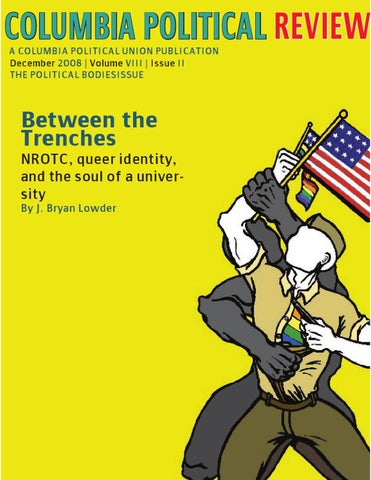
COLUMBIA POLITICAL REVIEW A COLUMBIA POLITICAL UNION PUBLICATION December 2008 | Volume VIII | Issue II THE POLITICAL BODIESISSUE
Between the Trenches NROTC, queer identity, and the soul of a university By J. Bryan Lowder
Columbia Political Review | December
cpr dec 08
staff
Editor-in-Chief Karen Leung
Art Editor Stacy Chu
Publisher Sajaa Ahmed
Design Editors Sarah Cohler Charles E. T. Roberts
Managing Editors Sara Doskow Sara Vogel Managing Editor of Special Projects Eric Lukas Senior Editors Ayla Bonfiglio Catherine Chong Ian Crone Jamie Kessler Ben Small
Ideas Editors Kabita Parajuli David Zhou Outreach Editors Devon Galloway Maisha Rashid Tiffany Tang Head Copy Editor Annie Ma
Columbia Political Review | cpreview.org
Campus Editors Erin Conway Kati Fossett Sophia Merkin Poll Analyst Nicolas Alvear Business Managers Alex Frouman Max Mogensen Fact-checking Team Arun Gollakata Adam Kuerbitz Caitlyn Malcynsky
POLITICAL BODIES SUSANNA O’KULA The Politics of Politeness Interview with Professor Jenny Davidson DAVID BERKE The (New York) State of Sex Same-sex marriage, abortion law, and Democratic control J. BRYAN LOWDER Between the Trenches NROTC, queer identity, and the soul of a university LANE SELL The Exposé Became the Cover-Up A review of Standard Operating Procedure AVRAM SAND Earl Hall, Politicized The politicization of faith in campus religious groups DAVID ZHOU
Campus Anti-violence and Consent Culture The movement and the message
4 6
contents
11 12 14 16
FEATURES MARYALICE PARKS On the Path to Sumak Kawsay Ecotourism and respecting “the good life” in indigenous Ecuador NICK KELLY Sleep After Election Day Citizenship in the American intellectual tradition IAN CRONE Surfing the Seven Torrents Piracy and property in the 21st century ADOREE KIM Mad Cow Infodemic Excessive democracy on the South Korean internet
18 20 22 24
COVER ART REBEKAH KIM
Title Of The Article
Columbia Political Review | December
> The Politics of Pol
Bodies, breeding, and hypocrisy in m Interview with Professor Jenny Davidson Jenny Davidson teaches in Columbia’s Department of English and Comparative Literature. She writes on eighteenth-century literature and culture, and her areas of expertise include British cultural and intellectual history and the contemporary novel in English. She is the author of Hypocrisy and the Politics of Politeness: Manners and Morals from Locke to Austen, and her most recent book, Breeding: A Partial History of the Eighteenth Century, comes out this winter. She also writes a popular blog, Light Reading. Susanna O’Kula talks to Prof. Davidson about the politics of manners and their representations. On the novel of manners: When people talk about the novel of manners, they’re often referring to the nineteenth rather than the eighteenth century—the novels of Jane Austen and Henry James come to mind, with their extraordinarily supple attentiveness to the play of human relations. But manners are of great interest to eighteenth-century writers also. A novelist like Samuel Richardson or Frances Burney describes the physical manifestations of the emotions in individuals as they are affected by social interactions with extraordinary imaginative perceptiveness and precision, and manners—a shorthand for the complex codes that govern those interactions—are perceived as a key to all sorts of other things, from individual psychology to the workings of political society. On the importance of etiquette in eighteenthcentury British society: Well, in a sense I’d want to say that rules of conduct matter in every time and place—though it’s true that in eighteenth-century Britain, there’s a particular intensity to the attention writers are paying to the relationship between ethics and etiquette. Social pressures like class mobility, the changing roles of men and women and the growth of empire overseas all contribute to anxieties about manners, of course; and in a different sense, the emergence of ways of
thinking and writing associated with the Scottish Enlightenment and the nascent social sciences places at a premium the discovery of new languages for sociability, manners, politeness and so forth. On how politeness could preserve civility, if not truthfulness: There are several notorious and highly polarizing examples in this period. When I sign a letter “Your most obedient and humble servant,” is that a falsification of my relationship with the person to whom I have addressed the letter? What about if I ask my servant to say that I am “not at home” to visitors—is that safely perceived as a conventional “white lie,” or do I actually degrade my own truthfulness by practicing these forms of supposedly innocent deception? It’s my contention, in Hypocrisy, that it’s not a coincidence that servants should take such a prominent place in both these important examples; I think that anxieties about relations between people of different social classes tend to fray the seams of arguments about politeness…Politeness comes to be able to hold a great deal of ethical and political value—it may be worth pointing out here the etymological connection between politics and politeness…. On the use of hypocrisy as a moral and political virtue today: There are always two poles on this kind of topic. Hypocrisy is hard to defend under its own name, and we live in a culture of exposé—if someone running for office is keeping a secret, the press has all sorts of incentives to cover it up. I think we’re all pretty comfortable condemning the outright hypocrisy of an Eliot Spitzer, whose very public crusade as moral reformer was fatally undermined by the revelation of his dealings with prostitutes. But there are other kinds of hypocrisy that may be more allowable. After the death of Stephen Jay Gould, for instance, I remember reading a collection of encomia by well-known scientists and writers on Gould’s contributions.
Columbia Political Review | cpreview.org
One of them was by Steven Pinker. Now, if you’ve ever read Steven Pinker, you know that really he thinks Gould’s contributions were quite pernicious, and that the fuzziness of thinking and argument displayed throughout Gould’s work completely invalidate whatever points Gould was trying to make! But it really and rightly would not be appropriate to take the occasion of a commemorative piece in a major national periodical to say that—in this kind of case, it seems to me right to concentrate on the positive, even if it represents pretty much a falsification of one’s views. On whether manners have been replaced as indicators of social status in our culture: Yes and no. Manners are inextricably bound up with notions of distinction, though in our own time manners have been far more clearly detached from birth than they were circa 1700. But one of my arguments in the new book is that breeding is an interesting keyword to explore precisely because it lets writers uncertain of their own position on the question of whether a gentleman is a gentleman by virtue of his birth or his upbringing hedge. Breeding, strange to say, works as a synonym for nature and for nurture; it clearly refers to matters of blood, pregnancy and so forth as well as meaning something more like rearing or upbringing. On the “politics of politeness” practiced by the presidential campaigns in the weeks leading up to the 2008 election: It’s an interesting question. Perhaps there was not enough of it for me to single out specific examples! But I think the praise that has generally accrued to John McCain’s concession speech, or to his defense of Barack Obama as a “decent family man,” shows the importance we still place on civility in politics. McCain clearly lost the election in part because those who had previously thought of him as a sincere and honest adherent to an admirable if possibly outdated notion of honor—one bound up with the traditions of the military and
liteness
modernity by Susanna O’Kula an almost chivalric idea of individual integrity— came to believe that he had given himself over to a mode of incivility that did not sit well with that identity. On how the work of Enlightenment thinkers interested in cultural betterment could resonate with our generation: The problems that vexed Enlightenment commentators on the relationship between inborn traits and education and the idea of human perfectibility continue to remain central objects of inquiry today. The stakes of such
al in terms that sound positive—a good example of this would be the parenthetical locution, as practiced by Southern ladies, of uttering the words “bless her soul” as a covert statement of the utmost disapproval and criticism. On our relation to eighteenth-century literature [Prof. Davidson is also the author of the novels Heredity and The Explosionist. Both incorporate events or people from the eighteenth century, although they are set in different places and time periods.]: The thing that drew me to the eighteenth
er mode I’m writing! On student interest in eighteenth-century British literature at Columbia: I have a sense, purely anecdotal, that during the eight years I’ve been at Columbia, enrollment in lecture courses in English has gone slightly down, regardless of field…classes that used to have 50 to 60 students are now more likely to have 35 to 40. This may simply be a function of us offering more seminars. I find that interest in eighteenth-century British literature is modest but sustained. I like teaching in
Shaina Rubin questions are very high, in terms of educational and social policy, so that we can never talk about nature and nurture in the abstract without thinking about the consequences of such arguments for individual children whose development will be aided or hindered by the positions we take. On manners and hypocrisy in New York City: Certain things about manners in New York are not strikingly polite—for instance, many Europeans find it extraordinarily rude how comfortable New Yorkers are at parties asking people they’ve just met what they do for a living, or confiding how much they pay for an apartment! Southern manners are more generally supposed to include hypocrisy than New York manners, though often there are ways within a code of politeness to express disapprov-
century and keeps me there is the combined sense that on the one hand, the eighteenth century is us—we are in a recognizably modern world from Locke’s time onwards, in a way that we are not if we are reading Shakespeare or Milton or Bacon or Hobbes. On the other hand, it’s still a distinctively strange world too, one that is full of unfamiliar and bizarre things that catch us short if we are starting to assume too easy an identification. That’s some of what I want to draw out in my fiction—and, of course, I spend so much time thinking about eighteenth-century things, the period naturally provides the idiom and ideas that I want to draw on in whatev-
this field partly because I have an evangelical commitment to spreading the word about the amazing unknown treasures of the eighteenth century—I believe that there are deep continuities between that period and our own, which makes it of particular interest. But I also like the way that students don’t come in with a lot of knowledge or background in this period, and that it is easy for me to surprise them with the interest and relevance of what is often assumed to be a slightly dull and respectable subfield of English literature!
Susanna O’Kula sso2108@columbia.edu English
Born and raised in the South, Susanna (CC‘10)naturallyhasexcellentmanners (mostofthetime)andeventuallyhopes to put them to use as a physician. Columbia Political Review | December
David Berke
The (New York) State of Sex Same-sex marriage, abortion law, and Democratic control Save for a fleeting moment in 1965, Democrats have not controlled the New York State Senate since 1935. For decades, the Republican-ruled Senate has been clashing with the Democratic State Assembly, the bitterly opposed factions battling themselves into a legislative stalemate. As a result, three men—the Governor, the Assembly Leader and the Senate Leader—have controlled New York politics, dictating policy to the otherwise irreconcilable state legislature. But thanks to this past election, the stagnation may end. Behooved by Obama mania, the Democrats gained a thin two-senator majority. Queens Republican stalwart Serphin Maltese fell to Democrat Joseph Addabbo, and Caesar Trunzo of Long Island lost to Brian Foley, giving Democrats a 32-to30 edge in the 62-seat chamber. Along with the Senate, Democrats maintained commanding control of the Assembly and the governorship. With this domination of state government, the expectation is that Democrats can now achieve long-time goals like further liberalizing abortion law and legalizing samesex marriage. But these goals may prove more difficult than the sea of blue indicates. The slim two-senator majority may not be enough for changes to social policy, and if not handled correctly, these issues could splinter the majority they helped to create. Though New York’s abortion laws are among the most liberal in the country, prochoice advocates have been working to expand the state’s abortion protections. In 2007, Governor Spitzer joined abortion access advocates to support the Reproductive Health and Privacy Protection Act (RHPP). The Act enshrines abortion until fetal viability as a “fundamental” right for New Yorkers and removes references to abortion in state homicide law. It also forbids any additional regulation of abortion.
The Republican Senate proved an insurmountable obstacle to passing the RHPP, and Spitzer, the bill’s chief champion, resigned after the public discovered his predilection for prostitutes. Now, pro-choice advocates are ready for a second try. “We’re definitely hopeful,” said Samantha Levine of the National Association for the Repeal of Abortion Laws (NARAL), an abortion access advocacy group. “This change is our opportunity to make New York a pro-choice leader.” NARAL canvassed, sent mailers, and cultivated support on behalf of Foley and Addabbo, and the upcoming session is prime time for Democrats to return the favor. However, fault lines within the Democratic Party may hinder movement on the RHPP. The day after the election, four city Democrats—Senators Pedro Espada, Rubén Díaz, Carl Kruger and Hiram Monserrate—formed an independent caucus that, if not appeased by Democrat leadership, may remain independent or support current Republican senate majority leader Dean Skelos. “The so-called ‘group of four’ is defined by their relatively conservative social views,” said Gerald Benjamin, state political expert at SUNY New Paltz. Five days after the election, Senator Monserrate dropped out of the caucus, but he was the most socially liberal of the group, the easiest ally for the Democratic establishment. Senator Díaz, on the other hand, is an entrenched social conservative, stating point-blank that he will never vote the Democratic line on abortion, samesex marriage, or stem cell research. “Senator Díaz has always been a friend to the pro-life life movement,” noted Debrah Cody, current director of political and legislative Activity for the NY Right to Life Committee. Though important to NARAL and many New York voters, passing the RHPP does not carry the same urgency it did in 2007. The
bill’s goal was to act as a fail-safe were the Supreme Court to strike down Roe v. Wade. The fall of Roe v. Wade was a real possibility under Bush and would have remained possible, even likely, if McCain had won. But with Obama in the White House, sizeable Democratic majorities in both Houses of Congress, and the possible selection of new Supreme Court justices by these Democrats, the federal right to abortion will undoubtedly stand for years to come. With issue of abortion safe on the federal level, Senate Democrats will be able to stall pro-choice progress in order to focus on shoring up their governing coalition. With same-sex marriage, however, the battle is far more contentious, with groups in the Democratic Party stubbornly demanding opposing outcomes. With no federal protection, the legislative wars over same-sex marriage could be brutal enough to topple the Democratic majority. Democrats are heavily indebted to gay advocacy groups, for their support was a driving force behind the Democratic takeover. Gay advocacy donations to senate races, the majority given by the Empire State Pride Agenda (ESPA), totaled around $500,000. Given that the cost of an entire Senate race averages $500,000, that financial support is sizable. Before this election, ESPA had worked with candidates on both sides of the aisle, but in light of recent Republican opposition to ESPA-backed legislation, the group swung Democratic. Without ESPA’s partisan support, the Democratic Senate takeover campaign would have been far weaker. ESPA’s mobilization was predicated on strong promises from Democrats. Malcolm Smith, the current Democratic minority leader in the Senate and the new probable majority leader, said at an ESPA fundraiser that same-sex marriage is at “the top of the list”
Is gay marriage still atop the Democratic list? “We’re putting everything on hold until we fix the economy,” said Senator Thomas K. Duane.
Columbia Political Review | cpreview.org
for Democrats, adding that he would introduce a same-sex marriage bill on “the first day of our session.” Audacious assertions aside, the senatorial numbers don’t add up. Only 22 of the 32 Democrats elected on November 4th are on record as supporters of same-sex marriage. Not even Senator Foley, one of those two coveted pickups, has come out for same-sex marriage. Senator Díaz of the now-“gang of three” may refuse to join the Democratic majority if Smith even introduces samesex legislation. Díaz, a reverend, ardently opposes same-sex marriage—going so far as to rebuke his own son, a same-sex marriage supporter, in the State Assembly. If Díaz perceives that his membership with the Democratic majority abets a same-sex marriage bill (a Republican majority would never introduce it), he may very well refuse to support Smith. So is gay marriage still atop the Democratic list? “We’re putting everything on hold until we fix the economy,” said Senator Thomas K. Duane, a prosame-sex marriage Democrat, to the New York Times. While the economy is the stated reason, the socially conservative “gang of three” has also played a role in quieting the roar for same-sex marriage. Democrats can cope with a stopgap on abortion legislation, but they cannot so easily renege on their previous same-sex marriage promises. After all that fundraising, ESPA will want results. If Democrats do not deliver, ESPA could return to its bipartisan lobbying. That would deflate Democratic chances of maintaining power in the 2010 elections, which would enable them to redraw district lines and protect their majority from Republican challenge. The expectation that Democrats would get moving on same-sex marriage was evident for Assemblyman Daniel O’Donnell, who represents the 69th Assembly district (including Morningside Heights). O’Donnell was the openly gay chief sponsor of the same-sex marriage bill that passed in the Assembly last year, but which was never considered by the Republican Senate. He said he hoped that Senate Democrats “keep their promises…after fundraising in the gay community.” A testy edge was apparent in his voice. “I’m looking forward to the Senate acting as quickly as the Assembly [on same-sex
marriage]…[Probable Senate Majority Leader] Malcolm Smith has always made it clear that he intended to do that.”
So Senate Democrats need same-sex marriage legislation to propitiate the gay lobby, but may not prefer to introduce such legislation to keep their majority. Given this bind, the avenues for compromise are limited. Civil unions, legal domestic partnerships with fewer benefits than marriage, seem like the logical course. About 75 percent of New Yorkers do not oppose them, compared to the 42 percent who are for same-sex marriage. However, under current New York law, civil unions would grant couples far fewer spousal rights than marriage. Thus, legalizing civil unions would require a complete revamping of domestic partnership law. Plus, civil unions are not enough for many same-sex couples. “Civil unions have proved problematic,” said O’Donnell. “If you say, ‘We are married. This is my spouse,’ people understand what that means.” To hold the party together for now, Dems
David Berke djb2142@columbia.com English, Creative Writing
could shepherd through the Gender Expression Non-Discrimination and the Dignity for All Students Acts, two pieces of anti-discrimination legislation for transsexuals and gay students. The Republican Senate failed to pass both acts, which are heavily supported by ESPA. If the gay lobby sees movement on this legislation, perhaps in tandem with civil unions and same-sex marriage on the post-2010 horizon, they may be sufficiently contented to continue supporting Democrats, all without the same-sex marriage legislation that could tear the Democrats apart. Plus, same-sex marriages are already unofficially legal in New York. Earlier this year, Governor Paterson ordered state offices to recognize gay marriages from out of state. Now, gay couples can marry in Massachusetts or Canada and have their marriages recognized in New York. So navigating the minefield of sex law may be possible for Democrats, but the reality is that the party’s social troubles extend beyond abortion and gay marriage. The independent caucus, though strongly concerned with these issues, is also dead set on securing more leadership roles for Latinos in the senate, and the racial tension is already boiling. “There’s a concern that we have a black president, a black governor, and we have a concern that we have to be sharing power,” said Mr. Díaz to the Times. Those three senators don’t want Malcolm Smith, also black, to take the reigns and may insist on a Latino majority leader. This black-Latino tension comes in tandem with longstanding unrest over Latino underrepresentation in the Senate, including a 1992 Latino-related redistricting battle that went all the way to federal courts. Tension and uncertainly are abundant. If the Democratic majority is to survive, it may spend its first term skirting social issues rather than confronting them, doing just enough to appease the independent three, pro-choice advocates and the gay lobby. If unsuccessful, this period of Democratic control could be as ephemeral as it was in 1964. And what happened to that 1964 Democratic majority? Infighting quickly tore it apart.
David (CC ‘09) has lived in New York his entire life. He urges you to pay more attention to local politics (but never work in them).
Columbia Political Review | December
J. Bryan Lowder
Between the Trenches NROTC, queer identity, and the soul of a university If you had to describe the interior design of the Stephen Donaldson Lounge, you might call it “trendy activism.” Soft, chic lighting gives a certain glimmer to the bowl of NYC-promo condoms resting on the side table. Queer theory books line the shelves, and a handwritten chart of “safe space” guidelines hangs from the room’s central column. Much of the decoration in the Lounge—the University’s dedicated LGBTQ students’ space—features its namesake, Stephen Donaldson. Posing in his naval uniform next to a large ship anchor, a smiling Donaldson surveys the Furnald basement room from a large portrait mounted beneath the windows. Over the years, the Lounge has played host to its share of controversy, but this fall, one issue has reigned supreme. Early in the semester, word spread that certain University Senators were moving to raise the question of bringing a Naval Reserve Officer Training Corps (NROTC) program back to Columbia’s campus. The leadership of various queer student groups, many which meet in the Donaldson Lounge, quickly mobilized to join the discussion by developing positions and drafting statements: tactics familiar to most activist organizations. But beyond the forums and flyers, a more interesting story was taking shape. Members of the queer community were forced, some for the first time, to confront the intersection between identity and politics directly. Being gay meant that you were expected to align with the anti-ROTC side, and while the membership of most queer organizations did so, a minority of students who were queer and supportive of the military found themselves in a balancing these two roles. Their sexual identities were politicized in a very specific way, yet their personal politics led them to resist this interpellation. In what has been called a battle over hearts and minds, this real internal struggle accesses, far more than partisan talking points, the deeper questions undergirding NROTC at Columbia. How does the individual relate to the community, how does that community influence the university, and what is the responsibility of that institution to larger civil society? Both sides have staunch answers, but
neither has it completely right. Those in the space between the trenches recognize this; and it’s through the lens of their experience that I hope we can find a little truth. THE PATRIOTIC HOMOPHILE I think it’s appropriate that Donaldson watches over this debate. He dealt with the same conflict between identity and politics that many members of the queer community face today. Originally named Robert Anthony Martin, Jr., by his parents, Donaldson adopted his pseudonym upon entering Columbia in 1965 to avoid damaging the reputation of his father, a Rutgers math professor and Navy veteran. His open bisexuality, he reasoned, would not do much for Dad’s career. Angered by instances of homophobic discrimination at Columbia, Donaldson quickly became a sort of proto-activist, starting a movement to establish a student “homophile” group on campus in 1966. After months of struggle, Donaldson’s Student Homophile League was finally granted an official University charter on April 19, 1967. As the first queer student organization in the United States, the SHL made headlines and gave Donaldson a platform from which to advance his gay rights agenda. The Columbia Queer Alliance (CQA), a descendant of the SHL, continues to advocate on behalf of LGBTQ students today. Gay rights were not Donaldson’s only interest. He also had a strong desire to serve in the US Navy, and, upon graduation, he pursued his dream. He served as a radioman from 1970-1971 with an unmarked record, only to receive a General Discharge in 1972 when personal letters detailing his homosexual exploits were discovered by officials. Donaldson fought the discharge, bringing a great deal of attention to the question of homosexuals in the military, but ultimately lost his case. But in 1977, President Carter upgraded Donaldson’s status as part of a general review program for Vietnam veterans. Donaldson became the first person dismissed on the grounds of homosexual activity to receive an Honorable Discharge. A certificate commemorating the upgrade still hangs in the Lounge.
Columbia Political Review | cpreview.org
Donaldson’s story of passionate struggle for both civil equality and service to country is highly relevant to the current situation. Donaldson was both gay and a supporter of the military, both a civil liberties activist and a soldier; he felt it impossible to ignore either aspect of his life. In the divisive climate of the current NROTC debate at Columbia, a segment of the LGBTQ population has found itself, like Donaldson, at ground zero of the collision between identity politics and civic engagement. As Donaldson’s example demonstrates, their position is not entirely new. The historical relationship between the University, a pluralistic space ostensibly open to all identities, and the military, a hierarchical organization necessarily limiting to individualism, is a complex issue that has deep significance for the definition of its modern institutional character. U.S.S. JOHN JAY The NROTC story at Columbia begins in the late 1960s, in the midst of dissatisfaction with the handling of the Vietnam War. The University had traditionally maintained strong ties to the military, having hosted a naval training unit on campus since 1916 (NROTC specifically began in the 1940s). During WWII, Columbia dedicated a large portion of its space and resources to the war effort with particular focus on the Navy, producing more naval officers per year than the US Naval Academy. A midshipman training program was housed in John Jay residence hall (colloquially called the U.S.S. John Jay) and a shooting range was even built under Kent Hall for the Rifle Club. In the decades that followed, support for the military diminished on campus, culminating in the years surrounding the infamous student protests of 1968. By the spring of 1969, the newly-constituted University Senate decided to ban NROTC from campus in an effort to satisfy the widespread anti-war movement within the community. Interestingly, it was Stephen Donaldson, then a member of the Columbia College Student Council (CCSC), who submitted the ban resolution to the Council, citing the military’s discrimination against homosexuals as a key reason to
remove the program from the University. Following the end of Vietnam, no move was made to reinstate the unit, and the issue remained essentially closed until the spring of 2005. In May of that semester, a grassroots movement led by student veterans to reestablish NROTC was thwarted by a University Senate vote of 53-10 against, with the military’s “Don’t Ask, Don’t Tell” (DADT) policy and its incompatibility with the University’s anti-discrimination statutes cited as the main reason. Since the early days of Donaldson’s SHL, homosexuals had won the declassification of homosexuality as a psychological disorder and obtained minority status similar to racialized groups in the liberal imagination. It’s not surprising, then, that DADT, a law overtly discriminatory towards gays, became such a hotbutton issue at Columbia. Still, unfazed NROTC proponents vowed that the 2005 vote was just “the end of the beginning.” The current controversy began in May of 2008. A group of SEAS students led by University Senator Rajat Roy began petitioning the Engineering Student Council (ESC) to reestab-
mer, and LGBTQ, anti-war, and other social justice organizations on the latter. TACTICAL MANEUVERS As I write a few days before the survey is released, ad campaigns are in full swing, the panel debates have passed, and both sides hope to win the support of the wider student body. The funny thing is, even with all their fervor, the hours of organizing, campaigning, and debating may be pointless. For one thing, the final word on NROTC must come from President Bollinger and the Board of Trustees, and he has made it clear that the return of the program is highly unlikely, regardless of student feeling. And it’s not even clear that the military would be interested in investing the money and manpower necessary to build a program at Columbia if given the go-ahead. The anti-ROTC side, it seems, has nothing to fear, and the pro side fights a losing battle. So what are we really talking about? NROTC itself isn’t the real issue—it’s just the symbol of a deeper conflict. Past all the rhetoric, the real fight concerns the ideologi-
A SIMPLE ISSUE On one hand, Columbia’s queer student groups—the Columbia Queer Alliance being one—ostensibly oppose the return of NROTC on the grounds that DADT stands in direct conflict with the University’s anti-discrimination policy. In other words, it’s simply a matter of legality. Established in 1993 by Congress under the Clinton administration, DADT (Title 10:654 of the United States Code) makes “a person who engages in, attempts to engage in, has a propensity to engage in, or intends to engage in homosexual acts” ineligible to serve in the US Armed Forces in the case that he or she is discovered to fit one of those categories. Officers are barred from asking about a serviceperson’s sexual orientation, while soldiers are banned from disclosing their sexuality to others within the military. Many viewed the measure as a compromise, as it allowed gays and lesbians to serve, where they had been completely prohibited before—only silently. Almost everyone now admits that the poli-
Donaldson was both gay and a supporter of the military, both a civil liberties activist and a soldier; he felt it impossible to ignore either aspect of his life. lish NROTC because the program offers scholarships to students struggling to meet tuition costs. An important detail to note is that, unlike other off-campus ROTC programs for the Air Force and Army in which Columbia students may participate, no naval program currently has an arrangement with the University. The debate got moving on September 11, 2008, when then-Presidential candidates Barack Obama and John McCain both called for the return of ROTC to Columbia at the ServiceNation Forum held in Alfred Lerner Hall. Obama said on the issue, “…the notion that young people here at Columbia or anywhere, in any university, aren’t offered the choice, the option of participating in military service, I think is a mistake.” While neither candidate even mentioned the current reasoning for the ban, this bipartisan directive reignited the issue, and the old battle-lines were quickly drawn. Over the next few weeks, student councils held a number of contentious discussions, eventually deciding to pose the question to students in a survey format, after which the University Senate could take more substantive action in accordance with student support. Ad-hoc coalitions quickly formed on the pro and anti sides, with mainly veterans and military supporters making up the for-
cal soul of the University. In a sense, the antiROTC side envisions an institution that stands as a model to the rest of society. Free from prejudice and discrimination, the “academy” should be a so-called “safe space,” where academics work to improve the world without interference from governments. The creation of such a space, in their view, challenges societal injustice by refusing to participate in its propagation. The pro-ROTC side has a more hands-on view. It imagines the University as inexorably linked to the nation-state (including the military), with an essential duty to engage directly with that construct. “Safe space,” they might argue, is a fantasy that doesn’t reflect the realities of civil society. While they agree that the academy should work to combat prejudice and discrimination, they firmly believe that the most effective strategy is direct involvement—change from the inside. To understand this disagreement over tactics, I think it’s helpful to examine the most salient point in the debate: “Don’t Ask, Don’t Tell.” Both sides agree that the military, and by extension NROTC, institutionalizes discriminatory practices though the DADT policy, and both sides believe that change is necessary. But they approach that change entirely differently.
cy is ethically problematic and, perhaps more importantly, logistically counterproductive to the military in a time when enlistment is low and forces are over-stretched. The newlyelected Obama administration has promised to tackle the issue by 2010, so DADT soon may be a moot topic. However, queer leaders on the con side say that this is not the point. “This isn’t about some romanticized idea of what the program [NROTC] might look like in the future,” said CQA Vice President Aries Dela Cruz (GS ’09) at the CCSC debate on November 19. “It’s about the program as it stands now. It’s a simple issue.” For Cruz and others, the fact that openly gay students would not be allowed to fully participate in NROTC now is reason enough to ban the Corps from campus. If their anti-discrimination policy logic were correct, then the issue might be as clear-cut as the anti-ROTC students claim. But some on the other side argue that Columbia already allows discriminatory organizations to operate on campus. Catholic student groups, for instance, can discriminate against gay students in accordance with Church doctrine. Study abroad programs suggest that students downplay their sexuality in certain cultural contexts. Because of FDA policy, this organization prohibits sexually active gay men from donating in
Columbia Political Review | December
its campus blood drives. The comparison to NROTC is striking. The Red Cross is a national organization, which, like the military, works for the benefit of the citizens. Gay people, unfortunately, are not allowed to “serve” in this organization because of federal law. Yet, the Red Cross van is a regular visitor to College Walk. How is this fair? Anti-ROTC partisans answer this criticism with two arguments. The first, the fact that NROTC would be institutionalized and not simply a student organization, is a good one. ROTC programs generally function as military science departments, complete with classes and instructors. These teachers would be granted full professor status without participating in the university tenure process, accountable only to the military. The University would have to find a way to vet new hires; oversight would be almost impossible. Understandably, anti-ROTC students fear that Columbia’s liberal arts ideology would not necessarily be preserved. Second, they say that it’s unfair to treat large bodies like the Catholic Church as single-minded entities—different sects could be more tolerant, for instance. It’s hard to see how this isn’t a little hypocritical, as this is precisely how anti-ROTC proponents treat the military. Furthermore, the Catholic Church’s position is similar to that of the military under DADT. Essentially, homosexuals aren’t excluded from the communion as long as they don’t act on their desires— as long as they “don’t tell” their sexuality. The doctrine seems to have the same effect as the military’s policy, yet Catholic organizations receive support from the University. Maybe the failure here is not of logic, but of the extent to which that logic is pursued. If anti-discrimination is the issue, then everything from the Red Cross to the Catholic Church should be banned. But I suspect
that most anti-ROTC students wouldn’t want this to happen. Collecting blood for sick people, they might agree, is more important than boycotting the Red Cross for a misguided and discriminatory policy that it’s not even responsible for. But where is the line drawn? What makes the goal of an organization more important than its means? THE 70 PERCENT SOLUTION Proponents of NROTC, first and foremost, believe that Columbia has a civic duty to support the US Armed Forces. While they admit that DADT is problematic and would like to amend it, most pro-NROTC students think that the issue isn’t as simple as “you discriminate, I don’t participate.” All assert that Columbia’s disengagement from the military is at best an ineffective method of fighting prejudice, and at worst, harmful to both parties. I recently talked with two Columbia students involved with the Armed Forces about these issues, and both men seemed to think that the real source of the resistance to NROTC lies in a misunderstanding of the nature of the military. One of the men, a Columbia College student who wished to remain anonymous, explained things this way: “The military has this idea called a 70 percent solution: a pretty good solution now is better than a 100 percent solution later when everyone’s dead. DADT is like that.” Sean O’Keefe (GS ’10), a former Green Beret, nodded in agreement. “In some sense, the point of basic training is to minimize your identity,” he said. “The [Department of Defense] wants to get rid of anything that might break cohesion, especially in combat units. It’s not fair, but DADT, like the exclusion of women from certain units, is necessary for unit cohesion. Until a better idea comes
Stacy Chu
10
Columbia Political Review | cpreview.org
along, the possibility of social tension is just too risky.” In my conversations, I found this 70 percent idea integral to the mindset of the proROTC supporters. Both men were quite clear in affirming that DADT is discrimination—they just feel that “defending the Constitution” is more important than total sexual freedom. This is the Red Cross question. When is mission more important than method? To the ROTC supporter, the success of the military, and perhaps more importantly, the defense of the nation, simply takes precedence over dealing with the problems that may or may not arise from the presence of openly gay servicepersons. Like blood for sick people, military success may require some sacrifice of individualism for the good of the collective. While I agree that national defense is a top priority, the underlying assumption of this argument strikes me as problematic. Ideally, the servicemen suggested, DADT would only apply to combat units, where quarters are close and emotions run high. This assumes that soldiers, gay or straight, could not be mature enough to control themselves on two levels. First, gay soldiers apparently can’t keep their hands to themselves. Straight soldiers couldn’t possibly deal with the fact that a gay person might be physically attracted to them, and so would have to retaliate, either passively or violently. The unit would destabilize, leading to mission disaster. I don’t buy this scenario. It casts homosexual desire (and heterosexual desire, for that matter, considering the exclusion of women from these units) as some sort of subversive force, and denies personal agency to everyone involved. Furthermore, it’s the perceived carriers of this force, gays and women, who must be removed, not the straight men who would “have to” react negatively. But as the men rightly pointed out, this prejudice isn’t unique to the Armed Forces. The military, they argued, is a job like any other. According to O’Keefe, “sexuality doesn’t matter on the ground.” “It’s like working at Goldman Sachs,” the College student added. “You can’t walk in there in a pink zoot-suit and expect to be taken seriously. Sometimes you have to bite your tongue for the good of the group.” In an organizational context, they argue, personal identity is always secondary to the success of the whole. If you accept this logic, it does seem unfair that Columbia actively encourages banking and consulting recruiters to come to campus, while banning the NROTC. Of course, these men do not speak for all pro-NROTC students. In fact, I think it’s fair to say that most proponents disagree with DADT entirely. What the men do have in common with the majority, however, is their strong belief in the positive impact that an NROTC pro-
What pro-ROTC activists seem to envision is a military that looks, in a sense, like the University. gram would have on the University and on the military. Almost everyone I spoke with made the case for a sort of osmosis theory of social change. Officers trained in a liberal arts tradition would export the values of their education to the military, thereby liberalizing the entire organization—an interesting idea that assumes that the military can and should be “liberalized.” What pro-ROTC activists seem to envision is a military that looks, in a sense, like the University. Creative leaders would use progressive ideas to run their platoons, and all Americans could serve with dignity, regardless of personal identity. I wonder if this is a realistic possibility. Change might be effected this way, but then again, NROTC programs have operated at other universities for decades, and the military arguably remains a bastion of conservatism. And the military, as an idea, must be organized hierarchically, and has an interest in the success of the mission over the happiness of the individual soldier. Even if homosexuals could serve without fear of discrimination, neither they, nor anyone else, would be allowed to question the actions of their superiors using Kant’s categorical imperative. So-called liberal values like the “free flow of ideas” may not be possible or desirable in every context. Policy change that limits discrimination, more than some abstract idea of liberalization, is probably what the military really needs, and I’m almost certain that the federal government will take those steps in the coming years. Regardless of future change in the larger military, the point still stands that NROTC, as it is exists, would directly discriminate against openly queer Columbia students today. THE SPACE BETWEEN So what’s the answer? There may not be a perfect solution, but we can learn a great deal by examining the tricky terrain between the trenches: the space inhabited by those individuals who happen to be both LGTBQ-identified and pro-ROTC. While traversing the expanse between two belligerent parties can alienate the individual from both, this distance can afford a certain insight into the conflict that’s difficult for the more entrenched players to access. Learned Foote (CC ’11), President of his class and Treasurer of the CQA, finds himself in this difficult position. Like Stephen Donaldson, Learned is a gay military supporter. He wants NROTC to return to Columbia, not be-
cause he wishes to participate himself, but because he thinks personal involvement is the only way to challenge prejudice. “You can’t talk with people you vilify,” Foote said when asked about his philosophy. “Hearts are changed though personal relationships.” The military and the discrimination therein, he argues, reflect the society of which it constitutes a part, and Columbia is not exempt. “Discrimination is a natural human tendency,” he said. “The idea of our campus as a safe-space—as a non-discriminatory space—is impossible.” Instead, Foote believes that homophobic institutions, like homophobic individuals, must be confronted directly. I admire Foote’s reminder that “vilifying” and disengaging completely from discriminatory people and institutions is not a productive measure, at least not in the long run. But I wonder if his dismissal of safe space is entirely fair. I don’t think most people interested in creating a non-discriminatory environment believe that such a place can really exist; rather, it’s a goal to work toward, and a condemnation of the discrimination that exists elsewhere. Justin Johnson (SIPA ’10), a gay military veteran, believes that homophobic institutions, like homophobic individuals, must be confronted directly. “When gay people come out to their family and friends, it changes opinions,” Johnson said. “How does excising ourselves from the discussion help?” Johnson, like Foote and other pro-ROTC students, feels that the best way to challenge DADT and more general homophobia is to fill the military with gay-friendly—and even openly gay— officers. As a gay person, he understands the queer community’s frustration with the discrimination embedded in NROTC, but he also questions the value of a boycott. “What are we really doing to fight DADT?” he asked. “I hope people, especially heterosexuals, aren’t using DADT to fight Vietnam.” Here, Johnson gets at something that I think is central to this entire debate. Many on the pro-ROTC side feel that beneath the cries of discrimination, the real reason for banning NROTC from Columbia is broader anti-militarism. Certain groups on the anti-ROTC side have taken decidedly anti-military stances, but the queer community and the groups that represent it, have not. The queer groups have,
J. Bryan Lowder jbl2121@columbia.edu English, Music Composition
however, aligned with anti-military organizations in the “con coalition.” This coalition raises the question of the limits of solidarity against a common enemy. While all of the con parties have an interest in keeping NROTC off campus, their alliance obscures the DADT question somewhat unfairly. If DADT is really the issue, then regardless of how the change is predicated, NROTC should be allowed to return once the law is repealed. Yet, based on some of the rhetoric I’ve heard from queer individuals on the antiROTC side, I worry that this isn’t the plan. The use of third-person pronouns like “they” and “them” seems to suggest that anti-ROTC activists view the military as inherently separate from themselves—a logic I find false and dangerous. This is the language of the anti-military crowd, and even though their interests are aligned with the gay community at present, anti-militarism has no necessary connection with queer politics. Queer leaders should be careful to maintain the distinction between protecting our community from discrimination and separating ourselves from society, because while “safe space” can be a tool for social change, it can also morph into a bubble of complacency and isolation. The pro-ROTC side’s logic about liberalization through osmosis might be flawed, but their belief in the intimate, necessary connection between the University and civil society—a society which requires a healthy military—is right. We, as a university community, have a duty to fight discrimination, both here and outside of our gates. Gay social justice is an honorable cause, and keeping NROTC off campus until the repeal of DADT may be the best way to support that cause. But it’s only a 70 percent solution at best.
Bryan (CC ‘10) enjoys writing words and music. Being (slightly) more interested in particles than politics, he hopes to become a science writer. Columbia Political Review | December
11
The Exposé Became the Cover-Up
Noah Breuer noahbreuer.com
Lane Sell Have we already forgotten the pictures from Abu Ghraib that washed over us four years ago? Without the photographs, there would have been no scandal. Without them we might never have known, or fully grasped, that young American volunteer soldiers who had been sent to Iraq as liberators had been put to work as criminals…In this respect, the photographs performed a profound public service; or they would have, if they didn’t make it so easy to think that they were the whole story. In these words, Pulitzer Prize winner Philip Gourevitch states the essential problem of Standard Operating Procedure, his new film-book project with documentarian Errol Morris (The Thin Blue Line, The Fog of War), which draws on extensive interviews with the enlisted MPs who took the fall for abuses at Abu Ghraib prison in the fall of 2003.
12
When we first saw those pictures, we thought we knew what they showed: gross abuse of innocent human beings at the hands of the American imperial machine. In a word, torture. Standard Operating Procedure is a bracing corrective to our rush to judgment of a shameful chapter in the history of a shameful war, reminding us that the pictures from the prison—the dead man in the shower, the bloodstained prison cell, the naked Iraqi pyramid, the hooded man on the box—do not tell the whole story. When Gourevitch points to the world outside the frame—the procedures and intentional lack of procedure that made abuse “not only possible, but…inevitable”—he provokes us to ask questions that absent themselves from dominant discourse, but which underlie the entire “scandal”: “What is the crime here? Is the crime taking photographs? Is the crime embarrassing us, the American people, or is the crime that which was revealed in the photographs?” Gourevitch goes on to reflect, “People see the
Columbia Political Review | cpreview.org
Standard Operating Procedure by Philip Gourevitch and Errol Morris The Penguin Press: 288 pp., $25.95 thumbs-up and the smile, they don’t see the crime.” To attempt these questions is to ask, most of all: How do we see outside the frame? And, although both writer and filmmaker are too elegant to say so directly, What is evil? On these last questions, Morris and Gourevitch owe much to Susan Sontag and Hannah Arendt. As Sontag observes in “Looking at War,” the problem isn’t that we remember through photographs, but that we remember only through photographs. With Abu Ghraib, the problem wasn’t that Americans of conscience judged the photographs, but that they judged only the photographs. Gourevitch argues that we fell under the spell of images: that “the power of a snapshot to convey a sense of perfect evidentiary knowledge, and its simultaneous pow-
er to be taken out of context,” made the famous photos “instrument[s] of deliberate misdirection.” Photographs, he notes, give us only “peepholes into history.” Morris’s archive, which includes telling letters from Private Sabrina Harman, suggests, further, that privileging sight at all may be a mistake. The crucial story of Abu Ghraib escapes the photographs precisely because photographs are not history. History, especially corrective history, demands expression in words. It requires that we not only see, but listen: listen to the people we have just seen or (mis)seen, and interrogate their words and ourselves, in an activity as silent as seeing even as it moves away from sight’s immediacy. Where the film forces us to feel with the MPs on the Military Intelligence block, Gourevitch’s writing probes problems of accountability and seeks the origin of the crimes at Abu Ghraib. The challenge to listen and see outside the frame provokes innovative formal responses from both writer and director. One of the book’s most striking stylistic features is its exclusion of the infamous images. Because those photos are already burned into our memory, and we can always see them, reading Standard Operating Procedure returns us to the moment of the photo-taking. Conspicuous in their absence, the photos are filled in by words. On film, too, Morris’s artful “illustrations” in slow motion and shadow point away from the photos (which appear only briefly), giving a visual context that includes “happy snaps.” And it is a testament to the clarity of Morris’s thinking that he never yields to the temptation to let the photos sit in majestic silence, but places them within a stark white frame—emphasizing their limits—and overlays them with provocative prose. The images are always accompanied by some voice giving an account of them—as act, as evidence, as cover-up. Standard Operating Procedure probes the nature and mechanics of evil. But Gourevitch stringently objects to the word itself. Evil, he has noted in interviews, almost unfailingly makes us think of a supernatural force external to our characters. In the wrong circumstances, though, most of us can be brought to commit wicked acts. Searching out the conditions that brought the MPs in the photographs to do what they did—and, more importantly, brought the people missing from the pictures (the interrogators, the torturers, the killers) to do what they did, off-camera—we need to understand how evil can lose, in Arendt’s formulation from Eichmann in Jerusalem, “the quality by which most people recognize it—the quality of temptation.” At Abu Ghraib, it happened through what interviewee Colonel Stuart Herrington terms “a perfect storm of insecure poisonous loca-
tion, inexperienced MP unit poorly led, inexperienced MI unit, hardworking interrogators trying to do the right thing, hamstrung by language, mortared, huge pressure to produce results from on high, very few resources, at the far end of the support chain.” But it also arose through the standard operating procedures instituted from above, vaguely permissive and permissively vague, intentionally open-ended, seldom written down. It came from assigning troops with no relevant training as prison guards and implementing them into the Intelligence program. As Gourevitch puts it, “There would have been no liberties to take, and no extremes to go to, if anybody had wanted to keep the MPs in check. Nobody wanted to because at Abu Ghraib lawlessness was the law.” Gross command negligence amounted to design. Though indebted to Arendt, Standard Operating Procedure’s work on the problem of evil (pardon the word) does more than rehash Eichmann. Adolf Eichmann mattered because he illustrated the malfunctioning of human conscience. Arendt described him as a man whose mind “was indeed set at rest when he saw the zeal and earnestness with which “good society” everywhere reacted as he did.” She notes that he did not need to “close his ears to the voice of conscience,” as the judgment had it, not because he had none, but because his conscience spoke with a “respectable voice”—that of respectable society around him. Eichmann merely judged what was acceptable on the basis of what was considered acceptable by his betters; what they said was good, he could not feel bad about. This was not the case for the MPs at Abu Ghraib. Gourevitch writes, “It is almost as much a cause for national pride as it is for despair that some American soldiers didn’t seem to understand, or to care, that they were supposed to be keeping their diabolical assignment a secret, that they never fully accepted the guilty code of omerta that comes naturally to those who are truly and self-consciously corrupt. They never entirely lost sight of the absurdity and insanity of their position.” The position for the night-shift MPs at Abu Ghraib was not one of simple conformity to the opinions of their betters, but a struggle between bruised consciences, perceived military necessity, and an atmosphere of permissiveness that actively encouraged abuse. Recovering these soldiers from the realm of monsters means remembering that the MPs were citizen soldiers, reservists sent into a war zone. Weekend warriors, kids working for college benefits, they were certainly not hard-
Lane Sell lds2113@columbia.com Classics, Visual Arts
ened torturers; the very fact of the photographs shows that they were amateur demons. They were like us, and like them we are not lily-white. In their shoes, we might have done the same, or worse. That they were ill-disciplined and illled was the very fact that allowed them to be exploited as fall-men when the scandal came to light. Naïvely, we might have believed that near-civilians would be the soldiers least likely to commit such abuses. And if they committed such acts, what were the hardened combat troops doing? The difference becomes clear in the battle record of the Marine First Recon Battalion chronicled in Evan Wright’s Generation Kill. These Marines, elite soldiers on par with Navy SEALs and Army Rangers, formed the tip of the spear during the invasion of Iraq. They were furnished with rules of engagement that turned cities and towns into free-fire zones, yet the pains these men took to avoid inflicting gratuitous suffering during their blistering advance through the Fertile Crescent testifies remarkably to the power of their discipline. Despite their battle cry—“Kill!”—these men believed they would be called to account for their actions. Their standard operating procedure was not lawlessness. “There is a constant temptation, when rendering an account of history, to distort reality by making too much sense of it,” Gourevitch warns. Nearly all who viewed the Abu Ghraib photos made too much warped sense of them. Thus the photos told Susan Sontag that the entire American nation was morally diseased—that we had raised a generation of violence junkies. They told the Army courts-martial that “a few bad apples” had dishonored the military profession. The current administration explained that the excesses of these “bad apples” were driving the insurgency: that rooting them out would turn the war around. Each account made too much sense of a world where sense itself had been suspended, except for that of pain. In rendering their account, the authors often refrain from explaining human behavior, instead forcing us to look at it. This move leaves the reader with a moral koan. The perverse irony of the Abu Ghraib photos is that they were often taken to document abuse; these documents ended up hiding the torture inflicted off-camera. We were almost bound to confound seeing with knowing, evidence with self-evidence. As Gourevitch has it, “That’s how it worked: no photo, no crime. The ocular proof: the exposé became the cover-up.”
Reports of Lane’s (GS ‘09) death have been exaggerated. Columbia Political Review | December
13
Earl Hall, Politicized
nonia, and the Columbia Chinese Bible Study Group told us that their groups were uninvolved, politically speaking; the leader of the Bahá’í Club described the faith as opposed to all forms of political partisanship, and expressed concern that even being interviewed for this feature would constitute political involvement. But by virtue of their tight-knit communities and the significance of faith in student life, Columbia’s religious organizations are especially well-situated to contribute to the campus conversation on politics, broadly defined. Avram Sand profiles four influential campus groups operating at the juncture of faith and politics.
HILLEL Hillel, the Jewish religious and cultural group, has to be careful about what kind of political statements it makes. Boasting the largest electronic mailing list on campus, it’s obviously difficult for Hillel to reach consensus in such a large and politically diverse group. Its religious subgroups—mainly the Reform, Conservative, and Orthodox prayer groups and various Torah study groups—have little to do with politics. Other groups under the Hillel umbrella relate to Judaism as an ethnic group or as a people with a long shared history. LionPAC, the nonpartisan Israel advocacy group whose website declares that it works “to educate the campus community about the importance of the America-Israel relationship,” regularly co-sponsors speaker events with both the College Democrats and Republicans. It also co-sponsored a series of lectures opposing the tenure bid of Professor Nadia Abu El-Haj along with the external group Scholars for Peace in the Middle East. The series brought high-profile Biblical scholars to Columbia to make the case that Abu El-Haj’s work was ideologically driven and built upon marginal archaeological research. The Progressive Jewish Alliance (PJA) acts as a kind of counterpart to LionPAC. One of PJA’s events last March, held along with Turath, the Arab Students’ Organization, was “a panel about Arab-Jewish campus relations, current challenges, diversity of opinion, and coalition building.” PJA also spearheaded protests against the campus visit of controversial neo-conservative activist David Horowitz during the October 2007 “Islamo-Fascism Awareness Week” with their “Not in Our Voice” campaign. Horowitz
In America, politics and religion are inseparable. Religious groups weigh in on issues ranging from the death penalty to abortion to the Iraq war. The war on terror has raised questions about America’s relationship with those of Muslim faith. Voters in the later Democratic primaries considered the influence Barack Obama’s pastor over the senator; some Republicans accused Obama of being a secret Muslim. Yet many Americans are uncomfortable with knotting faith Lorraine White and politics together, a tradition that can be traced back to anti-establishmentarianism and the separation of church and state. Both trends find expression at the intersection of Columbia’s religious and political life. For every religious group like the Muslim Students Association, which proudly creates spaces to discuss political issues to which members relate, others limit themselves to worship, text study, and social events. Many religious organizations on campus, such as the Cantonese Christian Fellowship, declined to speak with the Columbia Political Review. The Hindu Students Organization, Compass Christian Koi-
14
Columbia Political Review | cpreview.org
used the term “Islamo-Fascism” to link the type of terrorism practiced by fundamentalist groups like al-Qaeda, Hezbollah, and Hamas to a fascist agenda. Hillel rarely injects itself into political debates as a full institution, but that doesn’t mean it thinks that taking a position is never appropriate. For instance, Hillel was the main organizer of the ad-hoc Columbia Coalition intended to mediate between student groups and administrators when President Mahmoud Ahmadinejad visited in September 2007. Emily Steinberger (CC ’10), President of Hillel, says the group will make a statement “either if there is a vast majority of consensus or in reacting to a crisis in which Hillel leaders feel we need to represent the Jewish students on campus.”
INTERVARSITY “They must have voted the way they prayed.”
- Hunter S. Thompson on the results of the 2004 presidential election
CHRISTIAN FELLOWSHIP When refusing to interview on political issues, many campus Christian groups, such as the Korean Campus Crusade for Christ, advised the Columbia Political Review to speak with the Intervarsity Christian Fellowship (IVCF). However, Kyle Jurado (CC ’09), president of the Fellowship’s Columbia chapter, says that his organization tries to steer clear of politics. Jurado notes that “the Columbia Dems aren’t going to local churches and having worship services. For each group, there’s a strong focus for what they should be concerned with. For us, that’s Christ.” He ties that emphasis to the broad diversity of political views within IVCF and the group’s reluctance to alienate its members. According to Jurado, IVCF is mainly a worship community that also participates in social justice work; one example is its partnership with World Vision, a Christian relief organization, for which IVCF has raised tens of thousands of dollars to assist areas affected by years of Ugandan civil war. Though the Ugandan civil war is a conspicuously political conflict, IVCF does not support any one
party—the group seems to avoid partisanship, rather than entanglement with the political per se. Jurado emphasizes that while the World Vision partnership may naturally overlap with the perspectives of politically focused groups, Intervarsity’s motivation is entirely based in religious teachings.
MUSLIM STUDENTS ASSOCIATION The Muslim Students Association (MSA), like Hillel and IVCF, shies away from taking strong positions on many controversial issues. But unlike those two groups, MSA does not attempt to remain apolitical. MSA’s political committee functions similarly to Hillel subgroups on issues like the war in Iraq and the Israeli-Palestinian conflict. This committee cosponsored the Antiwar in Iraq movement last year. In addition to participating in a reading of names at the sundial, MSA helped organize a lecture by Professor Rashid Khalidi. According to MSA president Suzanne Motwaly (CC ’09), the committee plans to co-host a panel this January with the Muslim Public Affairs Council on the incoming Obama administration and its potential impact on US policies in the Middle East. Nonetheless, MSA picks its causes carefully. Former president Adil Ahmed (CC ’09) recalls that MSA worked closely with the College Republicans during last year’s David Horowitz “Islamo-fascism” controversy to tone down the rhetoric surrounding his visit. Ahmed says that the executive board also resisted pressure to stage a protest against Horowitz for fear that it “could turn too ugly.” Instead, MSA hosted a counter-panel with the College Democrats, the Columbia Political Union, and Amnesty International. When President Ahmadinejad came to campus last September, MSA did not participate in the Columbia Coalition. However, Ahmed explains that Muslim students understood why many Jewish students were made uncomfortable by the visit. “As a Muslim community in the United States, we were targeted following 9/11. We know what it’s like to be in New York City and be targeted, having someone come here and call us the problem,” he says. MSA also involves itself in political activism not obviously related to Islam and the Arab American community. In addition to maintaining cordial relations with the College Republicans, MSA has rallied for the Jena Six with the Black Students Organization, discussed immigration with the Student Organization of Latinos, and pushed for action on Darfur. Ahmed notes that MSA also considers Columbia’s Manhattanville expansion to be of concern: “There are people in our community who come to our events who are going to be forced out of their housing.” Ahmed ties the wide range of causes to a diverse constituency that includes students of Mid-
Avram Sand ads2130@columbia.edu East Asian Languages and Cultures
dle Eastern, East and South Asian, South American, and European descent.
COLUMBIA ATHEISTS AND AGNOSTICS Columbia Atheists and Agnostics (CA&A) is unique: its role consists largely of questioning religion’s role in society. Alon Levy (GSAS), CA&A’s Secretary, describes the group’s mission as providing a “forum for students to voice views on religion and political issues from a secular perspective.” He says that about half of all discussion meetings typically address political issues. Some of the topics have included the New Atheism Movement led by authors such as Richard Dawkins and Christopher Hitchens, the intersection between religion and gender, and the war in Iraq. The other major focus of the group relates to political and social discrimination against atheists in the United States. Levy points to a CA&A member from the deep south who had no friends in high school because she was an atheist, and another whose missionary parents cut her off as soon as they discovered she was not Christian. Though these examples are extreme, Levy asserts that discrimination from mainstream society is often left out of the public conversation. This is not to say that the group sees religion in the public sphere as necessarily problematic. Many events, like a recent “Ask an Atheist” panel, involve interacting with Columbia’s religious population. CA&A invited Austin Dacey, author of The Secular Conscience, to discuss the underpinnings of secular humanist morality and the need for discussion with those whose moral views draw on religion. During his talk, Dacey pushed strongly against the Rawlsian notion that public discussion cannot happen in moral terms because of irreconcilable differences between perspectives on morality. Levy claims that the group has a similar attitude and is willing to partner with religious groups like the Christian-inspired Veritas Forum for discussions. Ultimately, he opposes the general taboo on mixing religion and politics at Columbia, believing that public debates over policy need not be separated from the motives of various political advocacy groups. “How is the role of a group that supports immigrant rights markedly different from a religious group that takes political stances?” he asks. CA&C may lack a theological basis for organizing, but they tie political involvement to a secular humanist morality instead.
Avram (CC ‘10) is a board member of Lalekhet,areligiousgroupatColumbiaHillel. Heisinterestedintheeconomicsof religious pluralism. Columbia Political Review | December
15
David Zhou
Anti-Violence and Consent Culture The movement and the message
We take as given the idea that most people at Columbia strive for healthy and consensual sexual relationships in whatever form they might take—casual, committed, maybe even impulsive. Sexual assault is bad; this seems pretty self-evident. As idealistic and compassionate people, we would therefore seek to minimize sexual violence wherever it might occur. With these rather simple intentions, I signed up to facilitate a workshop on sexual consent for the New Student Orientation Program (NSOP) this year. My job, I thought, would be making sure that incoming students entered college life aware of the changing social rules for sexual conduct. Perhaps these conversations would help prevent violence as well as educate about sexual assault. Not until the training for NSOP facilitators did I realize how deeply political and philosophically expansive the program actually was. We spent more time discussing the impacts of homophobia, masculinity and gender norms than reviewing statistics of sexual violence. Sexual assault seemed an issue larger than the university itself, so prevention would have to be similarly expansive. After all, one of the first things we were told was that work done on an interpersonal level here can change the culture of a community, which can then change an institution, which can influence a nation. Apparently, all of this can be done at Columbia. Even if new students walked out of these workshops with a new understanding of sexual assault, I think they often missed these larger implications. They may not know that university programming regarding sexual violence are matched by few other institutions. And students may regard NSOP consent workshops as a necessary chore, like seeing one’s advisor, but fail to appreciate that even this basic awareness-building is backed by deeper principles connected to gender studies and grassroots activism. One’s mere participation can be a political act. Yet, it’s important not to get too theoretical when speaking of “changing a culture of violence.” The realities of sexual violence in college life are harsh. An estimated one in four college women experience sexual assault at some point in her college career. One in 16 college men admit to acts that qualify as rape; of that percentage, 63 percent have committed multiple (an average of four) rapes. Sexual violence is not limited to rape. 42.5 percent of college women who have been stalked were stalked by an ex-boyfriend. Two Columbia undergraduates in the past decade have been murdered by their partners.
And widespread misconceptions lie just beneath the exterior of this data. Most occurrences do not occur with a stranger in a dark alley. Many victims are men. Assault doesn’t need to be forceful. With these problems in mind, Columbia’s anti-violence work is not meant just to espouse values of antiviolence. Everyone has seen the “consent is sexy” campaign, but surprisingly few know the meaning of the broader anti-violence movement that produced it. When the consequences of sexual violence are so real, many wonder why the language of anti-violence is deployed so abstractly. After all, what is consent? How broadly can one speak of “anti-violence” in the first place? Simultaneous agreement between partners and the absence of emotional or physical trauma are just the obvious qualifiers. Even for those working to prevent sexual assault, there is no definitive answer to these questions, and perhaps there isn’t meant to be. To me, what these programs and campaigns ultimately seek to communicate is not how to avoid rape charges, but how to treat partners better. Perhaps then, students could get past the technicalities of what rape and consent are, and begin to investigate why discussing these seemingly vague topics are so interesting and crucial on a university campus. Under Health Services at Columbia, the office of the Sexual Violence Prevention & Response Program (SVPRP) oversees all programs pertaining to education, including the NSOP workshops, and advocacy for survivors of sexual assault. Also a mentor to student organizations concerned with sexual violence, SVPRP is very much at the center of the anti-violence work on campus. Under SVPRP are programs coordinated by staff administrators, like the Rape Crisis/Anti-Violence Support Center (RC/AVSC) and the Men’s Peer Education Program. But not until 2004 did SVPRP become the cohesive umbrella body of programs that it is today. Student demands originally made in the 1980s called for peer counseling and support for sexual assault survivors, yielding the creation of the RC/AVSC, where peer staffers can advise walk-in appointees and take hotline calls. The student demands made to the university administration were not so different from the methods leading up to the student strikes of 1968 and 2007. They coincided with a growing nationwide awareness of sexual violence and the institutional steps necessary to combat it. Subsequently, students and faculty fought for a university sexual assault policy, staff advisors to the
RC/AVSC, and 24-hour advocates to respond to sexual assault. During the mid-1990s, a full-time staff coordinator was added to the program, and SVPRP was integrated into the university. SVPRP director Karen Singleton was one of the students who fought for the creation of these programs in the 80s. Following her internship as a counselor at the RC/AVSC, she pursued a graduate degree in clinical psychology and, seeing work still to be done, returned to Columbia. What’s more, Singleton’s colleagues mirror her connection to activism and social justice movements. For instance, program coordinator Asere Bello has a history of community organizing with keen interests in improving conditions from the grassroots. Considering SVPRP’s on-the-ground approach to combating sexual assault, such a background is enormously practical even on the administrative level. The Men’s Peer Education Program, in contrast to RC/AVSC, became a full-time program only a year ago. It was created to reimagine men as allies to survivors and to develop their ability to change the underlying culture of masculinity. Some other intersecting issues tackled by the program include homophobia, racism and sexism. Bello, who coordinates the Men’s Peer Education Program, keeps in touch with over a hundred men, all at different levels of involvement in the anti-violence movement. He calls it a “pit-stop,” a space where men can engage in these topics at their leisure. Although the program has yet to hold its first meeting, Bello says that the point of the program is also to provoke conversations outside of organizations and structured groups. One would be hard-pressed to find SVPRP holding workshops on risk reduction (minimizing one’s chances of being assaulted by changing physical circumstances). Instead, the office aims to create a community that does not tolerate sexual assault by changing people’s attitudes about gender and masculinity. In essence, primary prevention of sexual violence means deep-rooted cultural change. This task is less tangible—and more challenging— than that of improving physical safety, which leads us to ask why fundamental cultural change is necessary. Michael Williams (CC ’10), a junior involved with the Men’s Peer Education Program, puts it this way: “It’s frustrating when you see people…discussing how they ‘bagged some chick last night’…It’s really about getting people excited about discussing things from more constructive angles.” Only a shift in the cultural standards for masculine behav-
“It’s important not to get too theoretical when speaking of anti-violence through social change.” 16
Columbia Political Review | cpreview.org
ior could create an environment that begins to actively reject violence before it even occurs. Prevention methods that don’t seek cultural change, as Bello explains, would only be “servicing the crisis.” Some may not see the need for discussions about the causes of sexual violence to stay as abstract as they are. Masculinity, for one, is a very broad topic. The fact is that while assault happens to both men and women, the vast majority of perpetrators are male, making sexual assault a deeply gendered crime. Thus in preventing assault, it may be more helpful to probe how it is engendered in expressions of masculinity than discussing legal definitions of consent and sexual assault. Culture change and conversations about these topics are fairly untraditional methods, but Singleton argues that this is all part of re-conceptualizing success and what it means to be effective. Speaking to Karen and Asere, I realized how far-sighted their goals really were. In a way, this tactic follows a pretty radical tradition, targeting problems deeper than the who’s and where’s of sexual misconduct. They believe that the causes of violence lie not merely in the circumstances by which it is committed, but in the psychology of the perpetrator—the feelings of power and entitlement that make violence thinkable and possible. Legislating and policing against assault fall wildly short of solving the problems at hand. The methods of student groups fighting sexual violence often mirror the primary prevention tactics championed by SVPRP. One example is Take Back the Night, which plans an annual nighttime march and speak-out to raise awareness about sexual assault. Working from an international model of public protest against crimes upon women, the group will hold its twenty-first annual march next semester. The march takes place in cities and college campuses around the world in similar forms. Take Back the Night also organizes other awareness-raising activities, including Bar Night, during which they speak to bar patrons about how alcohol and violence can coincide. “It’s jointly a space for protest and raising awareness and a space for survivors,” says Take Back the Night co-coordinator Linnea Hincks (CC ’10). According to Hincks, who attended her first Take Back the Night march in Stockholm when she was 13, the organization itself rarely focuses on risk reduction strategies. Instead, it, too, engages in critical discussions
in the vein of cultural change. “The development of public feminist self-defense was started by women bringing their experiences to the table and talking about how to act,” she explains. Clearly, Take Back the Night hopes to prevent future violence using activism as its primary instrument of change, but it is by no means the only student group to do so. V-Day, which stages The Vagina Monologues annually, also tries to combat violence against women in a similar way. One can hardly call its combination of art and activism anything but an attempt to change culture. What’s interesting about Take Back the Night’s organization is its deliberately nonhierarchical structure. “I think a lot of social justice organizations developed around achieving true equality, not just around legislation but the way we interact with each other… it brings to light what kind of organization [this] is,” says Hincks. Take Back the Night is not alone on campus in its use of nonhierarchical organizing; Students Promoting Empowerment and Knowledge (SPEaK), founded after the 1996 hunger strike for Ethnic Studies, is another example. Nonhierarchical groups share not only related political commitments, but also organizing strategies. Without hierarchy, Take Back the Night is able to bring together students uninterested in climbing the ranks and de-prioritize the work among its members. While Take Back the Night’s structure and mission may be a statement on political organizing, its members aren’t explicitly political, according to Hincks. This seeming contradiction invites the question of what kind of student joins this work. Certainly its grounding in feminism and its intersections with other civil rights movements have the power to draw progressive students, I thought. But was this true in practice? Are moderates or conservatives as likely to get involved? What about cultural groups and Greek organizations? Do these exclusions reflect political aversions? How do Columbia students resist anti-violence work? When examining at the roots of a movement, it helps to look at its challenges, student absence being one. But those who talked to me thought of involvement much more inclusively. “I honestly feel… that it’s really easy to overlook where people actually are working together,” says Williams. Bello and Singleton also emphasized the value of collaboration and referred to a recent event with slam poet Staceyann Chin, for which they allowed many groups to publicize the event in their own ways. Bello adds, “Violence happens from isolation, so we have to promote the collaborative process. Folks start the conversation in different places.” Despite, or because of, this movement’s progressive tendencies, it conceives of involvement in a nuanced and unusual way. While overcoming challenges, those involved in anti-violence work try to debunk many other conventional measures of success. They raise the question of quality versus quantity. “We’d rather have six people come together to continue a long-lasting conversation than a single event with a
David Zhou david.wei.zhou@gmail.com Neuroscience & Behavior and Comparative Ethnic Studies
thousand people,” Singleton says. SVPRP has reexamined its practices with regard to the implications of “co-sponsorships” (they prefer “sponsors”) and even the use of jargon and unfamiliar acronyms. They also devote lots of time evaluating their work’s meaning through follow-ups. Perhaps most importantly, these programs have rethought the promotion of anti-violence principles in ways that stretch the very definition of “work.” To Singleton, the student who posts flyers is no less privileged as a part of the movement than the student who facilitates a discussion. This philosophy is echoed in the opendoor policy of the Men’s Peer Education Program, as well as the application of non-hierarchy across the movement. Many more myths persist about work directed at ending sexual violence. Connotations attached to the labels “activist” and “student leader” prevent many students from being more engaged on a personal level, and they encourage the notion that the movement is closed and monolithic. Williams says, “People feel they’re not useful if they’re not an activist…That has to be challenged.” Hincks recognizes that many treat sexual violence as a “women’s issue,” but adds, “It’s time to make this an everyone issue.” This would demand that men confront their own perceptions of gender. But the challenge of making things relevant can be huge. According to Williams, “A lot of men don’t understand why a Men’s Peer Education Program or a Rape Crisis Center need to exist.” Being positive about student participation while simultaneously making these issues more relevant on a daily basis seems hard to balance. Despite these challenges, student groups like Take Back the Night and the SVPRP office make Columbia a nation-leading model for anti-violence work. “Columbia represents the cutting edge of work against violence,” Bello says. “We have the budget to hold our students to higher standards, and we have the resources to uphold that standard.” Other institutions and community organizations with limited resources often ask the office for advice on improving similar programs. Singleton asserts that it is the capacity of those working at SVPRP to turn old notions into new ideas that keeps Columbia ahead of the curve. And the very fact that others turn to Columbia for advice about its consent campaign may be evidence that it works. Columbia may be a platform from which antiviolence work can spread to other institutions on a national level, but sometimes the aims of the movement are much simpler: to treat people better. The political and the personal immediately connect. Some may try to fight sexual violence in order to change the world, but others do this on much more basic terms. Both efforts demand much more work to be done, but neither end with a simple drop in assault numbers. These conversations will endure, rooted as they are in the bigger ideas at stake—activism, politics, gender and culture.
David (CC ‘10) facilitated an NSOP consentworkshopthisyear,andfrankly,was alittlebitawkwarddoingso.He’sgoing to do it next year anyway.
Stacy Chu Columbia Political Review | December
17
MaryAlice Parks
On the Path to Sumak Kawsay Ecotourism and respecting the “good life” in indigenous Ecuador
We are 10,000 feet high, walking through the small indigenous community of San Clemente in the Northern Ecuadorian Andes. I am led by Juan Guatemal, the district’s newly elected president. He walks at a pace which leaves no doubt: he has lived at this elevation his entire life. Guatemal proudly points out the community’s legal boundaries, then tells me their story. Agricultural reform laws passed in 1964 entitled local farmers to individual lands, but many private hacienda owners refused to comply. So in the night, Guatemal’s father and others from the community built trenches, divided the land, and made it their own. Inspired by his father’s courage, Guatemal tells me, “We are dedicated to the land, to recuperating it.” How does this community plan to do that? Tourism. Not a hotel or restaurant, but a small ecotourism business that offers humble lodging in local homes, hikes in the Andes, lessons on traditional medicine, and locally grown, organic, native cuisine. The idea came to San Clemente residents from a national indigenous federation, one of many in Ecuador that support locally-owned ecotourism ventures. In many ways, these projects support their goals: claims to land, cultural survival, and community mobilization. Scholars sometimes discuss ecotourism as a form of greenwashed neoliberalism. Anthropologists are skeptical of tours marketing indigenous cultures to satisfy western tastes. Development economists worry
about whether local communities actually benefit. Martha Honey, Executive Director at the Center on Ecotourism and Sustainable Development at Stanford University, estimates that in the Galapagos Islands— the nation’s largest ecotourism site—only 15 percent of total tourism revenue actually enters the local economy. Environmentalists worry that “green” tourist options, creating roads and increasing traffic, may impact the very ecosystems they claim to protect. Though these concerns persist, ecotourism in Ecuador shows no signs of abating. And commitments to biodiversity and local businesses just gained ground in the nation’s newest constitution. Ratified on September 30, it includes many, though not all, of the demands made by La Confederación de Nacionalidades Indígenas del Ecuador (CONAIE), the nation’s largest indigenous organization. CONAIE had hoped to secure guaranteed decision-making authority for indigenous communities over the use of their land, but ultimately, the central government retained exclusive rights over all natural resources. But in a groundbreaking gesture, the constitution includes one key aspect of CONAIE’s proposal: the Kichua indigenous value of sumak kawsay (“a good life”), which refers to the interdependence of society and the environment. The constitution thus “recognizes the right of the people to live in a healthy and ecologically balanced environment” and makes “the preservation of the environment, the conservation
of ecosystems, and biodiversity matters of public interest.” It also guarantees citizens the right “to construct and maintain their own cultural identity.” The constitution’s commitment to environmental and cultural rights is sure to facilitate communitybased, ecologically friendly projects that come closer to CONAIE’s values than the dominant development strategies—petroleum, mining, and mass agriculture. Historically, local autonomy and land rights have formed the crux of the indigenous rights movement. As seen with Guatemal’s father, the movement gained momentum in the 1960s and early 70s with new land reform laws. Over the next 20 years, land reforms introduced an estimated 55,000 families and brought oil extraction teams to the region. Reacting to this affront to their autonomy and survival, Amazonian indigenous communities joined with tribal groups from the Andes to secure land titles. The indigenous movement emerged directly out of land claim battles. Yet local sovereignty continues to pose the greatest challenge. Thanks to governmental regulations passed in 2006, the state stands to profit from natural resources more than ever before. But as an alternative to big agribusiness, ecotourism often allows indigenous groups to dissuade the government from gifting their land to developers. Ecotourism also coheres with the goals of the greater indigenous movement by enabling intergenerational teaching and fortifying cultural practices. Extra income can
Guatemal’s father passed on to him a simple mandate: “Never surrender until you have recovered all of the land that belongs to us.” 18
Columbia Political Review | cpreview.org
MaryAlice Parks
allow communities to develop according to their cultural preferences. A Kanari community in the southern Andes used their new cultural tourism program to finance an early childhood health and education center. San Clemente youth carry cell phones and visit the internet café, but also cook traditional dishes and make traditional medicines. Samyr Salgado, professor at the Pontífica Universidad Católica del Ecuador, agrees that communities involved in ecotourism codify their culture by identifying and discussing it. But ecotourism may benefit the indigenous movement most in its power to organize communities. In San Clemente, business matters are discussed in town hall-like sessions rooted in indigenous political tradition. Anthropologist Frank Hutchins— once skeptical of ecotourism—recalls similar experiences in the Napo province of the Amazon. He observed “a built-in flexibility that allows communities autonomy over important financial and cultural issues and a home-grown sense of democracy.” And ecotourism can be supportive of the structures necessary for larger regional and national movements. One Achuar tribe community in the Northern Amazon gives profits from their eco-lodge to MaryAlice Parks History, Political Science maryaliceparks@gmail.com
the tribe’s larger political organization, the Federation of the Nationality Achuar, which lobbies against increased oil extraction and for further protection of its people. But this economic model may not be right for all communities. While San Clemente seizes on ecotourism’s potential, other groups resist entry into a market-based system. Some non-governmental organizations have tried to create ecotouristic enterprises in the northeastern Amazon to protect land from oil extraction. But much of the Huaorani nation, one of the area’s largest indigenous groups, remains uninterested, preferring to live free from outside engagement. Guatemal explains that his father passed on to him a simple mandate: “Never surrender until you have recovered all of the land that belongs to us.” This desire for complete local autonomy may never come to be. Even where communities accept ecotourism, it will be difficult to reconcile the enterprises with the government’s control over natural resources. The country’s newest constitution includes all the right rhetoric, but it will take real political action to turn these ideas into laws and institutions.
OriginallyfromTacoma,WA,MaryAlice (CC‘09)studiedabroadlastsemesterin Quito,Ecuador.Havinginternedfortwo US Congressmen, she hopes to work on Capitol Hill next year.
Columbia Political Review | December
19
Nick Kelly
Sleep After Election Day Citizenship in the American intellectual tradition Although I’d read about how Obama— and to a lesser extent McCain—had inspired and mobilized a truly astounding number of volunteers, when I visited Obama’s local campaign office in New Hampshire a few days before the 2008 election, I couldn’t help but be overwhelmed by their energy and sense of urgency. “You can sleep after election day,” I heard one volunteer say, and this battle cry seemed to capture a truth of the 2008 presidential campaign—that the election mattered, not only because of the president it would elect, but because of the sense of belonging and meaning citizens gained from their participation in it. But it also hinted at another truth: that come November 4th, for most people, the work would be over. Even though this year’s presidential primaries marked the highest voter turnout in over three decades, less than one-fifth of Americans expect to be involved in political issues after the election. It would be Obama’s job from there on out. What should we expect of citizens beyond voting and campaigning for representatives? McCain and Obama discussed citizenship at Columbia this past September 11th, but the event fell off the national headlines just a day later. Were the candidates so uninteresting that there was nothing to report? For the newspapers that feed on controversy, maybe. The candidates agreed that government simply needed to expand volunteer opportunities like the Peace Corps and Americorps. And when Judy Woodruff asked Obama about the differences between his and McCain’s views on citizenship, he answered meekly, “Well, I’m not sure there is anything dif-
ferent.” Where there’s no argument, there’s no story. But there was another story underlying the entire debate. How did these candidates, who seemed to disagree about everything else, come to agree not only on the meaning of citizenship, but also on what should be done about it? Citizenship, that idea for which so much blood and ink has been spent—this, of all topics, was chosen for its supposed apolitical, non-partisan content at a September 11th debate? Stranger still, wept under the political rug was the fact that the two candidates had radically different experiences of service—military service and community organizing—and that especially in Obama’s case, this service was hardly apolitical. While bipartisanship can indicate consensus and compromise, we should be suspicious of issues on which debate has ceased—where discourse has given way to a sterility of ideas and a narrowing of political imagination. TWO IDEAS OF CITIZENSHIP IN AMERICAN POLITICAL THOUGHT What does it mean to be an active citizen? In America, it has traditionally meant more than legal status, being a good neighbor, and voting on Election Day. No, active citizenship, as almost every American political thinker who cares about it has said, means something more: involvement in public life beyond the voting booth. But among proponents of active citizenship, agreement ends there. What constitutes “involvement,” and what do we mean by “public life”? And why should we want active citizens anyway? American thinkers have split rough-
ly into two factions on this question: republicans and liberals, as understood in the classical, not modern, sense. Republicans—like Aristotle, Machiavelli and Rousseau—believe citizens have significant political obligations beyond the voting booth. Liberals, like the three Johns (Locke, Mill, and Rawls) don’t think citizens have many obligations at all: mind your business, pay your taxes, and vote— if you feel like it. Perhaps surprisingly, most Americans agree with the liberal model: both Democrats and Republicans operate within this liberal claim for the limited obligations of citizenship. America’s distinctly liberal tradition radically narrows what we actually demand of citizens. But we don’t have to stop there: we can recognize liberalism’s limitations while importing ideas from other traditions. And we don’t have to look far, because liberalism has not always been America’s dominant political philosophy. Throughout its history, the United States has been in a perpetual identity crisis about whether democracy requires an active citizenry, or whether government should operate without demanding much citizen participation. Although the Constitution does not require active citizenship—and although Americans elect representatives to govern for them—it did not necessarily follow, for thinkers like Thomas Jefferson, that citizens had no obligations beyond voting. While Hamilton and Madison distrusted democracy and thought government should operate fairly independently of the people, John Adams was averse to liberalism because he believed a strong sense of moral citizenship was vital to democracy. Adams put it bluntly: “Public Virtue cannot exist without private virtue,
“Americans love a scapegoat. Usually ‘Washington’—the perennial punching bag of campaign rhetoric—fills that role nicely.” 20
Columbia Political Review | cpreview.org
and public Virtue is the only Foundation of Republics.” And Jeffersonians passionately called for intimate involvement in the political process. Americans, they argued, should engage in deliberative political participation and embody in their private lives the virtues they publically espouse. Though these criticisms were rooted in a desire to revive a mythical, idealized, pre-capitalist agrarian republic, thinkers like Adams and Jefferson still provide the resources for a distinctly American critique of liberalism. LET’S TALK: THE NEED FOR DELIBERATION It is not obvious why active citizenship requires deliberation. Isn’t volunteering enough? Volunteering—in one’s community, in the military, or in any number of other forms—is an undeniably selfless act of citizenship, but it is not enough. Like joining an association of citizens who share your policy goals, volunteering lacks an important element of citizenship: deliberation with citizens with whom you might disagree. And deliberative politics requires citizens to discuss political issues—be they specific policy questions, or candidate choices—in a variety of settings: school meetings, neighborhood associations, town halls, and the rest. Alexis de Tocqueville extolled deliberation’s virtues after observing it in action in the New England town meetings of the 1820s. He wrote, “The interests of the country are everywhere kept in view; they are an object of solicitude to the people of the whole Union, and every citizen is as warmly attached to them as if they were his own.” Through deliberation, citizens can expand their viewpoints beyond personal self-interest to the needs of the community and the nation as a whole. Social scientist James Fishkin has confirmed Tocqueville’s observations by demonstrating that when voters discuss issues in small groups in consultation with relevant experts, they become better informed and generate more coherent policy opinions. The modern world has not been kind to deliberation. In its 2008 report, the National Conference on Citizen-
ship (NCoC)—a government-created center that aims to promote America’s “civic life”—found that most Americans recoil negatively at the word “democracy.” Political philosopher Michael Sandel traces this “discontent” with democracy to the growth of state and the mass economy. “The first expression of the discontents that we find so powerful today showed up really in the early twentieth century, when suddenly big business and the national economy and monopolies and trusts organized economic power and social life on a vast scale and people felt disoriented, displaced,” he noted in an interview with David Gergen. Add to this the rise of massive bureaucracy, as well as the increased importance of experts in politics, and it’s not hard to see why citizens feel disconnected from—and averse to— government. John Dewey recognized the destructive impact of a large state and unwieldy economy on democratic deliberation as early as the 1920s, but he held out hope that citizens would deliberate again. He was wrong. From the turn of the twentieth century onwards, American politics has operated within a liberal framework, and active, deliberative citizenship has continued its long decline in both theory and reality. It’s true that major groups of citizens have made their voices heard in the twentieth centu-
ry through mass organized efforts like the women’s suffrage and civil rights movements. Presidents from JFK to George W. Bush have called on citizens to get more involved in government. But the general trend has been one of diminishing civic involvement—a drastic decrease in even the last 30 years. Though ballot initiatives have been on the rise, this form of democracy is more direct than deliberative: citizens vote their preferences without having to consider the common good or expose their views to the critique of fellow citizens. And while an explosion of online political discussion provides the illusion of discourse, the self-selecting nature of these communities does more to reinforce existing opinions than encourage intellectual engagement. Modern America could use a dose of deliberation in its politics. Professional politicians, small groups of dedicated activists, and expert bureaucrats dominate the political sphere; most citizens remain apathetic. The ills of our modern democracy—vitriolic partisanship, civic incompetence—urge us to bring this ideal back. It’s no panacea, of course: these problems have deeper roots that will not be solved by mere political reform, or even debate. People will continue to fundamentally disagree on many political and moral issues. Social inequality will not magically wither away. But deliberation is a good first step in a much-needed process of political reform. The Achilles’ heel of modern republicanism has been its inability to adjust to the modern political realities of mass politics and representative government. America is not Athens (thankfully); the sheer number of citizens, combined with the fact that we constitutionally delegate most political power to our representatives, seems to make deliberation irrelevant. Nor should we blindly and anachronistically revive an outdated model unless it responds to modern concerns. But a number of theorists, academics, and activists have been Stacy Chuc formulating innovative Columbia Political Review | December
21
ways to re-involve Americans in the political process. One innovative idea developed by Fishkin and Bruce Ackerman is the institution of a “deliberation day” during which citizens meet in small groups to discuss political issues and candidates before national elections. 80 percent of Americans favor such a proposal. National Issues Forums, a nationwide network of organizations that supports public forums, has already proven effective in creating decentralized, local deliberative forums for citizen debate. After the 2002 riots in Cincinnati over police shootings, over a hundred deliberative forums were created that, by bringing citizens together and forming community organizations, helped calm severe racial tensions. By updating the deliberative ideal for the modern era through proposals like these, we could put the individual citizen—not the government—back at the center of American political life. INDIVIDUAL RESPONSIBILITY FOR PUBLIC PROBLEMS Americans love a scapegoat. Usually “Washington”—the perennial punching bag of campaign rhetoric—fills that role nicely. It was only upstaged this year by the new American evil—“Wall Street”— and its infinitely better, amorphous twin— “Main Street.” Idealizing the common citizen as both helpless and morally pure is so endemic to our political discourse that we often don’t notice it. But it is more than a political ploy: it is indicative of how little politicians expect of Americans, and how little we expect of ourselves. Almost all Americans favor tighter fuel efficiency standards for automobiles, but a recent Pew survey reports that most people cannot—or will not—buy more fuel-efficient cars. This is old news. More interestingly, the NCoC noted that this “not unusual” discrepancy between personal behavior and policy preferences demonstrated either “hypocrisy or... that individual voluntary action is impossible [without government support].” Most people may very well be unable to afford fuel-efficient cars. But citizens living under a liberal government are not hypocritical when they want government to do things for them that they themselves are unwilling to do. In fact, these are ideal cit-
22
izens in a liberal state: perfectly self-interested, perfectly indifferent to the consequences of their actions. It’s often said that we get the government we deserve. Well, we get the citizens we deserve. Legislation mandating recycling, or energy-efficient cars and appliances (to name a few examples) is difficult if not impossible to pass in America, not only because of a general disgust for anything suggesting “paternalism,” but also because something in the American creed denies the idea that the individual must take responsibility for the social costs of his actions. Inculcating a sense of the common good in American citizens could help us to begin solving some of America’s most difficult problems. If only it were that easy. Before we can address the common good, we need some moral agreement on what it might entail. This hits at the most vexing and contested element of modern liberalism: the separation of the ethical sphere from the political sphere. Modern liberal theorists like John Rawls argue that citizens should not be able to legislate on moral issues: ethically speaking, each individual should have the right to determine the way in which he or she lives. To most modern liberals, this sounds exactly right: the culture wars of the last 30 years have shown that vast numbers of Americans (Christian conservative groups or otherwise) want to impose their conception of morality on all Americans. America’s diversity complicates matters still further: Americans have so many different moral and religious viewpoints that agreement seems impossible. As Columbia History Professor Casey Blake puts it, in this pluralist world, “Many people throw up their hands and say that the most we can hope for is a robust administrative state.” But by excluding ethical issues from
the political sphere, we also lose the ability to call for an expanded conception of citizenship. Imposing a moral standard for civic virtue would seem to violate the rights of citizens who want to determine the course of their own lives. Instead of abandoning morality in the political sphere, some communitarian philosophers rightly argue that we can keep moral questions—issues of the common good—in the political realm without allowing them to be defined entirely by cultural issues. Morality, and thus the ability to ask more of American citizens, need not be taken off the political table. Agreement on the common good will be difficult and contentious, but we need a serious debate about what this is—and what, if anything, Americans should feel compelled to do about it. Both the ideals of deliberation and private obligation rest upon a simple idea: that citizens should be involved in their own government. The two ideas work in tandem: deliberation expands citizens’ viewpoints beyond their personal self-interests, while private virtue encourages citizens to involve themselves in political life and work for the common good. Barack Obama seems to grasp this idea: in his election night victory speech, he declared, “Let us summon a new spirit of patriotism; of service and responsibility where each of us resolves to pitch in and work harder and look after not only ourselves, but each other.” These are inspiring words, but we should understand their context. Within America’s liberal tradition, they ring a little hollow. Mining the forgotten American tradition of republicanism may not be the only way to recreate a more meaningful ideal of citizenship, or even the best way. But we shouldn’t sleep on this opportunity to think creatively about citizenship in America.
Nick Kelly nfk2101@columbia.edu Political Science
Nick(CC‘09)enjoystheetherealworldof politicaltheoryandtryinginvaintoconnectittoreality.Hereflectsonlife’seternalquestions,suchaswhetherRousseau would wear boxers or briefs.
Columbia Political Review | cpreview.org
Don’t wait until the spring. New, web-only content at cpreview.org [+] video recaps of CPU-sponsored lectures [+] read Ben Small’s article on the Mythical Water Wars [+] don’t forget to check out our sister site, cubpub.org, which has the latest news on all things political on campus [+] stay up-to-date with the latest CPR news -e-mail cpureview@columbia.edu to subscribe to our mailing list
Columbia Political Review | December
23
Ian Crone
Surfing the Seven Torrents Piracy and property in the 21st century The villainous horde descends like a legion of locusts; my feeble bulwarks crumble and my economy collapses. I’m playing Stardock Games’ spacestrategy game Sins of a Solar Empire, but I might as well be describing piracy of a more mundane variety. As media companies seek to hinder the distribution and use of illegal pirated software, struggles between content-producing corporations and file-sharing users have generated a multi-billion dollar war. It’s a familiar story: even before high-speed internet facilitated easy “piracy,” the music, movie, and software industries strove to stop their customers from producing illegal copies of their intellectual property. Where once the only means to obtain a copy of content was via physical transfer—requesting an actual disc from an acquaintance—users can now download illegal copies of DVDs, CDs, and computer programs in minutes from sources half a world away. A key tool against file-sharing is DRM, or digital rights management— a catch-all term for any technical restriction on how digital content may be used. Apple’s “FairPlay” DRM bars users from playing music purchased from iTunes on Microsoft’s Zune media player; region codes prevent DVDs purchased abroad from working in the United States. Tech-savvy consumers inevitably crack these controls; in one famous case, the digital key that unlocked HD DVDs was published all over the internet. Spore, a widely anticipated space colonization game from software giant Electronic Arts (EA), met with harsh criticism from the gaming community because it could only be installed three times. Users revolted—the most popular reviewer on Amazon.com protested being “left with…a nice, colorful 24
$50 coaster”—and EA was forced to expand the limit to five activations. The damage, however, was done. Users “carpet-bombed” the game reviews on Amazon, leaving an average of 1.5 stars out of five for a game well-reviewed by most magazines and websites. Spore quickly became the most pirated game ever. Electronic Arts’ strategy, shared by many software companies, consists only of technical attempts to defeat pirates: limiting installations, requiring a unique key to be entered before installation, disabling the software under certain conditions. Yet these strategies alienate many customers. One recent game (Fallout 3) couldn’t be installed if the computer had widelyused DVD burning software; another (Mass Effect) required reactivation every 10 days. Software companies argue that these restrictions are necessary to thwart intellectual property theft. At any given time, thousands of people are sharing hundreds of games on popular BitTorrent software; one can debate how many downloaders would have actually purchased the game, but it’s clear that there is a considerable amount of p i r a cy. EA CEO John Riccitiello told industry web-magazine Gamasutra, “Everyone gets that we need some level of protection, or we’re going to be in business for free.” Stardock Games disagrees. Sins of a
Columbia Political Review | cpreview.org
Solar Empire, like all its games, has no copy protection; it ships with a code that allows users to download free updates, but does not restrict how many times it can be copied or installed without the code. One developer summarized the company’s position in a post on its website: “People who are dedicated to stealing your product will steal it … there are too many times when copy protection and DRM end up hurting legitimate customers.” The technology for file-sharing proliferates faster than the industry’s obstacles to it; better to offer a compromise than alienate the existing customer base. Many EA customers say they’re boycotting the company’s products until i t improves its stance on DRM. Content producers who characterize file-sharing as theft—they call the practice “piracy,” conjuring images of peg-legged, scurvious rogues—only cloud the issue. Pirates take booty in a zero-sum interaction: someone wins, someone loses. But the difference between physical property and intellectual property—between a car and a computer file—is clear. Stealing a car deprives the owner of its use. Downloading software doesn’t prevent a license holder from using it; instead, it repreCassie sents illegal distribution Spodak and a violation of the license agreement. Users who download rather than purchasing software harm the producer by taking potential revenue
out of his pocket. Intellectual property guarantees are important; they create an incentive to develop new ideas, which the inventor can sell knowing that a competitor will not simply copy and market an identical product. Yet these controls seem to have gone too far: rather than preventing a competitor from stealing ideas, they prevent customers from using their purchased property as they wish. Programmer and intellectual property pioneer Richard Stallman referred to DRM on the website of the Free Software Foundation as “[a] mechanism intended to deny the public the exercise of those rights which copyright law has not yet de-
readers to new authors and genres. What might seem a drain on profits is instead a boon. Some producers have recognized the value in marketing a product that is accessible to everyone. Several bands, most notably Radiohead, now offer downloads on a “pay-what-youwant” (often nothing) basis, hoping to make up any lost revenue by reaping new fans for tours and merchandise. The ultra-popular World of Warcraft, an online role-playing game with more than 11 million users, charges on a monthly basis, making the initial game sales problem, and therefore illegal downloads, something of a moot point.
has urged the Department of Justice to “vigilantly enforce intellectual property laws…[and] punish online theft.” Yet the Obama/Biden campaign website takes a softer stance, offering to “update and reform our copyright and patent systems to promote civic discourse, innovation and investment while ensuring that intellectual property owners are fairly treated.” Will the incoming Obama administration change course and advocate for a more reasonable compromise? Perhaps, but despite more recent efforts, such as a 2007 bill creating an executive agency dedicated to intellectual property enforcement, this battle will not be won by legislation. File-shar-
“Buying a game means purchasing a license to use the software, not an irrevocable right of possession.” nied them.” The extent to which property rights should apply to purchased software is contested, but DRM often delegates to the producer extensive power to dictate how the property may be used. We tend to think that when we make a purchase—like a hammer—we can use it however we like: to build furniture or to give as a gift. But buying a game means purchasing a license to use the software, not an irrevocable right of possession. Stealing a hammer is theft, punished by criminal statutes; downloading a computer game is copyright violation, punished by civil suit. Resolving the difference— retaining protection for artists and publishers without alienating customers—remains a sticky proposition. An intermediate kind of property— books—may offer a solution. Imagine a world in which books were treated like games, restricted to one user with a EULA and DRM. Would corporations consent to the creation of libraries, or to the right of customers to lend or give away books? Yet loans and libraries help create markets by turning children into readers and leading
Instead of assuming that all customers are pirates, perhaps companies should embrace the inevitability of piracy and treat it as free marketing—like allowing a free download of the basic game, but restricting some features to those who purchase it. These models—like Stardock’s—represent something of a new wave. But most companies aren’t buying it, pressing instead for better DRM, further legal pursuit of violators, and increased regulation. Congress has traditionally, if unsurprisingly, aligned itself with “Big Content.” Content producers lobbied Congress to pass the 1998 Digital Millennium Copyright Act, commonly known as DMCA. Under the aegis of this act, copyright violators—many of them college students—are targeted with big-money lawsuits by groups like the Recording Industry Association of America and Motion Picture Association of America. Vice President-elect Joe Biden, an ally of media companies,
ing has exploded in the decade since the DMCA was passed; no government can effectively restrain the behavior of hundreds of millions of people around the world. Today, the US Department of State estimates that 50 percent of US exports depend on intellectual property protection. Thus maintaining effective practices for selling that property are vital. Consumers are unlikely to change their behavior and have demonstrated their capacity to force change—at least in the short term. But real change in the way that companies like EA do business demands a reexamination of intellectual property in the age of the internet. If American media companies want to retain their dominance, they should remember the cardinal sin of empire: inflexibility. DRM is headed the way of the dodo. Ironically, it’s Spore, a game based on biological evolution, that tells the story: adapt or die.
Ian Crone ipc2101@columbia.edu Political Science, History
Ian (CC ‘09) defends the galaxy in his free time.
Columbia Political Review | December
25
Adoree Kim
Mad Cow Infodemic Excessive democracy on the South Korean internet
Just like any other day: I decided to take a scenic walk along Cheonggye Stream in downtown Seoul on June 12. I had spent the entire day watching TV indoors, and I wanted to get some fresh air. But at Seoul Plaza, just two minutes from my apartment, I was deluged by a large group of citizens picketing and shouting “I don’t want to die” and “Down with Lee Myung-bak.” They were protesting the South Korean government’s recent decision to resume US beef imports. So instead of enjoying some natural scenery, I spent most of my night sitting on the sidewalk, watching thousands of angry demonstrators pass by. The demonstrations began with President Lee Myung-bak’s decision in May to lift a five-year ban on American imports of beef without consulting the public first —exhibiting, to many Koreans, a lack of consideration for the health and opinions of the people. Shortly after, a Korean television channel aired an investigation of US beef that greatly exaggerated the threat of bovine spongiform encephalopathy (BSE): mad cow disease. Internet rumors drove the conflagration with online forums and “cafes” sharing photographs of dying cattle and videos of alleged BSE sufferers. Millions of “netizens”—a Korean term coined for the internet-savvy—logged on to post comments like, “I’m too young to die!” and “Unless you want to die from mad cow disease, join the rally tonight!” South Korean news has become the internet generation’s plaything. And why not? Youth often spend their leisure time in front of computers in 24-hour commer-
cial “PC rooms.” The last several years have seen the rise of online celebrities and a national obsession with Cyworld, a social networking site akin to Facebook. Local portal sites such as Daum and Naver exert enormous influence on society as they nearly monopolize forums for public debates. With their powerful search engines and deep data and news archives, portals, not media companies, are the source of firsthand information for most Koreans. 97 percent of Korean households have high-speed broadband access, and the internet has penetrated more than entertainment. Attempting to combat waves of complaints against the beef decisions and growing anti-government sentiment has become a nightmare for the ruling party. One online petition calling for President Lee’s impeachment, initiated by a high school student, gathered over 1.2 million signatures in a week. And Lee’s approval ratings have plummeted to the mid20s since the beef riots—a far cry from the 48.7 percent that won him the election. In the now-famous photos of the candlelight vigils held during the protests, it’s impossible to miss the high numbers of young people. 70 percent of the protesters were middle and high school students, still clad in their uniforms. And teens led the internet discussions on beef; they are the ones who post pictures of sick cattle and photoshopped caricatures of Lee Myung-bak. The internet has become an outlet—a dangerous one—for young Koreans. The internet’s facilitation of youth civ-
ic participation, however, is two-faced. The internet has the potential to cultivate dangerous extremist movements, but also the power to encourage positive, productive mobilization. As James Surowiecki writes in his 2004 book, The Wisdom of the Crowds, “The ethos of the Net is fundamentally respectful of and invested in the idea of collective wisdom, and in some sense is hostile to the idea that power and authority should belong to a select few.” This phenomenon might tempt us to think of the Obama campaign, which journalists have acclaimed for mobilizing young people over the internet. Noam Cohen of the New York Times recently lauded the President-elect’s smart, young people-oriented marketing: “Mr. Obama’s impressive online fund-raising apparatus owes to the enhanced social networking of sites like MySpace, Twitter and YouTube…Consider the video ”Yes We Can,” Mr. Obama’s words set to music by will. i.am of the Black Eyed Peas, which has been viewed more than 18 million times online, first at YouTube, and now at the Obama campaign’s portal.” Cohen praises the Senator for facilitating internet users’ collective efforts to create a community for mutual benefit. He conceives of the internet as a tool for the mass mobilization of those previously disaffected under a democratic franchise. And yes, young South Koreans are enamored of the idea of grassroots participatory democracy. In a sense, protestors were just as concerned with protesting an unresponsive and unsympathetic government as they were with US beef. It seems
“We have to guard against ‘infodemics,’ in which inaccurate, false information is disseminated, prompting social unrest that spreads like an epidemic.” President Lee Myung-bak to the South Korean parliament, July 2008 26
Columbia Political Review | cpreview.org
that the disparity between youth mobilization in the US and South Korea arises not from citizen initiative, but rather the media’s ability to shape and foment it. In the case of the beef protests, the same energy that was present in the Obama campaign’s youth support was funneled into angry— if just as fanatical—forms of civic participation. In the past, suggests Sohn Janghwan in Joongang Daily, the internet served as a more benign platform for discussion and minute-byminute participation as Surowiecki described. But Sohn also complicates this rosy perception, writing, “The internet today is not a forum for discussion but a forum for confrontation. Anyone with a different opinion is considered to be paid to work for the other side…Communication is not two-way but unilateral.” Overly simplistic, to be sure, but the influence of the media is undeniable. To a large degree, Generation H’s internet ethos is driven by forces that are traditionally overlooked. While media coverage of this movement has emphasized the citizens’ fanaticism and extremist appropriation of democratic ideals, such a narrative masks the larger agents that essentially fuel it. Harvard Law professor Cass Sunstein, the author of Republic.com 2.0, believes that the internet gives us unprecedented power to filter what we see, hear, and discuss. Paradoxically, however, our control over what we think and believe has been diminished. Sunstein writes that internet users tend to choose “like-minded sites and like-minded discussion groups…It is exceedingly rare for a site with an identifiable point of view to provide links to sites with opposing views; but it is very common for such a site to provide links
to like-minded sites.” And he claims that online discussion groups usually move “in the direction of their initial inclinations,” further polarizing users. Group polarization is a natural social tendency, Sunstein argues, but it grows more acute if people think of themselves as part of a group with a shared identity and a sense of solidarity. If site managers and discussion leaders deliberately—or even unconsciously—structure the group identities that members follow, how democratic could the internet possibly be? Too democratic, says the Korean government. In answer to a number of celebrity suicides driven by online rumors, President Lee told his parliament in early July, “We have to guard against ‘infodemics,’ in which inaccurate, false information is disseminated, prompting social unrest that spreads like an epidemic.” This past August, his administration began the Cyber Defamation Law. If passed by the National Assembly, forum and chatroom us-
Adoree Kim atk2112@columbia.edu Undecided
ers will be required to register with their real names. 900 agents from the government’s Cyber Terror Response Center began a month-long internet defamation crackdown in October, scouring blogs and online discussion boards to identify and arrest those who “habitually post slander and instigate cyber bullying.” The administration also plans to create a regulatory commission with the power to suspend and remove the publication of online articles it considers “fraudulent or slanderous,” according to Michael Fitzpatrick in the Guardian. While Lee’s overt censorship is another instance of internet users being restricted and shaped by dominant forces, the more insidious censorship and control practiced by the media elite may be just as undemocratic. It is both forms of control—one open, the other insidious—that turn a disease that hits one in one million people into an object of national fanaticism.
Adoree(CC’12)hasinternedasareporter for American, Korean, and Japanese newspapers. Columbia Political Review | December
27
28
Columbia Political Review | cpreview.org