COLUMBIA
DECEMBER 2006
POLITICAL REVIEW VOLUME VI , ISSUE II
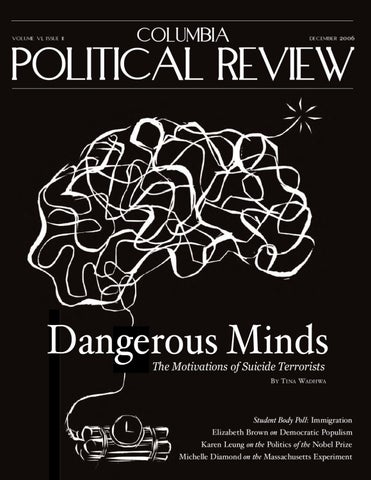
Dangerous Minds The Motivations of Suicide Terrorists
BY TINA WADHWA
Student Body Poll: Immigration
Elizabeth Brown on Democratic Populism
Karen Leung on the Politics of the Nobel Prize
Michelle Diamond on the Massachusetts Experiment
PROFESSOR CONTRIBUTION
Election Reflections
Only 30 percent approved of the work of the Republicancontrolled Congress. And so this became a retrospective “throw the bums out” election that revolved more around assessments of Bush and his Iraq policy (important for twoBy RICHARD M. PIOUS thirds of the voters), and House Republicans and their blind Political scientists analyze elections somewhat differently eye toward scandal and corruption (important for three-quarthan journalists, pundits and bloggers do. We measure and ters of voters), than on anything the Democrats offered. It analyze stable factors, i.e. party identifications, group alliances also involved “cognitive Madisonianism”—a fancy term for with parties, and turnout rates. By the start of the Bush pres- the idea that some voters will want to check-and-balance the idency, these tended to favor the Republicans, as the post- president by supporting congressional candidates from the New Deal electoral coalition seemed to be disintegrating and opposition. Among voters saying that Bush was a factor in their vote, a new Republican majority seemed to be coalescing. But during the last two years of Bush’s presidency, stable a two-to-one margin voted Democratic, a ratio exactly in line factors began to turn toward the Democrats: in 2004, party with prior generalizations made by political scientists. “The identification was tied, 37 to 37, but going into this election wave” was enough to overcome the incumbency advantage Democrats opened up a 5 point margin in party identifica- and gerrymandered districting, particularly in states that had tion. They had fended off GOP inroads among minority nonpartisan or bipartisan commissions drawing the lines. groups; they had made major gains among young voters; and However, in states with “anti-competitive” gerrymandered districts, such as Texas, Florida, they continued to gain strength in the Northeast and Midwest. Republican micro“Angry White Pennsylvania, Ohio, and Michigan, made much smaller gains in the targeting of voters had been countered in Men found a Democrats House (according to electoral analyst Sam recent elections by internet-organized volundifferent Hirsch who crunched the numbers on this). teer groups, which were increasing Democrat What impact will this election have on turnout in non-presidential contests since party for their the presidential contest? The Democratic 2002, especially among younger voters. These anger about advantage in stable factors, if maintained trends intensified in 2006: turnouts were up median wage through the next Congress, puts the party in marginally to a little over 40 percent—high for modern-day congressional contests, with stagnation, a strong position heading into the election. at the grassroots, Democrats now turnout among young voters up by 25 perinflation, and Especially control 15 state legislatures outright cent. corruption in (Republicans control 10), and Democrats By close to a 3-2 margin, young voters favored Democratic candidates. The South high places.” once again have a majority of governorships—28 to 22, especially in large states had broken off from the Democrats in the 1980s; now, in 2006, it seemed that the Northeast and (Texas, California and Florida excepted). With a large continMidwest had broken decisively away from the Republicans. gent of moderate Republicans defeated, the GOP congresOne-third of House Republicans in the Northeast were sional party will move to the right, putting it further outside defeated, 15 percent in the Midwest, and Democrats picked of mainstream thinking, which may set Republicans up for up 140 state legislative seats in the Northeast and 104 in the an even worse defeat in 2008. Yet we should remember that from 1968 through 1988, Midwest. All elections involve dynamic factors, that is, those that are when Democrats were also the majority party in both the election specific, and this election exhibited several of them. statehouses and the Capitol, Republicans were able to capiDemocrats converted Soccer Moms and Security Moms into talize on presidential elections by fielding more attractive GI Moms, more worried about casualties in Iraq than terror candidates with compelling themes. Dynamic election-specifthreats. Angry White Men found a different party for their ic factors overwhelmed Democratic partisan advantages.Past anger about median wage stagnation, inflation, and corrup- history may give Republicans heart and Democrats pause, tion in high places. The Christian Right became demoralized even as one party reassesses and the other celebrates. One final note: The best of the academic forecasters over Foleygate (one third of the evangelical vote went for the Democrats). The whole country was stunned by FEMA’s using quantitative models, such as Alan Abramowitz of inept response to Katrina. Democratic challengers received Emory University, predicted Democratic gains of 29 seats in enough funding and logistical support from the national early June. The political scientist with the best track record party to mount credible campaigns in many districts. over the years in qualitative predictions is Larry Sabato of the Independents switched by an average of ten to fifteen percent University of Virginia, whose website Crystal Ball is always toward the Democrats, even as Republican and Democrat worth consulting. Political junkies can sign up for e-mail disof his reports by going to partisans tended to remain loyal. Those who saw the war as tribution the most important issue broke for Democrats by a two to one www.centerforpolitics.org/crystalball. margin. By Election Day, only 39 percent of voters approved of Richard M. Pious is the Adolph and Effie Ochs Professor of American Bush’s performance (an average of poll results). Only 33.8 Studies in the department of political science at Barnard College. He can percent said the country was going in the right direction. be reached at rpious@barnard.edu. 2 | Columbia Political Review
Contents
W W W. C O L U M B I A P O L I T I C A L R E V I E W. C O M
EDITOR-IN- CHIEF
Paul Sonne
MANAGING EDITORS
Jonathan Blitzer Mark Krotov SENIOR EDITORS
M. Alper Bahadir Michael Brener Diego Laserna Yael Merkin Sara Vogel CAMPUS EDITOR
Michelle Diamond BUSINESS DIRECTORS
Nicolas Alvear Ben Parisi ART EDITOR
Chris Jo
DESIGN EDITOR
Saumil Kachhy
DEPUTY CAMPUS EDITORS
Andrew Gershon Katherine Katcher Mark Modesitt David Schor COPY EDITORS
Seth Berliner Ashley James Chris Kulawik Elizabeth Tarras WEB EDITOR
Vikaas Sharma STAFF ARTISTS
Michael Bredin Stacy Chu Rachel Lindsay Phyllis Ma (cover) Cassie Spodak
Tne Columbia Political Review is affiliated with the Columbia Political Union, a non-partisan student organization seeking to enhance involvement in the political process and foster political discourse. The CPU does not endorse the ideas contained herein; their worth is for our readers to determine. The CPR welcomes letters to the editor. They should be sent to cpureview@columbia.edu and should not exceed 150 words. Letters for publication must include the author’s name, contact information and Columbia affiliation. The CPR reserves the right to edit content.
Professor Richard Pious Election Reflections....................2
Books in Brief............................4 Illogic and Rhetoric Dan D’Addario The Audacity of Hype..... ...........5 Peter Schamp Knock Rummy............................6 Ian Crone Waiting for David Kuo................6 Karen Leung Worthy Writers, Prized Politics.............................8 PERSONAL ESSAY
Elizabeth Brown Left on Main Street....................12 Tina Wadhwa Mind, Brain and Terrifying Behavior..................15 CPR PERSONALITIES
Meet the Iraq Study Group........18
Michelle Diamond The Massachusetts Experiment...............................20 David Feith Corrupting China......................22 Michael Bredin Westward Ho! ............................23 DOLLARS AND SENSE
Nicolas Alvear Petrodollars and Private Interests........................25 POLITICAL MEDITATION
Seth Berliner What Are We Rebuilding?..........27 Sarah Morgan Nuclear Patriotism...................29
Huma Haider Failed Social Renewal...............31 BOOK REVIEW
Matthew Christiansen The Best Intentions by James Traub..............................33 CAMPUS PULSE
Student Poll Immigration...............................34
IN CONTEXT
December 2006
In 2005, a team of entomologists named three new species of slime-mold beetles after George W. Bush, Dick Cheney, and Donald Rumsfeld. After extensive “research,” it seems that the beetles bear a surprising similarity to their namesakes. Agathidium bushi is a stubborn beetle. Unfortunately, its stubbornness is impeded by severe tunnel vision. Thus, the beetle tends to foolishly attack larger predators, such as ferrets and raccoons. However, the beetle compensates for this near-fatalism with its persistent belief in a beetle afterlife.
Agathidium cheneyi is known for its individualistic hunting patterns and its lack of loyalty toward the other beetles in the tribe. The brutal beetle often sacrifices other beetles in its quest for food and is a hoarder—it protects its stash with an astounding ferocity.
Witty entomologists across the world have nicknamed Agathidium rumsfeldi Agathidium dumsfeldi because of its clueless nature. The beetle usually deals with a difficult situation by digging a hole from which it cannot extricate itself. –Mark Krotov
Columbia Political Review | 3
A Little Bit of Trickery: How We Ended Up in Iraq
BOOKS IN BRIEF
war of the cold sodas equals the Cold War. Of course, Coca-Cola—the beverage that greeted East Germans as they emerged from the iron curtain—symbolizes capitalism, with Pepsi (with its oppressively totalitarian sweetness?) standing for the Pinkos. Overall, in a phenomenally easy skim-read, Standage gives a convincing argument for how human history is tied to the liquids that we consume. And the drink to define our future? Standage writes that the 21st century is the age of that life-giving staple, water. Billions of people still do not have access to clean water, and those people who have it coming out of the tap drink it bottled. And plus, when we all move to Mars in the not-too-distant future, we’d better be sure there’s something to drink.
The title of Michael Isikoff and David Corn’s 463-page tome suggests a Greek drama in both scope and theme. In at least one of these respects, Hubris: The Inside Story of Spin, Scandal, and the Selling of the Iraq War does not disappoint. Its exhausting—excuse me, exhaustive—reporting on the Bush Administration comes to the conclusion that (gasp!) the prewar case against Saddam was suspect, and the White House deceptively used questionable intelligence to get Congressional and public approval for the war. The writers begin crafting their less-than novel theory with a dramatic irony that would make Sophocles proud. CIA operatives were called in the day –Alicia Berenyi after September 11th to begin drawing up covert ops for Iraqi It’s Not Watergate, destabilization. The irony? The But It’s Bad two agents in charge named their Hubris plan after an unsuccessful Greek A recent New York Times artiMichael Isikoff and David Corn military operation that ended in cle described rampant political retreat. Whoops. A History of the World in 6 Glasses apathy among young marines on From there, Hubris gets going Tom Standage the battlefields of Baghdad— with a damning, but well supsome of whom did not even State of Denial ported, interpretation of Karl know who Donald Rumsfeld Bob Woodward Rove and I. Lewis “Scooter” was. Safe and sound, far away Libby’s involvement in the from the carnage, we like to Valerie Plame affair, complete believe we are better informed. But what do we really know with a biting criticism of New York Times reporter Judith about the role Rummy played in the military campaign in Miller’s hawkish lead stories. The tale is compelling, but it Iraq? What was the conversation in the Oval Office like just gets bogged down in a muddled narrative that jumps around before the first air strike? In his third book on the Bush through time. Administration, State of Denial: Bush at War, Part III, Bob Hubris is full of insider facts, semi-terrifying revelations Woodward tells the disturbing saga of a failing war—starabout the pre-war administration, and even a little cloak ring Bush, Cheney, Rumsfeld and the rest of the White and dagger CIA intrigue. But in the end, if you’re looking House gang. for hubris and tragedy, you should stick with Oedipus. At least Criticized for pandering to the Bush Administration in it has a linear plot. his 2002 book Bush at War, this time Woodward uses his –Adam Brickman inside sources to treat the administration with greater scrutiny. His critique follows the Bush administration from Drink Your Way Through History Dubya’s pre-presidential campaign admission, “I don’t have the foggiest idea about what I think about international, forWhether it’s the Butler crazies who mill about clutching eign policy,” to the in-depth tête-à-tête Woodward arranged coffee cups with iron fists, fraternity boys chugging flat beer, with Rumsfeld last July. or that one girl who swears by Diet Coke, what we drink and Lacking the vigorous investigation of Woodward’s why we drink it constructs our self image. In The History of Watergate reporting, State of Denial contains little new inforthe World in 6 Glasses, Tom Standage goes beyond the individ- mation. We know there were no weapons of mass destrucual to describe political, philosophical, commercial, and sci- tion in Iraq, the war has no unified strategy, and yes, there entific histories in terms of beer, wine, spirits, coffee, tea and seems to be no end to the casualties. But Woodward’s reconcola. struction of scenes leading up to the war is compelling. Plus, And what master-narrative of beverage preferences it is always comforting to hear that in the days leading up to would be complete without an explication of the epic Coke Operation Iraqi Freedom, the President and Karl Rove and Pepsi divide? Such a war is not waged on the strength were trading fart jokes in the Oval Office. of cheesy Christmas commercials alone—Standage says the –Hyemin Yang 4 | Columbia Political Review
Media Frenzy
The Audacity of Hype
endorsing him for President in 2008, even though he has yet to announce his candidacy. Because Winfrey is not a journalist, she is free to succumb to the bias that the media’s infatuation stems from. And no one puts the sap in sappy like Oprah. But political voices more respected than Winfrey’s have jumped on the bandwagon with even greater Barack-fervor. Every journalist in America wants a compelling figure to write about, and for left-leaning reporters, Obama’s “arc” is delectable. He is the only politician with a profile as attractive as presumed Democratic frontrunner Hillary Clinton’s (poor Iowa Governor Tom Vilsack, whose announcement was greeted with just a few shrugs. But if he’s lucky, he’ll lose and then land that coveted Viagra ad-spot after Bob Dole kicks the bucket). Yes, there aren’t many other politicians in the Democratic Party as charis-
Poor Barack Obama. It is hard to say what he did to deserve such hatred and ire from the press. Listen to this scathing rebuke from the Today show’s Meredith Vieira: “You know you are the equivalent of a political rock star!” Or look at Joe Klein’s wicked vendetta against Obama, as seen in his recent Time cover story. “Indeed, as we traveled that Saturday… across the Mississippi into the mythic presidential-campaign state of Iowa, Obama seemed the political equivalent of a rainbow—a suddenly preternatural event inspiring awe and ecstasy,” Klein wrote. Why so harsh, Joe? Why so critical? Wait, scratch that. Barack Obama holds the distinction of being perhaps the most-hyped media golden boy of all time, or at least of recent political history. This is why he is able to land a Time cover with the headline, “Why Barack Obama Could Be the Next President,” and it explains his ability to get appearances on shows like Today and The Oprah Winfrey Show, while most freshman Senators promoting their memoirs would likely be grateful for ten minutes on C-SPAN. Oprah Winfrey’s show had a searching and powerful segment on Obama’s views on sectarian violence in Iraq— and by “sectarian violence in Iraq,” I mean “pizza.” “Senator Obama continues to contribute to family chores, including ordering pizza and balloons for his daughter’s birthday party,” the show informed us (the Senator’s response to such hardball questioning? “Oprah, you’re my girl”). Winfrey responded to Obama’s incisive foreign policy statements about the rising violence between mushTara Zabor room and pepperoni by
matic as Obama. Try to imagine the blank Nancy Pelosi on Oprah’s couch getting passionate about balloons and pizza or John Kerry talking about how he cooks eggs with his loving wife. (Note to the Dems: affluence and Botox don’t do not emote well). Now you can see why the media—yearning for a little Democratic bacon—loves Obama so. To be fair, one can hardly blame Obama for accepting invitations to toprated talk shows and agreeing to the placement of his face on the cover of Time. After all, though he seems like a rock star meets stay at home mom extraordinaire, he is, first and foremost, a politician. Unfortunately, though, it seems as if every interview he gives is either about his possible candidacy (“I haven’t completely decided or unraveled that puzzle yet,” he says), or it consists of softball questions designed to raise his profile for the possible candidacy. Come on, Meredith. If this guy is contending to become our next president, let’s grill him to see what he’s worth. Bacon, Meredith. It’s meant to be cooked, not caressed. But in the end, the media and Obama should both tread carefully, heeding the lesson of another Time cover boy who garnered attention in the runup to the 2004 presidential election. He was a media darling who realized far too late that the media’s love for his story outstripped the public’s support of his campaign. That man was Howard Dean, third-place in the Iowa caucuses, but for a brief and fleeting moment, first in the media’s fickle heart. –Dan D’Addario
*****
Columbia Political Review | 5
ILLOGIC AND RHETORIC
Lame Duck
Knock Rummy
On November 8, Donald Rumsfeld stood next to President George W. Bush as the two jointly announced his resignation as Secretary of Defense. The septuagenarian’s eyes had a twinkle in them as he drove himself down memory lane, fondly recalling the past six years of his illustrious career. He remembered his plans to revamp the military. He remembered those latenight brainstorming sessions alongside Dick Cheney (which concentrated a bit more on storming than on anything related to the brain). He remembered the exciting first days of the war in Iraq. He couldn’t quite remember his plan for winning, but that was okay. He knew what he had done in office. But, actually, that was a little unclear too. Well, he reasoned, at least he had been very clear about what he didn’t do. And now straight from the horse’s mouth... “I don’t do predictions.” You can say that again. Three and a half years into a war that was supposed to be six months long at the most, it has become clear that Rumsfeld took this one to the extreme. Predictions? Try any semblance of foresight. The American death toll reached 1000 in a year and a half, the Iraqi death toll anywhere from 6 | Columbia Political Review
Emily Lowry
10 to 30 times that. No weapons of mass destruction turned up. Both Bush and Tony Blair were forced to apologize for their claims that Saddam Hussein was pursuing a nuclear weapons program. Local weather stations have predicted snowstorms in the last three years with more accuracy, nuance, and foresight than Rummy managed to predict the outcome of his own war, despite the overabundance of technology and intelligence at his disposal. “I don’t do diplomacy.” So perhaps that’s not the explicit job of the Secretary of Defense. Still, that does not excuse Rummy from being tactful, or at least diplomatic, with reporters and those around him. His press conferences are now famous for the laid-back and jovial demeanor he took on when confronted by reporters about a conflict that seemed more and more like a disaster with every passing day. “Freedom’s untidy,” he said. “Death has a tendency to encourage a depressing view of war.” Then again, so does failure. “I don’t do numbers.” American dead: 2,883. American wounded: 21,778. Iraqi dead: 48,000-54,000. Dollars spent: $260 billion and counting. (“We don’t do body counts,” General Tommy Franks said). “I don’t do quagmires.” No, because
that would require taking responsibility. Unable to admit that he might be involved in a quagmire, Rumsfeld took on a more effective strategy in deflecting questions about the war than he did in waging the war itself. At one point, Rumsfeld’s apparent ignorance of the situation in which his military found itself prompted one of his top commanders in Iraq, General John Abizaid, to send a memo with a definition of “counter-insurgency.” And testifying before Congress, Rumsfeld said, “It’s not my business to do intelligence work.” True, intelligence isn’t his strong suit. “You go to war with the army you have, not the army you wish to have,” Rumsfeld once said. The same goes for the Secretary of Defense. Reporters were faced with so many denials that eventually the only question left to ask was what it was, exactly, that Rumsfeld did do. It appears that he did not do all that much, but then again, this seems appropriate for a leader whose notions of responsibility were somewhat vague to begin with. After all, when confronted with reports of major looting that was quickly demolishing Iraq’s culture and infrastructure, Rumsfeld offered one of his most incisive assessments of responsibility: “Stuff happens.” Thanks.
Culture Wars
*****
–Peter Schamp
Waiting for David Kuo: A Tragicomedy in Two Acts
[CPR Primer: Mark Foley is a Republican congressman from Florida who resigned in 2006 amid accusations that he sent sexually explicit e-mails and instant messages to male pages. Ted Haggard, an evangelical preacher from Colorado Springs, was the former leader of the National Association of Evangelicals and had ties to President George W. Bush. Haggard resigned from his post after admitting to consorting with and purchasing methamphetamine from a male prostitute in a hotel room in Colorado. Karl Rove is the White House Deputy Chief of Staff. David Kuo was the deputy director the White House Office of Faith-Based and Community Initiatives until this year,
when he resigned and published a tellall memoir accusing the Bush administration of not caring about conservative Christian values.] ACT 1:
Steps of a white building. October. Mark, sitting on a low mound, is typing furiously with both hands, panting. He gives up, exhausted, rests, tries again. As before. Enter Ted.
Ted: I’m glad to see you back. I thought you were gone forever. Mark: Me too. Ted: Together again at last! We’ll have to celebrate this. But how? (He reflects.) Get up till I embrace you. Mark: (Irritably). Not now, not now. Ted: (Gloomily). It’s too much for one man. (Pause. Cheerfully.) On the other hand what’s the good of losing heart now, that’s what I say. We should have thought of it a million years ago, in the nineties. Mark: (Pointing). You might button it all the same. Ted: (Stooping). True. (He buttons his fly.) Never neglect the little things of life. Mark: What do you expect, you always wait till the last moment. Ted: (Musingly). The last moment . . . (He meditates.) Hope deferred maketh the something sick, who said that? Mark: Why don’t you help me? Ted: Suppose we repented. Mark: Repented what? Ted: Oh . . . (He reflects.) We wouldn’t have to go into the details. Mark: Our being born? Ted breaks into a hearty laugh, which he immediately stifles, his hand pressed to his lower abdomen, his face contorted. Ted: One daren’t even laugh any more. Mark: (Irritably). What is it? Ted: Did you ever read the Bible? Mark: The Bible . . . (He reflects.) I must have taken a look at it. Ted: Do you remember the Gospels? Mark: I remember the maps of the Holy Land. Coloured they were. Very pretty. The Dead Sea was pale blue. The very look of it made me thirsty. That’s where we’ll go, I used to say, that’s where we’ll go for our honeymoon. We’ll swim. We’ll be happy. Ted: You should have been a politician. Mark: I was. (Gesture towards his rags.) Isn’t that obvious? Silence.
Ted: Ah yes, the two thieves. Do you remember the story? Mark: No. Ted: It’ll pass the time. (Pause.) Two thieves, crucified at the same time as our Saviour. One— Mark: Our what? Ted: Our Saviour. Two thieves. One is supposed to have been saved and the other . . . (He searches for the contrary of saved) . . . damned. Mark: Saved from what? Ted: Hell. Mark: I’m going. He does not move.
Enter Karl and Jesus. Karl drives Jesus by means of a rope passed round his neck, so that Jesus is the first to enter, followed by the rope which is long enough to let him reach the middle of the stage before Karl appears. Jesus carries a heavy bag, a folding stool, a picnic basket and a greatcoat; Karl a whip. Karl: (Off). On! (Crack of whip. Karl appears. They cross the stage. Jesus passes before Ted and Mark exit. At the sight of Ted and Mark, Karl stops short. The rope tautens. Karl jerks at it violently.) Back!
Noise of Jesus falling with all his baggage. Ted and Mark turn towards him, half wishing half fearing to go to his assistance. Ted takes a step towards Jesus, Mark holds him back by the sleeve.
Mark: (Undertone). Is that him? Ted: Who? Karl: (Terrifying voice). I am Karl! (Silence.) Karl! Mark: (recoiling before Karl). That’s to say . . . you understand . . . the dusk . . . the strain . . . waiting . . . I confess . . . I imagined . . . for a second . . .
Silence. Flabbergasted, Mark stops gnawing, looks at Karl and Ted in turn. Karl outwardly calm. Ted embarrassed.
Karl: (To Ted). Are you alluding to anything in particular? Ted: (Unbelievably resolute). To treat a man . . . (Gesture towards Jesus) . . . like that . . . I think that . . . no . . . a human being . . . no . . . it’s a scandal! Mark: (Not to be outdone). A disgrace! Karl: What do you prefer? Shall we have him dance, or sing, or recite, or think, or— Ted: I’d like well to hear him think. Mark: Perhaps he could dance first and think afterwards, if it isn’t too much to ask him.
Ted: (To Karl). Would that be possible? Karl: Dance, misery! Jesus puts down bag and basket, advances towards front, turns to Karl. Jesus dances. He stops. Mark: Is that all? Karl: Encore! Jesus executes the same movements, stops. Karl: Stand back! (Ted and Mark move away from Jesus. Karl jerks the rope. Jesus looks at Karl.) Think, pig! (Pause. Jesus begins to dance.) Stop! (Jesus stops.) Forward! (Jesus advances.) Stop! (Jesus stops.) Think! Jesus: On the other hand with regard to— Karl: Stop! (Jesus stops.) Back! (Jesus moves back.) Stop! (Jesus stops.) Turn! (Jesus turns towards auditorium.) Think! Jesus flees offstage. Karl chases him. Mark: Let’s go. Ted: But you can’t go barefoot! Mark: Christ did. Ted: Christ! What has Christ got to do with it? You’re not going to compare yourself to Christ! Mark: All my life I’ve compared myself to him. Ted: Well, shall we go? Mark: Yes, let’s go. They do not move. Curtain. ACT 2:
November. Enter Mark and Ted, hand in hand. Enter Karl, solo.
Karl: Mercy! I am blind! Fools, you have destroyed me! Mark: They found him, Karl. Ted: We’re sorry, Karl. Karl: Found who? Ted: David Kuo. Mark: Who? Karl: All is lost. Exit Karl.
Ted: I can’t go on like this. Mark: That’s what you think. Pull on your trousers. Ted: You want me to pull off my trousers? Mark: Pull ON your trousers. Ted: (Realizing his trousers are down). True. He pulls up his trousers.
Mark: Well? Shall we go to the party at Jeff Gannon’s? Ted: Yes, let’s go. They do not move. Curtain. –Ian Crone
Columbia Political Review | 7
WORTHY WRITERS, PRIZED POLITICS The Politics of the Nobel Prize in Literature
By KAREN LEUNG Exiles, racists, prisoners, men who like Germans too much: they’re all there. They and other species of delinquents have all been plucked and settled into literary history by the eighteenman team of the Swedish Academy, which has awarded the Nobel Prize in Literature since 1901. Although the Nobel, like other literary prizes, has always generated scandal—through its commercial dimensions, its failure to recognize giants in the literary fossil record while rewarding minor writers, accounts of the selling of prize medals at auctions—recent criticism has accused the Nobel of sinning against itself by conflating political involvement with literary merit; in other words, by breaking the artistic equivalent of the separation of church and state. Critics point to recent winners like Orhan Pamuk, Harold Pinter, and Elfriede Jelinek, and see in their victories a pattern not of literary achievement as such, but of outspoken political participation coupled with geographical diversity. Although a literary scholar may divide artists into their constituent parts—with the work on one hand and the human being on the other—the Nobel Prize has never aspired to that kind of willful partitioning. Alfred Nobel founded the award as a prize for “the most outstanding work of an idealistic direction,” a standard which, after all, is not mere sentimentalism. “There’s certainly a political conception, some conception of the relationship between literature and the world, and how literature should act on the world” built into the Nobel’s very premise, says Columbia professor of English and comparative 8 | Columbia Political Review
literature Martin Puchner. When the Swedish Academy decided to award bodies of work and not individual texts, the prize’s political element was all but guaranteed. A kind of “lifetime achievement award” that honors writers for their careers rather than for their individual books, the Nobel Prize in Literature has been politicized since the beginning. The prize sees a writer’s politics as part of a wider conception of his or her career. It has dared to consider writers outside of their work. It is a literary felon. Nobel Affirmative Action?
“The ideal candidate for the Nobel Prize today would be a lesbian from Asia,” Swedish literary critic Mats Gellerfelt declared in 1999. The Nobel committee does seem to be expanding its scope self-consciously—geographically, racially, and politically. With the committee’s attempts to privilege diversity, it is tempting (even if ultimately misguided) to see a kind of affirmative action happening for non-Western writers. Wole Soyinka, the 1986 winner, was
Stacy Chu
the first laureate from Africa, and in the decade and a half following him, there were winners from Egypt, Mexico, Saint Lucia, and Trinidad as well as the first ever African-American and Chinese-French awardees. This apparent “favoritism” drives criticism that the Nobel does not reward writers entirely on the basis of their art, but instead makes its decisions in service of some kind of diffuse political goal. But despite the adventurous movement of the Nobel frontier, recent winners do not seem to be the result of a simple diversity model. The choices have been European on the whole (although this is by no means evidence that the prize is free from the tyranny of politics, simply that that tyranny does not always compel the committee to reach outside of Europe). Puchner says that non-European choices were “driven necessarily by diversity because … so much interesting literature was produced outside Europe.” And though the Nobel seems to favor political writing, it is not crucial that the writers’ countries of origin are experiencing some definitional political moment—Dario Fo of Italy and Elfriede Jelinek of Austria are examples of this. Although questions of diversity hardly make Nobel selection a predictable process, the choices are still haunted by the impression that they were made for something other than literary achievement. Which makes one wonder whether a politics of exclusion may accompany the politics of inclusion—if, in other words, the lack of political involvement, or even the wrong kind of political affiliation, can bar great writers from winning the
Nobel. Must a writer be on the illustrious roster of dissidents and outcasts to be awarded the prize? Could someone like Philip Roth—whose work is by no means apolitical, but who grew up a member of the white middle class in suburban New Jersey—win it? “It’s very possible,” Puchner said, describing Roth as a very good choice. He added, however, that “it’s always dangerous to predict.” Though the Swedish Academy— which did not respond to inquiries from the CPR by press time—never comments on the political dimension of its choices, except on occasion to deny that it exists, it is clear that a number of the institution’s members see politics as part of the Academy’s character. In 1989, three members of the committee resigned over the body’s refusal to condemn threats against British author Salman Rushdie; they were disgusted by the Academy’s lack of political action. In 2005, Knut Ahnlund left the Academy in protest over the previous year’s winner, Elfriede Jelinek, whose work he described as “whining, unenjoyable public pornography” that “confused the general view of literature as an art.” He may have been disgusted by a different sentiment altogether—that is, by the committee’s excessive preoccupation with politics. That members have sometimes called for political action, and at other times bemoaned it, suggests that even the Academy itself has not resolved the nature of its mission. It gropes its way forward into literary history with a sense of palpable confusion. If the Nobel’s record of affirmative action is puzzling, this may be because the prize committee smuggles political meaning into the literary world under works of art that do not necessarily have much to do with politics, even if their authors might. The Nobel might want to be the cultural guerrilla in wars of ideas, but its ambitions are frustrated because the prize must be a political anointment of artistic icons—most of whom are already celebrated. “I don’t think the work of either Pinter or Pamuk”—the 2005 and 2006 winners—“needed any help from declarations of political opinion or from the Nobel Prize committee. These are both people of genuinely immense stature, a stature based on their work, and each
Nobel Prize
in Literature
2006 – Orhan Pamuk Turkey
2005 – Harold Pinter United Kingdom
2004 – Elfriede Jelinek Austria
2003 – J.M. Coetzee South Africa
2002 – Imre Kertész Hungary
2001 – V.S. Naipaul
Trinidad & Tobago, UK
2000 – Gao Xingjian China, France
1999 – Günter Grass Germany
1998 – José Saramago Portugal
1997 – Dario Fo Italy
1996 – Wislawa Szymborska Poland
1995 – Seamus Heaney Ireland
1994 – Kenzaburo Oe Japan
1993 – Toni Morrison United States
had already been recognized far and wide,” says Columbia English and comparative literature professor Bruce Robbins. Perhaps the lack of clarity in the Nobel’s intentions is the failure of every literary prize that has aspired to political engagement: politically interested prizes make room for claims that they ought to be disinterested, while prizes considered too disinterested are attacked for their refusal to accept that politics—in short, life—and art are inseparable. Indeed, if the Nobel found a way to extricate itself from the political dimensions of prizegiving, it would be criticized for endorsing an indulgent art-for-art’s sake agenda that neglects the idealism it was founded to reward But perhaps we should indulge a fictional scenario of our own and imagine a kind of “aesthetics only” Nobel. What
would the Nobel look like if it were wholly unfastened from its political compulsions and allowed to float freely toward the worthiest works of art? What might this award signify, and what sorts of problems—aside from the obvious gripe about the indulgence of art-forart’s sake—would it encounter? The “aesthetics only” Nobel would most likely be similarly unsatisfying; the prize would, as it does now, award writers of the very highest quality, but its recipients would still be overshadowed by a demand for diversity—a diversity of artistic, rather than political, sensibility. John Barth, Don DeLillo and Joseph Heller, some of the great postmoderns of the sixties and seventies, would never all receive the prize (not that any of them has already), because the choice of such a threesome would defy diversity of genre. And yet diversity of genre would likely become synonymous with another version of geographic diversity—the kind that sees artistic sensibility as bound up in the unique experiences of place. DeLillo’s novels could not have been written by anyone other than an American; Heller’s affiliation with the United States somehow informs his work’s unshakeable base character. Such Americanness—hard as it is to define—would pique the interest of a prize committee concerned with this peculiar sort of diversity. They might next seek out a sense of Canadianness, of Syrianness, or Koreanness—which, of course, would institutionalize the misreading of the authors’ works, since it would essentialize them down to their places of origin. Even a committee concerned only with artistic achievement would shape the demography of merit with a globally wandering eye. And its tastes might, as they do now, grow world-weary and return home to Western Europe often. Portrait of the Artist as a Politician
Czeslaw Milosz once searched his pockets and showed an interviewer a medallion engraved with the symbols of four Polish heroes: the insignia of Pope John Paul II, the miter of the archbishop, electricians’ tools (symbols of Lech Walesa, leader of the anti-communist Solidarity movement and eventual presColumbia Political Review | 9
ident of Poland), and a book representing Milosz. Milosz—the great poet upon whose famously overgrown eyebrows rests the distinction of innovation that forever changed literature—won the Nobel in 1980, decades after escaping Stalinist persecution and publishing The Captive Mind, an analysis of intellectuals under communist regimes. Solidarity was founded in September of the same year. The connection is clear: Milosz was chosen as an endorsement of a moral movement in Polish politics. Recent laureates like Pamuk and Pinter seem like similarly easy targets for the charge that the prize rewards the politics of the writers rather than the works attached to the writer’s name. Pamuk’s comments in a 2005 interview brought attention to the Armenian genocide that took place in Turkey between 1915 and 1917, and the government threatened him with imprisonment for “insulting Turkishness.” Pinter has been a vocal antiwar activist since the 1960s and said in an interview this March that he would spend the rest of his life railing against the United States. At times, the only thing standing in the way of the accusation… is the work. Puchner says of Pamuk and Pinter, “These writers don’t write, in any simple way, politically engaged art. On the contrary, [their work is] not written in a particularly propagandistic manner.” Puchner compares them to the nineteenth century public intellectual figure exemplified by Emile Zola, the French writer who made his reputation as a naturalist novelist, and then brought global attention to the wrongful conviction of the Jewish artillery officer Alfred Dreyfus in an incendiary letter to the French president titled “J’accuse…!” Zola’s political involvement in the Dreyfus Affair was possible precisely because of his artistic standing. Pinter and Pamuk belong to the same species of public intellectual— they are writers who have earned a literary reputation and have then used it to speak out on matters that do not necessarily have direct relation to their art. Perhaps the aberration isn’t the writer willing to make political pronouncements, but rather the writer who is not. “In the end, it would be somewhat difficult to find a writer of reputation who would be unwilling or uninterested in speaking out on any range of issues,”
10 | Columbia Political Review
“And the political implications of a prize that satisfies only a Western-centric view of nonwestern nations becomes even more problematic.” Puchner says. This suggests something about a writer’s profession that necessitates engaging one’s surroundings; it suggests something about the writer as an inherently political animal. Though the literary distinction of Pamuk and Pinter has gone more or less unchallenged, the Academy’s decision to honor them is still somehow problematic. After all, there are many great writers with large bodies of work who have not been contenders for the prize. “One of the strongest impulses in literary criticism, going all the way back to Marx and Engels, is to distinguish between the author as a person with political convictions on the one hand, and the work on the other,” says Robbins. Though a given author’s political involvement does not necessarily affect perceptions of his work among literary critics, it does affect his chances of winning the Nobel Prize. A writer’s real-life experience does not lend credibility to his work in the same way that past experience lends credibility to a politician. The position of the writer and that of the politician are somehow reversals of one another. The fact that John McCain spent six years in the Hanoi Hilton as a POW gives serious weight to his policies on torture and prisoner interrogation techniques. But for a writer, the work must be self-legitimizing. The meaning of the Nobel becomes even more complicated in light of this
summer’s controversy over Günter Grass, the German writer who won the prize in 1999. Grass seemed to fit squarely in the Nobel’s long list of leftleaning activists—until he divulged in a freshly published memoir that he had been a member of the Waffen-SS during World War II. Outraged commentators called on him to return his Nobel. And although many artists applauded Grass’s admission as a brave move, the public response implied that had Grass revealed his membership earlier—say, sometime before 1999—he may not have received the prize. In Grass’ fall from literary-political grace lurk the very forces of the Nobel’s politics of exclusion. And yet, the argument that he ought to renounce his award seems, at heart, fundamentally unliterary, since those who criticize him are not objecting to Grass’ leftist literary productions, but to Grass the man, who, in his late teens, served in a fascist organization. His shrillest critics are not therefore protesting against his work as an artist; they have had the nerve to consider him as a human being. Who Cares—Or, Prizes as Cultural Colonialism
The nature of the Nobel Prize in Literature should be clear by now: it does and does not seek out writers of great literary stature; it does and does not single out artists from countries experiencing suggestive political moments or developments; and, with its crass partisan implications, it both ruins and supports the purity of art. It may be difficult to see why anyone should care about a prize that is itself confused about the political and artistic dimensions of what it does, a prize awarded by a small committee made up of the cultural elite, a small committee comprised entirely of Swedes. To James English, author of The Economy of Prestige, the heavy symbolic force that a prize like the Nobel holds— because, no matter how literary insiders may disavow it, it remains a powerful symbol of high culture—is its own meaning. If the “politicization” of the Nobel Prize comes from the dirty political fingerprints left on the award’s artistic mission, it also streams out of the political and economic power it confers. The amount of attention that the prize
generates can have a very powerful legitimizing effect for previously obscure areas of literature by bringing immediate attention and near-certain book sales. The very commercial dimension of literature which is often scorned by scholars is also what gives the Nobel its artistic heft. As English points out in his book, “Since the 1960s, prizes have played an enormous role in the emergence of minoritarian and oppositional cultures into positions of visibility and esteem—the women’s movement, the civil rights and black power movement, the gay liberation movement.” Although English does not explore the political implications of this—his focus lies elsewhere—it is obvious that the cultural emergence he speaks of has been accompanied by undeniable political change. This explains how the effects of literary prizes, sneered at by scholars, can bleed into the academic world and even the world of public policy. When John Berger won the 1972 Booker Prize, and in his acceptance speech proceeded to call the Booker company a colonialist enterprise built on the backs of black Guyanese plantation workers, and then declared that half his prize money would be donated to the Black Panthers, it was the prestige of the prize he was denouncing that called attention to Berger’s concerns and his work. These concerns would come to haunt the as-yet-unfounded genre of postcolonialism, and have become one of the preoccupations of our political culture. However well the Nobel may call attention to those on the literary, cultural, and political margins, English argues that the Nobel’s choice of non-Western artists is a form of “cultural globalization.” When the prize committee decides to reach beyond the usual Eurocentric literary frontiers, as in their choice of Wole Soyinka, it picks works that are self-consciously about the region they come from, and at the same time, still palatable to Western cultural tastes. They may not, in the end, be the ones that have been most celebrated in their own country. English notes that Soyinka’s work has been dismissed by fellow Nigerian writer Chinweizu as an example of literature which applies just enough “Africanesque patina and inlays” to satisfy a “Western tourist taste
Nobel Prize
in Literature
1992 – Derek Walcott St. Lucia
1991 – Nadine Gordimer South Africa
1990 – Octavio Paz Mexico
1989 – Camilo José Cela Spain
1988 – Naguib Mahfouz Egypt
1987 – Joseph Brodsky
Russia, United States
1986 – Wolé Soyinka Nigeria
1985 – Claude Simon France
1984 – Jaroslav Seifert Czech Republic
1983 – William Golding United Kingdom
1982 – Gabriel Garcia Marquez Colombia
1981 – Elias Canetti
United Kingdom
1980 – Czeslaw Milosz
Poland, United States
1979 – Odysseas Elytis Greece
for exotica.” This becomes a problem of cultural imperialism, and even potential racism, in the shadow of the Nobel’s economic power. The more powerful the literary prize, the bigger the effect it has on a book’s sales and on the sales of its related family of literature. Because the Nobel is a means by which critics in the West expand the literary canon, it offers economic empowerment to particular categories of literature as they become acceptable to Western tastes. And the political implications of a prize that satisfies only a Western-centric view of nonwestern nations becomes even more problematic. In some sense, this makes the Nobel’s gestures of recognition for “obscure” non-European literature just another form of the colonialism that so many of its awardees have denounced. So the Nobel helps Western tastes
hold world literature hostage by priming new regions for book sales and the economic gain that follows. This is perhaps the most damning of any of the prize’s political aspects, since it seems to prove that the Nobel, which purports to be outward-looking in its selections, is actually viewing literature by peering into a mirror. The artistic legitimacy of such an award cannot help but appear delusional. Any defense of the Nobel must disclose deceit—any justification is not just wrong, but terribly insincere. Dishonest. And yet, when the Nobel’s record of picking writers of quality is allowed to speak for itself, it is more or less irreproachable. Almost without exception, the laureates would also be acceptable to a Nobel whose only agenda was “aesthetics in a vacuum.” This utterly politicized award is drawn irresistibly to the right artistic conclusions. This suggests that it may in fact be very hard for literary prizes like the Nobel to make mistakes. Maybe it is actually easy for such prizes to get it right, because quality announces itself, being wholly selfapparent. And among the obviously great and literarily serious, the Nobel need just make a choice, once a year— and if its choices fit a political profile, that does not diminish the stature of the writers it picks. Of course, the idea of self-apparent quality also defeats the purpose of literary prizes, since true quality hardly needs a prize to name it. (But let’s not be unfair). The Nobel, we can finally say with some conviction, is a recognition of artistic achievement with a view to the artist’s involvement in public life. It is an award that brings attention to lesserknown artists, while furthering the interests of the prize committee in what amounts to a tyranny of taste. It’s a prize that flies in the face of everything accepted about the view that art is noncompetitive and exists for itself—while somehow also sustaining it. It is a quandary that cannot resolve itself. Even more offensive than the writers it awards, the prize gets it right by getting it wrong.
Karen Leung, CC ’10, plans to major in English and Math, and her last article, “Generation Blowhard,” appeared in the October 2006 issue of the CPR. She can be reached at kl2290@columbia.edu.
Columbia Political Review | 11
Left on Main Street PERSONAL ESSAY
*****
Forging the New DemocraticWay
*****
By ELIZABETH BROWN
I was heading out the door after making a speech in Defiance, Ohio—a quaint, charming town deep in the state’s northwest corner—when a middle-aged man in faded jeans and a hunting jacket stopped me and extended his hand. “Excuse me, Ms. Brown,” he said. “I just wanted to let you know that I’m a registered Republican.” Given that my father, Sherrod Brown, is a longtime Ohio politician and a longer-time Democrat, such an introduction usually does not bode well. But, rocking side-to-side with his hands tucked deep into his pockets, the man continued: “I also just wanted to let you know my wife and I are paying attention this year, and you people are talking about stuff we care about.” His gesture toward the front of the large room indicated that “you people” was in fact the group of us who had just spoken— the Democrats of Ohio. It was our second stop on a whirlwind get-out-the-vote tour around Ohio the week before Election Day, and I was riding along as a representative of my father in his bid for US Senate against Republican incumbent Mike DeWine. The tour targeted towns like Defiance, small and conservative enclaves typically dismissed by Democrats focusing on Ohio’s liberal base. Come Election Day, the tactic would prove effective after all; reaching out to towns that had been off the map for the national Democratic Party for years invigorated Democratic campaigns across the country. Democrats retook Congress with a gain of six seats in the Senate and thirty in the House, while picking up six governorships. Pundits have seized on these results from all sides, anxious to make sense of this year’s historic political aboutface. From Jonah Goldberg in The Columbus Dispatch to Rudi Batzell in our own Columbia Spectator, the general consensus is that the Democrats merely sold out to moderate voters to savor the sweet taste of majority once again. The subtext here is grim: the Democrats have neither muscles strong enough nor positions durable enough to ensure any sort of uncompromised sustainability. The victories of Senators-elect Jim Webb (D-VA) and Bob Casey (D-PA) reinforce the idea that the Democrats had to go right to go big. After all, both are social conserva12 | Columbia Political Review
*****
tives, and Webb even served as Secretary of the Navy during the Reagan Administration. But at the same time, liberals like Senators-elect Claire McCaskill (D-MO) and Sheldon Whitehouse (D-RI) also defeated their incumbent opponents, and their victories point to a more complex equation. In Ohio—the state that sealed the deal on George W. Bush’s return to the White House two years ago—voters elected my father and Governor-elect Ted Strickland. Not long ago, such across-the-board progressives would have been met in towns like Defiance with, well, defiance. Considering the motley crowd of new Democrats representing our country, this year’s political shake-up has offered mixed messages. While the voters of Virginia and Pennsylvania chose Democrats with traditionally red tendencies, how did other Democrats, like my father and Claire McCaskill, manage to remain “true blue?” Some two months before the election, my father’s campaign released a commercial about the economy. In the ad, he walks along a fence outside an abandoned Ohio factory and, looking straight into the camera, comes down hard against trade agreements—the very arrangements that became the locus for Washington bipartisanship during the Clinton years. He talks about Ohio’s loss of manufacturing jobs and unfair practices whereby overseas workers are paid “three or four dollars a day.” In response to his opponent’s support of NAFTA, CAFTA, and the like, my dad asserts: “He says it’s just business—I say it’s wrong.” Unsurprisingly, each campaign visit to a union hall brought at least one positive mention of this ad. And yet, somewhat less expectedly, the commercial also garnered countless words of praise from average non-union voters, inspiring huge cheers in speeches statewide. In a crowd of 1,500 at a rally in Youngstown, my father’s vow to fight for fair trade and against free trade met with as many claps and shouts as his calls to end the Iraq War. CNN exit polls showed that 39 percent of national voters and 42 percent of Ohio voters ranked the economy as “extremely important.” This year, when voters thought about the economy, most thought about trade, not taxes. That distinction made a huge difference this election cycle because it became one way in which voters turned away from the usually effective Republican modus operandi. Promises of tax cuts tend to complement rhetoric on antiabortion and pro-gun conservatism, all stances that resonate powerfully in rural areas of Ohio like Defiance. Historically, Republicans have tapped into that rhetoric because of its reliability in securing votes—a phenomenon due, in large part, to its admittedly “populist” appeal. Although we traditionally associate populism with the
PERSONAL ESSAY
liberal politics of William Jennings Bryan, the concept can operate anywhere on the political spectrum, provided that—as its Latin root populus suggests—it reacts to the beliefs or worries of “the people.” One party often beats another depending on which brands of populism are at play. In a conversation I had with John Nichols, a writer and political analyst for The Nation, he talked about the different variations of populist politics. To Nichols, one example of conservative populism is the proliferation of anti-immigrant views—sparked by fears of job loss—that have inspired conservatives to plug anti-immigration laws across the country. “There is a populist component to that because people are concerned about their jobs and circumstances,” he says. That John Kerry maintained a twenty-point lead over George W. Bush in Ohio’s more urban counties and still lost the state is a clear sign that, among other things, this “conservative populism” was at work in rural areas during the 2004 Presidential election. Two years later, in this fall’s midterms, my father received about fourteen points more than Kerry did in some rural counties. And he won the state by twelve points. In part, this change is due to what the press has accurately pegged as an ideal year to be a Democrat. Leading up to Election Day, the country looked disapprovingly at the President’s job in Iraq; Ohio’s term-limited Governor Bob Taft had approval ratings in the single digits, and Mark Foley’s sordid instant messages delivered another formidable, pre-election blow to Republicans. It was the perfect storm. But in a state like Ohio, a twelvepoint win does not happen merely because of a swing among reactionary voters. What really made my father’s twelve-point victory and Governorelect Strickland’s resounding twentythree-point triumph possible was a long overdue answer to the pervasive conservative populism of recent years. By addressing Americans’ fears of unemployment—the very same fears that fueled the “conservative populism” Nichols described—Democrats in Ohio and elsewhere configured a populist message in terms of the economy and trade. “It’s much harder to be an economic populist,” Nichols told me, “because you’re really asking people to move beyond emotional reactions and toward an analysis of the economy. But if it’s done right and with sophistication, you
can really shape the politics.” Whereas the assertion that the “Democrats sold out” implies that no real progressive can win big races, Nichols, for one, argues precisely the opposite: many of the 2006 elections were won through a progressive populist affirmation of new political ideals, rather than through mere negations of the failing conservative strain. (More accurately, it was a combination of both). As polarizing as politics can be, most Americans still want the same basic things in their lives. They want to possess the resources to put their kids through college without having to be fearful of losing their jobs. They want their parents to be able to get the medication they need in old age. They want their country to be respected—not despised—around the world. Democrats did not have to change or manipulate the will of the American people to get elected this year; they simply had to recognize the American people and rearticulate their message. Despite analyses suggesting that Bush’s performance was the central issue in the November elections, 39 percent of voters said that “Bush was not a factor” in their decisions, whereas 32 percent said their vote was meant to “oppose Bush,” according to CNN polls. The importance of the economy outranked the importance of Iraq, terrorism, and socalled “values issues” in the minds of voters. In 2004, only “values issues” outranked the economy, and only by two percentage points. Considering the strikingly different face of the 2006 election results, it is fair to say that something other than—or at least in addition to—“lesser-of-twoevils” thinking was at play this year. As I traveled across Ohio, from Defiance to Stockport and eventually back to Columbus, I saw a genuine enthusiasm, one that could not be the sign of mere resignation among voters. In Stockport, a young couple that had driven an hour to attend that evening’s Democratic dinner took notes during the speeches and simultaneously gnawed on ears of corn. Afterward, they followed me to my car to stock up on buttons and pamphlets to pass along to their friends. Another man, a retired Ohio transportation worker, invited me to stand with him as he smoothed his “Sherrod Brown” bumper sticker onto the back window of his station wagon. To set the record straight, the man whose name my new Columbia Political Review | 13
PERSONAL ESSAY
“Politicians [must] kick away the crutches of affected moderate politics and learn, finally, how to walk on their own.” friend was affixing to his car is no moderate. In fact, many thought my father to be so liberal—so progressive—that his chances of winning the Ohio Senate race would be slim, particularly given areas like Stockport and Defiance. A November New York Times article about Senator Harry Reid recounts a conversation between Reid and Senator Chuck Schumer, chairman of the Democratic Senatorial Campaign Committee. As the two men watched election results roll in, Reid remarked, “Remember, Chuck, when they said Sherrod was too liberal?” In a state like Ohio, which paints its politics somewhere between purple and red, a guy who supports gay rights and abortion rights, who opposes free trade, and who voted against the Iraq War and the Patriot Act inspired worry among politicos, pundits, and outspoken bloggers from the get go. But from day one, I watched my father’s campaign steadily pick up steam and overcome peoples’ doubts precisely because he never apologized for his progressive positions, nor tried to hide under the cloak of a political moderate. Instead, he talked to Ohioans about what he has always believed and then showed that those very things are, as he has said so many times, “right down Main Street, right down the center of America.” For Democrats and progressives, this is the new populism. And it works. People all over the state shared their excitement about “populist” issues with me. At the first meeting of the newly minted North Dayton Democratic Club, members in attendance ranged from a young man my age, to a middle-aged mother of a soldier stationed in Iraq, to an older woman whose friends introduced her—despite her initial embarrassment—as a “recovering Republican.” Her friends thanked me for my father’s pledge to increase the minimum wage and for his outspoken opposition to the pharmaceutical industry’s monopoly on drug prices. The “recovering Republican” had not joined in on her friends’ conversation with me but had been quietly observing, and when I later asked what convinced her to come to the meeting that night, she did not miss a beat: “Our economy’s goin’ to 14 | Columbia Political Review
hell.” That was enough for this Republican to start recovering. The phenomenon this election brought to light is a bit like a pair of jeans that finally fits again after years without wear: the Democrats did something right his year. They fought to the majority successfully, albeit with the politics of two disparate camps. The moderate-leaning strain of this election, which separated the blue from the red on the basis of being antiBush, was effective in the hands of Democrats like Webb and Casey. What was a gutsier move, however, was the politics of this year’s other Democrats who, like my father, refused to trend purple. But to stay on message and remain politically viable demands that politicians kick away the crutches of affected moderate politics and learn, finally, how to walk on their own. If they can do that, the progressive populist message that formed some of the muscle in the Democrats’ legs this year can provide some semblance of sustainability and, more importantly, a big sense of appeal. In our conversation, Nichols compared populism to electricity. He said, “It’s the energy that powers our politics. Popular appeals help parties to win, help candidates to get elected.” If they choose to evince a real progressive populism in unapologetic terms, the Democrats could re-electrify their image. Questions about All photos courtesy of Elizabeth Brown the “future of the Democratic Party” would finally cease to go unanswered. In 2006, Democrats had a boost; they culled many of their votes from opposition rhetoric, an option that will no longer be available to what has now become the majority party. This boost has given the Democrats a window of opportunity to show Americans what they stand for, and to show that what they stand for is not inherently polarizing. Indeed, Democrats have all the electricity they need to light up Main Street. They just need to flick the switch. Elizabeth Brown, CC ’07, is majoring in English. She can be reached at ecb2102@columbia.edu.
MIND, BRAIN &
Terrifying Behavior THE PSYCHOLOGY OF A SUICIDE BOMBER
By TINA WADHWA
On September 11, 2001, Al-Qaeda members hijacked two commercial airplanes and crashed into the World Trade Center in New York, perpetrating the largest and most destructive individual suicide attacks in history. In addition to claiming thousands of lives, the suicide bombers’ efforts bore vast social, economic and political consequences. Having spent approximately $100,000 to undertake the attacks, AlQaeda effected a trillion dollar drop in global markets within one week and triggered massive increases in military and security expenditures. What is perhaps most disconcerting is that these suicide bombings can no longer be viewed as isolated occurrences. Data from the Rand Corporation indicates that suicide bombings as tactics of warfare are proliferating around the world. Over 75 percent of all attacks in history have occurred since 9/11. The current situation in Iraq provides a prime example. The Rand Corporation’s statistics reveal that the 104 suicide attacks perpetrated in Iraq in 2004, which involved fighters from at least 15 Arab countries, outnumbered those perpetrated across the entire globe in any previous year of contemporary history. The number of suicide attacks in Iraq in 2005 and 2006 is even higher. administration, current The Congress, the western media, and the general public often view suicide terrorists from the Middle East as uneducated individuals, reared in environments of poverty and hopelessness. However, evidence reveals that would-be bombers are generally as educated and
economically solvent as their surrounding populations. What, then, if not poverty, is the true root of suicide terrorism? The Politics of Suicide Warfare
From Bali to Baghdad, Tel Aviv to Moscow, Madrid to London, suicide attacks have redefined our sense of normality and are being used to horrific ends. Of course, suicide terrorism does not stem from one particular impetus, but from a mixture of political, religious, societal, and intrinsically personal motivations. From a political perspective, Robert Pape, professor of political science at the University of Chicago and author of Dying to Win: The Logic of Suicide Terrorism, has argued that terrorism constitutes “a response to military occupation,” with suicide terrorist attacks bearing in common a “specific strategic purpose: to compel modern democracies to withdraw military forces from territories that the terrorists consider to be their homeland.” Suicide “tactics are often used by so-called national liberation movements,” said Columbia political science professor Jack Snyder. The idea is to impose “unacceptable political costs on democratic or semi-democratic states [that are] militarily occupying the group’s national homeland or propping up a repressive government,” he said. Though strategic political goals propel suicide terrorists’ thinking, the suicide attack often fails to achieve the broader political goal at hand. “What is less convincing is Pape’s argument that liberation groups adopt these strategies
because they are effective,” says Snyder. “In fact, it is hard to point to a campaign of suicide terrorism that has achieved its strategic goals. Research shows the opposite is the case: terrorism succeeds when it is targeted mainly against government officials and when its goals are limited,” he added. When taken on their own, political goals in and of themselves are not sufficiently compelling to motivate an individual to become a suicide bomber; such motivations are usually coupled with other feelings of a more personal nature. Extremist religion often compounds the psychological drive. The perpetrators of the World Trade Center, London, and Iraq bombings all shared a religious orientation rooted in Islamic fundamentalism. “Paradise Now”
As 30-year-old Mohammad Sidique Khan, the English-born Muslim of Pakistani origin who blew himself up in the London Underground attack, said in his farewell video: “I and thousands like me are forsaking everything for what we believe.” Indeed, beyond a strategic logic, evidence suggests that the potency of religious extremist ideology represents a basic motivation for suicide warfare. “Although there have been suicide bombers motivated by politics and secular ideology, religion is a particularly powerful motivator because it taps into some of our strongest emotions and beliefs and because, in many forms, it can hold out the promise of a blessed life in the hereafter,” said Columbia Columbia Political Review | 15
political science professor Robert Jervis. Nasra Hassan, author of Are You Ready? Tomorrow You Will Be In Paradise, has spent years investigating the roots of such religious fanaticism. She found that all the suicide bombers she investigated were very different save for one unifying factor—their deep religious faith. Hassan contends that in order to be considered a viable candidate for self-immolation in a “voluntary” suicide mission, volunteers must express a fervent religious belief in the legitimacy of the attack. There are two particular elements that factor into suicide terrorism: one is the holy war, or jihad, which suicide bombers consider not just a war against oppressive occupation, but one fought in defense of Islam itself, and the other is the idea of shahid, or martyrdom. According to an article by Margalit Avishai in the New York Review of Books, it is the idea of the martyr, or the shahid, rather than the idea of jihad, that seems to capture the imagination of would-be suicide bombers. The idea of jihad may give the struggle a more global and distinctively Islamic goal, but the idea of shahid seems more powerful. It endows the idea of the suicide attack with a more personal appeal. When terrorist cells prepare the shuhada, or would-be martyrs, for their missions, the idea of securing an instant place in paradise plays a major role in the process. In an interview with Hassan, one young Muslim who unintentionally survived his suicide mission described his reaction upon hearing that he had been selected for the suicide mission as one of sheer ecstasy. The source of his joy, he said, rested in his fervent belief that in “pressing the detonator, you can immediately open the door to Paradise—it is the shortest path to Heaven.” When asked to describe his preparations for the suicide mission, he told Hassan that he maintained a constant state of worship in which the powerful “downward” propulsion of material and earthly things was subsumed in exchange for the far more potent “upward” pull, one inherent in the promise of martyrdom. Prior to his deployment, the young man knelt and placed his right hand on the Koran. The leader then asked, “Are you ready? Tomorrow you will be in Paradise.” 16 | Columbia Political Review
Terrorist Notoriety
The personal, familial, and societal pride that stems from the “success” of a suicide operation motivates would-be terrorists. A prime example of the social esteem bestowed upon suicide bombers can be found in the perpetually conflict-ridden Palestinian territories. According to a survey conducted among Palestinian adults from the Gaza Strip and West Bank by Dr. Nabil Kukali of the Palestinian Center for Public Opinion, 76.1 percent of those polled fervently support suicide attacks. “I am very happy and proud of what my son did and I hope all the men of Palestine and Jordan would do the same,” said the father of 22-year-old Saeed Hotary, a Jordanian member of Hamas who detonated himself outside a Tel Aviv discotheque in 2001, killing 20 young Israelis in the process. Most families seem similarly proud of their kin who become shuhada, and to honor and admire the family of a shahid is a religious obligation in some com-
Getty Images
munities, elevating the family’s status among religious and traditionalist Palestinians. Among Palestinians, being a shahid secures instant fame, spread by television stations like the Qatar-based al-Jazeera and the Lebanon-based alManar. Once a suicide bomber has completed his mission, he becomes an instant posthumous celebrity and brings fame and recognition to his family. It’s a sordid version of Hollywood stardom. Visitors to the Palestinian territories have noticed how well the names of the suicide bombers are known, even to small children. Posters and calendars are distributed with pictures of recent martyrs. After the operation, Hamas and Islamic Jihad launch elaborate public relations campaigns, distributing copies of the martyr’s audiocassette or video to the media and to local organizations as a record of their success and encouragement to other young men and women. The attack becomes the subject of sermons in mosques and provides material for leaflets, posters, videos, demonstrations, and extensive
coverage in the media. In addition, graffiti on walls in the martyr’s neighborhood praises his heroism. With the bomber’s family and sponsoring organization further celebrating his martyrdom with large-scale festivities, what becomes a veritable cult of glorification in turn fosters the continued growth and popularity of suicide warfare tactics. Marginalized Unity
Personal feelings of marginalization, humiliation, and inner conflict motivate suicide terrorists. Most often, such emotions are the result of a perceived detrimental onslaught of 21st century modernity; Osama Bin Laden’s chief deputy, Ayman Zawahiri, describes globalization as deeply humiliating to Muslims because the advent of modernity brings with it values antithetical to the Koran. These views often encourage Islamic youth to carry arms and defend their religion against the new world order. In many cases, bombers mention very specific events or incidents for which they are taking revenge, citing the deaths of close friends and relatives as impetus for their actions. Mahmoud Ahmed Marmash, a twenty-one-yearold bachelor from Tulkarm, blew himself up in Netanya, near Tel Aviv, in May 2001. On a videocassette recorded before he was sent on his mission, he said, “I want to avenge the blood of the Palestinians…and in particular, the blood of the baby girl Iman Hejjo, whose death shook me to the core.” In May 2002, Jihad Titi, a young man in his 20s from the refugee camp of Balata near Nablus, collected the shrapnel from the shell that killed his cousin. Titi stuffed the shrapnel pieces into the containers of TNT, which he then used to kill an elderly woman, her granddaughter, and himself. On the morning of Nov 27, 2001, Tyseer alAjrami, a man in his 20s (married and a father of three), blew himself up in a building used as a gathering place for Palestinian workers. In his will, he explained his death as retaliation for the killing of five children in Khan Yunis the week before. Darin abu-Isa, a student of English literature who blew herself up in March 2002, lost her hus-
band and brother in the current intifada; her family says that she did it to avenge their deaths. For them, suicide terrorism becomes an escape from insufferable mourning. Studies show that a disproportionate number of suicide bombers either lived abroad or were second-generation immigrants at the time of their deaths, with strong cultural and religious attachments to their homelands. In fact, all of the leaders of the 9/11 alQaeda faction and 75 percent of AlQaeda members in general joined the terrorist organization while they were living abroad. According to Understanding Terror Networks, written by ex-CIA case officer and forensic psychiatrist Marc Sageman, the individual bomber’s physical and cultural estrangement from his ethnic origins causes him to develop an extremist expatriot mentality that fosters within him feelings of fanaticism and religious superiority. These feelings become larger than life and tremendously burdensome, leading would-be attackers to revenge their cultural otherness in attacks against the entity that defines them as the other. Sageman has found that another subgroup cut off from their cultural origins, second or third generation immigrants, forms 10 percent of al-Qaeda members. Synthesis of this data ultimately led him to conclude that 85 percent of all al-Qaeda members had experienced some form of cultural and physical isolation. The transportation attacks in Britain on July 7, 2005 showed how cultural alienation can become a highly motivational factor in suicide terrorism, as all of the suicide bombers involved were “homegrown.” They were young British men of Pakistani and East African origin who ultimately opted to attack the country where they were citizens. All of these men were deeply religious, but more importantly, they all felt a sense of detachment and cultural estrangement from their mother countries that somehow became unbearable. A number of them recently had made long trips to Pakistan where they became reacquainted with their roots. While individual feelings are certainly key impulses, few instances of suicide terrorism stem from the lone
actions of bombers. Would-be suicide bombers could not organize and commit these acts of terrorism if it were not for terrorist ringleaders. Terrorist organizations commonly take advantage of fervent and alienated youth deemed susceptible to religious indoctrination and propaganda. They use a variety of religious, societal and financial rewards to tempt them. Under the training of charismatic leaders in selfcontained terrorist cells, these individuals become wrapped up in an emotionally bonded group of fictive kin. The would-be terrorists become so integrated in the social group that they lose their individuality and, in an altruistic fashion, become willing to sacrifice themselves for the group’s interests. To a terrorist, these cells often become family. The leaders manipulate this sense of unity, often equating collective rituals with altruism. In effect, they form tight-knit groups, in which the members are willing to die for one another. Paradise Now is a widely acclaimed film that traces the lives of two young Palestinians who are “chosen” to become martyrs for the Palestinian cause. The film explores their hopes for a better world and reveals how the chance at martyrdom gives them an opportunity, in their eyes, to transform their lives of humiliation and oppression into importance and meaning. It ultimately shows how suicide terrorism blurs the lines between the weak and the monstrous, the attached and the unattached. “There were some Palestinians who wanted to see these characters as superheroes, as almost inhuman in their great powers,” said the film’s director, Hany Abu-Assad in an interview with Newsweek. “There were also those— Europeans, Americans, Israelis, whomever—who wanted to see these characters as evil monsters. Again, as inhuman. But that’s not what this is about. They are human, they have hearts, brains, lungs. They are strong and weak—and it’s in those weak moments that they are the most human.” Tina Wadhwa, CC ’07, is majoring in political science and economics. She can be reached at tw2032@columbia.edu.
Columbia Political Review | 17
Meet the IRAQ STUDY
GROUP
JAMES BAKER: Texas native and Iraq Study Group (ISG) co-chairman James Baker is no stranger to the Bush Family’s historically turbulent relationship with Iraq. In addition to serving as George H.W. Bush’s Secretary of State, Baker was appointed Special Presidential Envoy to George W. Bush in matters pertaining to the Iraqi debt. Baker also amassed considerable experience brokering Middle Eastern financial negotiations as a senior partner at Baker Botts, a law firm that boasts clients like Exxon and the Kingdom of Saudi Arabia. A staunch Republican and an instrumental player in the 2000 Florida presidential recount, Baker continues to maintain a deeply personal stake in the outcome of the Iraq situation. His Carlyle Group stands to make up to $180 million from the multi-billion dollar Iraqi debt.
LAWRENCE EAGLEBURGER: Lawrence Eagleburger also has experience with the Bush administration, having succeeded James Baker as the Secretary of State under George H.W. Bush. In addition to serving Bush Sr., Eagleburger has come to be regarded as a successful political diplomat, boasting associations with prominent political figures from both parties. Despite early criticism of the war in Iraq, Eagleburger has admitted that legitimate actions were necessary to effect regime change in Iraq and prevent the country from acquring and/or using nuclear weapons. Eagleburger is also a member of the board of directors at Halliburton and the chairman of the International Commission on Holocaust Insurance Claims.
baker
ALAN K. SIMPSON: Former Senator and Representative of Wyoming Alan K. Simpson is the rare Republican politician to espouse gay rights in his community. Having served in the US army, Simpson also presided as Assistant Attorney General of Wyoming, with expertise in the realm of corporate law and regulatory and government affairs. As a member of the Republican Unity Coalition, Simpson co-signed the “Cody Statement,” which recognizes the gay and lesbian population of America.
SANDRA DAY O’CONNOR: Sandra Day O’Connor made history in 1981, when she became the first female Associate Justice of the Supreme Court. O’Connor’s moderate Republican stance often allowed her to adopt the role of swing vote on the Court, essentially enabling her to decide major cases that had previously reached a stalemate. After 24 terms on the Court, O’Connor retired in January 2006 and has since served as Chancellor of the College of William and Mary.
eagleburger
simpson
EDWIN MEESE III: A key adviser to President Ronald Reagan, Edwin Meese III has garnered extensive policy-making experience from within the executive branch. After Reagan’s election to the presidency in 1980, Meese was appointed his Counselor and as a member of both the Cabinet and the National Security Council. He played a crucial role in formulating the domestic and foreign policy of the Administration. From 1985 to 1988, Meese served as attorney general of the United States, but his involvement in the
o’connor
meese
PROFILES BY ERIC LUKAS, JENNIFER MAYER AND MAISHA RASHID – DRAWINGS BY CASSIE SPODAK
Iran-Contra affair tarnished his reputation, and he ultimately resigned from his post. Today, Meese serves as the Ronald Reagan Chair in Public Policy at The Heritage Foundation and as a distinguished visiting fellow at the Hoover Institute.
LEE HAMILTON: Democratic co-chairman of the bipartisan Iraq Study Group, Lee Hamilton represented Indiana’s 9th District in the House of Representatives for over thirty years and chaired several important committees, most notably the House Committee on Foreign Affairs and the Permanent Select Committee on Intelligence. Hamilton’s committee service effectively established him as an authority on American foreign relations, particularly those pertaining to the Middle East. Since retiring from Congress in 1999, Hamilton has consulted on matters of foreign diplomacy. He is certainly become accustomed to to high-profile investigative groups, having recently served as vice chairman of the 9/11 Commission.
VERNON JORDAN: Saturday Night Live fans may remember Jordan from a 1999 episode of the comedy show that featured a musical number about the Democrat, but in addition to garnering pop-culture acclaim, Jordan has also advised former President Bill Clinton on issues other than the Lewinsky scandal. He has served within the higher ranks of the NAACP, the United Negro College Fund, and the National Urban League. Sometimes called a Washington “power broker,” Jordan maintains business connections with several corporations ranging from Dow Jones to JC Penney. But despite his ubiquity, there exists next to no information on Jordan’s concrete views on the Iraq war.
hamilton
CHARLES S. ROBB: Charles S. Robb is a former Virginia governor and senator, and during his tenure in Washington, he chaired the Democratic Senatorial Campaign Committee. As the only senator to serve on three national security committees simultaneously, Robb’s experience with national security, public policy and the practice of law in the US makes him a qualified and valuable member of the ISG. In addition to serving on the ISG, Robb is also a Professor of Law and Public Policy at the George Mason University School of Law.
LEON PANETTA: A former captain in the US Army, Lean Panetta served as President Nixon’s Director of the Office of Civil Rights, and in 1976 he became a Democratic congressman from California’s 16th District. Panetta left Congress in 1993 when President Clinton appointed him as Director of the United States Office of Management and Budget and from 1994 to 1997, he also served as President Clinton’s chief of staff. Panetta emerged as one of the central players in the 1996 budget and played a major role in balancing the 1998 budget. After leaving Washington, Mr. Panetta co-founded the Leon & Sylvia Panetta Institute for Public Policy at California State University, Monterey Bay with his wife.
jordan
WILLIAM J. PERRY: Best known for his post-Cold-War adoption of the “preventive defense” method, former US Secretary of Defense William J. Perry lends a great deal of concrete experience to the ISG roster. Perry’s greatest claim to fame was his review and public assessment of the US’s infamous foreign policy toward North Korea under then President Clinton; Perry consulted with parties on both sides of the divide for the report, including the government of North Korea. He is currently recognized as an expert on national defense strategies, international military policies, and issues relating to North Korea and the greater Far East.
perry
panetta
robb
The Massachusetts Experiment
***** Is Universal Healthcare on America’s Horizon?
By MICHELLE DIAMOND
All hail Massachusetts! In April of this year, the Commonwealth State took a bigger step than any other state has taken in healthcare reform, passing bi-partisan legislation that will create nearly universalized healthcare for the state’s 6.5 million residents. The law takes a multi-vectored approach, combining a mandate on the purchase of health insurance with government subsidies that will make healthcare more affordable. Princeton professor of economics and public affairs Uwe Reinhardt praised the legislation for finding a possible fix to a flawed system, whereby the government must pay for uninsured patients to receive care—a system that essentially gives some people “freedom to mooch.” The new law requires all Massachusetts residents to purchase health insurance by July 1, 2007. The state government will impose financial penalties—fines that could amount to 50 percent of the cost of a health insurance plan—on those who do not purchase plans, making Massachusetts the first state to require its residents to be insured. Employers with more than 10 employees must provide health insurance to their workers or contribute $295 per employee per year to a state fund designed to cover the uninsured. That fund will give subsidies to the state’s uninsured residents, who will have the option of choosing plans from a number of private health insurance providers. “The thing that makes the 20 | Columbia Political Review
Massachusetts experiment interesting to people is that if it works, it would achieve universal coverage while maintaining some aspects of the current system,” said Dr. Michael Gusmano, a professor of health policy and management at Columbia. Indeed, the new program does not make a decisive break with the past. Rather, it forces people to engage with the system that already exists. A chief component of the Massachusetts plan is the creation of a health insurance “Connector,” a private marketplace where individuals and businesses with fewer than 50 employees will be able to purchase subsidized coverage from private companies. Edmund F. Haismaier, a research fellow in health policy studies at the Heritage Foundation likens the Connector to Carmax. “There are many different kinds of cars to choose from, all obtainable through one giant dealership,” he said, and “that dealership is the new Massachusetts health insurance Connector.” The Connector will also allow companies to offer less expensive insurance plans to young adults aged 19 to 26 without access to employersponsored insurance. The plan sounds promising. But does the Massachusetts experiment mean that America’s healthcare crisis—whereby approximately 47 million Americans go uninsured—can been solved? Does new legislation in Massachusetts mean that “the health-
care problem” has been relegated to the state-level? “The Massachusetts initiative has some aspects to it which will be attractive to other states and the federal government, but my own thought is that states cannot solve [this] problem on their own,” Dr. Michael Rachel Lindsay Sparer, a professor of health policy and management at Columbia, says, “I doubt other states can follow what Massachusetts has done.” This is true for a number of reasons. For one, unlike Massachusetts, most states do not have a governor seeking the 2008 presidential nomination, and thus do not have high-level executive leadership motivated enough to undertake such a large project. But the inclinations of outgoing Massachusetts Governor Mitt Romney aside, the existing healthcare market in the Commonwealth State puts it in a unique position for such reform. Often dubbed “Taxachusetts,” Massachusetts is a liberal state with an already-low rate of uninsured residents, making the problem much more approachable. Compared to the national average of 16 percent, only 10 percent of Massachusetts residents lack coverage, according to an April 2006 report from the Kaiser Commission. Within Massachusetts, an expansive Medicaid program already supports
employer-sponsored insurance. This makes the new legislation a logical jump. The Kaiser Commission reported that 68 percent of non-elderly residents in Massachusetts have coverage through their employers, while only 61 percent receive coverage through their jobs on the national level. The federal government also contributed $385 million to Massachusetts’ $1 billion uncompensated care pool, a fund that pays hospitals and other facilities for treating the uninsured. That money will now go to state subsidies for uninsured Massachusetts residents to purchase insurance plans by 2007. Other states do not have access to this federal funding and would have to finance such subsidies themselves—and that could translate into tax increases. Furthermore, the employer mandate has raised some eyebrows on the state level. “They will claim it’s not, but employer mandates are illegal under state law,” said Sparer. “Years ago, Maryland was not allowed to require employers to provide insurance to employees. However, the federal government can create an employer mandate, which is what Bill Clinton was advocating,” he said. But if there is one thing that both Democrats and Republicans at the national level seem hopelessly inept at, it is taking proactive steps in healthcare reform. In recent years, both parties have consistently failed to provide new direction and partisan disagreements have facilitated the downfall of most proposed solutions, such as the one advocated by the Clinton administration. The Massachusetts legislation represents a compromise between conservative advocacy for private sector control and liberal support for greater government spending. It requires the participation of both employers and employees, both individuals and the state. Perhaps this compromise presents
the perfect example for national reform. In any event, success in Massachusetts could thrust healthcare back in the national spotlight. “What happened in Massachusetts will help put this on national agenda,” Gusmano said, “it has already garnered quite a bit of attention, and changes in existing coverage systems will help push this onto the agenda as well.” Because many of the recently elected Democrats campaigned on platforms that included healthcare reform, Gusmano said he “would be shocked if the Democrats did not try to make this an issue in 2008.” Incoming Speaker of the House Nancy Pelosi has said that the new Congress will address healthcare within the first 100 hours it is in session. At the very least, healthcare will become a bigger issue under the Democrats, but does that mean the Democrats will follow in Massachusetts’ footsteps? Not likely. “They are not going to push for national health insurance under a Republican president who will veto it with 2008 elections coming up,” said
Sparer. “But they will push for expansion of existing programs and try to build up some momentum around healthcare reform for the 2008 presidential campaign,” he added. It seems that hope for healthcare may be on the horizon, and 2008 has been labeled the year for action. Although neither party has ever united behind a specific plan for national healthcare reform in full, with nearly 17 percent of Americans uninsured— including more than 8 million children—there is a growing sense that something needs to change. Whether conservative or liberal, potential reformers may look to Massachusetts for inspiration, if not for a model that can be reconfigured and applied to the rest of the country. If nothing else, Massachusetts represents a step in the right direction, because finally a state has done what most politicians have failed to do: something.
Michelle Diamond, CC ’08, is majoring in political science and creative writing and serves as the CPR’s campus editor. She can be reached at mnd2102@columbia.edu.
Columbia Political Review | 21
CORRUPTING CHINA Will Top Party Bureaucrats Hinder China's Progress?
By DAVID FEITH
Media and academic circles focus on China’s increasing economic and political power almost on a daily basis. Highlighted on the New York Times website is a section entitled “China Rises,” and major magazines declare that “nothing is changing the world’s political and economic landscape more than China’s joining the ranks of the great powers.” Such talk appears everywhere. There has been less talk, though, of a recent development in China that presents a more complex side of the country’s progress: the scandal of Chen Liangyu. Once a senior Communist party official, Chen was fired by the Central government this past September on charges of corruption. But his story hardly ends there. Chen’s sacking does not necessarily signal a fair determination of guilt. Some observers think that Chen’s firing is less about guilt of corruption than it is about guilt by association—with the political enemies of those who fired him. To complicate matters, with almost all of China’s news originating at state-run agencies, skeptical observers have little reason to take what they hear at face value. Before getting fired, Chen was the Communist Party’s top official in Shanghai, a position that put him at the helm of one of China’s fastestgrowing major cities. While Shanghai’s tall buildings and booming financial district are symbols of China’s new economic success, Chen’s story of corruption is not an unusual one, especially in a transition economy. “The state has been transformed from its main role of re-distributor to regulator,” says Columbia political sci-
22 | Columbia Political Review
ence professor Xiaobo Lu. “During this type of transformation, distortions such as corruption often emerge with new patterns, and the amount of corruption tends to be even higher than before,” he said. China’s transformations have opened its markets, resulting in more expansive exchanges of capital. Deals remain susceptible to tampering, especially by those in government positions of power. Chen was in such a position, and, according to his government accusers, he used it to siphon money for personal investment from a Shanghai social security fund. This would not be the first time that the lines between government and commerce have become blurred, to put it mildly. Economic corruption is evident countrywide when
cadres participate in business. Adherents of this practice are called “red-hat businessmen,” an allusion to their status as both public sector government officials and private sector businesspeople. According to Ting Gong, a professor of political science at Ramapo College, corruption has become “a critical non-market factor” in China’s economic development. This assessment is supported by the World Bank, which ranked China as the world’s 31st mostcorrupt country in 2006 and noted that the situation is not improving. Indeed, Chinese people often complain about government corruption. In rural China, disenfranchised villagers have registered their dissatisfaction with local government corruption
Tara Zabor
through various methods of resistance, the case. Rated “not free” by Freedom that Chen was corrupt and that the cenfrom letter-writing campaigns to acts of House in 2006 and sixth-from-last (just tral government used his corruption as violence against government buildings. better than North Korea, Cuba and a pretext to eliminate potential opposiDuring the 1989 student protests, the Myanmar) in Reporters Without tion. If Chen was truly corrupt, the largest mass protest movement in Borders’ world press freedom index in government’s action against him may recent times, NYU social science and 2006, China’s press is heavily con- be bold and just. If he was not, though, history professor Craig Calhoun found trolled by the State. Though individual and Hu acted out of political expedienthat the corruption issue was featured reporters are known to be especially cy rather than respect for law, it does front and center. An end to government bold in investigating corruption—per- not bode well for Chinese politics. corruption was a main demand listed haps because public interest in the matWhatever the case may be, the in a 1989 petition of intellectuals, and ter tempers the government’s ability to scandal highlights deep issues that in a number of surveys, it surfaced as crack down on such reporting—media affect Chinese society and call into the single largest shared goal among reports remain extremely biased. question China’s ability to become a What we know is that something is world power that operates by Western protesters in Tiananmen Square. The Chinese central government amiss at the highest levels of Chinese standards. China is rising, but the has become aware of its people’s con- government. It is more or less impossi- country is working against a chain of cerns about corruption and has acted ble for both Chen and his government corruption that could very well temper to improve its image. In some instances, accusers to be innocent of wrongdoing. its ascendance. the Chinese government has sought to Either Chen was deeply corrupt or Hu reassure citizens of its trustworthiness sacked him to consolidate his own David Feith, CC ’09, is majoring in history. through high-profile anti-corruption power—or both. It is possible, after all, He can be reached at djf2103@columbia.edu. moves. The firing and imprisonment of Beijing party Secretary Chen Xitong in 1995 serves as an example of such efforts. Government regulations against corruption have increased over the past decade, and the government has attempted to establish its anti-corruption bona fides, stating that “whoever it is, no matter how high their position, anyone who violates party rules or FOR OLAND MEMBERSHIP national law will be severely investigatCOMES AT A PRICE ed and punished.” Despite this rhetoric, some have charged that the central government’s countries. Any worker who receives a move against Chen has less to do with By MICHAEL BREDIN permit can leave to work in another corruption than with political jockeyEU country. ing. Observers think the move could be The UK, Ireland and Sweden have When Romania and Bulgaria a power play orchestrated by recently maintained an open-door immigration become members of the European elected President Hu Jintao—a sort of purge of rivals to help him consolidate Union next month, their citizens will policy for the EU’s newest members, power. Firing Chen helps him in this face severe restrictions when trying to and migrant workers—in particular regard because Hu’s predecessor and obtain work permits in the UK, British those from Poland—have headed westideological rival, Jiang Zemin, main- Home Secretary John Reid announced ward in floods. In many ways, it is the tained his powerbase in Chen’s in October. A recent study estimated same old story: poor immigrants come Shanghai and allowed the city to run the number of migrant workers who in search of a better life and end up relatively free of central regulation. A have fled Eastern Europe since 2004 at taking the jobs nobody else wants. In relatively unregulated Shanghai is one 600,000-plus—far more than the UK Poland, middle class citizens are leavof many “Jiang positions” that Hu government had anticipated. In fact, ing the positions of doctors and teachwishes to reverse. Some argue that the the new wave of immigration may be ers to become construction and factory investigation of Chen is a cover for the largest the UK has ever seen. workers, simply because the wages are Hu’s broader desire to move the Party Since becoming full member states much higher. This has worrying impliaway from the course set by Jiang. If two years ago, Cyprus, the Czech cations for Poland, which currently this is the case, Chen’s story would rep- Republic, Estonia, Hungary, Latvia, faces a 15.2 percent unemployment resent yet another major element of Lithuania, Malta, Poland, Slovakia, rate. Qualified people have left in Chinese life: the still-tenuous balance and Slovenia have enjoyed EU bene- droves, straining the Polish labor marof political power, especially around fits. The tearing down of trade barri- ket. times of leadership succession. In total, 800,000 million people ers has made it easier for their To make matters worse, a cloud of economies to thrive, and various have left Poland since it joined the EU uncertainty regarding the veracity of sources of funding have led to infra- in 2004. “Poles aren’t afraid to leave media reports continues to hang over structural benefits for the EU’s poorer anymore,” points out Agnieszka
Westward Ho! P
, EU
Columbia Political Review | 23
Currie, a Polish woman who moved to the Republic of Ireland in the early 1990s. Currie says that Polish immigrants “don’t have to speak a word of English.” Many Poles travel to Ireland for temporary work for weeks at a time. The fact that so many of their coworkers are also Polish helps alleviate the cultural barrier. Polish worker Alex Grabowski talks about another major motivation for emigrating: the chance to network and establish trade relations with other EU countries. After receiving a bachelor’s degree in English in Poland, he moved to the UK to “practice English, get experience, and work for big companies.” Currently working in a call center in Northern Ireland, he says that a common ambition is to “learn everything about business before going back to apply the skills.” In the UK, there is no doubt that immigrant workers have benefited the economy. Migrant workers have filled vital employment gaps in areas such as catering, construction, and transportation services. Important employment gaps from middle-class professions have also been filled. Polish doctors fly to British hospitals to take on medical duties for brief periods of time. Eastern European immigrants contribute £2.54 billion to the British economy annually, or an economic growth of 0.5 to 1 percent. The enormous wave of immigrants has yet to experience a severe social backlash, not only because it has been a win-win scenario for all individuals involved. In fact, several of Britain’s largest businesses have pushed for the continuation of the open-door policy for Romanian and Bulgarian workers to continue the recent boosts, asserting that John Reid’s restrictions would be “a major mistake.” While the “westward-ho” push might be a win-win situation for individual Polish immigrants and Western European economies, does Poland stand to benefit from this policy? Certainly there will be future benefits if Poles return to their homeland with heightened expertise under better economic conditions, but that might be a pipe-dream. 24 | Columbia Political Review
Michael Bredin
“Poles [who have moved abroad] will likely invest in Polish real estate” later on, said Columbia professor of political science Lucy Goodhart. She also noted the pressure on Polish wage rates, adding that in short-term, the country may run into problems. While the housing market and the building industry are booming in Poland, the workers to support both sectors are disappearing. EU money is available for development, but as Currie points out, “the infrastructure has not been set up to deal with it.” Meanwhile, specialists in important areas such as medicine are gradually disappearing—the so-called brain drain—as they find attractive opportunities and higher wages in Western Europe. Nobody is quite sure of who
will fill these gaps on the Polish homefront. Most of the Poles abroad seem to want to return home at some point, said Goodhart, but she insists that “we can only speculate” on such matters at this point in time. Rafal Dutkiewicz, the mayor of Wroclaw, admits that it could take 10 years for Poland’s wages to reach the level of those in Western Europe. He remains optimistic. In Ireland “in the 1980s many young people left, but they came back in the 1990s when [the economy] really started to prosper,” he said. With a population of 38 million, Poland is the largest of the 10 countries that joined the EU in 2004, and it currently suffers from the highest unemployment rate. As such, it is unlikely that an exodus on the scale of Poland’s will come from another EU country anytime soon. Unemployment in Romania, a country of 22 million, is at five percent, and in Bulgaria, unemployment is at 10.4 percent. Both Bulgaria and Romania have populations smaller than that of Poland. The phenomenal wave of Polish immigration serves as a startling example of how individual workers can take advantage of the expanding EU. Eventually, other large states like Germany and France will most likely lift their restrictions and provide Eastern Europeans with work permits. Although the wave of migrants has, without a doubt, been beneficial to the UK, the economic climate has been right for their arrival, with 250,000 new jobs appearing in Britain each year. For the time being, such a demand will continue to draw Eastern Europeans away from their homes, and Poland will have to concentrate its efforts on domestic development in order to lure its citizens back. Michael Bredin, SEAS ’08, is majoring in civil engineering and minoring in architecture. His last article, “What Follows Number Eleven,” appeared in the May 2006 issue of the CPR. He can be reached via e-mail at mdb2111@columbia.edu.
DOLLARS & SENSE
Petrodollars andPrivate Interests ECUADOR AND THE OCCIDENTAL PETROLEUM SAGA
By NICOLAS ALVEAR
Due to a surge in energy prices worldwide, transnational companies have reaped large-scale profits from Ecuador’s oil reserves over the past five years. In a twist of fate last May, however, the government of Ecuador seized the domestic holdings of American Occidental Petroleum (Oxy), an American transnational company that allegedly breeched its contract with the government. The government takeover of Oxy, Ecuador’s single largest foreign direct investor, has stoked fears in the international business community about a disregard for private property rights in Ecuador. While the Ecuadorian government continues to guarantee that the Oxy debacle is an anomaly, the million petrodollar question continues to loom large: in light of the government takeover, will foreign direct investors avoid Ecuador like the plague? In Ecuador, the nationalization of Oxy has become something of a people’s cause, a movement buttressed by nationalist and protectionist sentiments alike. The projected increase in government revenues from Oxy’s former holdings offers hope to Ecuadorians, many of whom do not feel that foreign direct investment has changed their standard of living in any meaningful way. But cracking down on foreign investors can be a slippery slope. In the past, transnational companies received 80 percent of extra revenues generated from Ecuadorian oil sold above a set price—leaving the remaining 20 percent to the Ecuadorian government. The Ecuadorian congress, however, recently reconfigured the country’s Law on Hydrocarbons, and under the new law, transnational companies must share 50 percent of any extra income with the state. The new regulation has asserted Ecuador’s right to a greater share of its oil revenues, and it has brought immediate consternation from international investors. The US State Department criticized the reforms. Some Ecuadorians have interpreted the State Department’s disapproval as a US-led effort to perpetuate a distribution of rev-
enues that favors transnational companies over the Ecuadorian government. The US Government described the new Ecuadorian policy as a 50 percent tax on foreign investment. After revising its contract with Oxy, the Attorney General of Ecuador filed a formal suit against the multinational, alleging a breach of contract. That the company violated its contract is hardly contested: Oxy shifted 40 percent of its share in Block 15 (an oil well in the Ecuadorian jungle) to the Canadian company Encana without the permission of the Ecuadorian government. Because the transfer constituted a breach of contract, the government exercised its legal right to confiscate the company’s assets and annul the contract. Oxy representatives, however, maintain that Encana never received legal rights but had been offered an “economic interest” in the site. Either way, Oxy’s claims were dubious, and facing fears that it would be barred from operations in Ecuador altogether, the company attempted to negotiate. Oxy offered to pay the government $20 million and support the new Law on Hydrocarbons’ 50-percent share clause, in exchange for the government’s permission to continue operations in the country. Interpreted by some as an admission of wrongdoing, Oxy’s proposal backfired and only intensified public unrest over American economic policy in the region. In fact, far from the bargaining chip that Oxy negotiators expected, the proposal managed to polarize the entire country. Social and leftist movements threatened to sue the president if he accepted Oxy’s proposals, while the private sector claimed that negotiation remained the best method to solve the problem. Private sector advocates argued—and continue to claim—that a termination of the contract with Oxy will repel foreign direct investment and further damage Ecuador’s credit profile. The Ecuadorian government agreed with the Attorney General and proceeded to take over Oxy’s assets on May 15, 2006. Ecuador’s single largest foreign direct investor, responsible for one-fifth of the country’s total daily oil production, was forced to cease all of its operations and leave
“Ecuador’s single largest foreign direct investor, responsible for one-fifth of the country’s total daily oil production, was forced to cease all of its operations and leave behind all of its assets.”
Columbia Political Review | 25
DOLLARS & SENSE
behind all of its assets. Opinions about the consequences of Oxy’s punishment vary. “The sanctions imposed by the government are comparable to condemning a driver to a life-sentence for crossing a red light,” says Julio Oleas, an economic analyst for Multiplica Consulting in Ecuador. “The long term consequences of this action could seriously affect the country’s economy. Even though the government might receive extra revenues from operating Block 15 in the short run, [the revenues] would be obtained at the expense of reduced foreign direct investment,” he said. Indeed the commercial consequences were felt immediately after Ecuador’s Minister of Energy announced the decision. Charles Shapiro, an official representative of the US State Department, demanded explanations and expressed “disappointment for what seems to be a takeover of assets of an American company.” “We accept Ecuador’s sovereignty,” he said, “but demand that the government respects the conditions put forth in the Bilateral Treaty of Commercial Cooperation.” That treaty prohibits hostile government expropriations of a foreign company’s assets. A few days later, the US government suspended negotiations on the Free Trade Agreement, which has been handicapped since the spring as a result of the Law on Hydrocarbons. Meanwhile, both the Minister of Economy and the Minister of Energy engaged Wall Street to explain to investment banks and debt holders that the Oxy mishap does not represent an organized attempt to nationalize oil resources. In order to ease the bond sell-off and escalation of the country’s risk premium, they explained that “the government had just enforced national laws.” Moreover, in an event organized by the Ecuadorian American Association, the two government officials pointed out that “many other transnational companies have offered to operate Block 15.” As this article goes to print, though, the State Company Petroecuador continues to operate the block. The government’s takeover of Oxy’s assets has, of course, raised serious concerns, particularly given that many economic analysts consider Ecuador a member of the so called “Latin American Axis of Outcasts”—a grouping that includes Venezuela, Bolivia, Cuba and Argentina. After only 6 months of operations, Petroecuador has surpassed Oxy’s 100,000 barrel-per-day output levels at Block 15. The Minister of Energy claims that the State-run
26 | Columbia Political Review
company has enough capacity to sustain this level of extraction in the long run. Moreover, the government will receive an additional $300 million dollars from new revenues generated by the reformed Law on Hydrocarbons. The Minister of Economy has claimed that, with Block 15 profits, revenues could increase to $1.5 billion by 2007. Setting aside the legal arguments of both parties and the question of whether or not Oxy breached its contract, for Ecuador, the oft-praised incremental benefits of foreign direct investment have been somewhat illusory. Contrary to many analyst forecasts, neither the government’s budget nor the country’s GDP have been devastated by the recent nationalization and law reform. On the contrary, this year the economy will boast a growth rate 1 percent higher than anticipated and an extra $800 million dollars in revenues, which the government will earmark for a special investment trust fund. But ill economic effects could appear in the long term. Last month, Rafael Correa won Ecuador’s presidential elections by an overwhelming margin. One of Correa’s trademark proposals is to oppose the arbitrage that Oxy has resorted to at the International Center for Settlement of Investment Disputes in Washington DC The transnational has sought $1 billion in compensation, Oxy’s approximate total investment in Ecuador since 1999. Correa ran on an antiOxy anti-foreign intervention platform, and his win indiEmily Lowry cates how Ecuadorians feel about the Oxy case. Figures suggest that the country will be better off without the activities of the multinational in the short run, that is, if the government diligently reinvests the extra income in education, healthcare, or infrastructure. But state-run oil companies tend to have lower productivity, and foreign companies will see the debacle as the government’s decision to steal private assets on a whim. Brandishing a few potential benefits and a host of probable damages for Ecuador’s economy, the Oxy saga and its effects remain far from their final chapter. Nicolas Alvear, CC ’09, is majoring in economics. He is currently the liaison at the Aspen Institute’s Initiative on Financial Security and the vice president of Columbia’s Organization of Latin American Students. He can be reached at na2194@columbia.edu.
POLITICAL MEDITATION
What Are We Rebuilding? Reconstructing New Orleans and Ground Zero
By SETH BERLINER We fill holes. It might be a generally human urge, and it is certainly an American instinct. When a piece of property appears vacant, we wonder what will fill it and how soon the project will be finished. Holes are unsightly; they grate on our penchant for completion. Particularly for Americans, unfinished deeds carry negative connotations. When New Orleans Mayor Ray Nagin called Ground Zero a “hole in the ground” last August, he displayed a coarse misunderstanding of the American lexicographical psyche. Outrage was quick in coming, but protest could hardly change the truth of the matter: Ground Zero is a hole in the ground. New Orleans, too, constitutes a hole in the ground. The differences between the two sites might seem overwhelming. Al Qaeda destroyed Ground Zero; Mother Nature, New Orleans. There is a master Adobe Stock Photos/Getty plan for rebuilding Ground Zero, while New Orleans’ was thrown out. Yet both remain holes, both are sites of terrible destruction, and somewhere between their similarities and differences, they reveal disturbing truths about America. Rebuilding
Ask yourself: “Why rebuild Ground Zero?” The question sounds rhetorical. Or perhaps it sounds unfamiliar because no one has asked it, or maybe it sounds sinister because it is a question not to be asked. There are, of course, political reasons for rebuilding. No politician wishing to keep his job would dare to suggest we do otherwise. And as with most things we do in America, there are economic reasons. Larry Silverstein, who leases the land from the Port Authority of New York and New Jersey, would like to get his money’s worth. There are, of course, also symbolic reasons. We cannot look defeated in our war on terror; we must project a bold future of American triumph. Now ask: “Why rebuild New Orleans?” This question is, curiously, a less dissonant one to our ears. Where the same question about Ground Zero shocks (how could you ask such a thing?), this one somehow bemuses. In fact, the question has been asked repeatedly and the answer has been fre-
quently (even casually) debated. Private property owners want to recover whatever value they can, and no resident wants to leave his home, but a number of influential observers have questioned the wisdom of rebuilding. Jack Shafer, writing in Slate, made a somewhat persuasive case against rebuilding New Orleans in full. The city, for one, was not a great place to live before the hurricane; it still sits in a bowl surrounded by water, and more than half of the city’s population is gone and does not desire a return, Shafer argued. Still, those who stayed want their city back. As if the differences in answering the question “Why rebuild?” were not enough, the gulf widens in considering the question of “How?” The Freedom Tower, projected to stand some 1,776-feet high, will provide Lower Manhattan with more than 2.5 million square feet of office space. It will be the tallest building in the United States, and also the safest. It will be a bigger, better version of what came before, architecturally speaking. Paul Goldberger, Dean of the Parsons School of Design and an architecture critic for The New Yorker, has repeatedly questioned the wisdom of building office space in an area that has no demand for it. New York Governor George Pataki has committed the State to filling at least some of the space so that the building will not sit empty, even though many State employees express little desire to work at Ground Zero. Silverstein is banking on a rebound in the downtown office space market that may never happen. The plan for the Freedom Tower goes well beyond concerns of practicality. It will be 1,776 feet tall. (It is as though we can keep the Founders’ dreams alive by defeating the terrorists through ham-handed symbolism!). In Goldberger’s words, the “ill-conceived” Freedom Tower “bespeaks a more primitive urge to get even.” Even if by building the Freedom Tower we can deflect our vulnerability long enough to forget that America lost 2,602 human lives on 9/11—that is, even if we can dupe ourselves into thinking that by projecting an image of infinite commercial and structural regrowth we can claim victory—we seem to have given up on conducting a similar exercise in delusion in our battle with Mother Nature. For, while Ground Zero gets rebuilt bigger, better and stronger, New Orleans is being put back together more or less as it was before, if that. In Katrina’s immediate aftermath, a Columbia Political Review | 27
POLITICAL MEDITATION
master rebuilding plan was adopted and then thrown out because New Orleans residents objected to its proposal to rebuild selectively, neglecting the lower-lying and less-populated areas, while reducing the scale of the city to a size appropriate to its halved population. After that proposal disintegrated, some suggested turning New Orleans into a tourist destination centered around the French Quarter and the Garden District—essentially, making New Orleans a big theme park. Of course, that idea did not get very far, either. And so a sort of collective non-decision was made, and rebuilding has gone forward in piecemeal fashion. The new New Orleans may not live up to its former self, let alone become bigger and better. The levees have been repaired, but not upgraded. Indeed, another Katrina would again wipe the Lower Ninth Ward off the map. Exposure
“Both 9/11 and Katrina did not so much create new problems as they brought to the fore realities that had not been fully acknowledged,” Goldberger points out. Islamic suicide terrorism was a threat far from the minds of most Americans until it was brutally thrust front and center. America ignored the warnings during the preceding years of peace and prosperity, and paid a terrible price. Similarly, in the wake of Hurricane Katrina, America saw the prejudice and ineptitude of her social and political systems laid bare. Benign neglect was finally shown for the malignant farce it was. Those hit hardest by Katrina were those who could least afford the hit. And yet something peculiar has happened since the disasters. While Ground Zero remains a potent political weapon five years after the Towers fell, New Orleans is barely mentioned in partisan discourse. When we hear someone argue for rebuilding Ground Zero, we think, “American.” When we hear someone argue for rebuilding New Orleans, we think, “bleeding-heart liberal.” “It is going to be very difficult to keep New Orleans alive
as a ‘real’ city—it was hard enough to do that pre-Katrina,” says Goldberger, “New Orleans has a systematic illness that extended throughout.” We seem to have resigned ourselves to that explanation. But the illness that infected New Orleans was not unique to that city; it just happened to be underlined starkly by Mother Nature. America was exposed and continues to grasp for a fig leaf, ignoring the fact that it needs an entire new wardrobe. Erasure
The difference between the rebuilding of Ground Zero and rebuilding New Orleans is vast. Ground Zero’s resurrection has been a fait accompli since the Towers fell. New Orleans’ rebuilding has been questioned since the levees were breached. Ground Zero’s rebuilding is an exercise in American delusion and grandiosity; New Orleans’ is one in American fatalism and irresponsibility. That these events and their aftermaths display such divergent American impulses often obscures the fact that they share a final step. “When you rebuild, you erase,” Joan Connelly, a professor of fine arts at New York University, said. We want to erase the reality that 9/11 and Hurricane Katrina presented. It is uncomfortable and upsetting—and we want none of it. So we rebuild and erase, and with that, our insistence that a bigger World Trade Center represents victory passes for truth. Our misbegotten hope that repaired levees will keep those who are still vulnerable secure takes on an air of plausibility. We are pretending our way to completion and success. We are erasing the picture of worrisome reality that these disasters drew for us, and we are creating our own. It looks a lot like the America that fell victim to terrorists and the aftermath of a hurricane; it looks a lot like the America that fell victim to itself. Seth Berliner, CC ’08, is majoring in urban studies. His last article, “Speech After Death,” appeared in the May 2006 issue of the CPR. He can be reached by e-mail at seth.berliner@columbia.edu.
All photographs by Mark Krotov and Adobe Stock Photos/Getty Images
28 | Columbia Political Review
Nuclear Patriotism ______ ______ ______
MAHMOUD AHMADINEJAD AND THE NEW IRAN By SARAH MORGAN It is easy to write off Iranian President Mahmoud Ahmadinejad as a leader lacking in diplomatic skills and refinement, or, in less elegant prose, as a lunatic. Though his uncouth behavior seems outrageous to many Americans, Ahmadinejad actually appears to be playing his cards right in terms of his interests. His aggressive and inflammatory antiWestern rhetoric has united his nation behind him, a major feat, given Iran’s numerous oppositional reform movements. Whether or not Iran intends its nuclear program for energy or for weapons, Ahmadinejad has utilized international debate to silence domestic opposition, promoting nationalistic pride to rally Iranians behind the government. Almost 30 years after the 1979 Revolution, the Islamic Republic of Iran has failed to deliver the promise of a free, liberal society. Democratic ideals of freedom and self-governance have remained elusive for those who joined the revolution to end the monarchical rule of the Shah and establish a democratic society. Many groups emerged out of discontent for what the revolution actually brought: a totalitarian regime ruled by clerics and an unelected Supreme Leader behind a façade of presidential democracy. Intellectuals, students, and women have formed groups in the hopes of effecting change in the Iranian government. But the stronghold of the Supreme Leader and the ruling clerics has held down many of these groups. Leading dissidents such as Akbar Ganji, who was repeatedly jailed for his views, and even the former reformist President Mohammad Khatami were unable to
subvert the clerics. The expediency and brutality with which the Revolutionary Guards suppress student riots have stifled all public expressions of dissent. In 2005, with the support of the Revolutionary Guards, Hezbollah, and some disillusioned reformists, the more conservative Ahmadinejad became president. The reformists who helped Ahmadinejad win the presidency put socio-political change on hold in exchange for Ahmadinejad’s promised economic reforms. In his first 15 months as president, Ahmadinejad has shown few signs of any intention to deliver on these proposed reforms, following Iranian rulers’ tradition of failed promises. In order to take pressure off the presidency and unite a country full of discontented citizens, Ahmadinejad has raised his profile on the international stage, using the nuclear debate to lead a wave of patriotism that has silenced internal opposition to the government. Whether or not this was a primary motive for using such heated rhetoric, as Columbia professor of history Richard Bulliet said, “Talking big on the nuclear issue has captured the imagination of the Iranian people.” Iran’s nuclear program is hardly Ahmadinejad’s innovative idea; long before his election, it had been revealed that Iran concealed its nuclear ambitions from the United Nations. The program started under the Shah in the 1970s, with its progress accelerating in the past 10 years. That Iran failed to disclose much about its program during these years has led the UN to doubt the innocence of the program. The terms of the Nuclear NonProliferation Treaty, however, give Ahmadinejad a strong legal ground in his charge that Iran retains the right to
pursue a nuclear program. The treaty states that every signatory has a right to a peaceful nuclear energy program so long as it complies with the International Atomic Energy Agency (IAEA) and its safeguards. Columbia professor of international politics Robert Jervis said that “legally, [Ahmadinejad] is right.” Many Western nations claim Iran’s program will be used for weapons proliferation, and they cite Iran’s noncompliance with the IAEA’s safeguards as evidence. Countering these claims, Ahmadinejad has pointed to the hypocrisy of a treaty that did not stop other countries such as such as Israel and Pakistan from acquiring and maintaining nuclear weapons. Ahmadinejad showed great political skill in his ability to seize the opportunity and use it to his advantage. In a speech to a group of students and clerics on November 22, 2006, the Iran Daily reported Ahmadinejad as calling for the “administration of justice” via “a national will,” proclaiming that, “today, a number of selfish and bullying powers are trying to plunder the wealth and resources of other nations.” Ahmadinejad has gained support for admonitions like this one, both from those within Iran who agree with his anti-imperialist rhetoric, and also from other third world nations that consider themselves to be victims of Western bullying and injustice. Despite perceptions of Ahmadinejad in the West, he has the support of many nations that empathize with what they perceive as Iran’s victimization by the West. Both internally and in some international circles, Ahmadinejad has won support with his nuclear rhetoric. Thanks to his success in unifying Iran’s many oppositional factions—in Columbia Political Review | 29
“The terms of the Nuclear Non-Proliferation Treaty, however, give Ahmadinejad a strong legal ground in his charge that Iran retains the right to pursue a nuclear program.”
part by pushing the need to solidify Iran’s national sovereignty— Ahmadinejad has put himself in a position of great power. Surrounded by American troops and observing America’s proactive policy of regimechange in Iraq from nearby, most Iranians, including the reformists, are undoubtedly interested in the question of national sovereignty. The appeal for nuclear power as a deterrent is perhaps a logical extension of these anxieties. A number of dissident factions have once again put differences aside to stand behind what they see as the best interest of Iran. The nuclear debate is a powerful source of nationalistic pride. Many Iranians feel that it is their nation’s right to have a peaceful nuclear energy program (or even weapons) and that they are being treated unjustly. In invoking this patriotic pride, Ahmadinejad uses history to support his narration of Iran’s constant victimization by the West. As Iran expert and Columbia professor Hamid Dabashi points out, Ahmadinejad has “connected the nuclear issue with colonial
abuses of natural resources.” Ahmadinejad likens the current US trend toward regime-change to the 1953 coup orchestrated by the CIA to protect American interests in Iran. He has tapped into the same type of nationalism by resurrecting the antiWestern jargon that rallied support behind Ayatollah Khomeini in the 1979 revolution. “The issue of nuclear energy (and potentially nuclear arms) has already become a matter of national pride for Iranians, and people across a wide range of the political divide vociferously endorse it,” Dabashi wrote in an April 2005 editorial. Ahmadinejad’s tendency to enrage the international community, and specifically the US, puts Iran’s reformists on the defensive. It becomes hard for them to find a platform whereby they do not appear to support American ambitions in the region. Ahmadinejad repeatedly paints them as unpatriotic or as supporters of foreign invasion. With few alternatives, the already dispirited and disorganized reformists have allied themselves
behind the government or have become fragmented. Ahmadinejad has played the political game successfully. It is possible that in the end his goal is more regional than national: to be the dominant power in a war-torn region and to be a major player in the international arena with nuclear weapons. Despite what his ultimate desires may be, “by almost any scenario, Iran has come out ahead,” Bulliet notes. The leading oppositional reform movements are on the defensive, desperate to detach themselves from a seeming advocacy of the imperialist West. Internationally, Ahmadinejad has explicit support from the leadership in Syria and Venezuela and public support in many other countries. Baiting the US seems to have proven popular: the more stringent the US policies, the more Iranians become attracted to nationalism, nuclear ambitions and the fight against the West. Sarah Morgan, BC ’09, is majoring in Political Science. She can be reached via email at sm2499@barnard.edu.
COLUMBIA
POLITICAL REVIEW If you are interested in writing for the Columbia Political Review or if you are interested in working on art, design, advertising or polling, e-mail us at CPUREVIEW@COLUMBIA.EDU visit us online at
WWW. COLUMBIAPOLITICALREVIEW. COM
to subscribe to our online mailing list
30 | Columbia Political Review
Failed Social Renewal As the International Community Prepares to Leave, Boznia-Herzegovina Remains Ethnically Divided
By HUMA HAIDER Between 1992 and 1995, 2.2 million people were forced from their homes during the war in Bosnia-Herzegovina (BiH). This displacement was not a byproduct of war, but rather the war’s very goal. Massive displacement was just one aspect of a policy of “ethnic cleansing,” achieved in BiH through harassment, assault, torture, rape, killings, forced relocation, confiscation of property and destruction of homes, places of worship and cultural institutions. “Ninety percent of the pre-war Bosnian-Serb population left the area now called the Federation, and over 95 percent of the pre-war Bosnian-Croat and Muslim inhabitants fled what would become the Republika Srpksa,” international law specialist Eric Rosand noted in a recent article. The Dayton Peace Agreement, signed in December 1995, put an end to the fighting between Serbs, Croats and Bosniaks (Bosnian Muslims) and officially divided the country into the two entities—the Bosniak-Croat Federation (51 percent of the territory) and Republika Srpska (49 percent). At the same time, the Dayton Agreement guaranteed all refugees and displaced persons “the right to return to their homes of origin freely,” a provision designed to reverse ‘ethnic cleansing.’ Eleven years later, more than one million former refugees and internally displaced persons (IDPs) are reported to have returned to their pre-war homes. Notably, these returns include over 450,000 minority returns—that is, refugees and IDPs returning to their pre-war homes in areas where they are now a minority group. The Property Law Implementation Process (PLIP) helped pave the way for increased returns. Developed in 1999, the PLIP depoliticized the ethnically
motivated return process, which had faced severe obstruction by local authorities who wanted to maintain ethnically homogenous areas. The PLIP focused on an individual right to property and a neutral, standardized procedure for property repossession. This reorientation was a success, and by the end of July 2005, the PLIP achieved a 93.3 percent property repossession rate. In the face of such impressive statistics, the international community declared Dayton a success; there are plans to phase out its operations next year. The United Nations High Commissioner for Refugees (UNHCR) has already closed field offices in BiH, and by 2007, the Office of the High Representative will be dissolved and EURFOR troops will be withdrawn. But in spite of the perceived success and rush to disengage, substantial efforts are still needed in the country to fulfill the Peace Agreement, as Bosnia and Herzegovina remain deeply divided along ethnic lines. The PLIP has certainly promoted property return, but it has deemphasized actual physical return. The shift away from the ‘right to return’ to the ‘individual right to property’ gave people the opportunity to sell their reclaimed property for profit, and remain in their areas of displacement. Even where houses have not been sold, official return statistics exaggerate the extent of return. Many returns involve only half the family—usually the elderly—while younger people and schoolage children remain in their areas of displacement, where they remain in the majority. In addition, many properties are used solely as summer homes, with owners residing elsewhere in BiH or abroad. The prospect of returning to one’s home community is fraught with fear of discrimination and hostilities, particularly for those who would become
minorities upon their return. Another troubling issue is “reverse returns.” In his report on displaced persons, Walter Kälin, Representative of the UN Secretary-General on the human rights of internally displaced persons, highlighted that a large number of returnees have left again, due to poor conditions in their original communities and the inability to reintegrate. Prior to the war, Bosnians, Serbs, and Croats were more or less friends and neighbors, and intermarriages were common, but the architects of the war had other designs and ambitions: the war’s objective was the division of communities and groups. Using fear and the dehumanization of the “other” as their tactics, the war’s planners fostered divisions that persist to this day. Bosnians, Serbs and Croats continue to harbor deep resentments and residual fear toward each other. Moreover, a study recently conducted for USAID reports that segregation within municipalities that have had significant minority return has prevented meaningful interaction across the ethnic divide. Segregated Schools
Segregated education is a problem that persists in various parts of the country. In some cases, two ethnic groups divide one school building, a process referred to as “two schools under one roof.” Students, teachers and staffs of different ethnicities attend the same school in different shifts, or they use separate entrances and occupy separate sections of the same building. In other cases, groups are segregated in different buildings. In areas where schools are located a distance from one another, parents have engaged in costly and inconvenient bussing, so their children can spend their school days with students of their own ethnic group. In other cases, children simply stay in the area of displacement to guarantee their Columbia Political Review | 31
majority status. Parents fear that if their children enter a minority environment, they will face discrimination and learn the curriculum, language, culture and specific version of history of the majority group. Despite agreements by officials to move toward a common core curriculum and efforts to delete offensive references in textbooks and apportion blame for the war properly, young people are still learning different interpretations of the past, complete with glorifications of one group and demonizations of the ‘other.’ In segregated schools, young people are not exposed to members of other ethnic groups, compounding a similar lack of exposure outside of school. The lack of positive interactions between ethnicities guarantees the difficulty of overcoming negative perceptions. This kind of interaction and familiarity is necessary not just among young people, but across all generations in Bosnia and Herzegovina—to foster trust, coexistence, social reintegration and a more tolerant and welcoming environment for return. Stunted Religious and Cultural Celebrations
But rather than reconciliation and familiarization, an opposite process of disregard and discrimination against the religion of the ‘other’ has been occurring, precipitating “underground” worship and celebration of specific cultures. Religious intolerance in the country directly reflects ethnic intolerance; ethnic Bosnians are generally associated with Islam, ethnic Croats with the Roman Catholic Church, and ethnic Serbs with the Serbian Orthodox Church. During the war, religious places of worship and monuments were deliberately destroyed as part of the campaign for ‘ethnic cleansing,’ so that all signs of a community’s existence would be eliminated. As such, the rebuilding of destroyed religious sites has been an important part of efforts to reverse ethnic cleansing and foster return and reconciliation. However, there have been incidents of further destruction over the years, including violence and obstruction directed at the rebuilding of the 32 | Columbia Political Review
tion holds true. The communal celebration of religion and culture is often a significant part of one’s social existence. Prior to the war, neighbors in BiH used to share in each other’s cultural and religious holidays and festivities, but today, the inability to celebrate fully, whether for physical or psychological security, is yet another indicator of the torn social fabric of the country.
Huma Haider
Ferhadija Mosque. This mosque once stood in the centre of Banja Luka— now a part of Republika Srpska—but today, the space remains empty. All sides have confronted hostility in recent years. For example, a 2002 report on internal displacement compiled by the Norwegian Refugee Council documents the explosion of a mosque in Gacko only three months after its inauguration, attacks on St. Anthony Catholic Church in Sarajevo during Easter week services, and the repeated stoning of the Orthodox Serb Church of St. Peter and Paul in Kozarac. More recently, UNHCR reported that compared to 2004, 2005 saw an increase in security incidents directed at returnees; many of these incidents were connected to national or religious holidays not welcomed by the other ethnicity. UNHCR’s Jacopo Giorgi explained that “if you are a minority, you don’t make it too obvious.” Minority groups deemphasize religious holidays. While discussing psychological security, Father Franjo Radman, at the Franciscan Monastery in Visoko, described that in Visoko, there are only 380 Catholics among 12,000 Muslims. He lamented that “during Christmas, there are no lights; there is no holiday, and everybody is working.” From Visoko to Banja Luka, the same effect of muted worship and cultural celebra-
The persistent hostilities and segregation between different ethnic groups that were rendered ‘enemies’ during the war prevent a meaningful reintegration into a multi-ethnic community. In such an environment, allowing for the return and the renewed presence of different groups does not automatically result in reintegration and coexistence. Rather, specific initiatives designed to bring groups together—such as joint activities that promote cooperation across ethnic lines and multiethnic school programs—are integral to repairing social relationships and moving toward reconciliation. Unfortunately, international peace building efforts rarely address the problem of devastated social relationships. The Dayton Peace Agreement did not provide any framework for the process of coexistence and reconciliation. Physical reconstruction and property return in BiH have continually received a much greater focus and more funding than initiatives targeting coexistence and reconciliation. However, as Sadako Ogata, former UN High Commissioner for Refugees, emphasized: “Coexistence lends itself to immediate consideration … Ruptured relationships cannot wait.” Unless much greater attention and funding are given to the social reconstruction of BiH, in 2007 the international community will leave a country where only those that orchestrated the war will have achieved their objectives.
Huma Haider is a student at the London School of Economics, where she is specializing in international human rights. This article is part of an exchange agreement between the CPR and The Script, the journal of the London School of Economics student union. Karen Leung’s “Worthy Writers, Prized Politics” will appear in the upcoming issue of The Script.
Precariously United
BOOK REVIEW
James Traub’s The Best Intentions: Kofi Annan and the UN in the Era of American World Power By MATTHEW CHRISTIANSEN
From its inception, the United Nations has basked in a sense of moral legitimacy unmatched by any other comparable international institution. While its sister postwar organizations such as the World Bank and the International Monetary Fund have experienced periods of international ill repute, the UN has more or less retained its exclusive right to confer legitimacy in the international arena. Even today, despite the UN’s ostensibly un-kosher embroilment in Rwanda, Srebrenica and most of the the other horrific catastrophes of the last 60 years, the international community save one continues to turn to the UN, relying on the organization for solutions to the world’s most complicated and morally vexing questions. Of course, the “save one” is the United States, the country that also happens to be the UN’s most important member. The US alone can imbue the UN with ultimate power, (as it did during the Suez crisis), or relegate it to irrelevance, as the Bush administration did in the run-up to the war in Iraq. It is this enduring conflict that lies at the heart of James Traub’s Best of Intentions: Kofi Annan and the UN in the Era of American World Power. As its rather cumbersome title suggests, the book analyzes the tensions between the UN’s moral imperative and the strategic interests of the modern world’s only superpower. Although he provides token discussions of the UN’s almost innumerable social, cultural, and economic programs, Traub focuses most concretely on the seven major peacekeeping missions adopted since the first Iraq war. With all the detail and drama expected from one of the New York Times’ most renowned political correspondents, each of the book’s peacekeeping vignettes describes the given conflict’s origins and characterizes the various thugs and mercenaries that the UN found itself up against. Traub subsequently turns to Turtle Bay, the UN’s perch on the East Side of Manhattan, where he exquisitely details the litany of bureaucratic and political compromises that precede any deployment of UN peacekeepers. Although Traub resists the temptation to draw facile and scant parallels between operations, two unifying themes emerge. First, the paralyzing fear of repeating past mistakes dominates the UN peacekeeping force’s plenary measures for each engagement. The hesitance in Rwanda was a direct result of the disaster in Somalia, just as NATO’s aggressive attempts to secure Security Council approval for Kosovo represented a reaction to the UN’s impotence in the face of eth-
nic cleansing in Srebrenica. The second emerging theme shows how the UN repeatedly refuses to take concrete action until a major power, usually the one involved (or the one whose national interests are most directly affected by the conflict), commits troops and treasure for the long haul. Unfortunately, for the well-intentioned bureaucrats at Turtle Bay, this often meant convincing a usually reluctant US to shoulder responsibility commensurate with its position in the world. For Traub, these two institutional flaws hold the key to assigning blame for the UN’s failures. The obsessive desire to avoid making the same mistake twice gave way to the UN’s misguidedly weak peacekeeping missions. The mandate for intervention in Somalia failed to circumscribe the use of force and as a result, dozens of peacekeepers were killed. The resulting push to establish “Mogadishu lines” further restricted engagement. New rules led to the failure of the Rwandan mission, which could not prevent genocide in part because of legal parameters that defined “appropriate” intervention, which of course meant no intervention. Traub’s argument is well designed and readily believable, particularly for anyone who has ever experienced a burdensome bureaucracy. It is Traub’s discussion of the second theme, however, that makes The Best Intentions a worthwhile read. He shows how US participation was necessary for each success; and he also shows how each failure resulted in part from US recalcitrance or outright hostility. In every case of failure, the US position was the result of a conflict between the moral imperatives that occupied the minds of UN bureaucrats and the national interest calculus of the US government. For a country as powerful as the US, the moral legitimacy conferred by the UN was not worth the bureaucratic gridlock necessary to secure it. The last third of the book deals with the UN effort to diffuse American hostilities about the graft-ridden Oil for Food Program in Iraq. While he maintains a key presence throughout the book, Kofi Annan earns his place in the title in this section. Traub is an open Annan admirer, and the last chapters read like an attempt to exonerate a man who became collateral damage in the clash between US and UN interests. This portrait serves as an interesting and effective reminder of the charisma and dedication that made Annan a Nobel Prize recipient. Yet the section lacks the structured analysis that renders the peacekeeping discussion so insightful. The last chapters are interesting in themselves, but their sprawling and nebulous conclusions give the impression of a journalist suddenly freed from word limits, rushing to fit every observation into his account.
Matthew Christiansen, CC ’07, is majoring in history and economics. He served as the editor-in-chief of the CPR during the 2005-2006 school year. He can be reached at mrc2104@columbia.edu. Columbia Political Review | 33
THIS ISSUE’S TOPIC:
Immigration and Border Security
In the wake of the midterm elections, what issue do you think will be most prominent in the national dialogue as we approach the 2008 presidential election?
In your eyes, how does illegal immigration influence the American labor market? Does not really have a significant effect - 14%
National Security - 9%
Takes jobs away from legal US citizens - 18%
Social Issues - 15%
Immigration - 3% War in Iraq 60%
The Economy - 13%
Fills jobs unwanted by US citizens - 68%
To what extent do you feel that immigration should be a priority for Congress or the White House? It should be a low priority - 17%
It should be the number one priority - 1%
It should be a high priority - 38%
It should be a mid-level priority - 44%
Generally speaking, America is:
Indifferent toward foreigners - 10%
Welcoming of foreigners and immigrants - 24%
Now that the Democrats will control Congress, do you anticipate a marked change in US immigration policy?
Yes - 39%
Skeptical of foreigners and immigrants - 51%
34 | Columbia Political Review
Hostile toward foreigners and immigrants - 15%
No - 61%
364 COLUMBIA UNDERGRADUATES WERE POLLED OVER THE COURSE OF ONE WEEK. In your eyes, what is the most pressing concern related to illegal immigration?
Which of the following do you think should be the one central piece of US immigration policy?
National Security - 23%
International Economic Trends- 34%
Invest in and support Latin American economies - 20%
Improve border security - 18%
Penalize businesses that employ illegal immigrants - 13%
Amnesty - 20%
Human Rights - 43%
Only statistically significant differences between the following reported subsets were reported.
Asked what issue would be most prominent in the national dialogue after the midterm elections: The Iraq War topped the list at 60 percent of responses, with immigration drawing very little concern at 3 percent. Women were more likely than men to respond “social issues.” Men were more likely than women to respond “the economy.” CC students were more likely to respond “the Iraq War” than SEAS or BC students were.
Asked how high a priority the issue of immigration should be in Washington: Only 1 percent thought it should be the top priority; 80 percent of responses fell into the “High” and “Medium” priority categories. CC students considered it a higher priority than BC or SEAS students did. Men were more likely to consider immigration a low priority than women were. Asked generally about the climate in America towards foreigners and immigrants: The response “skeptical” topped the
HIGHLIGHTS
list at 51 percent, while 25 percent responded “welcoming.” Fifteen percent responded “hostile.” Female students were more likely than male students to believe America is hostile to immigrants.
Asked how illegal immigration influences the American labor market: At 68 percent, the answer “fills jobs unwanted by US citizens” topped the list, while 18 percent of students responded “takes jobs away from US citizens.” The remaining respondents felt it to had no significant effect. The class of 2007 was least likely to respond “takes jobs away from US citizens.” CC students were more likely to respond “fills jobs unwanted by US Citizens” than SEAS students were. Women were more likely to respond “no significant effect” than men were.
Asked if the new Democratic Congress is likely to bring about marked changes in US immigration policy: Thirty-nine percent responded “yes.”
Asked what the most pressing concern related to illegal immi-
Create a robust guest-worker program - 29%
gration is: “Human rights” was the top response at 43 percent. “National security” trailed at 23 percent. Men were more likely to respond “national security” than women were. Women were more likely to respond “human rights” than men were. A member of the class of 2007 was more likely to respond “human rights” than a member of the class of 2010 was. Men were more likely to respond “international economic trends” than women were.
Asked what ONE central piece of policy should be instituted as far as US immigration policy: The responses were split almost evenly with “implement guest-worker program” topping the list at 29 percent, and “penalize businesses that employ illegal immigrants” at the bottom, with 13 percent. Men were more likely to respond “improve border security” than women were. Men were more likely to respond “penalize businesses that employ illegal immigrants” than women were. A member of the class of 2007 was more likely to respond “guest-worker program” than a member of the class of 2010 was. Women were more likely to respond “amnesty” than men were. –David Schor
Columbia Political Review | 35