light campaign newsletter of boston college
goal: Raise $1.5 billion for vital priorities. Light the World is the most ambitious fundraising campaign ever conducted by a Jesuit university. The recent appointment of David Quigley as dean of the College and Graduate School of Arts and Sciences is one of several steps the University is taking to reaffirm the primacy of the liberal arts on campus and to become the leader in liberal arts education among American universities. Page 2
volunteer service goal: Draw more Boston College alumni and parents to volunteer roles that have a tangible impact on the University’s advancement. Frances Dubrowski NC’70, P’09, has long enriched the University through her dedicated volunteer service, and she is currently helping to lead the new BC Energy and Environment Alumni Network. She discusses how giving her time and talent to BC has made a difference in her life. Page 3
annual giving goal: Inspire record numbers of alumni to give to the University each year. The campaign’s objective is 40,000 annual donors and a participation rate of at least 35 percent. The new Alumni Participation Challenge provides an excellent opportunity for all alumni to make an annual gift to Boston College and to support undergraduate financial aid at the same time. Page 4
legacy giving goal: Secure 5,000 legacy gifts from alumni, parents, and friends to provide the University with a strong financial foundation. The Shaw Society has a new look but still offers all an opportunity to be part of a special community of donors. Page 2
The Light the World newsletter is distributed to selected alumni, parents, and friends by the Office of Advancement Communications & Marketing. uacommunications@bc.edu
issue 3, winter 2010
Chicago Celebrates Regional Gala BC Community Gathers to Salute Midwest’s Impact
O
ver the past several decades, Boston College has risen to national prominence, and the Chicago Regional Gala, held on October 23, 2009, gave alumni, parents, and friends from the Midwest a special opportunity to consider their impact on BC’s remarkable growth and their critical role in the Light the World campaign. University Trustee and Chicago Regional Committee Co-chair Matthew Botica ’72, P’00, ’03, ’05, ’09, ’10, welcomed the more than 150 in attendance at The Peninsula Chicago “with a great sense of hope . . . and also with a great sense of urgency.” During his opening remarks, he stressed the need for action from all those present and, as the campaign entered its second year, the celebration served as a timely reminder for BC community members nationwide that their campaign support matters—enabling BC to take the next transformative step toward securing its place as the preeminent Catholic university in the world. “I’ve experienced Boston College’s upward trajectory firsthand,” says Botica, “and it’s been rewarding to see alumni become increasingly involved in the life of their alma mater. Their ongoing engagement allowed the University to set ambitious, yet attainable, campaign goals, and only by raising support to new levels can BC achieve the success promised by Light the World.” Botica participated in the $125-mil-
tunwa yee
campaign initiatives targeted philanthropy
world
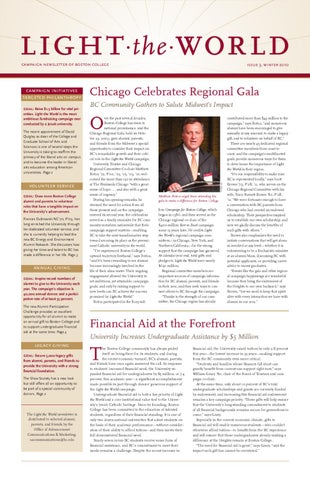
Matthew Botica urged those attending the gala to make a difference for Boston College.
lion Campaign for Boston College, which began in 1986, and then served as the Chicago regional co-chair of the $400-million Ever to Excel campaign some 13 years later. He credits Light the World’s regional campaign committees—in Chicago, New York, and Northern California—for the strong support that the campaign has garnered. At calendar year end, total gifts and pledges to Light the World were nearly $650 million. Regional committee members are important sources of campaign information for BC alumni, parents, and friends in their area, and they seek ways to connect others to BC through the campaign. “Thanks to the strength of our committee, the Chicago region has already
contributed more than $43 million to the campaign,” says Botica, “and numerous alumni have been encouraged to give annually at any amount, to make a legacy gift, and to volunteer on behalf of BC.” There are nearly 45 dedicated regional committee members from coast to coast, and the campaign’s multifaceted goals provide numerous ways for them to drive home the importance of Light the World in their region. “It’s our responsibility to make sure BC is represented locally,” says Scott Brown ’79, P’08, ’11, who serves on the Chicago Regional Committee with his wife, Tracy Burnett Brown ’80, P’08, ’11. “We were fortunate enough to have a conversation with BC parents from Chicago who had created an endowed scholarship. Their perspective inspired us to establish our own scholarship, and now we gladly discuss the benefits of such gifts with others.” Brown also emphasizes the need to initiate conversations that will get alumni involved at any level—whether it is volunteering to be a Eucharistic minister at an alumni Mass, discussing BC with potential applicants, or providing career advice to recent graduates. “Events like the gala and other regional campaign happenings are wonderful because they bring the excitement of the Heights to our own backyard,” says Brown, “but we need to keep that spirit alive with every interaction we have with alumni in our area.”
Financial Aid at the Forefront University Increases Undergraduate Assistance by $5 Million
T
he Boston College community has always prided itself on being there for its students, and during the recent economic turmoil, BC’s alumni, parents, and friends have once again answered the call. In response to students’ increased financial need, the University expanded financial aid for undergraduates by $5 million, or 7.4 percent, this academic year—a significant accomplishment made possible in part through donors’ generous support of the Light the World campaign. Undergraduate financial aid is both a key priority of Light the World and a core institutional value tied to the University’s Jesuit, Catholic heritage. Since its founding, Boston College has been committed to the education of talented students, regardless of their financial standing. It is one of only two dozen national universities that admit students on the basis of their academic performance—without consideration of their ability to afford tuition—and then meets their full demonstrated financial need. Nearly seven in ten BC students receive some form of financial assistance, and BC’s commitment to meet their needs remains a challenge. Despite the recent increase in
financial aid, the University raised tuition by only 2.8 percent this year—the lowest increase in 35 years—making support from the BC community even more critical. “Students and families whose finances fall short can greatly benefit from current-use support right now,” says William Geary ’80, chair of the Board of Trustees and campaign co-chair. At the same time, only about 10 percent of BC’s total undergraduate scholarships and grants are currently funded by endowment, and increasing this financial aid endowment remains a key campaign priority. “These gifts will help ensure that the University’s long-standing commitment to students of all financial backgrounds remains secure for generations to come,” says Geary. Especially in the current economic climate, gifts to financial aid will enable numerous students—who couldn’t otherwise afford tuition—to benefit from the BC experience and will ensure that those undergraduates already making a difference at the Heights remain at Boston College. “The need for financial aid is great,” says Geary, “and the impact each gift has cannot be overstated.”
Liberal Arts at the Campaign’s Core New Dean Points to an Exciting Future for A&S
W
field and an enterprise made possible by campaign support. “It’s clear that departments like English, history, philosophy, theology, and other humanities are part of our institutional identity,” says Quigley. But he notes that the University’s stance on the value of a liberal arts education isn’t shared nationwide and refutes a more popular academic movement. “What’s developed in the last half century in American universities,” says Quigley, “has been the sense that universities are more dedicated to job preparation than to exploring the greatest works in literature and understand-
according to Quigley, and seek to replicate in new projects the innovation that has marked the long-standing A&S Honors Program and PULSE, the service learning program that links academics and social action.
“What has sustained us is our belief in the power—the liberating power—of a liberal arts education.” “Boston College has developed new signature programs at the right time in the past,” says Quigley. “Now is that time again, and I think the Institute for Liberal Arts is that kind of initiative.” The institute will enable A&S to re-examine ways of organizing faculty work and to foster faculty-student collaboration. While some emphasis will be placed on more fully exploring particular academic disciplines, the ILA will specifically focus on cultivating relationships across departmental lines and fostering interdisciplinary projects, according to Thomas F. Rattigan Professor of English Mary Crane, who was recently appointed interim director of the institute. In its first year, the ILA supported faculty seminars and visiting scholar lectures and also collaborated with the McMullen Museum of Art on an exhibition of Civil War-era drawings. The institute’s most significant sponsorship to date, however, is the Guestbook Project, overseen by Richard Kearney, the Charles B. Seelig professor of philosophy. Through numerous events,
gary wayne gilbert
hile the trend in much of higher education has been to meet the call for programs that narrowly prepare graduates for a specific career, Boston College has set another course—to recommit to a legacy of liberal arts education nearly five centuries old. The Light the World campaign reaffirms the crucial role the liberal arts play at BC as a Jesuit, Catholic university, while providing the transformative power that will enable BC to take steps toward becoming the leader in liberal arts education among American universities.
New A&S Dean David Quigley interacts with students during his American studies seminar. The recent appointment of History Professor David Quigley as dean of the College and Graduate School of Arts and Sciences reflects this commitment and positions A&S to re-examine its curriculum and to pursue other innovative initiatives. Quigley played a significant role in discussions before the campaign launch that reconfirmed the primacy of the liberal arts at BC. He was also the founding director of the year-old Institute for Liberal Arts (ILA), a key component in BC’s undertaking in this
ing human history—really thinking about what the humanistic tradition and the liberal arts offer us.” Boston College, Quigley points out, has remained firm throughout that same period, standing by a core curriculum and maintaining a passionate commitment to placing the liberal arts at the center of a modern university. “What has sustained us is our belief in the power—the liberating power—of a liberal arts education,” he says. A&S will, however, review a core curriculum almost two decades old,
seminars, and multimedia presentations, the project examines how the five major religious traditions view the concept of hospitality. In the coming months, Crane intends to establish formal structures for the institute, including a board that will evaluate and select faculty proposals for ILA sponsorship. As Provost and Dean of Faculties Cutberto Garza has said, the institute will be “an incubator of ideas, courses, and programs.” The ILA and other efforts to rethink what A&S provides its students will translate to a more integrated academic experience for BC’s undergraduates. Their excellence and expectations, Quigley says, provide challenges that must be embraced and met. “The students attending BC are extraordinary in terms of their quality, their commitment to service, and their interest in investigating a range
“Boston College has developed new signature programs at the right time in the past,” says Quigley. “Now is that time again, and I think the Institute for Liberal Arts is that kind of initiative.” of academic pursuits,” he says. “But they have high demands for the kind of educational experience we’re going to deliver. We promise them a transformative education. I think initiatives like the ILA enable us to deliver on that promise.”
the shaw society’s new look
campaign leadership campaign chairs
convening campaign chairs
Charles I. Clough, Jr. ’64 and Gloria L. Clough ’96 William J. Geary ’80 and Kristi J. Geary Kathleen M. McGillycuddy NC’71
Margot C. Connell, H’09 John M. Connors, Jr. ’63, H’07, and Eileen M. Ahearn Connors ’66 Peter S. Lynch ’65, H’95, and Carolyn A. Lynch, H’09 Patrick T. Stokes ’64 and Anna Kristina L. Stokes
campaign council
Thomas F. Flannery ’81 Boston College Alumni Association
Peter W. Bell ’86 and Marilee Denelle Bell ’87 Boston College Fund Matthew J. Botica ’72 and Christine C. Botica Chicago Region Robert A. Ferris ’63 and Evelyn J. Ferris Northern California Region
The Shaw Society has a new look—and is looking for new members. The donor recognition society welcomes all who make a legacy commitment to Boston College and is named in honor of Joseph Coolidge Shaw, S.J., who helped found the University through his bequest of nearly 2,000 books and the proceeds of his life insurance policy. One of Fr. Shaw’s beloved volumes is depicted in the new Shaw logo and represents the proud giving tradition he sparked. In so many ways, legacy gifts have made possible the school’s journey from a humble institution for immigrants’ sons to a national university of ever-growing renown. And today’s donors can write the next chapter in Boston College’s story by making their own legacy gift. One of the campaign’s four goals is to secure 5,000 legacy commitments of all sizes from the BC community. There are numerous legacy giving opportunities, and each is a sound investment in the University’s future—donors of all ages can find a giving option that best meets their philanthropic goals. “I joined the Shaw Society because creating a legacy commitment made excellent sense,” says R. Blane Walter ’93. “My goal was both to take care of my family and to secure my alma mater’s long-term needs. I also wanted to make a gift that would establish a special connection to BC. A legacy gift was the perfect fit.” Discover more about legacy giving and the benefits of Shaw Society membership at www.bc.edu/legacygiving.
David T. Griffith ’68 Legacy Gifts Stephen P. Murray ’84 New York Region David P. O’Connor ’86 New York Region Thomas P. O’Neill III ’68 Gasson Society
2
Q&A
Boston College Spirit Burns Bright at Chicago Regional Gala
M
volunteer service
ore than 150 BC alumni, parents, and friends gathered at The Peninsula Chicago for a special evening that brought to life the promise and excitement of the Light the World campaign. Held on October 23, 2009, the Chicago Regional Gala served as a reminder of the collective strength of the BC community—and presented a wonderful opportunity for old and new friends to connect.
Frances Dubrowski NC’70, P’09, is one of the most active volunteers in the Boston College community, and her dedicated support of the Alumni Association’s numerous programs has enriched the BC experience of countless students and alumni. As the Light the World campaign continues, she encourages others to volunteer for BC and to help the University reach its goal of doubling the number of volunteers who give their time and talent back to the Heights—a goal in which “everyone wins,” according to Dubrowski.
tunwa yee
From left: University President William P. Leahy, S.J.; student speaker Jeffrey Skowera ’10; University Trustee and Chicago Regional Committee Co-chair Matthew Botica ’72, P’00, ’03, ’05, ’09, ’10; University Trustee and Campaign Co-chair Kathleen McGillycuddy NC’71; University Trustee Brian Paulson, S.J.; and Ronald Logue ’67, MBA’74, P’95
why do you feel a close connection to boston college?
tunwa yee
From left: Robert Singleton, Jr., P’08, ’10; Nancy Singleton, P’08, ’10; Chicago Regional Committee member Tracy Burnett Brown ’80, P’08, ’11; and Chicago Regional Committee member Scott Brown ’79, P’08, ’11
tunwa yee
From left: Richard Canning ’81; Chicago Regional Committee member Mary Belton ’79, P’10, ’11, ’13; and James Howarth ’81
kick like an eagle—student-athlete gina dimartino Soccer co-captain Gina DiMartino ’10 has taught numerous lessons to those who’ve opposed her on the pitch. She helped lead the women’s soccer team to the Elite Eight in the NCAA tournament this season and played on the U.S. national squad that captured the 2008 FIFA Under-20 Women’s World Cup. For the past three years, she has been placed on the watch list for the Hermann Trophy, awarded to the country’s best female collegiate soccer player. “I’m very competitive,” says DiMartino, with a smile. Yet, it’s the classroom lessons that truly matter to the senior from Massapequa Park, New York. DiMartino is a double major in elementary education and human development who one day
four different elementary schools in the Boston area. This spring, she’ll perform her semester-long teaching practicum, during which she’ll put to use lessons learned from BC courses such as “Teaching Mathematics and Technology” and “Working with Special Needs Students.” “Besides enabling me to excel on the field, my athletic scholarship will help me succeed in life,” says DiMartino, who currently receives the David F. ’58 and Patricia E. Cronin Scholarship. “I’m personally grateful for my scholarship. I always dreamed of being a teacher, and now I’ll have the opportunity to make a difference in so many children’s lives, thanks to the generosity of Boston College donors.”
hopes to have a class of her own. “I couldn’t have asked for better teacher preparation,” she says. “I feel competent and confident when I walk into a school.” DiMartino has student taught at
3
As a Newton College graduate, I first felt connected to BC when I became a class notes correspondent for Boston College Magazine. I enjoyed that experience so much that I wanted to become more involved. I guess you could say that’s what happened with each BC volunteer experience—and why I chose to serve on the Alumni Association Board of Directors and to join the Council for Women of Boston College.
how have you given back to bc? I don’t necessarily think of it in those terms, since I’ve received so much while “giving back.” For instance, I’ve met many wonderful people— alumni, faculty, administrators, and students—during my work with the Alumni Association’s Career Services Committee, which organizes networking and mentoring programs for students and alumni. I’ve also enjoyed the intellectual fulfillment and continued learning that goes hand in hand with staying connected to a vibrant educational institution like BC.
what is your most rewarding volunteer experience? I’m currently organizing the BC Energy and Environment Alumni Network with Patricia Randolph Williams ’77. It’s one of many alumni networks supported by BC and will give those who work in the energy and environmental fields a chance to merge their professional passions with their support of BC. what is one thing others should know about volunteering for bc? Volunteering for Boston College is one of the most rewarding experiences you can have—and if you aren’t participating, then you’re really missing out on something special. Discover more about BC volunteer opportunities at www.bc.edu/volunteer.
a new challenge awaits
lee pellegrini
Fresh off the success of the Neenan Challenge, BC alumni can now help bring their alma mater an additional $3 million for financial aid. Launched in the fall, the Alumni Participation Challenge is supported by the same anonymous donor who made last year’s drive possible—and is designed to help BC reach the Light the World campaign goal of 40,000 undergraduate alumni giving each and every year. These donors will form an essential base of financial support that will enable the University Alumni donors who answered the call to meet ongoing needs vital to the issued by Fr. William B. Neenan last year education and success of BC students. inspired the new Alumni Participation The new challenge is simple and Challenge. compelling. If alumni achieve annual participation targets throughout the campaign, they’ll trigger yearly $500,000 gifts for financial aid—money that will directly benefit those students who need it most. “Our goal for this year is 29,000 donors,” says campaign co-chair Charles I. Clough, Jr. ’64, P’87, ’93, ’98. “Their cash gifts—of any amount and for any purpose—will meet the most immediate needs of the University and count toward the challenge, so their donations will have an even greater impact on BC students.” The value of every gift lies at the heart of this new initiative: donations of $100 or less last year amounted to $1.3 million and benefited critical needs such as financial aid, faculty and student research, and student formation programming. “Annual donors are invaluable to the University,” says Clough, “and this new endeavor will inspire more alumni to take action, raising BC’s participation level to unprecedented heights. The combined impact of all donations makes the University strong and successful.”
www.bc.edu/ltw
office of university advancement 220 more hall 140 commonwealth avenue chestnut hill, ma 02467-3808
presorted first class us postage paid boston, ma permit no. 54465
light
sparks
The contributions, financial and otherwise, of many Boston College alumni are “sparks” that help “light the world.”
As a man who stood for election numerous times, Troy Clarkson ’90 knows the value of a good speech. He heard one this fall from University President William P. Leahy, S.J., and it motivated him to make his first-ever pledge to Boston College. Clarkson was attending the Boston kickoff for his upcoming 20th reunion. He recalls that Fr. Leahy passionately discussed the University’s Jesuit, Catholic commitment to “educate the whole person”; emphasized students’ contributions to society through their academic research and service projects; and made clear the difference that every donation makes at the Heights. “It was a very thorough and inspiring speech,” says Clarkson. Much of Fr. Leahy’s talk also focused on financial aid, another topic that hit home for Clarkson. His father died when he was in junior high school, and “it was through the generosity of others that I was able to attend BC,” he says. Clarkson majored in political science and became a selectman in his hometown of Falmouth, Massachusetts, at the age of 24 and successfully won re-election three times. Currently, he is county administrator of Plymouth County, which comprises 27 communities and nearly 500,000 residents. He
plymouth county development council
lives with his wife, Barbara, and their two children in North Falmouth, and he writes a weekly column on local happenings for the Falmouth Enterprise. Clarkson has always fully committed himself to the efforts that inspire him, so it makes sense that he intends to fulfill his BC pledge through annual gifts. These gifts, he says, will enable him to have an annual impact on campus and will give BC the opportunity to direct his donation to an area of urgent need each year. “I now realize the value of donor participation,” he says. “Annual gifts— regardless of their size—provide so many excellent opportunities for today’s students and ensure that BC remains a special institution.”
world issue 3, winter 2010