Introduction to Mego
A
family business founded in 1954, Mego Corporation evolved from a small import company into one of the most prolific manufacturers in the toy industry. Originally called MartinHoward Corp. (after the names of founder D. David Abrams’ two sons), the company sold a variety of products, acting as a sales representative for a number of importers. One such company imported various “lure” items, which are the relatively inexpensive toys retailers cleverly merchandise near checkout counters. Such products are also known as “hush up” toys, as parents are especially prone to impulse purchases that will quiet a fussy child.
In 1957, Abrams reached an exclusive agreement with a Japanese toy manufacturer to be their sole importer and sales representative. With the growing success, Abrams changed the company name to Mego. The 1960s were very busy, and found the entire Abrams clan working for Mego. D. David’s wife, Madeline, was employed from the outset, and sons Marty and Howard joined the family business in 1958 and 1967, respectively. During 1963, Mego established a trading company in Hong Kong called “Lion Rock.” Initially a broker, Lion Rock acted as Mego’s agent in the Orient, and would go on to become Mego’s principle manufacturer in Asia. In 1967, Mego entertained the notion of a public offering, and they immediately began the process of capitalization. In 1969, they filed with the Securities and Exchange Commission (SEC), and joined the American Stock Exchange (AmEx) in May 1971. The move toward a public offering coincided with a massive shift in Mego’s business model. “Mego itself has really gone through a metamorphosis over the last four years,” stated Mego president Marty Abrams in a December 1974 interview. “We had a non-proprietary line that we felt was a winding road to nowhere.” The public offering allowed Mego to develop proprietary lines that otherwise would have been fiscally out of reach. The company had a specific transition plan, one that would take several years to implement. “We never intended to do it one year,” confirmed Abrams. “It was a three-year program,” he stated, that called for the complete elimination of non-proprietary products. By 1974, Mego no longer offered any of the 88¢ ‘lure’ toys that had defined the company throughout the previous two decades.
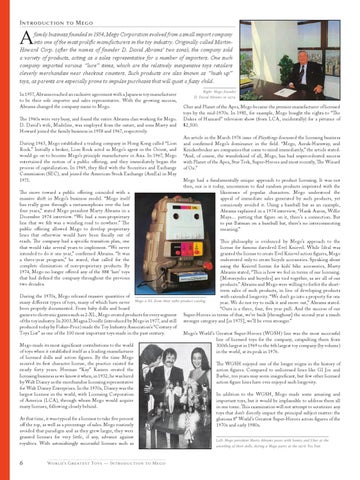
Right: Mego founder D. David Abrams in 1979.
Cher and Planet of the Apes, Mego became the premier manufacturer of licensed toys by the mid-1970s. In 1981, for example, Mego bought the rights to “The Dukes of Hazzard” television show (from LCA, incidentally) for a pittance of $2,500. An article in the March 1976 issue of Playthings discussed the licensing business and confirmed Mego’s dominance in the field. “Mego, Azrak-Hamway, and Knickerbocker are companies that come to mind immediately,” the article stated. “And, of course, the wunderkind of all, Mego, has had unprecedented success with Planet of the Apes, Star Trek, Super-Heroes and most recently, The Wizard of Oz.” Mego had a fundamentally unique approach to product licensing. It was not then, nor is it today, uncommon to find random products imprinted with the likenesses of popular characters. Mego understood the appeal of immediate sales generated by such products, yet consciously avoided it. Using a baseball bat as an example, Abrams explained in a 1974 interview, “Hank Aaron, Willie Mays… putting that figure on it, there’s a connection. But to put Batman on a baseball bat, there’s no interconnecting meaning.”
This philosophy is evidenced by Mego’s approach to the license for famous daredevil Evel Knievel. While Ideal was granted the license to create Evel Knievel action figures, Mego endeavored only to create bicycle accessories. Speaking about using the Knievel license for kids’ bike accessories, Marty Abrams stated, “This is how we feel in terms of our licensing. [Motorcycles and bicycles] are tied together, as are all of our products.” Abrams and Mego were willing to forfeit the shortterm sales of such products, in lieu of developing products During the 1970s, Mego released massive quantities of with extended longevity. “We don’t go into a property for one many different types of toys, many of which have never Mego 2-XL from their 1980 product catalog. year. We do not try to milk it and move out,” Abrams stated. been properly documented. From baby dolls and board “Ours is a three, four, five year pull. And the success of our games to electronic games such as 2-XL, Mego created products for every segment Super-Heroes in terms of that, we’ve built [throughout] the second year a much of the toy industry. In 2003, Magna Doodle (introduced by Mego in 1977, and still stronger category and [in 1975], we’ll be even stronger.” produced today by Fisher-Price) made the Toy Industry Association’s “Century of Toys List” as one of the 100 most important toys made in the past century. Mego’s World’s Greatest Super-Heroes (WGSH) line was the most successful line of licensed toys for the company, catapulting them from Mego made its most significant contributions to the world 300th largest in 1969 to the 6th largest toy company (by volume) of toys when it established itself as a leading manufacturer in the world, at its peak in 1976. of licensed dolls and action figures. By the time Mego secured its first character license, the practice existed for The WGSH enjoyed one of the longer reigns in the history of nearly forty years. Herman “Kay” Kamen created the action figures. Compared to unlicensed lines like GI Joe and licensing business as we know it when, in 1932, he was hired Barbie, ten years may seem insignificant, but few other licensed by Walt Disney as the merchandise licensing representative action figure lines have ever enjoyed such longevity. for Walt Disney Enterprises. In the 1970s, Disney was the largest licensor in the world, with Licensing Corporation In addition to the WGSH, Mego made some amazing and of America (LCA), through whom Mego would acquire important toys, but it would be implausible to address them all many licenses, following closely behind. in one tome. This examination will not attempt to scrutinize any toys that don’t directly impact the principal subject matter: the At that time, it was typical for a licensor to take five percent glorious 8” World’s Greatest Super-Heroes action figures of the off the top, as well as a percentage of sales. Mego routinely 1970s and early 1980s. avoided that paradigm and as they grew larger, they were granted licenses for very little, if any, advance against Left: Mego president Marty Abrams poses with Sonny and Cher at the royalties. With astonishingly successful licenses such as unveiling of their dolls, during a Mego party at the 1976 Toy Fair.
6
World's Greatest Toys — Introduction to Mego