14
www.pacepress.org
FEATURES
February 20, 2013
Obama administration’s drone program under fire Students join members of Senate and Congress in calls for more transparency PATRICK DEHAHN Staff Writer The Obama administration’s use of armed drones in global regions such as South Asia, North Africa and the Middle East has recently been highly contested. “Drone” is another name for an Unmanned Aerial Vehicle, and while there are many purposes for these remotely-controlled UAVs, they are widely known for their armed and surveillance purposes. The subject of drones has come to light recently with investigations into the drone-officiated Sept. 2011 killing of Anwar al-Awlaki, a top al-Qaida operative in Yemen. Al-Awlaki was an American-born Muslim cleric who at the time of his death retained American citizenship. The investigations forced the release of a Department of Justice document stating that it is lawful for the American government to use “lethal force in a foreign country […] against a U.S. citizen [who is] actively engaged in planning operations to kill Americans.” University student Jon Hand is wary of the document, saying, “The government no longer even claims that these drones are exclusively used in overseas warfare. In fact, a recent memo released to NBC by the Department of Justice provides the legal rationale for using drones against American citizens—regardless of whether they are inside or outside of US borders.” The government’s belief is that it is better to use armed drones rather than send in American armed troops or CIA groups into certain countries on the basis of fighting the war on terror. It feels that an unmanned aerial vehicle with missiles can further prevent casualties—U.S. soldiers and innocent civilian lives—on the ground. NBC News reported that three Americans were killed by drone strikes in Yemen in the fall of 2011. “The fact that the U.S. can use a drone to kill another U.S. civilian is nothing new, it’s been happening for years,” said university junior Katie James, before adding, “Congress and the President has the right to issue orders in states of emergencies or terror that can go against citizens’ rights.” With many cases, it’s a matter of trust that the U.S. government correctly coordinates the attack and has the right person taken out. With no right to trial being taken into consideration, many argue they’re unconstitutional. The stakes are higher with drones in a sense.
James continued by saying that she finds it “problematic to continue the use of drones without ensuring that these individuals are actual threats. I don’t think drones are the best measure—there is a lot of uncertainty.” Hand adds, “If you believe in the Bill of Rights, you must believe that the life of every human being is worth something, and that every human being has the right to defend himself, the right to a fair trial, and the right to life. Using drones to assassinate people is the US government’s way of stripping people of their natural, human rights.” There’s also the argument that these drone attacks can be considered acts of war. Although the U.S. government is operating in conjunction with the areas the drones are operating over, the drones are flying over other countries, observing the area and also performing strikes on foreign land, something that many would argue is a breach of international law. The United Nations has also announced that they are currently setting up a committee investigating civilian deaths from U.S.’s drone strikes. If proven true, international law would have been breached in the U.S. drone attacks. “They are using these drones to hunt down and assassinate specific individuals in foreign countries—with or without the permission of those countries. We are using drones to act unilaterally and invade foreign airspace at will,” Hand debates. “The accuracy of these drones is debatable, but this much is certain: With all the bombs we are dropping from these things, we are surely creating more enemies and causing more war.” In a global Pew Research Center survey done last year, 17 of 20 countries said they did not support U.S. drone strikes. In that same survey, 66 percent of Americans supported the drone attacks taking place across the world. Since that survey from last year, The Huffington Post and the YouGov organization held a poll in Jan. with the result of Americans only supporting strikes killing highlevel terrorism suspects that weren’t Americans. The support for killing terrorists who were also Americans dropped dramatically from 59 percent to 44 percent. President Obama announced Jan. 14 in a Google+ Hangout that Americans “deserve to know more” about drone strikes and is moving forward possible changes in the program. However, even with this, the support for such drone strikes by the United States is still on a whim.
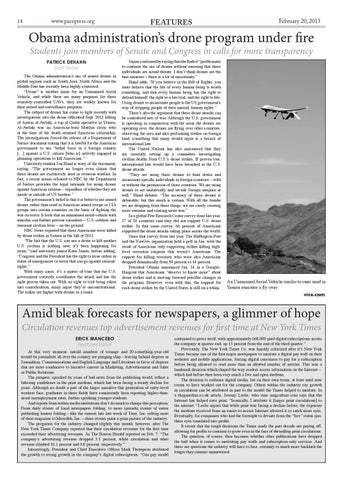
An Unmanned Aerial Vehicle similar to ones used in Yemen executes a fly-over vice.com
Amid bleak forecasts for newspapers, a glimmer of hope
Circulation revenues top advertisement revenues for first time at New York Times ERICK MANCEBO Features Editor At this very moment, untold numbers of teenage and 20-something-year-old would-be journalists all over the country are jumping ship—leaving behind degrees in Journalism, Communications and English Language and Literature in favor of degrees that are more conductive to lucrative careers in Marketing, Advertisement and Sales or Public Relations. The jumpers, spooked by years of bad news from the publishing world, reflect a faltering confidence in the print medium, which has been facing a steady decline for years. Although no doubt a part of the larger narrative this generation of entry-level workers face, graduates in these fields have consistently been reporting higher-thanusual unemployment rates, further spooking younger students. And reports from within media institutions don’t do much to change this perception. From daily stories of local newspapers folding, to more sporadic stories of entire publishing houses folding—like the rumors late last week of Time, Inc. selling most of their magazine to Meredith, Inc.—these stories paint a grim picture of the industry. The prognosis for the industry changed slightly this month, however, after The New York Times Company reported that their circulation revenues for the first time exceeded their advertising revenues. As The Boston Herald reported on Feb. 7, “The company’s advertising revenue dropped 3.1 percent, while circulation and other revenue climbed 16.1 percent and 4.8 percent, respectively.” Interestingly, President and Chief Executive Officer Mark Thompson attributed the growth to strong growth in the company’s digital subscriptions. “Our pay model
continued to prove itself, with approximately 668,000 paid digital subscriptions across the company at quarter end, up 13 percent from the end of the third quarter.” Previously, The New York Times Co. was harshly criticized after it’s New York Times became one of the first major newspapers to institute a digital pay wall on their websites and mobile applications, forcing digital customers to pay for a subscription before being allowed to read more than an allotted number of articles. This was a landmark decision which shaped the way readers access information on the Internet— which had before then been very much a free and open medium. The decision to embrace digital media, but on their own terms, at least until now seems to have worked out for the company. Others within the industry say growth in circulation can be attributed in part to the model the Times helped to institute. In a theguardian.co.uk article, Jeremy Leslie, who runs magculture.com says that the Internet has helped save print. “Ironically, I attribute it [larger print circulations] to the internet.” Leslie argues that while print was facing a decline before, the exposure the medium received from an easier-to-access Internet allowed it to catch more eyes. Eventually, for companies who had the foresight to deviate from the “free” status quo, these eyes translated into profits. It seems that the tough decisions the Times made the past decade are paying off, allowing for profits to continue to grow even in the face of dwindling print circulations. The question, of course, then becomes whether other publications have dropped the ball when it comes to instituting pay walls and subscription-only services. And these are questions the industry will have to face, certainly to much more backlash the longer they simmer unanswered.