4
www.pacepress.org
March 20, 2013
WORLD NEWS
Chavez’s death continues to cause controversy in Venezuela ANA SOSA Contributor On Tuesday Mar. 5 it was announced that Hugo Chavez, the president of Venezuela, died from a heart attack in the city of Caracas. He was 58 years old. Though heart attacks are not uncommon for men of this age, Chavez had been suffering from other health related issues that contributed to his death. In 2011, Chavez announced to the citizens of Venezuela that he would be undergoing surgery for a cancerous abscessed tumor in his pelvis. When the cancer cells came back a year later, he was forced to undergo more surgery, in addition to chemotherapy and radiation. The type of cancer that Hugo Chavez suffered from was never specified, but he was in critical condition before he ultimately lost the battle against the disease. On Friday Mar. 8 supporters of Chavez lined up in front of the military academy of Caracas in order to catch a glimpse of their late leader’s casket. The line of funeral attendees stretched 1.5 miles down the streets of Caracas; some aficionados camped out on the streets for two days before the event just to be closer to his body. Many cried, many chanted, and many found solidarity in the crowd. Other streets of Caracas were deserted; the country’s was intently focused on Chavez’s death. The citizens of Venezuela weren’t the only ones affected by his passing. His funeral was attended by important world leaders, celebrities, and other relevant public figures. Raul Castro, Cuba’s head of state, and Mahmoud Ahmadinejad, Iran’s head of state, were just a couple of the iconic faces seen amongst the elite crowd of individuals. Sean Penn and Rev. Jesse Jackson were also spotted at the funeral. Hugo Chavez’s body was originally going to be embalmed and put on display, very much like the bodies of Mao Zedong, Ho Chi Minh, and Vladimir Lenin. However, because the body was not prepared in time, it has been decided that it will not be available for permanent viewing. The Venezuelan electoral commission announced during the event that a new presidential election is to take place on April 14. According to the Venezuelan Constitution, Diosdado Cabello, who is currently the president of the Bolivarian Republic of Venezuela’s National Assembly, was intended to become Venezuela’s interim president. However, on December 8, 2012, Hugo Chavez stated that if he was not able to complete his presidency due to his health, Vice President Nicolas Maduro should be sworn in as president of Venezuela. Nicolas Maduro, who will be running for president in the coming election, has been the interim president of Venezuela since March 8. The government has followed the late president’s wishes to put Maduro in power, despite the fact that it is against the constitution’s protoco.
Governor Henrique Capriles, Maduro’s contender in the future election has blamed the socialist party for manipulating Hugo Chavez’s death in order to give Maduro an unfair advantage in the election. He insisted that the government is “fraudulent” for disrespecting the constitution, an accusation to which Maduro responded by calling him a “fascist.” There is growing tension between the two parties as of now, and the election looks like it will be a tumultuous event, attended by a very divided Venezuela. Though Chavez’s funeral displayed a large percentage of supporters known as “Chavistas,” a large portion of the Venezuelan population are happy to see Chavez go. Those who were not fans of Chavez primarily blamed him for running a dictatorship masked under a socialist government, for the rising inflation of the Venezuelan Bolivar, and the unnecessary recession of the economy. In 2010, the CIA world factbooks gave Venezuela one of the highest inflation rates in the world at 29.1%. When Senior Arianne Esposito—who was born and raised in Venezuela— was asked how she felt about the leader’s death, she responded “I felt freedom and anxiety, because with his death I imagined a better political and socio-economic future for my country. I thought about the millions of people who have died under his ‘dictatorship’ where there was only violence, hatred and destruction. I think a lot of Venezuelans are relieved and hopeful at the prospect that things could be different in a not so distant future.” Junior Jamilla Pipersburg, who lived in Venezuela for some time, was asked the same question, and shared a different perspective of Chavez: “I thought that his death was sad because of the economic danger that Venezuela is currently in. When a political force dies it is the people who are left picking up the pieces. With elections looming we can only hope that the new electorate takes into consideration the current state of affairs and improves them. I cannot say if Mr. Chavez was a good or bad president, but I think new government has a tough job ahead of them. Pipersburg had seen the development of her city under the rule of Chavez. Loyal supporters praise him for using the revenue from Venezuelan oil to improve education and implement health care programs. In 2009 the poverty rate went from 62% down to 29% according to the World Bank. It is not uncommon to find these two different viewpoints from Venezuelan citizens. It is up to the people of Venezuela, however, to elect a leader that will bring prosperity to the country. Many are hoping for a new economic strategy that will bring down the inflation, poverty and crime rate. Others are wishing for another figure like Chavez that will implement “Chavismo” with the same passion. The US government hopes for a leader that will improve the ties between the USA and Venezuela.
NATIONAL NEWS
Flatbush protests continue PATRICK DEHAN Staff Writer
NYPD have increased their controversial presence in Brooklyn after a police shooting of 16 year-old Kimani Gray two weeks ago has ignited nightly protests calling for justice and positive change in the relationship between police and the Flatbush community. Mar. 18 marked a full week of protests in the East Flatbush area. The makeshift candlelit memorial set up home on the street corner of 55th street and Church Avenue. Most nights, participants have gathered for a vigil. Recently, they have been accompanied by NYPD cop cars patrolling Church Avenue with silent flashers on, mounted cops on horses, police officers standing in pairs on each street corner and riot cops with zip cuffs. Mar. 11, marchers ransacked a Rite Aid and protesters threw bottles and rocks at the Brooklyn 67th precinct. Numbers grew Tuesday night as families came and chanted against the police. Chants such as “NYPD-KKK how many kids will you kill today?” were heard. There has been debate over whether or not these could be called protests or riots. University student Caitlin Richardson says, “You can call yourself a nonviolent protest all you want, but if the NYPD is there in riot gear, you are no longer a nonviolent protest, you are a riot.” On the other hand, student Sam Krushinsky states, “I think that they are disrespectful to the family and [their] mourning. The trashing of the Rite Aid in the midst of what was a peaceful vigil bothered me because there was no reason for that. And what has escalated from that, I think is a little much.” Alireza Vaziri, senior, said, “The members of the community need to control themselves and not let their emotions get the best of them.” Brooklyn City Councilman Jumaane Williams wanted to have a community meeting. He has been a voice to try to calm Flatbush residents after violence, looting and arrests. Protesters who went to the precinct were approached by rows of barricades and riot cops in front of the police station. Since then, numbers have died down but protests have continued. The Twitter hashtag #BrooklynProtest has trended across the United States. The loss still felt all around Flatbush occurred on the night of Mar. 9, when around 11:30 p.m. two plainclothes police officers approached Gray after he walked away from a group of friends in East Flatbush. The NYPD says they saw Gray suspiciously adjust his pants, raising their concern to question him. Shortly after walking up to him, Gray had reportedly pulled out a gun at them, resulting in the two officers shooting the teenager. The city’s medical examiner’s officer shared he was hit with seven bullets with three in the back. Gray was pronounced dead after arriving at a local hospital. Witnesses in the area have come up to claim that he was not holding a weapon. A New York Times source told Gray’s sister Mahnefah that he was only fixing his belt. Vaziri added, “The death of Kimani Gray is not something novel to me. Since I have been living in New York City, there have been many incidents were police officers have gunned down members of the community. This situation is a bit more difficult to accept knowing how young Kimani Gray was.” The NYPD is following standard police procedure and is conducting an internal affairs investigation. Even with Gray having a questionable criminal background, many Flatbush residents are calling for an independent investigation of the shooting. Posters for this investigation can be seen all along Church Avenue in front of storefronts and business windows. Vaziri says, “I do believe that the over policing and the stop and frisk movement has placed the citizens of these communities in a stressful situation. Police officers are racially profiling.” Kimani Gray’s wake and funeral will take place Mar. 22 and 23.
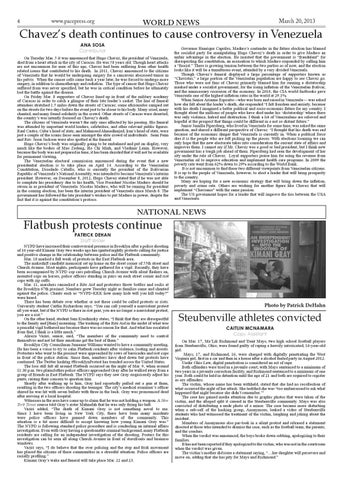
Photo by Patrick DeHahn
Steubenville athletes convicted CAITLIN MCNAMARA Copy Assistant On Mar. 17, Ma’Lik Richmond and Trent Mays, two high school football players from Steubenville, Ohio, were found guilty of raping a heavily intoxicated, 16-year-old girl. Mays, 17, and Richmond, 16, were charged with digitally penetrating the West Virginia girl, first in a car and then in a house after a alcohol fueled party in August 2012. Under Ohio Law, digital penetration is considered an act of rape. Both offenders were tried in a juvenile court, with Mays sentenced to a minimum of two years in a juvenile correction facility, and Richmond sentenced to a minimum of one year. Both could be held in detention until the age of 21 and both are required to register as sex offenders. The victim, whose name has been withheld, stated that she had no recollection of what occurred the night of her attack. She testified she was “too embarrassed to ask what happened that night because she didn’t remember.’” The case has gained media attention due to graphic photos that were taken of the victim, and the alleged split it caused in the Steubenville community. Mays was also convicted of distributing a nude photo of a minor. The case became more disturbing when a sub-cell of the hacking group, Anonymous, leaked a video of Steubenville students who had witnessed the treatment of the victim, laughing and joking about the incident. Members of Anonymous also par-took in a silent protest and released a statement directed at those who intended to dismiss the case, such as the football team, the parents, and the coaches. When the verdict was announced, the boys broke down sobbing, apologizing to their families. It has not been reported if they apologized to the victim, who was not in the courtroom when the verdict was given. The victim’s mother did issue a statement saying, “…her daughter will persevere and move on, adding that she has pity for Mays and Richmond.”