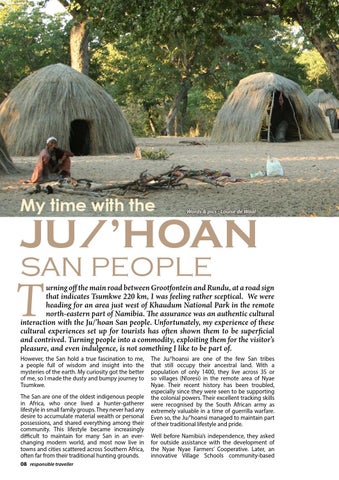
My time with the
Words & pics - Louise de Waal
JU/’HOAN SAN PEOPLE
T
urning off the main road between Grootfontein and Rundu, at a road sign that indicates Tsumkwe 220 km, I was feeling rather sceptical. We were heading for an area just west of Khaudum National Park in the remote north-eastern part of Namibia. The assurance was an authentic cultural interaction with the Ju/’hoan San people. Unfortunately, my experience of these cultural experiences set up for tourists has often shown them to be superficial and contrived. Turning people into a commodity, exploiting them for the visitor’s pleasure, and even indulgence, is not something I like to be part of.
However, the San hold a true fascination to me, a people full of wisdom and insight into the mysteries of the earth. My curiosity got the better of me, so I made the dusty and bumpy journey to Tsumkwe. The San are one of the oldest indigenous people in Africa, who once lived a hunter-gatherer lifestyle in small family groups. They never had any desire to accumulate material wealth or personal possessions, and shared everything among their community. This lifestyle became increasingly difficult to maintain for many San in an everchanging modern world, and most now live in towns and cities scattered across Southern Africa, often far from their traditional hunting grounds. 08 responsible traveller
The Ju/’hoansi are one of the few San tribes that still occupy their ancestral land. With a population of only 1400, they live across 35 or so villages (N!oresi) in the remote area of Nyae Nyae. Their recent history has been troubled, especially since they were seen to be supporting the colonial powers. Their excellent tracking skills were recognised by the South African army as extremely valuable in a time of guerrilla warfare. Even so, the Ju/’hoansi managed to maintain part of their traditional lifestyle and pride. Well before Namibia’s independence, they asked for outside assistance with the development of the Nyae Nyae Farmers’ Cooperative. Later, an innovative Village Schools community-based