Kanika Mishra Do you believe that music is a skill that can be acquired over the years as opposed to the natural-given gift most people perceive it to be? I started Violin when I was three, but of course that didn’t become my main instrument. Playing Piano by ear was made possible partly by my early ear training. But, maybe, it could have happened another way... I guess we’ll never know! It seems to me that there are many different ways to have a musical life. I’ve come to know many musicians who are remarkably gifted from an early age, and many others who got started as instrumentalists/composers relatively late in life. I’ve known great musicians who had formal training from early childhood and other great musicians who had no formal training at all. I’ve known people who don’t identify as musicians who are nonetheless remarkably musically perceptive and aware, and I’ve known professional ‘musicians’ who can’t perceive or identify some basic attributes of sound. I suppose the main point is that music is something that belongs to all of humankind. While there may be very skilled practitioners who are amazing to behold, the rest of us can participate in it too.
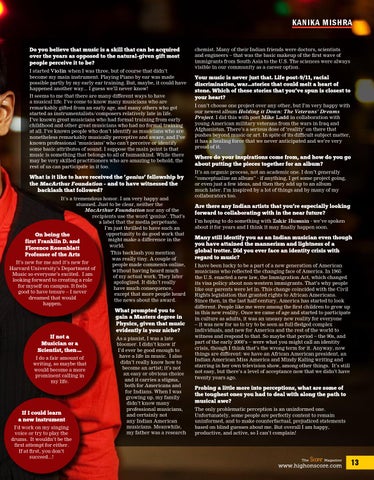
What is it like to have received the ‘genius’ fellowship by the MacArthur Foundation – and to have witnessed the backlash that followed? It’s a tremendous honor. I am very happy and stunned. Just to be clear, neither the MacArthur Foundation nor any of the recipients use the word ‘genius’. That’s a label that the media perpetuate. I’m just thrilled to have such an opportunity to do good work that On being the might make a difference in the first Franklin D. and world. Florence Rosenblatt This backlash you mention Professor of the Arts was really tiny. A couple of It’s new for me and it’s new for people made comments online, Harvard University’s Department of without having heard much Music so everyone’s excited. I am of my actual work. They later looking forward to creating a role apologized. It didn’t really for myself on campus. It feels have much consequence, good to have tenure -- I never except that more people heard dreamed that would the news about the award. happen.
What prompted you to gain a Masters degree in Physics, given that music evidently is your niche? If not a Musician or a Scientist, then… I do a fair amount of writing, so maybe that would become a more prominent calling in my life.
If I could learn a new instrument I’d work on my singing voice or try to play the drums. It wouldn’t be the first attempt for either. If at first, you don’t succeed...!
As a pianist, I was a late bloomer. I didn’t know if I’d ever be good enough to have a life in music. I also didn’t really know how to become an artist; it’s not an easy or obvious choice and it carries a stigma, both for Americans and for Indians. When I was growing up, my family didn’t know many professional musicians, and certainly not any Indian American musicians. Meanwhile, my father was a research
chemist. Many of their Indian friends were doctors, scientists and engineers -- that was the basic makeup of the first wave of immigrants from South Asia to the U.S. The sciences were always visible in our community as a career option.
Your music is never just that. Life post-9/11, racial discrimination, war...stories that could melt a heart of stone. Which of these stories that you’ve spun is closest to your heart? I can’t choose one project over any other, but I’m very happy with our newest album Holding it Down: The Veterans’ Dreams Project. I did this with poet Mike Ladd in collaboration with young American military veterans from the wars in Iraq and Afghanistan. There’s a serious dose of ‘reality’ on there that pushes beyond music or art. In spite of its difficult subject matter, it has a healing force that we never anticipated and we’re very proud of it.
Where do your inspirations come from, and how do you go about putting the pieces together for an album? It’s an organic process, not an academic one. I don’t generally “conceptualize an album” - if anything, I get some project going, or even just a few ideas, and then they add up to an album much later. I’m inspired by a lot of things and by many of my collaborators too.
Are there any Indian artists that you’re especially looking forward to collaborating with in the near future? I’m hoping to do something with Zakir Hussain - we’ve spoken about it for years and I think it may finally happen soon.
Many still identify you as an Indian musician even though you have attained the mannerism and lightness of a global trotter. Did you ever face an identity crisis with regard to music? I have been lucky to be a part of a new generation of American musicians who reflected the changing face of America. In 1965 the U.S. enacted a new law, the Immigration Act, which changed its visa policy about non-western immigrants. That’s why people like our parents were let in. This change coincided with the Civil Rights legislation that granted rights to African Americans. Since then, in the last half-century, America has started to look different. People like me were among the first children to grow up in this new reality. Once we came of age and started to participate in culture as adults, it was an uneasy new reality for everyone -- it was new for us to try to be seen as full-fledged complex individuals, and new for America and the rest of the world to witness and respond to that. So maybe that period -- the 90s, and part of the early 2000’s -- were what you might call an identity crisis, though I think that’s the wrong term for it. Anyway, now things are different: we have an African American president, an Indian American Miss America and Mindy Kaling writing and starring in her own television show, among other things. It’s still not easy, but there’s a level of acceptance now that we didn’t have twenty years ago.
Probing a little more into perceptions, what are some of the toughest ones you had to deal with along the path to musical awe? The only problematic perception is an uninformed one. Unfortunately, some people are perfectly content to remain uninformed, and to make counterfactual, prejudiced statements based on blind guesses about me. But overall I am happy, productive, and active, so I can’t complain!
The
Score Magazine
www.highonscore.com
13