Discover Germany | Special Theme | Best of Bern
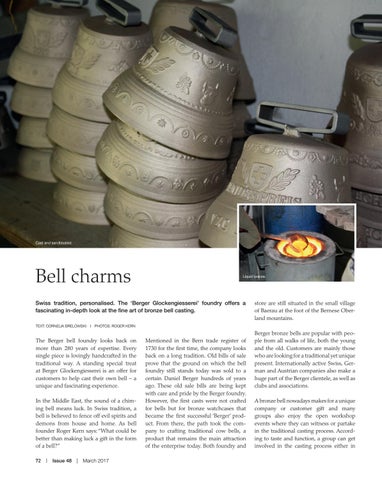
Cast and sandblasted.
Bell charms
Liquid bronze.
Swiss tradition, personalised. The ‘Berger Glockengiesserei’ foundry offers a fascinating in-depth look at the fine art of bronze bell casting.
store are still situated in the small village of Baerau at the foot of the Bernese Oberland mountains.
TEXT: CORNELIA BRELOWSKI I PHOTOS: ROGER KERN
The Berger bell foundry looks back on more than 280 years of expertise. Every single piece is lovingly handcrafted in the traditional way. A standing special treat at Berger Glockengiesserei is an offer for customers to help cast their own bell – a unique and fascinating experience. In the Middle East, the sound of a chiming bell means luck. In Swiss tradition, a bell is believed to fence off evil spirits and demons from house and home. As bell founder Roger Kern says: “What could be better than making luck a gift in the form of a bell?” 72 | Issue 48 | March 2017
Mentioned in the Bern trade register of 1730 for the first time, the company looks back on a long tradition. Old bills of sale prove that the ground on which the bell foundry still stands today was sold to a certain Daniel Berger hundreds of years ago. These old sale bills are being kept with care and pride by the Berger foundry. However, the first casts were not crafted for bells but for bronze watchcases that became the first successful ‘Berger’ product. From there, the path took the company to crafting traditional cow bells, a product that remains the main attraction of the enterprise today. Both foundry and
Berger bronze bells are popular with people from all walks of life, both the young and the old. Customers are mainly those who are looking for a traditional yet unique present. Internationally active Swiss, German and Austrian companies also make a huge part of the Berger clientele, as well as clubs and associations. A bronze bell nowadays makes for a unique company or customer gift and many groups also enjoy the open workshop events where they can witness or partake in the traditional casting process. According to taste and function, a group can get involved in the casting process either in