Discover Germany | Special Theme | Top Architects Switzerland
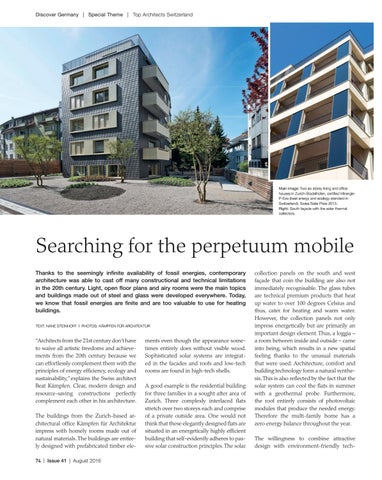
Main image: Two six storey living and office houses in Zurich-Stadelhofen, certified MinergieP-Eco (best energy and ecology standard in Switzerland). Swiss Solar Prize 2013. Right: South façade with the solar thermal collectors.
Searching for the perpetuum mobile Thanks to the seemingly infinite availability of fossil energies, contemporary architecture was able to cast off many constructional and technical limitations in the 20th century. Light, open floor plans and airy rooms were the main topics and buildings made out of steel and glass were developed everywhere. Today, we know that fossil energies are finite and are too valuable to use for heating buildings. TEXT: NANE STEINHOFF I PHOTOS: KÄMPFEN FÜR ARCHITEKTUR
“Architects from the 21st century don’t have to waive all artistic freedoms and achievements from the 20th century because we can effortlessly complement them with the principles of energy efficiency, ecology and sustainability,” explains the Swiss architect Beat Kämpfen. Clear, modern design and resource-saving constructions perfectly complement each other in his architecture. The buildings from the Zurich-based architectural office Kämpfen für Architektur impress with homely rooms made out of natural materials. The buildings are entirely designed with prefabricated timber ele74 | Issue 41 | August 2016
ments even though the appearance sometimes entirely does without visible wood. Sophisticated solar systems are integrated in the facades and roofs and low-tech rooms are found in high-tech shells. A good example is the residential building for three families in a sought after area of Zurich. Three complexly interlaced flats stretch over two storeys each and comprise of a private outside area. One would not think that these elegantly designed flats are situated in an energetically highly efficient building that self-evidently adheres to passive solar construction principles. The solar
collection panels on the south and west façade that coin the building are also not immediately recognisable. The glass tubes are technical premium products that heat up water to over 100 degrees Celsius and thus, cater for heating and warm water. However, the collection panels not only impress energetically but are primarily an important design element. Thus, a loggia – a room between inside and outside – came into being, which results in a new spatial feeling thanks to the unusual materials that were used. Architecture, comfort and building technology form a natural synthesis. This is also reflected by the fact that the solar system can cool the flats in summer with a geothermal probe. Furthermore, the roof entirely consists of photovoltaic modules that produce the needed energy. Therefore the multi-family home has a zero energy balance throughout the year. The willingness to combine attractive design with environment-friendly tech-