1_DiscoverBenelux_Issue19_July_2015_Q9_Scan Magazine 1 26/06/2015 20:48 Page 61
Discover Benelux & France | Business | Luxembourg School of Finance
ademic and theoretical with the real world, the professional side.” He cites as examples of this with the annual autumn colloquium organised with Clearstream Banking, and the presentations held weekly throughout the academic year where companies or subject matter experts spend an hour explaining what they do and how they do it.
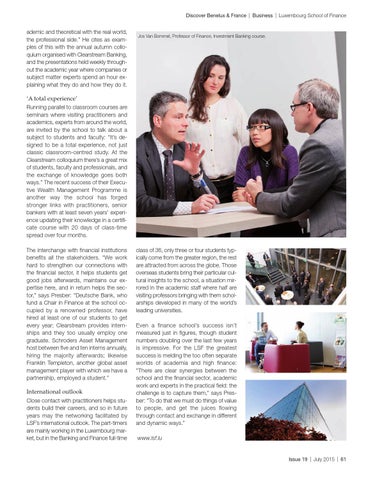
Jos Van Bommel, Professor of Finance, Investment Banking course.
‘A total experience’ Running parallel to classroom courses are seminars where visiting practitioners and academics, experts from around the world, are invited by the school to talk about a subject to students and faculty: “It’s designed to be a total experience, not just classic classroom-centred study. At the Clearstream colloquium there’s a great mix of students, faculty and professionals, and the exchange of knowledge goes both ways.” The recent success of their Executive Wealth Management Programme is another way the school has forged stronger links with practitioners, senior bankers with at least seven years’ experience updating their knowledge in a certificate course with 20 days of class-time spread over four months. The interchange with financial institutions benefits all the stakeholders. “We work hard to strengthen our connections with the financial sector, it helps students get good jobs afterwards, maintains our expertise here, and in return helps the sector,” says Presber: “Deutsche Bank, who fund a Chair in Finance at the school occupied by a renowned professor, have hired at least one of our students to get every year; Clearstream provides internships and they too usually employ one graduate. Schroders Asset Management host between five and ten interns annually, hiring the majority afterwards; likewise Franklin Templeton, another global asset management player with which we have a partnership, employed a student.”
International outlook Close contact with practitioners helps students build their careers, and so in future years may the networking facilitated by LSF’s international outlook. The part-timers are mainly working in the Luxembourg market, but in the Banking and Finance full-time
class of 36, only three or four students typically come from the greater region, the rest are attracted from across the globe. Those overseas students bring their particular cultural insights to the school, a situation mirrored in the academic staff where half are visiting professors bringing with them scholarships developed in many of the world’s leading universities. Even a finance school’s success isn’t measured just in figures, though student numbers doubling over the last few years is impressive. For the LSF the greatest success is melding the too often separate worlds of academia and high finance: “There are clear synergies between the school and the financial sector, academic work and experts in the practical field: the challenge is to capture them,” says Presber: “To do that we must do things of value to people, and get the juices flowing through contact and exchange in different and dynamic ways.” www.lsf.lu
Issue 19 | July 2015 | 61