2_2_DiscoverBenelux_11_November_2014_Q9_Scan Magazine 1 06/11/2014 23:08 Page 59
Discover Benelux | Special Theme | Dutch Architecture & Interiors
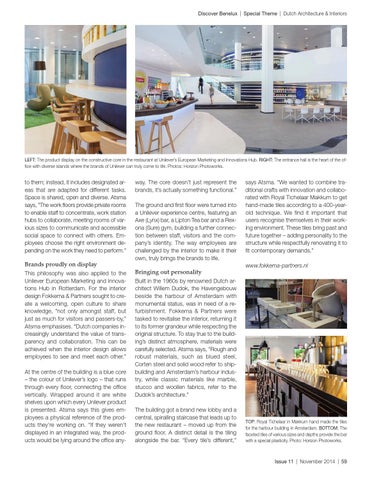
LEFT: The product display on the constructive core in the restaurant at Unilever’s European Marketing and Innovations Hub. RIGHT: The entrance hall is the heart of the office with diverse islands where the brands of Unilever can truly come to life. Photos: Horizon Photoworks.
to them; instead, it includes designated areas that are adapted for different tasks. Space is shared, open and diverse. Atsma says, “The work floors provide private rooms to enable staff to concentrate, work station hubs to collaborate, meeting rooms of various sizes to communicate and accessible social space to connect with others. Employees choose the right environment depending on the work they need to perform.”
way. The core doesn’t just represent the brands, it’s actually something functional.” The ground and first floor were turned into a Unilever experience centre, featuring an Axe (Lynx) bar, a Lipton Tea bar and a Rexona (Sure) gym, building a further connection between staff, visitors and the company’s identity. The way employees are challenged by the interior to make it their own, truly brings the brands to life.
Brands proudly on display This philosophy was also applied to the Unilever European Marketing and Innovations Hub in Rotterdam. For the interior design Fokkema & Partners sought to create a welcoming, open culture to share knowledge, “not only amongst staff, but just as much for visitors and passers-by,” Atsma emphasises. “Dutch companies increasingly understand the value of transparency and collaboration. This can be achieved when the interior design allows employees to see and meet each other.” At the centre of the building is a blue core – the colour of Unilever’s logo – that runs through every floor, connecting the office vertically. Wrapped around it are white shelves upon which every Unilever product is presented. Atsma says this gives employees a physical reference of the products they’re working on. “If they weren’t displayed in an integrated way, the products would be lying around the office any-
says Atsma. “We wanted to combine traditional crafts with innovation and collaborated with Royal Tichelaar Makkum to get hand-made tiles according to a 400-yearold technique. We find it important that users recognise themselves in their working environment. These tiles bring past and future together – adding personality to the structure while respectfully renovating it to fit contemporary demands.” www.fokkema-partners.nl
Bringing out personality Built in the 1960s by renowned Dutch architect Willem Dudok, the Havengebouw beside the harbour of Amsterdam with monumental status, was in need of a refurbishment. Fokkema & Partners were tasked to revitalise the interior, returning it to its former grandeur while respecting the original structure. To stay true to the building’s distinct atmosphere, materials were carefully selected. Atsma says, “Rough and robust materials, such as blued steel, Corten steel and solid wood refer to shipbuilding and Amsterdam’s harbour industry, while classic materials like marble, stucco and woollen fabrics, refer to the Dudok’s architecture.” The building got a brand new lobby and a central, spiralling staircase that leads up to the new restaurant – moved up from the ground floor. A distinct detail is the tiling alongside the bar. “Every tile’s different,”
TOP: Royal Tichelaar in Makkum hand made the tiles for the harbour building in Amsterdam. BOTTOM: The faceted tiles of various sizes and depths provide the bar with a special plasticity. Photo: Horizon Photoworks.
Issue 11 | November 2014 | 59