2_2_DiscoverBenelux_11_November_2014_Q9_Scan Magazine 1 06/11/2014 23:06 Page 45
Discover Benelux | Special Theme | Dutch Architecture & Interiors
OPPOSITE PAGE: Alexander pond in Russia. TOP LEFT: Sukhodolskaya in Russia. LEFT: The Palace Quarter, the Netherlands. RIGHT: The Field of Lions, the Netherlands.
over the public place by placing windows and outdoor areas in a strategic location. Liveliness is added as well by combining functions like shopping and housing, which results in movement during both day and night. Otherwise it is not a social environment but a living factory: a place where you arrive, park your car and enter your house without seeing anyone. Instead, we aim for a sustainable environment that supports the start and growth of communities.”
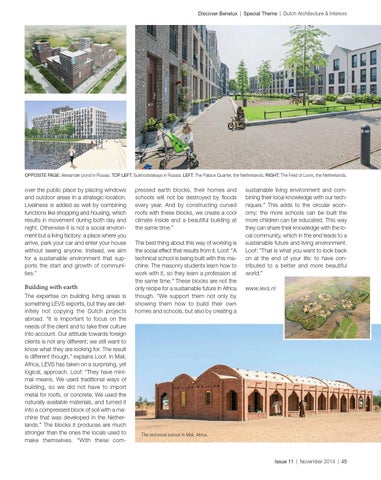
Building with earth The expertise on building living areas is something LEVS exports, but they are definitely not copying the Dutch projects abroad. “It is important to focus on the needs of the client and to take their culture into account. Our attitude towards foreign clients is not any different; we still want to know what they are looking for. The result is different though,” explains Loof. In Mali, Africa, LEVS has taken on a surprising, yet logical, approach. Loof: “They have minimal means. We used traditional ways of building, so we did not have to import metal for roofs, or concrete. We used the naturally available materials, and turned it into a compressed block of soil with a machine that was developed in the Netherlands.” The blocks it produces are much stronger than the ones the locals used to make themselves. “With these com-
pressed earth blocks, their homes and schools will not be destroyed by floods every year. And by constructing curved roofs with these blocks, we create a cool climate inside and a beautiful building at the same time.” The best thing about this way of working is the social effect that results from it. Loof: “A technical school is being built with this machine. The masonry students learn how to work with it, so they learn a profession at the same time.” These blocks are not the only recipe for a sustainable future in Africa though. “We support them not only by showing them how to build their own homes and schools, but also by creating a
sustainable living environment and combining their local knowledge with our techniques.” This adds to the circular economy: the more schools can be built the more children can be educated. This way they can share their knowledge with the local community, which in the end leads to a sustainable future and living environment. Loof: “That is what you want to look back on at the end of your life: to have contributed to a better and more beautiful world.” www.levs.nl
The technical school in Mali, Africa.
Issue 11 | November 2014 | 45