2_2_DiscoverBenelux_11_November_2014_Q9_Scan Magazine 1 06/11/2014 23:06 Page 39
Discover Benelux | Special Theme | Dutch Architecture & Interiors
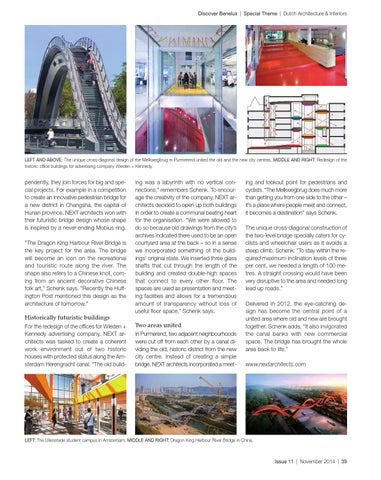
LEFT AND ABOVE: The unique cross-diagonal design of the Melkwegbrug in Purmerend united the old and the new city centres. MIDDLE AND RIGHT: Redesign of the historic office buildings for advertising company Wieden + Kennedy.
pendently, they join forces for big and special projects. For example in a competition to create an innovative pedestrian bridge for a new district in Changsha, the capital of Hunan province, NEXT architects won with their futuristic bridge design whose shape is inspired by a never-ending Mobius ring. “The Dragon King Harbour River Bridge is the key project for the area. The bridge will become an icon on the recreational and touristic route along the river. The shape also refers to a Chinese knot, coming from an ancient decorative Chinese folk art,” Schenk says. “Recently the Huffington Post mentioned this design as the architecture of tomorrow.”
ing was a labyrinth with no vertical connections,” remembers Schenk. To encourage the creativity of the company, NEXT architects decided to open up both buildings in order to create a communal beating heart for the organisation. “We were allowed to do so because old drawings from the city’s archives indicated there used to be an open courtyard area at the back – so in a sense we incorporated something of the buildings’ original state. We inserted three glass shafts that cut through the length of the building and created double-high spaces that connect to every other floor. The spaces are used as presentation and meeting facilities and allows for a tremendous amount of transparency without loss of useful floor space,” Schenk says.
Historically futuristic buildings For the redesign of the offices for Wieden + Kennedy advertising company, NEXT architects was tasked to create a coherent work environment out of two historic houses with protected status along the Amsterdam Herengracht canal. “The old build-
Two areas united In Purmerend, two adjacent neighbourhoods were cut off from each other by a canal dividing the old, historic district from the new city centre. Instead of creating a simple bridge, NEXT architects incorporated a meet-
ing and lookout point for pedestrians and cyclists. “The Melkwegbrug does much more than getting you from one side to the other – it’s a place where people meet and connect, it becomes a destination” says Schenk. The unique cross-diagonal construction of the two-level bridge specially caters for cyclists and wheelchair users as it avoids a steep climb. Schenk: “To stay within the required maximum inclination levels of three per cent, we needed a length of 100 metres. A straight crossing would have been very disruptive to the area and needed long lead up roads.” Delivered in 2012, the eye-catching design has become the central point of a united area where old and new are brought together. Schenk adds, “It also invigorated the canal banks with new commercial space. The bridge has brought the whole area back to life.” www.nextarchitects.com
LEFT: The Uilenstede student campus in Amsterdam. MIDDLE AND RIGHT: Dragon King Harbour River Bridge in China.
Issue 11 | November 2014 | 39