s
1960s 1970s 1980s 1990s Hines in Houston: Yesterday, Today, and Tomorrow The Association of Commercial Real Estate Professionals (ACRP) was founded in 1987 as a business oriented non-political association to enhance its members’ and guests’ knowledge of the commercial real estate industry, to establish business relationships and promote comradeship among a diverse group of individuals who are affiliated with or have an interest in the Houston commercial real estate industry. On January 30th, Mark Cover spoke to ACRP members at their monthly breakfast meeting at the Houston Country Club. Mark Cover, who has been with Hines for over thirty years, spoke about the company’s early years. Gerald Hines founded his namesake firm in Houston in 1957. Since then, Hines has steadily grown into a global powerhouse in real estate investment, development Mark Cover and management. Today, as a co-owner, along with his son Jeffrey, Gerald Hines leads the firm’s Executive Committee, participates in new business and investor relationships and advises the firm’s regions on architectural excellence. Gerald began his career as an air conditioning contractor. After WW2, he moved to Houston and began putting air conditioning in Houston buildings. At some point, he began to build the buildings that were going to house the air conditioning systems that he installed. Today some of those buildings have been torn down, but not all of them. Some of Gerald’s first commercial buildings can be seen on Richmond Avenue. In the sixties, he began to build taller buildings and some of those buildings were “colossal disasters”, but Gerald continued to learn as he built up his company. Almost fifty years ago, Gerald Hines convinced a global oil company to relocate from New York into the fifty-story building he would construct for them out of poured concrete. At that time, he hadn’t built a commercial building taller than five stories. The Shell Building is still standing today. Conventional wisdom has it that that building will still be standing after the rest of downtown Houston has fallen down. Because Gerald, as an engineer, knew that he’d have a lower life cycle cost, and a less expensive mechanical system that would be quieter as well as cheaper to run, he put in thirteen foot poured floor heights which has al-
lowed the building to be updated and remodeled multiple times.
2000s
2010s
very precise spacing of these homes. This project consists of a 47-acre tract behind the Star Motor Dealership on Old Katy Road. Hines develops indepth community plans and works with some excellent homebuilders. A new project, slightly less dense, has just been approved in the Woodlands. Hines first entered this market in the Dallas area, and to date has completed approximately 15 of these planned community projects. He deals with zoning, land conditions, and the timing needed to get the houses built on a sequential basis. Another area where Hines has a current expanding focus is industrial which originated in Mexico and Panama and subsequently has expanded back into the U.S.
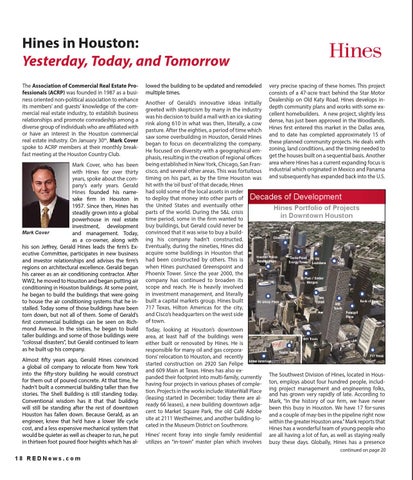
Another of Gerald’s innovative ideas initially greeted with skepticism by many in the industry was his decision to build a mall with an ice skating rink along 610 in what was then, literally, a cow pasture. After the eighties, a period of time which saw some overbuilding in Houston, Gerald Hines began to focus on decentralizing the company. He focused on diversity with a geographical emphasis, resulting in the creation of regional offices being established in New York, Chicago, San Francisco, and several other areas. This was fortuitous timing on his part, as by the time Houston was hit with the ‘oil bust’ of that decade, Hines had sold some of the local assets in order to deploy that money into other parts of Decades of Development the United States and eventually other Hines Portfolio of Projects parts of the world. During the S&L crisis in Downtown Houston time period, some in the firm wanted to buy buildings, but Gerald could never be convinced that it was wise to buy a building his company hadn’t constructed. Hines Portfolio of Eventually, during the nineties, Hines did acquire some buildings in Houston that Projects in had been constructed by others. This is whenHines Hines purchased Greenspoint Portfolio of and Downtown Houston Phoenix Tower. Since the year 2000, the company has continued in to broaden its Projects scope and reach. He is heavily involved in investment management, and literally Downtown built a capital marketsHouston group. Hines built 717 Texas, Hilton Americas for the city, and Cisco’s headquarters on the west side of town. Today, looking at Houston’s downtown area, at least half of the buildings were either built or renovated by Hines. He is responsible for many oil and gas corporations’ relocation to Houston, and recently started construction on 2920 San Felipe and 609 Main at Texas. Hines has also expanded their footprint into multi-family, currently The Southwest Division of Hines, located in Houshaving four projects in various phases of comple- ton, employs about four hundred people, includtion. Projects in the works include: WaterWall Place ing project management and engineering folks, and has grown very rapidly of late. According to (leasing started in December; today there are alMark, “In the history of our firm, we have never ready 66 leases), a new building downtown adjabeen this busy in Houston. We have 17 for-sures cent to Market Square Park, the old Café Adobe and a couple of may-bes in the pipeline right now site at 2111 Westheimer, and another building lowithin the greater Houston area.” Mark reports that cated in the Museum District on Southmore. Hines has a wonderful team of young people who Hines’ recent foray into single family residential are all having a lot of fun, as well as staying really utilizes an “in-town” master plan which involves busy these days. Globally, Hines has a presence
Decades of Development
continued on page 20
18 REDNews.com