Crazy Compost! Getting down and dirty with decomposition!
Garden Time! See what our 7th grade chefs are cooking up!
Student Views on the Importance of School Gardens!
VOL 3/ ISSUE 1 JUNE 2012
What’s Cooking?
Written by seventh graders of Columbia Secondary School for Math, Science, and Engineering a public school, community, and university partnership1 Fresh! Vol. 3:1
Table of Contents 6 14
GARDEN TIME! Planting and harvesting in our freshly blooming garden. CRAZY COMPOST Our times at Governors Island and in our garden learning how to compost from the pros.
20
FABULOUS FARMING Feeding chickens, napping with goats, planting tomatoes, and loving it all.
2 Fresh! Vol. 3:1
Learni an
W
How peopl
WELCOME TO
FRESH!
WHAT’S COOKING? ing to cook with campfires, knife skills, nd freshly picked herbs and vegetables
SIMPLY SUSTAINABLE What does it mean to be sustainable in an urban setting?
HEROES OF SUSTAINABILITY le like you can make a huge difference in the world.
76
36
60
Fresh! magazine is created entirely in the month of June as the term project for the Food and Sustainability “J-Term” class. After going on trips and working in our community garden, job assignments are handed out to each person, and the work begins. Before getting to work in each of their jobs, first each person must write at least two articles for the magazine. Once they are done, the editors revise the articles and the copy editors edit them. Then the articles are passed to the photo editors who decide which pictures will go with the article. Finally, the article and the picture go to the art directors who place it in the magazine along with the picture and decide the colors and layout for that page. The advertising specialists then say where to add in all the ads from our sponsors. We then have a finished magazine, ready for printing! We write Fresh! to talk about different ways to be sustainable. There are articles about composting, both on small and large scales, which talk about the advantages of composting. There is also talk about organic and local food, how it is good for you and the environment. Our goal with Fresh! is to inspire people to be more sustainable and give back to the Earth, and also to educate people on how and why they should do this. We hope that this issue of Fresh! inspires you to change your life for the good of yourself, others, and the environment. 3 Fresh! Vol. 3:1 - Jenna
EDITORIAL & PRODUCTION STAFF EDITORS Ashley Calaysha Maya Tiana COPY EDITORS Jade Jean Franco Nadya Victor ART DIRECTORS Jenna Kevin Niyati ILLUSTRATORS Charlie Eamonn Eli Julie Thomas
4 Fresh! Vol. 3:1
PHOTOGRAPHY DIRECTORS Abby Carla Elliot Gabriel Nyla Rachel Sammy Yelitza ADVERTISING SPECIALISTS Ahmed Alex Gilberto Jessica Rafael Tyler Xiomara Zora EDITORS IN CHIEF Prof. Meredith Hill Prof. Anna Newman Prof. Marcela Johnson
SPECIAL THANKS! To the following individuals and organizations whose generosity and awesomeness helped make our magazine possible! Michael Harlan Turkell Marcela Johnson Henry McMahon Vani Gandhi Rebecka Jerome Matt Mili Andrew Barrett Christine Petro Lydia Schulman Samantha Blatteis Peter Tzannes Erik Martig Gia Machlin Dyanne Norris Ethne Clarke and the Organic Gardening Team Marisa, Charlie, and Earth Matter Ronny, Claire, Kylie and Ronnybrook Dairy Farm David Vigil and East New York Farms Dede Lahman and Community Food and Juice Marnie and Thompson Finch Strawberry Farm Caroline Hiteshaw, Samantha Hill, and the Columbia Greenmarket NYC Grow to Learn Team Alex, Andy, David, Ben, Heather, Amy, and Frost Valley Team Abraham Castillo, Juan Carlos Velasquez, Andi Velasquez, Maria Herrera, Megan Murphy, Carlixta Villafana, Julie Gonzalez, Daisy Gonzalez, Shavette Thompson, Pam Cress, Debbie Taylor-Kerman, Noemi Molina, Mark Kerman CSS Food & Sustainability Families CSS Administration The Foundation for Excellence in Education 5 Fresh! Vol. 3:1
I
n one of the first lessons in this course, we asked students to consider how natural ecosystems function, and what it is that makes an ecosystem sustainable. To do this, students took on roles of organisms in a Hudson Valley ecosystem and modeled naturally occurring energy transfers – and experienced how these transfers are disrupted if the ecosystem is thrown off balance by an outside force. They quickly saw how ill thinking human forces can throw astray the natural balance achieved in nature (when insecticide threatened the mosquito population, for example, the frog population suffered, too). We start with this so that students understand a critical piece of the agricultural puzzle: agriculture, as we know it today, is created by us. Though a farm may seem, especially to an urban dweller, to be quite a “natural” setting, it’s not a system that was already living in sustainable balance when some farmer came into the mix. In building agricultural systems, it is up to us humans to honor and respect the land on which we are building. It is up to us to think back to those natural ecosystems and consider what forces help a system to maintain balance. And it is up to us as consumers, too, to understand that our choices influence what is produced for us. With this in mind, our Food and Sustainability class aims to consider how the food industry can provide healthy, reliable food without ruining the earth - and how we, as urban citizens, can help take steps toward this. The thirty-two seventh graders in this course explored this topic from all angles – from mapping our school neighborhood “Foodshed” to visiting local farms whose products supply our NYC Greenmarkets. We talked to experts in the field (from urban composters to rural farmers), and spent time getting our hands dirty at our own Columbia Secondary School Community Garden. And, we traced our experiences throughout by documenting them here, through the photographs, illustrations, and stories that follow in our third volume of Fresh! Youth Voices on Food and Sustainability. When planning this class again, a colleague remarked to me, “well, this will be easy since you’ve done it twice before, right?” “Well, not exactly…” I replied, 6 Fresh! Vol. 3:1
knowing that this is not something that can simply be re-done from year to year in the same fashion. As our magazine title suggests, Fresh! is new and forever dynamic. Students now start the class by exploring past issues of Fresh! and pondering what new spin their edition will have. We go on new field expeditions and talk to new people. Rather than rewriting what’s already been done, we build, giving each year’s edition a Fresh! voice of its own. In the absence of a grant that helped fund our week-long farm stay in our first two years of the class, this year’s Fresh! adventures found us even more local than ever – yet found us with as rich learning opportunities as we could have imagined. Our class got more intouch than ever with our urban foodscape and, I think, may have inspired some future community gardeners, urban farmers, environmental activists, green engineers, farm to table chefs, food journalists, and incredibly conscientious citizens. While we learned about sustainable agricultural possibilities, we also discovered the amazing kindness and generosity that seems to go handin-hand with a passion for sustainable growing and living. The many individuals who generously welcomed us to share their time and expertise showed what a remarkable community exists in this field. We thank them with utmost gratitude for bringing a true collaboration to the teaching and learning process. Now, we hope that you, our readers, can give back by helping us come full circle in supporting the incredible businesses and projects documented here. I am often asked why I became a teacher. I think my best answer is exactly what you’re about to explore: the power of young people to take action in their world. The young voices you will meet here are some of the best hope for our future I can imagine. It’s an honor to be able to work together with them, both as a teacher and a learner. Welcome to Fresh! - Meredith Hill “Editor in Chief”
7 Fresh! Vol. 3:1
8 Fresh! Vol. 3:1
Garden Time!
9 Fresh! Vol. 3:1
GARDEN TIME!
A Living Classroom:
By Ahmed
The Garden
I
Gardening is an activity that involves hard work, dedication, blood, sweat, and tears.
began gardening this year at the age of 13. Gardening was new to me because I had never experienced anything close to this before. I thought gardens were just places full of grass, but after spending a couple of weeks in the garden, I got used to the experience of gardening and actually started to get more and more involved. I realized that gardens are places where food and plants can grow and tasks like composting and weeding are crucial to making that happen. Composting was one of the first and hardest challenges I faced. Compost helps the ecosystem come together by breaking down food scraps and turning it into nutrient-rich soil for plants in the garden. At first, when I personally got closer and closer to composting, I just wanted to throw up, go home and never come back. However, with fear comes will and determination. I was completely lost when we dumped all of the compost out and had to put it back in, with bugs and flies surrounding the area. But, I fought through it and got the job done with the help of two other people. With absolutely no experience in composting, I turned the compost! I still don’t like composting, but now I’ll do it once in awhile. Following composting was another hard gardening challenge. During the next activity, my class lined up by birthday and we passed buckets of soil from the beginning to the end. We did this for about 30-45 minutes. The last activity was was to pull out weeds. This activity was easy, but dirty. Looking back, I have learned so much since I started with no gardening experience in gardening to now having some experience. ď ’
10 Fresh! Vol. 3:1
Gardening
GARDEN TIME!
(AKA The Art
of Being in a Garden)
By Jade
W
hat is gardening? Yes, it is the art of being in a garden, but what does that mean? To me, it means being free. Getting out into nature is very important. People need to get dirty to be experiencing the world. Like right now, most of my day is spent sitting down and staring at a screen, like the rest of America. I might get covered in dirt, maggots, worms and mulch at my local park or community garden, but it’s worth it. I get a taste of what nature truly is, and trust me, it’s not a bunch of farm animals roaming around on some farm in suburbia, it’s really just getting out and getting involved in helping the world and helping get involved with plants and animals. There’s only one problem: how do you do this type of thing in the city without all that open space? There are plenty of empty lots in the city that could be made into beautiful gardens. Personally, when I garden, I’m out in the world of nature. I’m planting Swiss chard, tomatoes, chocolate mint, lettuce, parsley, and lots of other things. I also help with the composting program and the “Garden to Cafe” program. I’m helping my community become green, and by doing that, I am one small step on the way to saving the Earth. It has been proven that taking time out to involve yourself in nature can help you be more relaxed and less stressed and rushed. There are lots of ways any person can get involved in gardening. You could start a small in your house or on your fire escape with potted plants. So get out into the world and start helping everyone in your community be more green!
11 Fresh! Vol. 3:1
GARDEN TIME!
Sunshine State
I
slowly packed for the new move to New York. I pictured streets full of sounds, places surrounded by people, and areas stuffed of murmuring voices. To admit, it scared me. Florida seemed so peaceful, quiet, and just in general, pleasant. There was a type of vibe that felt comfortable in Florida. But now, my parents’ business wasn’t doing well. And as my mom would always say, “With business comes family responsibilities.” It annoyed me when she said that. She was right, but c’mon, moving? That’s a bit too much. Our restaurant in Florida slowly began to drop as our restaurant in New York rose to the top. My parents brought up the idea that there was no reason to stay in Florida. I had to say good-bye. To my friends, places … and the space. That grass and fresh trees were going to disappear. I would no longer be in the “Sunshine State.” Do you know when people say, take chances because it may turn out great? Well, that's exactly what happened! Coming here to New York has not only brought me joy, but my school has a garden! Knowing that made me smile from ear to ear. Getting a chance to work at the garden was something I wasn’t gonna give up!
12 Fresh! Vol. 3:1
By Julie
The garden was by my teacher. Professor Meredith Hill was inspired to give kids the ability to have a chance to still be connected to nature and its community even though we live in New York. Like me, she grew up in an area where people spent a lot of time outside. After moving to New York, she herself felt the need to still be attached to gardening. While searching for areas to create a garden, she found a vacant lot. Hill told me, “It was ugly. It had weeds everywhere! There were chains on the lock. It was so tiny and small! But we had to make something out of nothing!” After about a year of sending letters for the place, we got it, and the Columbia Secondary School Community Garden began! Hill was proud, not only would she get a piece of home back, but the students have their own small community. Now, organizations such as GreenThumb and Grow To Learn provide the garden with soil, plants, and tools. Since its founding in 2010, there have been many actions to help the garden grow. The stu-
GARDEN TIME! dents, for instance, collect food that they didn’t finish in the cafeteria. One thing that this garden keeps going is composting. It’s the act in where you re-use food/waste to create nutrient-rich soil. As my classmate noted, “Some activities we do are planting. We’ve recently planted carrots, garlic, and swiss chard. We’ve also built raised beds, and painted the doors to make the garden pop out. It’s really fun!” As you can see, the students enjoy spending time at the garden. While asking them why, people said, “I love going to the garden because it is very pretty and the vibe is so peaceful.” Somebody also said, “Not only is the place sustainable, but it’s a great place to hang out that is more connected to nature than the city.” Some students see the garden as a part of their home, and they're proud of that. In the end, my teacher expressed her feeling of how the garden has shaped the CSS community. Not only is the garden a place for the students, but it’s another place for them to care for and they enjoy that. After the progress of the garden and its working, Hill has been astonished of the amazing
work that the students and the community have done. She still continues to work hard with the students to make the garden an even better place than it is today. Overall, moving to New York has given me a whole new point of view of what is possible in an urban environment. The garden begins to flourish and the restaurant goes great. The family is my school, and the garden is my new “Sunshine State.”
13 Fresh! Vol. 3:1
GARDEN TIME!
Global Gardening To some, gardening is simply a good pastime. They only garden because they want to make their yard look pretty or because it’s fun. To others it’s a way of life. Farmers work on farms because it is their livelihood. To me, however, gardening is a way of bringing life and sustaining to the world. I may just be a 12 year old New Yorker, but I have worked in my local school community garden for about a year and a half now and I have seen what kind of impact gardening can have on a school community. Through gardening, we were able to feed approximately 300 students food that was harvested from the garden! We served them pesto hand-made from the cilantro and basil that we had grown. Though we added in other ingredients from farmer markets and the school cafeteria, we were able to introduce all these people to sample fresh garden produce... from only one tenth of an acre of garden space! Image how many people we could feed if there were gardens that were quintuple the size! Going beyond community gardens in the United States, if we put these kinds of garden systems into third world countries that are suffering from starvation, it could significantly decrease the amount of people suffering from starvation. Going beyond community gardens in the United States, if we put these kinds of garden systems into third world countries that are suffering from starvation, it could significantly decrease the amount of people suffering from starvation. Most of the people that are suffering from starvation are poverty stricken or live in destitution. About 1.7 billion people live in destitution or absolute poverty. A way to help people who are living in these dire situations is gardening. Through 14 Fresh! Vol. 3:1
By Tyler
working on new methods for farming and gardening, they would be able to trade and/or sell the fruits and vegetables they grow, thus helping them move out of destitution Destitution or poverty does not affect all regions of the world the same way. In some places poverty is very prominent, and in other places it has little to no effect. Regardless, it is something that affects the world as a whole. Something else that affects the world is health. By health I’m referring to obesity, heart disease, diabetes, blood pressure and the likes. A way that the world could become a much healthier place is through gardening. Through gardening, people would be able to grow and eat fresh, pesticide and herbicide free fruits and vegetables.This would then have a positive impact on world health. Something else that I noticed while I was gardening is that, it was so peaceful. Peace is something that is needed in the world today.. Without peace there is war, so the world as a whole should always be striving towards world peace. A way we can do this is yet again, through gardening. If the world all shared something in common, it would be somewhat easier for different cultures to relate to one another. If everyone related and understood each other more easily, then things would be a lot more peaceful. If someone said that gardening is a good pastime I wouldn’t disagree with them . If someone said that gardening is just the way some people live, I could not argue with them. But I see gardening as much more than that. I see it as something that can potentially help the world become a better place.
GARDEN TIME!
Soil Sanctuary
By Maya
The CSS Community Garden is much more than just a space filled with “gross” insects, weeds, and hundreds of plants! The CSS garden is a sanctuary. You might say that it is a sanctuary of hard work and dirty clothing, but there is something special and calming about gardening, and I’m not the only one who thinks so. Every Friday after school, about 10 students go to the garden to work, and, I have to admit, socialize. But whether it’s pulling weeds, planting tomatoes, or having girl-talks in the “spacey” tool-shed, there’s always something fun to do in the garden. One spring afternoon, a friend and I were working on watering, but we couldn’t find the watering can. We ended up connecting a long tube to a water bottle and filling it up with rain water. We watered all of the plants by the gate with our new contraption. Not only did we help give plants necessary resources that day, but we also had A LOT of fun. On other, less productive days, my friends and I do some composting or weeding, but then we go into the shed and talk to let out our stress or how we feel. For me, the garden has become a sanctuary. It is a great place to be with friends, relax, and help the environment.
15 Fresh! Vol. 3:1
CRAZY, CRAZY,
COMPOST! 16 Fresh! Vol. 3:1
CRAZY COMPOST
Heating Up With Chicken Poop
W
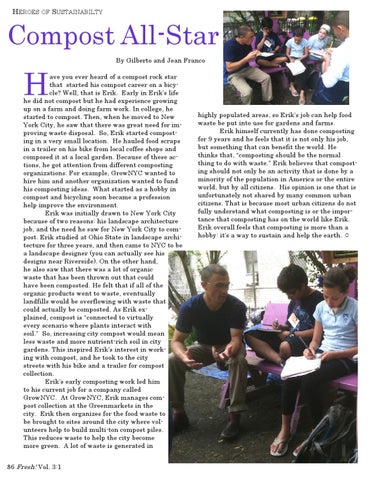
hen we started composting at our school community garden, I convinced my family to collect compost and regularly bring food scraps from home. When I heard about our school challenge to keep 1,000 lbs of compostable food waste from our students’ homes and cafeteria out of landfills, I thought that was A LOT of compost. That is, until I went to Governor’s Island and helped out with Earth Matter’s compost project. On Sunday, June 10th, 2012, twenty students from the "Food and Sustainability" class went to Governor's Island. We found that we were going to build a compost pile out of 8,000 lbs of food waste for the whole day. At Governor's Island we all composted. We didn't actually collect the compostable food waste. That was done at Greenmarkets in Brooklyn the day before, and brought to the island on a truck at 6:45 am that day. Our job was to turn it and layer it so that it was easier for the compost to turn into soil. We were making an Earth lasagna. This project was led and guided by an organization called “Earth Matter.’’ At Governor's Island they had chickens and goats. We got to touch the goats, but that wasn’t our main job. We were working in the “Hot Chicks House,” which is where our compost pile was made. We were able to work with
By Xiomara
the chickens, and even though they always ran away from us, they were doing work just like us. They were breaking down the compost material so that it could turn into soil faster - by eating parts, scraping through it to get their favorite materials, and pooping in it. We were helping by putting the compost in layers, or as Charlie liked to refer to it, lasagna. Our first layer was the soil, which we had to flatten out by using hoes and shovels. Next we opened many bags (252!) of compostable food scraps, then broke up all the big pieces. After we broke up the compost, the worst part came- we had to shovel up a half decomposed pile of compost and chicken poo! It was about 97 degrees when we first started shoveling, and the closer we got to the center, the hotter it got... and it was also incredibly smelly. In the end it was extremely hot and funny, but it was also educational. This was so much compost, so it seemed like it must’ve come from many places, so I was surprised that it only came from waste from a few Greenmarkets. If we could compost all compostable waste, I can’t even imagine how much we’d have to turn to make compost! However, if we did compost, we could save a lot of money and space and reduce negative environmental impact. Erik told us that $125 million is wasted every year on waste removal, which could be turned into compost. One ton of waste costs roughly $125 to remove, and there is about a million tons of waste collected in our city every year. The next time you are throwing away your food scraps that are non-oils or meats, remember that there are many places that are willing to take compost. YOU can help make that difference!
17 Fresh! Vol. 3:1
CRAZY COMPOST
What Do the Worms Have to Say?
By Jade
A
couple times a week, I wake up to the sound of groaning and moaning, and the sound of plastic gloves being slapped on. You may think I hate being woken up, but I don’t, I absolutely adore it. Those sounds mean it’s eating time for me. The humans tend to collect garbage and put it in bins for decomposers, like me, a red wiggler, to break down into clean soil. This system is called composting. It keeps trash out of landfills and it makes clean and free soil.
The system goes like this: Food gets eaten by people, and sometimes they leave scraps behind, which I still don’t understand, who does that?
1. Fruits, veggies and bread scraps get separated out into a bucket aside from other foods like meat, dairy, and any fried foods (That’s right, I’m healthier than you thought!). 2. The bucket is brought to the compost bins in the garden that are full of all kinds of decomposers like me: maggot Bob, roly poly Rita, dung beetle Sandy, and lots of my other friends. 3. The food gets decomposed and turned into soil (in other words, I get a DELICIOUS meal!) New vegetables and other edible plants get planted in this soil and the whole process gets restarted.
18 Fresh! Vol. 3:1
If everyone starts doing this and encouraging others to do the same, waste in landfills will be reduced, I would be less hungry, and the Earth will ultimately be more green.
CRAZY COMPOST
COMPOST You come to the garden What do you see? Both annuals, perennials, and even some weeds But before these things sprouted They started as seeds Where’d this seed grow? Where did it sprout? Where’d it begin ‘fore the flowers came out? It grows in the dirt It sprouts in the soil And the dirt and the soil came from plants that had spoiled But before the fruits became soil They were made into compost To get compost, we mix in some things Things that are called browns and greens The greens come from fruit and the browns come from trees When we mix the browns and greens The compost slowly turns to soil For all the plants and seeds ! - Tyler
19 Fresh! Vol. 3:1
CRAZY COMPOST By Abby (& Simon)
Searching for
Simon Hi! It’s Simon. Professor Hill sent me on a fun, adven-
turous, and frightening journey. My journey began with a nice bike ride through Brooklyn to the compost drop-off site at the Grand Army Plaza Greenmarket. It was the first time my ducklings and I experienced the world. As we arrived to the compost drop-off site. I started to get frightened. I was grabbed out the basket and held over a big black bag with compost in it. Then a bright light came towards me and I heard a “Snap!” Next thing I knew, my ducklings were gone and I was surrounded by food scraps like veggies and fruits, but no oils, meat or dairy. I was so frightened, and I stood in there overnight, alone and scared. The compost gained an odor and I began getting even more scared. I missed my babies. Are they okay? How long is it going to take
for them to find me? When will they compost everything?
Suddenly, the next day, I was able to see light shining through my bag and heard children’s laughter and complaints. I listened carefully to their conversations, and finally I began to understand what was happening! Professor Hill’s Columbia Secondary School students had taken a trip to Governor’s Island and decided to build a compost pile with over 220 other bags of compostable material…. All of which looked exactly like the bag I was in. Would they ever find me?
20 Fresh! Vol. 3:1
CRAZY COMPOST
I heard them call my name! They were looking for me, and couldn’t wait until they found me. But time passed, the day got longer and no one had discovered where I was. After waiting a long time, finally I heard the voices of Marissa, Charlie, and Erik, some composters who continued to work on the compost pile after the Columbia Secondary School students had left. Suddenly, I saw the light for a second time and was unexpectedly dumped onto a load of compost, dry leaves, and other materials that are helpful to the compost. Luckily Marissa grabbed me, took me on her bike, and started pedaling towards the dock where she finally caught up to Professor Hill, Professor Newman, and other seventh graders. I was then handed over to Professor Hill, and when they all boarded a boat back to Manhattan, she sent me to be with my ducklings. Now we are all a safe, happy family together!
21 Fresh! Vol. 3:1
Fabulous Farming!
22 Fresh! Vol. 3:1
FIND YOUR FARM A farm is a plot of land devoted to the raising of animals and especially domestic livestock, as defined by Merriam-Webster. Yet, East New York farms taught us that a farm does not have to raise only animal. In fact, their farm ran using only insects! Several farms we visited may not fit your image of a typical farm filled with cows, grassy hills, and a large white house. The East New York farm is a city-owned Brooklyn farm that manages to stay sustainable in the midst of honking cars and hectic city conditions. Almost a hundred and fifty miles away, the farm at Frost Valley is tending to their goats, chickens, cows, alpacas, and garden. We learned that the farmers treat their livestock as best as they can before slaughter, as the goats trotted around us happily. The garden is also grown 100% organic, with no pesticides, herbicides, or fertilizer. Meanwhile, a dairy farm named Bobolink (that only sells aged cheese and bread - no milk) raises cows so freely that we could not find any on the farm. At a similar farm called Ronnybrook, which is known for selling its popular dairy products around New York, the cows are personally-named and are milked for organic milk, yogurt drinks, and ice cream. Finally, Rodale Institute, which has existed for decades, is run by people who strongly believe in teaching people the importance of organic food. There, the animals and gardens are assembled compactly, with the animals close together and lots of raised beds for the garden. We investigated the diverse kinds of farms that exist in northeast America, and how we can share our knowledge of growing sustainable food with the rest of the world. ď ’ - Nadya
23 Fresh! Vol. 3:1
FABULOUS FARMING
Milking Goats… ...Not Cows, GOATS! MILKING GOATS While we were at Frost Valley, we went to a farm and we got to explore! When we were at the farm we all got to milk a goat. The goat was full of milk because her kids didn’t drink the milk. The milk was hurting the goat because it had so much. Ben, the head of the animals, told us that when we milk the goat it wouldn’t hurt because its kids usually drink the milk with teeth. Our hands don’t have teeth and they are soft. The way you should to milk a goat is to put your thumb on your index fingers and squeeze at top of the tit. Then you “wave” to roll down with the last three fingers and out comes the milk! It was really cool to milk a goat for the first time. - Rafael
24 Fresh! Vol. 3:1
L
By Alex
iving in the city, I never thought that I would go to a farm. Then, we went to one and I end up milking a goat! On this farm, there were a lot of animals, including cows, goats, chickens, alpacas, and more! When we walked into the barn, it was dark and had a distinctive smell to it. Someone showed us around and we saw the alpacas and goats. There was one goat in the corner of the barn that we actually got to milk! There was a tin can under the goat to catch all the milk we were getting. The goat was large and white, and it was nice and calm, but someone stood in front of it and pet it just in case it started to get restless. There was a specific way to milk the goat. You need to first squeeze and then roll four fingers down and pull a little bit. A lot of people liked milking the goat, but at first they were a little scared. After everyone tried to milk the goat, they enjoyed it! I enjoyed it too but it did feel a little weird. But milking goats are important! You can drink goat milk, although a lot of people in the United States don't. The main thing goat milk is used for is goat cheese. Now, when I go to the store and buy goat cheese, I think of the day that I milked a goat!
FABULOUS FARMING
Active Animals By Jenna
Alpacas and llamas and sheep Are kept for their fur If you make it a hat, you look like a sir Because it is soft Chickens are kept To lay eggs all day And after that they Are used for their meat Cows are kept Just for their meat And with all of the grass they eat They feed us for a year Goats are used Only to make milk They don’t have fur as soft as silk But they love the people most The animals are lovable And friendly and nice There’s also a cat who eats all the mice And they all love the people who take care of them 25 Fresh! Vol. 3:1
FABULOUS FARMING By Carla
Radical Ronnybrook Farm
H
ave you ever tasted fresh, local, chemical-free ice cream? If so, have you ever felt that it tastes so much better than the other types of ice creams that have chemicals in them? Well hear this: we went to this cow farm called Ronnybrook farm. It was a fun experience to be there because we saw a lot of cows and the products they make. For example, they made ice cream, milk, and some yogurts. The food they made was so delicious, and it was so much different than any other types of ice cream, milks, and yogurts I’ve tasted. I wonder why though? Was it because of the kind way they treated the cows? Was it because they don’t use chemicals that makes it taste different? Was it because the cows are milked just feet away from where the ice cream is made? Think about it. Now I’m going to explain how it tasted: Ronnybrook farm products taste good and great. It’s fresh and new and very refreshing. My taste buds exploded when I tasted it. I love Ronnybrook’s products, they make me sing. The cows graze in the hills of grass. Then they milk them and the time pass… Then they take the milk to the ice cream machine and it takes some time… Then goes to the cooler, which is cold, “very freezing,” as they told. The package, the ice cream, and there to eat very healthy, good and sweet. As you can see, I loved this ice cream so much because it’s fresh and the cows are treated well. I like this ice cream better than the other ice creams such as the in-organics and commercially processed ice cream. Yes, some other ice creams are organic but... this one is different because this ice cream had taste in it. Was it because of the ways they treated the cows? Or was it because the cows graze on the grass? Maybe there’s not one “right” answer, but what I do know is that it tasted organic and fresh.
26 Fresh! Vol. 3:1
FABULOUS FARMING
Rockin’ Ronnybrook!
By Eli
M
y first experience with Ronnybrook milk was a sensation I never felt before. I usually dislike milk, but for some reason I loved their milk. My first taste of Ronnybrook milk was at the Greenmarket next to Columbia University when we were mapping our local foodshed around the area of our school on 123rd street. When I tried the milk, I originally thought that Ronnybrook was a small company that just delivers milk to a few Greenmarkets around New York. I was wrong. When we drove to Ronnybrook, l loved what I saw. It was a huge chunk of land where cows could roam free! The landscape was 700 acres big with 200 cows that would live long and happy lives. When we went into the barn, all of the cows had “mattresses,” and every cow had her own name. I thought in my head that I would love to be one of those cows living there. When we went inside where they processed the milk, they only put the milk into bottles with no added ingredients! With the milk from their cows, they made many different dairy products such as butter, ice cream, or yogurt. It was cool to get to see all of the machines that created these products. At the end of our tour, Ronny was nice enough to let us try the chocolate milk and the ice cream. Both of them were to die for. I would highly recommend getting Ronnybrook milk at your local Greenmarket because it is local and delicious milk made from very happy cows!
27 Fresh! Vol. 3:1
FABULOUS FARMING
The Inside Scoop: from Cow to Cream! We hopped off of the bus to find Ronnybrook Farm: a few small buildings, barns, and silos nestled amongst stretches of green fields. Out front, we found a Ronnybrook milk truck and a baby cow. We soon discovered that this cow belonged to Claire, Ronny’s grandniece and one of our tour guides for the day!
FIRST STOP: YOGURT PRODUCTION
We got to peek inside at the Ronnybrook yogurt makers busy at work producing and bottling delicious Ronnybrook drinkable yogurt. Claire popped on a hairnet, cleaned her boots, and went inside to point out what was going on behind the window! Next door, we looked in at the room where quarts of yogurt are processed.
28 Fresh! Vol. 3:1
KEEPING COOL!
FABULOUS FARMING
Then, we visited the area where the milk and ice cream are kept cool. The refrigerators are giant rooms that are kept at a certain temperature for the milk to stay cool before it is transported to local stores, and even New York City Greenmarkets! The room where ice cream is kept was so cold, it was even SNOWING!
CARING FOR COWS Next, we went to see where all the milk comes from that goes into Ronnybrook’s dairy products: the cows! Inside Ronnybrook’s cow barn, Claire and Kylie (Claire’s friend and co-tourguide) told us about the cows. Each cow has her own place, where they come for milking each day. The cows know their spots , and automatically go to their own stall without being guided. Ronny himself answered some of our questions and showed us the machinery used to milk the cows.
BABY COWS & ICE CREAM! After visiting the (adorable!) baby cows, we got to sample Ronnybrook’s chocolate milk and ice cream… YUM!
29 Fresh! Vol. 3:1
FABULOUS FARMING
Marvelous Milk!
By Jessica
D
o you like milk? I know I do! Want to know why? It’s because I love Ronnybrook’s milk. It’s the tastiest milk you have ever tasted. Ronnybrook’s farm is filled with wonderful cows that eat grass. Unlike other companies that sell milk, Ronnybrook doesn’t have their cows in a confined space, they are allowed to run as freely as possible. These cows have a wonderful life producing milk. The milk being produced is all healthy and natural because the food being given to them is mostly grass and water, the foods that they are supposed to eat. In Ronnybrook’s Farm, there are no pesticides or hormones given to the cows. All the milk being processed is then used to make chocolate milk, strawberry milk, regular milk, and many more. It is also used to make ice-cream and yogurt. Their ice-cream and yogurt come in different flavors. Also, all of their cows are treated like family and they even have names! When mommy cows have babies the farm keeps the female cow babies and sells the male cow babies. They keep the female babies so they can grow up and produce more babies and milk. They sell the male cow babies because they don’t produce milk, so they don’t need them and also, they can become very aggressive. All the cows here are taken cared of and loved whether they are sold or kept for the best. I recommend Ronnybrook’s milk, ice-cream , and yogurt if you want the tastiest product of milk!
30 Fresh! Vol. 3:1
FABULOUS FARMING
Meat Lovers… a perspective. Approximately 3.2% of U.S adults are vegetarians or follow a vegetarian based diet. There are many people in society today who are becoming vegetarians. However, for those who aren’t vegetarians it is important that they have good meat. On the Frost Valley farm, all of their meat is fresh. They raise and care for their cows for 2 years before they are slaughtered. For lunch we were scheduled to have hamburgers from a cow that was once living on the farm. Should you still eat it after knowing its life story? Imagine if your life was that of a cow. It began when you were small calf. You mother nursed you and took care of you. Some humans would come by everyday and make sure you had food, their warm hands on your skin everyday for 2 years. And the next thing you know, you’re gone, taken away to become food. There are so many people today who are becoming vegetarians and trying to eat organic foods because it is “in style” but if you’re not a vege-
tarian, it doesn’t make you a bad person. Ben is someone who works on the Frost Valley farm and he was a vegan for most of his life until he started eating meat. However, the meat he was eating was fresh. It is hard to have a lot of information about the food you are eating from the Supermarket. You don’t get a lot of information about where that animal was before it was wrapped in that plastic and the people at the store rarely have information about it either. However, when you eat meat from an animal that you had a personal relationship with and stayed with throughout the process of it being turned into food it makes it better to eat. Some people feel that it is even better to eat the meat when it is
By Ashley fresh and when you know the animal and when you know where it has been because you have a lot of background knowledge and can be informed about what is going into your body. There still are vegetarians who feel that eating anything that crawls, swims, flies or walks is cruel and wrong. Everyone is entitled to her own opinion and after having a talk on the Frost Valley farm, I really started thinking about what life would be like without meat. That food provides us with protein, and the food gives butchers and farmers jobs, but if we keep eating it, there won’t be anymore. However, the animals are cared for and before eating the meat, a small prayer should be said for the animal, thanking them for their meat and making it known that you actually care about the food you eat. All in all, in my opinion meat is good for us. Most of the population is made up of omnivores. Meat plays a big role in our lives and whether you chose to be a vegetarian doesn’t make you a good or bad person because we are all entitled to our own choices about what we eat. We eat what we eat, and you’re still a good person if that food happens to be meat. 31 Fresh! Vol. 3:1
FABULOUS FARMING
Uniquely Urban: East NY Farms
By Niyati
Farm Facts Did you know that... The East New York Farm grows various vegetables, such as peppers, beans, peas, kale, and collard greens. Their pepper plants are surrounded by plastic to keep the soil warm and to prevent weeds from growing near the peppers. The winter can keep plants from growing, but their collards greens and kale usually survive through the winter. Beans and peas produce nitrogen for plants, which is necessary for the plants to grow well. The farm has many bee hives. Bee hives are an important factor for gardens and farms since bees are pollinators Bees are hygienic and dislike mold and excessive moisture, so beehive lids are left slightly open to circulate the air. A small hive has the ability to produce about 100 lbs. of honey, and each week, about 15 lbs of honey are produced in total.
All that from an urban farm!
32 Fresh! Vol. 3:1
W
hen you think of a farm, what do you imagine? You probably think of animals, barns, grass, trees, and lots of land for farming. When imagining a city, you probably think of buildings, cars, and sidewalks. What happens when you put together a farm and a city? East New York Farms! East New York Farms is a perfect example of a sustainable urban farm. The farm is located in Brooklyn, New York in an urban neighborhood. This type of farm that is located in the city is called an urban farm. There are no animals, barns, or many trees, and the amount of land isn’t as much as a large farm. It is similar to a “typical” farm in that it grows crops of vegetables to be sold at the neighborhood farmer’s market. We visited this urban farm to see the advantages and disadvantages of having an urban farm, and how an urban farm can help the city, and the environment. The East New York Farm neighborhood hosts a local farmer’s market, in which many farmers come together to sell their produce. The farmer’s market consists of farmers from different backgrounds who each bring their own food to the market. “It is interesting to have so many different types of food,” said David from East New York
Farms. The market fills up almost the entire sidewalk with farmers and produce. There are open markets, and the next one is on June 30th, 2012. Volunteers are welcome and encouraged to work at East New York Farms and can have a gardening experience. Volunteer days are the first and third Saturdays of each month. There is an opportunity for paid internships, but most of the community gardeners are volunteers. This East New York Farm is sustainable and organic. They don’t use pesticides, herbicides, or chemical fertilizers. The farm also uses renewable sources for energy. Their water system is based on collecting rainwater. They use tubes that are on the edges of the roofs of two houses. When it rains, the water collects on the roofs and then drains into the tubes, which are connected to pipes that flow into the rainwater bins in the farm. Another renewable source in the farm is the solar panels. The solar panels run the fans in the greenhouse as well as the weather station. It is useful to be able to know that it has rained for a certain amount of time and to be able to compare it to the health of the plants. “Having a weather station really helps,” said David. The farm is
FABULOUS FARMING sustainable in the way that they make use of their waste by having compost bins. There are screens on the top of the compost bins so that the compost can air out. Composting is just one of the ways that makes the East New York farm sustainable and organic. The sustainability of a farm is an important element to look for when visiting a farm. East New York Farms is sustainable and is trying to increase their sustainability. Rural farms can be easier to manage, but urban farms like East New York Farms are needed because fresh food should be accessible to cities. Urban farms can help the community by providing fresh food, and it can help the environment by using renewable sources of energy. Urban farms, such as East New York Farms support the world’s progress towards sustainability.
Oh No! There are also some problems that occur with urban farms... Since the farm is urban and city owned property, it can be confiscated with a 30 day notice. There are many weed problems because the weeds take nutrients from the compost and grow even larger. There is a limited amount of space, and the farm is unable to expand outwards, so instead, they grow upwards! They try to be sustainable by saving space and growing their cucumbers about 6 feet tall.
SUSTAINABILITY IN THE CITY Have you ever been to a farm with no animals? Well guess what, this urban farm is because they sell fresh produce from a green market every week. East New York Farms is a farm where kids can learn how to grow vegetables and fruits and we as people can eat all of the healthy organic food that they sell. East New York Farms has a lot of ways of helping the environment. One of those ways is to compost. They have 4 bins where they keep it in. They also have contraptions on a few of the neighboring buildings so that the rain water gets drained and then used in the process of growing the fruits and vegetables. East New York Farms is an organic farm with no pesticides or herbicides. That makes the food better for you and more tasty. It also means that they have to deal with small animals and weeds. They have big fencing to keep out all the small animals. Also they put mulch down to get the weeds to stop growing. They also have plastic covering with holes poked through them so the plants can grow but the weeds can’t. - Eli 33 Fresh! Vol. 3:1
FABULOUS FARMING
Farm to Fabric: Wool, Fiber, & Cotton By Tiana Where do our clothes come from? The store? The mall? But where do they come from before that? Is the material they’re made out of just grown somewhere? This is part correct, but only for cotton. But how about if I told you they were grown on a farm, on the animals. Yes, we use animals for food and milk and nutritious purposes, but the wool from the animals (such as llamas, sheep, and alpacas) are also materials used in our clothes. At one of the Frost Valley farms, I met some of the animals that have their “raw” wool/fur used to make sweaters and some of our clothes. But how does it go from being fur on an animal to the clothes on our backs? There’s a whole process in which this happens. The first thing the farmers do is sheer the animals and gather most of the fur. The second thing is that they clean the fur they’ve gathered because the animals have been in dirt and mud and there may be insects or bugs still in the fur. Next, the fibers are processed so they can be used in other materials by felting or spinning. This is the whole process of the fur from the animals becoming clothes. The steps for the actual process are explained here, but there’s one last step missing that may not seem necessary but really is. The very last step is to thank the animal and be grateful to them. In the end, the animals were the ones who gave us their fibers and we need to thank them and be grateful.
34 Fresh! Vol. 3:1
FABULOUS FARMING
Farm Fun.
35 Fresh! Vol. 3:1
Frost Valley Farm Ecosystems Frost Valley is located in upstate New York, so you can probably imagine that it is much different than the city. Since Frost Valley and New York City are two different places, they will most likely have different ecosystems. An ecosystem is the result of putting together all of the living and non-living things in an environment. These “things” are also called biotic and abiotic factors, and when they are placed with each other, they create a complete “ecosystem.” Adapting to Frost Valley was very hard for us New Yorkers, and it would probably be the same case if someone was living in the mountains and came to the city. We live in different ecosystems with different habitats and different animals, but we must remember that an ecosystem is not only made from living things, but it is also made by non-living things. We must also remember that non-living things play a role just as important as any other part of the environment. For example, soil plays an important role in the environment and it is non-living. Soil is where all the plants grow and the plants make the environment better. In the Frost Valley Farm, we were able to see an ecosystem which showed the relationship between these biotic and abiotic factors. It was very cool because while we were at Frost Valley Farms, we were able to see all of these factors working together to create a living system.
36 Fresh! Vol. 3:1
By Victor
FABULOUS FARMING
CHANGING ECOSYSTEM Did you know that through different changes in a certain ecosystem, different animals can adapt to it through generations? In an ecosystem, animals need to have certain traits that can allow them to eat, survive, and reproduce. These traits, however, were not held by animals in earlier generations. Some animals were not able to protect their young from predators such as the Killdeer bird, which had more recognizable eggs in earlier generations. Overtime, the Killdeer adapted to the ecosystem and obtained an adaptation in the eggs that camouflage them from predators making their reproduction rates higher. This adaptation in the Killdeer was obtained over generations of the Killdeer losing their offspring because of the predators in the environment. The ecosystem also changes the behavior and actions of an animal because of the ecosystem’s predators. For example, rats in farms avoid predators by building small walking ways or roads underneath the grass so that predators do not attack them. Another example is when the Killdeer bird does a distraction act in which it acts as if it has a broken wing when predators approach its children so that it can distract the predators from the offspring. These things are adaptations that animals have obtained over generations. Ecosystems constantly change over time and these things have led animals today to have some of the traits they have so that they can survive in their environment. An ecosystem not only relies on animals and adaptations, but insects and decomposers as well. For example, for an ecosystem to exist on a farm, there has to be decomposers in order to break down nutrients for the environment to fully function. Overall, an ecosystem is composed of different animals, insects, and decomposers working together to create an ecosystem. The ecosystem’s functions changes over generations and animals have to adapt to the ecosystem in order to further carry on there. - Gilberto 37 Fresh! Vol. 3:1
What’s
38 Fresh! Vol. 3:1
Cooking?
WHAT’S COOKING?
JAMMIN’ JAM STEPS 1. Wash your hands with soap thoroughly (sing “Happy
Birthday” twice to make sure you’re scrubbed!) 2. Gather some strawberries and pull out their stems. 3. Wash off the strawberries. 4. Wash off a jar and squash strawberries with bottom of jar. 5. Wash your hands again. 6. Mix calcium powder and water in a jar. 7. Wash and place the jars and lids in a pot of water until it boils. 8. Mix sugar and pectin in a separate bowl. 9. Place the smushed strawberries in a pot on the stove. 10. Mix as it heats ups. 11. Once the berries start to boil, add the pectin and sugar. Stir vigorously! 12. Take the empty jars and lids out of the boiling water. 13. Then pour about a cup of strawberry jam in each of the jars. 14. Measure to make sure the jam is a quarter of an inch from the top of each jar. 15. Put the lids on the jars and tighten. 16. Place the jars in a pot full of boiling water for about 10 minutes in order to seal the safety button. 17. Let cool off for at least an hour. 18. Store for as long as you’d like, but enjoy within two weeks once you open it (and trust us, you’ll want to open it soon!) Enjoy! - Ahmed
39 Fresh! Vol. 3:1
WHAT’S COOKING?
By Ahmed
Jammin’
40 Fresh! Vol. 3:1
WHAT’S COOKING?
with
JAM! 41 Fresh! Vol. 3:1
WHAT’S COOKING?
Jam, Jam, Jam Wash your hands on your birthday and sing a song. Wash the strawberries and the utensils really good but don’t take too long. Prepare the strawberries. Don’t have mercy and rip their tops off! Then MASH, MASH, MASH the strawberries to a mushy mess. Use the other ingredients such as: Perfect Peptin, the jelly-ifier Crazy Calcium Water and Super Sugar, to make it sweet to fill-in the rest of the jam making process, Then MIX, MIX, MIX the mixture until you see bubbles but don’t forget, you can also hear them. BOIL, BUBBLE and cause TROUBLE in the jam pot Look into the pot as a witch would into her cauldron and make sure the jam is ready to go under a “cooling down” spell Now comes the storing, so you can save the yummy jam. You will use those glass jars and labels to put your jam into In the process you will ORGANIZE, POUR, WIPE, and LID At the end, you can proudly place a label on your jam, go ahead, name it Mine is “SAM JAM :) <3” What’s yours?
42 Fresh! Vol. 3:1
By Sam
WHAT’S COOKING?
43 Fresh! Vol. 3:1
WHAT’S COOKING?
44 Fresh! Vol. 3:1
WHAT’S COOKING?
Once I was a berry, I was bright, I was red, Then a small giant came stumbling towards my bed, She picked me up and brought me home, Along with others of my organic kind, They plucked off my head of pretty green hair, All that was left was my dignified bright red.
Jazzy Jam By Jade
I got mushed into bits, But still I did not cry, For I knew I was crushed for the well being of others, I was boiled and sealed in a gold-topped, clear jar, And lastly I was tested, For the purpose of others feeling much more alive.
45 Fresh! Vol. 3:1
WHAT’S COOKING?
Handy Knives
By Carla
Have you ever had trouble with knives? Have you ever had any injuries because of knives? Have you wasted too much money on buying new knives? Now I’m going to tell you how to prevent you from having these issues. There is only one solution to prevent these, and it is.... using your hands!. Using your hands to cut food is easy, free, and very safe. Most people think “it’s too hard” or “it’s messy,” but trust me, it’s really not. You can cut many things with your hands, for example:
Asparagus Cauliflower Broccoli Lettuce Swiss Chard
Now you may be thinking “How can I break these with my hands?” Well, I’m going to tell you now. Asparagus Tip: You may not know this, but there’s this breaking point in Asparagus. you just bend it and it just snaps! Would you rather do this or cut your finger with a knife? Broccoli & Cauliflower Tip: That’s not all, Cauliflower and Broccoli are very similar, they’re little groups of florets together, so basically you can you rip them out. Easy as that, huh? Never thought of that? Well, now you know. Swiss Chard Tip: Swiss Chard is really easy and fun! You just break it in half and you’re done. Lettuce: Lastly, for lettuce, you can just pull the leaves out of the bulb. No knife, No mess, and your lettuce stays fresher longer! I hope you understand that not all fruit and vegetables are the same, they all have their own way to cut them. Also, it all depends on what size you want them. For example, lettuce you can leave as a whole leaf, or you can cut it into little pieces. Also like basil, you can just pluck it out of the plant, but, not everyone eats the basil as a whole so you may have to cut it up into pieces. Sometimes, people are scared to cut things with a knife because they think that they will cut themselves, well that’s not the case. Sometimes you do have to be careful, and here are some tips on using a knife:
Go slow! ~ Don’t try to go too fast, and try to not cut your fingers. Make a flat surface! ~ If you make a flat surface, your food object won’t be sliding everywhere. Make a fist shape! ~ Don’t stick out your fingers, because you may cut yourself. Not everything you cut is the same ~ If you don’t know something, just ask.
While these knife skills will help you use your utensils with ease, your hands may come in handy more than you’d think. So, the next time you cook, think to yourself, “Do I really need a knife?” and see if your hands can do the job instead!
46 Fresh! Vol. 3:1
WHAT’S COOKING? Knife skills and fruit cutting are two important lessons we learned from our knife skills class taught by Michael Turkell, and the main thing we learned was that strong knife skills are not only for professional chefs, anyone can have good knife skills! The most important thing about cutting fruit (or any food) is cutting safety. There are many techniques that allow us to be safe and have tons of fun because we know that the chefs like having fun. The food each chef makes shows the fun the chef has by the way it looks and by the way it tastes.
FRUIT NINJA: FOR REAL! Learning how to cut fruits and vegetables with Prof. Turkell the right way was a lot of fun. He is such a knowledgeable person and a great chef. I now know so much more about being safe while using a knife to cut fruits and vegetables. We learned where to place your fingers when cutting. When cutting, make sure your fingers are away from the knife. Also make sure you are cutting on a flat surface and make sure the food is on the flat side so that you will have control of the fruit. Prof. Turkell’s workshop was cool because I got to cuts fruits I had never cut before like the mango. The best part was when I went home and later that week, my family bought a lot of the fruits that we cut in class and I got to put my skills to the test!
KNIFE TIPS: 1.Whenever you cut a fruit or vegetable, always make sure it has a flat edge. This is especially important when cutting slippery fruits, for example mangos and avocados! 2.Whenever cutting make sure to grab the fruit or vegetable in a “claw” so you can keep a sturdy grip on it. A “claw” is when you use four fingers and place them on the fruit or vegetable you are cutting-make sure to keep that thumb tucked in! 3.Whenever cutting it is not necessary to lift the knife up and chop. Take your time and slowly cut while lifting it gently but not so high and cutting down. 4.Use these skills and they will help you be safe, have fun, and enjoy cooking! - Jessica & Victor
- Calaysha
47 Fresh! Vol. 3:1
GETTING THERE: FINDING THE LANGUAGE OF FOOD Michael Harlan Turkell, now a food photographer, has worked for many magazines and as a chef. He started working as a pizza maker when he was fifteen. Soon after his twentieth birthday, right in the beginning of college, his father gave him a camera. He was so busy in the kitchen that it was the only place he could use the camera! So he decided to combine the two things he loved as a career: food and photography. Originally he didn’t want to do food photography and wanted to major in computer font to create fonts on programs like Microsoft Word. However, he ended up finding his passion in the food world. He now does more food photography and has a food radio program about different types of food and wine that can be found on iTunes. For Michael, cooking is now more of a hobby than a job. Michael thinks of food as a common language: there may be a little different style of food around the world, but food speaks to us all in many different ways.
The
Chef behind the
Camera About Michael Harlan Turkell: food photographer, food radio host, and chef… and Open Face Project Photographer and Fresh! Collaborator!
- Kevin
RENAISSANCE MAN OF THE FOOD SCENE… AND SEEN Michael Harlan Turkell is a food radio show host and a food photographer who captures the events of the kitchen or “the back of the house.” As you can see, food seems to be in this man’s blood. “Photography is what I love and so is food. I found a way to combine them. It’s great.” He used to be the editor of Edible Brooklyn and Edible Manhattan, but now does freelance work with magazines and hosts a radio show called “THE FOOD SEEN” where he interviews people from the food world. Along with all of this, Michael has, for the past 10 years been working on a personal cookbook that is coming together nicely. It is obvious that Michael's history with photography and food has put him where he is today, and I hope that he continues his work as a food photographer, cookbook writer, and radio show host. Don't forget to check out his show THE FOOD SCENE on HeritageRadioNetwork.com - Rachel
48 Fresh! Vol. 3:1
Open FACE!
H
ave you ever heard of an Open Face Face sandwich? Well neither did I until I was given the assignment to create an Open Face sandwich self-portrait in Prof. Hill’s 7th grade art class. Overall, the objective of the project was to create an interpretation of your face using sandwich ingredients, such as deli meats and cheeses, condiments like mayonnaise and ketchup, and fruits and vegetables. Something special about these sandwiches was that they didn’t have a top piece of bread on them until the face was complete. Not having a cover on the sandwich gives you the opportunity to put in a variety of ingredients. It also allows you to plan out your face and provides maximum space for your entire sandwich. This activity allowed students to be creative and use “materials” in a different way. Who would’ve ever thought that lettuce would make such good hair or that grapes make the cutest earrings? Considering the fact that the sandwiches do not completely resemble the students who created them, it allowed the students to see unique interpretations of themselves. There are many different ways that someone can set up their station to make their Open Face sandwich. When we did it in art class, everyone in the 7th grade collaborated on a list of ingredients for our sandwiches. Over the course of the next few days, students continuously brought ingredients to the art classroom. On the day of the sandwich creations, we had a bundle of ingredients we could use to make our sandwiches. All the bread was at one table, all the meat and cheeses at another, fruits and vegetables at another table, and condiments at the final table. Finally, were allowed to walk around and create our sandwiches. Before I started, I thought about how I wanted it to look and how I wanted it to taste. After a short amount of planning, it was time for me to make my sandwich. First, I picked the ingredients that I wanted in my sandwich. Then, I thought about how I wanted to incorporate them in the creation of my face. Finally, Prof. Turkell photographed our faces! The thing I enjoyed the most about making the Open Face sandwiches was getting to see all of the crazy things my friends did with their sandwiches and what they really look like in comparison to their sandwiches. The entire experience is something I will never forget because it was so much fun, and I got to be creative and make a self-portrait using “materials” I’m not use to using. Best of all was eating it. So, the next time you want to make a sandwich, try to be creative and make your own Open Face Face sandwich. You don’t even have to stop at sandwiches, you can make all different kinds of art with your snacks, but, if you do happen to get creative with your next sandwich, feel free to snap a photo before you bite, and email it to us at cssopenface@gmail.com.
What happens when you combine 96 seventh graders, a self-portrait assignment, and deli meats?
By Ashley
Check it out at http://cssopenface.tumblr.com 49 Fresh! Vol. 3:1
WHAT’S COOKING?
CAMPFIRE COOKING 101 As we all know, fire is a fantastic heat source, but it is also an amazing way to cook! That is, if you know how to use it. For centuries, humans have been cooking directly on fires. Why shouldn’t we? Here are the basics for campfire cooking. The Fire: There are two ways to cook on a campfire. The first kind is roasting, where you cook over the fire. The second kind is cooking on the coals. When cooking on the coals, you want to wrap your food up in tin foil (unless you want your food burnt to a crisp!). Also, when cooking on the coals, you do not want large sticks or logs. When large sticks or logs are fueling the fire, the flames are larger, and it makes it harder to cook on the coals. What you want to cook with are coals and smaller sticks. Tools: We all know the classic campfire meal: s’mores! One main component of a s’more is the stick! A good stick is the most important tool you need in order to cook on a campfire. Sticks are mainly used when you are roasting over a fire. Many tools can be substituted with a stick like tongs, spatula, skewer, etc. Now that you know the basics of campfire cooking, why don’t you go give it try? Cooking on a campfire gives a more natural taste to the food, and can even make foods taste better! - Eamonn 50 Fresh! Vol. 3:1
Cooking on the
A
t Frost Valley, we had the chance to leave our city kitchens and try our hand at campfire cooking. We started a fireplace fire and we got to make our own pizzas and decorate them with toppings of our choice. Then, we wrapped our pizzas in aluminum foil and placed in the in the fire. In a mere 2-3 minutes they were done! After it cooled off, we got to enjoy our tasty open fire dinner. During this experience, I learned about the differences between cooking in a fire and cooking in a toaster or a regular oven. There are many differences between cooking with a live fire or cooking in a regular oven. For example, cooking in a campfire takes less time for food to cook because the fire is much stronger than other ovens. On the other hand, regular ovens could be better because you have no control of how hot the flame of an open fire is going to be. With a regular oven, you can set the temperature, mostly in intervals of 25 degrees. Therefore, that affects the taste of it and how it comes out: too overcooked (burned), medium rare, etc. - and you have more control of this outcome in a regular oven. To cook in an open fire, you need to put your food inside aluminum foil and make sure that it is secured and tight. In a regular oven, you use regular pans and don’t need to be as specific about keeping food protected from the fire. Also, in the campfire
Campfire
WHAT’S COOKING? By Thomas
you have to use tongs to get out your food because it’s too hot to handle it closely, while in an oven you can use a mitt and its much easier to take out.
A NATURAL OVEN At a campfire, there’s so much you can do Laughing, dancing, and singing too But I know of a thing that is more fun It’s waiting until your s’mores are done! Campfire cooking can’t be beat The way that it sizzles is really neat The sparks, the sizzles, the fizzles, the heat Warming your hands and warming your feet There are lots of foods that can be cooked If you want, check in a recipe book. S’mores in the fire Smoke rising higher Marshmallows turning brown Swiveling round and round. Gooey, sticky s’mores Waiting for more Sitting around a campfire in the trees How much better could it be?
Personally, I think I prefer cooking in a campfire over cooking in a regular oven because overall, it is a better cooking experience. I would have to get used to cooking in a campfire and making sure I don’t ever overcook or undercook anything. Also, I really just like having that fresh nature, campfire smell. The next time you want to have a cooking adventure, leave your oven behind, hit the woods (or just a closeby fireplace), and try some campfire cooking!
The Frost Valley campfires were really fun For the teachers, the parents, and everyone A perfect evening, a toasty seat A starlit vacation, a great retreat. Natural environment, big tents Having a wonderful experience The marshmallow roasting, The graham cracker toasting, The firewood burning, The children are learning to cook. Crickets chirping all night long People singing campfire songs Nature is meant to be enjoyed So join the fun of natural noise! Campfires can be a spectacular time Of being together, a long waited climb Start your own campfire today By being in nature to brighten your day! - Niyati
51 Fresh! Vol. 3:1
WHAT’S COOKING?
Fairway Food Challenge! By Sam Have you ever rushed through Fairway? With a challenge needing completion? Well, on Friday, June 8, 2012, the Food & Sustainability class from Columbia Secondary School went to Fairway Market and experienced a shopping challenge. The students were divided into groups named after vegetables being grown at our community garden on 119th street and Amsterdam Avenue. Each group was given a recipe to create and shop for our guests that we would be receiving later that day at our garden gathering, who were coming to share their stories about working in careers related to Food & Sustainability. Once we all got to the market, we divided into our groups, listened to instructions, got out our recipes, and everyone was set to go. We were told to find the ingredients in the Fairway market, look for both organic and inorganic products and compare prices so that we could purchase everything on our list (we had a budget of $25 each) and serve the amount of people needed. The groups distributed throughout the market and each collected all the ingredients they needed for the meal they were going to prepare. My group was assigned the Fava Bean Recipe and we faced many challenges while shopping for it. For example, some ingredients that we had trouble with were the fresh fava beans, strawberries and pecorino cheese. We had difficulty finding fresh fava beans in the market and deciding on how many to purchase because we had to be able to feed the required amount of guests. My group was unfamiliar with fava beans and didn’t know much about them and how we were going to deal with them. Eventually, my group bought about 2 pounds of fava beans and it did fill our requirements. In addi-
52 Fresh! Vol. 3:1
tion, we had to pick between organic and inorganic depending on the price, what we had to spare from our budget and whether they looked fresh or not. Furthermore, we had a similar problem with the cheese and we had to find the most local cheese but also one that fit in our price range. My group was a good example of the challenges we faced while we completed this activity. We had to keep the budget in mind when deciding between choosing organic and inorganic. Some groups couldn’t afford to buy the organic foods because of how much more expensive they were compared to the inorganic items. It was also an activity that not only used our math skills such as adding, subtracting, comparing prices and estimating but our awesome thinking and decision skills as well. At the cash register, with all the groups’ groceries, each group was given the $25 to spend in order to make our dishes. Once everyone had made the right choices on what to buy, the Fairway Food Challenge was closed... and was a success! Next stop: kitchen! Time to make our salads!
Ing
S 9
WHAT’S COOKING?
Salad Sensations! Our fairway challenge was followed by turning the classroom into a kitchen, and concocting these salads! Check out the recipes and see what the chefs have to say!
SHOPPING SPECULATIONS Below are a few tips shoppers should consider when at the store to reduce spending and focus on buying healthy, tasty food.
Budget Set a certain amount of money to a spend for every meal you make and l anel z n a do not go over your budget. Don’t P lia a overboard when shopping for food d i s rV iece aui o ge p r M a l s and only buy what you need. If it is a nto such orn i t n o , i d n o a meal for four people, make rea : weet sty b ients ras r cru ice o gred o , enough for the four people not s d n io ed rea try b oes, larg pedo) on e pieces n u more, so you have just enough and o r c rg o at d Sala s day-old lum tom ea (red t rn into la o p p t p you don’t waste a lot of money. 9 cu nds ripe liced Tro leaves, s u il ns ) o Also, try to look for sales on items m 2 po p thinly resh bas e l u f edium 1/2 c ked cup r to taste m and this will also help you to save 2 c e ut 1 pa nd pepp (abo e c m i e u a t money. nj om Salt lemo at ro ezed il side
sque set a live o sing and Dres p freshly a-virgin o st , l i- Organic Vs Non-Organic l e d w u e r e gred coat 1/2 c cups ext lemon z hinly slic ed in poo r t u s s t s Organic food is most likely more ea c or , to 1 1/2 blespoon c cloves, her m til well in rature. read t b i o a l t r e e a th n expensive than non-organic bee g th 1/2 h er u d all temp all of dium g an ix toget at room with inutes. n 3 me i g s cause organic products don’t use n s i m m e , re ss ing d n hands then serv s: e dre about 10 n n i h t o a i f t a pesticides, fertilizers, hormone m o re ld, c le Direc ine half rinate for d the r. Using ors to me d b a a m , growth, or genetic engineering. ed Co to m ppe he flav rinat d pe ture s ma h salt an to allow t pera a Therefore, less material and less h it ad s e bre on well w 5 minute h t money is used to protect these n Whe nd seas t least 1 a a t s s t fruits and plants. Since less money re en . Let rated is being used it can be sold for a
cheaper price.
PANZANELLA It was a lot of fun creating the Panzanella Salad. It was a lot of fun mainly because we were able to make it with our friends. One of the challenges that our group faced was cutting the onions. When it was my turn to cut the onions it made my eyes watery and since my eyes were watery, I cut the onions in a weird way. The only thing I disliked was cutting the onions. -Julie
Local Vs. Non-Local Local foods are foods that are grown within a 250-300 mile radius of the place in which they are sold, while non-local foods are grown and shipped from over a 300 mile radius. Local foods will most likely be sold cheaper because they traveled a shorter distance and cost less money to ship. You should shop for local foods because they will be cheaper. I hope these tips were very helpful and you know what to during your next food shopping trip! - Abby
53 Fresh! Vol. 3:1
SMASHED CHICKPEA SALAD
Sma Ingr e she 2 15 dients: d Ch -oun ickp ce c an c My favorite part of making the salad was ea S h i 4 ta ckpe alad bles mixing all the ingredients together and a s , dra poo 2 ta i n b n ed a seeing the finished product. Some2 ta lespoon s sliced nd r b inse Zes lespoon finely c black o thing that my group found challenging d t an l h i ves chop opp d S e juice al t a was getting the correct flavoring and taste. p d e A fe nd pep from a d fresh red onio Something that I personally disliked was w gl p ugs per to ta lemon arsley n of o s having to pry open a can without a can t e live Dire oil c opener. 1. M tions: i x ev eryt h i ng b ut -Yelitza 2. Very the You l olive ’re n ightly s oil in mas few ot l o a sm h s ma o all to ller b king fo the ch ickp its to r a h mids ize b hold ummu ea mix owl. ture s-lik it tog with ethe e pur ee b r. the b ut s o met ack of a hing clos fork or er to a a co potato arse m chop asher. with a
Potato S
POTATO SALAD My favorite part about making the potato salad was seeing the finished product. One of the challenges that my group faced was that when we had cut up the celery, we had cut it too big. We had realized that we cut the celery too big after we had added the mayo and the mustard. Something our group as a whole disliked was having to take out the celery and cutting them up and putting them back in again. -Tyler
54 Fresh! Vol. 3:1
Ingredie
alad
nts:
ed d, scrubb , unpeele cups) s e to ta o ed p 1/2 Salad (about 1 red-skinn medium oarsely chopped s d n u o p 5 ,c le spears ut 1 cup) 8 dill pick s, chopped (abo out 1 cup) b lk celery sta onion, chopped (a d re 1 small Dressing yonnaise a 2/3 cup m ns Dijon mustard gar oo p s le er vine b ta 2 apple cid h dill s n o o p s 2 table ced fres oons min ste p s le b ta 2 ta pepper to Salt and
-tender, a r until fork large bow te a w d e salt r to d transfe of boiling s: large pot es into chunks an Direction in s e to to , ota 1. Cook p ool, then cut pota les, celery bine pick dc m n o a c d in n ra a D op oking, ch es are co to ta o p e th 2. W hile nd dill. vinegar a d. mustard f the sala the rest o to s e to e pota 3. Add th
FAVA BEAN SALAD What I liked about making the fava bean salad was learning how to prepare a lot of different foods that I didn’t know how to prepare before. What I found most challenging about making the Fava Bean Salad was that the fava beans had to be shelled twice to get the actual bean and to be shelled a second time it had to be boiled for a minute. What I disliked about making the fava bean salad was shelling the beans. -Gabriel
about 30 wl.
Fava
nS Bea
alad
on ar sing Dres of 1 lem ic vineg rgin i e Juic p balsam extra v nts: s e i u n d c s Âź spoo Ingre bean s taste table l fava quarter 4 h r to i s e o e r n p i f e p t v d d pe ol i ut 1 Sala s shelle erries cu and r abo p b o Salt f s 2 cu s straw a p d fav 2 cu arugula ese helle k. s e e d h o t . Wil rino Ch er co side anch s et a lt, bl not to ov Peco a n s e th th s to n wi owl, so a add easo ce bath ng b d i s n x i , a l i : m i s s to bo in a ned arter ction ater a seaso Dire avas to qu f w n f i e o t h t u o . et a po ansfer t ps, c pper , and plac r ring en to black pe egar r or ard, e n c r i s 1. B te then t g v i d e ic und e the and platt sam m i nu mov fresh gro skin , bal ut on a e r e e c h i n t p ju nd the ve then mon al t a ies, emo of le edients berr n with s 2. R h w s a r r t la easo e ing a sp the s with ate all th ash bowl, S s W s . e g r 3 r o ixin . en d corp erve the m la, th ss to in u g nd s u a o r t a p , l i o e t o live dd th o on 4. A virgin o corin e p a f o extr . urls eel c p plate , r e peel ing a s U 5.
minutes.
onion,ma
, yonnaise
55 Fresh! Vol. 3:1
GREEK PASTA SALAD What I liked about making the greek pasta salad was that it was really, really easy and it was a lot of fun. One of the challenges my group faced was getting the dressing for the salad to taste right. I didn’t find anything that I disliked. I loved every second of making the greek pasta salad. -Carla
Ingr
edie
nts: Gre Sala ek P Pas d asta ta Blac Sala k d Tom olives Feta atoes Red cheese onio n Dre s Dire Two sing ction 1. C 1 ts garlic c ook s: p pas ¼ c dijon m loves ta. up b ust 2. W ½c up o alsamic ard into hile the Salt li vine larg and ve oil gar e ch pasta is pep u c n o k per okin 3. M s. to ta g, c u i x th ste e dr t the e o s l s i ves, 4. C ing. omb tom atoe i ne all in s, fe gred ta ch i ent ees s. e, a nd r ed o nion s
56 Fresh! Vol. 3:1
Gree dien Ingre
ad
n Sal
ts:
ed Salad greens chopp Mixed Walnuts, s 2 cup s le p p A erries 4 Cranb d Drie heese c Goat ing Dress honey p 2 tbs mustard 2 tbsp live oil ar vineg aste. â…› c. o balsamic ts to t n p ie s d b e 3t g ingr ens. djustin d gre . a e : , ix s ix n m s m e tio ke to Direc e and spin to thin slic es. d sha dients. s n c in in a ie s R r p le . e ja p 1 o r se int o p ap into a er ing 2. Ch goat chee gredients . Add oth t g 3. Cu dressing in d dressin n t 4. Pu s greens a s o T . 5
GREEN SALAD What I liked about making the salad was that I got to work with knives and a lot of other cooking utensils. A challenge that my group faced was cutting the apples because they were slippery. What I disliked about making the salad was that the apples were so slippery that I almost cut myself. -JeanFranco
57 Fresh! Vol. 3:1
WHAT’S COOKING?
Flavor From Gardening By Tiana
G
rowing in the CSS garden, there are many different types of vegetables. For example, there is lettuce, swiss chard, snap peas, tomatoes, garlic, squash, carrots, beets, broccoli, spinach, and kale. Because they are all different vegetables, they all have different times when they are ready to be harvested and collected. This week, we had several vegetables that were ready to be harvested. The plants we picked were Swiss chard, lettuce, mint, thyme, oregano, chives, rosemary, sage, and violas. When I found out that we were going to eat the food we picked I really didn’t want to. It seemed disgusting to eat plants that bugs and insects have been on. Well I was wrong, the food we picked was washed and turned out to be delicious. We cooked a quinoa salad, wrapped in lettuce from our garden. We first cooked the quinoa, and then added almonds, walnuts, salt, vinegar, and dried cranberries. We also sautéed Swiss chard along with some onions, paprika, and garlic. After we were done making and eating all of our food, we had mango and banana smoothies to drink. At first, I thought that this salad wouldn’t taste very good, but I found that it was actually very tasty and fresh. Harvesting and eating food from a garden that may be full of bugs may seem disgusting, but its local, more organic, and tastes great.
58 Fresh! Vol. 3:1
WHAT’S COOKING?
Goods from the Garden! By Niyati When we harvest produce from the garden, we use it to cook a meal in the classroom. During our “Food and Sustainability” class, we harvested Swiss chard and used it to make a dish. Vani Gandhi, my mother, came to the classroom and taught us how to cook Swiss chard and chickpeas using various spices. We also made a blueberry smoothie with blueberries, walnuts, and almond milk. My mother is a physician who is also trained in nutrition and integrative medicine. Integrative medicine includes the practice of various Eastern and other natural healing methods. She educates her patients about nutrition and she also recommends spices and teas and herbs. She told us about the benefit of eating green vegetables, beans, nuts, and fruits. Green vegetables provide a lot of nutrients and vitamins that are good for the body. Berries have antioxidants that help people to prevent and fight off infections. My mother told us all about how foods are not only tasty, but beneficial to the body, too. By cooking vegetables straight from the garden, we saw how easy it is to make a delicious and healthy meal.
When I eat Indian food I am always wondering how is the food prepared. Today, Vani Gandhi came into the classroom and made a delicious Indian dish. It was chickpeas and Swiss chard from the CSS garden, cooked with spices and other fresh ingredients. Some of the spices not only add a new flavor, but can also be used as medicine in some cases. For example, turmeric can be used to treat several diseases like Alzheimer's, arthritis, and cancer. On the side, there was a blueberry walnut smoothie, which also tasted wonderful. I loved the food so much I had fourths! -Eli
59 Fresh! Vol. 3:1
SWISS CHAR Serves 4 Cooking Time: 5-10 minutes Ingredients: 1 tbsp extra virgin olive oil cloves garlic 1 onion ½ teaspoon turmeric One pinch sea salt
Method: 1. Chop onions into small pieces a with the back of a spoon. 2. Wash the Swiss chard leaves, re wide strips or pieces. 3. Take a large pot or sauté pan an sauté for few minutes. 4. When the onions are slightly bro 5. Add turmeric and salt at this tim 6. Cover the pan and add a little w 7. Open the lid and check frequent
BEANS RECIPE Serves 4 Cooking Time: 15-20 minutes Ingredients: 1 can Navy beans or garbanzo beans ½ bunch Fresh cilantro ¼ tsp Mustard seeds ¼ tsp Cumin seeds ¼ tsp Ground coriander and cumin ½ tsp Sea salt 1 tablespoon Extra virgin olive oil ½ tsp Turmeric 1 Lemon
-
Method: 1. Chop fresh cilantro. 2. Drain the liquid from the can of beans. 3. Heat olive oil in a pan on medium heat. 4. Add mustard seeds and cumin seeds and heat until the mustard seeds start spluttering and popping. 5. Add navy beans into the pan and cook the beans. 6. Add turmeric, ground coriander and cumin powder, salt. 7. When cooked, add chopped fresh coriander. 8. Squeeze lemon or lime on the beans before eating.
Delicious D 60 Fresh! Vol. 3:1
From the kitchen of Vani G and our garden harvest cooking
RD RECIPE (APPLIES TO OTHER GREENS)
and peel garlic cloves and cut the garlic cloves or smash the cloves
emove the tough portion of the stalk, and chop or break into 1-2 inch
nd heat olive oil. When oil is hot, add chopped onions and garlic and
own, add the Swiss chard leaves and let it cook. me. Combine thoroughly. water if needed.. tly and mix all ingredients well again.
BLUEBERRY SMOOTHIE Serves 4 Preparation Time: 10 minutes Ingredients: 2 cups Fresh or Frozen blueberries 4 cups Almond milk or coconut milk - 4 cups 4 small handfuls Walnuts (best if soaked in advance in water) Method: 1. Add almond milk to the blender along with blueberries and walnuts 2, Blend thoroughly. 3. Pour into glasses.
Dishes
Gandhi g workshop!
61 Fresh! Vol. 3:1
Simply
62 Fresh! Vol. 3:1
Su Su
ustainable ustainable
63 Fresh! Vol. 3:1
SIMPLY SUSTAINABLE
Our Foodshed We went around the Morningside neighborhood and went to shops and restaurants. We had to rate each business from 0 to 5 stars. Every star had a certain meaning. For example, the first star was if the food was local, second was if the food was homemade, third was if they recycle, fourth was if the food was fresh, and the last star was if the food was organic. We went from our school on 123rd St and walked down to 110 st while making many stops along the way to assess how sustainable the businesses are. Also, we went to a farmer’s market next to the Columbia University Campus. According to the people who gave us a tour, many farmers come from about 30-35 miles away. Most of the food was organic. The food is grown by farmers that know what they are doing, and their business practices are certainly “five star sustainable.”
64 Fresh! Vol. 3:1
By Rafael
What does it take to be five-star Sustainable?
SIMPLY SUSTAINABLE
Mapping Our “Foodshed”
N
ew York is for famous its food, and its many restaurants. People eat at restaurants, shops, and food vendors every day. While we usually think about how healthy the food is for our bodies, we also need to try to find whether restaurants are healthy for the environment. Most people don't know how sustainable the food sellers they buy from really are. So, students Columbia Secondary School’s “Food & Sustainability” class sought to find out how sustainable the restaurants around their school were. In order to do this, they went into each individual store or restaurant in the neighborhood and asked them questions about the food they sell. The five questions were based on whether or not the store was sustainable: Does
this store sell fresh fruits or vegetables? Is the food you sell organic? Is the food you sell sourced locally? Do you sell homemade food? What do you do with your waste (i.e. composting and recycling)? These questions were chosen because they answered the main question, “Is our neighborhood sustainable?” For example, produce bought locally would help support the local agricultural economy. It also means that the food does not need as many preservatives to help the food travel, and you know where the food comes from because you can visit where the food is made. They found that some restaurants did not focus on being sustainable. Dunkin Donuts, for example, did not do very well. They are not based on being sustainable. Other places, like Chipotle, get business by being sustainable, selling local food, and recycling all waste possible. Overall, most places make an effort to be wasteless, homemade, and have organic options, but most of the food in our neighborhood is not locally grown.
By Gabe The community can take many steps to help become more sustainable. But the people must also make decisions on where they buy food. Maybe buying from a store that is sustainable would be more responsible than buying from a grocery store. With the information they gathered, the students started to plot all the locations they had visited. Each location was identified and written on a note card, each with the restaurant name and a short description about the restaurant identified. Each location was then given a rating out of five stars based on how they answered the five questions. To determine whether they are “Five Star Sustainable.” Each star was designated an image. A truck for being local, an apple for selling fruits and vegetables, a “no chemical spray” sign for being organic, a house for being homemade, and a recyclable cup for waste. Each point could be given either a 0, .5, or 1 point rating in order to indicate just how “Five Star Sustainable” our community is!
65 Fresh! Vol. 3:1
SIMPLY SUSTAINABLE
What’s Behind The Carts? By Nyla
While observing the various food markets in our area, CSS students asked business owners questions in order to determine how sustainable their businesses were. We asked several food carts the sustainability questions, and students left the carts with a skeptical feeling when the cart owners answered the sustainability questions so positively. None of the owners could show proof that their carts were sustainable. You might be thinking, “Hmm... fresh and healthy donuts?” Yeah, I don’t think so either. Fortunately, five students (Jean Franco, Jade, Nyla, Nadya, Tiana) and Professor Meredith Hill came across a unique halal cart owner named Khalil that answered our questions honestly. This time, they made sense. We asked him the five questions that determined how sustainable the cart was: whether or not it was fresh, organic, local, homemade, and what it did with waste. Surprisingly, the food cart vendor actually said none of their products were healthy or sustainable! His response was so surprising because his was the third cart we visited, and he was the only vendor who gave us an honest insight on the food served in food carts. Other than the things that we asked, he told us four very interesting facts about his job: Most of his customers are low-income He wouldn’t even feed the food to his own kids Would prefer to sell healthy foods, but no one would buy it He only eats the food once in awhile because it is too fattening Interviewing so many cart owners and only receiving one honest response gave us insight into the reality of the business world. All of them knew the food they were selling was unhealthy, but only one was willing to be truthful and give us the facts.
66 Fresh! Vol. 3:1
SIMPLY SUSTAINABLE
Creating an organic “Community”
By Gabe
T
he restaurant Community Food and Juice is a mostly organic restaurant owned by Dede Lahman and her husband. We visited Community Food and Juice to find out more about what makes their business practices sustainable. At Community Food and Juice, Dede told us about how as much of the seasonal produce as possible is sourced from local farms. They gave us a platter of strawberries, cheddar, and feta cheese. At first glance, the strawberries were deformed and quite small. From the look of it they looked like they were rotten. But Dede said this was because the strawberries had not been sprayed with preservatives and hormones. I took a bite, and the strawberry was full of flavor. This was supposedly because chemicals had not interfered with the strawberry, giving it a more natural and flavorful taste, unlike the grocery store brands that may look more appetizing but do not taste very flavorful. Next, we tried the cheddar. There was something strange about this cheddar: it was not orange. It was instead a whitish-yellow. Dede explained that most cheddar is not actually orange. At some point manufacturers decided to put orange coloring in cheese. This organic cheese had not been colored, and it was not one of the 10% of cheeses that were naturally orange. It was very sharp and strong, more then regular cheddar. The cheddar came from Bobolink Dairy Farm, a farm in New Jersey that Dede told us she had visited. Later in our class, we also saw the source of this cheese firsthand by visiting Bobolink, too! Next was the feta, which was of course was organic. Most feta is dry and very salty. Though this was not the case, because this feta was more moist and had a very subtle flavor, almost sweet. It was surprising that the non-organic form of foods I usually eat taste so much different then the local, organic versions. Dede and her husband wanted to be able to sell good organic food so they created a homemade and organic restaurant for the Morningside Heights community, and specifically students at Columbia University. Though it is not always organic and lo-
cal, ( only 30% of the food is local in the winter due to limited seasonal produce available in colder northeast climates), during harvest seasons more than 75% of the foods are organic and local. Not as much food can be organic during the winter because the restaurant must buy food from other parts of the country—and the world. This means the food must be sprayed with preservatives to be able to travel on its long voyage. Still, Community Food and Juice very hard to provide as much organic food as they can. The food was delicious, and the prices were modest. I definitely hope to go back there for a full meal myself. I give this restaurant a 4 out 5 of stars, because they make an effort to sell organic food, that still tastes good, to people who live in an area where that isn't usually accessible. This is a go-to restaurant for organic food lovers.
FIVE-STAR SUSTAINABLE! Community Food and Juice is ran by Dede, her husband, and a bunch of workers. They get local food, and they make their menus by the seasons. For example, if it was winter, there would be food made from winter fruits and veggies. The restaurant, “Community Food and Juice” recycles and composts to the best of their ability. They’re a great restaurant that is nice and friendly, and I recommend going there. - Kevin
67 Fresh! Vol. 3:1
SIMPLY SUSTAINABLE
Columbia Greenmarket
E
very Thursday and Sunday on Broadway from 116th Street to 114th Street, farmers from upstate New York and rural New Jersey all drive in with their home-grown and homemade products. Some of them travel as much as three hours each way in order to bring fresh produce to the City. As you might expect, what they have to offer varies throughout the year, however it is always locally grown. Having local and seasonal products are important to New York City residents because they are healthier and taste better than other non-organic, non-local products. Having the produce driven in a short time means the food is fresh, whereas supermarket foods can sit on the shelves for days. The freshness makes the food taste better. In the late spring farmers will bring in baskets of freshly picked strawberries which are then replaced by corn, and tomatoes with many varieties of fresh apples arriving in the fall. You will also find fresh seafood, chicken, beef, duck, turkey and pork pretty much throughout the entire year. There are also a large variety of baked goods, such as bread, pies, cakes and cookies, which were made locally at the farms, as well as homemade pasta and locally produced wine. These products are considered organic and local because, though the farmers do not grow all of the ingredients, they buy them from other greenmarket farmers who do grow them. Additionally, you can always get farm fresh eggs and a variety of cheeses. On Thursdays, you will be able to find organic milk and yogurt drinks from Ronnybrook farms. All in all, everyone can be satisfied at the Columbia Greenmarket. ď ’
68 Fresh! Vol. 3:1
By Jenna
SIMPLY SUSTAINABLE
What’s Green at Greenmarket?
An Inside look at the NYC Greenmarket By Xiomara
O
n June 7th of 2012, Columbia Secondary School’s “Food and Sustainability” class visited the Columbia greenmarket. The market manager, Caroline Hiteshew, and Samantha Hill from GrowNYC (the organization that supports Greenmarkets) gave us a tour and explained the meaning of the greenmarkets to us. The definition of greenmarket is an openair marketplace for products fresh from the farm. Greenmarkets are unique because unlike many grocery stores, they provide the community with organic or local products. “Local” food means it traveled within 150- 200 miles maximum from the place its grown. All the produce at the Greenmarket is local and most of it is organic. When we toured the Greenmarket, we were able to look at the produce. Their produce is healthy, and we compared the differences between supermarket produce and greenmarket produce. We also got a description of the farms represented at the greenmarket. They are very open, and the animals raised can roam freely. We also talked to the farmers about the time they had to wake up to get to New York City in time for the Greenmarket. Some people had to wake up at 3 am, while others at 5 am! One thing is for certain though, everyone had to wake up early. We were able to try many types of food they had at the market. We were able to taste a cooked sauce made with rhubarb, strawberries, sugar, and water. We also got to taste milk and strawberries separately. Although the strawberries were small, they were red and delicious. The milk was also delicious. I was very happy we got to taste the food. After the tour we were allowed to go shopping and get our own treat. It was fun to explore the market, and I think it is a very creative way to teach kids about farms. 69 Fresh! Vol. 3:1
SIMPLY SUSTAINABLE
From City to Farm: Our Trip to Rodale RODALE INSTITUTE FARMS! Many people believe that farms are just made to keep animals. However, do you ever think about the reason as to why a farm is built? You see, J.I. Rodale used to live in the city like many of us today. He always wondered what he was eating, and where it came from. So one day, he bought 32 acres of land to create what has become the Rodale Institute Farm. The farm, as we speak, still goes strong. The owners increased the land to about 300 acres. Since Rodale has a magazine themself, they have something that not all farms have: a test garden! It is where they grow things for the magazine to make sure it comes out at the perfect time for the specific edition. One of the farmers there even told me, “Most of the time, we plant things a year before, just to make sure they're ready!” That way, they can be sure that the magazine pictures are seasonal to the current edition, which is put together before the actual season that year. The farm also relies on nature to play a big role in their timing. The workers explained that nature and the weather matters because the weather may be cold, rainy, or hot, and all of that will affect the plants and garden. At Rodale, they have recently been adding animals such as chickens, pigs, and cows, in order to make the farm as cyclical as possible. They also have been getting bees and hives. What amazes me is that the chickens have their own automatic water system. The chickens’ home is located on a movable tractor called the chicken tractor. The farmers at Rodale move the chicken tractor whenever the chickens run out of food in their area There are only three breeds of chicken, with 80 chickens total, that lay about 75 eggs a day. All chickens need shelter at night, like a home to stay safe and away from predators. What are pigs for? Well, in this farm the pigs root the ground to have fresh new soil. When the pigs finish, they move to a different area to begin rooting once more. 70 Fresh! Vol. 3:1
By Julie
SIMPLY SUSTAINABLE
INTERVIEWING THE EXPERTS! When visiting the institute, my group and I had the privilege of interviewing the magazine’s art director. His name is Gavin Robinson and he has worked for Rodale for about 6 years now. He explained to us several ways that he does his job. For example, he mentioned that being the art director meant that they pick pictures and drawings that are going to be edited or put into the magazine. Another thing is that he decides which illustrator is the best and has the style of drawing that connects to the article the most. Some illustrators even send Gavin pictures and books of their art just to make sure that they get picked. Robinson also noted several ways a drawing is put into a magazine. Stage one is when the illustrator hands in a small sketch just to get an idea of what he/she is drawing. The second stage for the drawing is the rough sketch which has been revised from the small sketch and has more details. The final stage is when he picks three concepts of what he likes. One important tip that he gave us was, “Just make sure the reader has a good time reading the article, and that the words are legible to read. Then lastly, just make sure the reading is well navigated.” He told us that the best part of his job is having control over what gets done. However, a challenge he faces is making sure everybody agrees with the magazine. Another challenge is using his time, because he doesn’t want to waste it. Overall, interviewing Gavin was interesting! He enjoys being able to spend time with everybody and work on the magazine!
71 Fresh! Vol. 3:1
SIMPLY SUSTAINABLE
MIXING FOOD IN THE KITCHEN! Now, reminisce back to the beginning of the article when I mentioned that Rodale has a test garden. Well, they also have test kitchens. A test kitchen is where they test recipes before they put them in the magazine to make sure the recipe is good and right. The chefs make sure that the when they need food that is not grown in their garden or farm, they get supplies from places they know have good local and organic food. However, 90% of the food they have is organic and grown at the farm. In the test kitchen, Rodale chefs helped us to make our own creation—an organic trail mix!
In the end, visiting Rodale was an incredible opportunity to learn about the Rodale history and get a behind the scenes look at the making of a magazine... and the great food was the cherry on top! ď ’ 72 Fresh! Vol. 3:1
SIMPLY SUSTAINABLE
Organic Gardening
O
in the Making
rganic Gardening is a bimonthly magazine that provides advice and ideas to planters regarding sustainable gardening, founded in 1942 by J.I Rodale. The main goal of the magazine is to offer new perspectives on agriculture. Our class was fortunate enough to visit a Rodale Inc. office, where each “team” (editing and copy editing, illustrations and photography, and advertising) interviewed a few people with corresponding jobs. At my table, the editors explained to us the production process, in its simplest form: developing, refining, and proofing the articles, the layout, and the images. The editors have an Excel spreadsheet that goes into the details of the procedure. Before writing the articles, Organic Gardening gives their trusted writers specific instructions of what they want from them, including a general word count, which is usually around 1,200 words. When improving the articles, they try to make as minimal edits as possible. In order to make sure that everybody is the same page, the coworkers use the same sources for dictionaries, science websites, etc. The copy editor’s job is to fix spelling, grammar, and punctuation, but they can also notify other members of the staff of something in the article that seems suspicious, such as a fact that they are skeptical about, and check the
By Nadya
legitimacy of quotes. According to the staff, Organic Gardening usually works on their upcoming edition a few months in advance, and since their magazine writes about agriculture relevant to the season, it is necessary for them to collect their photos several months in advance. Once the issue has passed inspection, it is distributed to its approximate 375,000 subscribers, but today you can also download it onto your iPad. In fact, Organic Gardening has had to develop a good amount of computer software skills over the years in order to sustain their profits. On Facebook you can now look through the magazine’s archives find old photos of covers dating back to 1942, as well as additional videos and tips for horticulturists. The Facebook page, in addition to the individual blogs they run, and emails are the main way that Organic Gardening receives its feedback. As you can see, there is a lot that goes into the making of the magazine from the layout to the photography, and every member has a role to play. According to the staff, they often step out of their specific line of work to give each other suggestions. The team effort is what allows Organic Gardening to share its knowledge to thousands of growers worldwide. 73 Fresh! Vol. 3:1
SIMPLY SUSTAINABLE
‘Til the cows come home...
A
t Bobolink Farms they wereBy Yelitza n't prepared for all of these kids. First, we went to “the cave.” Sounds exciting, right? Well, we were cramped in a room full of moldy cheese and bread of different varieties, which was really, really cold! (After, we got to taste them and they tasted really good). But then we went on a hike and saw nothing but electric fence, cow manure, and spiders. Once we reached the top, there were so many things to see. For example, there was grass. But... no cows. So then Nina, the owner of Bobolink, started calling her husband who was at a farmer’s retirement party and she asked, “Where are my Searching for the Bobolink cows... cows”? In our minds we thought, “If they are your cows what are you doing asking someone else where they are?” On our way back, we finally found the cows. Nina explained and we all listened: sometimes it’s hard to track down even your own herd of cows when you have a lot of land for them to graze. But before we saw the cows, two people fell--one even fell into the cow poop! What a despair they were. So then we went back and we had dinner of bread, cheese, and jam... but, not at a picnic table or on a picnic blanket but on a small patch of grass spotted with dog poop! The dogs were very sweet though. Then the bathroom was such a delight, it was filled with flies and fly traps right next to the toilet. It was even worse when we were in line, and we noticed ...still searching... some feathers in a bucket. We looked and it was a dead chicken. We thought, “poor thing, how could it have died?” When we asked the farmer, he said it had been hit by a car. That’s the bad thing about free range: even though your animals have a better life they have a higher risk of getting hit by a car. Despite all of these inconveniences, we learned the difference between what it was to be on a big farm like Rodale with lots of staff, to a smaller family-run farm like Bobolink, with a smaller staff and a big space. Overall, even though Bobolink was full of missing cows, a lot of poop, beetles, daddy longlegs spiders, and grass, we got a real picture of farm life on a small dairy farm - and they showed us how good ...and searching... it is to have free range animals.
74 Fresh! Vol. 3:1
SIMPLY SUSTAINABLE
NOT YOUR NEIGHBORHOOD GROCERY STORE! When I go to my neighborhood grocery store, I buy that big block of pure orange cheddar cheese. I know cheese has dairy in it, which comes from cows, but the cheese has gone through a long process to get to your grocery store. It is very hard to find fresh, organic cheese. At Bobolink, they have just that. their process is very fast, organic, and efficient. The process starts with their beautiful cows. We went on their grazing field to look for the cows. Looking for the cows was really hard because the field was so big. The cow need a really big field to graze because believe it or not, the cows can get too stressed. Stressed cows make bad milk. Being stressed creates too many white blood cells that gets into the milk to make the natural flavor of the milk altered and unhealthy. At Bobolink, the cows have lots of space to build a stress-free environment - and delicious cheese! Every morning the cows are taken to the barn to be milked. With the milk, the people at Bobolink make the cheese the way they want it. The cheese is then put into the cave where it is aged for almost a year for it to be healthy enough to eat. The cave is not what you think of when you think of the word “cave”. It’s not a scary dark hole where bats live. It is actually a little cold room filled with cheese growing mold, but when it comes out of the cave it’s delicious. When we tried the cheese I could really taste the intensity of the flavor. It tasted like natural, grass fed cheese. It’s amazing how much of a difference there is between my neighborhood grocery store’s cheddar cheese and the delicious, natural cheddar cheese at Bobolink. - Charlie
75 Fresh! Vol. 3:1
SIMPLY SUSTAINABLE
I
Industrial Farms
ndustrial farms are places that raise animals and crops in high densities. In other words, these farms put many animals in a very small building and grow corn or soybeans with a steady flow of nitrogen fertilizer with pesticides and herbicides. There are two types of industrial farms: one type is factories with a large amount of animals confined into one area being fed the cheapest type of feed, and the other is big plots of land with very few farm workers and huge monocultures of a certain crop. The two crops most likely to be on an industrial farm are corn and soybeans. Industrial farm operations involving animals being confined into an area and being fed the cheapest feed are called CAFOs. CAFO stands for Confined Animal Feeding Operations and it is the main way that America gets its meat. Coincidentally, CAFOs do not use animals’ natural feed and just feed them the cheapest feed—corn—which results in meat that may not be as healthy as that from cows who are fed naturally. CAFOs also create a lot of pollution from the nitrogen-rich manure, which turns into nitrous runoff, and then makes nearby water unsanitary and unhealthy. CAFOs also heavily rely on antibiotics to be able to produce a lot of meat and animal products that are safe for consumers. Many animal rights activists complain that CAFOs are unethical to animals and protest their confinement in factories. Incidentally, CAFOs also pollute underground water, which a lot of people in the U.S. use as drinking water. The other industrial farm is a farm that heavily relies on synthetic fertilizer, a large plot of land, seeds, and government subsidies. The industrial monoculture system makes farmers lose almost a dollar for each bushel of corn, but government subsidies help almost cover the remainder of the cost per bushel. “Monocultures” is just a fancy way of saying a huge plot of land with only one crop planted everywhere. The downside to this system is that if there are monocultures, a disease may come and make the entire field full
76 Fresh! Vol. 3:1
By Elliot
of disease in a very short amount of time. Also, there is the downside that only corporations win the fight because they use extremely cheap corn and turn it into a more expensive product that they make billions of dollars on. Industrial farms’ main product is corn and corn is in almost every processed food. The U.S. government pays for farmers to produce more corn to keep corn prices as low as possible, and that is how industrial farms help make corn cheap. In conclusion, industrial farms are ways to make food grow in larger quantities at a faster pace than normal. They also make a lot of people at soda companies rich and they make the farmers and U.S. government poorer. The industrial farms also cause a lot of pollution to the land and water from excess elements, most specifically, nitrogen.
Food for Thought
By Jean Franco
Omnivore’s Dilemma: Young Readers’ Edition
T
he Omnivore’s Dilemma: Young Readers Edition, by Michael Pollan,
is a witty, best-selling novel that discusses how food is produced in America, and how it arrives at our dinner tables all across the nation. Since Pollan wants to reach all generations of readers, he decided to write an edition for those young readers without oversimplifying too many details. This is so the “young reader” gets to read the same amount of content as the original version, but with a more simplified view. Throughout the book, Pollan narrates his personal experiences with people to add details to the events, like his interactions with the farmers, scientists and food companies. The Omnivore’s Dilemma has a layout of four “parts,” and a discussion/ afterword section. Each of these parts discusses different topics, but they all revolve around one central issue: how the food industry has changed, how food is made, and how the animals you eat are treated. In addition, on the first page to each of these parts, there are meals with their “source” and ingredients listed. Pollan uses this as a reference point to talk about where the food came from. The four parts include: “The Industrial Meal,” “Industrial Organic Food,” “Local Sustainable,” and “The Do-It-Yourself Meal.” The Omnivore’s Dilemma does make you think about one thing throughout the book, something that Pollan uses to pull the reader into the book: where does my meal come from? Do you know where that animal you’re eating comes from? How it was treated? How many chemicals are in there? Questions like these circulate in the reader’s mind as he reads the book, and Pollan does a good job in answering
them one story at a time. This book really does make you think about what you do in your daily life (and you might not look at it the same why). The “The Industrial Meal” section starts out with discussing corn as being a huge piece in the “industrial food chain.” However, Pollan also points out that corn’s role in the food chain has both negative and positive sides. For example, corn is cheap enough to be able to feed all of the animals on an average farm (hence corn being in almost all meat products), but it’s negative in the sense that pushes out all the other crops from being grown, which then reduces the amount of diversity of crops being grown. In “Industrial Organic Food” Pollan differentiates the basic interpretations and definition of “organic” and “non-organic” foods. At the same time, Pollan finds similarities between the two terms. Pollan describes his basic interpretation of “organic,” which is chemical-free or allnatural, however, according to Pollan, some of the food is still industrial. In “Local Sustainable” Pollan travels to Polyface Farm, and investigates how the animals are raised. Mr. Salatin, the owner, has the animals and the surrounding environment as a functioning “system.” The farm and its animals have a cycle, which is what makes it all connected. The fourth and final part, “The Do-It-Yourself Meal,” is kind of a summary. Pollan discusses hunting and gathering as being a part of a short food chain. This part can make you appreciate the hard work that you do to get the food you want. Michael Pollan does a great job in trying to track down ways today’s society of the “industrial food chain” works behind the scene. Omnivore’s Dilemma overall scratches the surface (and sometimes digs under it) of how the “industrial food chain” in today’s society both positively and negatively affects our dietary habits and economy, and helped shape the nation.
77 Fresh! Vol. 3:1
Heroes of Sustain
78 Fresh! Vol. 3:1
nability
What makes someone a “hero of sustainability?� After hosting lunch and interviews with eight people whose daily jobs bring them up close and personal to the real life Food & Sustainability scene, we got some answers!
79 Fresh! Vol. 3:1
HEROES OF SUSTAINABILITY
Christine and her Million Dollar Decision Christine grew up in a small town where there wasn't much to see but stars and some farms, until she moved to New York City and saw all the buildings and how different it was from her home town. She had moved to Brooklyn, NY ,and was settling in and getting comfortable with her community, when she discovered her love of food... and compost. STARTING TO COMPOST Christine Petro had an interest in compost and didn't know why. It was something that developed over time, but it definitely had to do with her love of cooking. She loved to cut up vegetables and see the array of pretty colors and then see them in the compost bin. She loved to know that everyday she was making the world a better place by composting. Growing up in a small and rural town with no variety of food was a big factor in her interest in different types of food like fruits and veggies. When she moved to New York, she was introduced to all new types of food, which interested her. That was when she really thought that she wanted to so something to help the agricultural environment and composting was something that she wanted to do. Christine began composting by collecting her food waste at home and composting it in her friend’s backyard compost bin or at her local Greenmarket compost drop-off. Little did she know how compost would soon figure into her life in big, big ways!
80 Fresh! Vol. 3:1
By Alex, Zora, & Yelitza BIG PROJECTS September was a very important month for Christine. As a citizen in District 39 in Brooklyn, she was honored with the chance to help decide how her district would spend one million dollars, through a process called Participatory Budgeting. In Participatory Budgeting, citizens of a district get together to create ideas for projects to improve the community, which are later voted on by the people living in that district, giving the community a say in what’s happening in their community and how money will be spent. Christine began going to Participatory Budgeting meetings to get involved in her community, and soon found herself part of the Environment Committee. Ultimately, the project Christine collaborated on through the Environment Committee, called Brooklyn Neighbors Composting, proposed to spend $165,000 on an in-vessel composting system in order to get eve-
HEROES OF SUSTAINABILTY
ryone in the community to compost more. Having the invessel system would allow the community to create more compost drop off points all around and throughout the community, and would help people process the compost that is currently collected at Greenmarkets and composted by hand (which is a LOT of work!). Christine became a budget delegate, which are the people who create project ideas on which to spend the million dollars. After budget delegates proposed their ideas, the district put them all on a ballot, so citizens could vote on which project would get money. Christine had a whole campaign for this competition to convince others to see the importance of community composting. On voting day, everyone was very nervous. It was one of the most stressful times in this entire project, but it all paid off. The Brooklyn Neighbors Composting was chosen second, which means that their project will receive $165,000 to fund the in-vessel compost system! With this money, they will be able to place an in-vessel system at one of the sites where compost is currently processed by lots of volunteers and lots of hard work. This will make composting more efficient and allow Brooklyn Neighbors Composting to handle larger volumes of food waste. IDEAL FUTURE Something that Christine would imagine as the future that she feels that she will achieve through all this hard work would be more and more composting. It is Christine’s goal to have everyone composting so that it is casual and it is what people do as an everyday life routine. Christine’s ideal future would be that it is normal to compost on the street and that everyone’s houses have garbage, recycle, and compost bins. After cooking, people would compost all their food waste that is compostable. You would be able to put your compost outside in a separate pile and someone would come and pick it up. She would also like to create more job options that have to do with compost, so that she and many others can get paid for doing what they love. Instead of this being a part-time extra curricular activity, she would like to make it a thing that she does full-time. She would also like to take part in a cool organization called Compost for Brooklyn, which would help her get in the habit of composting every day. Overall, she is an amazing person who believes that composting can make the world a better place, and all she can hope for is that she will make an influence in the world and will come one step closer into making the world a green planet.
LYDIA’S RAINWATER HARVESTING PLAN Lydia is a very inspiring person as well as a dedicated gardener. She recently visited a rainwater harvesting community in India. She stayed on a campus where most of their water sources were rainwater. In India, she learned how efficient a rainwater system can be. Now, She is planning to install a rainwater harvesting system in our CSS community garden. A rainwater harvesting system is a system where you collect rain to use and give water to the plants when they need them. The way Lydia plans to install a rainwater harvesting system is by putting bins beneath the shed roof so that when it rains the water can roll off of the roof and into the bins. Right now in the garden, we have a smaller system of rainwater harvesting. We have two huge bins that collect the water when it rains, and leave buckets out to collect even more. So, the impact Lydia’s plan will have on the CSS garden is the fact that we can collect more water so that we will have enough water to give to the plants on hot summer days. We are looking forward to collecting more rainwater once Lydia’s plan is put into action! - Calaysha
81 Fresh! Vol. 3:1
HEROES OF SUSTAINABILTY
Peter Tzannes: a composting hero
C
omposting is an important activity that would greatly help get rid of the large amount of food scraps in our world. Sadly, there aren’t many people in the urban community who compost. However, there are still those who are very involved with compost and are proud of what they do, such as Peter Tzannes. Peter Tzannes is a Compost Coordinator at GrowNYC. He works at a Green Market in a bright orange tent that says “GrowNYC Sustainability Center.” He talks to people about composting and he also has two trash bags in a rack in the front of the tent where people can come and throw out their kitchen scraps. Peter explains to those who visit his stand about composting and how it can help the world. Later in the day, Peter is one of the people who drives a truck to the various drop off points and collects the thousands of pounds of food waste that people have dropped off at green markets that Saturday. This food waste is then delivered to a site, where it is mixed with carbon rich brown matter, and blended up to create a giant compost windrow – the result of many hard-working people’s physical labor. Considering the fact that a career in composting is not the most common job, Peter had to do some searching before he came across the job with GrowNYC. “I was doing research on the Internet and I was looking for an internship,” says Tzannes. He wanted to learn more about compost and he was searching for compost work and there just happened to be an ad from GrowNYC. Peter seems to always have had an interest in sustainability because he started composting when he was young. His grandparents had a compost heap in their backyard in the suburbs, which had a lot of worms in it, and he spent a lot of time there. “I started composting very young 82 Fresh! Vol. 3:1
By Ashley
and I can’t remember a time when I didn’t compost,” says Tzannes. Because of his interest and experience, Peter studied Urban Ecology in school. When Peter was asked what interested him in Urban Ecology, he responded by saying, “I feel like cities are generally not sustainable enough. So from an ecological perspective there are a lot of problems in cities, from water drainage, to air quality to waste production.” Along with his love for compost, he also seemed to have a good understanding of why composting was so important and where we would be without it. “If we didn’t compost, the water and air would be polluted. The greenhouse effect would become more evident on the earth and the earth would continue to heat up. Composting helps get things back on track,” says Tzannes. Considering he works with compost in the city he also felt that it was important because it has a positive ecological effect and would help reduce the presence of rats by getting rid of curbside trash. If Peter was not working with GrowNYC, he says that would try to do something different but would still want to stay working with compost. The work that Peter does really helps make a difference and is helping keep us and our world healthy and sustainable. To him, sustainability is “When order is maintained in the environment and things can regenerate by themselves. When you are sustainable, you are helping keep things in order and keep things healthy.”
HEROES OF SUSTAINABILTY
I
School Gardens “Matt”-er
talian family man, ExGreenGorilla worker, GreenThumb worker, traveler, farmer, gardener, teacher, Matt Mili sat down with us to talk about his “awesome” career and life. Matt had a childhood filled with fresh produce and home-cooked family meals. He grew up with a family garden and cooking and eating with his family every night. He thought that was the normal way to live, but once he left home to attend college in Philadelphia, he soon realized that was not true. None of his friends cooked or really knew anything about food, so he decided to make a clever arrangement with friends who wanted a nice homemade meal. His friends would buy all the food and he would cook it for them and himself. This way, he didn’t have to pay for his meals but his friends had good, home-made meals. Matt toyed with many different professions before stumbling across his current position at GreenThumb. He started out working for a record label and later in a law office, but he didn’t really enjoy it. He then traveled to Spain and Portugal to experience gardens and farms on a larger scale, starting to pursue his passion for farming. He enjoyed working on the farms during his travels, but also liked living in a city and did not want to give that up.
By Maya After traveling, he applied for a job at Green Gorillas, a organization that works community gardens in Brooklyn. After Green Gorillas, he realized that he found the job for him, and he started to work with GreenThumb. Matt describes his role in GreenThumb as piloting a program that supports school gardens, helping his supervisor with deliveries (of materials like mulch and soil), and running garden workshops. As a part of GreenThumb, he also attends Farm School NYC, a certificate program that focuses on urban agriculture and food justice. There he is earning his urban farming certificate. He works with and helps many schools such as PS 32 (in Carroll Gardens), PS41 (in Brownsville), and Boys and Girls High School (in Bed-Stuy). When asked about what he thinks is necessary to develop a school garden, Matt answered that every school is different but they all require teamwork, administrative and community support, and enjoyment of and appreciation for the garden. He is “super excited” about how GreenThumb is helping people use gardens to get to know others and taste new foods, and he wants to see more government and school support for school gardens. Matt is happy about the choices he made to get to where he is now. He is glad he went to Spain and Portugal where his passion for gardening was uncovered, and that he went to Philadelphia for college so he could realize he wanted to work in the city. He is also thankful for his family and Italian heritage, which made him “think and believe that food is a great way to bring people together.” He is “overjoyed” with his career, job at GreenThumb, and connection with gardening and farming. “In gardens, things kind of slow down, even if you are in the chaos of the city.” When asked to describe his work in one word, he said “AWESOME!!”, without hesitation.
83 Fresh! Vol. 3:1
HEROES OF SUSTAINABILTY
Two (Green) Thumbs Up! Andrew’s Key to Sustainability By Charlie
A
s a twelve year old living in New York City, I can’t walk one block without seeing trash on the ground. Every block, I have a feeling of wanting to stop this pollution. I don’t want to blame anyone, because it’s really easy to drop a small piece of paper on the floor and not bother to pick it up. I just think most kids my age aren’t aware of how to work towards a more sustainable earth. Andrew Barrett, a member of the Green Thumb organization, is helping with this issue. Green Thumb is one of the largest community garden programs in the nation. Andrew goes to school community gardens, including ours at CSS, and helps them turn it into a sustainable/ green garden by providing materials such as soil and tools to these gardens. A few years ago, Andrew came to the lot near our school when Prof. Hill was first trying to create our garden. “When I first got to the garden, all it was was a big pile of weeds,” he said. Andrew helped weed and bring piles of soil and mulch to our garden. In the past two years, I have learned a lot from our garden. Going to the garden during classes and after school, I have become much more aware about being “green,” sustainable, and how to compost. “The key to sustainability is awareness,” Andrew says. He thinks all kids need to be aware of our environmental impacts in order to make a more sustainable earth. Kids need to be taught how to recycle. Like me, hundreds of kids in New York are learning about being sustainable because of Andrew. For example, when Andrew was visiting a high school, he created an activity in which students were to put different products into the trash, recycle, or compost as fast as possible. Here at CSS we did a similar game in our class.
84 Fresh! Vol. 3:1
Andrew himself used to be a lot like the kids he teaches. Like me, he thought about being green at a young age. He was very into agriculture throughout grade school. In college, Andrew joined the Peace Corp for agriculture. The Peace Corp was created by John F. Kennedy in the 1960s, and its purpose was to create a program where people with experiences in different topics were sent to different places around the world to help people. Andrew was sent to Honduras. “The people there would spray dangerous pesticides on their crops and eat them only days later,” he recalled. They also did not know how to sell their crops properly. Andrew taught them to make cheaper, more organic pesticides and helped the people in Honduras be healthier and increase their income. Now, Andrew helps kids in New York City to be more aware and to make others aware of how to help the earth become a more sustainable place. You can do many things to make those around you aware about the importance of caring for our environment. And like me, you could write an article about it!
HEROES OF SUSTAINABILTY
GOING GREEN: ANDREW’S STORY Andrew is a person who works at GreenThumb, which is an organization that gives garden support to schools and sometimes delivers materials as well to get school community gardens started and growing. Andrew’s story is important because it can teach us about sustainability and helping others, not just nationally, but globally. Andrew has volunteered all over the world in a few organizations such as Americorps, Peace Corps, and now GreenThumb. Andrew started helping other people be more sustainable by joining the Peace Corps.The Peace Corps is basically a volunteer program started in 1961 by President Kennedy and the U.S. government. He spent 27 months training and working there. He spent three of those months learning about how to help the farmers in Honduras. During that time, he also had to learn Spanish in those short 3 months because he was going to a village where no one knew how to speak English! He then spent two full years in the Honduran village teaching farmers who had no electricity how to use pesticides properly. After the 2 years were up, Andrew returned to the U.S. and then took a small hiatus and then volunteered in Americorps after he finished school. Americorps is an organization that helps communities in the U.S. to be greener and smarter. In Americorps, he helped try and encourage people in the community to shop from CSA’s. CSA’s (Community Supported Agriculture) are plans that involve a local farmer and people from the community. What happens in a CSA is that a person pays a one time yearly fee to a farmer that covers the cost of all of the farmer’s things and such and in return, the person gets weekly deliveries of fresh products from the farm. Although CSA’s benefit people and farmers, it is pretty expensive so only the rich people can participate in CSA’s while poor people cannot participate in the CSA’s. Andrew volunteered in Americorps for some time, but then realized that he needed to make a living for his passion for sustainability and then found his current position at GreenThumb. Now he provides New York City school community gardens with supplies and talks to students about GreenThumb, and the importance of being environmentally conscious. And that’s how he wound up talking to us that very day. - Elliot 85 Fresh! Vol. 3:1
HEROES OF SUSTAINABILTY
Compost All-Star By Gilberto and Jean Franco
H
ave you ever heard of a compost rock star that started his compost career on a bicycle? Well, that is Erik. Early in Erik’s life he did not compost but he had experience growing up on a farm and doing farm work. In college, he started to compost. Then, when he moved to New York City, he saw that there was great need for improving waste disposal. So, Erik started composting in a very small location. He hauled food scraps in a trailer on his bike from local coffee shops and composed it at a local garden. Because of these actions, he got attention from different composting organizations. For example, GrowNYC wanted to hire him and another organization wanted to fund his composting ideas. What started as a hobby in compost and bicycling soon became a profession help improve the environment. Erik was initially drawn to New York City because of two reasons: his landscape architecture job, and the need he saw for New York City to compost. Erik studied at Ohio State in landscape architecture for three years, and then came to NYC to be a landscape designer (you can actually see his designs near Riverside). On the other hand, he also saw that there was a lot of organic waste that has been thrown out that could have been composted. He felt that if all of the organic products went to waste, eventually landfills would be overflowing with waste that could actually be composted. As Erik explained, compost is “connected to virtually every scenario where plants interact with soil.” So, increasing city compost would mean less waste and more nutrient-rich soil in city gardens. This inspired Erik’s interest in working with compost, and he took to the city streets with his bike and a trailer for compost collection. Erik’s early composting work led him to his current job for a company called GrowNYC. At GrowNYC, Erik manages compost collection at the Greenmarkets in the city. Erik then organizes for the food waste to be brought to sites around the city where volunteers help to build multi-ton compost piles. This reduces waste to help the city become more green. A lot of waste is generated in 86 Fresh! Vol. 3:1
highly populated areas, so Erik’s job can help food waste be put into use for gardens and farms. Erik himself currently has done composting for 9 years and he feels that it is not only his job, but something that can benefit the world. He thinks that, “composting should be the normal thing to do with waste.” Erik believes that composting should not only be an activity that is done by a minority of the population in America or the entire world, but by all citizens. His opinion is one that is unfortunately not shared by many common urban citizens. That is because most urban citizens do not fully understand what composting is or the importance that composting has on the world like Erik. Erik overall feels that composting is more than a hobby: it’s a way to sustain and help the earth.
I like Greenmarkets, Sam I Am!
By Thomas
In New York there are 53 Greenmarkets. A Greenmarket is a outdoor local market that sells fresh and healthy produce grown by farmers in the New York area. Samantha is a manager of one of these Greenmarkets. At the CSS community garden, we had guests who joined us to enjoy different salads which were handmade and mainly organic. Each group was able to interview one of our guests, and our group interviewed Samantha who works in the Grand Army Plaza Greenmarket in Brooklyn, amongst others. Samantha grew up in California but moved to New York in her childhood. She became interested in farmer markets in high school, and wanted to pursue it as a career. Samantha is someone who thinks about her diet and the things that go into her body. She tries to get organic food, but sometimes it’s too expensive. Therefore, Samantha tries to establish a balance of both organic and non-organic foods in order to keep costs low. When it comes to recycling, Samantha uses the three R’s: reuse / reduce / recycle. Also, she tries to be as green as possible by changing her eating habits from unhealthy ones to healthier ones. For example, she worked on a farm which provides her with healthy and fresh produce. Samantha helps the community be greener by eating healthy and showing an example of living sustainably.
GIA’S ECOPLAN Gia Machlin may be owner, president, and CEO for a for-profit organization, but she is also very eco-friendly. Her website, EcoPlum, sells items that aren’t accessible anywhere else and are all goods that are made of recycled items such from jewelry to clothing and bags. Since they’re eco-friendly and each is one-of-a-kind, her target audience is women who are financially stable so they can afford to buy from her website because the average price of items is thirty dollars. Before starting EcoPlum, Gia read an article that stated one water bottle took 700 years to decompose, and other facts about sustainability. This completely moved her thinking and she had excellent business skills, so she decided to use them to help make the earth a better planet. Now, Gia has been working with sustainability and EcoPlum for 4 years. When she was asked to define sustainability, she said it was about “ keeping our earth livable and doing actions everyday that don’t destroy and pollute the earth.” Every month, her website gets 10,000 - 15,000 page views and she hopes to raise the number of page views and continue helping to make the world a better place. -Abby
87 Fresh! Vol. 3:1
Good enough to eat
88 Fresh! Vol. 3:1
89 Fresh! Vol. 3:1
See your world from a Fresh! perspective.
90 Fresh! Vol. 3:1