Special Report NEXT-GENERATION AVIONICS FOR MILITARY AND SPACE APPLICATIONS
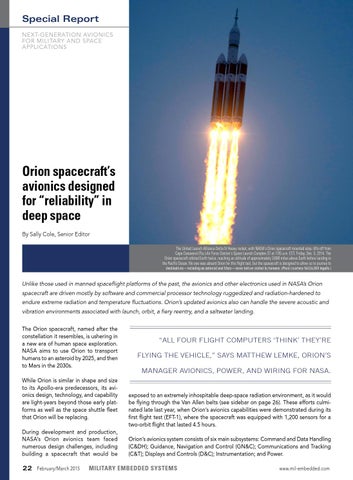
Orion spacecraft’s avionics designed for “reliability” in deep space By Sally Cole, Senior Editor The United Launch Alliance Delta IV Heavy rocket, with NASA’s Orion spacecraft mounted atop, lifts off from Cape Canaveral (Fla.) Air Force Station’s Space Launch Complex 37 at 7:05 a.m. EST, Friday, Dec. 5, 2014. The Orion spacecraft orbited Earth twice, reaching an altitude of approximately 3,600 miles above Earth before landing in the Pacific Ocean. No one was aboard Orion for this flight test, but the spacecraft is designed to allow us to journey to destinations – including an asteroid and Mars – never before visited by humans. (Photo courtesy NASA/Bill Ingalls.)
Unlike those used in manned spaceflight platforms of the past, the avionics and other electronics used in NASA’s Orion spacecraft are driven mostly by software and commercial processor technology ruggedized and radiation-hardened to endure extreme radiation and temperature fluctuations. Orion’s updated avionics also can handle the severe acoustic and vibration environments associated with launch, orbit, a fiery reentry, and a saltwater landing. The Orion spacecraft, named after the constellation it resembles, is ushering in a new era of human space exploration. NASA aims to use Orion to transport humans to an asteroid by 2025, and then to Mars in the 2030s. While Orion is similar in shape and size to its Apollo-era predecessors, its avionics design, technology, and capability are light-years beyond those early platforms as well as the space shuttle fleet that Orion will be replacing. During development and production, NASA’s Orion avionics team faced numerous design challenges, including building a spacecraft that would be
22 February/March 2015
“ALL FOUR FLIGHT COMPUTERS ‘THINK’ THEY’RE FLYING THE VEHICLE,” SAYS MATTHEW LEMKE, ORION’S MANAGER AVIONICS, POWER, AND WIRING FOR NASA.
exposed to an extremely inhospitable deep-space radiation environment, as it would be flying through the Van Allen belts (see sidebar on page 26). These efforts culminated late last year, when Orion’s avionics capabilities were demonstrated during its first flight test (EFT-1), where the spacecraft was equipped with 1,200 sensors for a two-orbit flight that lasted 4.5 hours. Orion’s avionics system consists of six main subsystems: Command and Data Handling (C&DH); Guidance, Navigation and Control (GN&C); Communications and Tracking (C&T); Displays and Controls (D&C); Instrumentation; and Power.
MILITARY EMBEDDED SYSTEMS
www.mil-embedded.com