athome Written by: Bailey Hemphill
During the session, the mediator walks both parties through the creation of the parenting plan. The mediator—and, in an ideal situation, a co-mediator—attempt to keep the parties on track by establishing an interest-based mediation model where they go over what the parties are trying to do and what their interests really are. The parenting plan process, on average, is a three-hour mediation session.
Putting the Children First: Divorce Mediation
D
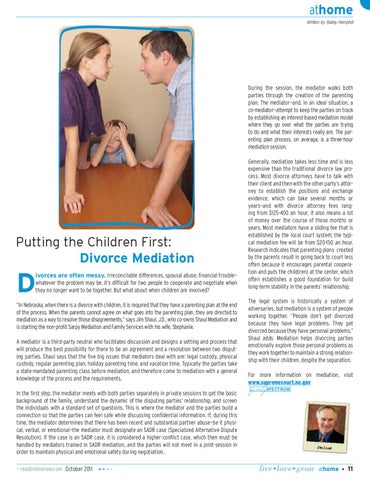
ivorces are often messy. Irreconcilable differences, spousal abuse, financial trouble— whatever the problem may be, it’s difficult for two people to cooperate and negotiate when they no longer want to be together. But what about when children are involved?
“In Nebraska, when there is a divorce with children, it is required that they have a parenting plan at the end of the process. When the parents cannot agree on what goes into the parenting plan, they are directed to mediation as a way to resolve those disagreements,” says Jim Shaul, J.D., who co-owns Shaul Mediation and is starting the non-profit Sarpy Mediation and Family Services with his wife, Stephanie. A mediator is a third-party neutral who facilitates discussion and designs a setting and process that will produce the best possibility for there to be an agreement and a resolution between two disputing parties. Shaul says that the five big issues that mediators deal with are: legal custody, physical custody, regular parenting plan, holiday parenting time, and vacation time. Typically the parties take a state-mandated parenting class before mediation, and therefore come to mediation with a general knowledge of the process and the requirements. In the first step, the mediator meets with both parties separately in private sessions to get the basic background of the family, understand the dynamic of the disputing parties’ relationship, and screen the individuals with a standard set of questions. This is where the mediator and the parties build a connection so that the parties can feel safe while discussing confidential information. If, during this time, the mediator determines that there has been recent and substantial partner abuse—be it physical, verbal, or emotional—the mediator must designate an SADR case (Specialized Alternative Dispute Resolution). If the case is an SADR case, it is considered a higher-conflict case, which then must be handled by mediators trained in SADR mediation, and the parties will not meet in a joint-session in order to maintain physical and emotional safety during negotiation. • readonlinenow.com October 2011 • • • •
Generally, mediation takes less time and is less expensive than the traditional divorce law process. Most divorce attorneys have to talk with their client and then with the other party’s attorney to establish the positions and exchange evidence, which can take several months or years—and with divorce attorney fees ranging from $125-400 an hour, it also means a lot of money over the course of those months or years. Most mediators have a sliding fee that is established by the local court system; the typical mediation fee will be from $20-150 an hour. Research indicates that parenting plans created by the parents result in going back to court less often because it encourages parental cooperation and puts the child(ren) at the center, which often establishes a good foundation for build long-term stability in the parents’ relationship. The legal system is historically a system of adversaries, but mediation is a system of people working together. “People don’t get divorced because they have legal problems. They get divorced because they have personal problems,” Shaul adds. Mediation helps divorcing parties emotionally explore those personal problems as they work together to maintain a strong relationship with their children, despite the separation. For more information on mediation, visit www.supremecourt.ne.gov
familySPECTRUM
Jim Shaul
live•love•grow
athome • 11