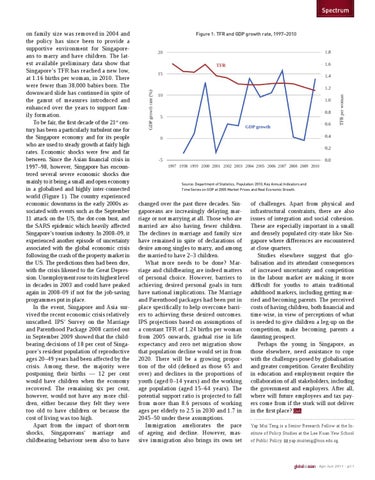
on family size was removed in 2004 and the policy has since been to provide a supportive environment for Singaporeans to marry and have children. The latest available preliminary data show that Singapore’s TFR has reached a new low, at 1.16 births per woman, in 2010. There were fewer than 38,000 babies born. The downward slide has continued in spite of the gamut of measures introduced and enhanced over the years to support family formation. To be fair, the first decade of the 21st century has been a particularly turbulent one for the Singapore economy and for its people who are used to steady growth at fairly high rates. Economic shocks were few and far between. Since the Asian financial crisis in 1997–98, however, Singapore has encountered several severe economic shocks due mainly to it being a small and open economy in a globalised and highly inter-connected world (Figure 1). The country experienced economic downturns in the early 2000s associated with events such as the September 11 attack on the US, the dot-com bust, and the SARS epidemic which heavily affected Singapore’s tourism industry. In 2008–09, it experienced another episode of uncertainty associated with the global economic crisis following the crash of the property market in the US. The predictions then had been dire, with the crisis likened to the Great Depression. Unemployment rose to its highest level in decades in 2003 and could have peaked again in 2008–09 if not for the job-saving programmes put in place. In the event, Singapore and Asia survived the recent economic crisis relatively unscathed. IPS’ Survey on the Marriage and Parenthood Package 2008 carried out in September 2009 showed that the childbearing decisions of 18 per cent of Singapore’s resident population of reproductive ages 20–49 years had been affected by the crisis. Among these, the majority were postponing their births — 12 per cent would have children when the economy recovered. The remaining six per cent, however, would not have any more children, either because they felt they were too old to have children or because the cost of living was too high. Apart from the impact of short-term shocks, Singaporeans’ marriage and childbearing behaviour seem also to have
Figure 1: TFR and GDP growth rate, 1997–2010
Source: Department of Statistics. Population 2010, Key Annual Indicators and Time Series on GDP at 2005 Market Prices and Real Economic Growth.
changed over the past three decades. Singaporeans are increasingly delaying marriage or not marrying at all. Those who are married are also having fewer children. The declines in marriage and family size have remained in spite of declarations of desire among singles to marry, and among the married to have 2–3 children. What more needs to be done? Marriage and childbearing are indeed matters of personal choice. However, barriers to achieving desired personal goals in turn have national implications. The Marriage and Parenthood packages had been put in place specifically to help overcome barriers to achieving these desired outcomes. IPS projections based on assumptions of a constant TFR of 1.24 births per woman from 2005 onwards, gradual rise in life expectancy and zero net migration show that population decline would set in from 2020. There will be a growing proportion of the old (defined as those 65 and over) and declines in the proportions of youth (aged 0–14 years) and the working age population (aged 15–64 years). The potential support ratio is projected to fall from more than 8.6 persons of working ages per elderly to 2.5 in 2030 and 1.7 in 2045–50 under these assumptions. Immigration ameliorates the pace of ageing and decline. However, massive immigration also brings its own set
of challenges. Apart from physical and infrastructural constraints, there are also issues of integration and social cohesion. These are especially important in a small and densely populated city-state like Singapore where differences are encountered at close quarters. Studies elsewhere suggest that globalisation and its attendant consequences of increased uncertainty and competition in the labour market are making it more difficult for youths to attain traditional adulthood markers, including getting married and becoming parents. The perceived costs of having children, both financial and time-wise, in view of perceptions of what is needed to give children a leg-up on the competition, make becoming parents a daunting prospect. Perhaps the young in Singapore, as those elsewhere, need assistance to cope with the challenges posed by globalisation and greater competition. Greater flexibility in education and employment require the collaboration of all stakeholders, including the government and employers. After all, where will future employees and tax payers come from if the stork will not deliver in the first place? Yap Mui Teng is a Senior Research Fellow at the Institute of Policy Studies at the Lee Kuan Yew School of Public Policy. yap.muiteng@nus.edu.sg
· Ap r-J un 2 0 1 1 · p 1 1