>> january > february
D
uring the 1950s, 3D cinema experienced what many perceive as its golden era. american teens would take a ride to their local picture house, order a soda and popcorn, cuddle up with their sweetheart or beau, and gaze upwards in anticipation of the awesome three-dimensional delights that awaited them. Initially 3D was a novelty only fit for the monster movie matinée; Invaders from Mars and Creature from the black Lagoon would evoke shrieks of joy and screams of fear from the sea of teens who sat before them, all adorned in classic red and cyan cardboard glasses. Today, the scenario may be similar: boyfriends and girlfriends seeking out gory shocks, parents and children searching for Technicolor wonderlands and everybody else lining up to see this summer’s ‘must-see’ blockbuster - except what was once a cheap thrill on a Saturday night is now being heralded as either the saviour of cinema or demonised as a celluloid assassin sent to strip ‘cinema the art form’ of all integrity. 3D technologies have existed for almost a century, yet today the argument of whether their implementation is of any value has never been so fiercely debated dividing audiences, filmmakers and
Star warS: epiSoDe 1
critics alike. One of 3D’s biggest criticisms lies in its emphasis upon style over substance, a trend which has proved unavoidable when much of its resurgence and transition into the mainstream has been choreographed by aesthetic exhibitionists such as james Cameron. Cameron’s visual tour de force, avatar, was undoubtedly a benchmark of 3D cinema’s box office success and aesthetic capabilities, yet the film’s worldwide impact opened the doors for numerous lacklustre followers to ride upon its coattails, leaving audiences with sore eyes, empty pockets and a bitter taste in their mouths. The critiques grew more damning, even big hitters such as The Dark Knight and Inception director Christopher nolan dismissed 3D as technologically inadequate and a necessary evil enforced by film studios. yet finally, after some initial teething pains, 3D has seemingly found its stride. Martin Scorsese’s Hugo was perhaps 3D cinema’s most legitimate outing to date, the narrative itself an ode to the ‘cinemagician’ whom many consider the godfather of special effects, George Méliès. Scorsese succeeded where many others had failed, establishing a spiritual connection between the classic and contemporary. The fact that the auteur embraced 3D and delivered, despite what many presumed would be a blot on
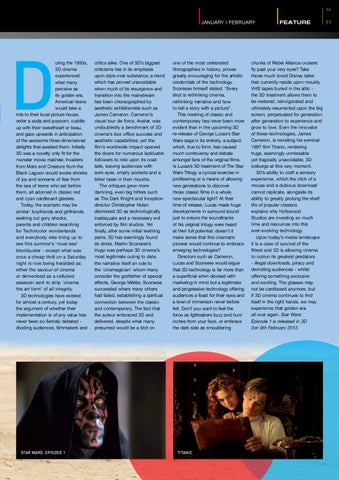
one of the most celebrated filmographies in history, proves greatly encouraging for the artistic credentials of the technology. Scorsese himself stated: “every shot is rethinking cinema, rethinking narrative and how to tell a story with a picture”. This meeting of classic and contemporary has never been more evident than in the upcoming 3D re-release of George Lucas’s Star Wars saga in its entirety, a subject which, true to form, has caused much controversy and debate amongst fans of the original films. Is Lucas’s 3D treatment of The Star Wars Trilogy a cynical exercise in profiteering or a means of allowing new generations to discover those classic films in a whole new spectacular light? at their time of release, Lucas made huge developments in surround sound just to ensure the soundtracks of his original trilogy were heard at their full potential; doesn’t it make sense that this cinematic pioneer would continue to embrace emerging technologies? Directors such as Cameron, Lucas and Scorsese would argue that 3D technology is far more than a superficial whim devised with marketing in mind but a legitimate and progressive technology offering audiences a feast for their eyes and a level of immersion never before felt. Don’t you want to feel the force as lightsabers buzz and hum inches from your face, or embrace the dark side as smouldering
titaNic
FEATURE
chunks of rebel alliance cruisers fly past your very eyes? Take those much loved Disney tales that currently reside upon mouldy VHS tapes buried in the attic the 3D treatment allows them to be restored, reinvigorated and ultimately resurrected upon the big screen, perpetuated for generation after generation to experience and grow to love. even the innovator of these technologies, james Cameron, is revisiting his seminal 1997 film Titanic, rendering huge, seemingly unmissable yet tragically unavoidable, 3D icebergs at this very moment. 3D’s ability to craft a sensory experience, which the click of a mouse and a dubious download cannot replicate, alongside its ability to greatly prolong the shelf life of popular classics explains why Hollywood Studios are investing so much time and resources into this ever-evolving technology. upon today’s media landscape it is a case of survival of the fittest and 3D is allowing cinema to outrun its greatest predators - illegal downloads, piracy and dwindling audiences - whilst offering something exclusive and exciting. The glasses may not be cardboard anymore, but if 3D cinema continues to find itself in the right hands, we may experience that golden era all over again. Star Wars: Episode 1 is released in 3D 3on 9th February 2012.
11