OntheHill Q&A with Senator Pat Toomey
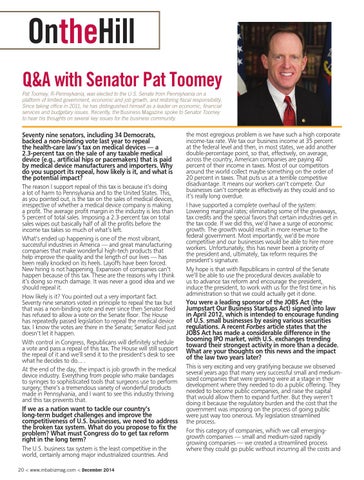
Pat Toomey, R-Pennsylvania, was elected to the U.S. Senate from Pennsylvania on a platform of limited government, economic and job growth, and restoring fiscal responsibility. Since taking office in 2011, he has distinguished himself as a leader on economic, financial services and budgetary issues. Recently, the Business Magazine spoke to Senator Toomey to hear his thoughts on several key issues for the business community.
Seventy nine senators, including 34 Democrats, backed a non-binding vote last year to repeal the health-care law’s tax on medical devices — a 2.3-percent tax on the sale of any taxable medical device (e.g., artificial hips or pacemakers) that is paid by medical device manufacturers and importers. Why do you support its repeal, how likely is it, and what is the potential impact? The reason I support repeal of this tax is because it’s doing a lot of harm to Pennsylvania and to the United States. This, as you pointed out, is the tax on the sales of medical devices, irrespective of whether a medical device company is making a profit. The average profit margin in the industry is less than 5 percent of total sales. Imposing a 2.3-percent tax on total sales wipes out basically half of all the profits before the income tax takes so much of what’s left. What’s ended up happening is one of the most vibrant, successful industries in America — and great manufacturing companies that make wonderful high-tech products that help improve the quality and the length of our lives — has been really knocked on its heels. Layoffs have been forced. New hiring is not happening. Expansion of companies can’t happen because of this tax. These are the reasons why I think it’s doing so much damage. It was never a good idea and we should repeal it. How likely is it? You pointed out a very important fact. Seventy nine senators voted in principle to repeal the tax but that was a non-binding vote and ever since then Senator Reid has refused to allow a vote on the Senate floor. The House has repeatedly passed legislation to repeal the medical device tax. I know the votes are there in the Senate; Senator Reid just doesn’t let it happen. With control in Congress, Republicans will definitely schedule a vote and pass a repeal of this tax. The House will still support the repeal of it and we’ll send it to the president’s desk to see what he decides to do... . At the end of the day, the impact is job growth in the medical device industry. Everything from people who make bandages to syringes to sophisticated tools that surgeons use to perform surgery; there’s a tremendous variety of wonderful products made in Pennsylvania, and I want to see this industry thriving and this tax prevents that. If we as a nation want to tackle our country’s long-term budget challenges and improve the competitiveness of U.S. businesses, we need to address the broken tax system. What do you propose to fix the problem? What must Congress do to get tax reform right in the long term? The U.S. business tax system is the least competitive in the world, certainly among major industrialized countries. And 20 < www.mbabizmag.com < December 2014
the most egregious problem is we have such a high corporate income-tax rate. We tax our business income at 35 percent at the federal level and then, in most states, we add another double-percentage point, so that, effectively, on average, across the country, American companies are paying 40 percent of their income in taxes. Most of our competitors around the world collect maybe something on the order of 20 percent in taxes. That puts us at a terrible competitive disadvantage. It means our workers can’t compete. Our businesses can’t compete as effectively as they could and so it’s really long overdue. I have supported a complete overhaul of the system: Lowering marginal rates; eliminating some of the giveaways, tax credits and the special favors that certain industries get in the tax code. If we did this, we’d have a surge of economic growth. The growth would result in more revenue to the federal government. Most importantly, we’d be more competitive and our businesses would be able to hire more workers. Unfortunately, this has never been a priority of the president and, ultimately, tax reform requires the president’s signature. My hope is that with Republicans in control of the Senate we’ll be able to use the procedural devices available to us to advance tax reform and encourage the president, induce the president, to work with us for the first time in his administration so that we could actually get it done. You were a leading sponsor of the JOBS Act (the Jumpstart Our Business Startups Act) signed into law in April 2012, which is intended to encourage funding of U.S. small businesses by easing various securities regulations. A recent Forbes article states that the JOBS Act has made a considerable difference in the booming IPO market, with U.S. exchanges trending toward their strongest activity in more than a decade. What are your thoughts on this news and the impact of the law two years later? This is very exciting and very gratifying because we observed several years ago that many very successful small and mediumsized companies that were growing were at a stage in their development where they needed to do a public offering. They needed to become public companies, and raise the capital that would allow them to expand further. But they weren’t doing it because the regulatory burden and the cost that the government was imposing on the process of going public were just way too onerous. My legislation streamlined the process. For this category of companies, which we call emerginggrowth companies — small and medium-sized rapidly growing companies — we created a streamlined process where they could go public without incurring all the costs and