Going public Government is backing the internet of things
Page 5
Added dimension
Page 8
3D printing is giving manufacturing a make over
Prying eyes
Page 11
Is business collecting too much customer data?
June 2011
BusinessTechnology
Distributed within the Sunday Telegraph, produced and published by Lyonsdown which takes sole responsibility for the contents
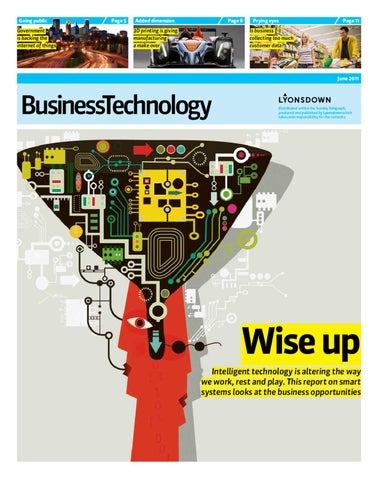
Wise up Intelligent technology is altering the way we work, rest and play. This report on smart systems looks at the business opportunities
2
Business Technology
an independent report from lyonsdown, distributed with the sunday telegraph
June 2011
Smart grids – the future of energy Smart energy systems are a vital tool in the armoury that will enable us to tackle climate change and meet emissions targets Last month, the International Energy Agency (IEA) reported that world-wide carbon dioxide (CO2) emissions from energy sources reached record levels in 2010. This is despite the millions of words written about the linkages between CO2 and climate change and the commitments by politicians around the globe to control emissions. In the UK, the Climate Change Act 2008 sets targets which include an 80 per cent reduction in emissions by 2050. Approaching this target will involve a switch from natural gas warming our homes, oil powering our cars and coal feeding power stations to renewable energy – hydroelectricity, wind, waves, tides and sunlight. Apart from the technical and financial challenges of constructing thousands of off-shore wind turbines and tidal barrages and installing photo-voltaic panels on millions of roofs, these technologies will require a fundamental shift in how we use energy. Since the power station building boom in the 1950s, Britain’s electricity system has been based on the principle that the consumer is king. In the interval of a cup final, millions of households switch on their electric kettles and, in power stations up and down the country, automatic control systems feed more coal into the boilers to provide more electricity. The same principle does not work for
renewables – the consumer has no control over the flow of the tides, the strength of the wind or the amount of sunlight. The supply of energy will be determined by the natural world and we will have to manage our use to match what is available. This need not be as draconian as it sounds as, for many applications, it is unimpor-
Since the power station building boom in the 1950s, Britain’s electricity system has been based on the principle that the consumer is king tant when the energy is supplied. If a commuter arrives home in the early evening and plugs in her electric car, she is unlikely to be interested whether it is charged between 10 and 11 pm or between 3 and 4 am, so long as it is ready for use by 7.30 next morning.
This is the challenge the smart grid will address. We need to find a way of controlling the various energy-using devices in our homes to match what is available, without too great an impact on our quality of life. Today, the same design principles and smart technologies that made possible the internet, and vast global communication networks, are beginning to be used to reconfigure the world’s power grids to match our use of electricity with the supply. We need to create a future in which millions of individuals can store and generate renewable energy locally in their homes, offices, factories, and vehicles, and share their power generation with each other. A smart grid can be defined as an electricity network that can intelligently integrate the demands of everyone connected to it – generators, consumers and those that do both – in order to deliver sustainable, economic and secure electricity supplies. Professor Roger Kemp from the Institution of Engineering and Technology (IET) explains the magnitude of the challenges we face. “As well as ambitious programmes in energy utilisation, we need to rebuild our electricity generation and transmission infrastructure”, he says. “Over the next 20 years, the coal-fired power stations, that provided more than half our electricity last winter, will be closed. All but one of the existing nuclear stations will reach
Professor Roger Kemp
the end of their lives. Government targets are that, by 2030, renewable energy should supply 45 per cent of our needs, compared with 3 per cent today. “Building so many renewable energy systems represents a massive engineering challenge. But building the hardware is probably the easy part – with sufficient investment and manpower it is possible. Designing the control systems that let it all work together and integrate with the appliances in millions of homes and businesses is something that hasn’t been done before. This system of systems will need to be controlled by a smart grid that is an order of magnitude more sophisticated than the smart meters currently being introduced.” For more information visit www.theiet.org
an independent report from lyonsdown, distributed with the sunday telegraph
June 2011
Foreword
Business Technology
3
Smart Systems – in this issue
Smart thinking
Global opportunities abound in the world of smart systems. Big players are increasingly harnessing the power of small technology to meet the challenges of the future
By Dina Medland
When we talk about smart systems, we are talking about capability rather than smart in the sense of clever. In its pure technological meaning, smart technology refers to the adoption of miniaturised devices that can sense, actuate and control in one manner or another. For most people who are not tech geeks, socalled smartphones are the obvious example. For joined-up smart systems to be truly capable of clever and far-reaching results, we need to take the technology a step further by harnessing it to the torrent of data increasingly available today. Research from the McKinsey Global Institute and its Business Technology Office recently found that the use of big data is becoming a way for companies to innovate, compete and create value. New growth opportunities are likely to depend on the scale of data, its real-time nature and high-frequency, it said. There are many technological issues to be resolved in the use of smart systems, and
concerns remain around the security of data and privacy. But alongside companies and commercial organisations, consumers could also see the benefits of new developments. They could be offered sophisticated choices closer tuned to their needs, and they could also benefit as governments, struggling to deal with ageing populations and infrastructure, look to smart systems for public policy decisions across a spectrum of issues – from energy to transport and healthcare. For example, when it comes to smart routing using real-time traffic information, McKinsey estimates that by 2020 more than 70 per cent of mobile phones are expected to have GPS capability. The potential global value of smart routing in the form of time and fuel savings will be about $500bn (£303bn) by 2020, it says – the equivalent to saving drivers 20 billion hours on the road, or 10-15 hours every year for each traveller and about $150bn (£91bn) on fuel consumption. The combined effects of emerging internet technologies, increased computing power and fast digital communication are yet to come.
In this supplement, we look at some of the technology and its implications for individual players on a small scale. At Aston Martin Racing and Shapeways, a Dutch manufacturing company, products are being created directly from computer-aided designs without the need for machine tools. Space4 uses sophisticated IT to rapidly adjust home designs to meet consumer requirements, as does Domino’s Pizza, in a different market altogether. Rising energy costs have made the introduction of smart meters and smart grids a major focus. Amid increasing concerns about sustainability, the ICT industry can point to evidence that shows that harnessing vast amounts of data with smart technology is, in fact, all about a goal of zero wastage – whether in design, manufacturing or delivery. Roberto Siagri, president of the computer hardware group Eurotech has seen it all. He says: “In 1992, we looked at how we could adapt computers in real life – we moved to grids and now to the ‘cloud’. Now the ‘internet of things’ has materialised and a smart planet can be achieved.”
Policy matters
5
In print
8
It’s personal
9
Nosey parker
11
A small affair
13
Public services are up for grabs
Industry gets a new dimension The daily grind may never be the same How much customer data do firms need? All firms benefit from smart technology
Contributors Publisher Bradley Scheffer brad@lyonsdown.co.uk
Creative Director Martin Nolan studio@lyonsdown.co.uk
For more information on any of our supplements please contact us:
Managing Editor Lucie Carrington lucie@lyonsdown.co.uk
Production Manager Nicki Sitaras nicki@lyonsdown.co.uk
Telephone: 020 8349 4363 Email: info@lyonsdown.co.uk Online: www.lyonsdown.co.uk
Editor Dina Medland editor@lyonsdown.co.uk
Project Manager Marc Morrow marc@lyonsdown.co.uk
Sponsors
Dina Medland is an independent writer and editor. Her first job was writing for the BBC, from where she moved to The Economist and then spent eight years with the Financial Times. Today she is a regular FT contributor and writes on a wide variety of subjects, including boardroom issues. Sue Tabbitt is a freelance journalist who has been writing about the business impact of technology and telecoms for over 20 years, covering a broad range of topics for national titles including The Daily Telegraph and The Guardian, as well as the specialist business and technology press. Cath Everett has written about business, technology and employment-related issues since 1992. A news writer by background, she worked in-house for a range of technology-related titles before going freelance 11 years ago and broadening her professional horizons. She writes regularly for The Guardian.
Paul Bray read Modern History at Oxford. Since 1988 he has written about almost every topic from business and technology to travel, education and food and drink, for many publications including The Daily Telegraph and Sunday Telegraph, The Guardian, The Sunday Times, Britain’s Top Employers, Computing, Director and Nasdaq International. Tracey Caldwell is a freelance business technology journalist. She is a regular contributor to Guardian Professional Networks and is editor of Biometric Technology Today, published by Elsevier. She writes for a number of business-to-business titles covering topics including networking, mobile working, business information management and green ICT. Cover illustration: Istockphoto/Tjasa Zurga
More from Lyonsdown 10.07.2011
Enterprise agility – The Sunday Telegraph
According to the Massachusetts Institute of Technology, agile organisations increase their revenue 37 per cent faster than non-agile organisations. And, they generate 30 per cent higher profits from the revenue they pull in. Find out how your business can become more nimble and profitable.
17.07.2011
Connected TV – The Sunday Telegraph
The convergence of broadcast and online TV is the biggest change in broadcasting since the digital switchover and represents huge challenges and opportunities for broadcasters, content providers and advertisers. Learn how to profit from TV’s latest iteration and what it means for your business.
06.09.2011 E-government – The Daily Telegraph
All public sector organisations are under pressure to cut costs, increase efficiency and improve the delivery of vital services while also becoming more open and accountable. Read how public services are using ICT to deliver these contradictory goals.
Product life-cycle management 14.06.2011 For copies of this report email info@lyonsdown.co.uk
4
Business Technology
June 2011
an independent report from lyonsdown, distributed with the sunday telegraph
Industry view
Turning point in the energy revolution The £10 billion smart meter programme heralds a new era, giving consumers tighter control of their energy use and household bills The biggest update of home technology since the arrival of natural gas is under way. It will cost at least £10 billion and engineers will have to visit every house in the land. But the installation of smart meters in all homes will bring substantial energy savings for households and help achieve the country’s targets for cutting carbon emissions whilst unlocking new technologies such as electric vehicles, solar panels and smart appliances. Smart meters will bring benefits estimated to be at least £17 billion split between consumers, who will no longer receive estimated bills and will be able to see and control their energy consumption to start saving money on their bills, and the industry which will be able to slash billing costs and offer new, innovative energy tariffs. In a sense, the humble gas and electricity meters in all our homes are the last bastion of the old disconnected world. To take readings, blokes with ID cards have to physically look at the dials and take notes, and even after decades of deregulation the industry has still not devised a way of allowing one man to read both meters when he calls. The British government is pushing the smart meter programme hard with the Department of Energy and Climate Change (DECC) setting a target for all 53m gas and electricity meters in Britain to be replaced by 2019. Centrica, which operates in the consumer market as British Gas, is moving even faster, according to Dean Keeling, the company’s managing director for Smart Homes. “British Gas has taken a leadership role in smart metering,” he says. “We will have over 300,000 meters installed in homes and businesses this year and 2 million by the end of next year – it is one of the biggest
Unlocking alternative technologies
Smart meters could transform energy use
programmes going into homes since central heating arrived in the 1970s.” The primary motivation for the rapid move into smart meters is to allow customers to see their energy use as it happens; currently, they only see the true consequences of leaving the thermostat on the central heating boiler set too high over the winter six months later, when they get an enormous estimated bill through their letterbox. Keeling points out that this may cause anger and resentment but it does not motivate a change in behaviour, as the bill is likely to arrive in the summer and the shock will be a distant memory when the winter comes round again. “Smart is a crucial technology in helping customers control their energy use,” he says. Households may also become truly carbon neutral and perhaps even earn a bit of money by generating electricity with photovoltaic panels, wind turbines and microgeneration, he points out. Keeling acknowledges that smart meters won’t save money on their own. “Just putting in a smart meter without changing the way you use energy won’t save you any money. As a starting point we expect customers to save around 2-3 per cent on their energy bills. However, when customers really engage with their energy and change their behaviour this can dramatically increase. With our Green Streets pilot engagement programme,
customers were saving 18 to 25 per cent.” It is more than just saving money, however. British Gas is rolling out smart meters as fast as possible because it sees the technology as enabling it to expand to become a supplier of pretty well everything a household needs. Keeling says: “We are looking at new ways in which British Gas can grow by delivering innovation to the market, from areas we are in today – mainly heating systems – to things
British Gas has taken a leadership role in smart metering. We will have over 300,000 meters installed in homes and businesses this year – Keeling, British Gas you might be surprised we are involved in.” The advent of smart metering will not only help customers understand how they use energy but also help them to use it differently. Smart will support innovative appliances such as washing machines and boilers that can be controlled from smart phones. It will even support electric vehicle charging and the decarbonisation of transport. “We see smart as a gateway technology”, says Keeling, “it really does have the potential to open up the home, not just in energy but also in security, home area networks and health and wellbeing”. The result will be a transformation of the British Gas engineer from a simple gas man (or woman) to the person who can do almost anything, from plumbing to electrics, home insulation and even installing solar panels. (British Gas is, surprisingly, one of the country’s biggest installers of insulation and solar panels).
“We have 13,000 engineers who go into customers’ homes and businesses on a daily basis, and we want to continue to be trusted to look after their world,” Keeling says. “We want our customers to have a better, transparent relationship with us.” On the supply side, smart meters will enable British Gas to do more with less, both to cut costs and lower carbon emissions. “We look at security of supply in a low carbon world,” Keeling says. “Smart metering gives us a tool which leads to a dynamic smart grid for the UK.” The smart grid will eventually allow a degree of demand management. In particular, it will help to manage the spikes in demand that currently force the installation of far more generating capacity than is needed to cope with average demand levels – something that is hugely expensive, wasteful and environmentally damaging. There are still areas of the smart meter programme that need to be finalised. One is the lack of a technical standard for communication, which will not emerge until 2014 when an “enduring solution” must be established, according to the DECC timetable. British Gas is using mobile data modules using the GPRS standard so the meters can communicate by text message, but other solutions will be required. “We will need bespoke solutions for some people, for example where the meter is in a basement or in a very old property with thick walls where radio signals have difficulty [getting through], and in apartments where you need to ensure you get the right signal out of the right flat,” Keeling says. “And there is the problem of remote areas without mobile phone coverage.” But he is confident these technical problems will be overcome. “British Gas is technology agnostic and we will comply with whatever standard is agreed,” he says. The important thing is to move ahead as fast as possible. “We are creating substantial numbers of jobs in the UK at a time when the country really needs them and we are providing real cash savings in our customers’ homes,” he says. “Smart metering is great for consumers, great for British Gas and great for UK PLC.”
an independent report from lyonsdown, distributed with the sunday telegraph
June 2011
Business Technology
5
Public policy
Transforming the city landscape From energy to transport to healthcare – smart systems are set to overhaul the way our services are delivered. The race to supply them starts here By Dina Medland
Of all the many things that smart technology could do for us, its implications for government public policy decisions are probably the most exciting. The reality of major advances in information and communication technology is evident in Ericsson’s Networked Society Index, a report showing that cities with a high level of ICT maturity are significantly better at managing issues such as environmental management, infrastructure, public security, quality of healthcare and education. “What we are seeing in cities today is the enormous concentration of people, talent and economic wealth,” says Erik Almqvist, director and head of consultancy at Arthur D Little’s telecom, media, electronics and financial services Nordic practice. “The 600 largest cities in the world produce 60 per cent of global gross domestic product, which has never happened before in human history. A city is a concentrated microcosm of society which either grows or declines, and ICT plays a huge role in utilising its economic assets and talents.” His co-author on the report, Wilhelm Lerner, head of the consultancy’s central European strategy and organisation practice, adds: “With ageing populations, the cost of healthcare will be outrageous. Increasing e-health abilities (through
smart systems) will enable us to allow people to grow old in their own environment. Smart grids and energy utilisation will allow cities to anticipate and minimise the future, as well as current, costs.” In the UK, competition to be part of the roll-out of 47m smart meters in homes by 2020 has created a considerable buzz in the industry. The project was initiated by the previous government, but recently the coalition committed to a fourth carbon budget which puts the country on course to cut emissions by at least 80 per cent by 2050. David Green is programme director, smart metering, at Arqiva, which is in a consortium with BT and Detica to bid for the national provision of communication and data services to the Department of Energy and Climate Change (DECC). He says: “All energy suppliers will buy services from DECC, and the services will roll out from 2014. In the future, we’ll have local micro-generation of power, with feed-in tariffs. These changes and electric vehicles will change the demand on the network.” As smart meters provide energy companies with instant measurements of usage, this allows more accurate bills and pricing plans that charge consumers more when demand is highest. The Smart 2020 report, commissioned in 2008 by the Climate Group on behalf of the Global e-Sustainability Initiative with independent analysis by consultancy McKinsey, found ICT was a key factor against climate change and could enable emission reductions of 15 per cent. But Dominic Vergine, director of sustainability development at ARM, the company which designs the embedded technology at the heart of most advanced digital products, thinks the improvement in energy efficiency is likely to be far more than that. “Smart 2020 only considered current technologies.
The key omission and therefore unquestionable inaccuracy of the projection of 15 per cent is how will the emergence of new technologies affect both sides of the footprint projections?” he says. “The use of smart meters and grids, micro-controllers in motors, smart buildings, transport and industrial control – not to mention transformational technology such as cloud computing – will all converge at some stage. And it will be everything working in synergy that will provide the biggest transformation in energy efficiency.” ARM technology today is everywhere – in almost all mobile phones, in more than half of car braking systems and in three-quarters of the forthcoming electric vehicle charging points as part of the Source London scheme (PricewaterhouseCoopers is to pilot electric cars with London-based employees as part of its sustainable travel strategy). The use of smart systems in transport is steadily accelerating in cities across the globe. Eight years after the launch of London’s congestion charge, the emphasis across the UK is “on trying to promote intelligent transport solutions with more real-time information available for transport authorities, drivers and passengers to give them greater control in planning their journeys,” according to Jon Lindberg, who heads transport at Intellect UK, the trade body representing the UK technology industry. Technology now allows CCTV monitoring, displays above motorway lanes and sensors buried into the road which measure speed and proximity of cars, data which can then be analysed by software that triggers appropriate alerts. The UK has one completely “managed” motorway at the moment, the M42 around Birmingham, Lindberg says. The true power of such transformational technology will only be seen when it all starts to be connected up across the broad
spectrum of public policy issues. One indication that it’s the future is the recent decision by Siemens, Europe’s largest engineering conglomerate, to reorganise and launch a fourth sector to its business: Infrastructure and Cities is to be made up of products ranging from trains to energy distribution and smart grids. Another indication comes from Eurotech, one of Europe’s few big computer hardware groups, which has operations in Cambridge. It has survived and prospered by adapting – most of its sales are for computers used in transport, logistics, automation, medical
The true power of technology will only be seen when it all starts to be connected up across the broad spectrum of public policy issues devices and defence. It is also in the first phase of marketing the Aurora supercomputer, in partnership with Intel. Roberto Siagri, Eurotech’s founder and CEO, says: “The internet of things has materialised and a smart planet can now be achieved: what is new is the control we now have of extreme amounts of data coming out of devices. The law of technology says in the first place it appeared dehumanising, then it enabled – and now it is network humanising.” It seems churlish to sound a cautionary note in the face of such enthusiasm, but as we speed towards smart systems everywhere, there remain concerns that the more connected we become, the more we are at danger from lapses of security and the hacking of sensitive information.
6
Business Technology
June 2011
an independent report from lyonsdown, distributed with the sunday telegraph
Industry view
Meeting the last mile challenge Standardising how to deliver services to consumers and ensure all the technologies communicate effectively is the final piece in the smart grid jigsaw What exactly is a smart power grid? We all know that the power grid supplies pretty much all the electricity to our homes, offices and businesses, but add some intelligent communications and control and you then enable fundamental changes to the way we consume power – more effectively, more efficiently and with two-way digital control of consumers’ appliances and systems. This is the smart grid and new technologies are now available to make this a reality.
Fujitsu is one of the first manufacturers to offer fully programmable components to meet the new industry standards for this emerging market However, one of the biggest challenges is standardising how to deliver these services over the last mile – from the infrastructure of the grid on to the consumer at the edge of the power network. Clearly power line
communication (PLC) – or sending the digital control data up and down the same copper wires used to carry the mains power – is the ideal physical medium as the copper is already in place. The real last mile challenge, however, is to implement industry standards and methods to ensure everything communicates efficiently and effectively. Innovation is fastest at the edge of the smart grid in home/consumer applications and this is now supported by industry standards such as PRIME (power line related intelligent metering evolution) and a few others. It is regulated by CENELEC, (the European Committee for Electrotechnical Standardisation) which defines how all devices should operate and communicate – essential, for example, in the automatic registration of new equipment when added to smart grid nodes (terminal points in the network). Smart grids also add intelligence to a standard grid by implementing sensors at points throughout the electricity supply chain, providing valuable control and feedback information to both consumers and suppliers. Devices that perform such functions must meet strict specifications when delivering their own signal power on to the lines and are expected to deliver this power very efficiently. For example, the maximum output
From gas light to smart light
power specified by the CENELEC transmission rules is around 0.5 watts. This doesn’t sound like much, but if the device producing it is only 25 per cent efficient (which is not uncommon), then 2W of actual signal power would need to be generated. This is undesirable and can be avoided with more efficient, modern digital output techniques. With this in mind semiconductor device manufacturers like Fujitsu Semiconductor Europe have developed digital system-onchip (SoC) devices, with highly efficient (80 per cent) digital signal outputs which only
require 0.6W output power. These are now being deployed widely in low power devices for connection to the smart grid. Indeed, Fujitsu’s family of efficient and powerful PLC SoC devices is already available for integration into all types of intelligent devices – from smart grid controllers and smart PLC electricity meters to fridges, heating systems and solar panel installations that can release unused solar-generated power back into the smart grid. There are also many applications outside the consumer space that can benefit greatly from this family of products, such as intelligent street lighting. To ensure all of these systems interact effectively, SoC vendors must work closely with the standards bodies and software suppliers. Fujitsu is one of the first manufacturers to offer fully programmable components to meet the new industry standards for this emerging market. For smart grid systems designers, this is the place to start – using devices like Fujitsu’s PLC SoCs to considerably simplify and accelerate product development and ensure compatibility with the rapidly growing smart grid network. Pierluigi Cebrelli is director, embedded solutions, Fujitsu Semiconductor Europe www.emea.fujitsu.com/semiconductor
Making the best use of energy technology The safe and secure installation of smart meters is being championed by infrastructure maintenance firm Enterprise The UK government, like most others in the developed world, is driving forward the installation of smart meters. In the UK that means 53 million gas and electricity meters in 30 million homes and businesses will be replaced by the end of 2019 with new, up-todate devices that will help consumers improve the way they manage their energy usage and lower their bills.
By 2019, the average consumer (with both electricity and gas) is expected to reduce their consumption by between 10 per cent and 20 per cent The safe and secure installation of the new meters is vital to them being accepted and working effectively. Smart meters are already available and some suppliers have already commenced installations, although the main roll-out begins
in 2014. Smart gas and electricity meters will enable consumers to monitor their energy usage through an in-home display so they can get the data remotely. In future they will be able to control appliances using their mobile phone or computer. Information will be presented in an easily understandable format. The minimum data provided will be the past and present rate of energy use, and its cost. Smart meters are also used by Enterprise to measure generation from Solar PV installations. Smart meters will deliver a range of benefits to consumers, energy suppliers and networks. Consumers will have real-time information on their energy consumption to help them control energy use, save money and reduce carbon emissions. By 2019, the average consumer (with both electricity and gas) is expected to reduce their consumption by between 10 per cent and 20 per cent*. With energy prices rising at a greater rate than inflation, the savings will increase rapidly in the long term. In addition, suppliers will have access to accurate data for billing, allowing them to improve their customer service and reduce costs, for example by reducing call centre traffic, ending visits by meter readers, and the eradication of estimated bills. Energy networks will also have better information with which to manage and plan
current activities as well as supporting the move towards smart grids to support sustainable energy supplies. This will also help to reduce costs in the long term. Minimum standards for smart meters will ensure that they work for all energy companies. This means that it should be easier for consumers to switch their gas and electricity
supplier if they find a better deal elsewhere. Consumers need to be aware that the smart meter roll-out programme is coming. The size and complexity of it cannot be underestimated. That is why the roll-out needs to be executed by companies with significant experience in safe and secure meter installation, such as Enterprise. Enterprise, the UK’s largest provider of maintenance and front-line services to the public sector and utility industries, installs over 800,000 meters every year on behalf of companies such as National Grid, British Gas and Northern Gas Networks. To ensure that the company provides everything the consumer needs it plays a key role in EU Skills and the National Skills Academy for Power (NSAP) and chairs the Metering Network Group. The use of smart meters is essential for the UK to achieve its CO2 emission targets. Consumers will adapt swiftly to the new technology but that will happen only if the devices are installed safely and securely in their property by experienced and reputable organisations. * Data from a number of trials in the UK and Ireland.
Gas meters may never be the same
Martin Deehan is metering services director, Enterprise
an independent report from lyonsdown, distributed with the sunday telegraph
June 2011
Business Technology
7
Industry view
Why machines should learn to talk We already have smart technology in our domestic devices. With a common platform and language they could communicate with each other – and make our lives even easier Smart technology is an accepted part of the modern home and we’re no longer in awe of the washing machine that calculates how much water to use, the central heating that gives itself an extra hour in bed on Sunday, and the TV box that can record seven separate soap operas while we’re on holiday. What these devices don’t do is talk to each other. Your washing machine can’t quiz your energy supplier to find out the cheapest time of day to run. Your central heating can’t read the weather forecast and turn itself up just before an Arctic blast arrives. Your video recorder can’t save footage from your CCTV camera when your motion-sensitive security lights detect a prowler outside. Compared with other kinds of technology, this is somewhat primitive. If you buy a new camera and connect it to your PC and printer they’ll automatically start communicating, even though each is made by a different manufacturer. And when those manufacturers equipped their factories they took it for granted that all the machinery would work together, because interoperable controllers for industrial equipment have been around for years. There’s no reason why the same shouldn’t soon be true of domestic gadgets, entertainment systems or home security, says Lorraine
Choosing a tune may never be the same
Bardeen, who leads the team responsible for Microsoft’s Windows Embedded operating system in Europe. Even your car could join in, telling the central heating to switch on when you’re a few miles from home or tuning the radio to the same station you
were listening to at breakfast. “Once you have an intelligent central controller that talks to all the devices in your house, you’ll have a lot of flexibility and control,” says Bardeen. Mundane things like finding the cheapest rate electricity could be fully automated, while you could do the sophisticated stuff – selecting some music, say, or adjusting the security lights – from anywhere in the house or even outside it. “All the information you need to understand what’s happening in your home and to make decisions about it will follow you wherever you are, thanks to the internet and cloud computing,” says Bardeen. “You could programme the video recorder and check the security cameras while you’re away, or tell the central heating you’re staying out for the evening.” Each device will need a common operating system such as Windows Embedded, an IP address so it can connect to the home network (like a computer connecting to the internet), and a means of speaking the same language as other devices (known in the trade as a standardised connectivity protocol). Finally, devices will need to be easy to use with at-a-glance graphical displays and a natural interface such as touch, gesture or voice.
“A consistent and intuitive user experience is a top priority for us,” says Bardeen. “If you wanted to turn up the heating, for example, you might just touch ‘home’ and ‘temperature’ and push the bar up a notch.”
Private motorists currently face a myriad of charges, levied from multiple sources and including VAT and taxes on fuel and insurance, vehicle excise duty and, in some locations, congestion and road toll charges. Add on to this the current requirement for insurance, and we have an opportunity for a converged charging solution, providing private motorists with a ‘pay as you drive’ bill that includes roaming fees for recharging batteries when away from home. Intelligence in the car and charging posts would again allow usage details to be downloaded while the car is being recharged. This would be used to create an individual bill that would automatically be issued and allow for
the allocation and collection of energy, road tax, VAT, parking and insurance premiums. Data privacy may become an issue but anyone who owns and uses a non-pre-pay mobile phone knows that the information being collected from the electric vehicles is little different from what the mobile phone companies already collect and know. We have the opportunity to revolutionise personal transport with EVs, but do we have the courage and insight to build the infrastructure that will deliver this revolution?
Even your car could join in, telling the central heating to switch on when you’re a few miles from home The technologies to achieve all this exist today, says Bardeen. All that’s needed is for manufacturers to convince us that we want them. And given our seemingly insatiable appetite for ease and comfort, that shouldn’t be too hard. www.microsoft.com/windowsembedded/ europe/greensolutions
The road ahead
Demand is growing for electric cars, but is the country ready for such a major change in the way we use private transport? Electric vehicles (EVs) are charging into the consumer’s and legislators’ sights with a number of new vehicles being launched, government subsidies introduced, and new charging points and council-sponsored ‘clubs’ that give unlimited vehicle recharges for a fixed annual fee being launched. EVs provide the opportunity for a seismic shift in the way we approach the use of personal motorised transport on our roads. How long before we see a similar scheme, for instance, to London’s network of cycle
If the car was plugged in for a recharge, data would be automatically downloaded and driving habits would be monitored stations where small keyless electric city cars are tethered to smart charging posts with access provided to registered users through an extension of the popular and proven Oyster card? The card would contain details of the driver, including age, eligibility to drive and
personal identification. If the car was plugged in for a recharge, data would be automatically downloaded and driving habits would be monitored and the data analysed. This would allow individual usage to be monitored and charged while ensuring the right number of charging stations were in the right locations with the right number of EVs to meet demand. These community ‘pay as you drive’ schemes would use a network of public access points but to be truly effective they require a national infrastructure to allow information to be shared across city and regional boundaries. Without this, users would be confined to tight geographic boundaries and could not guarantee to be able to charge the vehicle when required outside of these boundaries. Community users would receive a consolidated charge for driving the EV based upon a variety of key factors. Premium charges would apply for peak times in an effort to reduce congestion and discounts could be calculated for other less busy times. If you wanted to drive in the city centre, then top-up charges for congestion and some inner city zones would automatically be applied, as could parking charges. Finally, a charge for each mile driven would be calculated to ensure that drivers paid based upon physical usage – those that drive further pay more.
Andy Corkhill heads the EMEA utilities practice for Convergys andy.corkhill@convergys.com
8
Business Technology
June 2011
an independent report from lyonsdown, distributed with the sunday telegraph
3D printing
The shape of things to come From printing your own iPod to creating smart parts for cars and planes, 3D printing techniques are poised to change manufacturing as we know it By Sue Tabbitt
Fast forward a few years and manufacturing will have come full circle, returning to the cottage industry model of old where local craftspeople developed products to meet local needs, using local materials. This is the picture being painted by experts in advanced manufacturing technologies, who suggest that conditions are ideal to foster a new industrial revolution. At the centre of the proposed shift is 3D printing, or additive manufacturing, which promises to make it as cost-effective to make a single, bespoke item as it is today to mass-produce thousands of units of the same product. Not just dumb objects, either. Developers are working towards techniques that will soon enable manufacturers to produce parts with embedded intelligence, with the potential to transform engineering of vehicles and aircraft. The science, which despite sounding like something out of Star Trek is already 20 years old, involves creating products directly from computer-aided designs without the need for machine tools. Instead, the designs are “printed out” layer by layer using the material of choice (provided this is something that can be manipulated when a laser or reasonable heat is applied). Before too long, the palette will extend to conductors and semi-conductors and it will be possible to incorporate multiple materials in a single item, with the result that consumers at home will be able to pop out their own iPods simply by selecting the print button their PC.
If consumers don’t fancy turning their home into a science lab, production will be directed to a local service provider (think photo processing or fax/copy outlets). Already Shapeways, a Dutch 3D manufacturer born out of Philips’ research lab, reports that some 13,000 separate design files were uploaded to its website for “printing” in a single month.
Lighting up the future: is 3D printing the new industrial revolution?
Products to date have included iPad stands, miniature models of real people, jewellery created from scientific algorithms, and personalised Rubik’s Cubes. Testament to how far the technology has advanced already, Shapeways offers many
materials for use, including soda-lime glass, full-colour sandstone, acrylic-based photopolymers, and even stainless steel (with gold and bronze finishes) and sterling silver. Ceramics will follow soon, and eventually electronic items will be added to the list. “All that’s missing, if anything, are more online interfaces to make it easier for non-designers to bring their ideas to life,” says Duann Scott, an industrial designer and researcher who heads up communications at the company. Although Shapeways currently operates only out of Eindhoven in the Netherlands and New York in the US, it offers free shipping on items valued at over £20 so designers are able to build almost anything they want, quickly, without needing to invest in manufacturing tools or facilities. For Bill O’Neill, a laser engineer who runs a research group at the University of Cambridge, bringing manufacturing closer to home is one of the main aims of additive processes. “The reason all this is so important is because of the utilisation of materials, resources and energy in current manufacturing,” he says, noting that with personal production more use could be made of local materials and recycled goods. “There is zero waste with these [3D printing] machines. You make only what you want each time and you’re no longer throwing away material when you create a hole, for example.” While the ability to make complex solid products without machine tools is exciting in its own right, a further significant leap will come once materials with conductive properties can be incorporated into the process. This
Full speed ahead to the premier league of racing. With designs on taking part in this year’s Intercontinental Le Mans Cup, the team faced a super-tight deadline to prepare a new purpose-built car. 3D printing helped keep the build cycle tight. The technology, provided by Stratasys, allows new components to be generated directly
Aston Martin: taking tools out of the equation
3D printing, or additive manufacturing, promises to make it as cost-effective to make a single, bespoke item as it is to mass-produce thousands of units
is looking into this. Spearheading the work is Dr Neil Hopkinson, whose particular area of expertise is applying inkjet and infrared technology to 3D printing using a special technique he has patented. “Smart components respond to the environment they’re in, which often requires circuitry,” he says. “The aim now is to print conductive paths and electronic components within parts.” Whichever additive technique is used, this could have enormous implications for car and aircraft manufacture: “It would mean that wiring – which represents substantial weight, affecting speed and performance, fuel efficiency and CO2 emissions could be eliminated. That would be huge.”
3D printing – the science
Thanks to 3D printing, Aston Martin Racing is gaining traction at the top of its field Using additive manufacturing techniques, Aston Martin Racing was able to create its flash new Le Mans Prototype 1 car in just six months. Inspired by the experience, the team is now looking to produce finished components in the same way. The AMR-One is Aston Martin’s passport
could propel 3D printing into the realm of smart systems. Thanks to a £5m research grant from the Engineering and Physical Sciences Research Council, a team at Loughborough University
from the team’s computer-aided design (CAD) system using high-performance industrial thermoplastics. “It meant we could knock up a dummy build of a car in a matter of days,” says team principal George Howard-Chappell. When a mechanical fault arose with the engine during testing abroad, the team was able to work up a new air intake duct in the space of a weekend. “Previously, something like that would have taken at least two weeks,” he says. The team is now looking to use 3D printing to make durable, working parts. One advantage, besides speed of production, will be financial; some components can cost tens of thousands of pounds. “The AMR-One is a limited run of six cars,” Howard-Chappell says. “For some bits that will wear out or could be crash-damaged, we might need to make 30 units; for others, such as those inside the cockpit, we may only need six. It’s here that 3D printing could really make a difference. We could easily make a 50 per cent saving in some cases.” This is because, with additive manufacturing, machine tools have been taken out of the equation. It also paves the way for sleeker designs, as shape ceases to be an issue.
Those who have never heard of 3D printing often scoff at what’s being proposed, but if we listened to the doubters, we’d never get anywhere, says Bill O’Neill, a laser engineer and additive manufacturing evangelist at the University of Cambridge. The technology has already been used to create a full-sized bike made from steel-strength nylon by engineers from the Bristol wing of the European Aeronautic Defence and Space Company. Although various techniques are used, all 3D printers work by building the component or product layer by layer, whether using a liquid, powder or sheet material that has been broken down by heat, UV light or chemical reaction. Particular techniques include fused deposition modelling to laser sintering. Electron beam melting is a type of additive manufacturing for metal parts.
O’Neill: no room for doubt
an independent report from lyonsdown, distributed with the sunday telegraph
June 2011
Business Technology
9
Personal services
Data drives customised care Smart systems are set to usher in a new era of bespoke, flexible services that could touch on every aspect of daily life
Washing your smalls may never be the same
By Cath Everett
As today’s dumb, standalone products increasingly morph into the intelligent, networked devices of tomorrow, the growing amount of data being generated from them about what consumers do, as well as when and how, will be used to create a new range of tailored services. While such services will cover everything from health and retail to energy supply, on the commercial side of things they are expected to lead to the creation of a whole raft of new and variable pricing models based on what suppliers deem is “favourable” consumer behaviour or not. This wider range of options will replace the inflexible price bands of today, which are all-too-often based on less effective, blanket or very broad categories. Energy consumption is one example. Today’s frequently inaccurate bills are based on sporadic meter readings or guesstimates, but the appeal of smart meters is that they can automatically send real-time usage information to utility companies on an ongoing and regular basis. They can then analyse and understand how much power individual households are using at any given time and when, in order to forecast future demand. The ultimate aim is to smooth out currently expensive spikes in power consumption by making customers aware that they will be charged peak rates at peak times and a sliding scale of lower rates when demand is less intense. For example, putting the washing-machine on in the early evening when lots of people are cooking their evening meal will in future come with a premium price tag, while switching it on just before going to bed could result in a discount. Philippe Vallee, vice-president of telecommunications at Gemalto, which makes the specialised SIM cards for smart meters,
explains the rationale: “The more you understand the consumption of a household, the more you can individualise services and offer people specific tariffs based on that consumption.” Loyalty programmes, reward schemes for green customers and even some of the prepaid mechanisms available for mobile phones today could also be introduced, he adds. Smart systems are also expected to make a big impact in the world of retail. The technology is already starting to appear in the form of digital signage, which can be used to display
Smart systems are set to make a big impact in the world of retail: the technology is already appearing in the form of digital signage everything from news and local information to interactive advertising messages. A key advantage for advertisers using digital over more traditional static signs is that content can be delivered in the form of text, images, animation or video. If typical demographics or consumer behaviour are analysed, such content can also be changed quickly to deliver more targeted, tailored messages and/ or promotions to specific audiences in specific locations at specific times. Moreover, because digital signs are able to
communicate with mobile phones, if shoppers click on and interact with a given advert, they can be sent information about the location of the product within the store they are in as well as discount coupons and other promotional offers. The idea is that, if they make a purchase within the usually tight timeframes prescribed, they will be able to get money off or other rewards. While health-related smart system-based services are of a less commercial bent, they are just as likely to change the way things are done. In Germany, for example, BMW has joined forces with Deutsche Telekom to provide emergency e-call services. If one of BMW’s latest models is involved in an accident, crash sensors will automatically call the emergency services so help can be provided immediately. And it’s the shape of things to come: the European Union is making it mandatory for all car makers to support such services by 2014. In the UK, Cambridge Consultants believes that smart systems could help to improve the quality and reduce the cost of patient care by enabling health providers to look after an increasingly ageing population more effectively in the community. To meet the challenge, the firm, which provides product development and commercial expertise to entrepreneurs and early-stage companies, has come up with the Minder system. Minder is a wireless pocketsized device which provides patients with an interactive, timed to-do list customised for them by clinicians. After they have taken blood pressure or blood sugar readings, or other necessary diagnostic tests as instructed, the information is sent automatically to their electronic medical record to update it. Should there be any problems, the patient’s GP or consultant is alerted immediately to ensure suitable action is taken. As Duncan Smith, head of Cambridge
Consultants’ products and systems division, says: “The holy grail is to have a system that automatically monitors patients, sends data to clinicians and provides valuable feedback to users themselves. We’d then be in a position to turn down the growth curve in health costs and provide patients with real-life enhancement options.”
Plugging into new opportunities Monitoring home energy usage is just the first step for Panasonic’s smart system technology Japanese electronics giant Panasonic is in discussion with a number of unnamed utility providers to start a limited UK trial of its homeenergy management system this autumn. The idea is to hook up smart meters and a range of its own wireless electrical appliances to the management system so that it can monitor each participant household’s power consumption as a first step towards setting variable, personalised tariffs. The long-term goal, however, is to create a plug-and-play hub that can monitor and control any type of electronic and micro-generation equipment, irrespective of manufacturer, to ensure that energy is channelled and consumed in the most efficient way possible. Simon Eves, Panasonic’s general manager for environmental affairs, says: “If I told my home energy system I’d be back at 8.45pm and wanted a shower, it would look at the sensors in the hot water tank and work out the best options for warming the water up to ensure that carbon usage was as low as possible.” While the system would be able look at historical energy usage patterns and optimise performance on that basis, individuals would also be able to manually override it following changes to their normal routine, he adds.
10
Business Technology
June 2011
an independent report from lyonsdown, distributed with the sunday telegraph
Industry view
An energy industry revolution The successful rollout of smart meters across Britain is vital in the challenge to cut energy consumption The energy industry is facing challenges like never before. Energy demands across the world are rising at the same time as we need to reduce emissions and tackle climate change. The infrastructure we use for producing and transporting energy is ageing and needs replacing over the coming years. As a sector, energy is facing a “trilemma” – how to guarantee a secure energy supply, at the lowest possible cost, and with the least effect on the environment. Solving these major issues will need consumers to engage with the energy industry and deliver action as never before. For most of us today, our interactions with the energy industry revolve around an occasional visit by someone to read our meter and receiving a regular bill from our supplier. Often, your bill is based on an estimated reading which may be different from your actual usage, which can cause disputes with your energy supplier. And if you want to change supplier, the process can take up to six weeks. In any other industry, these timescales would seem inefficient, but they reflect the complexity of the systems involved, and the difficulty of getting meter readings when many meters are inside the home or in hard to reach areas. Faced with these challenges, the government has launched an industry-wide programme to roll out smart meters to all residential gas and electricity consumers in Great Britain. This is a massive project
- delivering it will be one of the largest and most complex changes undertaken by the energy industry. It will involve replacing 53 million gas and electricity meters and visiting more than 30 million premises by the end of 2019.
So what is a smart meter?
supplier – perhaps even facilitating same-day switching. The new processes are likely to be accompanied by the emergence of new tariffs and products that will enable you to fit them around your personal use – an opportunity for innovation and increased choice for the consumer.
Well, it’s more than just a new gas or electricity meter. It’s new technology that provides access to your energy consumption as you use it, and will be able to interface with emerging smart technologies and equipment. It will also provide a direct two-way secure communications channel between your meter and your supplier, and possibly in the future other services that you choose to use. This will see the end of estimated bills and wasted visits from the meter reader.
Delivering smart metering will be one of the largest and most complex changes undertaken by the energy industry
How will smart meters change the way we use energy?
What are the benefits of smart metering?
Smart meters will make energy use visible to you, the consumer. Via an in-home display unit linked to your meter, you’ll be able to see how much energy you use and how much it costs every time you boil a kettle or adjust your heating. Having this information available will allow you to make informed choices about what energy you use and when. Coupled with new back-end systems that the new meters allow, it will make it much easier to change
The benefits of smart metering go further than just the consumer level. Accurate data that shows when and where energy is used will help support planning how the energy transportation networks need to evolve. But, by using data from smart meters, consumers can actively manage their consumption and help to reduce pressure on the networks. It can also help to reduce the need for additional generation to cover peaks in demand and accommodate the
growing output from renewables such as wind and solar. Adopting smart technologies and appliances will enable consumers to get much more engaged in the future of energy. By using the new smart technology, you will not only be able to better control your energy costs, but you will also be playing your part in solving these major national issues. For over ten years, ELEXON has been central to changes in the energy industry. Our core strengths are end-to-end development, procurement, implementation and delivery of complex solutions. We manage highly intricate, multi-party balancing and settlement arrangements for the GB wholesale electricity market to deliver the services critical to the trading arrangements and handle over £1.6bn of our customers’ money every year. Delivering shared solutions to common industry problems is what we do. In the interests of the industry, government and consumers, we are fully participating and shaping the future implementation of smart metering. We are proposing smart solutions that aim to use our existing capabilities and experience, reducing risk and cost to the industry – and enabling full realisation of the potential benefits from smart meters. For more information www.elexon.co.uk/smart
The future has arrived
No longer just for billionaires and Bond villains, the magic of the smart home is now accessible to everyone For decades, the “smart home” has been talked about as either a development for the future or as something that is only within the reach of billionaires and Bond villains. The truth is, over the last five years many intelligent devices have made their way into our lives from Sky+ to the smartphone and it won’t be too long before your new fridge or washing machine will be smart too.
The home area network will be the catalyst for many new devices and applications for the home – not least in the energy arena However, although we are collecting an increasing number of smart devices, these are independently controlled so our home isn’t necessarily getting smarter; it’s just getting more complex.
What consumers want are plug and play systems to simplify their life and a single user interface for control where they can add devices and applications seamlessly and control them with a minimum of effort and maximum style. In addition, if a smart home is to be accessible to everyone, it must also be easy to use and affordable. Some 70 per cent of UK homes now have broadband and it can be used to make information gathered from devices in the home available securely anytime, anywhere using a laptop, smartphone or tablet PC. Using technology with which we’re already familiar, the smart home can help consumers to take control, be more efficient, save money, cut carbon emissions and have greater peace of mind. Smart technology company AlertMe has done just this in providing a smart hub connected to broadband that can identify devices in the home and provide applications in the cloud that enable the user to monitor and manage their home wherever they are. The system has further intelligence in that it begins to learn about the home routines, adapting to ensure maximum comfort and convenience and providing personalised insight, analysis and advice to increase efficiency. It is expected that this new type of platform, called a home area network (HAN), will
quickly be the catalyst for many new devices and applications for the home – not least in the energy arena where analyst company ON World has predicted that there will be nearly 50m devices in the home for energy management alone by 2014. As smart meters are rolled out over the next five to ten years and as we incorporate technologies such as solar photovoltaic (PV), electric vehicles and smart appliances, the smart home will provide added visibility to simplify and minimise energy costs for consumers. Imagine automatically switching on the washing machine and dryer or charging your electric car when electricity is
free or at its cheapest. Smart technology means this is all possible today. However, systems and devices, while secure, need to be open to new developments and able to talk to each other. WiFi and Bluetooth are already commonplace, but technologies such as ZigBee and Powerline are emerging as communications standards in the home for smart meters in different territories. So interoperability is important to ensure technology is the enabler for the smart home that doesn’t just provide control but works magically to enhance our lives. www.alertme.com
an independent report from lyonsdown, distributed with the sunday telegraph
June 2011
Business Technology
11
Privacy
Smart homes set to be killer app of the smart grid In the global drive for sustainability, using technology to build eco-homes could be the smart move By Tracey Caldwell
As governments look to smart systems for efficiency and cost savings, the information and communications technologies (ICT) industry has a key role to play. In January the World Economic Forum called for the ICT industry to take the initiative and lead by example, saying: “Executed properly, the ICT-enabled part of this revolution could have a greater impact than any other sustainable development initiative in history.” One area of opportunity is in smart buildings. These buildings have lower energy consumption and control systems that include sensors and smart algorithms to measure, monitor and optimise energy consumption
via the integrated management of lighting, heating and air conditioning which makes up 70 per cent of a building’s energy consumption. Energy analysts at global research company IDC forecast that commercial smart building systems sales globally will reach $10.2bn (£6.2bn) in 2015 and call smart building systems the emerging “killer app” for the so-called smart grid. Advances in energy efficiency and electricity demand management through smart building systems will transform the interaction between commercial buildings and the electricity grid, according to Casey Talon, research analyst with IDC Energy. Developments in analytics software showing exactly how much energy is being used or carbon saved will drive the market, according to Talon. She says: “One of the big challenges in adoption and the investment in smart building systems is showing the data to investors and decision makers. “Advanced analytics is a really important component. Whether it be providing dashboards to the tenants in the building to show greenhouse gas reduction for sustainability goals or more importantly for making investments, they can see that this saving in electricity translates to the bottom line.”
Private lives Business beware – not all customers appreciate the advantages of smart systems. Rather, they see them as a massive infringement on personal privacy By Paul Bray
When shopkeepers stood behind counters, wore striped aprons and closed early on Wednesdays, they knew all about their regular customers, who expected to receive a personal service. Those days seemed to have vanished for ever, but now smart technology is bringing them back. Amazon knows what you like to read. Facebook knows what you look like.
marketing information that are tailored to them, rather than having their time wasted by a cascade of generalised irrelevancies. “There needs to be some kind of value exchange, with benefits to both sides,” says Gordon Weston, director of technology solutions at customer intelligence agency Indicia. “Tesco’s Clubcard is a great example: Tesco gets a wealth of information and consumers get points and discounts.” If we buy something from a retailer and
Smart space Space4, part of Persimmon Homes, is producing smart homes from its factory in Birmingham The site turns out timber-framed houses, at the rate of one a week, on a production line that has a lot in common with car manufacturing plants. Sophisticated IT enables house designs to be adjusted rapidly to meet customer requirements and environmental standards. Space4 uses MRP (materials requirement planning) technology, which takes all the sales orders, plans production for the factory and schedules raw materials, with direct links to suppliers. Closed panel timber-framed houses benefit from improved thermal insulation and air tightness in comparison with traditional brick-built houses, resulting in reduced carbon emissions over the lifetime of the house – or indeed student accommodation or care homes, which have also popped off the Space4 production line. Space4 has 100 house designs on file and managing director Chris Hagan says, “Having
Computer generated housing
that amount of automated IT files which you can call upon at any time rather than a selected few houses means it is a very flexible manufacturing process. The IT is a scheduling system so you are making the ground floor of one plot, the second floor of another plot. It is that flexible that we are building to customer orders – we are not building to stock.” However, the house supplier is not looking to introduce smart building controls into its portfolio. “It is all in the fabric – make that as energy efficient as you can and then bring in your IT solutions,” says Hagan. Nigel Greenaway, Persimmon South division CEO, says: “The panels are 50 per cent more energy efficient than traditional masonryconstructed homes. The government has done a bit of a U-turn away from the bolt-on goodies – wind turbines and so on. ‘Fabric first’ is the new buzzword.”
You are what you eat
Your mobile phone knows where you’ve been. Tesco even knows when you’ve had a baby (because you start buying nappies). There’s no doubt of the value of such information to the company. “Clubcard is at the centre of a lot of what we do,” says a spokeswoman for Tesco, which has more than 15 million active users of its hugely successful loyalty card. “It makes good business sense to understand our customers and target them in a relevant way.” But what about the individual? Do we want a return to the days of the corner shop (with 21st-century convenience and pricing, of course)? Or do we feel Big Brother has fatally wounded our privacy? The key for businesses that seek the former response, says Paul Berney, EMEA managing director of the Mobile Marketing Association, is to observe the “three Ps”: permission, preferences and privacy. “If consumers can be persuaded to give knowing and willing consent and the organisation respects their privacy, they tend to be quite positive,” he says. As long as there’s a mechanism for them to opt out whenever they want, many people actually prefer to receive special offers and
hand over a loyalty card or store card, it would be naïve not to expect the company to remember this and use the information for our mutual benefit. “Nowadays I think customers are very savvy and they understand and accept that that’s how it works,” says Mathew James, customer care manager for a major retail chain. But we also expect companies to treat our personal information responsibly: to keep it secure, not divulge it to third parties, etc. High-profile failures – whether it’s a mass hacking attack or a memory stick left on a bus – can cause huge reputational damage. “Just because you can access customer data, it doesn’t mean that you should, or that you should store it or analyse it,” says Weston. As he points out, the law says there must be a specific and recognised purpose. Data that reveals the customer’s location, whether it’s a mobile phone call or a credit card transaction, can be especially sensitive. If it’s necessary to ensure the correct tariff or currency is used, or if the customer actively requests location-specific information, that’s fine. But if people feel they’re being spied on or taken advantage of, the business could soon find itself looking for some new customers.
12
Business Technology
June 2011
an independent report from lyonsdown, distributed with the sunday telegraph
Industry view
Communications breakdown? Not an option The smart grid will be as critical to the economy as the internet. But its successful development depends on watertight security The World Economic Forum recently said that smart grids are fundamental to a worldwide low-carbon economy. Smart grids will also benefit utilities and consumers through reduced network losses and improved electricity network reliability. While the smart grid will require a multitude of technologies – smart meters, sensors,
Now is the time for communication providers and technology companies to invest and experiment in durable smart grid technologies that are fast, secure and reliable monitors, data storage and analytics – all of these are just parts of the puzzle. In the same way that the internet invisibly glues together servers and connections and applications, it is the connecting communications network that
is central to the smart grid’s success. We all take for granted the communication systems that support the likes of ATM machines and wireless hotspots. Utilities in turn should not preoccupy themselves with the communications network that sits behind the smart grid. It just needs to be seamless, effective, fast and secure: an invisible, silent, reliable given. To make the smart grid real, the UK faces a number of challenges, not least of which will be ensuring it, and the myriad systems attached to it, are secure. Security must be paramount from the very first steps of development. The smart grid is as critical to the smooth operation of the nation and the economy as the road and rail networks, or the internet, and must be considered as such. The operating models between utilities and information communications technology (ICT) companies will have to be based on broad and deep trusted partnerships with ICT businesses who have a profound understanding of the responsibility involved in transmitting and managing critical data. Utilities will be focused on harnessing the intelligence that the smart grid will give
Time to invest in the smart grid
them to analyse what is happening across transmission and distribution networks. That intelligence allows them to continue to guarantee reliable and high quality energy supply and distribution, despite the numerous changes that will be wrought on their business by increasing use of renewable energy, electric vehicles, and combined heat and power systems. But gathering all of that intelligence without the right network behind it is like giving
someone an email account without internet access. Delivering a unified system demands that utilities and communication partners develop a patchwork of initially independent communications networks. Clean power at a universally consistent entry cost must remain a touchstone of the infrastructure programmes that will create the smart grid. To maximise their business cases, utilities will need communication partners with proven credentials. Cable&Wireless Worldwide has a strong heritage in the utility sector. It has more than 1,100 operational network sites in the UK, many of them co-located at substations and on the transmission companies’ sites; and more than 20,000 route kilometres of glass fibre, most of it wrapped around the earth wire of much of the UK’s energy transmission networks. This gives it unparalleled understanding of the issues faced by energy providers. The smart grid will require significant investment but it is one that is worth making in order to leave a sustainable and technologically-rich critical asset for future generations. Now is the time for communication providers and technology companies to invest and experiment in durable smart grid technologies that are fast, secure and reliable. Amy Cooke is business development director at Cable&Wireless Worldwide. For more information www.cw.com
Empowering consumers is key to energy challenge Energy companies are integral to the government’s £11bn smart metering programme to enable householders to cut costs and help the country meet targets on climate change Around £200bn is set to be invested by the government in the energy sector to help meet targets on climate change, and the energy supply industry is rapidly changing in response. Ofgem, the government’s energy regulator, expects the average household bill to rise by between 14 per cent and 25 per cent by 2020 to pay for this massive investment. The government recognises the impact that this will have on domestic consumers and one
The programme requires energy retailers to fit around 50m meters in 30m homes by 2019, a huge challenge in itself of the measures being taken is to introduce smart meters. The aim is to empower domestic consumers, allowing them to really understand their energy use so they can better manage the costs and select the right tariff for
their household. The Department of Energy and Climate Change expects the smart metering programme to cost around £11bn and to deliver overall savings of around £18bn which will mitigate part of the increase in energy costs to consumers. The programme requires energy retailers to fit around 50 million meters in 30 million homes by 2019, a huge challenge in itself. So what is smart metering? Smart meters are the next generation of gas and electricity meters using communications technology to send data to and from the meter, as well as being able to communicate with devices in the home, such as washing machines. A display unit will also be provided that will show the cost and energy use data in real time and daily or weekly totals. Smart metering will offer consumers a huge range of benefits, including accurate bills, appropriate tariffs and information that will enable them to manage and potentially reduce their energy usage. On a large scale, they will enable the development of smart grids and support the reduction of carbon emissions. OnStream is a wholly owned subsidiary of National Grid and is one of the UK’s leading metering companies with extensive experience of smart metering. OnStream has been actively engaged across the industry and heavily involved in developing smart
Smart meters helping control energy costs
processes, systems and technologies. Working with a large number of energy retailers, OnStream has installed around 100,000 smart meters and developed its own award-winning smart meters. OnStream has ensured its meter technicians have a strong customer ethos so that they can provide a positive and well-informed service to every individual. OnStream is anticipating investing heavily in smart meters on behalf of domestic energy retailers and is supporting both small and larger suppliers with their smart meter requirements. The next year or so is critical for energy retailers in developing and learning
how to ensure consumers have the right installation experience, their data is protected and the cost benefits are actually delivered. OnStream is supporting energy retailers in finding an optimum solution for the roll-out. “We’ve invested in our future and developed our business so it’s ready to provide smart metering services today. We’ve introduced market-leading systems and new processes to ensure that we can deliver the operational efficiency and consumer experience that our energy retailer customers are seeking,” says Sharon Rodriguez, director of OnStream. www.onstream.co.uk
an independent report from lyonsdown, distributed with the sunday telegraph
June 2011
Business Technology
13
Small firms
Small firms, big ideas Using the latest technologies can benefit customers, boost sales and reduce costs for smart-thinking companies, whatever their size
By Steve Gold
What makes a company great? Leadership? A content and efficient workforce? Happy customers? Probably all of these things, but a company’s success can also be given a significant nudge with the intelligent use of technology. And not just technology for its own sake, but using joined-up thinking. This is the essence of smart systems and PricewaterhouseCoopers’ Company of the Year awards is a good pointer to those firms that harness the power of technology and add joined-up thinking – as well as all the above attributes – to become a contender. The 2010 awards in March lauded Renishaw as Best Technology Company of the Year and, looking at the technical measurement and precision engineering firm’s history since it was founded in the 1970s, it’s not difficult to see why. Renishaw invests a hefty 17 per cent of its annual sales into research and development and engineering, with most research carried out at its Gloucestershire headquarters on the site of a former 19th-century woollen mill. Founded in 1973 by chairman Sir David McMurtry and his deputy John Deer, Sir David’s first product was a touch-trigger probe he invented to solve a specific inspection requirement for Concorde’s engines. In April this year, Renishaw received its 14th Queen’s Award for innovation and a month earlier, one of its apprentices
– Roxanne Pollard – was chosen to represent the UK at the Los Angeles Intel International Science and Engineering Fair, along with her innovative bicycle safety helmet. Last year’s winner of the Best Technology Company accolade was Imagination Technologies, a Hertfordshire-based multimedia chip technologies firm which won the Queen’s Award for enterprises in international trade in the same year. The company is perhaps best-known for its Pure digital radio division, but most of its innovations are used at the heart of the
“Smart meters have the potential to save businesses money because they can analyse their energy consumption in real time” – Slater
millions of smartphones and tablet computers we use on a daily basis. It is currently developing an advanced system-on-a-chip software and systems design project with funding from regional development agency Yorkshire Forward and the European Union. This January, the firm exhibited at the
giant Consumer Electronics Show in Las Vegas, where it showed off a range of smartphones and tablet computers powered by its innovative chips, as well as the next generation of internet systems. According to vice-president Tony KingSmith, the company used the show to provide an insight into the market at all stages of new technology delivery, from today’s most iconic products to the technologies that will enable tomorrow’s devices. Smart technology is at the heart of the government’s plans to see most UK homes and businesses equipped with smart energy meters by the end of the decade. Andy Slater, the director of smart metering firm Sensus – whose Flexnet technology is deployed with more than 220 utility firms worldwide – says smart meters have the potential to save businesses money because they can analyse their energy consumption in real time. They can then, he adds, modify their energy consumption behaviour once they realise where – quite literally – their money is going. Sensus smart meters do not use conventional telephony or cellular technology for the simple reason that not all meters have access to a phone line or, in the case of a gas or water meter, a power line. In fact, Sensus’s radio data modules, which are at the heart of its smart meters, work on the principle that its radio system sleeps for 60 seconds and then listens briefly for a signal before going to sleep again, something that means smart mater batteries can last up to 15 years between charges.
A pizza the action Embracing new technology has delivered £10m sales for Domino’s Pizza One of the smartest companies around at the moment in terms of its use of modern technology is Domino’s Pizza. Domino’s was one of the first takeaway/ delivery home food firms to offer online ordering back in 1998, since when it has won multiple awards for digital innovation. This April, the pizza delivery company scooped two awards in the Experian Hitwise UK Top 10 programme, lauding its website as the top site in both the brands and manufacturing plus restaurants and catering categories for the food and beverage sector. These awards came on the back of an award for best retail and home shopping as part of the Campaign Media Awards, as well as being shortlisted for the 2009 PricewaterhouseCoopers awards. According to Domino’s sales and marketing director Simon Wallis, the firm has consistently embraced new technology to stay in tune with its customers. The company has recently reported sales of £10m through its Apple iPhone smartphone application since the service’s launch last September – it was downloaded 500,000 times in its first six months.
Wallis: in tune with customers Wallis says that 40 per cent of orders for Domino’s deliveries are now processed online and via mobile phone, all linking into the company’s computer system, with terminals in every branch across the UK and Republic of Ireland. Customers making orders via smartphone tend to have a younger demographic than regular internet consumers, he adds, as they are usually on the move and frequently repeat their last order, mainly because there are fewer keystrokes involved than completing a brand new order. According to Wallis, the internet ordering service gives the customer a better experience, as it allows them to choose what they – and the rest of the household – want. “Dad might be in the garden on a Friday evening, while the kids are upstairs playing. Mum can order online, liaising with the family to ensure they get what they want,” he says. Contrast that to a busy telephone order line at a Domino’s on a Friday evening, when the operator doesn’t really have time for the customer to take 10 minutes deciding what to order. So do the company’s staff feel threatened by the use of online/mobile phone ordering? The use of digital technology, says Wallis, frees staff in the store to do what they do best: working on the streamlined pizza production line and getting the product to the customers as quickly and efficiently as possible.
14
Business Technology
June 2011
an independent report from lyonsdown, distributed with the sunday telegraph
Industry view
The future is... safely connected The smart grid – an inter-connected distribution network for energy – will be one of the most important technical innovations of the 21st century. Its security will be vital Over the next decade the world is set to get closer to an inter-connected power distribution network. The roll-out of this “smarter” electricity grid will represent one of the greatest technical achievements since the industrial revolution, changing lives globally. Electrical power generation, transmission and distribution has not significantly changed since the early 20th century and the nature
One of the greatest challenges is the expected longevity of smart infrastructure. Smart meters will need to last at least 20 years, for example of energy supply means that any upgrade will need to factor in the challenges of being introduced into a live system – and be expected to work immediately. The aim of the smart grid – a key initiative
that both government and utility companies are pursuing – is to create a platform for managing generation and supply and to help address: • Energy demand. As the global population increases so does the demand on energy. Without improved management, house holds and businesses will experience power outages. Effective use of new distributed energy storage techniques, such as electric vehicles, will help to flatten the demand curve.
• Energy independence. Over the past two
decades many governments have worked to reduce their reliance on energy sources from foreign countries. In 2007 the US brought in the Energy Independence and Security Act and in 2008 the UK created the Department of Energy and Climate Change. Both are focused on reducing dependence on and cost of external energy and on making better use of energy alternatives such as wind and wave power.
• Reduction of emissions. Since adopting the Kyoto Protocol in 1997 governments have been continually debating the impact
Where there’s smoke: the smart grid should help reduce emissions
of our carbon emissions. However, there is widespread agreement that greenhouse gases should be controlled and reduced. Today, we are all accustomed to living in a connected world where the internet is ubiquitous. Along with the benefits this brings to our daily lives, we are now also aware of its hazards, such as privacy invasion, financial and identify theft, and service disruption from threats like computer viruses and malware. If these elements of security and privacy are not addressed in the smart grid, the results could be devastating. Thankfully, lessons can be taken from other industries. Techniques such as encryption, key management, logical countermeasures and physical safeguards can be deployed to mitigate risks such as eavesdropping, fault injection, man-in-the-middle
attacks and denial of service. But perhaps one of the greatest challenges is presented by the expected longevity of this smart infrastructure. It is expected that smart meters will need to have a lifetime of at least 20 years, for example. This puts demand not only on the physical but also the virtual functionality – the connectivity standards and security in use within these devices. Predicting what might be possible in 20 years is unfeasible, so effective paths for secure upgrading will be essential to keep any smart grid system working in the future. With a 116-year track record , UL has helped to define safety in areas ranging from the public adoption of electricity to new breakthroughs like the smart grid. For more information see the UL website www.ul.com
Taming the data avalanche Ferranti and Avanade are working in partnership to bring a pioneering software system to the UK that will empower smart utilities as they address the challenges of a rapidly transforming market Utilities used to be regarded as dull but safe local monopolies. Not anymore. The suppliers of the water and energy without which modern life would be impossible are now exposed to the winds of competition and waves of criticism from fickle customers and angry shareholders. On top of that, the industry is in the front line of the global response to climate change, having to adapt to complex charging structures to encourage people to use less energy, switch to green energy and even generate their own and sell it back on to the grid. And it is going to get worse. A wave of new entrants and mergers is putting strains on IT departments presented with the need to re-engineer their software systems on a regular basis. So it is a critical moment for the reappearance in Britain of one of industry’s great names: Ferranti. Back in the 19th century, Ferranti virtually invented the system of central power stations distributing AC power. Working in partnership with leading systems integrator Avanade, Ferranti is bringing to the UK its product suite for the utilities – MECOMS. Ian Campbell, Ferranti’s business development director in Britain, explains: “The MECOMS product makes optimal use of Microsoft Dynamics AX and covers a wide
Don’t get buried in data
range of utility business areas such as customer information systems, CRM, Complex Billing, Meter Data Management, Load Forecasting and Enterprise Asset Management with a strong focus on lowering cost to serve.” Avanade – a joint venture between consultancy Accenture and Microsoft – is the perfect partner. “The strong relationship with Microsoft combined with the in-depth experience of Avanade and the strength of a product that has been proven in liberalised markets across Europe makes this a very appealing proposition for any utility,” Campbell says. “MECOMS streamlines business processes such as meter-to-cash to combine high efficiency with first-class customer service. This flexibility to adapt to changing business needs is also reflected in local blueprints which enable MECOMS to handle complex aspects of the UK market such as market interaction, which deals with meter readings, changes of supplier, changes of tenancy and so on by exchanging messages across an industry network consisting of many hundreds of participants.” MECOMS is particularly suited to meeting the challenge of the government’s smart metering programme which mandates the roll out of 53 million smart meters to 27m premises, each producing an avalanche of data. Daryn Edgar, senior director, Dynamics
AX at Avanade believes the combination of MECOMS and Dynamics AX offers something new to the utilities market. “Avanade has a deep technical expertise across the entire range of Microsoft technologies combined
A wave of new entrants and mergers is putting strains on IT departments presented with the need to re-engineer their software systems on a regular basis with a services approach, harnessing expertise from consultants round the globe,” she says. “MECOMS and Dynamics AX form a platform that ties the front and back offices together and streamlines operations.” One of the strengths of MECOMS is its close integration with the world’s most widely used and best-understood software, Edgar adds. “It sits on the Microsoft technology stack so it is relatively low cost and easy to use. Case studies show that staff in call centres can be on stream in a couple of days instead of weeks or months.”
an independent report from lyonsdown, distributed with the sunday telegraph
June 2011
Business Technology
15
Industry view
Too smart for our own good? Increasingly sophisticated technology is helping us lead more efficient lives, but it could also be using our personal data without our consent The information that smart systems can capture, compute and communicate usually has a utility and commercial value far beyond their original design purposes. This presents a significant privacy challenge. Consumers rarely have a complete understanding of just what data smart systems and devices will store, or of how such data may be used. The information recorded by your energy smart meter should enable you to manage your energy consumption more efficiently and reduce your bills, but it can also be used to determine details of your lifestyle, behaviours and preferences, including the times you are home. Should that information be available to the police, insurance companies or marketing agencies? Your car’s smart system may help prevent accidents or reduce fuel consumption, but should your insurer know how well you drive? In April it was reported that a file on Apple iPhones and iPads running Apple OS 4 listed all GPS movement of the owner, logged and timestamped, without encryption or protection. When users synchronised their devices with their computers, this file was transferred - giving Apple and everyone with access to the device users’ computers a very
accurate picture of their movements. Users did not knowingly consent to this use of their personal information. While most of us are comfortable with the data that smart systems collect being used to provide the service for which we purchased
Your car’s smart system may help prevent accidents or reduce fuel consumption, but should your insurer know how well you drive? them, such as accurate billing, we are much less comfortable about the undisclosed uses to which it can be put. The Data Protection Act requires any use of personal data to be fair to the individual and accompanied by a fair processing notice; meaning that if businesses gather information which can be linked to an individual, they must tell the individual that they hold it and how they use it. But achieving informed
Jammed in: how much should car insurers know about customers?
consent to future potential data uses for these technologies is not straightforward. In reality, further consents and processing notices may be required as the data’s utility becomes apparent - but it is difficult to obtain additional consents after a service, system or device has been first sold unless the purchaser buys further services based on it - when additional consents can be sought. Our current regulatory framework for data protection and privacy was implemented before there was any real insight into the scale of information generation, capture, hosting and sharing through smart systems and ‘the cloud’. In its March 2011 ICT strategy the government confirmed its commitment to delivering appropriate levels of privacy, by engaging with the private sector to provide “21st-century identity assurance methods”.
Boom time looms for sensor sector The demand for intelligent sensors in all areas of modern life, from the home to heavy industry, means there’s a massive commercial opportunity just waiting to be seized Most business opportunities are measurable. They sit in a particular industry, offer limited scope and can broadly be predicted. Then there are those that defy quantification, providing such a rich array of possibilities that it becomes almost impossible to count the ways in which they could potentially be exploited.
The time is coming when your central heating will know exactly when the tariff is right to pump heat into your house based on tomorrow’s weather The world of smart sensor development is one of these. With everything from household goods to heavy industry managed via an increasingly complex web of electronics,
software and mechanical parts, demand for intelligent sensors that can be used to monitor and analyse their operation is increasing almost exponentially. “In the last decade we’ve seen interest explode in developing sensors to carry out specific tasks within complex systems. We’re supporting everyone from individual inventors creating new markets to consortia of the world’s best known companies striving to address sector-specific industrial needs,” says Dr Mark Begbie, director of technology transfer institute iSLI. “With smart sensor integration opening up so many avenues, the scale of the opportunity is frankly jaw-dropping.” At iSLI, the Institute for System Level Integration, research engineers are already delivering smart sensing systems to industry, working with clients including an entrepreneurial housewife whose idea for wireless monitoring of consumption of utilities has become a million-pound business. At the other end of the scale, the organisation is involved in an initiative with blue-chip
Sensors improve wind efficiency
companies in the aerospace industry to demonstrate a system enabling the real-time wireless monitoring of aircraft components during flight. To illustrate the sector’s evolution, Begbie draws on the example of smart sensors in the automotive industry. Simple sensors initially carried out a limited range of functions, such as measuring manifold air pressure.
Government departments are starting to put this aspiration into practice: DECC and Ofgem are adopting ‘privacy by design’ principles, undertaking a privacy impact assessment and proposing to develop a ‘Privacy Charter’ to ensure that the smart meter programme appropriately addresses privacy issues. As a consequence, businesses need to keep their data protection, privacy and security policies, procedures and technologies under constant review to ensure they remain compliant with evolving data protection requirements and that consumers have given truly informed and specific prior consent to the uses to which their data will be put. Ian Stevens and John Armstrong are partners at law firm CMS Cameron McKenna LLP www.cms-cmck.com
They have become more numerous and have evolved into intelligent integrated systems, governing a plethora of complex functions including on-the-fly suspension adjustment, tailoring air-bag behaviour to specific accident scenarios and even enabling cars to park themselves. In the world of sensors, virtually anything can be improved. The time is coming when a North Sea wind turbine will ask for preventive maintenance when the boat is out and your central heating will know exactly when the tariff is right to pump heat into your house based on tomorrow’s weather. In the UK and across the globe, research teams are integrating sensors to improve safety, performance and efficiency in every sector from A&E to wind and wave. Engineers from iSLI are extensively engaged in developing new solutions in many fields. They believe use of smart sensors for condition monitoring and prognostics in far offshore energy generation alone will drive an explosion in demand for the technology. For Begbie, the emerging sensors market is a sector where the focus is on innovation as much as invention. It’s not all about inventing new wheels; rather it’s about extending existing technologies to specific industry problems. “There are billion dollar markets wide open to the right idea and technology,” he says. “We’ve worked with people from gardenshed inventors to multinational engineering companies and have helped them take steps into potentially huge markets by evolving established concepts and applying them to fresh new fields.” www.isli.co.uk