From small acorns
Page 5 How tall will the mighty oak of microelectronics grow?
Best of British
Page 8
Voice of a visionary
The most exciting developments step into the limelight
Page 11 Sir Robin Saxby on the past, present and future of UK industry
October 2011
BusinessTechnology
Distributed within The Sunday Telegraph, produced and published by Lyonsdown which takes sole responsibility for the contents
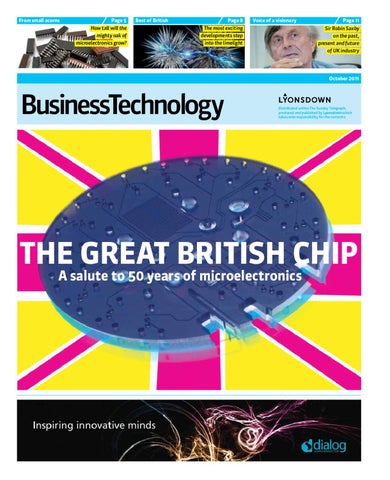
THE GREAT BRITISH CHIP A salute to 50 years of microelectronics
an independent report from lyonsdown, distributed with the sunday telegraph
October 2011
Foreword
The products may be small but Britain’s microelectronics industry is a huge success story. It’s time for the designers, entrepreneurs and engineers to step into the limelight By Jonathan Watson
Managing Editor Lucie Carrington lucie@lyonsdown.co.uk Editor Jonathan Watson Creative Director Martin Nolan studio@lyonsdown.co.uk Sub Editor Amy Dickson amy@lyonsdown.co.uk Journal Assistant Natalie Luketic natalie@lyonsdown.co.uk Project Manager Marc Morrow marc@lyonsdown.co.uk For more information on any of our supplements please contact us: Telephone: 020 8349 4363 Email: info@lyonsdown.co.uk Online: www.lyonsdown.co.uk
The recent death of Apple co-founder Steve Jobs provoked some extraordinary reactions. “The world has lost a visionary,” said US President Barack Obama. The mayor of New York, Michael Bloomberg, described him as “a genius who will be remembered with Edison and Einstein, and whose ideas will shape the world for generations to come”. Stephen Fry told the BBC that he doubted there was a human being on the planet who had been as influential as Jobs in the past 30 years on the way culture has developed. The tributes showed how times have changed since the first patent for a microchip was granted 50 years ago. Brands such as Apple, Microsoft and Google – unheard of in 1961 – built on the foundations laid in the 1950s and 1960s to become an integral part of our lives. And yet here in the UK, we know relatively little about our own microelectronics companies. They seem in many respects to be part of a hidden industry. Lord Sugar, one of our country’s highest profile business figures, said earlier this year on BBC reality show The Apprentice that he had never come across an engineer who could turn his hand to business. The remark was swiftly rebutted by Sir James Dyson, who noted that 15 per cent of FTSE 100 companies have engineers on their boards. To be fair to Lord Sugar, this lack of awareness is far from unique. Few people realise that when a waiter brings them a handheld
card-reader so they can pay their restaurant bill, it is usually powered by technology developed by Cambridge-based ARM Holdings. In 1990, the company consisted of 13 engineers in a converted barn; it now has about 1,700 employees and is a member of the FTSE 100 with a market capitalisation of around £7.6 billion. Nor do they realise that when their TomTom satnav tells them to turn left at the next roundabout, it is partly thanks to technology developed by Edinburgh-based Wolfson Electronics. Wolfson is also a key supplier to companies such as Samsung and Research In Motion (RIM), the Canadian developer of the ubiquitous BlackBerry. Also based in Cambridge is CSR, which has dominated the market for Bluetooth chips and whose location, FM, Wi-Fi, audio, TV, video and camera technologies are at the heart of many of the world’s most recognised electronics brands. These are just a few of the 11,500 businesses that make up the UK’s electronics sector – a sector that employs around a quarter of a million people and generates revenues of £23 billion every year. In this report, we seek to shed a little more light on the achievements of our microelectronics industry. Microelectronics is, of course, a global business. ARM co-founder Sir Robin Saxby was very keen to make this point in his interview (page 11). It’s a global business in which the UK’s microelectronics designers, researchers, entrepreneurs and engineers should be aiming to play a major role.
1961
the year Robert Noyce was awarded a patent for his silicon integrated circuit. p5
250,000
people employed by the UK electronics sector. p8
1 billion
transistors in microchips today, compared with 50 in 1968. p11
Sponsors
Contributors Jonathan Watson edits Business Technology reports for Lyondsdown. He is a journalist specialising in law, business, telecoms and technology. Before going freelance in 2004, he worked for Euromoney and Screen Digest.
Cover: Lucy Ward
3
Microelectronics – in this issue
Small and mighty
Publisher Bradley Scheffer brad@lyonsdown.co.uk
Business Technology
Guy Clapperton writes about technology and small business for national newspapers. He is an occasional broadcaster and presenter, and has chaired seminars for Bafta on the future of television.
Sally Whittle has worked as a journalist since 1998 in a variety of staff and freelance roles. She regularly contributes news and features to the technology press, including ZDNet, Computing, Computer Weekly, Information Age, Mac User and The Guardian.
Michael Newlands has written for publications ranging from the South China Morning Post to the South African Sunday Times, the Times of London and the New York Times. Now settled in the UK, he freelances for telecoms and IT publications.
4
Business Technology
October 2011
an independent report from lyonsdown, distributed with the sunday telegraph
Industry view
Mastering the art of electronics evolution Innovative technology is filling the microchip design gap We have all come to rely on an ever more sophisticated range of personal devices. The electronics industry worldwide is worth billions, yet it is facing a crisis. Most people these days have heard of Moore’s Law, which underpins modern electronics. This states that microchips will become twice as transistor-dense and approximately twice as powerful every two years. However, the ability of engineers to Transistors per die
increasing faster than it is possible to remove it. This results in the phenomenon of dark silicon – it will simply not be possible to have all parts of a microchip operating at maximum speed switched on at the same time. At Akya we have a solution to both of these problems. ART, our innovative technology, allows us to produce semiconductor intellectual property that performs many of the essential functions of modern microchips,
Moore’s law for memory chips and microprocessors
design microchips using all those transistors is not increasing at anything like the same speed. This is the so-called “design gap”. Engineers solve this problem by buying chunks of predesigned semiconductor intellectual property, which they then bolt together. Moore’s Law has been driven by something called Dennard Scaling. This is the idea that if you halve the size of a transistor, you also halve the amount of power it consumes. This is no longer true in the most advanced microchip manufacturing processes, and therefore the heat generated by microchips is
but without requiring the high clock speeds (and hence high power consumption) of conventional solutions. The industry needs a change, and ART is the next stage in electronics evolution. ART is set to underpin the next generation of modern electronics, allowing manufacturers to continue to offer phones, computers and other devices with the ever more advanced features we have come to expect. For more information visit www.akya.co.uk
Embedding the right skills Maintaining top level software design and engineering competence is vital to the future of manufacturing With every industry now manufacturing products that contain embedded computer systems, software has become the critical factor dominating embedded systems design. In order to remain competitive in this constantly changing market, it is critical to continuously strengthen competency and expertise in designing and developing these embedded systems. We all too often find embedded software developers are electronic engineers with no formal software development background,
We aim for an average of 30 per cent productivity improvement in our trained engineers or software application developers with little or no understanding of the complications of developing embedded software. A lack of embeded software development skills leads to poor quality products with software errors, products that do not meet the required speed and efficiency criteria, and delay in time to market. The skills required by an embedded engineer cannot be gained by attending vanilla, IT biased, software development courses. At Feabhas, we specialise in training engineers to produce high quality, fast,
Better training, higher productivity
Delivering courses on or off-site
efficient, reliable embedded software. Our areas of expertise are the programming languages C and C++, embedded software testing, embedded software design techniques and embedded Linux and Android. We can also assess your engineers before and after their training with us to ensure they have made the required improvement. After a comprehensive training programme with us you should experience increased productivity, reduction of error costs, and increased quality and reliability of software. We aim for an average of 30 per cent productivity improvement in our trained engineers.
About Feabhas Feabhas is a specialist training and consultancy company focused on real-time embedded development. Feabhas offers a wide portfolio of training courses, delivered on-site or as public courses as well as consultancy expertise covering a wide spectrum of systems engineering, software design and process engineering for real-time systems. As a vendor-independent company Feabhas ensures that knowledge is provided on an unbiased, pragmatic and practical basis, incorporating the best techniques and technologies available today for real-time embedded development. www.feabhas.com
an independent report from lyonsdown, distributed with the sunday telegraph
October 2011
Business Technology
5
Microelectronics
To infinity and beyond The humble microchip has become a vital part of our lives since it first appeared a half-century ago and the possibilities for its future are still endless By Guy Clapperton In April 1961, Robert Noyce of Fairchild Semiconductor was awarded a patent for his silicon integrated circuit, or microchip. He went on to be one of the founders of Intel, which in 1971 invented and patented the microprocessor in the form of the 4004 – the first complete central processing unit on a single chip. A few years earlier, in 1964, Jack Kilby of Texas Instruments had also gained a patent for a microchip, based on germanium rather than silicon. He’d developed it in 1958, but it took a while for the patent to come through. Neither Noyce nor Kilby, nor even the board of the nascent Intel, could have imagined just how much of an impact their innovation was to have, not only on the electronics industry but on the lives of billions of people across the world. According to Dr Simon Moore, reader in computer architecture at the University of Cambridge Computer Laboratory and senior member of the Computer Architecture Research Group, the Intel chip was an object of ridicule when it first came out. “People asked: why would you want a crude, single chip processor when ‘real men’ used multichip mini-computers or mainframes?” he says. He even suspects that the Intel board, at the time attached to memory-chip manufacturing, weren’t entirely in favour of their new toy. Chips went on to power some amazing developments, and not just in computing. In 2011, for example, we think nothing of using our mobile phone to tell a video recorder to store a programme when it’s miles away, and the programme itself is often beamed through space. For companies such as microchip designer ARM Holdings, mobile phones are crucial to their business – 90 per cent of mobile phones have ARM technology inside them. However, a third of its business comes from hard disk drives, digital cameras, tablet computers and even car braking systems. If an ARM-powered car skids, the vehicle can take over from the driver and apply the
brakes very rapidly, roughly about ten times a second. “You only want to wrest control from the driver in an incredibly controlled way, so you only do that in very specific circumstances and there need to be a lot of inputs – the angle, the severity of the conditions,” says co-founder Tudor Brown. Processing all of this data to come up with the
play music and you had your tape or CD, and you’d play it,” he says. It was similar in the video arena – if you wanted to watch a video, you’d put a tape on. This has all changed. “The content has become portable and interchangeable,” he says. “You have the music on your portable player and you might want to listen to it on your home stereo, on your car stereo, or on earphones at an airport.” The ability to transport the content between different outputs –
passenger airplanes were not cost-effective and the market moved toward low-cost mass transport.” Deloitte strategy consultant Matt Guest also accepts that the direction of growth could change. “Although impressive, updates on the microchip have slowed down over the past ten years. This is because we are now approaching the end of what silicon can deliver from a performance perspective,” he says. “True, we’ve progressed from desktop chips with 180 nanometre cores in 2000 down to about 22 nanometres in 2011, but most of the performance improvements have come from redesigning the way in which the processor, chipset and other components function.”
Sight to the blind
command “take over” is a job for the microchip rather than the driver. Many other devices contain chips, says Brown. “You don’t think of a camera as a computer but, increasingly, that’s what it is. They take in an image from sensors, they process it and they store it so that you can retrieve it. All of these devices, even something as basic as the window winder in a car, contain chips.” Joep van Beurden, chief executive of single-chip wireless device designer CSR, is heavily involved in making products communicate with each other, using technologies such as Bluetooth and Wi-Fi. CSR puts all of these functions on to one chip, which shrinks it down. He believes that machine-to-machine communications are a growing area. “Previously, if you wanted to play music, you had one device that was suitable to
something taken for granted by now – is entirely down to chips. Even washing machines have chips. The timers used to be controlled by a motor, but using chips means fewer moving parts are needed. “Replace it with a microprocessor to do the sequencing and so on, and it becomes a lot cheaper,” says ARM’s Brown. One thing hasn’t changed since 1961: predicting the future remains as difficult as ever. However, it seems highly unlikely that chips will become any less important in the next 50 years. Moore believes prices will continue to come down and adds that we might see some unexpected twists. The industry may not continue moving towards faster and faster chips, he says. “This is analogous with the airline industry, which was pushing for ever faster aircraft until it became apparent that supersonic
Microchip technology is making the unthinkable a reality in a trial by a German firm Microchips can help us achieve things which in 1961 would have looked like science fiction. One example is the work of German company Retina Implant, which involves planting chips in the eyes of people who have lost their sight through retinitis pigmentosa. Chief executive Walter Wrobel says that in a current trial, 20 patients have started seeing crude forms again. Nine of them have taken power supplies home with them so they can function independently. “There has been a high level of success,” he says, although results vary between individuals. “Some of them see only horizontal or vertical bars and others can see letters and identify different objects.” These objects have included ducks swimming on a river but, more importantly, the now partially sighted patients can see obstacles when they are walking, and so their personal safety has improved. One reported seeing his girlfriend for the first time after the implant.
6
Business Technology
October 2011
an independent report from lyonsdown, distributed with the sunday telegraph
Industry view
Delivering a mobile experience for 2016 The next generation of mobile devices will depend on technology that provides higher-performance, more energy-efficient processing ARM has, over the past 20 years, worked hard to establish the ARM architecture as the lowpower standard in mobile devices. Indeed, on average there are 2.5 ARM processors in every phone, rising to 5 for smartphones. This ubiquity, and the wide breadth of the
ARM ecosystem, has positioned ARM well to understand the long-term trends of the mobile and related industries. ARM works closely with partners to provide the technology necessary to address future consumer demands for devices, such as smartphones.
User experience
A significant focus for all levels of the mobile ecosystem, from silicon providers to mobile operators, is the overall user experience. The question is, what will your smartphone look like five years from now, in 2016? Whether you are a mother, a molecular biologist, or a student gamer, you will expect a great user experience with seamless connectivity, otherwise you will change mobile network or buy a new smartphone. User experience will still be based on a number of criteria. At a minimum, tomorrow’s consumers will expect a device that is always on, runs applications at light speed, has an excellent graphical interface and features high-level connectivity. Of course, all this will need to be supplied at an affordable price. Everything on mobile Over the next five years, consumers and professionals alike will use their mobile in a very different manner. Increasingly, their smartphone will become the device that they use to connect to the world – the ’must have’ consumer electronics item they cannot do without. For the past two decades this has been the role of the PC or laptop, but this is changing rapidly as mobility and connectivity become paramount. High performance,
Ubiquitous: five ARM processors in a smartphone
energy-efficient technology now means that consumers can have the best of that world – and more – on their mobile devices. Next generation Outside of devices themselves, the technology behind mobile connectivity will also continue to influence the pace and direction of mobile development, as well as the user experience. LTE (long term evolution) and LTE Advanced standards are set to bring the bandwidth and performance of advanced home networks to mobile devices. Successful adoption of these relies on the development of technology that can provide higher performance processing while maintaining the current level of low power consumption. This is as true for the technology that connects the mobile device to the network as it is for next-generation base stations that will provide the infrastructure for LTE and LTE Advanced. When these advances in connectivity are combined with the technology in consumers’ mobile devices, an outstanding user experience and as-yet unimagined uses will become possible. ARM and the ARM ecosystem are well positioned to help deliver this 2016 user experience. www.arm.com
Preparing graduates of today for the challenges of tomorrow Giving universities and academic institutions across Europe access to essential industry-standard design tools without worry over cost of ownership Universities have a vital role to play in the support and growth of the UK economy through the supply of high quality graduates and industrially relevant research. The Science and Technology Facilities Council’s Microelectronics Support Centre (MSC) at the Rutherford Appleton Laboratory has been supporting UK academia for more than 30 years. The MSC has support contracts with universities to introduce the advanced design techniques and tools that are necessary to implement modern electronic systems. This essential role enables the universities to conduct industry relevant research, and to train the highly capable engineers that form the lifeblood of the UK electronic systems design industries. The electronic systems design industry depends heavily on a range of high quality commercial design tools, which are continually evolved to meet the demands of increasing system complexity. Competitive design is impossible without such tools configured into design flows. However, their cost of ownership is extremely high due to their complexity and the high levels of support required to use them effectively; this cost is a critical issue for academic use. The MSC’s Europractice service addresses this by selecting, configuring and providing access
to these commercial design tools at affordable prices for both research and large-scale classroom teaching. The MSC provides the direct technical support for this complex software, as well as the design processes required to successfully design modern electronic systems. Using this scheme, UK universities are able to use the same software as in industry, from leading companies such as Cadence Design Systems, Mentor Graphics and Synopsys, in their teaching and research. The Europractice service covers 75 universities and research facilities across the UK, with more than 600 member academic institutions across Europe; all directly supported by the MSC on a pay-as-you-use basis. In addition, Europractice provides access to semiconductor fabrication facilities through project partners – imec, Belgium, and Fraunhofer-IIS, Germany. The MSC also offers advanced training courses on a wide range of electronic systems design topics. These include analogue, digital, mixed-signal and RF integrated circuit design, embedded system design, programmable device design, advanced verification and computer modelling of semiconductor and micro-electronic-mechanical devices. These courses are run from the MSC’s dedicated training centre at the Rutherford
Appleton Laboratory throughout the year and have been designed to introduce postgraduates, academics and researchers to the best design methodologies and tool practices. The Science and Technology Facilities Council (STFC) is keeping the UK at the forefront of cutting-edge international science and tackling some of the most significant challenges facing society such as meeting our future energy needs, monitoring and understanding climate change, and global security. The STFC has a broad science portfolio and works with the academic and industrial
communities to share its expertise in materials science, space and ground-based astronomy technologies, laser science, microelectronics, particle and nuclear physics, alternative energy production, radio communications and radar. The STFC operates and hosts worldclass experimental facilities, including the ISIS pulsed neutron source, the Central Laser Facility, and is the majority shareholder in the Diamond Light Source. Dr John McLean is head of the Microelectronics Support Centre – John.McLean@stfc.ac.uk www.stfc.ac.uk
STFC is supporting universities to nurture electronic systems design skills
an independent report from lyonsdown, distributed with the sunday telegraph
October 2011
Business Technology
7
Industry view
A 3D experience for all A way of converting 2D images to 3D on handheld devices has been devised in response to market demands When the wave of interest in 3D video swept the world following the release of the movie Avatar, electronics companies were quick to work on designs that would bring the technology into the hands of consumers. Handset makers realised they could show 3D images without forcing users to wear clunky and often fragile spectacles. But engineers at Dialog Semiconductor could see a looming problem. Most of the videos and images that people had on their phones were shot in 2D. For some 80 years, Hollywood movies used 2D almost exclusively. “We realised this market needed a way to convert 2D to 3D images automatically if it were to take off. But as we looked around we realised that the systems out there could never work on a mobile device. Hollywood pays up to $100,000 a minute for this, using racks and racks of PCs. We wanted to be able to do it on a phone, and without draining the battery flat in a matter of minutes,” says Gary Duncan, vice president of engineering at Dialog. Dialog’s engineers developed a way of converting the images using far less power and without taxing the phone’s main microprocessor at all. Their first prototype was a pizza-sized demonstrator. But this was not enough to convince potential customers that they had a system that would squeeze into a portable gaming machine or phone. “So we built our own Android phone and put the prototype chip inside,” says Duncan. “People could see instantly that it was going to work.” In many companies, the idea of building a mobile phone as a Bagherli: configurable power management
demonstrator would have taken months of meetings – time that could be used for development goes into convincing managers who don’t understand the technical implications of the decisions they make. “At Dialog, many engineering decisions go through peer-group review rather than being forced through layers of management,” says Duncan. “These groups challenge engineers and stimulate their imagination rather than stifle them with bureaucracy.” Dialog’s CEO Jalal Bagherli agrees: “In so many industries, good ideas from engineers so often go to waste because companies take too long to recognise their value. The strongest players in the integrated circuit industry are built on this spirit of innovation and enterprise. And this goes back to the industry’s beginnings.” Fifty years ago, Robert Noyce of Fairchild Semiconductor developed the core concepts for building circuits on silicon that allowed engineers to move from computer processors that would barely fit in a chassis the size of a filing cabinet to versions many times faster, but no bigger than a dust mite. “Noyce and his colleagues did something equally important at Fairchild: they defined the blueprint for an industry created almost entirely by innovative, entrepreneurial companies,” says Bagherli. “Having come from a successful Cambridge start-up company, something I was keen to instil in the culture at Dialog is that entrepreneurial spirit. At Dialog, you can make a difference – and not get lost in a bureaucratic machine.” Dialog has, in turn, benefited from the flexibility it offers engineers: the company increased its sales more than six times in less than five years and was twice voted the best company in Europe by the influential Global Semiconductor Association (GSA). Bagherli adds that the ability to respond
quickly to market changes by fleet-footed companies is key to the reason why integrated circuits now permeate our lives: “This industry has achieved so much by developing solutions to real problems. For the first 50 years, the emphasis was on performance –
“In so many industries, good ideas from engineers so often go to waste because companies take too long to recognise their value” – Bagherli making computers smarter. Now the focus is on making portable platforms like tablets and smartphones smarter with increasing features – thus replacing the computer as the technology driver. Conserving energy is also key, especially to get longer battery life from these lithium-ion powered devices. Smarter electronics can do so much to improve that.” According to researchers working on European Union-funded programmes, some 70TWh of electricity – the output of eight full-sized power stations – could be saved using state-of-the-art power electronic technologies in consumer products, from phones to washing machines. To put power management into a growing range of electronic devices engineers at Dialog realised the answer lay in more flexibility. “Many of the devices on the market could only work in a narrow range of devices. Our engineering team came up with the idea of making power management configurable and allowed us to move into many different systems,” Bagherli says.
“To make these ideas happen you need a company culture and structure that recognises what skilled engineers can achieve. Twothirds of our workforce worldwide are in engineering-oriented roles,” says Bagherli. “We cannot rely just on what worked for a group of entrepreneurial engineers in 1961. That’s why we have introduced schemes to nurture and develop engineering talent and encourage them to come up with new ideas.” Dialog played a key role in the development of the UK’s Electronics Skills Foundation, a programme backed by the government and the electronics trade association, NMI, to encourage students to move into the electronics industry, and for them to acquire the skills they need. “The UK has a history of excellence in engineering and that’s reflected in Dialog’s own make-up. More than a quarter of Dialog’s permanent employees are based in the UK,” Bagherli explains. “The development continues inside Dialog,” says Duncan. “We provide mentoring support to our employees as soon as they join. For our engineers we have a technical ladder group that works with management to develop the solutions the company will need in the future.” To ensure that engineers have the time to develop innovative ideas, Dialog has introduced a scheme where staff on the technical ladder can use 20 per cent of their time to work on ideas outside of normal product development. “When a new challenge appears – and energy efficiency probably won’t be the last one – it’s the people and culture of electronics companies such as Dialog that are going to be best placed to address it by making space for people to think. It’s an environment where people who want to get things done can make sure they are done,” Bagherli concludes. www.dialog-semiconductor.com
8
Business Technology
October 2011
an independent report from lyonsdown, distributed with the sunday telegraph
Microelectronics
Two steps forward
Secrets
By Michael Newlands
network, base station or even a mobile phone. Sensium received an enormous boost in July Two sister companies with the same value-added when it was approved by the US Food and Drug philosophy are taking aim at the US market with Administration (FDA), giving it access to the US pioneering microchips that drive advances in market. It will go into US hospitals early next medical and human sciences technology. year. The next challenge will be to find a way into DNA Electronics still has its premises at people’s homes – a process that is being handled Imperial College London, while Toumaz has been by a new US partner and investor. spun out from the college Also poised to take and is now based in off in the US market and Oxfordshire. awaiting FDA approval is Both have Professor the SNP Dr (pronounced Chris Toumazou as snip doctor). Several years chairman and chief ago, Toumaz started using executive, and both microchips to measure feature solutions he has chemical signals, and fashioned from a fusion took this a stage further of microelectronics, radio Digital plaster: monitors heart rate to use semiconductors communications and and transistors to match biochemistry. a digital code to a genetic code when strands of The core product of AIM-listed Toumaz is DNA are introduced to the chip surface. Sensium, a “digital plaster”, which is about the The technology has now been licensed to two same size as a conventional plaster and sits on the of the three largest gene-sequencing companies chest. It houses a microchip that not only does in the world. the work of an electrocardiogram (ECG), but also Utilising the huge databases of genetic monitors heart rate and other functions such as mutations these firms are building up, covering breathing, temperature and movement around all types of drugs and diseases, the SNP Dr is a the clock. handheld device the size of a memory stick. The chip can perform diagnostics on the It compares readings from patients’ saliva with measurements and send the results back via an information on a database to provide early ultra-low-power wireless transmitter, which is warnings of how vulnerable a person might be also housed in the semiconductor, to a hospital to particular diseases.
The UK’s electronics sect businesses. This success of the most exciting Brit
No train no gain A chip developed by researchers at Southampton University has caught the eye of a Chinese company, which is looking into developing it for different applications. The research team, led by Professor Michael Kraft, had set up a project to develop an accelerometer – a device that measures acceleration – to compete with state-of-the-art research devices, but did not have any particular applications in mind. The Chinese company – which Kraft cannot yet name - approached him after he gave a paper on the chip at a scientific conference. “Our chip is not revolutionary and other companies and researchers have made similar devices, but this company liked the potential of
our product and we agreed to work together,” says Kraft. Two specific applications for the highly sensitive chips are monitoring high-speed railway tracks and oil and gas exploration. In the first case, the chips would be placed at intervals along a railway line and would measure the vibrations each time a train passes. Any variations would give advance warning of developing faults. In oil and gas exploration, the chip could become a cheap replacement for the large and expensive geophones used to measure the seismic activity triggered by explosions. “There are many other potential applications in areas like navigation, robotics, platform tilt sensing and vehicle stabilisation,” says Kraft.
Potential: sensitive chips are being used to detect developing faults on railway lines
Time to switch North Yorkshire-based microelectronics company Peratech makes a simple yet wideranging claim for its proprietary technology; it is capable of replacing every electronic switch in the world. Developed in 1996 by David Lussey, one of the company’s founders and now chief technology officer, Quantum Tunnelling Composite (QTC) is only now coming into its own following years of research and development, and a restructuring and refinancing of Peratech in 2006. Put simply, QTC is pressuresensing material. When lying inert its properties are those of an electrical insulator, but if you apply pressure, it changes to a conductor with the same conductivity as the metal traditionally used for switching. It is a more efficient alternative to traditional switches in use in industries as varied as healthcare, automotive, aviation, computers, mobile
phones and sporting goods. Peratech licenses the technology to manufacturers as a package which includes supply of the product, supply of components, integration and connectivity solutions, associated firmware and software and engineering consultancy. The company opened an office in Singapore this year to service its growing Asian customer base and a US office will open next year. QTC’s selling point, says joint chief executive Philip Taysom, is its clear advantages over existing technologies for the increasingly important touch screen sector, a market worth $13.5 billion (£9 billion) a year. “Until QTC came along there were two types of touchscreen, capacitive and resistive,” he says. “Our technology offers compelling advantages over them. Both of the other technologies have their own significant problems, which QTC does not have although it has all the benefits and more besides.” QTC: used in mobile phones
$315 billion (£200bn) Predicted revenue for worldwide semiconductor industry in 2011
Source: Gartner Research
an independent report from lyonsdown, distributed with the sunday telegraph
October 2011
Business Technology
9
Microelectronics xxxxxxxxxxxxxxxx Help or hindrance?
s of our success
Does the UK’s microelectronics industry need government support to help it reach new heights? We asked the experts
tor employs around 250,000 people in some 11,500 s story is often overlooked, but here we bring some tish work in microelectronics out of its hiding place
It’s not easy to get a consensus within the UK’s microelectronics industry on what the government and other organisations should or should not be doing to help. One thing most people seem to agree on is that the UK has a tremendously talented pool of researchers, engineers and designers who are responsible for many unique microchips and often for the solutions they enable around the world as well. Where we fall down, academics and company directors also generally agree, is in getting our excellent products to the marketplace and convincing people to buy them.
More help needed
Someone who thinks the government should be doing a great deal more is Professor Michael Kraft of the University of Southampton’s School of Electronics. The German academic, who has lived in the UK for many years, says the level of funding and support is low compared to other competing European countries. “Look at Germany, where the Fraunhofer Society has 60 applied science research institutes with an annual budget of €2 billion (£1.7 billion),” he says. “Here the government is making a big noise about its plans to invest £30m annually in three technology and innovation centres, with three more planned for later.” In Germany, he argues, Fraunhofer bridges a gap between research and industry that is not properly bridged here, despite UK research being of a very high standard given the lack of funding. “Government must recognise this problem,” he says. “The last government recognised it but did not do anything about it, while the current government is doing something but not nearly enough.”
Axxxxxxxxxxxxxxxx measure of progress A unique British-made sensor that detects electrical potential could revolutionise the way measurements are taken in fields as diverse as health monitoring, forensics and video gaming. Designed and fabricated by the country’s last remaining silicon chip manufacturer, Plessey Semiconductor, the Electric Potential Integrated Circuit (EPIC) won a gold award for outstanding achievement in June at the Sensors Expo in the US. A first-generation model comprising two sensors attached by wires to a display box has been successfully field tested in a medical setting, replacing a traditional electrocardiogram (ECG). “Our sensors can produce the same results as an ECG in a similar easy-to-read display, but there are only two of them, about two centimetres each in diameter, and they do not need to be attached to the skin or even touch
EPIC: replacing traditional ECGs it,” explains marketing director Derek Rye. The patient holding one sensor in each hand sets up a circuit that allows the electrical activity of the heart to be measured and recorded. Eye movement can also be recorded by placing a sensor on each temple, while muscle movement can be recorded with sensors at each end of the muscle. Now the technology has been proven in the field, Plessey is working on wireless communication from sensor to base unit and extra power on the chip to permit
Play to our strengths
Making sense of the sea Seeding the world’s oceans with a swarm of autonomous microsensors is the long-term aim of an ambitious University of Southampton project. Funded by the Engineering Physical Research Council and the National Environmental Research Council, the four-year project is being led by Professor Hywel Morgan and Dr Matt Mowlem of the National Oceanography Centre. “We know so little of what goes on in the oceans,” says Morgan. “As well as developing our scientific understanding of the oceans, the information we gather will help us understand global climate change.” The project’s aim is to develop small, robust sensors able to withstand the very high pressure encountered deep under water and with a power supply enabling them to record independently over a long period of time. The sensors will measure ocean chemistry, ocean biochemistry and physical parameters. The ultimate aim is to integrate them with the thousands of Argo floats that have been scattered through the seas and oceans for the past few years to measure temperature and salinity. The floats descend to a depth of 2,000m, then drift with the ocean currents, slowly rising to the surface and firing off a report to a
satellite before going down again. Prototypes of a first generation of sensors have been manufactured and field tested, strapped onto an Argo float lowered into a deep Scottish loch. The challenge now is to develop a smaller generation of chips to build into new Argo floats. There are also commercial possibilities being examined in pollution detection in lakes and rivers, plus water treatment, drinking water and environmental monitoring. Sensors: small and robust
Derek Rye, marketing director at Plessey Semiconductors, has a different view. It is easy, he says, to complain about lack of infrastructure and support from government “but that is old news”. He feels it is difficult to be too critical “because there are a lot of initiatives from both government and industry bodies which Plessey certainly has been using”. The UK microelectronics sector, he feels, should compete largely in niche markets “with unique and innovative products which find new market applications”. Hywel Morgan, also a professor at the University of Southampton, agrees to a certain extent and says the industry in this country is particularly strong in adding value. “We are good at the engineering design that goes into the integration of different components to develop smart technologies, such as intelligent sensor systems which can measure a wide range of parameters,” he says. “This is a British strength we can capitalise on.” Inventor, researcher, academic and chief executive of two microelectronics companies Professor Chris Toumazou of Imperial College London takes this a step further. “I think we have to move away from the idea of components and instead think of microchips as being enabling to solutions and start to push more up the value chain from the transistor and CMOS level,” he says. He points out the cost of microchips is negligible, but the royalties to be generated from the solutions they enable are potentially huge.
£23 billion Annual revenue of UK microelectronics industry, making it the fifth largest in the world
Source: National Microelectronics Institute
10
Business Technology
October 2011
an independent report from lyonsdown, distributed with the sunday telegraph
Industry view
Prize asset in the technology world Intellectual property solutions company is focusing its energies on nurturing and driving the UK technology industry We may be suffering the worst economic crisis since the 1930s, but you wouldn’t know it from sales of smartphones or tablet computers. We can tighten our belts elsewhere. But personal technology has become so fundamental to our enjoyment of life that we just can’t stop buying the latest product with the greatest wow-factor. And can you blame us? Who wouldn’t want a phone where they could take a picture and zoom into it just by spreading their fingers? Or computers where video games look like real videos? Or a digital radio where the sound is as clear as crystal? Britons have an extra reason to feel proud of these technological marvels, says Tony King-Smith, vice president of marketing at Imagination Technologies. “A disproportionate amount of the technology in today’s phones, computers, cars and other high-tech devices is designed in the UK,” he says. “We have a long and proud heritage of designing the best solutions from first principles, stretching right back through the early pioneers of computing to the Industrial Revolution.” Take Imagination Technologies, a British company that employs more than 1,000 people worldwide, of which more than 800 are design engineers, most of them here in the UK. Although it owns Pure, the manufacturer of high-quality digital radios, the company’s
An ever more complete range of features can be included on a single chip using Imagination’s IP
main business is designing the technology for the chips that run mobile phones, portable and desktop computers, digital radios and even cars. “Our business is designing intellectual property (IP) which we license mostly to semiconductor companies,” says King-Smith. “Most consumer electronics devices are built from the same basic technologies: graphics, video and audio handling at the back end, communications at the front end, and processing in the middle. “For almost 20 years we’ve been identifying a number of these building blocks that we predict every device would be using – such as graphics, video and communications. And we developed IP for these that our customers can reshape very quickly to make a wide range of chips suitable for powering all sorts of consumer devices.” Imagination Technologies’ customers include many of the top semiconductor makers, whose chips are used by most of the world’s top high-tech brands. By using chips containing IP that has been tried and tested in the market, but which they can utilise in unique ways, manufacturers can combine minimum risk with maximum commercial potential, says King-Smith. This is essential today, because technology changes so fast that low volume, high price market entry is no longer possible - new products must be mass-produced from day one.
“Last year 245m chips were shipped containing our IP,” says King-Smith. “We’ve built up a centre of excellence and skills that even the biggest technology companies couldn’t reproduce. Most wouldn’t dream of designing their own graphics processor from scratch; they use ours. And the lead we have over our competitors is enormous – the designs we’re completing now won’t reach the consumer for another two to five years.” There’s only one cloud on the horizon. “We’re starting to be limited by the number of engineers we can recruit,” says King-Smith. “Because of visa restrictions, the UK government has made it harder to recruit graduates from abroad – even if they studied in the UK – and not enough British kids are taking up engineering. So, as we continue to expand, we’re having to look at other options, such as expanding our design teams in India.” It’s yet another piece of UK excellence that risks being dispersed overseas unless legislators and educationalists can up their game. “But Imagination is relentlessly positive about its UK-based future,” says King-Smith. “We’re determined to help make the UK the unassailable world leader in electronicsrelated technologies, and our UK engineering base is our prize asset that we intend to nurture and grow for many years.” www.imgtec.com
Turning innovation into international success UK electronics software design experts are leading the way in helping entrepreneurs develop their ideas into successful businesses The UK electronics industry has a wealth of innovative talent and businesses, so why do we struggle to convert them into billion dollar enterprises? “Starting an innovative electronics company in the UK currently presents enormous challenges,” says Adrian Buckley, area director for northern Europe at Mentor Graphics, a world leader in software design tools for all aspects of electronics. “Yet such companies have historically been relied on by mid-sized companies to rapidly fill ‘technology gaps’ to allow growth into new and emerging markets. “By actively connecting companies and collaborating with like-minded industry figures, Mentor believes that the innovation engine will turn more quickly and more successfully. The result will be revenue growth for the UK electronics industry.” “In areas such as Silicon Valley, people network naturally and think big. In the UK we often come across mid-sized companies that want to expand but lack a key technology – there are small companies that could supply
this – but the two don’t connect.” Government wants to help, but the channels for focusing investment are often diffuse or blocked. “Government money exists, but it’s difficult to inject it effectively because the industry is relatively uncoordinated,” says Buckley. Since 2005, Mentor Graphics has been investing to improve matters. “We set up Cre8Ventures to help entrepreneurs with good ideas get them to market much more quickly and effectively,” says Buckley. “We set out to overcome three main obstacles. The first is getting a market, so we connect start-ups to potential customers at a very early stage so they can create a saleable product. The second is funding, so we build relationships with venture capitalists and make new businesses more visible to them. And the third is access to supporting technology and tools at affordable prices, which can be supplied by Mentor Graphics and our partners.” The pioneer of Maximum Performance Computing, Maxeler Technologies – which has recently attracted JP Morgan as a shareholder – was an early believer in Cre8Ventures. Oskar Mencer, its CEO and consulting professor at Stanford University, said: “Cre8Ventures provided support in helping us to develop our first product through to introductions into their network flow of activity.” With Cre8Ventures addressing the electronics start-up community, Mentor began work on the next challenge: the value chain. This year Mentor launched the European
Microelectronics Academy (EMA), in partnership with the National Endowment for Science, Technology and the Arts (NESTA), the government body that invests in innovation. “The EMA aims to help mid-sized electronics businesses step up the value chain and give them the potential to become multi-
national enterprises,” says Buckley. “We help enable access to funds and provide a very wide network of people with experience of creating large electronics companies.” The plan is to operate throughout entire supply chains. An early focus is home automation, where a large number of companies operate in virtual isolation. The EMA aims to organise these and help them
create more integrated solutions in fields such as home energy management, on-demand entertainment and in-home healthcare. “Through the EMA we will enable companies to say, ‘We’re creating this solution, how could it help you?’” says Buckley. “For example, healthcare companies and the NHS have an increasing need to deliver more healthcare in the home, but they want to be convinced that the solutions are credible and the technology is ready now. This is where the EMA can help.” EMA has already helped a number of electronics businesses on the road to success. For example, EMA linked six companies to collaborate and inject their technologies to innovate a new business called Continuum Bridge, which will provide solutions to connect the “internet of things” in the home. EMA’s approach is accelerating Continuum’s development and is enabling access to prospective markets and funding. Dr John R Forrest, CBE, FREng, is a distinguished figure in the UK’s electronics and telecommunications industry. “I am delighted to lend my support and time to the European Microelectronics Academy,” he says. “Growing businesses successfully in the electronics world is frighteningly difficult, but the UK has the innovative DNA in this sector which I believe can significantly contribute to the future wealth of this country.” www.mentor.com www.emanetworks.com
an independent report from lyonsdown, distributed with the sunday telegraph
October 2011
Business Technology
11
Microelectronics Vicki Couchman
A chip off the old block Sir Robin Saxby helped ARM Holdings become a world leader in microchip design. We asked him for his views on the state of the UK’s microelectronics sector
Interview by Jonathan Watson
What is your view of the UK’s microelectronics sector today?
Well, my starting point would be: why would you want only to think about the UK? We can’t afford to think of the industry in that way. The microelectronics sector is probably the most global industry on the planet. Even when I joined Motorola in 1973, it was already a global industry. In those days it was all about Silicon Valley, but there is no silicon there any more. It’s all software. The silicon is in places like China and Taiwan. So you have to start with some global thinking and get the playing field right. The world has changed dramatically since I started designing microchips in 1968. Those chips contained 50 transistors, whereas today’s microchips contain a billion. This makes it impossible for one person or one country to get everything right on their own. We have fantastic designers, fantastic universities, great entrepreneurs and great soft skills here in the UK. But if we start from a “think UK” perspective, we’ll get it wrong. People need to jump on an aeroplane and talk to others. That’s one thing I’m always telling the start-ups I’m involved in: think global, act local. One of the reasons ARM is successful is that on day one I said we had to be a global
company and we had to be the best in the world. That was back in 1990 and it’s proven to be true. If you’re starting up a company today, that vision of global success and leadership and being the best is 1,000 times more important than it was 20 years ago, because the world has changed.
If you were starting ARM today, would you do things differently?
No, I would do it exactly the same way. All the principles we started ARM with – being a global company and being the world’s best – still apply. You need to start with a clear vision, a clear plan and a clear goal, and then work out the details. That said, the world has changed hugely. The international competition is much stronger, especially from India or China. The reality now is that a good engineer, anywhere on the planet, is competing with all the other good engineers on the planet. The other big change since we started ARM is that there is now much more bureaucracy and many more corporate governance issues to deal with. You mustn’t let all that slow you down. The guys in the East don’t have all this baggage on their backs, and that is a competitive advantage to them.
Does the UK have the right skills?
One of the things I’m concerned about is that we train a lot of foreign PhDs, teach them all
our secrets and then force them to go home to compete with us rather than keeping them employed here. How stupid is it to kick the best foreign scientists and engineers out of the country? Is that really going to help our economy? The good news is that there are children in school who are just as good as we were, if not better. We still have some great people. However, I am concerned there is not enough funding for PhDs at British universities. There is practically no funding for any science or engineering PhDs.
Should the government do more to help the industry?
Government support means government interference. Seed capital is useful in the start-up phase, and the Technology Strategy Board is a good thing. I would advise startups to get involved with that if they can. The danger is that if you build a company that is totally dependent on government money, it will ultimately end in tears. You have to work for your money, not get hooked on the drug of government funding, because that will kill the company. Ultimately it’s not politicians who make business happen. If they could stop interfering, help the universities, focus on the things they are really in charge of – and do that well – that would be a good thing. The good news is that if you are a globally successful corporation, the world is your
oyster. If the local politics are bothering you, you can move your operations somewhere else.
What are you working on now?
I’m involved as an angel investor in a company called Sontia, which has an amazing sound technology. It has tuned its software to work closer to the human ear to produce a much better sound than Dolby or anything else. That company has the potential to be the leader in the world market. Another company I’m involved with is Ideaworks 3D, which is software conversion. If you have software that runs on an iPhone, moving it across to Android takes a lot of work. They have a suite of software tools to make the conversion between platforms much more efficient. My primary objective at the moment is to make things happen and to have fun. If a by-product of that happens to make me some money, that’s fine. I have different motivations from a venture capitalist – I just want to help create wealth from technology. Sir Robin Saxby Born in Derbyshire, 1947 Educated at Chesterfield Grammar School and Liverpool University Founding CEO, ARM: 1991 Knighted in 2002 Chairman of ARM until 2006 Emeritus chairman: 2006-2007
12
Business Technology
an independent report from lyonsdown, distributed with the sunday telegraph
October 2011
Industry view
Vision for the future
Rod Oldfield CEO, GarField/ Matrics We see significant developments in display technologies. The resolution of displays is increasing and the next generation of televisions will have around 16x the number of pixels you see on a current high definition TV. A number of technologies, for example eye tracking, are likely to emerge to satisfy the demand for 3D displays, especially TVs that don’t require glasses. Displays will start appearing in places we would least expect a few years ago, LCDs will become thinner and flexible, and the emergence of coloured electronic inks will allow displays to be built in to the bodies of devices, such as programmable skins for mobile phones.
Microelectronics has made incredible advances over the past 50 years and has many applications and uses – what significant developments and uses do you see in the next three to five years?
Jamie Knight Managing Director, Micross Components
Geoff Barrett Technical Director, Broadcom UK
The ever increasing demands for consumer-driven electronics drives our industry and forces mass production offshore to maximise economies of scale and profits. Wearable computing for media and health applications, increased security monitoring from photo and biometric sensors, and webaided diagnosis for medical and automotive applications are among the many new technologies we expect to embrace as part of our future daily lives – much of it conceived and developed in the UK. Micross Components is focused on maintaining a technically strong engineering and manufacturing base in the UK to support not only the innovative and creative ideas that develop from our highly revered centres of learning, but also to ensure that legacy products and designs can be supported with maximum integrity long into the future. Micross is proud to be a British-based manufacturer and service provider for the electronics industry.
We expect continued strong growth in smartphones, tablets and internet bandwidth. Over the next 3 to 5 years, 50-100Mbps internet to the home will grow strongly and enable further advances in internet-based services, especially high definition video. The connected home (for example, television, computer, appliances and surveillance) will become a reality, most likely controlled from smartphone and tablet. Mobile connectivity will become ubiquitous, not only for smartphones but also connecting many automotive and medical applications to central services providing real-time information and monitoring. Whatever the future, it will be enabled by microelectronics and the UK design industry is and will be a significant contributor. Gordon Holden Chief Technology Officer, Exception Group Advances in medical electronics integration will encompass electronic stimulus overcoming motor neurone disorders. Diagnosis and treatment through benign invasive technology such as edible pills will transform the patient experience, providing effective, focused care. Warfare from remote locations using encrypted communication technology will provide intelligent micro-organisms providing penetration and visual imagery for target confirmation. Energy harvesting electronic development is already ahead of demand for these applications. TV white-space technology will provide wireless bandwidth connectivity, exceeding Wi-Fi performance to foster next generation cloud-based video-streaming. The monopoly enjoyed by Sky TV will be challenged by Google, Microsoft and Apple.
Dr Paul Taylor CEO, Dynex Semiconductor In high-power electronics, applications will develop rapidly due to the drive to low carbon and the pace of change in developing countries such as China. This will accelerate the advances in electric vehicles, more electric aircraft, railway and metro systems, the electric power grid, and new energy supplies. High voltage semiconductors – such as IGBT modules, diodes and thyristors – are used at the core of these applications. They will become more robust and energy efficient, they will be primarily based on silicon with some use of silicon carbide, and with significant advances being in the materials, packaging and interconnect technologies.
Dr Drew Nelson Group CEO, IQE Group Advanced materials such as compound semiconductors will play an increasingly important role in opening up new technologies and will facilitate the continuation of Moore’s Law well beyond the physical limitations of single element silicon. Materials such as gallium arsenide, indium phosphide and gallium nitride will enable a range of advanced wireless, electronic and photonic applications such as ultra-high speed, “always on” connectivity, utility scale solar power generation, high efficiency, low energy LED lighting, The Matrix-like gesture recognition and a host of other consumer, lifestyle, health and security devices. In short, compound semiconductors will emerge as the new silicon.
Richard Lansdowne Director, Advanced Communications, Semtech Growth in communications, especially wireless devices, will outstrip everything. We expect to solve major challenges for the mobile networks’ switch to 4G. Everything is too reliant on GPS, which is easily jammed, and we see high growth in our solutions that provide accurate time (better than 100ns) without GPS. Increases in silicon photonics and our optical SerDes is the key to supporting the enormous data rates, both in network core and cloud computing data centres. We will see optical fibre solutions everywhere. Such tiny silicon geometries are massively susceptible to damage and this is fuelling growth in our transient voltage protection devices.
an independent report from lyonsdown, distributed with the sunday telegraph
October 2011
Business Technology
13
Microelectronics Getty Images
Smarter way to save
The final frontier
Whether it’s greener power or cutting electricity bills, microchips are helping us take control of our energy Microelectronics is having a big impact in the energy sector, where so much effort is being made to develop more sustainable energy supplies. Cambridge University spin-out and global leader in clean technology CamSemi is using energy-efficient power conversion products and has already developed industrial controllers for automated production processes, which have been hailed as more efficient and able to work at lower power than existing devices. Another key player is International Rectifier, founded in 2000 to exploit ultra-low power silicon chip technology developed at Imperial College London, which is working to reduce energy waste from motors, the world’s single largest consumer of electricity. The wider context here is the development of “smart grids” – a type of electrical grid which attempts to predict and intelligently respond to the behaviour and actions of all electric power users connected to it. Smart grids are gearing up to be a major market in their own right, based on nothing less than a fundamental re-engineering of the entire electricity services industry. In the UK, the government is playing a key role by aiming for every home to be equipped with smart meters by the end of 2020. These devices, which show exactly how much gas and electricity is being used, should bring an end to estimated (and hence frequently inaccurate) billing as the technology can send back an accurate meter reading to energy companies every day. The whole system, of course, is powered by microelectronic intelligence.
The microchip has transformed our lives over the past 50 years and UK firms are leading the way towards an even more high-tech future By Sally Whittle So what has the microchip ever done for us? Well, maybe we should consider its history and impact in another way: without microelectronics there would be – deep breath – no mobile phones, GPS, digital TV, internet, computers, modern cars, industrial robots, medical scanners or computercontrolled production. So says “futurologist” and electronics industry expert Professor Peter Cochrane. He believes that as a direct result of such devices, we can expect a world with industries based on “true electric vehicles, robots for the office, home and hospital, programmable materials” and, why not, “scanners almost as good as Mr Spock’s tricorder”. In industrial settings, smart machines are making smart products, according to Peter Thorne, managing director of manufacturing consultancy Cambashi. “Some of these changes are incremental, some more fundamental,” he says. “For example, standard interfaces to the microelectronics in production machines have enabled software vendors to offer new types of real-time management ‘dashboards’ that let managers see the state of the business
Smart devices: may lead to a world with robot workers
now, rather than waiting for the monthly report.” Technology developed in the UK looks set to play a big part in delivering such real-time, super-connected industries. According to the National Microelectronics Institute, the trade body that represents the UK semiconductors, microelectronics and electronics systems industry, UK firms have a 40 per cent share of the European independent electronics systems market. And where will microelectronics end up taking us? For Duncan Smith, head of product
development at Cambridge Consultants, the defining element of the next few years will be what he calls “embedded connectivity”, where electronic components are so low cost and low power that “you can connect anything in your life to the internet directly or via a third device”. In this coming age of massively-distributed electronics connecting to each other and the web in more and more intelligent ways, can we be that far off a “tricorder” in every home – with massive opportunities for British investors and industry along the way?
Healthy progression
Microchip devices are making us healthier - and helping the professionals ensure we stay that way
Home monitoring devices are one area of healthcare that has benefited from microchip technology. The HealthHub from Docobo allows monitoring of longterm conditions such as chronic heart disease, chronic obstructive pulmonary disease and diabetes by measuring various vital signs, including blood pressure and blood oxygen level. It then uploads data to a healthcare provider, enabling active remote monitoring and advice so that patients can, to some extent, take care of themselves. During a trial by Knowsley Health
and Wellbeing, patients with heart failure and cardiovascular disease were monitored in their own homes and used the HealthHub to take a 20-second ECG reading; along with daily blood pressure and blood oxygen readings. This information was then transmitted remotely to a clinician who could monitor the patient’s condition in real time, assess the patient’s condition and determine the need for a full ECG, cutting down on unnecessary visits to outpatient clinics and emergency hospital admissions. “Making a recovery in their own familiar
environment is preferable to being in a hospital setting and is also more convenient for friends and family of the patient,” says Darren Persand, Knowsley’s health and wellbeing assistant commissioning manager. Other microelectronics-driven innovations in health aimed more at the consumer include the Withings Body Scale which, if this doesn’t sound too frightening, is a webenabled bathroom scale. A new generation of home fitness aids is also emerging, such as the Fitbit, a sort of 21st century pedometer and activity monitor in one.
Many predict a big driver in the success of products like these will be their small size, low power profile and ability to seamlessly connect with other networks – driven again, by another UK-led innovation, the Bluetooth short-range comms system, now a global industry but sparked by work at Cambridge-based CSR. Expect to see Bluetooth-enabled devices in your sports bag, car, motorcycle helmet and pretty much any setting where a human body can benefit from being monitored in a connected way.
In the right lane Intelligent use of microchips is helping industry leaders to manage traffic in a more sophisticated way We all know about the impact of automatic number plate recognition, but that’s only a tiny part of the way microelectronics are revolutionising the transport market. A key concept here is intelligent transport systems, an umbrella term for the use of technology in transport planning. For example, some microchips implanted in cars enable them to warn other vehicles of slippery road conditions, or recent crashes which are holding up traffic. Cambridge Consultants has been involved in the recent M42 experiment to see if clever use of the hard shoulder could ease congestion. “Using microelectronics can make highways smarter and help us manage traffic better,” says director of products and systems Duncan Smith. “By intelligently using the hard shoulder, by putting sensors and intelligent systems that let operators quickly identify whether to open additional lanes, we proved benefits are possible.”
€2.9 billion (£2.5bn) Projected value of intelligent transport to European communication services by 2020
Source: innovITS
14
Business Technology
an independent report from lyonsdown, distributed with the sunday telegraph
October 2011
Industry view
Unsung hero of modern life The magic of microelectronics underpins social and economic progress In 1965 Moore’s Law ignited a technological race that has enabled the information age of mankind. No other industry has an equivalent to Moore’s Law or successively lived up to its potential, mastering manufacturing and design complexity at a phenomenal rate. This year the European Commission designated microelectronics as a key enabling technology, meaning it is a strategic capability that cannot be measured in monetary terms alone. Today we see the buzz of the internet of things – connected cars, assisted living, future internet, tablet devices, smart cities, low-carbon economies and so on – offering a tech-fest of social importance and economic opportunity. Dig beneath the fashion words and you’ll spot the trend that truly enables it all: microelectronics. Semiconductor and software technology is now deployed in virtually every part of our lives and the thrust of electronification shows no sign of abating, simply because it delivers
to become household names, yet chances are you use their products every day. Innovators such as ARM, CSR, Imagination Technologies and Wolfson provide the lowest power, the fastest graphics, the best audio and the connectivity in your mobile devices. Startups such as eoSemi are replacing quartz with silicon technology while Picochip is solving our wireless
The UK has a new breed of national champions so many benefits. So, given microelectronics’ fundamental importance, how does the UK fare? We lead Europe in the transformation of our industry. Today we boast a new breed of national champion that is leaner, fitter and more competitive. The companies we have grown are unlikely
telecommunications challenges. The last time NMI counted, it estimated that about 80 per cent of UK industry was made up from overseas investment, with 17 of the world’s top 25 semiconductor companies having bases here. More recently, American companies such as Broadcom, Maxim, Atmel and NVidia have made acquisitions paying hundreds of millions of dollars to UK entrepreneurs and
investors. This is good for the nation, as each purchase was for more than the technology – the intellectual capital and people that come with the deal – so jobs are retained and often created. The national asset is “sticky” and not transferable to a lower cost country. This creates a challenge for us as demand for talented engineers outstrips availability. NMI identified a decline of nearly 50 per cent of young people studying electronic engineering at degree-level between 2002 and 2008. In response to this the UK Electronics Skills Foundation was launched in 2010. A national programme offering scholarships to undergraduates, the aim is to increase the supply of high-calibre, industryready graduates. The good news is that the programme is off to a flying start – this year scholarships increased by 70 per cent. NMI passionately believes in the use of microelectronics to society and the UK economy. It is a high-value and sustainable industry, yet is largely hidden from society. The next time you use your mobile device, drive your car, watch TV or use the internet, spare a thought for the magic that is taking place under the hood: microelectronics is the great enabler for modern life. John Moor is VP of Design Innovation, NMI www.nmi.org.uk
Your Country Needs You
NMI is the trade association for the Semiconductor, Microelectronics and Electronic Systems Communities of the UK and Ireland. Our objective is to aid the development of a sustainable, world-leading industry by building a strong network and acting as a catalyst and facilitator for commercial and technological development. A not-for-profit organisation funded by its members, NMI spans the supply chain and includes Electronic Systems Design and Manufacturing Companies, Integrated Device Manufacturers, Fabless Semiconductor Manufacturers, Semiconductor Foundries, Semiconductor Suppliers, Electronics Design Services, Intellectual Property Providers, Research & Academic Institutions, National and Regional Government Agencies. Our work includes • Promoting the Electronic Systems, Micro & Nano-electronics sectors to government, policy makers and regulators. • Supporting skills development, education and training. • Encouraging innovation, communication and collaboration through networking, brokering and sign-posting activities. • Improving operational efficiency through R&D funding, benchmarking and best practice initiatives. • Providing an industry specific information flow
www.nmi.org.uk
Government has invited NMI to lead a strategic report identifying opportunities and barriers to growth for the Electronic Systems community of the UK. If your organisation is part of this community we want to hear from you. To register your interest please contact ESReport@nmi.org.uk
Industry Summit and Annual Dinner November 3rd, London As part of the Debate then Celebrate! theme, NMI is very proud to present details of its Gala Dinner and Industry Awards celebration to be held at the Wyndham Grand Chelsea Harbour, London. Please see http://bit.ly/NMIgala2011 for more details
The Future World Symposium 2012 April 24th/25th Wembley, London Join the leaders of industry, innovation and UK research at iconic Wembley. The Future World Symposium is NMI’s flagship conference and will focus on the increasing role of electronics in • Consumer • Home • Automotive • Health
You can see the future if you know where to look. http://on.fb.me/FWS-UK
an independent report from lyonsdown, distributed with the sunday telegraph
October 2011
Business Technology
15
Industry view
Classifieds ASIC/FPGA design and IP licensing Outsource design partner for semiconductor companies. Design realisation partner turning your ideas into silicon. Turnkey ASIC/FPGA design backed by our silicon-proven eSi-IP portfolio for fast, economical turnaround. Email: info@EnSilica.com Web: www.EnSilica.com
AnCuig AnCuig provides “particulate free” Novel Platinum inks, without colloidal or nano-particles for printed electronics, biotechnology, semiconductor, microfluidics, nanotechnology and related industries. Also high surface area precious metal sensor materials. Tel: +44 (0) 1355 581025 Main: +44 (0) 1355 581020 Mob: +44 (0) 7530307088 Email: larrymcghee@ancuig.com Web: www.ancuig.com
Austria Austriamicrosystems is a leading designer and manufacturer of high performance analog ICs focusing on the areas of power management, sensors and sensor interfaces and mobile infotainment. Austriamicrosystems UK Ltd, 1 West Park Road, Bramhall, Stockport SK7 3JX, UK Tel: +44 (0) 161 439 2215 Email: richard.maguire@ austriamicrosystems.com Web: www.austriamicrosystems.com
Elonics Ltd Headquartered in the UK, Elonics is a global leader in RF integrated circuits, developing novel silicon tuner technology for high performance terrestrial and cable TV broadcast applications including connected television and multimedia set top boxes. Tel: +44 (0) 1506 402 360 Fax: +44 (0) 1506 402 361 Email: info@elonics.com Web: www.elonics.com
Busch UK Limited Busch UK Ltd offers specialised semiconductor and fine vacuum pump repairs and spares for all major manufacturers’ Ingenious Quality Ltd products through its dedicated facility in East With over 25 years in the semiconductor Kilbride. Full decontamination, remanufacture and electronics industries, we offer quality and testing capability covers standard and and reliability management, environmental intelligent pumpsets. management and health and safety Busch (UK) Ltd, 22 Langlands Place, Kelvin South AnCuig provides management consultancy to high technology Business Park, East Kilbride, Glasgow G75 0YF Platinum , without companies in the inks UK and Europe. colloidal or nano- par Tel: +44 (0) 1355 570201 “Particulate Free” Novel Tel: +44 (0) 1256 767897 Fax: +44 (0) 1355 590791Printed Electronics, Biotechnology ,Semiconductor, Microfluidics, Nan Email: info@ingenious-quality.com Email: sales@busch.co.uk . Web: www.ingenious-quality.com Web: www.busch.co.uk nology and related industries
RoodMicrotec RoodMicrotec is a long-established European independent and certified test lab, offering two sites in Stuttgart and Noerdlingen in Germany for the highest quality assurance of electronic and optoelectronic products. These services include test engineering, production test, programming, qualification, burn-in and failure analysis. Mr Mike Jarvis Tel: 07785 341322 Email: mike.jarvis@roodmicortec.com Web: www.roodmicrotec.com
International Rectifier International Rectifier Regards (NYSE:IRF) is a world leader in power Swindon Silicon Systems management technologyLarry from analog and McGhee Having broad-based design expertise, mixed signal ICs to advanced circuit devices, Director Technical Sales Swindon has an international reputation integrated power systems and components. for design and supply of high quality and Leading manufacturers of computers, energy performance analogue and mixed signal efficient appliances, lighting, automobiles, AnCuig Ltd ASICs for use in automotive, industrial and satellites, aircraft and defence systems rely on IR’s solutions to power their next-Building consumer product sensor interfaces. James Watt Tel: 01793 649400 generation products. Scottish Enterprise Technology Park Email: sales@swindonsilicon.co.uk Tel: 01633 810 121 Web: www.swindonsilicon.co.uk Web: www.irf.com East Kilbride
Cadence Cadence enables global electronic design innovation and plays an essential role in the creation of today’s integrated circuits and electronics. Customers use Cadence software, hardware, IP, and services to design and verify advanced semiconductors, consumer electronics, networking and telecommunications equipment, and computer systems. Tel: 01344 360333 Email: marketing_euro@cadence.com Web: www.cadence.com
Also High Surface Area precious metal sensor materials .
G75 0QD +44 (0)1355 581025 Direct +44 (0)1355 581020 Main +44 (0)7530307088 Mob Dynex Semiconductor Ltd e-mail; larrymcghee@ancuig.com Based in Lincoln, Dynex is a recognised high power semiconductor specialist with more than 50 years’ experiencewww.ancuig.com in high voltage bipolar power discretes, IGBT modules and power subassemblies for power conversion systems. Tel: 01522 502753/502901 Fax: 01522 500 020 Email: power_solutions@dynexsemi.com Web: www.dynexsemi.com
Excellence in Mixed Signal Technology Applicos designs and produces advanced analog and mixed-signal electronics. Our focus is on the test and measurement industry. We have standard instruments and modules and provide full custom solutions. Tel: +31 578 696769 Email: website-mail@applicos.com Web: www.applicos.com
Alstom Grid Alstom Grid is committed to delivering solutions to our utility and large industrial customers worldwide that answers the need for smarter, more stable, more efficient and environmentally friendly electrical grids. Dr Norman MacLeod Tel: 01785 238878 Email: norman.macleod@alstom.com Web: www.grid.alstom.com/contactcentre
GarField/Matrics Ltd A leading digital/analogue design house and fabless silicon chip supplier. With specialist skills in key markets including display technology. Standard products and IP and full custom ASIC design from specification, design, layout through to fabrication. Tel: 01 453 872922 ext 713 Email: martinew@gfmicro.com Web: www.gfmicro.com
Aptina A leading innovator of CMOS imaging technology, Aptina delivers excellent pixel performance, sensor functionality and camera system capability to a world going visual. With Aptina’s high-quality imaging portfolio, customers can deliver new and differentiated solutions faster. Tel: +44 (0)1344 383300 Email: aptina-uk@aptina.com Web: www.aptina.com
Ebara Ebara Precision Machinery Europe (EPME) is a leading worldwide supplier of products to the semiconductor, LED, photovoltaic, flat panel and MEMS markets. Products supplied: dry vacuum pumps, gas abatement, chemicalmechanical polishing and plating systems. Tel: +44 (0) 1506 460 232 Fax: + 44 (0) 1506 460 222 Web: www.ebara-pm.eu
IQE IQE is the global leader in advanced semiconductor wafers based on GaAs, GaN, InP, SOI and SiGe epitaxy for a wide range of electronic, wireless and photonic applications including MEMs, sensors, CPV, lighting and communications. Tel: +44 (0) 29 2083 9400 Email: info@iqep.com Web: www.iqep.com
Enlavo Due to lack of standardisation, the use of mains wires for home networking cannot develop into consumer electronics markets. To address this, we’re developing a multi-standard, software-defined device. Enalvo is seeking development partners and funding. Martin Sotheran, CEO Tel: +44 (0) 7796 307957 martin.sotheran@enalvo.com www.enalvo.com
Veale Wasbrough Vizards VWV has a team of 12 lawyers specialising in information technology and communications technology law. As members of NMI, we advise public and private sector clients operating in the semiconductor, microelectronics and electronic systems communities. Jonathan Oddy Tel: 07584 191 949 Email: joddy@vwv.co.uk Web: www.vwv.co.uk
Micross Micross is a global provider of custom semiconductor components, distributed products, connectors and component modification services. We represent a single source for speciality electronics through design, manufacturing and distribution. Tel: 01420 594180 Email: semiconductor@micross.com Web: www.micross.com