History 101
“Green” Before Green Was Cool ARTICLE AIMEE PELLET | PHOTOGRAPHY PROVIDED
A
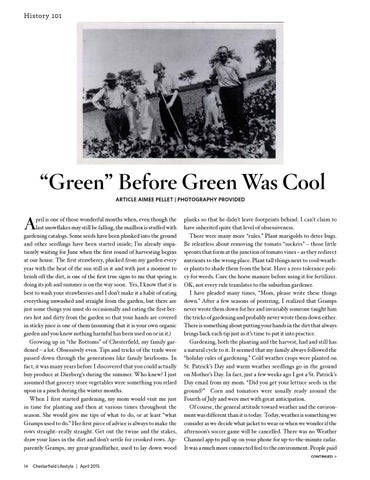
pril is one of those wonderful months when, even though the last snowflakes may still be falling, the mailbox is stuffed with gardening catalogs. Some seeds have been plunked into the ground and other seedlings have been started inside; I’m already impatiently waiting for June when the first round of harvesting begins at our house. The first strawberry, plucked from my garden every year with the heat of the sun still in it and with just a moment to brush off the dirt, is one of the first true signs to me that spring is doing its job and summer is on the way soon. Yes, I know that it is best to wash your strawberries and I don’t make it a habit of eating everything unwashed and straight from the garden, but there are just some things you must do occasionally and eating the first berries hot and dirty from the garden so that your hands are covered in sticky juice is one of them (assuming that it is your own organic garden and you know nothing harmful has been used on or in it.) Growing up in “the Bottoms” of Chesterfield, my family gardened – a lot. Obsessively even. Tips and tricks of the trade were passed down through the generations like family heirlooms. In fact, it was many years before I discovered that you could actually buy produce at Dierberg’s during the summer. Who knew? I just assumed that grocery store vegetables were something you relied upon in a pinch during the winter months. When I first started gardening, my mom would visit me just in time for planting and then at various times throughout the season. She would give me tips of what to do, or at least “what Gramps used to do.” Her first piece of advice is always to make the rows straight--really straight. Get out the twine and the stakes, draw your lines in the dirt and don’t settle for crooked rows. Apparently Gramps, my great-grandfather, used to lay down wood
planks so that he didn’t leave footprints behind. I can’t claim to have inherited quite that level of obsessiveness. There were many more “rules.” Plant marigolds to deter bugs. Be relentless about removing the tomato “suckers” – those little sprouts that form at the junction of tomato vines – as they redirect nutrients to the wrong place. Plant tall things next to cool-weather plants to shade them from the heat. Have a zero tolerance policy for weeds. Cure the horse manure before using it for fertilizer. OK, not every rule translates to the suburban gardener. I have pleaded many times, “Mom, please write these things down.” After a few seasons of pestering, I realized that Gramps never wrote them down for her and invariably someone taught him the tricks of gardening and probably never wrote them down either. There is something about putting your hands in the dirt that always brings back each tip just as it’s time to put it into practice. Gardening, both the planting and the harvest, had and still has a natural cycle to it. It seemed that my family always followed the “holiday rules of gardening.” Cold weather crops were planted on St. Patrick’s Day and warm weather seedlings go in the ground on Mother’s Day. In fact, just a few weeks ago I got a St. Patrick’s Day email from my mom. “Did you get your lettuce seeds in the ground?” Corn and tomatoes were usually ready around the Fourth of July and were met with great anticipation. Of course, the general attitude toward weather and the environment was different than it is today. Today, weather is something we consider as we decide what jacket to wear or when we wonder if the afternoon’s soccer game will be cancelled. There was no Weather Channel app to pull up on your phone for up-to-the-minute radar. It was a much more connected feel to the environment. People paid CONTINUED >
14
Chesterfield Lifestyle | April 2015