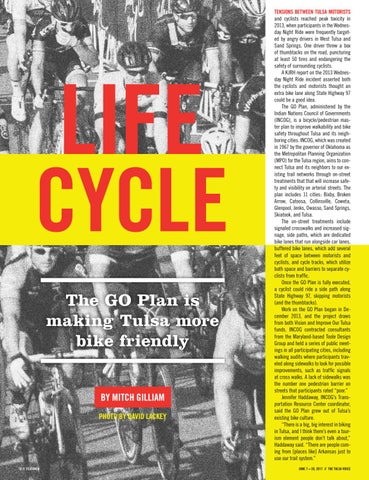
The GO Plan is making Tulsa more bike friendly BY MITCH GILLIAM PHOTO BY DAVID LACKEY
18 // FEATURED
TENSIONS BETWEEN TULSA MOTORISTS and cyclists reached peak toxicity in 2013, when participants in the Wednesday Night Ride were frequently targeted by angry drivers in West Tulsa and Sand Springs. One driver threw a box of thumbtacks on the road, puncturing at least 50 tires and endangering the safety of surrounding cyclists. A KJRH report on the 2013 Wednesday Night Ride incident asserted both the cyclists and motorists thought an extra bike lane along State Highway 97 could be a good idea. The GO Plan, administered by the Indian Nations Council of Governments (INCOG), is a bicycle/pedestrian master plan to improve walkability and bike safety throughout Tulsa and its neighboring cities. INCOG, which was created in 1967 by the governor of Oklahoma as the Metropolitan Planning Organization (MPO) for the Tulsa region, aims to connect Tulsa and its neighbors to our existing trail networks through on-street treatments that that will increase safety and visibility on arterial streets. The plan includes 11 cities: Bixby, Broken Arrow, Catoosa, Collinsville, Coweta, Glenpool, Jenks, Owasso, Sand Springs, Skiatook, and Tulsa. The on-street treatments include signaled crosswalks and increased signage, side paths, which are dedicated bike lanes that run alongside car lanes, buffered bike lanes, which add several feet of space between motorists and cyclists, and cycle tracks, which utilize both space and barriers to separate cyclists from traffic. Once the GO Plan is fully executed, a cyclist could ride a side path along State Highway 97, skipping motorists (and the thumbtacks). Work on the GO Plan began in December 2013, and the project draws from both Vision and Improve Our Tulsa funds. INCOG contracted consultants from the Maryland-based Toole Design Group and held a series of public meetings in all participating cities, including walking audits where participants traveled along sidewalks to look for possible improvements, such as traffic signals at cross walks. A lack of sidewalks was the number one pedestrian barrier on streets that participants rated “poor.” Jennifer Haddaway, INCOG’s Transportation Resource Center coordinator, said the GO Plan grew out of Tulsa’s existing bike culture. “There is a big, big interest in biking in Tulsa, and I think there’s even a tourism element people don’t talk about,” Haddaway said. “There are people coming from [places like] Arkansas just to use our trail system.” JUNE 7 – 20, 2017 // THE TULSA VOICE