FEATURE
Algae
in ornamental fish feeding
by Dr Aleksandra Kwasniak-Placheta, Tropical, Opolska str 25, 41-507 Chorzow, Poland and Prof. Dr Leszek Moscicki, Lublin University of Life Sciences, Doswiadczalna str. 44, 20-280 Lublin, Poland
T
he development of aquafeed production is followed by the growing interest in raw materials which are to be interesting, attractive and valuable, not only in terms of their properties. There is no doubt that algae are one of them. Feeds with the addition of algae are perceived as premium products. This can result from the fact that algae evoke certain associations with healthy food for humans. Animal food with algae must then trigger the same positive associations. Moreover, specially processed algae or feeds with the addition of algae offered by the producers allowed for keeping popular algae-eating freshwater and marine fish.
Algae used in the production of aquafeed for ornamental fish
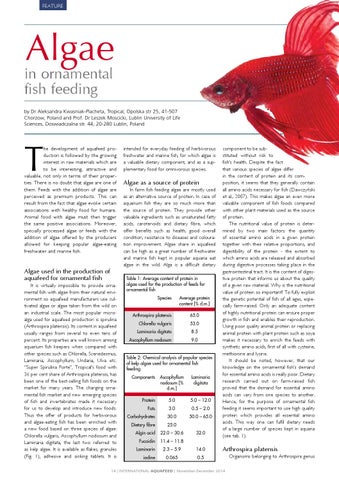
It is virtually impossible to provide ornamental fish with algae from their natural environment so aquafeed manufacturers use cultivated algae or algae taken from the wild on an industrial scale. The most popular microalga used for aquafeed production is spirulina (Arthrospira platensis). Its content in aquafeed usually ranges from several to even tens of percent. Its properties are well known among aquarium fish keepers when compared with other species such as Chlorella, Scenedesmus, Laminaria, Ascophyllum, Undaria, Ulva etc. “Super Spirulina Forte”, Tropical’s food with 36 per cent share of Arthrospira platensis, has been one of the best-selling fish foods on the market for many years. The changing ornamental fish market and new emerging species of fish and invertebrates made it necessary for us to develop and introduce new foods. Thus the offer of products for herbivorous and algae-eating fish has been enriched with a new food based on three species of algae: Chlorella vulgaris, Ascophyllum nodosum and Laminaria digitata, the last two referred to as kelp algae. It is available as flakes, granules (Fig. 1), adhesive and sinking tablets. It is
intended for everyday feeding of herbivorous freshwater and marine fish, for which algae is a valuable dietary component, and as a supplementary food for omnivorous species.
Algae as a source of protein
In farm fish feeding algae are mostly used as an alternative source of protein. In case of aquarium fish they are so much more than the source of protein. They provide other valuable ingredients such as unsaturated fatty acids, carotenoids and dietary fibre, which offer benefits such as health, good overall condition, resistance to diseases and colouration improvement. Algae share in aquafeed can be high as a great number of freshwater and marine fish kept in popular aquaria eat algae in the wild. Alga is a difficult dietary Table 1: Average content of protein in algae used for the production of feeds for ornamental fish Species
Average protein content [% d.m.]
Arthrospira platensis
65.0
Chlorella vulgaris
53.0
Laminaria digitata
8.5
Ascophyllum nodosum
9.0
Table 2: Chemical analysis of popular species of kelp algae used for ornamental fish feeding Components
Protein
Ascophyllum nodosum [% d.m.]
Laminaria digitata
5.0
5.0 – 12.0
Fats
3.0
0.5 – 2.0
Carbohydrates
30.0
50.0 – 65.0
Dietary fibre
25.0
Algin acid
22.0 – 30.6
Fucoidin
11.4 – 11.8
Laminarin iodine
32.0
2.3 – 5.9
14.0
0.065
0.5
component to be substituted without risk to fish’s health. Despite the fact that various species of algae differ in the content of protein and its composition, it seems that they generally contain all amino acids necessary for fish (Dawczyński et al., 2007). This makes algae an even more valuable component of fish foods compared with other plant materials used as the source of protein. The nutritional value of protein is determined by two main factors: the quantity of essential amino acids in a given protein together with their relative proportions, and digestibility of the protein ‒ the extent to which amino acids are released and absorbed during digestive processes taking place in the gastrointestinal tract. It is the content of digestive protein that informs us about the quality of a given raw material. Why is the nutritional value of protein so important? To fully exploit the genetic potential of fish of all ages, especially farm-raised. Only an adequate content of highly nutritional protein can ensure proper growth in fish and enables their reproduction. Using poor quality animal protein or replacing animal protein with plant protein such as soya makes it necessary to enrich the feeds with synthetic amino acids, first of all with cysteine, methionine and lysine. It should be noted, however, that our knowledge on the ornamental fish’s demand for essential amino acids is really poor. Dietary research carried out on farm-raised fish proved that the demand for essential amino acids can vary from one species to another. Hence, for the purpose of ornamental fish feeding it seems important to use high quality protein which provides all essential amino acids. This way one can fulfil dietary needs of a large number of species kept in aquaria (see tab. 1).
Arthrospira platensis
14 | INTERNATIONAL AQUAFEED | November-December 2014
Organisms belonging to Arthrospira genus