EXPERT T●PIC
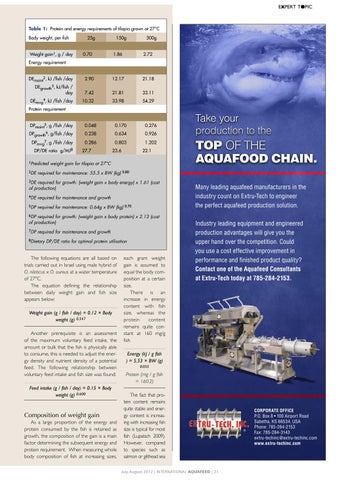
Table 1: Protein and energy requirements of tilapia grown at 27°C Body weight, per fish Weight gain1, g / day
25g
150g
300g
0.70
1.86
2.72
Energy requirement DEmaint2, kJ /fish /day
2.90
12.17
21.18
DEgrowth3, kJ/fish / day
7.42
21.81
33.11
DEm+g4, kJ /fish /day
10.32
33.98
54.29
DPmaint5, g /fish /day
0.048
0.170
0.276
DPgrowth6, g/fish /day
0.238
0.634
0.926
DPm+g7, g /fish /day DP/DE ratio g/MJ8
0.286
0.803
1.202
27.7
23.6
22.1
Protein requirement
take your production to the
TOP of the aquafOOd chain.
1Predicted weight gain for tilapia at 27°C 2DE required for maintenance: 55.5 x BW (kg) 0.80 3DE required for growth: (weight gain x body energy) x 1.61 (cost of production)
Many leading aquafeed manufacturers in the industry count on Extru-Tech to engineer the perfect aquafeed production solution.
4DE required for maintenance and growth 5DP required for maintenance: 0.64g x BW (kg) 0.70 6DP required for growth: (weight gain x body protein) x 2.13 (cost of production)
Industry leading equipment and engineered production advantages will give you the upper hand over the competition. Could you use a cost effective improvement in performance and finished product quality? Contact one of the aquafeed Consultants at extru-tech today at 785-284-2153.
7DP required for maintenance and growth 8Dietary DP/DE ratio for optimal protein utilisation
The following equations are all based on trials carried out in Israel using male hybrid of O. niloticus x O. aureus at a water temperature of 27°C. The equation defining the relationship between daily weight gain and fish size appears below: Weight gain (g / fish / day) = 0.12 × Body weight (g) 0.547 Another prerequisite is an assessment of the maximum voluntary feed intake, the amount or bulk that the fish is physically able to consume, this is needed to adjust the energy density and nutrient density of a potential feed. The following relationship between voluntary feed intake and fish size was found: Feed intake (g / fish / day) = 0.15 × Body weight (g) 0.600
Composition of weight gain As a large proportion of the energy and protein consumed by the fish is retained as growth, the composition of the gain is a main factor determining the subsequent energy and protein requirement. When measuring whole body composition of fish at increasing sizes,
each gram weight gain is assumed to equal the body composition at a certain size. There is an increase in energy content with fish size, whereas the protein content remains quite constant at 160 mg/g fish Energy (kJ / g fish ) = 5.53 × BW (g) 0.055
Protein (mg / g fish = 160.2) The fact that protein content remains quite stable and energy content is increasing with increasing fish size is typical for most fish (Lupatsch 2009). However, compared to species such as salmon or gilthead sea
®
July-August 2012 | International AquaFeed | 21 ET-221A.indd 1
Corporate offiCe P.O. Box 8 • 100 Airport Road Sabetha, KS 66534, USA Phone: 785-284-2153 Fax: 785-284-3143 extru-techinc@extru-techinc.com www.extru-techinc.com
1/20/12 1:57 PM