Rice Milling around the World; early approaches Milling journals of the past at The Mills Archive by Mildred Cookson, The Mills Archive, UK
A Chinese legend says that rice is the gift of animals rather than the gods. After a series of disastrous floods, all plants had been destroyed and no food was available. People survived through hunting, but it was very difficult, because animals were scarce. One day a dog ran through the fields with bunches of rice seeds hanging from its tail. The people planted the seeds, rice grew and hunger disappeared. At the Mills Archive we have in our library numerous journals, books and catalogues, as well as many images, on rice production from all corners of the world. These range from hand winnowing to milling by modern day methods. This article concentrates on the early primitive methods, largely dependent on muscle-power, either from animals or humans. Subsequent articles will look at our coverage of the introduction of water power and the early stages of industrialisation. One of our journals, The Miller (7 August 1882), has many articles on rice milling from different countries. A report from Burma indicates that the paddy was sown in June after the rains had fully set in, first in the higher lands where it was sown on the surface of the water, forming nurseries. After the plants had reached 18 inches they were pulled up by the roots and tied in bundles to be transplanted into fields lower down, which by this time had been ploughed ready to receive them. The transplanting took place in September and was performed by the women and children. It was hard work as it required stooping all day long in ankle deep water. One article suggests that there is no more beautiful sight in the world than the fresh emerald green of the tender young rice plants! Once transplanting was done no further care was necessary beyond driving off the birds as the crop ripened and seeing to the water supply by opening sluices. Occasionally, with a late or heavy monsoon, thousands of acres were sometimes submerged and the crops ruined, as happened in 1876 and 1877 when there was great suffering among the populace. The journal issue is well-illustrated, featuring a series of images of different processes from early times to some which are still used today. Rice milling in China, before the invention of modern machinery, was carried out in local villages by muscle power using millstones or a single large stone. The rice 8 | October 2015 - Milling and Grain
would be threshed first to remove the husk, then crushed between stones pulled round by an animal, usually donkeys or oxen, or by hand. It must have been heavy work as most illustrations shows two men, one pulling and one pushing the heavy stone round to decorticate or remove the husk. Unmilled rice, known as paddy (Indonesia and Malaysia: padi; Philippines, palay), was usually harvested when the grains had a moisture content of around 25 percent. In most Asian countries, where rice was almost entirely the product of small farms, harvesting was carried out
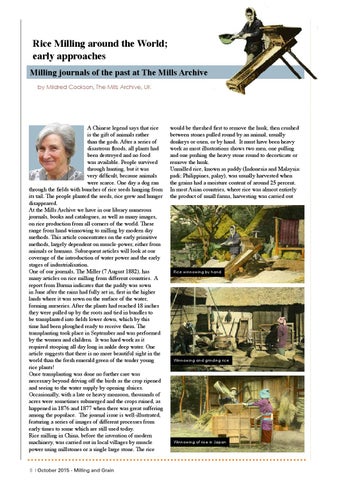
Rice winnowing by hand
Winnowing and grinding rice
Winnowing of rice in Japan