F
3/3 Feedmill of the future … here today-built for tomorrow!
PROCESS FLOW
Raw material intake
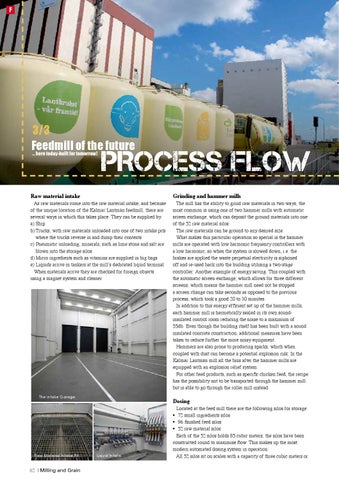
As raw materials come into the raw material intake, and because of the unique location of the Kalmar Lantmän feedmill, there are several ways in which this takes place. They can be supplied by: a) Ship b) Trucks; with raw materials unloaded into one of two intake pits where the trucks reverse in and dump their contents c) Pneumatic unloading; minerals, such as lime stone and salt are blown into the storage silos d) Micro ingredients such as vitamins are supplied in big bags e) Liquids arrive in tankers at the mill’s dedicated liquid terminal When materials arrive they are checked for foreign objects using a magnet system and cleaner.
The intake Garage
Raw Material Intake Pit
62 | Milling and Grain
Grinding and hammer mills
The mill has the ability to grind raw materials in two ways; the most common is using one of two hammer mills with automatic screen exchange, which can deposit the ground materials into one of the 52 raw material silos. The raw materials can be ground to any desired size. What makes this particular operation so special is the hammer mills are operated with low harmonic frequency controllers with a low harmonic, so when the system is slowed down, i.e. the brakes are applied the waste perpetual electricity is siphoned off and re-used back into the building utilising a two-stage controller: Another example of energy saving. This coupled with the automatic screen exchange, which allows for three different screens, which means the hammer mill need not be stopped a screen change can take seconds as opposed to the previous process, which took a good 20 to 30 minutes. In addition to this energy efficient set up of the hammer mills, each hammer mill is hermetically sealed in its own soundinsulated control room reducing the noise to a maximum of 55db. Even though the building itself has been built with a sound insulated concrete construction, additional measures have been taken to reduce further the more noisy equipment. Hammers are also prone to producing sparks, which when coupled with dust can become a potential explosion risk. In the Kalmar Lantmän mill all the bins after the hammer mills are equipped with an explosion relief system. For other feed products, such as specific chicken feed, the recipe has the possibility not to be transported through the hammer mill but is able to go through the roller mill instead.
Dosing
Liquid Intake
Located at the feed mill there are the following silos for storage: • 72 small ingredients silos • 96 finished feed silos • 52 raw material silos Each of the 52 silos holds 85 cubic meters; the silos have been constructed round to maximise flow. This makes up the most modern automated dosing system in operation. All 52 silos sit on scales with a capacity of three cubic meters or