The Earsham Roller Flour Mills on the River Waveney in Norfolk (From The Miller, October 2nd 1893)
Milling Journals of the past at the Mills Archive
T
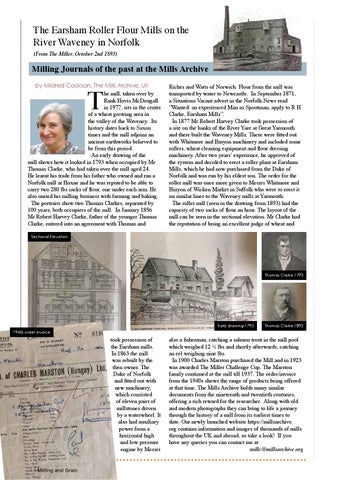
by Mildred Cookson, The Mills Archive, UK he mill, taken over by Rank Hovis McDougall in 1977, sits in the centre of a wheat growing area in the valley of the Waveney. Its history dates back to Saxon times and the mill adjoins an ancient earthworks believed to be from this period. An early drawing of the mill shows how it looked in 1793 when occupied by Mr Thomas Clarke, who had taken over the mill aged 24. He learnt his trade from his father who owned and ran a Norfolk mill at Hoxne and he was reputed to be able to carry two 280 lbs sacks of flour, one under each arm. He also united his milling business with farming and baking. The portraits show two Thomas Clarkes, separated by 100 years, both occupiers of the mill. In January 1856 Mr Robert Harvey Clarke, father of the younger Thomas Clarke, entered into an agreement with Thomas and
Riches and Watts of Norwich. Flour from the mill was transported by water to Newcastle. In September 1871, a Situations Vacant advert in the Norfolk News read “Wanted: an experienced Man as Spoutman, apply to R H Clarke, Earsham Mills”. In 1877 Mr Robert Harvey Clarke took possession of a site on the banks of the River Yare at Great Yarmouth and there built the Waveney Mills. These were fitted out with Whitmore and Binyon machinery and included some rollers, wheat cleaning equipment and flour dressing machinery. After two years’ experience, he approved of the system and decided to erect a roller plant at Earsham Mills, which he had now purchased from the Duke of Norfolk and was run by his eldest son. The order for the roller mill was once more given to Messrs Whitmore and Binyon of Wicken Market in Suffolk who were to erect it on similar lines to the Waveney mills at Yarmouth. The roller mill (seen in the drawing from 1893) had the capacity of two sacks of flour an hour. The layout of the mill can be seen in the sectional elevation. Mr Clarke had the reputation of being an excellent judge of wheat and
Sectional Elevation
Thomas Clarke 1793
Early drawing 1793 1940s order invoice
8 | Milling and Grain
took possession of the Earsham mills. In 1863 the mill was rebuilt by the then owner, The Duke of Norfolk and fitted out with new machinery, which consisted of eleven pairs of millstones driven by a waterwheel. It also had auxiliary power from a horizontal high and low pressure engine by Messrs
Thomas Clarke 1893
also a fisherman, catching a salmon trout in the mill pool which weighed 12 ½ lbs and shortly afterwards, catching an eel weighing nine lbs. In 1900 Charles Marston purchased the Mill and in 1923 was awarded The Miller Challenge Cup. The Marston family continued at the mill till 1937. The order/invoice from the 1940s shows the range of products being offered at that time. The Mills Archive holds many similar documents from the nineteenth and twentieth centuries, offering a rich reward for the researcher. Along with old and modern photographs they can bring to life a journey through the history of a mill from its earliest times to date. Our newly launched website https://millsarchive. org contains information and images of thousands of mills throughout the UK and abroad, so take a look! If you have any queries you can contact me at mills@millsarchive.org