F FEED
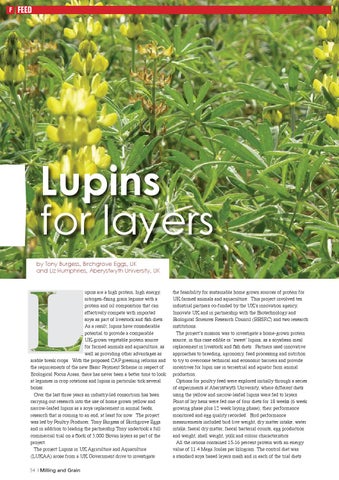
Lupins for layers by Tony Burgess, Birchgrove Eggs, UK and Liz Humphries, Aberystwyth University, UK upins are a high protein, high energy, nitrogen-fixing grain legume with a protein and oil composition that can effectively compete with imported soya as part of livestock and fish diets. As a result, lupins have considerable potential to provide a comparable UK-grown vegetable protein source for farmed animals and aquaculture, as well as providing other advantages as arable break crops. With the proposed CAP greening reforms and the requirements of the new Basic Payment Scheme in respect of Ecological Focus Areas, there has never been a better time to look at legumes in crop rotations and lupins in particular tick several boxes. Over the last three years an industry-led consortium has been carrying out research into the use of home grown yellow and narrow-leafed lupins as a soya replacement in animal feeds, research that is coming to an end, at least for now. The project was led by Poultry Producer, Tony Burgess of Birchgrove Eggs and in addition to leading the partnership Tony undertook a full commercial trial on a flock of 3,000 Bovan layers as part of the project. The project Lupins in UK Agriculture and Aquaculture (LUKAA) arose from a UK Government drive to investigate 34 | Milling and Grain
the feasibility for sustainable home grown sources of protein for UK farmed animals and aquaculture. This project involved ten industrial partners co-funded by the UK’s innovation agency, Innovate UK and in partnership with the Biotechnology and Biological Sciences Research Council (BBSRC) and two research institutions. The project’s mission was to investigate a home-grown protein source, in this case edible or ‘sweet’ lupins, as a soyabean meal replacement in livestock and fish diets. Partners used innovative approaches to breeding, agronomy, feed processing and nutrition to try to overcome technical and economic barriers and provide incentives for lupin use in terrestrial and aquatic farm animal production. Options for poultry feed were explored initially through a series of experiments at Aberystwyth University, where different diets using the yellow and narrow-leafed lupins were fed to layers. Point of lay hens were fed one of four diets for 18 weeks (6 week growing phase plus 12 week laying phase), their performance monitored and egg quality recorded. Bird performance measurements included bird live weight, dry matter intake, water intake, faecal dry matter, faecal bacterial counts, egg production and weight, shell weight, yolk and colour characteristics. All the rations contained 15-16 percent protein with an energy value of 11.4 Mega Joules per kilogram. The control diet was a standard soya based layers mash and in each of the trial diets