F
Researching and Reporting
Figure 3: Royal steam mill - Hedrick & Strauss Corporation, Budapest
The roller flour milling
revolution Question:
Name 6 Hungarians who made significant international contributions to their country.
Answer: Laszlo Biro; Zsa Zsa Gabor; Abram Ganz; Ferenc Liszt; Andras Mechwart; Erno Rubik. Would a contemporary roller flour miller, or a world grain dealer, have known the names of Abram Ganz and Andras Mechwart? Perhaps not, because the answers lie in Hungary
I
by Rob Shorland-Ball for Milling and Grain
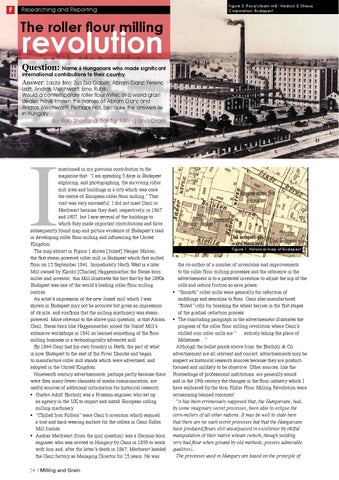
mentioned in my previous contribution to the magazine that: “I am spending 5 days in Budapest exploring, and photographing, the surviving roller mill sites and buildings in a city which was once the centre of European roller flour milling.” That visit was very successful; I did not meet Ganz or Mechwart because they died, respectively, in 1867 and 1907, but I saw several of the buildings to which they made important contributions and have subsequently found map and picture evidence of Budapest’s lead in developing roller flour milling and influencing the United Kingdom. The map extract in Figure 1 shows [Jozsef] Henger Malom, the first steam-powered roller mill in Budapest which first milled flour on 15 September 1841. Immediately North West is a later Mill owned by Karoly [Charles] Haggenmacher the Swiss-born miller and inventor; this Mill illustrates the fact that by the 1890s Budapest was one of the world’s leading roller flour milling centres. An artist’s impression of the new Jozsef mill which I was shown in Budapest may not be accurate but gives an impression of its size, and confirms that the milling machinery was steampowered. More relevant to the above quiz question; is that Abram Ganz, Swiss-born like Haggenmacher joined the Joszef Mill’s extensive workshops in 1841 so learned something of the flour milling business in a technologically advanced mill. By 1844 Ganz had his own foundry in Pesth, the part of what is now Budapest to the east of the River Danube and began to manufacture roller mill stands which were advertised, and adopted in the United Kingdom: Nineteenth century advertisements, perhaps partly because there were then many fewer channels of media communication, are useful sources of additional information for historical research: • Gustav Adolf Bucholz was a Prussian engineer who set up an agency in the UK to import and install European rolling milling machinery • “Chilled Iron Rollers” were Ganz’s invention which ensured a true and hard-wearing surface for the rollers in Ganz Roller Mill frames. • Andras Mechwart (from the quiz question) was a German-born engineer who was invited to Hungary by Ganz in 1859 to work with him and, after the latter’s death in 1867, Mechwart headed the Ganz factory as Managing Director for 25 years. He was
24 | Milling and Grain
Figure 1: Historical map of Budapest
the co-author of a number of inventions and improvements to the roller flour milling processes and the reference in the advertisement is to a patented invention to adjust the nip of the rolls and reduce friction so save power. • “Smooth” roller mills were generally for reduction of middlings and semolina to flour. Ganz also manufactured “fluted” rolls for breaking the wheat berries in the first stages of the gradual reduction process. • The concluding paragraph in the advertisement illustrates the progress of the roller flour milling revolution where Ganz’s chilled iron roller mills are “. . . entirely taking the place of Millstones ...” Although the bullet points above from the Bucholz & Co advertisement are all relevant and correct, advertisements may be suspect as historical research sources because they are productfocused and unlikely to be objective. Other sources, like the Proceedings of professional institutions, are generally sound and in the 19th century the changes in the flour industry which I have embraced by the term Roller Flour Milling Revolution were occasioning learned comment: “it has been erroneously supposed that, the Hungarians, had, by some imaginary secret processes, been able to eclipse the corn-millers of all other nations. It may be well to state here that there are no such secret processes but that the Hungarians have produced flours still unsurpassed in excellence by skilful manipulation of their native wheats (which, though yielding very bad flour when ground by old methods, possess admirable qualities). The processes used in Hungary are based on the principle of