F
&FEED MILLING TECHNOLOGY
14 | September - October 2014
GRAIN
Choosing the right bagging system by Thomad Ziolko
T
he configuration of a packaging plant for a milling business depends on various factors. The packing of the final product is one of the most labour intensive steps in the process of grain milling. That is why this part of the system should be as automated as possible. The capacity of the bagging line is simultaneously connected to the processes ahead and afterwards. This requires a very close connection and co-ordination between the bagging and the production logistics and the subsequent storage and distribution management.
in Europe, North America and Australia, paper-packaging material is generally used as packaging material, woven polypropylene is mostly used in Latin America, Asia and Africa for 10 - 50 kg bags. Apart from simple retail practice, climate conditions or the less than careful handling of the sacks favour a packaging of inexpensive woven polypropylene. Environmental balance also influences the discussion in Europe about packaging material. Since the production of paper is very energy intensive, environmental balance favours the use of plastic bags if correctly disposed.
In Europe, North America and Australia the majority of milled products are loaded in tankers as bulky loads. In Latin America, Africa and Asia the load is overladen through packing in open sacks or ventilated bags. Around the world the open sacks are most commonly used because this packaging has advantages for milled products. In addition to the pure function of packaging, more and more mills are using grain packaging as a marketing instrument. The surface of the sack, the means of sealing it and/or the material used, allows the company to bring up the value from an undistinguishable grain product that could be exchanged for any other, to a unique and un-mistakeable brand.
Open or ventilated sacks?
Bagging material
The woven plastic sack and the paper bag have largely replaced the traditional jute or cotton sacks. As a disposable bag, the paper sack conforms to the hygienic standards required today. The costly cleaning work and the removal of bugs and impurities are no longer necessary. Whereas
Ventilated sacks are the simpler solution for automated bag attachments, going without sealing up bags in small packaging plants or with low hygiene requirements. In favour of packaging in open bags not only is there better hygiene, more exact weight and increased flexibility in relation to bag sizes and the bulk density of the product, there is also easier opening of the bags by the final customer. These advantages explain the trend towards bagging in low cost, open sacks for the bagging of milled grain products.
Manual or automatic?
The choice between manually operated or automatic equipment depends directly on the products, the local conditions and the size of the different systems of the business. Criteria such as the weight of the sack, sack sizes and quality, the required performance of packaging, the closing mechanism and logistics can be used for the lay out of a bagging plant. Single nozzle packing stations
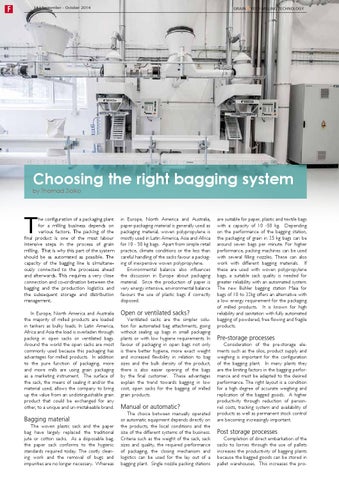
are suitable for paper, plastic and textile bags with a capacity of 10 -50 kg. Depending on the performance of the bagging station, the packaging of grain in 25 kg bags can be around seven bags per minute. For higher performance, packing machines can be used with several filling nozzles. These can also work with different bagging materials. If these are used with woven polypropylene bags, a suitable sack quality is needed for greater reliability with an automated system. The new B端hler bagging station Maia for bags of 10 to 32kg offers an alternative with a low energy requirement for the packaging of milled products. It is known for high reliability and sanitation with fully automated bagging of powdered, free flowing and fragile products.
Pre-storage processes
Consideration of the pre-storage elements such as the silos, product supply and weighing is important for the configuration of the bagging plant. In many plants they are the limiting factors in the bagging performance and must be adapted to the desired performance. The right layout is a condition for a high degree of accurate weighing and replication of the bagged goods. A higher productivity through reduction of personnel costs, tracking system and availability of products as well as permanent stock control are becoming increasingly important.
Post storage processes
Completion of direct embarkation of the sacks to lorries through the use of pallets increases the productivity of bagging plants because the bagged goods can be stored in pallet warehouses. This increases the pro-