F
&FEED MILLING TECHNOLOGY
12 | July - August 2014
GRAIN
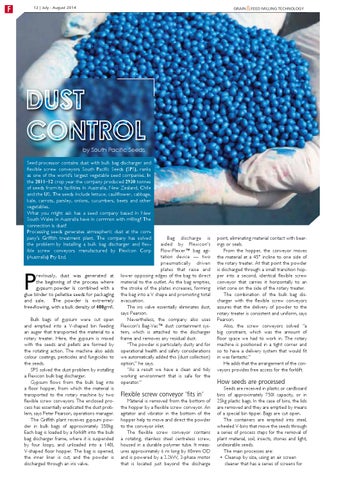
by South Pacific Seeds Seed processor contains dust with bulk bag discharger and flexible screw conveyors South Pacific Seeds (SPS), ranks as one of the world’s largest vegetable seed companies. In the 2011–12 crop year the company produced 2930 tonnes of seeds from its facilities in Australia, New Zealand, Chile and the US. The seeds include lettuce, cauliflower, cabbage, kale, carrots, parsley, onions, cucumbers, beets and other vegetables. What you might ask has a seed company based in New South Wales in Australia have in common with milling? The connection is dust! Processing seeds generates atmospheric dust at the company’s Griffith treatment plant. The company has solved the problem by installing a bulk bag discharger and flexible screw conveyors manufactured by Flexicon Corp (Australia) Pty Ltd.
P
reviously, dust was generated at the beginning of the process where gypsum powder is combined with a glue binder to pelletise seeds for packaging and sale. The powder is extremely free-flowing, with a bulk density of 400gm/l. Bulk bags of gypsum were cut open and emptied into a V-shaped bin feeding an auger that transported the material to a rotary treater. Here, the gypsum is mixed with the seeds and pellets are formed by the rotating action. The machine also adds colour coatings, pesticides and fungicides to the seeds. SPS solved the dust problem by installing a Flexicon bulk bag discharger. Gypsum flows from the bulk bag into a floor hopper, from which the material is transported to the rotary machine by two flexible screw conveyors. The enclosed process has essentially eradicated the dust problem, says Peter Pearson, operations manager. The Griffith plant receives gypsum powder in bulk bags of approximately 350kg. Each bag is loaded by a forklift into the bulk bag discharger frame, where it is suspended by four loops, and unloaded into a 140l, V-shaped floor hopper. The bag is opened, the inner liner is cut, and the powder is discharged through an iris valve.
Bag discharge is aided by Flexicon’s Flow-Flexer™ bag agitation device — two pneumatically driven plates that raise and lower opposing edges of the bag to direct material to the outlet. As the bag empties, the stroke of the plates increases, forming the bag into a V shape and promoting total evacuation. The iris valve essentially eliminates dust, says Pearson. Nevertheless, the company also uses Flexicon’s Bag-Vac™ dust containment system, which is attached to the discharger frame and removes any residual dust. “The powder is particularly dusty and for operational health and safety considerations we automatically added this (dust collection) option,” he says. “As a result we have a clean and tidy working environment that is safe for the operator.”
Flexible screw conveyor ‘fits in’
Material is removed from the bottom of the hopper by a flexible screw conveyor. An agitator and vibrator in the bottom of the hopper help to move and direct the powder to the conveyor inlet. The flexible screw conveyor contains a rotating, stainless steel centreless screw, housed in a durable polymer tube. It measures approximately 6 m long by 80mm OD and is powered by a 2.2kW, 3-phase motor that is located just beyond the discharge
point, eliminating material contact with bearings or seals. From the hopper, the conveyor moves the material at a 45° incline to one side of the rotary treater. At that point the powder is discharged through a small transition hopper into a second, identical flexible screw conveyor that carries it horizontally to an inlet cone on the side of the rotary treater. The combination of the bulk bag discharger with the flexible screw conveyors assures that the delivery of powder to the rotary treater is consistent and uniform, says Pearson. Also, the screw conveyors solved “a big constraint, which was the amount of floor space we had to work in. The rotary machine is positioned in a tight corner and so to have a delivery system that would fit in was fantastic.” He adds that the arrangement of the conveyors provides free access for the forklift.
How seeds are processed
Seeds are received in plastic or cardboard bins of approximately 750l capacity, or in 25kg plastic bags. In the case of bins, the lids are removed and they are emptied by means of a special bin tipper. Bags are cut open. The containers are emptied into steel, wheeled V-bins that move the seeds through a series of process steps for the removal of plant material, soil, insects, stones and light, undesirable seeds. The main processes are: • Cleanup by size, using an air screen cleaner that has a series of screens for